Geschke Center
Doctoral Dissertations Theses, Dissertations, Capstones and Projects
Spring 5-16-2018
Athletic Identity and Mental Health: The
Experiences of Black Male Former
Student-Athletes
Miguel Frank
University of San Francisco, [email protected]
Follow this and additional works at:https://repository.usfca.edu/diss Part of theClinical Psychology Commons
This Dissertation is brought to you for free and open access by the Theses, Dissertations, Capstones and Projects at USF Scholarship: a digital repository @ Gleeson Library | Geschke Center. It has been accepted for inclusion in Doctoral Dissertations by an authorized administrator of USF Scholarship: a digital repository @ Gleeson Library | Geschke Center. For more information, please [email protected].
Recommended Citation
Frank, Miguel, "Athletic Identity and Mental Health: The Experiences of Black Male Former Student-Athletes" (2018).Doctoral Dissertations. 455.
A Clinical Dissertation Presented to
The University of San Francisco
School of Nursing and Health Professions
Department of Integrated Healthcare
PsyD Program in Clinical Psychology
In Partial Fulfillment of the Requirements for the Degree
Doctor of Psychology
By
Miguel Frank, M.A., M.S.
Table of Contents
Title Page ...i
Signature Page ...ii
Dedication ...v
Acknowledgments...vi
Specific Aims ...7
Chapter One Introduction ...8
Definitions...9
Chapter Two Literature Review...10
Social Identity ...10
Athletic Identity ...11
Student-Athlete Experience ...14
Black Male Student-Athlete Experience ...17
Sports Retirement...23
Bronfenbrenner’s Ecological Systems Theory ...25
Chapter Three Methodology ...28
Qualitative Research ...28
Sample...29
Instruments ...30
Interviews ...31
Qualitative Analysis ...31
Positionality and Reflexivity Statement...36
Participant Profiles ...37
Chapter Four Results ...40
Athletic Identity Measurement Scale (AIMS) ...41
Qualitative Interviews ...41
Athletic Identity ...43
Age and Athletic Ability ...43
Professional Aspirations ...44
Preferential Treatment ...45
Recruiting ...47
Black Student-Athlete Experience ...47
Perception of Others and Athletic Prejudice ...48
Athlete-Student Stereotype ...50
Black Athletic Identity ...51
Racism...53
Overt Racism ...53
Racial Profiling ...54
Athletes and Protective Status ...55
Career Termination ...55
Circumstances Leading to Career Termination ...56
Relationships ...56
Mental Health...57
Loss of Identity ...58
Depression...58
Protective Factors...59
Chapter Five Discussion ...61
Interpretation and Connection to Literature ...62
Implications...69
Limitations ...71
Recommendations for Future Research ...72
Appendix A: Athletic Identity Measurement Scale ...73
Appendix B: Interview Questions ...74
Appendix C: Table One ...75
Dedication
I have been very fortunate to be surrounded by strong women in my life. This project is dedicated to them.
To my grandmother, thank you for everything. By allowing my mother and me to stay with you, she was able to go back to school and provide me with the best life possible. You have always been so proud of me. My only wish is that you were here to share in this with me.
To my mother, thank you. I have only ever wanted to make you proud of me. I still remember the conversation after you had completed graduate school. I was 10 years old at the time and you were thinking of pursuing a doctorate of your own. You decided against it because you felt that you needed to spend more time with me. I made a promise during that conversation that I would get a doctorate for both of us. Well, here we are. We made it.
To my wife, Marisol, thank you for always being my biggest cheerleader. Thank you for sharing your light with me and leading me out of the darkness. I would not have made it without you. I am so thankful for everything you have done and the way you have supported me
Acknowledgments
I would like to take the time to acknowledge those who have provided their support
throughout this process. This project would have not been possible if not for the following
people who dedicated their time, expertise, and support. I would like to thank my initial
dissertation chair, Dr. Michelle Montagno, who at times I felt was more passionate about this
project than I was. Thank you for starting me out on this journey. It is unfortunate that we could
not finish this together, but know that I would not have made it this far without you. To my
current dissertation chair, Dr. David Martinez, thank you for agreeing to see me through the end
of this process. Thank you to my committee members, Dr. Konjit Page, Dr. William Bosl, and
Dr. Brent Richard Ferm.
Thank you to my participants for their willingness to share their stories with me. I would
also like to thank the counseling staff at California State University, Northridge and San Jose
State University for your unconditional support during this process. To my friends, thank you for
always showing up. Thank you for always checking in on me and not allowing me to forget
about all of you. You have kept me grounded throughout this journey and have reminded me to
Specific Aims
Revenue has changed the landscape of intercollegiate athletics. With television deals
worth billions of dollars and athletic departments with multi-million dollar budgets,
student-athletes are at the center of it all during their college careers. Student-student-athletes develop salient
athletic identities, sometimes to the detriment of their other social identities (Chartrand & Lent,
1987; Pearson & Petitpas, 1990). Within the intercollegiate sports population, Black male
student-athletes are an overrepresented group, representing nearly 21% of student-athletes
(Simiyu, 2012). Black male student-athletes represented 46% of football players and 60% of
basketball players for a total of 70% of all Black male student-athletes playing either football or
basketball (Simiyu, 2012).
Due to the notoriety that comes from participating in either of these sports, Black male
student-athletes are at risk for overidentifying as athletes, which could have a negative impact on
their lives once their athletic careers are terminated (Beamon, 2012). The purpose of this
research is to examine the experiences of Black male former student-athletes after their athletic
careers have been terminated. The research will consist of interviews with Black male former
student-athletes to examine their life experiences while they were student-athletes, how they
adjusted to no longer being student-athletes, and how they have coped post-transition. This study
will include the use of the Athletic Identity Measurement Scale (AIMS), a scale used to
determine how strongly individuals identify with their athletic identities (Brewer, Van Raalte, &
Chapter One - Introduction
On college campuses across the nation, student-athletes represent a unique group among
the student population. While the goal of many student-athletes is to make a career out of playing
their sport professionally, the reality is that only a small percentage are able to do so, with less
than 2% of student-athletes continuing on to play professional sports (Teicher, 2005; Young,
2007). Black male student-athletes are an overrepresented group in intercollegiate athletics.
Between 2007 and 2010, Black males made up 2.8% of the degree-seeking undergraduate
population at Atlantic Coast Conference, Big East Conference, Big Ten Conference, Big 12
Conference, Pac-12 Conference, and Southeastern Conference schools, with Black
student-athletes representing 57% of football players and 64% of basketball players at these same
schools (Harper, Williams, & Blackman, 2013).
Dating back to when they were children, student-athletes have often been recognized for
their athletic ability (Wenner, 1995). Their athletic ability has come to define their identity to
such an extent that student-athletes often do not fully develop other identities
(Yukhymenko-Lescroart, 2014). It has come to influence how they interpret information, behave, and cope with
the various situations that they will experience in their lives (Cornelius, 1995). In addition to
their identity as athletes, Bimper, Harrison, and Clark (2012) found that Black student-athletes
are very aware of their racial identity, with it often being as salient as their athletic identity. They
also found that the continual reinforcement of one’s athletic identity can cause one to become
disconnected from their racial identity over time (Bimper et al., 2012). Bimper and colleagues
(2012) found that Black male student-athletes believed their racial and athletic identities needed
to be nurtured, but chose to nurture their athletic identity because they were perceived as
Definitions
For the purpose of carrying out the present research, this study used the following
definitions:
• NCAA - National College Athletic Association. The NCAA is an association that
organizes and oversees the athletic programs of colleges and universities throughout the
United States and Canada.
• Exhaustion of eligibility - Student-athletes typically have five years to participate in four
years of intercollegiate athletics. This term describes instances when student-athletes are
no longer eligible to participate in intercollegiate athletics due to exceeding their five
years on campus.
• Athletic identity - The degree to which an individual identifies with the athlete role.
• Racial identity - An individual's sense of having their identity defined by belonging to a
particular race or ethnic group.
• Former student-athletes - Individuals that previously participated in intercollegiate
athletics.
• Revenue sports - College football and college basketball are considered “revenue sports”
due to the amount of money generated for their respective schools.
• PWI - Predominantly white institutions.
Chapter Two - Literature Review
This review of literature defines the concepts of social identity and identity salience,
while also exploring how student-athletes come to establish their athletic identities and how this
identity is reinforced by their social environments. This review of literature will also explore the
multiple roles that Black male student-athletes must navigate during their intercollegiate athletic
careers. For student-athletes in general, they must learn to navigate the demands and challenges
that come with being a student and an athlete. Black student-athletes, however, must contend
with any racial prejudice that they may encounter. The literature will also examine the concept of
retirement and how athletes cope with that specific life transition and its potential consequences.
Bronfenbrenner’s ecological systems model will also be examined as a framework for
understanding identity development in Black male student-athletes.
Social Identity
Tajfel and Turner (1979) posit that an individual’s self-image is derived from social
categories to which they perceive themselves as belonging. Individuals strive to maintain or
enhance their self-esteem through group membership, which in turn influences self-esteem.
Social groups have positive and negative associations and the individual’s identity is influenced
by how they come to value the group. Social identity theory postulates that a person’s
psychology often depends on the state of the groups that define the self and that these groups
provide the individual with stability, meaning, purpose, direction, and will have positive
implications for the individual’s mental health (Haslam, Jetten, Postmes, & Haslam, 2009).
However, if one’s sense of social identity is compromised in some way, then this tends to have
that group membership serves as a way to enrich the lives of group members and is a source of
personal security and emotional bonding. Furthermore, groups shape our psychology through
their capacity to be internalized and contribute to our sense of self which provides us with a
sense of social identity.
Similarly, Erikson (1968) posits that an individual’s identity connects their personality to
the social world. An individual’s identity is constructed based on the various ways that they have
come to identify themselves and be identified by other people. Identities are organized in a
salience hierarchy, which determines the probability that each of these identities will be present
in a given situation (Stryker & Serpe, 1982; Hogg, Terry, & White, 1995). Furthermore, identity
is formed within the multiple contexts of social interactions, institutions, processes, and
relationships (Scanlon, Rowling, & Weber, 2007) and the development of aspects of one’s
identity is often dependent on the recognition and acknowledgement given to a specific identity
from the surrounding systems (Hoberman, 2000). Elite athletes receive elevated levels of social
reinforcement for their physical abilities and have much of their individual conception of identity
is based on athletic performance and is defined by others’ view of them as athletes (Beamon,
2012).
Athletic Identity
The concept of athletic identity is the degree to which an individual identifies with the
athletic role (Brewer et al., 1993). For student-athletes, the athletic role is often the most salient
of their identities. Developmental theory suggests that late childhood through early adulthood
represents a critical period for the development of an individual’s identity (Houle, Brewer, &
salience of the athlete role increases throughout high school and decreases over the course of
one’s college career (Miller & Kerr, 2003). Brewer and colleagues (1993) posit that there exists a
negative relationship between strong athletic identity and the increase in age of the
student-athlete. In other words, as a student-athlete gets older, the extent to which they identify as an
athlete decreases. Given this relationship, the expectation is that student-athletes are better
equipped to handle the termination of their athletic careers, the loss of their athletic identity, and
are not at risk for experiencing psychological distress.
However, Adler and Adler (1991) found that athletes with higher skill level and those
who are heavily recruited throughout high school enter college fully immersed in their athletic
identity and that the athletic identity becomes stronger and more exclusive with age. Previous
research (Houle et al., 2010) indicates that by becoming involved in sports at an early age causes
the identity of the individual to become heavily intertwined with the sport instead of dispersed
among other areas. Additionally, as previously mentioned, group membership and the
acknowledgment given to a specific identity significantly impact its development. In this regard,
an individual's athletic identity is no different. An athlete who is committed to and achieves
some degree of athletic success receives positive reinforcement from coaches, teammates,
parents, friends, and fans, thus enhancing their self-esteem (Marx, Huffman, & Doyle, 2008).
Group cohesion is actively promoted and rewarded (Brown, 2000) and student-athletes who
commit themselves to their peers and their group find it difficult to develop balanced identities,
as the athletic identity and its interests are prioritized (Marx et al., 2008).
Another point to consider when examining an individual’s athletic identity and its
development is the recruitment process that many of these individuals go through. As
been able to invest more resources into the recruitment of student-athletes in order to maintain
success (Lavigne, 2010). The proliferation of various sports camps provides individuals with the
opportunity to showcase their talent in front of numerous college coaches and these camps are
available to individuals as young as middle school. In addition to sports camps, travel teams have
been created to allow highly-skilled individuals to participate in various tournaments where
college coaches will be in attendance and their talents can be evaluated. Furthermore, there have
been websites such as Max Preps, Rivals, and 247 Sports that have been developed in order to
rank high school student-athletes based on their athletic ability. In some instances, individuals as
young as 8th grade have been offered athletic scholarships by major universities (Tyson, 2016;
Daniels, 2016; Donohue, 2016; Feldman, 2016) and will go on to be told how great and special
they by college coaches and media throughout their high school years during the recruitment
process (Feldman, 2007). The exposure provided by these camps and the acknowledgment of an
individual’s athletic ability, when paired with the recruitment process, reinforces an individual’s
athletic identity before they even step foot on a college campus.
At the intercollegiate level, an individual’s athletic identity continues to be reinforced due
to the high level of competition and the demands placed on the individual to succeed (Brewer,
Selby, Linder, & Petitpas, 1999) and the interaction with their social groups. There exists a
sports culture related to intercollegiate athletics that reinforces an individual’s athletic identity.
Student-athletes that participate in sports at the Division I level spend many hours per week
participating in practices and games related to their sport. However, student-athletes must also
participate in team meetings, strength and conditioning sessions, community outreach, and other
public appearances (Poux & Fry, 2015). Due to the demands that student-athletes must confront,
identity and relatable experiences. Prior to 1996, the NCAA allowed college campuses to have
dormitories specifically for student-athletes (Rowland, 2014). Since implementing rules to
prohibit this practice, colleges and universities have managed to find a loophole that allows
schools to house student-athletes in one dormitory as long as the majority of students living there
are not athletes (Rowland, 2014).
Ideally, college represents the opportunity for young adults to explore various identities
and careers before determining which suits them best. However, student-athletes are not afforded
this luxury due to overidentifying with their athletic identity, resulting in a lack of career
maturity. Super (1957) posits that individuals are career mature or ready to make appropriate
choices when they have engaged in planned exploration and have appropriate occupational
knowledge, self-knowledge, and decision-making knowledge. However, individuals that strongly
identify with their athletic identity are often less likely to plan for a career after athletics (Grove,
Lavelle, & Gordon, 1997) and are more likely to experience identity foreclosure. Identity
foreclosure occurs when an individual settles into a single identity, closing off any further
exploration of other identities in their hierarchy (Erikson, 1956). As such, student-athletes are
more likely to experience career immaturity and identity foreclosure (Murphy, Petitpas, &
Brewer, 1996) as a result of developing an overly strong athletic identity due to exposure to
competition and formalized training from an early age (Mitchell, Nesti, Richardson, Midgley,
Eubank, & Littlewood, 2014).
Student-Athlete Experience
The college experience is very different for student-athletes than it is for their non-athlete
peers. Parham (1993) identified six demands and challenges that student-athletes must confront
responsibilities; b) they must balance a healthy social life with athletic responsibilities; c) they
must balance athletic success with the lack of athletic success; d) they must balance their
physical health and injuries; e) they must balance their interpersonal relationships, and f) they
must face the challenge of coping with the termination of their athletic careers.
In their survey of student-athletes at 18 Division I schools, Potuto and O’Hanlon (2007)
found that in their sample of 930 student-athletes, 82% reported that they spent more than 20
hours a week participating in practice and competition. Potuto and O’Hanlon (2007) found that
53% of student-athletes reported that they did not spend as much time on their academics as they
would like due to athletic participation and 11% indicated that athletics prevented them from
majoring in what they wanted to pursue. In regards to potential career exploration, Potuto and
O’Hanlon (2007) found that 70% of student-athletes believed that there were educational
opportunities that they could not participate in because of athletic responsibilities. Additionally,
60% of student-athletes reported that there were on-campus events that they were unable to
attend because of their athletic time demands. However, it is worth noting that student-athletes
viewed these as being acceptable trade-offs of being a student-athlete (Potuto & O’Hanlon,
2007) and it is also worth noting that the survey included student-athletes across all sports, not
just revenue sports.
Stereotype and identity threat occur when an individual feels at risk of confirming
negative stereotypes about their social group (Steele & Aronson, 1995). There exists a belief that
student-athletes are the recipients of special treatment and are not held to the same standard as
their non-athlete peers (Baucom & Lantz, 2001). Student-athletes are often viewed as not taking
their academics seriously and as only using school as a means to pursue a professional career in
competency in comparison to non-athletes (Baucom & Lantz, 2001; Hobneck, Mudge, & Turchi,
2003). Further, Baucom and Lantz (2001) found that school faculty was more likely to believe
that student-athletes had poor study habits, would not be able to balance their various
responsibilities, would not perform as well academically as non-athletes, and generally did not
believe them to be capable of being successful college students. Simons, Bosworth, Fujita, and
Jensen (2007) conducted a survey of student-athletes at a Division I university to determine how
they believed members of the campus community perceived them, finding that 33% reported
negative perceptions from faculty and 60% reporting similar perceptions from other students.
Furthermore, more negative perceptions were associated with revenue sports than with
non-revenue sports (football or basketball; Simons et al., 2007).
The perception of special treatment for student-athletes stems from how much time
student-athletes must commit to their sport, the revenue that their sport generates for the
university, the number of athletic scholarships compared to the number of academic
scholarships, and a variety of other accommodations that student-athletes may be provided
(Tucker, Morgan, Oliver, Kirk, Moore, Irving, Sizemore, Turner, & Emanuel, 2016). In regards
to the additional support that student-athletes receive, the belief exists that this additional support
is unfair to non-athletes (Potuto & O’Hanlon, 2007). Further, Simons and colleagues (2007) posit
that the perception of student-athletes is that they are unqualified and illegitimate students whose
only interest is in athletics who expect special treatment from those around them, with
non-athletes being more suspicious and less trusting of student-non-athletes who earn an A in class
(Engstrom & Sedlacek, 1991; Tucker et al., 2016).
The responsibilities that student-athletes must adhere to may contribute to the perception
accommodations in order to participate in athletic competitions (Tucker et al., 2016). These
accommodations include coming to class late or leaving early, missing classes or exams, being
allowed to take make-up exams, taking exams away from campus, and turning in assignments
late. Related to this, Williams, Colles, and Allen (2010) conducted a study of Division III
athletes that found that 62% of student-athletes surveyed were refused accommodations by
faculty and were viewed negatively by non-athlete peers.
For student-athletes, their experiences are affected by the interactions that they have on
campus. However, in addition to the experiences they have in the classroom, student-athletes
may also be affected by their performances on the field and their actions off the field.
Student-athletes may face criticism from non-athlete peers and other individuals in the community
because of poor athletic performance (Tucker et al., 2016). Blackshaw and Crabbe (2004) posit
that the experiences of athletes have been combined with the celebrity that comes as a result of
their visibility and these experiences have become commodities to be glamorized by the media.
However, the experiences of all student-athletes are not the same. Differences exist among the
student-athlete experience when taking into account the sport that the student-athlete plays and
race.
Black Male Student-Athlete Experience
As it relates to Black student-athletes, they must also contend with the coupling of racial
and athlete stereotypes. The stereotypes often held by administrators, faculty, and non-athlete
peers can cause Black student-athletes to internalize negative stereotypes and create a heightened
sense of athletic identity (Harrison, Sailes, Rotich, & Bimper, 2011).Black student-athletes hold
group, being a student-athlete, and participating in revenue sports (Steinfeldt, Reed, & Steinfeldt,
2010). For student-athletes that identify as Black, there has been an ongoing discussion regarding
an explanation for their athletic success (Harrison, Lawrence, & Bukstein, 2011). One
explanation that has been offered is that athletic success is dependent on social and cultural
factors such as family support, peer encouragement, media support, and socioeconomic status
(Coakley, 2010; Comeaux & Harrison, 2004). Another explanation that has been offered linked
athletic success to genetically determined racial differences (Entine, 2000); these discussions are
often linked to the concept of race. However, the success of White athletes is often attributed
solely to cultural factors – exposure to specific sports, family and peer encouragement, and role
models (Harrison et al., 2011).
Among the Black population, the portrayal of Black success is limited and tends to focus
heavily on athletics. The Black community has been marginalized through policies that deny
them equal access to resources, less qualified teachers, poor schools, and racial
microaggressions, which combine to contribute to poor academic performance in children of
color (Comeaux & Jayakumar, 2007). Public perception is that professional sports are one of few
pathways for success within the Black community (Edwards, 2000; Frey & Eitzen, 1991).
Steinfeldt and colleagues (2010) found that young Black males may be internalizing the
stereotype of professional athletics as the predominant pathway to success for Black athletes. As
a result, a high proportion of Black students go to school with a single-minded purpose to excel
in athletics (Simiyu, 2012). There also exists the fact that there are very few visible role models
outside of athletics to inspire young Black people (Coakley, 2010; Edwards, 2000). In a 2012
study, across Division I schools, Simiyu found that while Black students made up 10% of the
represented 46% of football players and 60% of basketball players for a total of 70% of Black
male student-athletes participating in revenue sports (Simiyu, 2012). Harrison, Harrison, and
Moore (2002) posit that Black males view involvement in athletics as important to social
acceptability, group membership, and as a way to gain the respect and approval of peers. Further,
Harrison and colleagues (2002) posit that Black males gain inspiration from existing role models
who are athletes with high status. As a result, the focus of Black male athletes is towards
basketball, football, and track and field (Harrison et al., 2002).
Once they arrive on campus, Black male student-athletes must contend with institutional
racism when considering their experiences at predominantly White institutions (Simiyu, 2012).
As a Black student-athlete at a PWI, it is not uncommon to experience feelings of isolation,
being misunderstood, a sense of powerlessness, feelings of being judged, pressure to assimilate
to different values, and being stigmatized as a Black athlete (Melendez, 2008). Institutional
racism and its historical relationship with intercollegiate athletics can provide context for
understanding the experiences of Black male student-athletes and Black student-athletes in
general. Since the 1950s, Black athletes began to be allowed to participate in intercollegiate
athletics (Simiyu, 2012). The growing popularity of intercollegiate sports forced institutions and
coaches to put their prejudice aside and recruit the best players regardless of race or academic
preparedness (Simiyu, 2012). Despite the inclusion of Black student-athletes, their on-campus
experiences included dealing with racism and prejudice. In addition to the isolation that many
student-athletes often experience, Black male student-athletes must also contend with negative
racial, gender, and athletic stereotypes (Beamon, 2014). Educational stereotypes of Black
student-athletes continues to persist, with some White faculty members and students having
instances, Black student-athletes felt antagonism from their professors (Adler & Adler, 1991).
The negative academic stereotypes of Black student-athletes may be affecting them more than
their White counterparts, with White football players graduating at a 20% higher rate and with
White basketball players graduating at a 32% higher rate (Lapchick, 2010). Additionally, Black
male student-athletes at Division I institutions have the lowest graduation rate of all race, ethnic,
and gender classifications (Smith, 2004).
In a 2014 qualitative study across Division I schools, 18 of 20 Black male former
student-athletes expected to experience some level of discrimination while on campus (Beamon, 2014).
Though previous research has found that student-athletes are perceived to receive special
treatment, most of the respondents in the study identified the classroom as a racially hostile
environment and attributed it to negative stereotypes about Black males and student-athletes held
by faculty (Beamon, 2014). Furthermore, Black male student-athletes were also found to feel
isolated from the non-athlete Black student population on campus despite a strong Black racial
identity (Beamon, 2014). Bimper and colleagues (2012) found that Black male student-athletes
believed their racial and athletic identities needed to be nurtured, but often chose to nurture their
athletic identity because they were perceived as athletes. Beamon (2014) found that Black male
student-athletes believed that they were required to choose between their athletic and racial
identities. In one instance, when a major racial conflict occurred on campus, one respondent
indicated a desire to participate in protests, but choosing not to do so because of their role as an
athlete and the fact that their coach did not want members of the team participating in protests
(Beamon, 2014). In their study, Bimper and colleagues (2012) found that Black male
“disconnected” from their racial identity. Being forbidden from speaking out against racism may
also detach them from their Black non-athlete peers (Lapchick, 1996).
Sports are often discussed within the context of a post-racial narrative, citing the
increased participation of persons of color across various sporting venues (Bimper, 2015).
However, when discussing their experiences as members of a team, the majority of Black male
student-athletes reported self-segregation in the locker room and on campus and did not believe
that sports promoted racial harmony (Beamon, 2014). Participants reported that they were often
the victim of racial abuse from their own fans, opposing fans, and local residents in town.
Furthermore, they reported that they had not experienced overt racism prior to coming to campus
(Beamon, 2014). Black student-athletes are very aware of their racial identity and how they are
perceived by non-athletes. Steinfeldt and colleagues (2010) found that Black college football
players farther along in their careers reported that they were more aware that society does not
highly value those that identify as Black, particularly Black athletes. To an extent, the
experiences of Black male student-athletes mirror those of their Black non-athlete peers when it
comes to experiencing feelings of isolation and alienation as a result of being one of few Black
students on campus (Solorzano, Ceja, & Yosso, 2000).
The media’s portrayal of Black male student-athletes in comparison to their White
counterparts may also contribute to the negative perception of Black male student-athletes.
Entman (2006) found that three dominant media images of Black males exist: criminals, athletes,
and entertainers. Entman (2006) contends that Black male athletes receive more publicity for
getting into trouble than for their positive contributions and that media coverage feeds into the
existing stereotypes of irresponsible, violent, angry Black males. In her study, Frisby (2015)
race of the athlete. In a review of 155 articles, Frisby (2015) found that despite more stories
being written about White male athletes (43.9%) than Black male athletes (38.7%), media
coverage focused more on Black male athletes (66.7%) than White male athletes (22.2%) when
connected to a crime. And in terms of stories on domestic and sexual violence, media coverage
focused more on Black male athletes (70.6%) than White male athletes (17.6%).
In addition to the role that media coverage plays in shaping the perceptions of Black male
athletes, sports broadcasters have a similar role as it relates to Black male student-athletes. Rada
and Wulfemeyer (2005) reviewed 20 hours of football coverage and 53 hours of basketball
coverage to determine the frequency in which sports broadcasters prime racial stereotypes of
Black males. Eighteen different announcers were included, all male, with two being Black (Rada
& Wulfemeyer, 2005). A total of 486 comments were coded, with Rada and Wulfemeyer (2005)
finding that of the 49 comments that were coded as negative, Black male student-athletes were
the recipients of 92%. However, it is worth noting that some comments that were coded as
positive were related to positive comments made about a student-athlete’s athletic ability. In this
regard, Black male student-athletes received 92% of the positive comments related to physical
ability and White male student-athletes received more positive comments related to their
character (58%) and personal interests (56%; Rada & Wulfemeyer, 2005).
The overrepresentation of Black males participating in intercollegiate sports, and sports
in general, suggests that Black males have been conditioned to participate in activities that serve
to reinforce their athletic identity. Black male student-athletes are being socialized to think of
themselves solely as athletes at the expense of their other identities outside of the athlete role,
including their Black identity, even when experiencing racism and prejudice in the form of
Taking this into consideration, what occurs when a Black male student-athlete’s identity
develops at the expense of their Black identity and is then lost due to injury, exhaustion of
eligibility, or a failure to have a professional career?
Sports Retirement
For student-athletes, and athletes in general, the termination of one’s athletic career and
the resulting loss of their athletic identity can be perceived as a significant life transition given
the extent to which an individual’s athletic identity has been developed. Sports retirement is
something that every athlete must face and it typically occurs in the following forms for
student-athletes: injury, exhaustion of eligibility, or deselection. A developed athletic identity has been
associated with difficulties adapting to sports retirement (Alfermann, Stambulova, & Zemaityte,
2004) and anxiety in career-making decisions (Grove et al., 1997; Webb, Nasco, Riley, &
Headrick, 1998). Moreland-Bishop (2009) examined the impact of career transition on
student-athletes and found that student-student-athletes struggled with identity loss and loss of their social
network due to no longer interacting daily with coaches and teammates.
In athletic competition, there is an increased risk of experiencing some form of injury.
Brewer (1993) found that athletic identity in student-athletes was positively associated with
depressed mood when individuals were asked to imagine experiencing a career-ending injury.
Pearson and Petitpas (1990) posit that retirement forced by injury would be particularly
disruptive to an individual’s athletic identity. Horowitz, Wilner, and Alvarez (1979) developed
the Impact of Event Scale to measure perceptions of events accompanying traumatic life events.
Though it was not developed with student-athletes in mind, Shuer and Dietrich (1997) conducted
injury was equivalent to the impact of natural disasters; the student-athletes sampled perceived
chronic injury as a life or death matter.
Mitchell and colleagues (2014) found that student-athletes may experience psychological
or behavioral disturbance when they can no longer participate in their respective sport, while
Brown and Potrac (2009) posit that players who fail to have a professional career may be at risk
of psychological distress. Individuals who experienced deselection experienced high levels of
negative emotions and viewed the loss of their athletic identity as a social death, betrayal,
abandonment and social exclusion (Blinde & Stratta, 1992; McKenna & Thomas, 2007;
Moreland-Bishop, 2009). Furthermore, many athletes do not feel that they have accomplished
everything that they set out to achieve in their sport if they are cut from the team and forced to
end their careers (McKnight, Bernes, Gunn, Chorney, Orr, & Bardick, 2009). Conversely, for
athletes who succeeded in their sport, they showed stable levels of self-esteem, self-identity, and
fewer difficulties post-retirement (Sinclair & Orlick, 1993).
As student-athletes retire and attempt to transition into alternative careers, the interactions
that they have with others may prevent them from doing so. Moreland-Bishop (2009) found that
student-athletes would continue to be identified as athletes by the community and reported that
student-athletes consider it to be a barrier in terms of completing their transition. Further,
Beamon (2012) found that in her sample of 20 Black male former student-athletes, many
resented the emphasis that others placed on their athletic identity after exiting athletic
competition and believed that the fixation of others on their athletic identities contributed to them
still identifying as such. Further, all respondents described difficulties as they retired from
competitive sports (Beamon, 2012). Respondents had expectations to play professional sports
loss similar to dying, the loss of a body party, or the death of a family member (Beamon, 2012).
Additionally, many respondents indicated that they delayed developing other identities after
retirement because they believed an opportunity to continue their career would present itself.
Many respondents identified their race and size as traits non-athletes would use to identify them
as athletes and believed that it contributed to how others interacted with them, while also stating
that achieving athletic success was something that they had been taught since childhood
(Beamon, 2012).
Bronfenbrenner’s Ecological Systems Theory
Bronfenbrenner’s ecological systems theory can be used to explain how Black male
student-athletes have come to strongly identify as athletes from early childhood, through
adolescence, and into adulthood. Ecological systems theory posits that human development is the
reflection of several systems with which people interact (Bronfenbrenner, 1979). In
Bronfenbrenner’s theory, the micro, meso, exo, macro, and chronosystems are the primary
systems associated with this model. Each system influences the individual and the other systems
differently, thus creating different results at various stages of the individual’s development.
Previous research indicates that Bronfenbrenner’s ecological model could be used to explain the
development of sports talent (Krebs, 2009), while other research examined the sports
socialization of Black males (Beamon, 2010).
The microsystem describes the systems that an individual interacts with most frequently.
For athletes, this group often includes their parents, family, peers, school and their coaches. Once
their athletic ability is identified at an early age, they are often pushed to excel in their sport by
relationships, and roles. Beamon (2010) found that most respondents began receiving messages
from their social groups regarding a focus on sports as early as 10 years old and noted that their
immediate and extended families placed an emphasis on athletics. In their study of how parents
socialized student-athletes at a Division I institution, Beamon and Bell (2006) found that parents
placed more of an emphasis on athletics during childhood for Black football players.
The mesosystem comprises the interrelations among two or more settings in which the
developing person actively participates. Bronfenbrenner (1979) used the relationship between
school and home to describe how the mesosystem affects children and their development.
Wenner (1995) posits that school and parents reinforce the athlete role by allowing students to
miss class for sports practice and games, while also labeling children as “special” due to their
athletic abilities.
The exosystem describes how larger systems come to impact smaller systems that
directly influence the development of an individual’s athletic identity. Teachers, counselors, and
coaches are often required to follow a set of guidelines developed by administrators or governing
bodies (e.g. NCAA). The degree to which student-athletes identify with the athlete role can be
influenced by receiving favorable grades from teachers, being pushed towards easier classes by
counselors in order to maintain eligibility, having coursework completed by tutors, and receiving
individualized attention from coaches and other support staff.
The macrosystem encompasses the three other levels and examines the relationship that
exists between the individual and their ethnic and socioeconomic culture. Macrosystems can
include national policies for sports and television networks (Krebs, 2009). In describing the
describing a macrosystem that can potentially influence microsystems (neighborhood and
family), mesosystems (the relationship between the two), and exosystems.
The chronosystem describes the passage of time and the impact of significant life
transitions in an individual’s life (Bronfenbrenner, 1979). Within the context of student-athletes,
the chronosystem can be defined as representing the end of their athletic careers and their
transitions into non-athlete roles. Black male student-athletes are products of their environment;
the current culture of athlete celebrity and fame has shaped their ideals and their perception of
success. Given the importance attributed to athletic success, many respondents cited professional
athletes as childhood role models. Most respondents viewed media as a major contributor to their
sports socialization and athletic identity development and Edwards (1988) argued that the lack of
Chapter Three - Methodology
The purpose of this study was to examine the experiences of Black male former
student-athletes in revenue sports in order to gain a deeper understanding of how their athletic identity
was developed over time and to determine any potential mental health implications as they
transitioned out of their athletic careers.
Qualitative Research
Qualitative research plays a role in the ability to inform research of a large scale issue or
problem (Stake, 2000) and helps to understand conditions and occurrences from the participant’s
point of view. Blinde and Stratta (1992) suggest that previous studies that have utilized
quantitative methods in examining former student-athletes may not have grasped the
fundamental nature of the phenomenon that is their transition out of athletic careers. Qualitative
methods may prove useful in capturing information regarding the actual process of athletic
identity development and transitioning out of athletic careers. For Black student-athletes, our
understanding could be enhanced by qualitative methodology and the belief that their voices
need to be heard in order to truly understand the many issues that surround them (Adler & Adler,
1991; Beamon, 2010).
A phenomenological approach is a form of qualitative inquiry which focuses on the
human experiences of those who have lived with or experienced a particular phenomenon
(Lichtman, 2013). This approach’s primary goal is to understand human experience in
context-specific settings (Patton, 2001). The purpose of this study was to examine the experiences of
Black male former student-athletes, their athletic identity development, and their transition out of
Black male student-athletes and obtain a first-person account of a specific domain of experience
(Thomas & Pollio, 2002).
Sample
Patton’s (2001) strategy of purposeful sampling was employed. The purpose of this
strategy was to select information-rich cases for in-depth study with the sample size being
contingent upon the study’s scope and purpose. According to Patton (2001), sample depends on
the following factors: a) what the research wants to know; b) the purpose of the study; c) what is
at stake; d) what will be useful; e) what will have credibility, and f) what can be done with
available time and resources. In this study, the following criteria were utilized to purposefully
select participants: a) student-athletes who attended Division I universities; b) Black male former
student-athletes who participated in revenue sports; c) student-athletes who were highly recruited
out of high school, and d) on full or partial athletic scholarships. The criteria selected were used
due to Black males being overrepresented in the revenue sports of football and basketball, the
high visibility of their sport, and the perceived impact it could have on their development.
As a result of the personal connections that the researcher had to individuals who
participated in intercollegiate athletics and the connections to various athletic departments within
the area, snowball sampling was used to identify participants who fit the sampling criteria, with
initial contact being made either by the researcher or mutual connections.
Smith, Flowers, and Larkin (2009) suggest that the focus of phenomenological research is
quality, not quantity, and given the complexity of most human phenomena, phenomenological
research usually benefits from a concentrated focus on a small number of cases. Further, as a
these things. Thus, Smith and colleagues (2009) suggest a sample size of six participants as
being sufficient for a doctoral level study. Similarly, according to Turpin et al. (1997), clinical
psychology doctoral programs in Britain recommend that having six to eight participants is
appropriate for a phenomenological study. A sample of this size gives an opportunity to examine
similarities and differences between individuals and the amount of qualitative data gathered is
not overwhelming (Pietkiewicz & Smith, 2012). Participants will include six Black-identified
male former student-athletes based on the selection criteria previously outlined.
Instruments
The Athletic Identity Measurement Scale (AIMS, Brewer et al., 1993) requires
participants, both athletes and non-athletes, to rate themselves on a 10-item instrument with
responses ranging from “strongly disagree” to “strongly agree” on a 7-point scale. The 10-item
AIMS instrument is supported as both a unidimensional instrument (Brewer & Cornelius, 2001;
Brewer, Cornelius, Stephan, & Van Raalte, 2010) and a multidimensional instrument (Brewer &
Cornelius, 2001). The evaluation of the unidimensional scale can be performed on the total
scores to produce a single self-evaluation score that represents their athletic identity, with higher
scores indicating a stronger identification with the athletic role. The multidimensional scale
contains three subscales: social identity, exclusivity, and negative affectivity (Brewer et al.,
1993). Social identity is the degree to which an individual views themselves as occupying the
athlete role. Exclusivity is the degree to which an individual’s self-worth is established through
participating in the athletic role. Negative affectivity is the degree to which individuals
The AIMS has been used retrospectively in previous studies in which retired athletes
were asked to reflect on their athletic identity at the time of retirement (Grove et al., 1997;
Schacar, Brewer, Cornelius, & Petitpas, 2004). Previous research suggests that individuals can
recall large amounts of information about their late adolescent and early adulthood years due to
the development of one’s identity, self-image, and life schema during this time (Fitzgerald, 1988;
Rathbone, Moulin, & Conway, 2008). For the present study, the unidimensional version of the
10-item AIMS was used as a descriptor of athletic identity and was included in the participant
profile. The scores are added together, with higher scores (out of a total 70 points) indicating a
stronger identification with the athlete role.
Interviews
Each participant participated in an individual interview that was recorded. The interviews
were semi-structured with the questioning focused on participant experiences related to their first
introduction to sport and the perceived impact it had on their identity and interpersonal
relationships as they aged. Additionally, participants were questioned on their sport career
aspirations and their transition into a non-athletic career. The interviews lasted between 60-90
minutes and covered topics that the participants believed to be relevant, with the interviews
being transcribed verbatim by a third party.
Qualitative Analysis
Manen (1990) contends that there are four steps of a phenomenological study: bracketing,
intuiting, analyzing, and describing. Step 1: Bracketing is defined as identifying and suspending
any preconceived beliefs and notions that one may have about the phenomenon being researched.
phenomenon being explored.This self-examination occurred prior to analyzing the data and
included engaging in conversations about the research with colleagues to bring awareness to any
preconceived notions or biases held by the researcher. It was during this examination that the
researcher identified assumptions, including: a) that participants had professional sports
aspirations; b) participants experienced racism or prejudice while on campus; and c) that
participants may have experienced mental health concerns related to the end of their athletic
careers. This process enabled the researcher to review each transcript from the lens of having no
prior assumptions regarding Black male student-athletes, their experiences at predominantly
white institutions, and any potential mental health concerns upon career termination. By doing
so, the researcher was able to fully experience the responses provided by the participants and
gain different perspectives on the various topics covered throughout the interviews.
Step 2: Intuiting is defined as the researcher remaining open to the meaning attributed to
the phenomenon by those who have experienced it. In this phase, it was important for the
researcher to allow the participants to define their experiences through their own narratives. Due
to bracketing, the researcher engaged in the interviews open to the lived experiences of the
participants.Though the interviews were structured, the researcher did not bombard participants
with question after question. Instead, the interviews became more conversational, with
participants given space to share whatever they deemed relevant to their experiences as Black
male former student-athletes. This ultimately contributed to a richer narrative being shared by the
participants.
Step 3 & 4: Analyzing is the process of coding, categorizing, and making sense of the
meaning of the phenomenon. Describing occurs when the researcher comes to understand and
phenomenological approach, thematic analysis was used for the analyzing and describing
processes. Thematic analysis is a method for identifying, analyzing, and reporting patterns
(themes) within data (Braun & Clarke, 2006) and was used by this researcher for the analyzing
and describing phases of this phenomenological study. Braun and Clarke (2006) have outlined
and detailed six phases of thematic analysis. In this study, thematic analysis was completed using
NVivo, a qualitative data management software program. Phase one: Familiarizing Yourself with
the Data consisted first of having the interviews transcribed by a third party. Then, the researcher
read through the data set twice prior to coding, which Braun and Clarke (2006) posit enables the
shaping of the researcher’s ideas and identification of possible patterns. It was also during this
phase that the researcher made mental notes related to the ideas for potential codes.
Phase two: Generating Initial Codes consisted of creating initial codes from the data and
identifying a feature that appeared interesting to this researcher (Braun & Clarke, 2006). The
researcher initially conducted open coding. During initial line-by-line readings of the transcribed
interviews, key points by which the data could be grouped were identified and codes related to
specific identifying features were created by the researcher. For example, the researcher grouped
together responses that indicated the age at which participants began playing their sport and the
age at which their athletic ability was recognized by others. At the conclusion of this phase, 50
individual codes had been created within the data set.
Phase three: Searching for Themes occurred once all the data had been coded. This phase
refocused the analysis at the broader level of themes and involved sorting the different codes into
potential themes (Braun & Clarke, 2006). The researcher made use of handwritten notes to assist
in the creation and organization of themes. When developing themes, attention was given to the
correlated with the existing literature. For example, experiences of prejudice and racism were
categorized under the theme of campus experiences. Four overarching themes were initially
created based on the coded data set: identity, campus experiences, mental health concerns, and
protective factors.
Phase four: Reviewing Themes occurred once the initial themes were created and
involved the refinement of those themes. During this phase, it became evident that some themes
either did not have enough data to support them or were better suited to collapse into another
theme (Braun & Clarke, 2006). This phase also involved two levels of reviewing and refining
themes; the first level required the researcher to read through the codes of each theme and
consider whether they appear to form a coherent pattern and the second level of review was to
determine whether the themes were relevant to the data set as a whole (Braun & Clarke, 2006).
During the first level of review, it was determined that the theme of identity was better
suited being renamed to athletic identity in order to more accurately reflect the codes that existed
within the theme. The theme of campus experiences was renamed Black student-athlete
experiences to better capture all of the experiences shared by the participants. In reviewing the
theme of mental health concerns, it was determined the theme would be renamed to mental
health to more accurately reflect the codes existing within the theme. It was also determined that
the theme of protective factors would be better suited merging with the theme of mental health.
Furthermore, the researcher determined that the following codes would be better suited being
moved to different themes due to their similarity to already existing codes. The professional
aspirations code was categorized under the theme of athletic identity and the coping with
experiences code was moved under the theme of Black student-athlete experiences. In continuing
would be more accurately categorized with the creation of another theme; career termination.
Upon the creation of the career termination theme, codes related to circumstances of career
termination were moved to this theme. During the second level of review, it was determined that
the themes of athletic identity, Black student-athlete experience, career termination, and mental
health were related to the data set as a whole based on a review of the literature and the
responses of the participants.
Phase five: Defining and Naming Themes is described as determining what aspect of the
data each theme captures and considering how each theme fits into the broader narrative of the
data (Braun & Clarke, 2006). The theme of athletic identity came to represent the following
existing codes: age and athletic ability, professional aspirations, preferential treatment, and
recruiting. The theme of Black student-athlete experiences came to represent the following
existing codes: black athletic identity, perception of others, and racism. The theme of career
termination came to represent the following existing code: circumstances leading to career
termination. The theme of mental health came to represent the following existing codes:
depression and protective factors.
Braun and Clarke (2006) contend that it is important to determine if any theme contains
sub-themes which can be useful for giving structure to a particularly large and complex theme.
During this phase of the analysis, it was determined that sub-themes existed within all four
themes. Within the theme of athletic identity, responses related to age and athletic ability was
previously identified as coded data. Similarly, within the theme of Black student-athlete
experiences, responses related to perception of others (prejudice) and racism were previously
identified as coded data. However, due to the wide range of coded responses, they were
perception of others (prejudice), the following code was created based on participant responses:
athlete-student stereotype. Under the sub-theme of racism, the following codes were created
based on participant responses: overt racism, racial profiling, athletes and protective status.
Additionally, for the sub-theme of circumstances leading to career termination, the following
code was created: relationships. Lastly, within the theme of mental health the following codes
were created for the sub-theme of protective factors: family and friends, fatherhood, importance
of academics, support from other student-athletes, and athletic identity. The final phase of
thematic analysis included presenting the information in a clear and concise way (Braun &
Clarke, 2006). The data is presented in the following chapter in the form of direct quotes and
narratives articulated by the respondents.
Positionality and Reflexivity Statement
Positionality is the practice of the researcher describing his or her own position in relation
to the study, with the implication that this position may influence aspects of the study, such as
the data collected or the way in which it is interpreted (Qin, 2016). Additionally, reflecting on
the research relationship involves examining one’s relationship to the respondent and how the
relationship dynamics affect responses to questions (Hsiung, 2010). I am a college educated,
African-American male from a middle class environment. For the past few years, I have worked
in various mental health and academic settings throughout California. My experiences have
allowed me to interact with the Black student-athlete population in various contexts related to
academics and their mental health.
This project is significant due to previous research indicating that Black men are being
through a career in athletics. To that end, I was also once a student-athlete who had professional
aspirations. Though I realized that I lacked the ability to continue pursuing athletics past high
school, I watched as many of my peers tried and failed to make their dreams a reality. Despite no
longer actively participating in sports, I remained a huge sports fan, particularly of college
athletics. This interest allowed me to develop a deeper understanding of the recruitment of high
school athletes, the professional aspirations of college athletes, and how a variety of factors can
influence the development of an individual’s identity.Given my background and interest in
college athletics, I shared many commonalities with my participants. Due to identifying similarly
to my participants, I believe that this allowed them to respond to questions in a way in which
they felt comfortable.
Participant Profiles
The six participants are introduced here. Each participant racially identified themselves as
Black and/or African-American and had completed their athletic careers at time of interviews.
The participants ranged from 33 years of age to 52 years of age. The participants were all
recruited to be scholarship athletes at the Division I level and participated in either football or
basketball. The participants were selected due to Black males being overrepresented in the
revenue sports of football and basketball, the high visibility of their sport, and the perceived
impact it could have on their development. Participants were recruited through personal
connections the researcher has with individuals who participated in intercollegiate athletics and
with various athletic departments within the area.
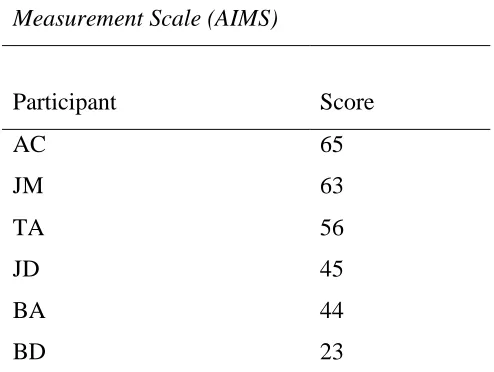
AC – AC was raised in the San Francisco Bay Area and was highly recruited during high
currently resides in the San Francisco Bay Area where he works as a social worker. He registered
a score of 65 on the AIMS.
BA – BA was raised in the San Francisco Bay Area and was recruited by smaller colleges
and universities during high school before choosing to attend school in the San Francisco Bay
Area. After spending a couple of years there, he transferred to a university in Southern California
to finish his basketball career. He registered a score of 44 on the AIMS.
JM – JM was raised in the San Francisco Bay Area and was heavily recruited during high
school prior to getting injured. He tore his ACL four games into his senior year of high school
and chose to attend community college. After recovering from his injury, he accepted a
scholarship offer a university in the Northwest to play football. He registered a score of 63 on the
AIMS.
BD – BD was raised in the Southeast and was heavily recruited during high school after
being recognized as the top player in the state. He accepted a scholarship offer to play basketball
in the Midwest. He transferred twice prior to finishing his career. He registered a score of 23 on
the AIMS.
JD – JD was raised in the San Francisco Bay Area and was lightly recruited during high
school. He chose to attend a local community college over smaller colleges and universities. Due
to his performances at the community college level, he initially committed to a university in the
Southwest before accepting a scholarship offer to play football in the Southeast. He registered a
score of 45 on the AIMS.
TA – TA was raised in the San Francisco Bay Area and was lightly recruited during high
played basketball. He later accepted a scholarship offer to play basketball at a university on the
West coast. He attempted to play professionally overseas prior to returning home and
Chapter Four - Results
This study retroactively measured the athletic identity of Black male student-athletes and
explored their experiences as Black male student-athletes from the time they were introduced to
their sport through the termination of their athletic careers. This study also explored the potential
for mental health concerns among Black male student-athletes as a result of their on-campus
experiences and as they transitioned out of their athletic careers. A void in previous research and
literature examining the phenomenon of Black male student-athletes and mental health facilitated
interest in this study. Exploring the experiences of Black male former student-athletes provided
important information regarding the development of their athletic identities and the impact of
this identity on their mental health. A qualitative framework was used to design this study, with
thematic analysis used to guide data collection and analysis. The results highlight the lived
experiences of the participants.
This chapter presents findings based on data collected through administering the Athletic
Identity Measurement Scale (AIMS) and through interviewing a sample of six Black male
former student-athletes. In place of their real names, participants will be identified by their
initials. Throughout this chapter, the experiences of the participants will be revealed primarily
through the verbatim responses of the participants. By conceptualizing their experiences through
the lens of Bronfenbrenner’s Ecological Systems Theory, the findings present a rich and
meaningful view of their early childhood, adolescent, and adult experiences. Additionally, the
findings provide answers to how their athletic identities developed over time, how their
experiences as Black male student-athletes reinforced their athletic identities, and how the loss of
Athletic Identity Measurement Scale
Immediately prior to their interviews, participants completed the Athletic Identity
Measurement Scale (AIMS). At the time of administration, participants were asked to reflect on
their athletic identity at the time of their retirement. Results of the AIMS are summarized in
Appendix C. Scores ranged from a high of 65 to a low of 23, with 49.3 being the mean score of
the participants. In addition to the AIMS, qualitative interviews were used to obtain a deeper
understanding and meaning of the participants’ experiences of their athletic identity, their
experiences as Black student-athletes, career termination, and the overall impact on their mental
health.
Qualitative Interviews
Bronfenbrenner’s ecological systems theory will provide a framework through which to
understand how Black male student-athletes have come to strongly identify as athletes from early
childhood, through adolescence, and into adulthood. In Bronfenbrenner’s theory, the micro,
meso, exo, macro, and chronosystems are the primary systems associated with this model. The
microsystem describes the systems with which the individual has direct contact. The mesosystem
is the relationship between two systems that impact the individual. The micro and mesosystem
are present within the theme of athletic identity. The exosystem describes how larger systems
come to impact smaller systems that directly influence the development of an individual’s
identity. The macrosystem is composed of cultural values, customs, and laws and connects the
relationship between the individual and society at large. The exo and macrosystem are present