Available online on 15.06.2019 at http://jddtonline.info
Journal of Drug Delivery and Therapeutics
Open Access to Pharmaceutical and Medical Research© 2011-18, publisher and licensee JDDT, This is an Open Access article which permits unrestricted non-commercial use, provided the original work is properly cited
Open Access Research Article
Formulation and Evaluation of Polyherbal Ointment for Wound Healing and
Antimicrobial Activity
Sanjay B. Bhawar*
1, Santosh B. Dighe
1, Rutuja B. Tambe
21. Department of Pharmacology, Pravara Rural College of Pharmacy, Pravaranagar, Tal-Rahata, Dist-Ahmednagar, India
2. Department of Quality Assurance Techniques, Pravara Rural College of Pharmacy, Pravaranagar, Tal-Rahata, Dist-Ahmednagar, India
ABSTRACT
Herbal therapy and herbal drugs predominates in traditional medicine as well as in alternative medicine practiced in the developed world. Among the various indications where traditional herbal medicines are used, skin related disorders is ranked top. Thus, the main objective of the present study is to formulate and evaluate a polyherbal ointment for wound healing and antimicrobial activity. Ointments were formulated using hydroalcoholic extracts (soxhlet extraction) of Piper nigrum and Curcuma longa were evaluated for its physicochemical property, wound healing and antimicrobial activity. Ointments were prepared using different concentrations of the extracts such as 2%, 4% w/w by fusion method using emulsifying ointment as base. Formulations were tested for its physicochemical properties like pH, spreadability, extrudability and viscosity and gave satisfactory results. The prepared formulations were also stable at various temperature. Further, extract were evaluated for its antimicrobial activity against Staphylococcus aureus, Pseudomonas aeruginosa, Bacillus subtilis and Proteus vulgaris by paper disc diffusion method. All the extract showed predominant activity against selected species. Formulations were also evaluated for wound healing activity. Hence an attempt was made to formulate a polyherbal ointment, and to evaluate for its physical parameter, the formulated ointment was compared with the standard ointment (povidone iodine). Overall result of this study reveals that this is an effective polyherbal ointment.
Keywords:Piper nigrum, Curcuma longa, Wound healing activity, Antimicrobial activity.
Article Info:Received 12 April 2019; Review Completed 06 June 2019; Accepted 10 June 2019; Available online 15 June 2019
Cite this article as:
Bhawar SB, Dighe SB, Tambe RB,Formulation and Evaluation of Polyherbal Ointment for Wound Healing and
Antimicrobial Activity, Journal of Drug Delivery and Therapeutics. 2019; 9(3-s):575-582
http://dx.doi.org/10.22270/jddt.v9i3-s.2917
*Address for Correspondence:
Sanjay B. Bhawar, Department of Pharmacology, Pravara Rural College of Pharmacy, Pravaranagar, Tal-Rahata, Dist-Ahmednagar, India
1. INTRODUCTION:
There are many causes for the increased use of the herbal medicines. These may scale from the appeal of products from ‘nature’ and the understanding that such product are ‘steady’ (or at least ‘safer’ than conventional medicines, which are often contemptuously referred to as ‘drugs’), to more complex reasons related to the theoretical views and religious beliefs of individuals. (1)
The emphasis on use of medicinal plants had either to be placed on the treatment rather than prevention of diseases. Over 90% of traditional medicine remedies contain medicinal plants, the medicinal plants that have been implicated with preventive measures in diseases control strategies. (2)
The 16th and 17th centuries were golden era of herbal
medicines. The more and more plants incorporated during 18th and 19th centuries in America. After that, scientists
started making synthesizing plant compounds by their
own.(3)
The wound may be defined as a loss or breaking of cellular and anatomical or functional continuity of living tissues. Wound healing is a biological process that is initiated by trauma and often terminated by scar formation. Thus healing is essentially a survival mechanism and represents an attempt to maintain normal anatomical structure and function. (4)
The word antimicrobial was derived from the Greek words anti (against), mickros (little) and bios (life) and refers to all agents that act against microbial organisms. The introduction of antimicrobial agents into general clinical use represents one of the land- Mark medical advances of modern medicine.(5)
or worn off. This adhesion is due to their plastic, rheological behavior, which allows the semisolids to retain their shape and cling as a film until acted upon by an outside force, in which case they deform and flow. (6)
Many medicaments meant for topical application to intact or broken skin or to mucous membranes, have been presented in the form of semisolid consistency variously designated as ointment, creams, salves, pastes etc. and used mainly as
protective or emollient for the skin. (7)
The skin has three layers. Beneath the surface of the skinare
nerves, nerve ending, glands, hair follicles and bloodvessels.
A typical human skin surface is known to include, on the
normal 40-70 hair follicles and 200-300 sweat ducts on
every square centimeter of the skin. (8)
2. MATERIAL AND METHODS:
2.1 Collection of plant material
The fruits of Piper nigrum and rhizome of Curcuma longa
were purchased from the local market of Ahmednagar
district of Maharashtra. 2.2 Extraction process
The fruits of piper nigrum and the rhizome of Curcuma longa
were procured and pulverized in electrical grinder. About 150 gm of powdered Fruits and rhizomes were used for extraction, powder were pass through 120 mesh sieve to remove fine powder and coarse powder and coarse powder was used for extraction. (9) The solvent used for extraction
was alcohol & water (7:3). Technique: Soxhlet apparatus
The powdered fruits of Piper nigrum and rhizomes of
Curcuma longa were extracted with solvent for removal of
coloring matter by defatting process using continuous soxhlet extraction method. After complete defatting the defatted powder were condensed with solvent for 30 hrs. Extraction temperature was maintained at 500 c. The extract
was filtered and concentrated to get thick paste and after it freeze dried to get powder. The extract was stored in air tight container. (10)
2.3 Formulation of ointment:
Table.1 Formula for Ointment base
Sr. No. Ingredients Quantity
01 Stearic acid 15 g
02 White wax 2 g
03 Yellow Vaseline 8 g
04 Triethanolamine 1g
05 Propylene glycol 8 g
06 Purified Water quantity sufficient to 100 g
Table.2 Formula for Herbal Ointment
Sr. No. Extract Use Quantity of extract in gm for given formula F1(2%) F2(4%)
1. Hydroalcoholic extract of
Piper nigrum 0.5 gm 1 gm
2. Hydroalcoholic extract of
Curcuma longa 0.5 gm 1 gm
3. Ointment Base Q.S.100 gm Q.S.100 gm
2.3 Evaluation of Ointment Formulation: a. Color and Odour: -
Color and Odour of all ointments was examined by visual examination. (11)
b. pH:-
The pH of ointment formulation was determined by using digital pH meter. 1gm of ointment was dissolved in 100 ml of distilled water and stored for two hours. The measurement of pH of each formulation was done in triplicate and average values were depicted. (12)
c. Spreadability Test: -
Spreadability is expressed in terms of time in seconds taken by two slides. To flip out or from cream when placed in between the the slides under the direction of certain load. Laser the time taken for separation of two slides, better the
spread ability. It is calculated by using the formula. S = M x L/T, where, M = Weight tied to upper slide, S = Spread ability of formulation, L = Length of Glass Slides, T = Time taken to separate the slides. (12)
d. Extrudability:
A closed collapsible tubes containing ointments was pressed firmly at the cramped end. When the cap was removed, ointment extruded until pressure dissipated. Weight in grams required to extrude 0.5 cm ribbon of ointment in 10 sec was determined. (13)
e.
f. Accelerated stability study:
A physical stability test of herbal ointment was carried out at 80C for 450C and stability was carried out for one month. The
different parameter such as color, odor, texture, traces of gritty particles, skin irritation test were studied for all formulation at first month. (13)
2.4 Pharmacological activity: 2.4.1 Experimental animals:
Wistar albino rats weighing between 150-180 gm were obtained from Laxmi bio farms private limited, Pune. The rats were housed in cleaned metallic cages and kept in well ventilated room and allowed to acclimatized to the laboratory condition for one week before being used. They were fed with standard animal pellet and had free access to water and libitum. The animal were randomly divided into four groups. The protocol of the experiment (1942/PO/Re/S/17/CPCSEA/2018/02/02) was approved by Institutional Animal Ethics Committee (IAEC) of Pravara Rural College of Pharmacy, Loni and were conducted in accordance with permission from Committee for the
Purpose of Control and Supervision of Experiments on Animals (CPCSEA).
2.4.2 Excision wound model
Excision wounds were used for the study of rate of contraction of wound and epithelization. Animal were anesthetized with Thiopental sodium and the hairs on the skin of the back, shaved with sterilized razor blade. A circular wound of about 500mm2 area and 2mm depth was
excised rats, 5cm away from the ear. The entire wound was left open. The was done topically in all the cases. The wounds were traced on transparent tracing paper by permanent marker on the day of wounding and subsequently on alternate days until healing were complete. Wound area was measured on days0, 3, 6, 9, 12, 15, 18 for all the groups. (14, 15)
2.4.3 Treatment protocol
The excision wound models rats were randomly divided into four groups (n=6/ groups). Total 24 Rats.
Treatment was given in following manner;
Table.3 Treatment protocol
Sr.No. Name of groups Treatment 1. Vehicle control ointment base 2. Standard Povidone iodine ointment
3. Test I (2%) Hydroalcoholic extract of Piper nigrum and Curcuma longa (0.5 gm)
4. Test II (4%) Hydroalcoholic extract of Piper nigrum and Curcuma longa (1 gm)
2.4.4 Antimicrobial activity
In-vitro antimicrobial screening was performed by paper disc diffusion method. The antimicrobial activity was performed on the hydroalcoholic extract of the rhizome of
Curcuma longa and Fruits of Piper nigrum. Activity was
performed against four pathogenic bacteria like Bacillus subtilis, Staphylococcus aureus, Pseudomonas aeruginosa and
Proteus Vulgaris (Two-Gram positive and two-Gram negative
bacteria). Sterile discs (6 mm diameter) made of Whatman
filter paper were impregnated with 20µl of different concentration of both the test extract (20mg/ml, 40mg/ml, 60mg/ml, 80mg/ml, 100mg/ml) and air dried to eliminate residual solvent and then was placed on the agar media In addition to these disc loaded with hydroalcoholic and disc loaded with Amoxycillin were used as negative and positive control. Plates were then incubated in incubator at 37°C for 24 h. After incubation both the plates were observed for zones of inhibition, and their diameter were measured including the diameter of the disc. (16)
2.4.5 Determination of Minimum inhibitory concentration (MIC)
Minimum inhibitory concentrations (MIC) of the hydroalcoholic extract of Curcuma longa and Piper nigrum
were determined by Serial dilution method. Nutrient broth media were prepared and 5ml of media is taken in each of the test tube. Hydroalcoholic extract of fruits and rhizome is prepared of different concentration (100mg/ml, 50 mg/ml, 25 mg/ml, 12.5 mg/ ml, 6.25 mg/ml and 3.125 mg/ml 1.56 mg/ml, 0.78 mg/ml, 0.39 mg/ml). Freshly grown bacterial strains of Pseudomonas aeruginosa is inoculated in broth media and grown at 37ºC for 18 hrs. Each tube was inoculated with different concentration of both the extracts
prepared at different concentration. All the tubes were incubated at 37ºC on a shaker with 140 rpm for 24 h. Presence of turbidity denoted presence of microorganism in the test tube after the period of incubation, whereas the complete absence of any turbidity indicates complete inhibition of microbial growth. The test tube with the lowest dilution with no detectable growth by visual inspection was considered the MIC. After incubation, the bacterial growth was measured at 660 nm. The % of inhibition was calculated by using the formula below: (16)
% Inhibition = OD of culture with sample/ OD of culture without sample x 100
Fig.3 MIC of Curcuma longa Fig.4 MIC of Piper nigrum
3. Statistical analysis
Data obtained were analyzed using One Way Analysis (ANOVA) followed by dunnet test and expressed as mean ± SEM. Differences between means were regarded significant at P<0.001.
4. RESULTS
4.1 Evaluation of Ointment
Accelerated stability study- The ointment was found to be physically stable at different temperatures. There were no changes in the spreadability, irritant effect even after exposure to different temperatures. For one month stability study at different temperature conditions viz. room temperature, 80C and 450 C, different parameters were
studied and result observed as below.
Table.4 Physicochemical Evaluation Parameters for Ointments: Sr.no Parameter Ointment formulation
F1 F2
1. Nature Semisoild Semisoild
2. Color Yellowish brown Yellowish brown
3. Odour Characteristic Characteristic
4. Texture Gummy Gummy
5. Trace of gritty particles No No
6. Skin irritation No No
7. PH 6.90 6.90
8. Spreadability 6.31 6.31
9. Extrudability 0.5 gm 0.5 gm
4.2 Wound healing activity
Table.5 Effect of polyherbal formulation on healing of excision wound model
Treatment Wound area
(mm
2)
Groups Control Standard HAE of PN & CL
(2%) HAE of PN & CL (4%) 0 Day 511±0.91 510±0.62 505±0.76 508±0.82
3rd Day 468±0.63** 402±0.51** 426±0.43** 416±0.42**
6th Day 435±0.52*** 325±1.05*** 351±0.48*** 333±0.52***
9th Day 385±0.59*** 237±0.79*** 270±0.52*** 251±0.63***
12th Day 340±0.83*** 203±0.39*** 233±0.46*** 202±0.55***
15th Day 301±0.86*** 166±1.20*** 184±0.47*** 177±0.45***
18th Day 256±1.69*** 54.3±0.48*** 76.3±0.41*** 62.9±0.36***
Period of epithelization in days
13 6 11 8
Graph.1 Effect of Standard, Test 1 and Test 2 on wound area 4.3 Antimicrobial activity
Table.6 Zones of Inhibition Shown by Piper nigrum on bacterial strains
Pathogens Zones of Inhibiton in mm at different concentration Negative Control 20mg/ml 40mg/ml 60mg/ml 80mg/ml 100mg/ml Positive
Control
Staphylococcus
aureus 4.9 4.9 4.9 5.0 5.0 5.0 Nil
Bacillus substilis Nil Nil Nil Nil Nil 7.0 Nil
Pseudomonas
aeruginosa 4.0 4.1 5.0 5.0 6.0 8.0 Nil
Proteus vulgaris Nil Nil Nil Nil Nil 6.0 Nil
Table.7 Zones of Inhibition Shown by Curcuma Longa on bacterial strains
Pathogens Zones of Inhibition in mm at different concentration Negative Control 20mg/ml 40mg/ml 60mg/ml 80mg/ml 100mg/ml Positive
Control
Staphylococcus
aureus 4.0 4.1 4.8 5.8 6.0 6.0 Nil
Bacillus substilis 3.2 3.2 4.8 5.0 5.0 7.0 Nil
Pseudomonas
aeruginosa 4.0 4.1 5.0 5.0 6.0 6.0 Nil
Proteus vulgaris Nil Nil Nil Nil Nil 7.0 Nil
0 100 200 300 400 500 600
0 Day 3rd Day6th Day9th Day 12th Day
15th Day
18th Day
W
o
un
d
ar
ea
(
m
m
2
)
Days
Control
Standard
HAE of PN & CL (2%)
Table.8 Minimum Inhibitory Concentration for hydroalcoholic extract of Piper nigrum Sr no. Conc. Of extract
mg/ml Bacterial Percentage Inhibition Staphylococcus
aureus Bacillus substilis Pseudomonas Aeruginosa
1 Control 0 0 0
2 100 96.013% 98.058% 98.089%
3 50 73.023% 73.049% 72.046%
4 25 73.023% 73.049% 72.046%
5 12.5 68.964% 67.874% 65.765%
6 6.25 50.167% 48.632% 45.432%
7 3.125 40.068% 40.067% 41.670%
8 1.56 9.008% 10.680% 11.809%
9 0.78 2.101% 3.112% 1.673%
10 0.39 0 0 0
Minimum inhibitory concentrationfor hydroalcoholicextract of Piper nigrum can be considered as 25mg/ml for all 3 bacterial strain.
Table.9 Minimum Inhibitory Concentration for hydroalcoholic extract of Curcuma longa Sr no. Conc. Of extract
mg/ml Bacterial Percentage Inhibition Staphylococcus
aureus Bacillus substilis Pseudomonas Aeruginosa
1 Control 0 0 0
2 100 95.023% 93.058% 94.089%
3 50 70.023% 71.049% 69.046%
4 25 69.067% 67.084% 69.087%
5 12.5 69.067% 67.084% 69.087%
6 6.25 69.067% 67.084% 69.087%
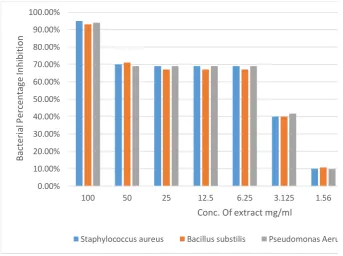
7 3.125 40.068% 40.067% 41.670%
8 1.56 10.008% 10.670% 9.809%
9 0.78 3.111% 2.112% 3.773%
10 0.39 0 0 0
Minimum inhibitory concentrationfor hydroalcoholic extract of Curcuma longa can be considered as 12.5mg/ml for all 3 bacterial strains.
0.00% 10.00% 20.00% 30.00% 40.00% 50.00% 60.00% 70.00% 80.00% 90.00% 100.00%
100 50 25 12.5 6.25 3.125 1.56 0.78 0.39
B
acte
ri
al
P
er
centa
ge
Inhi
bi
ti
o
n
Conc. Of extract mg/ml
Staphylococcus aureus Bacillus substilis Pseudomonas Aeruginosa
Graph.3 Graphical representation of Curcuma longa extract at various concentration of the extract on pathogens
Effect of the hydroalcoholic extracts of Piper nigrum and
Curcuma longa on wound area (mm2) Table- 5. The initial
wound areas selected for the study were in the range of 500 mm2. In standard group the wound area decreased 54.3
mm2on the 18th day. In hydroalcoholic extract (4%
ointment) treated steadily decreased and it was 62.9 mm2on
the 18th day. Thus the hydroalcoholic extract (4% ointment) compared to standard restored the wound area. In present investigation the hydroalcoholic plant extracts of Piper
nigrum and Curcuma longa was tested against three
pathogenic bacterial strains viz. Staphylococcus aureus,
Bacillus substilis and Pseudomonas Aeruginosa. The
antibacterial efficacy of the extracts of Piper nigrum and
Curcuma longa was quantitatively assessed on basis of
inhibition zone and MIC (Minimum inhibitory concentration). The zone of inhibition by diffusion method shown by both extracts on various concentration given in table 6 & 7. The MIC value for Piper nigrum and Curcuma
longa was found to be 25mg/ml and 12.5 mg/ml
respectively.
5. DISCUSSION
The phytochemical study of the plants piper nigrum and
Curcuma longa revealed the presence of various active
constituents such as alkaloids, flavonoids, steroids and tannins. In excision wound model standard was effective than test. As in the antimicrobial activity plants extract showed significant activity. So further they were investigated for the formulation of ointment and then evaluated for wound healing activity. The present study involved excision wound model. In excision wound model animals were treated with polyherbal ointment showed better healing.
6. CONCLUSION
Herbs are plants that content healing properties and can treat a number of health problems. The study on selected plants for the formulation proved the potential for therapeutic use of wound healing and antimicrobial purpose. Plants used in work were Piper nigrum and Curcuma longa
extracted by using hydroalcoholic solvent (7:3) and extract was used to formulate ointment. Ointments were evaluated
for physical parameters which revealed that all the values were within acceptable limits. The herbal formulation shows significant Wound healing and antimicrobial activity.
ACKNOWLEDGEMENT
Authors are thankful to Principal and management of Dr. Balasaheb Vikhe Patil( Padmbhushan Awardee) Pravara Rural Education Society Pravaranagar, for providing the necessary facilities and encouragement for carrying out research work.
REFERENCES
1. Heinrich M, Barnes J, Gibbons S, Williamson EM. Fundamentals of pharmacognosy and phytotherapy. 2nd edition. London:
Churchill Livingstone Elesvier; 2012. p.4.
2. Sofowara A, Ogunbodede E, Onayade A. The role and place of medicinal plants in strategies for diseases prevention. African Journal of Complementary and Alternative Medicine, 2013; 10(5): 210-229.
3. Pithava A, Pithava A. Current prospects of herbal medicine in the world. Journal of Pharmacognosy and phytochemistry, 2016; 4(4): 60-67.
4. Kumar V, Khan AA, Nagarajan K. Animal model for the evaluation of wound healing activity. International bulletin of Drug Research, 2013; 3(5): 93-107.
5. Munuswamy H, Thirumalai T, Rajamani S, Elumalai EK, David E. A review on antimicrobial efficacy of some traditional medicinal plants in Tamilnadu. Journal of Acute Diseases, 2013: 99-105.
6. Lackman L, Liberman HA, Kanig JL. The theory and practice of industrial pharmacy. 4rd edition. New Delhi: CBS Publisher and
Distributors Pvt. Ltd.; 2013. P.534-538.
7. Shelke U, Mahajan AA. Review on: An ointment. International Journal of Pharmacy and Pharmaceutical Research, 2015; 4(2): 170-192.
8. Asija R, Asija S, Sharma D, Dhaker PC, Nama N. Topical ointment: an updated review. Journal of Drug Discovery and Therapeutics, 2015; 3(25): 47-51.
9. Khandelwal KR, Sethi V. Practical Pharmacognosy Technique and Experiments.28th edition. Pune: Nirali Prakashan; 2017.
p.23.1-23.11, 25.1-25.8.
10. Mukherjee PK. Quality control of herbal drugs. 3rd edition.
11. Seker M, Rashid NA. Formulation, evaluation and antibacterial properties of herbal ointment containing methanolic extract of clinacanthus nutans leaves. International Journal of Pharmaceutical and Clinical Research, 2016; 8(8): 1170-1174. 12. Dukare S, Gaikwad P, Kolhe S, Jadhav SL. Formulation and
evaluation of polyherbal ointment. American Journal of Pharmtech Research, 2017; 7(6): 62-70.
13. Sawant SE, Tajane MD. Formulation and evaluation of herbal ointment containing neem and turmeric extract. Journal of Scientific and Innovative Research, 2016; 5(4): 149-151.
14. Patel AM et al. Preparation and evaluation of wound healing activity of new polyherbal formulation in rats. American Journal of Phytomedicine and Clinical Therapeutics, 2013; 1(6): 498-506.
15. Pradhan D, Panda PK, Tripathy G. Wound activity of aqueous and methanolic bark extracts of Vernonia arborea Buch-Ham. In wister rats. Natural Product Radiance, 2009; 8(1): 6-11. 16. Singh N, Gupta S, Rathore V. Comparative antimicrobial study