California State University, San Bernardino California State University, San Bernardino
CSUSB ScholarWorks
CSUSB ScholarWorks
Theses Digitization Project John M. Pfau Library
1999
A lower bound for the cyclic cutwidth of the n-cube
A lower bound for the cyclic cutwidth of the n-cube
James Shigeo Namekata
Follow this and additional works at: https://scholarworks.lib.csusb.edu/etd-project
Part of the Mathematics Commons
Recommended Citation Recommended Citation
Namekata, James Shigeo, "A lower bound for the cyclic cutwidth of the n-cube" (1999). Theses Digitization Project. 1847.
https://scholarworks.lib.csusb.edu/etd-project/1847
A LOWER BOUND FOR THE CYCLIC CUTWIDTH OF THE N-CUBE
A Project
Presented to the
Faculty of
California State University,
San Bernardino
In Partial Fulfillment
ofthe Requirements for the Degree
Master ofArts
in
Mathematics
by
James Shigeo Namekata
A LOWER BOUND FOR THE CYCLIC CUTWIDTH OF THE N-CUBE
A Project
Presented to the Faculty of
California State University,
San Bernardino
by
James Shigeo Namekata
June 1999
Approved by:
J(^enh Chave%"^air, Mathematics
Dr. Roll app
Dr. Jo tein
Dr. Terty Hallett, Graduate Coordinator
Dr. Peter Williams, Department Chair
ABSTRACT
The linear cutwidth ofa particular family ofsubgraphs ofthe ^-dimensional cube, Qn, is used to provide a good lower bound for the cyclic cutwidth ofQn- A summary ofprevious research dealing with the cyclic cutwidth ofgraphs is investigated. A
theorem stating that the linear cutwidth ofa graph is equal to the cyclic cutwidth ofthe
disjoint union oftwo copies ofthe same graph is proved. Next,a recurrence relation is solved and used to find the linear cutwidth ofour subgraph ofQn. By using the
theorem, we are able to calculate the cyclic cutwidth ofthe union oftwo disjoint copies ofour subgraph;thus, providing a lower bound for the cyclic cutwidth ofthe
n-dimensional cube. Finally,this lower bound is improved by applying the theorem to
Qn-\ U Qn-\•
ACKNOWLEDGMENTS
I would like to thank my advisor. Dr. Joseph Chavez, whose patience and
time was invaluable to me. His work and guidance gave me the inspiration to
complete this project. I would also like to thank my family and friends for the
support they gave me during the long hours ofresearch that went into completing
friisproject.
TABLE OF CONTENTS
ABSTRACT . iii
ACKNOWLEDGMENTS iv
LIST OF FIGURES vi
1 INTRODUCTION 1
2 SUMMARY OF THE LITERATURE.. ... 5
3 FINDING THE LOWER BOUND FOR THE CYCLIC
CUTWIDTH OF THE N-CUBE. 11
3.1 Subgraph ofthe 4-cube 12
3.2 Extending to higher dimensions 14
3.3 Defining ^S) 15
3.4 Y-coloring scheme 16
3.5 Solving the recurrence relation .23
3.6 Relationships befiveen/cw(G)and ccw(G) 23
3.7 Other discoveries fi*om our research 25
4 CONCLUSION 26
4.1 Results 26
4.2 Future research 27
LIST OF FIGURES
Figure 1..,...,... 2
Figure2... ... 3
Figure 3...,,... 4
Figure 4... 8
Figure 5... 15
1 INTRODUCTION
Over the last few years,a variety ofgraph labeling problems have sparked the
interest ofmathematicians. The bandwidth,edge snm,and cutwidth problems are problems in which one must label, or number,the vertices ofa given graph in order to optimize some parameter. The particular problem we will study in this paper is the
cutwidth problem, which basically involves finding a labeling ofthe vertices ofa graph
so that the maximum number ofedges between consecutive vertices is minimized.
A graph, G,is defined as a structure with a set ofvertices, V,and a set ofedges,E,
whichjoin pairs ofdistinct vertices. An n-cube is an n-dimensional unit cube with 2"
vertices, each with degree n, and edges. The vertices ofan n-cube may be
represented as n-tuples ofO's and 1's. Edges connect pairs ofvertices that differ in
only one coordinate in their n-tuples. We will denote the cube with 2" vertices as Qn.
A vertex numbering ofG is a fimction:
1]: V whereM = |F|,
which is one-to-one and onto. A numbering may be thought ofas embedding the
vertices ofG onto a linear host graph(path). The cutwidth ofG,with respect to rj,
cw(G : rj), is tiie maximum number ofedges which pass between any two
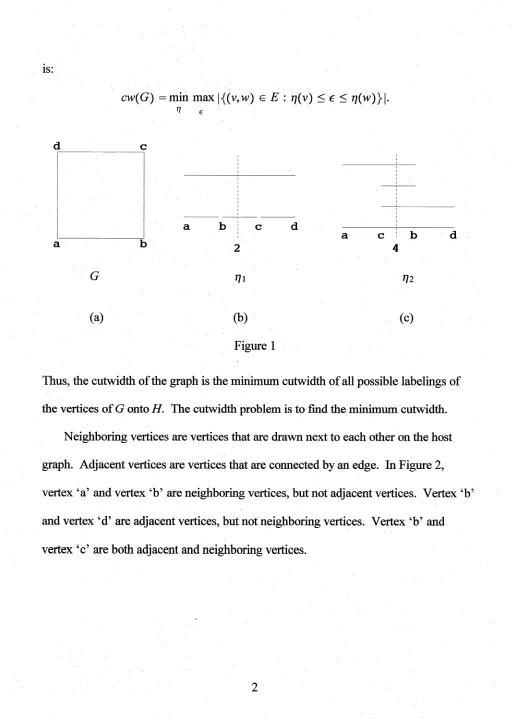
neighboring vertices on the host graph,H. Figure 1(a)depicts the graph of^2,which
we label as G. Figure 1(b)shows one particular numbering(r;i)ofthe vertices ofG
onto the host graph,H,where the linear cutwidth is 2. Figure 1(c)shows another
is:
cw(G)-min max|{(v,w) e E: t](v) <€< ri(w)}\.
e
a c b d
2
G VI V2
(a) (b) (c)
Figure 1
Thus,the cutwidth ofthe graph is the minimum cutwidth ofall possible labelings of
the vertices ofG onto H. The cutwidth problem is to find the minimum cutwidth.
Neighboring vertices are vertices that are drawn next to each other on the host
a b c d
Figure 2
There are some special properties ofan embedding ofG onto H. Ifany two
vertices are connected by an edge in G,then a path must connect the same two vertices
on H. Ifa path tiravels past a vertex on the host graph,H,to get to a more distant
vertex,then it is considered to pass through each vertex that it passes by. Thus,the
cutwidth is the maximum number ofpaths passing between anytwo neighboring
vertices ofH. By changing the labeling ofthe vertices ofG,we rnay change the
cutwidth. IfG has n vertices,then there are «!embeddings ofthe vertices ofG onto
H. The solution ofthe linear cutwidth problem is the minimum ofthe cutwidths for
each ofthe possible embeddings ofG onto H. When the host graph is a path,the
cutwidth problem is called the linear cutwidth ofG,and it will be denoted bylcw(G).
When the host graph is a cycle,the cutwidth problem is called the cyclic cutwidth of
G,and it will be denoted by ccw{G).
We may think ofthe cyclic host graph for an n-cube to be in the form ofa 2"-gon.
The cyclic cutwidth ofG,with respect to t], denoted ccw{G : //),is the maxirrmm
denoted ccw(G), is the minimum value ofccw(G : i]) over all numberings rj.
A simple example to examineis the three-dimensional cube, Q3. See Figure 3a. A linear layout consists ofthe eight vertices ofQ3 embedded on a path,H. Let 771 be the vertex numbering ofdie eight vertices ofQ3 shown in Figure 3b. The twelve edges which connect vertices in Q3 must also connect the same vertices in H. The linear cutwidth is the maximum number ofpaths between any two neighboring vertices of//. So,in this example,/cw(03 : 771) = 5. The/cw(g3)would be the
minimum ofthe cutwidths for each ofthe possible embeddings ofQ3 onto H.
h q
(a)
a b c d e f g h
5
(b) (c)
By comparison,we consider one numbering ofthe eight vertices ofa
three-dimensional cube on a cyclic host. Since there are eight vertices,the host graph,
H,will be in the form ofa regular octagon. The twelve edges ofG must also be drawn
as paths in H. Paths actually travel along die perimeter ofthe octagonpassing through
each vertex they pass by. Each path has two ways to travel around the octagon.
Actually,so we can visualize the embedding,we will draw paths which connect the vertices with straight lines through the interior ofthe octagon.
Let 772 be the numbering shown in Figure 3c. To calculate the cyclic cutwidth, ccw{G : 772)5 we conshuct a ray from the center ofthe octagon to the regions between
each pafr ofneighboring vertices. The numberdfedges crossed is found for each pair
ofneighboring vertices and the maximum number ofedges is recorded as the
cutwidth. Thus,cch'(|03 : 772)-3. The Gcw(g3)wouldbe theniinimumofthe
cutwidths for each ofthe possible embeddings ofQt, onto H.
2 SUMMARY OF THE LITERATURE
There have been countless hours ofresearch spent trying to find the cyclic cutwidth ofthe 77-dimensional cube. Many researchers as well as Students have tried
to solve this complex problem. The cyclic cutwidth problem is veiy difficult in
general, but some results are known for special cases.
The survey paper byF.R.K.Chung[3]provides valuable background
information about the cutwidth problem. Several results comparing the cutwidth ofa
important to the present project are Chung's suggestions for tuture research of cutwidth problems. Most ofthe results examined by Chung Concentote on the case where the host graph is a path. Chung suggests finding the cutwidth for a variety of
different host graphs. Some examples ofother possible host graphs are grids,trees and
/cycles.
The cutwidth problem ofthe n-cube has been studied when the host graph is both
a path and rectangular grid. The cutwidth ofa graph when the host graph is a grid is
called the congestion ofthe graph. A team ofresearchers including S.Bezrukov,M. Rottger,U-P Schroeder,L.Harper,and J. Chavez obtained a recurrence relation for
the linear cutwidth ofthe ^-dimensional cube [1]. By solving this recurrence,they
found the linear cutwidth to be
2""'-2 ;
ifn is even
«) ~
ifn is odd.
Following is their interesting result relating the congestion to the linear cutwidth oftheu-cube.
Theorem (2.1) x P2>a) = lcw(Q„2)^where rit + n2 = n, > n\,and
Pm is apath ofm vertices.
Thus,from this theorem,the linear cutwidth ofan «-cube can be used to find its
congestion.
Y.Lin[7]studied the cyclic cutwiddi for the complete bipartite graph. Lin states
whereX- {xi,X2,...,Xm} and Y= {yi,j2,—,yn},an upper and lower bound can be
calculated.
Theorem (2.2[Lin]) For any integers m,n,thefollowing holds:
riCLf
Lin also has a corollary that ifm and « are both even or ifm = then the cyclic cutwidth is given by the above lower bound.
Corollary(2.3[Lin]) Ifboth m and n are even or m = n, we have:
= fi([fIfJ +
fflff1)l-Thus,we have bodi an upper and lower bound as well as exact results for special cases
ofthe cyclic cutwidth ofcomplete bipartite graphs.
In this paper, we are interested in finding a lower bound for the cyclic cutwidth of
the «-dimensional cube. Although the exact solution has yet to be proven,many
researchers have ideas ofwhatthe cyclic cutwidth ofthe n-cube should be. J. Chavez
and R.Trapp[2]have conjectured thdt the n-cube's cyclic cutwidth can be calculated
using the following formula.
—-—-— ifYi is cvciT
Conjecture(2.4[Chavez-Trapp]) ccw(e„)= ^
I
3 — ifn is odd.
This conjecture has been verified by computer for the three-dimensional cube.
written in C-H- code to calculate the cyclic cutwidth ofthe 3-cube. First, he found the
number ofways to embed the eight vertices ofthe 3-cube onto an octagon. His
computer program found and evaluated the cyclic cutwidth ofall(5040)(4G96)or 20,643,840 cases possible.
Beatrice James[6]verified the Ghavez-Trapp conjecture for the 3-dimensional and 4-dimensional cubes. Her method ofproving the cyclic cutwidth for the 3 and
4-dimensional cubes is interesting and unique. An outline ofher prooffor the
3-dimensional cube follows(the 4-dimensional case is similar).
James noticedthat the 3-cube is composed oftWo disjoint 2-cubes connected by
four distinct edges. She also noticed that when the vertices ofthe 3-cube were
embedded onto the cyclic host,the two distinct 2-cubes can either contain the center or
not contain the center. (See Figure 4.) Therefore,this particular proofhad three cases
to examine: both 2-cubes containing the center,one containing the center,and neither
containing the center. And in each case,she fovmd that the cyclic cutwidth had to be at
least three;thus, proving that the cyclic cutwidth ofthe 3-cube is three.
e
Containing the center Not containing the center
Figure 4
Francisco Rios[8],assisted by his mentor,R.Trapp,discovered some interesting relationships between the linear cutwidth and the cyclic cutwidth ofcomplete graphs. First, a theorem for finding the linear cutwidth ofany complete graph was proved. Next,hefound a relationship between the linear cutwidth and the cyclic cutwidth of complete graphs based on the proofe ofhis previous two theorems. Butthe main point
ofinterest in Rios' paper is his theorem for finding the cyclic cutwidth ofcomplete
graphs.
Theorem (2.5[Rios]) For any complete graph Kn on n vertices.
if Y is even
ccwiKn)= 4
iff is odd
ri
^ifn is odd.
Since the w-dimensional cube is a subgraph ofthe complete graph with 2" vertices, then the results ofthe cyclic cutwidth ofcomplete graphs provides us with a result which will be more than the cyclic cutwidth ofthe ^-dimensional cube. But an
interesting relationship between the linear cutwidth and cyclic cutwidth is his corollary
to his theorem. This corollary will be ofinterestto this paper.
Corollary(2.6[Rios]) For any complete graph Kn on n vertices.
ifiL is even
ccw{Kn)= <
ifj. is odd
By Rios' corollaiy,the savings ofcutwidth from using a cyclic host compared to
the linear host is half.
Atthe other end ofthe spectrum,J. Chavez and R.Trapp[7]formd an important
relationship between the linear cutwidth and the cyclic cutwidth oftrees, which shows diat no savings is achieved.
Theorem (2.7[Chavez-Trapp]) IfTis a tree, then lcw{T) = ccw{T).
This relationship states that given any tree,the linear cutwidth and the cyclic cutwidth
are equal. We know that the linear cutwidth is always greater than or equal to the
cyclic cutwidth since whenever a linear chassis is embedded onto a cycle,some ofthe
edges may wrap around the cycle;thus,reducing the cut. But ifG does not contain
any cycles,as is the case for a tree,then we expect the linear cutwidth and the cyclic
cutwidth to be equal.
In order to prove that the linear and cyclic cutwidths are equal,Chavez and Trapp
proved that the linear cutwidth is less than or equal to the cyclic cutwidth. They did
this by describing an algorithm which produces a linear layout ofa tree, T,from a
cyclic layout without increasing the cutwidth;thus,proving the linear cutwidth ofa
tree is equal to the cyclic cutwidth ofa free.
One approach toward solving the cyclic cutwidth ofthe n-dimensional cube is to
find an upper and lower bound. Lin and Chung both used upper and lower bounds to
narrow down their results. This technique ofusing bounds is not uncommon in
combinatorics. An established upper bound for the cyclic cutwidth problem is
provided by Conjecture(2.4). Therefore, we decided to approach the cutwidth problem presented in this paper by looking for a good lower bound ofthe cyclic
cutwidth ofthe n-dimensional cube.
3 FINDING THE LOWER BOUND FOR THE CYCLIC CUTWIDTH OF
THEN-CUBE
The main goal ofthis project is to find a good lower bound for the cyclic cutwidth
ofthe n-cube. As a means ofaccomplishing this goal, we began by looking at families
ofsubgraphs ofthe «-dimensional cube for which we could calculate the cyclic
cutwidth.
We started by looking at a3-cube and figuring out how many edges we can take
away before the cyclic cutwidth changed. Although this method would definitely give
us a subgraph ofthe 3-cube with the same cyclic cutwidth,increasing the dimension
would only complicate matters. Plus,there was an inconsistency and no apparent
pattern to the number ofedges removed when we used the same method on the 4 and
5-cubes. Therefore, we decided to disregard this method and try a different approach.
Our next approach to finding a subgraph was to build up to an n-cube instead of
taking away from it. We knew that in order for a subgraph to represent a reasonable
lower bound,it would have to contain a majority ofthe edges ofthe n-cube. We
started by considering a 4-cube and a particular family ofsubgraphs that gives
interesting results.
i
3.1 Subgraph ofthe 4-cube
Ifwe take one edge in a 4-cube and find all 2-cubes which share that one
particular edge, we will find there are always three 2-cubes which share that edge.
The subgraph consisting ofthe union ofthese 2-cubes is interesting. We will prove
that the subgraph ofthe 4-cube consisting ofthe fiiree 2-cubes sharing one common
edge has a cychc cutwidth of3.
Following the B.James[6]approach, we observe that each 2-cube can either
contain the center(and contribute a cutwidth of1 to the graph)or not contain the
center(and contribute a cutwidth of2to the graph). (Refer back to Figure 4.)
Theorem (3.11) The subgraph ofthe 4-cube consisting ofall 2-cubes sharing one
common edge has a cyclic cutwidth of3.
Proof Since there are three 2-cubes to look at, we see that four cases arise. These
cases deal with the containment ofthe center by the 2-cubes.
CASE I
Suppose all three 2-cubes contain the center. Each will contribute a cut ofone to the total cut. Thus,the cutwidth is 3.
CASE II
Suppose two 2-cubes contain the center. This will automatically yield a cut of
two in all directions. When we place the remaining 2-cube on the host graph so that
it does not contain the center, it will have to double back over itself. This will
contribute a cut oftwo to some region ofthe host graph. Therefore,the host graph
will have a cut offour.
CASE III
Suppose one 2-cube contains the center. This will automatically yield a cut of
one in all directions. The second 2-cube can be placed on either side ofthe common
edge. Since this 2-cube will have to double back on itself^ contributing a cut oftwo;
thus,this will automatically yield a total cut ofat least three.
CASE IV
Suppose none ofthe 2-eubes contain the center. Then the 2-cubes will have to
be placed on either side ofthe common edge. There are only two possible layouts.
One possible layout is when two ofthe 2-eubes are placed on one side ofthe common
edge and the remaining 2-eube is placed on the other side. Since each 2-eube will
have to double back on itself, each will contribute a cut oftwo. Thus,the side with two 2-cubes will contribute a total cut offour. The other layout is where all three of
the 2-eubes are placed on the same side ofthe common edge. Clearly,this will
contribute a cut ofat least three.
(End ofproo^.
The cyclic cutwidth ofthe 4-cube is six [6]. Although this subgraph only gives us
halfofthe cyclic cutwidth ofthe 4-eube, we notice that there is another disjoint copy of
the same subgraph within the 4-cube. We also notice that the edge that shares all three
2-cubes in common has an "opposite edge"in the 4-cube. Ifu and v represent the
vertices ofone edge in the 4-cube,then there exists an imique "opposite edge." Ifwe
label the vertex which is the furthest distance from vertex m as u' and the vertex which
is the ftirthest distance from vertex v as v',then (u',v') will represent the "opposite
edge." For example,ifu is represented by(0,0,1,0),then u' will be represented by
(1,1,0,1). Since the two copies ofthe subgraph are disjoint, we may be able to increase the cyclic cutwidth ofom subgraph by laying both copies onto the same host
graph. Before considering whether this is true, we decided to increase the dimension
ofour problem to see ifwe could find similar results or develop a pattern in higher
dimensions.
3.2 Extending to higher dimensions
We next looked at a 5-dimensional cube. Our subgraph consists oftaking one 2-cube and all 3-cubes sharing that one face. After drawing many examples,we were ready to prove that the cyclic cutwidth ofour subgraph must be at least 5. Butifwe
were to proceed in a manner similar to the previous proofs we would have twice the
number ofcases to examine.
After being able to provide a prooffor the cyclic cutwidth ofour subgraph for the 4-dimensional case, we wanted to be able to find the cyclic cutwidth ofour subgraph for any dimension. We notice that our subgraph ofa 5-dimensional cube consists of four 2-cubes arranged in the shape ofa"F'. (See Figure 5.) The central 2-cube is connected to the three outer 2-cubes in a wayto form three 3-cubes sharing a common
face.
Ys
Figure 5
We can genemlize this subgraph ofthe cube for any dimension,n. The common
(n-3)-cube will be arranged in the center ofthe'T'and the three(n -3)-cubes will
be arranged on the three endpoints ofthe"F'. The three(n — 3)-cubes will have each
oftheir vertices connected to each ofthe vertices ofthe common(n — 3)-cube in a way
to form cubes. Thus,when the common(«-3)-cube connects with the other
(n-3)-cube,they will form an(n-2)-cube, We will denote this subgraph ofthe
M-dimensional cube as F^.
3.3 Defining 0{S)
A technique from[1]is useful here. In that paper,0{S)is defined when S^ V,
where Fis the vertex set ofa given graph:
9(S)= l{(v,w) G E: V G S,w ^ «S}|.
Basically,9(S)counts the number ofedges in G with one vertex in Sand the other
vertex not in 5'.
We let r; : V^ {1,2, be a numbering ofthe vertices ofa graph, G. Then
for each/,0 < I < |F|, define <5/(7/) - //"^({l,2,.
We know/civ(G : 77) can be
thought ofas the maximum number ofedges that pass between any two vertices on die
linear host graph. Hienweknow
lcw(G : 77) =max 9{Sii(ri)). 0<i<m
But since we know that for the graph ofthe n-cube,the munbering scheme given by
the lexicographic ordering ofthe vertices minimizes 9(Se)for each
lcw(Qn) =max 9{Sst{lex)). o<e<2"
We also note that,fi^om [1], we have two observations about 9(^S):
(i) For all5c V,9{S) = 0(5'^). Thus
min 9{S)= min 9{S).
(ii) On we have the following recursion.
9{S^n{lex))=\ ^0(%-2(/ex)) if0 < £ < 2«-2
I 2"-^ +9(S^_2«-2^_2(lex)) if2«-2 < ^ < 2«-i.
(b)
3.4 Y-coloring scheme
Notice that in(ii)a recursion occurs. This gives some hope that we might be able
to solve the linear cutwidth problem for using a recurrence relation.
Recall that consists ofthree(«-3)-cubes,each with vertices, where each
ofthe vertices are connected to the vertices ofa central(n-3)-cube in a way to form
three(n-2)-cubes sharing the central cube as a common face. (Refer back to Figure
5.) We"color"in the vertices to show they are included in the setS,and calculate
9(S)for each setS. Each vertex that we color and add toS will change both the
internal and external cuts. The internal cut is the number ofedges that he within the
(n-3)-cube and have one vertex in 5"and one vertex not in S. The external cut is the
number ofedges that connecttwo(n-3)-cubes and have one vertex in Sand one
vertex not in 5'. The marginal internal and marginal external cuts are the changes in
the cuts by adding one new vertex to S.
There are severaltmique characteristics to the Y-coloring scheme. The first is that
once one vertex from an(n — 3)-cube is colored, we must keep coloring the vertices
from the same(n-3)-cube until all ofits vertices are colored. Only after all ofthe
vertices ofthe(n — 3)-cube are in Scan we choose to start coloring the vertices of
another(n — 3)-cube.
The reasoning behind this is simple. Since the goal is to minimize the total cut
every time a vertex is added to S,it would not make sense to add vertices fi*om another
(n-3)-cube to S. When a vertex from the original(n-3)-cube is added to S,the
external cut will increase by one,and the internal cut will increase by less than(n-3).
Ifthe vertex from another(n-3)-cube is added to Sbefore all ofthe vertices from the
original{n -3)-cube are colored,then the external cut will still increase by one,but the internal cut will increase by(w-3). Therefore,to minimize the total internal cut, it is clear that all ofthe vertices from the original {n-3)-cube should be colored before moving on to another(« -3)-cube.
A second characteristic is that the first vertex chosen in the Y-coloring scheme is
never from the central(n-3)-cube. The reasoning is quite clear. Ifa vertex is chosen from the central {n -3)-cube,then we would have an internal cut of{n-3),and an external cut of3(one going to each ofthe outer(«-3)-cubes.) But,ifwe choose a vertex from one ofthe outer {n -3)-cubes, we still have the same internal cut, but an external cut ofone. Since the Y-coloring scheme aims to minimize the total cut, it is best to start by choosing one ofthe vertices from one ofthe outer(« -3)-cubes.
Another characteristic ofthe Y-coloring scheme is that the maximum 6 occurs
j when one {n -3)-cube is completely colored and a second {n-3)-cube is partially
colored. This statement is proven by reducing three out ofthe four cases down to the
fourth case.
First,suppose only one ofthe outer{n-3)-cubes has a portion,sayK*(where
K* < 2""^),ofits vertices colored. Then 9(Sk*)will consist ofboth an internal and
extemalcut, where the external cut will be AT*. But ifwe follow the numbering
characteristic ofthe Y-coloring scheme and finish coloring the vertices ofthe first
(n-3)-cube and start coloring the vertices ofa second(n-3)-cube,it is clear that
9(S2''-3+k*)will consist ofthe same internal cut, but a total external cut equal to
2«-3 +K*. Since 6(Sk*) < ^(S2''-3+k*),0 is not optimized when only a portion ofthe
vertices ofone(n -3)-cube are colored in.
Second,suppose three ofdie(n-3)-cubes have all oftheir vertices colored and
K* vertices from the remaining(n- 3)-cube are colored. Since
6{S2"-3-k*) = ^('^3(2"-3)+a:*)by observation(i),this configuration is the complement of
the first case. Since
< 0(5'2/^3+(2'>-3_;5:*)), then
^('S'3(2"-3)+a:*)<
Therefore,6is not optimized when the vertices of
three ofthe(n-3)-cubes are colored in.
The remaining case is when all ofthe vertices from two(n -3)-cubes and K* of
the vertices from the central(n-3)-cube are colored. 6(^S2(2"-^)+k*)will consist ofan
internal cut, plus an external cut of2(2 )+K*. By observation (i), we see that
^('^2(2""')+x*) ~ ^('^2"~'+(2""'-x*))• Therefore, we choose 0(iS'2n-3+(2"-3-A^*))
A final characteristic ofthe Y-coloring scheme is that9 is maximized when at
least halfofthe vertices are colored in the second colored(n-3)-cube. Let.K'*
represent the number ofvertices colored in a p^ially colored(n-3)-cube. By
observation(i),the internal contribution ofa set ofvertices ofsize K* is equal to the
internal contribution ofa set ofvertices ofsize
-K*. IfK* < -T(2'^^),then
2«-3 -K* >
■j-(2""^). The external contribution of a set of vertices of sizeK* willbe
less than y(2"~^ ). But the external contribution of a set of vertices of Size 2""^ —K*
willbe at least )• Therefore, to maximize the external cut of a set of vertices of
sizeK, we would want to choose the number of colored vertices to always be at least
From these observations, we see that6 is maximized when one ofthe
{n-3)-cubes has all ofits vertices completely colored and a second(n-3)-cube has
at least halfofits vertices colored.
Lemma(3.41) The solution ofthe problem ofmaximizing 9(Yk^)with respect to the Y-coloring scheme is given by thefollowing recurrence relation'.
Proof Let A'represent the total number ofcolored vertices in .Then by
previous discussion,K - +K*(where K* is some number ofcolored vertices of
the second cube). Either
<K* < (2"-^)or i(2"-3) < K* < ^(2"-^).
Begin by assuming "I"(2
< AT* < (2""^).
, 0{YK^n) = K+9{QK*,n-3)
= K+ 9{Q2«-i-K*,n-i)by obs^ation (i).
By using the formula from observation(ii)part(a), with i = 2"~^ -A"*, we see
9(rK,„)=K+2(2"-'-K*)+0(Q2'-S-K*,n-5)
= K+2(2"-1-K)+0(Q2''-2-k,.-5)
= 2"~^ -A:+0(02«-2-A:,«-5)•
We know that for 2"~^ < w < 2(2""^),
^(T>M,n-2) — )>
^ ~ 9(Ym,n-2^ —M.
Letm-2"-^ =2"-^-K.
Tlius, w =9(2" ^
'.Then,- : ^ .
«(i&)= 2"-'-Ji:+9(fi2«_x^5)
: .
■
=2"--A:+0(a._2^^_5) ;
= V^-K+e(Y„jy^-m
= 2"-'-X+9(n(2-')-&f-2)-9(2"-')+A:
= 16(2-5)
-9(2"-')
= 7(2—5)
Thus,when
■|-(2"''^) < K* < (2"~^), we have the followingrecurrence relation:
6(I&„) = 7(2-5)+e(l^,2^.,.jf,^2).
The proof of the other case follows veiy similarly. Assume .ST = 2"~^ + where
< K* <
= + 0(02" 3
By using the formula from observation (ii) part (b), with S = 2"'^ -K*,we see
+0(Q2»^-K*-2»-^^-5)
= K+2" + 0(62''-5-[2"-3-A:*-2''-'],«-5)>
We can simplify 2»-5 - 2"-3 + ^* + 2"-^ to 2«-4 + - 2"-3
/■ '^vButsince'iC* =^:-2'^^:'
. - ; •■2«-4, +x* - 2"~^ = 2"-'^+.S:-2"-^-2^, '
, : = 2«^-+X-2«-^. .
Therefore,0{YK,n) — K+2"^
We know that for
<m< 2(2"~^),
^(^m,n-2) = w +0(Q„_2"-^,n-5)
^ ^(Qm-2"'^,n-5) ~ ^(T»j^n-2)— W.
Let m -2"~^ = K+ 2""^ -2"~^ and solve for m.
Thus, m = 2""^ + + 2"~^ -2""^
= 2''-5+J:+ 2(2«-5)-8(2«-5)
= K-5{2"-^).
Then 6{YK,n) = +2"~^ +0(Qk+2"^-2"-^^-^5)
= K+ 2"~^ +0{Qm-2"-\n-5)
= K+2"-'+ e(Ym,n-^)-m
-
2"-4 +0(1^_5(2«-5),„_2)-[^-5(2«-5)]
= 7(2-5)+ 0(T^_5(2»-S),„_2).
Thus,when •j(2—^) < K* < -^(2—5)^ we have the following recurrence
relation:0(Ta:,„) = 7(2-5)+6>(7j^_5(2"-5),„_2).
Comparing the two recurrence relationsjust obtained, we observe an apparent
discrepancy. However,since K-5(2—5^ gjj^j9(2—5)-^are complementary(that
is,sum to 2—5),by observation(i),the two recurrence relations are identical.
(Endofproo^.
3.5 Solving the recurrence relation
Now that we have the recurrence relation A„ = 7(2""^)+ A„-2, with its two initial
conditions(A3 - 2and^4 = 4), we must solve this non-homogenous relation. We
start by solving the homogenous part, which gives An = Ci(l)" + C2(-l)''. Then we
calculate the non-homogenous part and add its result to the homogenous solution,
which gives = Ci + C2(-l)''+ —(2"). Using the initial conditions to solve for
Ci and C2,we get Ci --y and C2 = —which gives us the following lemma.
Lemma(3.51) lcw(Y„)= -y - y(-l)"+ ^(2)".
Proof lcw(Yn)is the minimum over all numberings ofthe maximum values of9. But
sincethe Y-coloring scheme is die optimal numbering,its maximum,given by the
solution to the recurrence relation,is lcw(Y„).
(End ofproof).
3.6 Relationships between lcw(G)and ccw(G)
We also have another useful lemma. Let G be a graph embedded onto a cyclic
host,H. Let CMax be the maximum ofthe cuts between neighboring vertices of77and,
Cm« be the minimum ofthe cuts between neighboring vertices of77.
Lemma(3.61) The sum ofCmox cind Cum
be atleastlcw(G). That is,
^Max "I" C^in ^ lcw(G^.
Proof Assume that Cmox + Cuin < lcw(G). Ifwe take all ofthe edges that contribute
to Cum place them on the opposite side ofdie center, we would decrease the cut
ofCMin to 0;thus,creating a linear layout ofthe vertices ofG around the center.
Since lcw{G)is the minimum over all numbefings,lcw{G) < Cuax + Cm«- We have
a contradiction since,
/cw(C?)^ Cmox "I* ^Min lcw{G^.
Thus,Cmox + CMin Z lcw{G).
(End ofproof).
We use this lemma to support the following theorem. It shows how the cyclic
cutwidth oftwo disjoint subgraphs are related to the linear cutwidth ofone ofthe
disjoint subgraphs.
Theorem (3.62) Let G\ and G2 be two isomorphic graphs,and let G\ U G2 be the
disjoint union ofG\ and G2. Then ccw(Gi U <^2) = lcw(G2).
Proof LetjFfi andifi be the cyclic hosts for Gi and G2,respectively. Let be
the maximum ofthe cuts between neighboring vertices ofHi and Cij^ be the
minimum ofthe cuts between neighboring vertices ofHi. Also,let €2^^ be the
maximum ofthe cuts between neighboring vertices of7/2 and C2Mm be the minimum
ofthe cuts between neighboring vertices ofH2. Then by Lemma 3.61,
C\Max + Ci^„ > lcw{Gi)and€2^ + C2m > Icw{G2). Also,
ccw(Gi U G2)> max(Ci^ C2m„tC2i^ax
Assume without the loss ofgenerality, Ci^ > €2^,,.
Adding C2m,„ to both sides, we get
+ C2M,n >
+ C2^„ > lcw{G2).
Therefore,cch'(Gi U G2)>/cw(G2).
To show the reverse inequality,label the vertices ofG\ by vi,V2,...,v„, and
the vertices ofG2 by Then arrange the vertices of(Gi U Cr2)in the
cyclic layout so vi is adjacent to V2, which is adjacent to V3, and so on to v„, and v„
is adjacent to the wi, which is adjacent to 1/2, which is adjacent to M3, and so on to
which is adjacent to vi. Clearly, we see that the ccw(Gi(jGj) < IcwiGi).
Thus,cch'(Gi U(r2) = Icw{G2).
(End ofproof).
From this theorem, we know that we can use the linear cutwidth of Y„ to find the
cyclic cutwidth ofthe union oftwo copies of This would provide a lower bound of
the cyclic cutwidth that we are looking for.
Knowing the solution to our recurrence relation, we have following theorem.
Theorem (3.63) ccw(7„ U 7„)= -y - y(-l)"+ ^(2)".
Proof The proofofthis theorem follows clearly fi-om Lemma(3.51)and Theorem
(3.62).
3.7 Other discoveries from our research
We can use Theorem (3.62) which relates the linear cutwidth ofa graph, G,to the
cyclic cutwidth ofthe imion oftwo copies ofG,G U G,to obtain a better lower bound
for the cyclic cutwidth problem. In the n-cube,there are disjoint copies oftwo
in - l)-cubes as subgraphs. We know that the(«- l)-cube is a more complete
subgraph than our Thus, we obtain the following improved lower bound.
ifn is even
Theorem(3.71) ccw(0„)> /cw(0„-i)=
I
^
ifn is odd.
Proof The formula for the lcw(Q„)is given in[1]. The ^-dimensional cube contains
disjoint copies oftwo {n - 1)cubes. Letting Gi = 0„_iand G2 = Qn-i, and using
Theorem (3.62), we can calculate an improved lower bound for the cyclic cutwidth.
(End ofprooQ.
4 CONCLUSION
4.1 Results
Although the Chavez-Trapp Conjecture(2.4)has yet to be verified for all cases,
we found a lower bound that can be used to give a good estimate for the cyclic
cutwidth problem. By looking at a family ofsubgraphs ofthe n-cube,which we called Yn,we were able to find two disjoint copies ofthe same subgraph in the n-cube. Then
using Theorem (3.62),we were able to state that the cyclic cutwidth oftwo disjoint
copies of Y„ is equal to the linear cutwidth ofone copy ofTn- Although a formula for
finding fiie linear cutwidth ofY„ did not exist, we were able to use the definition of
9(S)and the "Y-coloring"scheme to find the linear cutwidth ofT„.
Calculating 6(S)for Yn where n is small was not difiBcult. But as n increased,so
did the complexity ofcalculating 9(S). Therefore, using a technique found in [1], we
were able to find a recurrence relation for calculating lcw(Y„). This proved to be an
important step towards solving our lower bound problem.
After all ofthe results were calculated, we found a better lower bound using two
disjoint{n- 1)-cubes instead of as our subgraph. Using Theorem(3.71), we were
able to find a lower bound that is approjdmately80% ofthe upper bound given by
Conjecture(2.4). This discovery was uncovered after realizing that every
n-dimensional cube contains two disjoint(n- 1)-cubes as subgraphs. Then applying
Theorem (3.62),we were able to prove Theorem (3.71).
4.2 Future research
Since a lower bound was found,the immediate question for future research is
"what keeps us fi'om solving the cyclic cutwidtb problem for the w-dimensional cube?"
It would be nice to improve our lower bound to get results closer to the results from Conjecture(2.4).
The subgraph composed ofthe disjoint union oftwo{n-\)-cubes is missing
exactly edges from the complete «-dimensional cube. We could spend some time
investigating bow adding these "missing edges" might increase the lower bound in
Theorem (3.71).
Another area ofinterest might be to use Theorem(3.62)to solve other
applications or problems. This theorem might be applied to simplify the proofe of
difiBcult problems.
BIBLIOGRAPHY
[1] Bezrukov,S., Chavez,J., Harper,L.,Rottger, M.,and Schroeder,U-P. "The Congestion ofn-cube Layout on a Rectangular Grid",(to appear in
Discrete Mathematics)
[2] Chavez,J. D.and Trapp,R. "The Cyclic Cutwidth ofTrees''
Discrete Applied Mathematics Vol 87,pgs. 25-32,1998.
[3] Chung,F.R.K. "Labelings ofGraphs", Graph Theory,3. Academic Press,
1998. ~ ~
[4] Gregory,Ray N. "Cyclic Cutwidth ofThree Dimensional Cubes", Masters Thesis March 1998,California State University San Bernardino.
[5] HaTary,Frank. Graph Theoiy. Addison-Wesley Publishing Company.
Reading,Massachusetts, 1969.
[6] James,Beatrice. "The Cyclic Cutwidth ofthe Three-Dimensional^d Four-Dimensional Cubes", California State University San Bernardino, McNair Scholar's Program Summer Research Journal Vol 1,No 1,1996.
[7] Lin,Yixun. "On Cyclic Cutwidths", Department ofMathematics,Zhengzhou
University, China,preprint.
[8] Rios,Francisco. "Complete Graphs as a First Step Towards Finding the Cyclic
Cutwidth ofthe n-Cube", California State University San Bernardino, McNair Scholar's Program Summer Research Journal Vol 1,No 1,1996.
[9] Tucker,Alan. Applied Combinatorics 3rd edition. John Wiley and Sons Inc. New York, 1995.