Rethinking assessment for the science modules in the
first year nursing programme
Final Project Report
Contractor:
Waikato Institute of Technology, Hamilton
Rethinking assessment Final Report (November) Page 2 of 70 Authors
Jane Stewart Joint project leader
Principal Academic Staff Member School of Education
Waikato Institute of Technology [email protected]
Dr Gudrun Dannenfeldt Joint project leader
Principal Academic Staff Member Science Programme Manager
School of Science and Primary Industries Waikato Institute of Technology
Angela Stewart Researcher
Principal Academic Staff Member School of Health
Waikato Institute of Technology
Dr Kevin Stewart Researcher
Principal Academic Staff Member
School of Science and Primary Industries Waikato Institute of Technology
Victor Fester Researcher
Principal Academic Staff Member Capability Development
Rethinking assessment Final Report (November) Page 3 of 70
Jackie McHaffie Researcher
Senior Academic Staff Member School of Health
Waikato Institute of Technology
Pam Williams Researcher
Lecturer in Health Studies
Manukau Institute of Technology Auckland
Dr Rose Hipkins Research Mentor
Chief Researcher
Rethinking assessment Final Report (November) Page 4 of 70
Table of Contents
Abstract ... 5
1.0 Introduction ... 6
2.0 Background to the study ... 6
3.0 Aim ... 10
4.0 Methodology ... 11
5.0 Findings and Discussion ... 16
6.0 Conclusion ... 30
7.0 Appendices ... 33
8.0 Output Appendices ... 47
Rethinking assessment Final Report (November) Page 5 of 70
Abstract
This project evaluated an innovative assessment tool that was developed to provide evidence that students were developing science-informed competence for nursing. Measuring and assessing competence in nursing education is a current world-wide concern, and few solutions have so far been offered (Anderson, 2008; Cowan et al., 2005; Lauder et al., 2008; Pincombe et al., 2007). At Waikato Institute of Technology, the prescription of Nursing Council of New Zealand nursing competencies into the science modules of the Bachelor of Nursing curriculum commenced in 2009. Examination of the alignment of pedagogy, curriculum and assessment revealed that existing methods of assessment did not effectively assess all aspects of competence. This research project investigated what tools could be used to assess evidence of the development of all aspects of science-informed competence in nursing education, and developed a new assessment tool. This was a practical science test with 14 Objective Structured Clinical Examination (OSCE)-type stations, worth 30% of the final grade. The tool was evaluated in terms of its construct, and concurrent and consequential validity through a variety of data collection methods.
Rethinking assessment Final Report (November) Page 6 of 70
Rethinking assessment for the science modules in the first year nursing
programme: Final Project Report
1.
Introduction
This report presents the results of an evaluation of the effects of changes to an assessment tool in a first year nursing science module, Human Body for Nursing, included in a Bachelor of Nursing Programme at the Waikato Institute of Technology, New Zealand (Wintec). An interdisciplinary team developed a new assessment tool (final practical science test)1
The report begins by outlining the drivers for embarking on this research project and describing recent developments in assessment of tertiary education. This leads to stating the overall aim and research questions. The methods used for collecting and analysing the data are presented and the findings are outlined and discussed. The report presents conclusions and some recommendations regarding how competency-based assessment of nursing science within tertiary environments might be enhanced. Several outputs have resulted from this project and these are listed in the final appendices.
for the practical component of the module, to attempt to assess all aspects of competence, rather than only knowledge and skills. They then evaluated the tool, with a focus on its construct, concurrent and consequential validity, seeking feedback from students via a questionnaire and focus group interviews.
2.
Background to the study
Over the years, academic staff at Wintec heard many anecdotal stories about science as a ‘problem’ for nursing students. In 2005, a research project was conducted that focussed on students’ perceptions of learning science in the first year nursing programme, in order to research the nature and extent of the problem. Students reported finding first year nursing science difficult and time consuming (Gibson-vanMarrewijk & Stewart, 2005). Assessment results reflected the difficulties, with around 30% of students failing the module. The project focused on making changes to pedagogy and curriculum practices, with the aim of improving success rates in science. The research
1
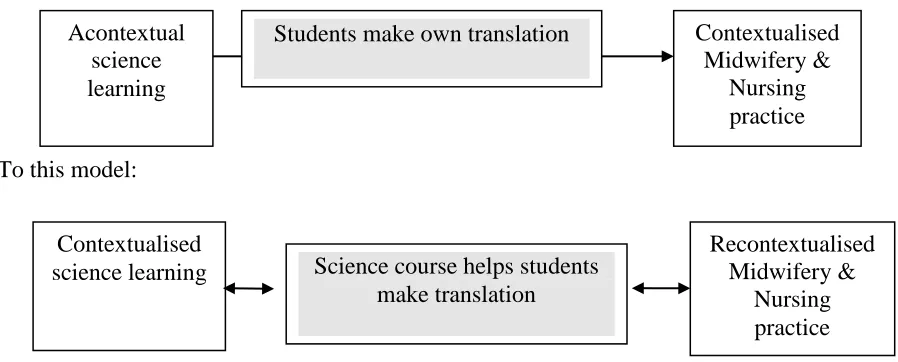
Rethinking assessment Final Report (November) Page 7 of 70 sought to find ways to support students to make links between theory and practice. We anticipated that this would require a change from traditional teaching, which tends to leave students to create links for themselves. Staff increased the level of student interaction through online activities, in class/laboratory discussion and activities. The overall thrust of the research is summarised in the following diagram:
A shift from traditional teaching:
To this model:
Figure 1. The type of change to traditional teaching sought by the research
Overall, students’ feedback regarding teaching methods and resources was positive. There was evidence of increased student motivation and engagement compared to previous years, but there was no clear evidence of improvement in the summative test results. This became a driver for a further research project into nursing science assessment practices. Another driver for this project was the recent inclusion of Nursing Council of New Zealand (NCNZ) competencies into the science modules of the Bachelor of Nursing Curriculum (Wintec, 2009).
In a 2009 Wintec research project, an attempt was made to integrate the competencies and learning outcomes in a science module with the development of one science-informed competency. Students were recognised to be at a pre-entry level of competence and a distinction was made between this level and an occupational level of competence (Hager, 2004; Mitchell et al., 2009). They were required to demonstrate competency growth towards the entry level of a registered nurse (NCNZ, 2007;
Acontextual science learning
Contextualised Midwifery &
Nursing practice Students make own translation
Contextualised science learning
Recontextualised Midwifery &
Nursing practice Science course helps students
Rethinking assessment Final Report (November) Page 8 of 70 Ministry of Education, 2005). Therefore, assessments for first year nursing science needed to focus on the building blocks of complex performance and capabilities to meet the immediate goals of the science module as well as link forward to future learning in different contexts. The approach was similar to that reported by Major (2005) who noted that “to make learning manageable, it must be broken down into small pieces … [therefore] encouraging holism through building on those manageable small pieces” (ibid, p. 452).
Constructing ways to gather evidence of developing competence through innovative modes of assessment became the next logical step, as we did not believe that the traditional methods achieved this. The previously used Objective Structured Clinical Examination (OSCE) was reviewed and an assessment tool was designed for implementation at the end of November, 2010. Elements of the newly developed assessment tool, which accounted for 30% weighting for the science module, were formatively tested within laboratory sessions prior to the final implementation.
Developing the new practical assessment tool questions relied on an iterative process over a six month period prior to the final practical test. This was achieved through a series of collaborative workshops where the proposed questions were brainstormed. The newly developed questions were then piloted in four laboratory sessions, and the findings from each of the pilots were reviewed by the team. For example, ‘blood’ was one of the pilot laboratory sessions. The first post-lab question for this laboratory was: “One of the key points of the lab was to demonstrate antigen-antibody reactions in blood. Explain why this would be important for a nurse to understand”. Student responses to the post-lab question included:
• So that if we needed to give a blood transfusion we would give the correct blood
• If the wrong type of antigen-antibody was to be given to the patient, the blood would start clotting and kill the patient
• It is important when doing a blood transfusion
• So that the nurse would know the patient’s correct blood type.
Rethinking assessment Final Report (November) Page 9 of 70 contributed to the development of the final practical assessment tool. Not only did the pilot laboratory sessions provide a rigorous process for development of the 2010 assessment tool but it also ensured that students were consistently supported to make links between their science learning and nursing practice, preparing students for the final practical test.
Initially, the 2010 assessment tool was planned to have only three stations with a varied scenario, but the manageability of this structure was called into question due to practical issues of the large number of students and time constraints. It was agreed that 14 OSCE-type stations with fewer questions at each station would be able to serve the purpose for the assessment tool.
The purpose of the tool was to make appropriate judgments about whether students could make links between their science learning and prescribed contexts, required for future professional practice. Finding such links would provide some evidence that students were developing science-informed competence. Although an initial small step, this project provided an example of what we believed to be pedagogically sound assessment, which supports learning in an area which is perceived as ‘difficult’ by students, with associated poor pass rates.
Recent developments in assessment of tertiary education
Rethinking assessment Final Report (November) Page 10 of 70 Competence-based assessment opens up possibilities for new types of assessment tasks, particularly as notions of competence have changed in recent years to embrace more holistic and complex ideas (Mclellan, 2007; Stewart, Fester, Dannenfeldt, Stewart, & McHaffie, 2010). One implication for assessment practices is the need to assess a wider range of aspects of learning, “not only … observable behaviours which can be measured, but also unobservable attributes, values, judgemental ability and dispositions” (Worth-Butler et al., 1994, cited in Yorke, 2008, p. 15). As previously noted, a competence approach calls into question some aspects of the validity of traditional methods of assessment which provide evidence of knowledge and skills, but do not address the wider dimensions of competence.
Alongside the tertiary education shift to internal and standards-based assessment is the growing emphasis on teaching excellence, which has drawn attention to the importance of formative assessment, or assessment for learning. There is an expectation that assessment tasks are more informative of students’ actual learning in relation to clearly stated goals, and questions should be designed to include the possibility of gaining insights into potential next learning steps. That is, assessment needs to fulfil two responsibilities; firstly to be a reliable, valid measure of student performance and secondly, to provide meaningful guidance for future learning (Davidson et al., 2009). Fulfilling both responsibilities, in the context of this project, meant focusing on meeting the immediate goals of the science module as well as linking forward to future learning in different contexts (Stewart et al., 2010, p. 58).
Rethinking assessment Final Report (November) Page 11 of 70 practices with insufficient information about the effects of the assessment on students. He suggests there is a need to check consequential validity of assessments (Boud, 2007). The focus on pedagogy includes awareness that different types of tasks give different learners opportunities to demonstrate what they know and can do. Barriers to achieving best practice assessment in this regard could be linked to the noted reluctance on the part of some tertiary education institutions (TEIs) to develop innovative pedagogically sound assessments (Hattie 2009; Davidson et al., 2009). External pressures may cause assessment to have a primarily summative function, with the reliability of assessment as the main concern (Mclellan, 2007). The implications of increasing pedagogical awareness mean some of the traditional assumptions about assessment may no longer hold:
Rethinking assessment Final Report (November) Page 12 of 70
3.
Aim
The project aimed to improve the validity and reliability of assessment outcomes for nursing students in their first year science programme, through the systematic evaluation of an innovative assessment tool (final science practical test), and its consequences.
The research questions were
1. Does the new assessment tool provide evidence that students are making links between science learning and nursing practice?
2. Does the new assessment tool provide evidence of students’ developing science informed competence?
Rethinking assessment Final Report (November) Page 13 of 70
4.
Methodology
Process or formative evaluation is a form of evaluation research that “is concerned with what actually happens in practice”, (Owen, 1993, p. 129). It is often distinguished from summative or outcome evaluation (Robson, 2002) and is characterised by the following five dimensions:
1. The orientation is towards improvement 2. The program is in a state of development 3. The focus is on delivery
4. The evaluation is timed during the program
5. Typical approaches include responsive evaluation and action research (ibid, p. 22).
The approach used in this research project can be likened to responsive evaluation in that it had a strong democratic orientation, and because planning took place at the site level with programme deliverers taking responsibility for all aspects of the evaluation process (ibid, p. 137). Findings from process evaluation research can be used for several purposes, one of which is “to assist those responsible for delivering a programme to improve their practice” (Owen, p. 25). One of the main uses of the findings from this project was to provide the basis for future action in terms of assessment practice in the first year science module.
Consent to complete the research was gained from the Wintec Human Ethics in Research Committee and all participants were required to sign consent forms. At the beginning of the second semester of 2010, 68 students (52% of the total number of students enrolled in the module) gave their consent for their assessment results to be analysed. They consented to complete the questionnaire, and 31 of these students also consented to participate in focus group interviews. The significant risk of poor participation in the research was lessened through several strategies:
Rethinking assessment Final Report (November) Page 14 of 70
• Consent to participate was provided in two separate opportunities, firstly for the self-completion questionnaire and secondly for the focus group interviews.
• The timing for data collection was streamlined in order to minimise the disruption for students. The questionnaire was designed to be completed in less than fifteen minutes and the focus group interview in less than one hour.
• The focus group interview findings were intended to deepen our understanding of the students’ responses from the questionnaire results. Having two different forms of data collection for the same research questions lessened the risk of low participation rates and afforded opportunities for some triangulation of findings. Construct validity
The assessment tool was evaluated in terms of its construct validity; that is, how valid the assessment tool was in providing evidence of students’ developing science informed competence and focusing their attention on linking science learning to nursing practice. Data to evaluate construct validity was collected in three ways:
1. The research team created a matrix to map the new assessment tool against the following dimensions of competence: knowledge, skills, attitudes, values and abilities. The matrix was based on an earlier Wintec research project which framed a year one science competency according to recent notions of competence (Stewart, J., Fester, V., Dannenfeldt, G., Stewart, K., & Mc Haffie, J., 2010) (see Appendix 7.1). A comparison was made between the 2009 assessment and the 2010 assessment tools, in particular the way the students’ attention was focused on making links between science learning and nursing practice, by mapping both tools against the competence matrix (see Outputs appendix 8.3).
Rethinking assessment Final Report (November) Page 15 of 70 responses in terms of the links students made between their science learning and nursing practice:
0 = no response
L 1 = likely to repeat content in answers, but no links with practice / knowledge
L 2 = makes links with practice or knowledge
L 3 = makes links with both practice and knowledge.
3. Student answers from one selected question were further analysed for evidence of students’ developing science-informed competence across all dimensions of competency.
Concurrent validity
The new assessment tool was evaluated in terms of its concurrent validity at the request of the project funders. In this context, concurrent validity refers to the correlation between students’ performance on a new instrument with their performance on a second instrument. In this regard, concurrent validity is similar to predictive validity in that both are seeking agreement between two measures (Cohen, Manion & Morrison, 2007). We measured the level of agreement between the newly developed assessment tool results in science module, Human Body for Nursing (HLSC514) and the results of the summative assessment relating to the clinical component from another compulsory module in the first semester of the nursing programme, Nursing through the Lifespan
(HLBN513).
Consequential validity
Rethinking assessment Final Report (November) Page 16 of 70 consistency of the focus construct (Gliem & Gliem, 2003). Results of this preliminary analysis were used to improve the reliability of the final questionnaire. Data from the Likert-scale responses to 15 items in the final version of the questionnaire were collated as percentages and the mean response for each item was calculated (see Appendix 7.2). For the three open questions, the student responses were collated and key themes relating to the research questions were extracted by two researchers independently, and then their decisions were compared.
Students who gave their consent remained for focus group interviews, after they had completed the questionnaire. The format of the focus group interview schedule was finalised using the findings from a pilot focus group interview (see Outputs appendix 8.6). Students were asked to brainstorm seven focus questions relating to the practical test. Their verbalized responses, as well as their discussion during the brainstorming activity, were captured using a digital audio recorder and researchers’ notes. The audio files were used to deepen the analysis and for supporting quotations. As with the questionnaire analysis, key themes were extracted from both the written and audio notes by three researchers independently and then compared for purposes of investigator triangulation (Silverman, 1993, cited in Cohen, Manion & Morrison, 2007).
Methodological summary
Rethinking assessment Final Report (November) Page 17 of 70
Does the new assessment tool provide evidence that students are making links between science learning and nursing practice?
Does the new assessment tool provide evidence of students’ developing science-informed competence?
How do students understand the new assessment tool?
What is their response to the new assessment tool?
Construct validity
Consequential validity
Science-informed competence matrix map comparison
Analysis of student results on a 4-point Likert-scale
Student self completion questionnaire
Student focus group interviews
Research Questions Validity Data Collection
Concurrent validity Correlation of student
Rethinking assessment Final Report (November) Page 18 of 70
5.
Findings and Discussion
The research aim was to enhance the validity and reliability of assessment outcomes for nursing students in their first year, through the systematic evaluation of a new assessment tool and its consequences. The number of students participating in the research was close to the 50% expected. A total of 131 students were eligible to complete the assessment in November 2010. At the end of the semester, 62 (47% of total) of the 68 students who originally gave their consent to participate in the research remained in the module. Their test results provide the basis of the findings on construct validity.
Construct validity
Does the new assessment tool provide evidence that students are making links between science learning and nursing practice?
Rethinking assessment Final Report (November) Page 19 of 70
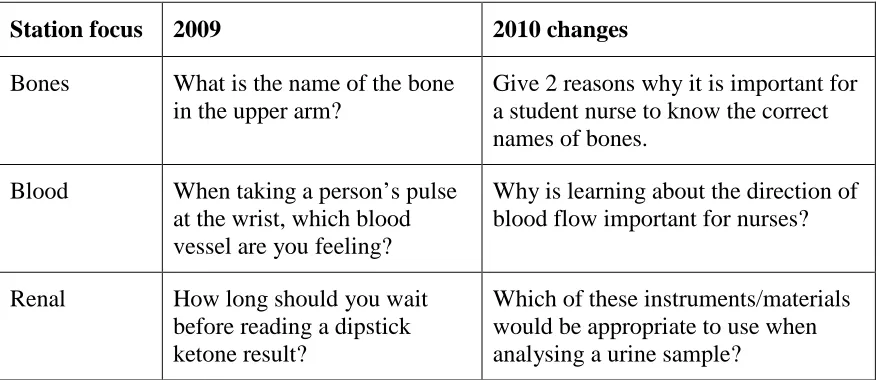
Station focus 2009 2010 changes
Bones What is the name of the bone in the upper arm?
Give 2 reasons why it is important for a student nurse to know the correct names of bones.
Blood When taking a person’s pulse at the wrist, which blood vessel are you feeling?
Why is learning about the direction of blood flow important for nurses?
Renal How long should you wait before reading a dipstick ketone result?
Which of these instruments/materials would be appropriate to use when analysing a urine sample?
The students’ (n = 62) answers to the questions in the new assessment tool were analysed to see how well the assessment tool focused their attention on making links between their science learning and nursing practice. Four questions which provided clear opportunities to form links were selected from the 2010 assessment tool and were then analysed using the 4-point Likert-scale.
Table 1: The nature of responses to one selected item at Station 14
Q14.4 Give 2 reasons why it is important for a student nurse to know the correct names of bones.
No response
No links to practice or knowledge Links with practice or knowledge Links with practice and knowledge
30% 5% 37% 27%
The responses to this question showed the greatest evidence of linking to both theory and practice (27% of students). Examples of student responses included:
• To apply treatment to the correct area
• To understand what is wrong when talking to other medical professionals
Rethinking assessment Final Report (November) Page 20 of 70
• So they can correctly tell which bones are affected when analyzing a patient or looking at x-rays.
Table 2: The nature of responses to one selected item at Station 6
Q6.4 Why is learning about the direction of blood flow important for nurses?
No response
No links to practice or knowledge Links with practice or knowledge Links with practice and knowledge
23% 37% 32% 8%
A total of forty percent of students answering this question made practice and/or knowledge links. Of the thirty-two percent who made links with practice or knowledge, nearly all (29%) made practice rather than knowledge (3%) links. Only 8% of the students linked to both science knowledge and nursing practice. A possible reason for the lower levels of linking of both knowledge and practice, compared with Q14.4 is that, at first year level, the concept of blood flow is more abstract than the experience of a broken bone.
Table 3: The nature of responses from the second selected item at Station 6
Q6.1 When taking blood from a vein at the elbow, do you put the blood pressure cuff/tourniquet above or below
No response
the elbow? Explain why.
No links to practice or knowledge Links with practice or knowledge Links with practice and knowledge
6% 6% 84% 3%
Rethinking assessment Final Report (November) Page 21 of 70 Table 4: The nature of responses to one selected item at Station 12
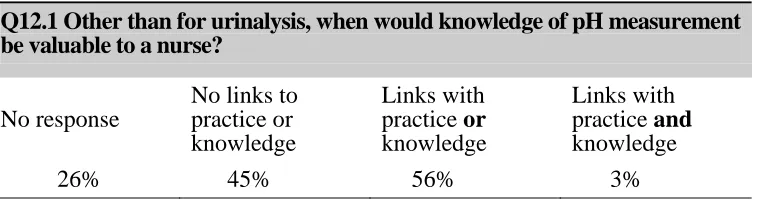
Q12.1 Other than for urinalysis, when would knowledge of pH measurement be valuable to a nurse?
No response
No links to practice or knowledge
Links with practice or knowledge
Links with practice and knowledge
26% 45% 56% 3%
In this case 56% of students made links to either practice or knowledge, with most of these (50%) being links to knowledge.
Examination of student responses revealed that most students successfully made links to science learning or nursing practice, rather than to both. Another finding was that students were able to make more links to knowledge and practice when they were responding to more concrete concepts, such as a broken bone. Students were less likely to make links to both knowledge and practice when the concept was more abstract, such as the direction of blood flow. Despite efforts to word questions to elicit a practice link, many answers were linked to science knowledge only. We concluded that students required more explicit help to make the translation between science learning and practice contexts. Analysis of the student responses to the assessment tool clearly showed the extent to which students were able to make links between science learning and nursing practice, however the wider dimensions of students’ developing science-informed competence were not demonstrated clearly. Some light was shed on this dimension by further analysis of students’ responses to another of the questions in the assessment tool.
Does the new assessment tool provide evidence of students’ developing science-informed competence?
Rethinking assessment Final Report (November) Page 22 of 70 the student would approach a client was expressed in the responses such as: “Is it ok for me to take your blood?”, “Do you mind if I just lift your sleeve up?” or “If they mind us doing it (religion)”. The attitude component of competence was also evident where students expressed the need to be careful and accurate. Responses included, “Do you have a known blood disease?” and “Do you have a history of clotting?”. Some responses noted by the students demonstrated both values and attitudes components of competence in what they asked, for example, “Have you had a blood test before?” and “Are you feeling ill?” or “Any medical conditions or fear of needles?” and “Do you have a known disease or clotting problem?”. The researchers concluded that student responses to Question 8.3 of the assessment tool provided evidence of development of the wider aspects of science-informed competence.
The second check on whether the assessment tool provided evidence of the wider aspects of competence was made by comparing the assessment tool utilised prior to the integration of nursing competencies into the science module, with the new assessment tool. The questions from the assessment tools of 2009 and 2010 were analysed for their inclusion of the components of competence (knowledge, skill, attitude, value and practical ability) and a matrix was drawn up (see Outputs appendix 8.3). In 2009, the assessment tool consisted of 19 stations with multiple questions per station. The questions were focused on knowledge and skill assessment; while the assessment of attitudes and values was implicit only. This can be illustrated by using the following examples from the 2009 assessment:
• Station 5: Blood vessels, Question 3. ‘Which blood vessel supplies the head with oxygenated blood?’ This assesses knowledge, and thus there is only one correct answer.
• Station 9: Renal system, Question 2. ‘How long should you wait before reading a dipstick ketone result?’ This assesses knowledge and skill, and implies an attitudinal aspect requiring multiple responses.
Rethinking assessment Final Report (November) Page 23 of 70 of competence was much more explicit. For example: ‘Station 4: Renal system (urinalysis), Question 1. Which of these instruments/material would be appropriate to use when analysing a urine sample?’ Here all aspects of competence were elicited from students who were required to select relevant items for use in urine testing. The students could select from numerous appropriate and inappropriate choices which included gloves, hand cream, safety glasses, spectrometer, stethoscope etc. This demonstrated their knowledge of the urine testing process (practical skill). Aspects of the attitude component of competence were assessed when students selected items that provided evidence they knew the equipment needed for clean, safe and careful practice. Although it was more difficult to assess the values component of competence, students did have to show their responsiveness to the task and commit to a choice. This required them to keep in mind what would be at stake when making an error with a urine test in the practical situation. The assessment was carried out in a laboratory situation, but the context was related to nursing practice, thus enabling the students to demonstrate their ability in preparing for a urine test in practice.
Two questions are compared in the table below, illustrating the difference in the construction of the assessment tools (2009 and 2010). For more detail of the questionnaire analysis see Outputs appendix 8.3.
Knowledge Skill Attitude Value Ability
2009
Station 9 – Renal system 2. How long should you wait before reading a dipstick ketone result?
2010
Station 4 – Renal system 1. Which of these
instruments/material would be appropriate to use when analysing a urine sample?
Rethinking assessment Final Report (November) Page 24 of 70 Our intention when developing the new assessment tool was to include all components of competence in the assessment. We believe the new tool met the requirements of a science-informed competence assessment. There was a clear move away from the knowledge-telling model (as seen in the 2009 tool) towards a knowledge-transforming assessment tool, which allowed students to interpret stimuli and develop their answers (Mclellan, 2007).
Concurrent validity
The investigation of concurrent validity was based on the assessment results of the 47 students (36% of total) enrolled concurrently on two modules, who completed both the assessment tool and the clinical component of a nursing module in the first year nursing programme. The concurrent validity was determined by investigating the level of agreement between the students’ results from the assessment tool in the science module (HLSC514) and the results from a concurrent summative assessment in a nursing module (HLBN513). The nursing assignment was a case report including a practical aspect of observation and recording. The Pearson’s product coefficient was 0.38, indicating a poor correlation between the two sets of results. Seventeen students (37%) failed the science assessment and 7 students (15%) failed the nursing case report. Four of the students who failed the nursing case report passed the science assessment. These findings are confirmed by the results summary for the science (HLSC514) and nursing (HLBN513) assessments, as illustrated in the following table:
N = 47 Science assessment Nursing assessment
Passed 30 students (64%) 40 students (85%) Failed 17 students (36%) 7 students (15%)
Average mark 55.8% 71.13%
Range – Top score Bottom score
85.3% 31.4%
Rethinking assessment Final Report (November) Page 25 of 70 The analysis indicates that the two assessments were looking at different aspects of competence and that success in one module was not a predictor of success in the other. On reflection, this is probably not surprising. In the practical component of the nursing module the links to practice that the assessment task offered were implicit. The students’ responses to the practical component were not assessed on whether they directly related to nursing practice or nursing competencies. Comparing the two modules to determine validity of the assessment rests on the assumption that personal attributes of individual students will support the ability to demonstrate comparable competence in both assessments. It also assumes that these attributes will “equip a person with transferable skills which can be applied to different situations” (Fordham, 2005, p. 42). The objective of the research was not to determine how students transfer generalisable skills to different situations, but how students can be encouraged to develop science-informed competence and demonstrate this in science-related assessments.
Consequential validity
Students’ perceptions of the assessment tool were gathered through a questionnaire and focus group interviews. Fifty students (38% of total) answered the questionnaire and 15 students (11% of total) participated in the focus group interviews. The number who completed the questionnaire was slightly fewer than the expected 50% participation rate; however the number of students who participated in the focus group exceeded the expected 10% participation rate.
How do students understand the new assessment tool?
Rethinking assessment Final Report (November) Page 26 of 70
Item agree/strongly
agree %
The practical test helped me identify gaps in my learning (what I still
need to know) 74%
I can explain why physiology is relevant in a nursing assessment of a
patient 58%
The practical test motivates me to achieve my goal of becoming a nurse 50% The practical test showed me that science is relevant to the other nursing
modules 48%
The practical test allowed me to apply scientific terms/concepts to
nursing competencies 48%
I can now describe why knowledge of physiology is important for
nursing practice 44%
Rethinking assessment Final Report (November) Page 27 of 70 Findings from the focus group interview (n = 15) suggested that most students understood that the assessment tool had been designed to link to a ‘nursing perspective’. In particular, the case studies included in the assessment were recognised as linking to nursing practice. These links were particularly recognised when students had prior knowledge and experience.
Students also recognised the assessment as providing them with feedback on their progress towards becoming registered nurses:
They designed the questions to put us in the nursing frame of mind, going through the process of not knowing to knowing – and that’s what they are trying to teach us (focus group participant).
The students’ certainty about links to nursing practice did not extend to knowledge of the nursing competencies, with some students voicing confusion over the nursing competencies and what they were. On the other hand, one student interpreted the practical test as all being linked:
Do you not think being a competent nurse you need to link to our bodies anyway? Competencies, skills – they were all in the test. I think it all links somehow. It has to, otherwise why would they be giving it to us? (focus group participant).
Questionnaire and focus group interview findings both confirmed that on the whole students understood the intent of the assessment tool.
What is their response to the new assessment tool?
Rethinking assessment Final Report (November) Page 28 of 70 Those items attracting the most disagreement were associated with the students’ personal performance in the test: their use of effective communication skills, values attitudes and abilities and their personal enjoyment:
Item disagree/
strongly disagree %
I enjoyed the practical test 84%
I used effective communication skills during the practical test 77% I used my values, attitudes and abilities during the practical test 31% The practical test assessed what we learned in the module 30%
The responses could be associated with the timing of the questionnaire, directly after the practical test and prior to another assessment in the afternoon. Assessing their own performance at this point in time could be described as being more reactionist rather than reflective, tending towards the negative.
The majority of students experienced time constraints during the assessment. There was one consistent response to the third open-ended item: ‘In the practical test, what opportunities were missed for you to show the links between science and nursing?’ Of the 39 replies to this question, 31 related to the time constraints experienced by the students. The only other minor theme that emerged was about the perceived lack of preparation given by the tutors.
We concluded that the students’ response to the assessment was affected by several variables. The first was the timeframe, whichwas perceived as being too short:
Rethinking assessment Final Report (November) Page 29 of 70 He concludes that time is the variable that most affects mode of cognition. “In busy practice situations there may be little time for explicit analytic thinking” (ibid, p. 12), instead an instant/reflexive mode of cognition is utilised (ibid). The time pressure in the assessment setting was likely to have limited the students’ responses and not allowed deep thinking, as compared with the possible results when provided with a more relaxed environment. Consequently, another pressing change needed to the assessment tool is extending the timeframe available per station, or alternatively, reducing the number of stations in the time available.
Another variable impacting on students’ response to the assessment tool was the wording in the assessment tool and confusion over the format for their responses. This finding is consistent with an earlier project (Gibson-vanMarrewijk, Hipkins, Stewart, Dannenfeldt, Stewart, McHaffie, 2008) when students reported that “knowing what written language to use to describe something in assessment was difficult” (p. 34), implying a learning challenge which may mask the students’ understanding. In the earlier project, we concluded that “such responses suggest that the apparent lack of links in written work were more about the mode of assessment than a lack of actual connections” (p. 35). Literacy skill levels have been found to influence trainees’ abilities to take what they learned in the classroom and apply it to the job (Taylor, Ayala, & Pinsent-Johnson, 2009), and writing tasks can be problematic in terms of providing evidence of the extent of learning, particularly for a person with limited competence in the English language (Mclellan, 2007).
The third variable was the perceived differences between the laboratory classes, lectures and the assessment. “In the lab we did have to do it, but it was not step by step”. Another student noted that the laboratory sessions focused on structure and function, whereas the assessment included further questions:
Rethinking assessment Final Report (November) Page 30 of 70 Some students were concerned that they had had no previous experience in the laboratory sessions with some of the equipment used in the practical test, while another student noted a disjuncture between science and the rest of their programme of study relating to different learning expectations. Having noted that some students (30%, n = 15) were concerned about their lack of previous experience, it should also be noted that 34% of students (n = 17) agreed or strongly agreed that the practical test assessed what they learned in the module.
The negative responses to the assessment were not surprising given the timing of data collection and with reference to earlier research findings. Brosnan et. al. (2006) found their participants reported high levels of stress associated with OSCE assessment, particularly associated with waiting in the corridor beforehand. In addition, over half their participants agreed that OSCE assessments were more stressful than forms of written assessment (p. 121).
Mclellan (2007) outlines three ways of understanding the effects, or consequences, of assessment on learning:
1. The cognitive complexity of tasks can have a positive effect, leading students to employ deeper learning strategies.
2. The feedback received, with and after completing the assessment task, can be formative.
3. The transparency of, and students’ involvement in, the assessment process can enable students to strive for domain understanding, rather than experience assessment as something that is done to them (Struyen et al., 2003, cited in Mclellan, 2007, p. 444).
Rethinking assessment Final Report (November) Page 31 of 70 responses to the assessment tool appeared in line with “experiencing assessment as something done to them” (Struyen, 2003, cited in Mclellan, 2007, p. 444). In some cases it may have limited their motivation to strive for domain understanding, given their apparent lack of recognition of how important the range of knowledge and skills will be for their future role as a nurse:
In all our other classes we talk about not being doctors, we’re nurses and then it comes to science and they expect us to be like a surgeon or something … We are expected to do all this stuff (focus group participant).
On the other hand, students appeared to be motivated by the perceived challenges ahead, based on the formative feedback received as a consequence of completing the assessment tool:
If anything the practical test highlights how well we have to know stuff, it highlights how much we need to know. It shows the areas that we might not understand and what we need to learn more (focus group participant).
The compelling contrasts, revealed by the above quotes represent the divergent findings of the research. These were illustrative of individual student characteristics, but also indicative of wider tensions and challenges in assessment. The dual responsibility of the assessment to gauge how well the immediate goals of the science module had been met, as well as to link forward to future learning in different contexts, was the first notable challenge. The shift towards assessment for learning revealed new issues with reliability and manageability (Stewart, Musgrave & Matheson, 2009). Another challenge was presented by the increasing cognitive complexity of tasks associated with embracing more holistic and complex notions of competence. Cognitive complexity led to further literacy demands on students, which was particularly problematic for those students with limited competence in English language.
Rethinking assessment Final Report (November) Page 32 of 70 instrument variables, we concluded that further review of the wording and format of the assessment tool was necessary.
Limitations of the research
A limitation became evident in the evaluation of the concurrent validity of the assessment tool. We chose to measure the concurrent validity of the assessment tool by comparing students’ results from two very different assessment tasks, a practical science test and a nursing case report. Comparisons of the two results provided limited information about the assessment tool’s edumetric quality of providing the best possible opportunity for students to make links between their science learning and nursing practice (Mclellan, 2007). That was not the explicit intention of the nursing assessment (case report), whereas it was the explicit intention of the science assessment. The timing of data collection highlighted the limitation of using a tool for the dual purpose of assessment and research. The data collection methods had to fit within the constraints of the module timetable and the large number of students enrolled. The assessment tool was implemented at the beginning of examination week for the first year nursing students and the data collection was timed directly following the assessment. Students’ responses were immediate, capturing the initial reactions to the first assessment of the week. These responses may be qualitatively different from responses collected after a reasonable time lapse. The timing of data collection was dictated by the end of the academic year. Expecting students to return to Wintec in order to participate in a research project would be unrealistic. The researchers believed the participation rate would have been considerably less if there was a delay in data collection. The timing of the data collection from students fulfilled the research methodology requirements but was not ideal for the students’ experience of the module. This is captured in the beginning comment from one focus group participant, “Can we streamline it [focus group interview] because I think we are all a bit edgy about how long we need to spend here”.
Rethinking assessment Final Report (November) Page 34 of 70
6.
Conclusion
The project aimed to improve the validity of assessment outcomes for nursing students in their first year science module through the systematic evaluation of a new assessment tool. Although the focus was mainly on the edumetric quality of the assessment, the traditional psychometric qualities of being fair and fit-for-purpose were also in mind (Mclellan, 2007). The following is a summary of the conclusions reached to the four research questions.
1. Does the new assessment tool provide evidence that students are making links between science learning and nursing practice?
On examination of student responses it was revealed that most students successfully made links to science learning or nursing practice, rather than to both. Another finding was that students were able to make more links to knowledge and practice when they were responding to more concrete concepts. The assessment was carried out in a laboratory situation, but the context was related to nursing practice, thus enabling the students to demonstrate their ability to meet the immediate goals of the science module as well as link forward to future learning in different contexts. Thinking about the instrument variables, we concluded that further review of the wording and format of the assessment tool was necessary, to ensure that evidence of links to practice was specifically requested.
2. Does the new assessment tool provide evidence of students’ developing science informed competence?
Examination of the students’ responses to the question provided evidence that the new assessment tool enabled assessment of all aspects of competence, including the contribution of student attitudes, values and abilities to knowledge and skills. These were the building blocks for further development of science informed competence by the student nurses.
Rethinking assessment Final Report (November) Page 35 of 70 Findings from the focus group interview and questionnaire suggested that most students understood that the assessment tool had been designed to link to a ‘nursing perspective’ and put them ‘in a nursing frame of mind’. Overall the findings showed students did understand that the items in the assessment tool referred to linking their science learning to future learning, nursing practice and their goal of becoming a nurse. 4. What is their response to the new assessment tool?
Analysis of the questionnaire findings showed that students’ responses to the assessment tool were overwhelmingly negative and uncertain, with the majority of students experiencing time constraints during the assessment. These responses need to be read in the light of the timing of data collection immediately after the assessment, which were reactionist rather than reflective.
The quest for a pedagogically sound assessment tool, which supports learning, is still in its infancy. As noted by Mclellan (2007) assessment, learning and teaching remains complex and contestable. Although the challenges and tensions in assessing competence in nursing education remain, new understandings were gained from the comprehensive information about the effects of the assessment on learning. Future changes to the assessment tool are more likely to be based on students’ pedagogical preferences (Boud, 2007), leading to a better balance between assessment of learning and assessment for learning. The research project was successful in providing an initial step towards improving the validity and reliability of assessment outcomes for nursing students in their first year science programme. Further steps towards this aim can be achieved through the following recommendations.
Recommendations for future practice and further research
1.
Changing the timeframes associated with the assessment• decrease the wait time for students prior to the assessment
• increase the time allocated per Station
Rethinking assessment Final Report (November) Page 36 of 70
• explicitly request responses which enable students to link their science learning to nursing practice
• Change the format of the answer sheet to allow enough space for more complex responses.
3.
Further research with the research participants in order to collect data from returning students may provide worthwhile findings on the consequential validity of the assessment tool.Rethinking assessment Final Report (November) Page 37 of 70
7. Appendices
7.1
Year one science competency
7.2
Questionnaire results
Rethinking assessment Final Report (November) Page 38 of 70
7.1
Year One Science Competency
Knowledge Skills Attitude Values Abilities
Know what it
measures in a managed Use a BP cuff
context
Do it carefully.
Record accurately
Honest Responsive
Respect Confidentiality
Putting it all together in
managed context
Cardio – vas system
Know what contexts you
might need this for Rehearse making an explanation of the
result
Know why it matters to be careful – what’s at stake
Professional Transfer
Year One Science Competency Updated – safely and accurately measure BP in a managed context and
Rethinking assessment Final Report (November) Page 46 of 70
7.3
HLSC514 Human Body for Nursing
Module Learning Outcomes Analysis against NCNZ Competencies for the Registered Nurse Scope of Practice
This table identifies where the Domain 1 Professional Responsibility learning outcomes specified in the graduate profile are demonstrated and assessed in the: Level 5 Modules
Domain 1 Professional Responsibility Competencies: 1. U se s ci en tif ic ter m s 2. E x p la in s tru ct u re + fu n cti o n o f cel ls 3. E x p la in s tru ct u re + fu n cti o n of or gan s 4. K n ow le d ge of b as ic b io ch em 5. D em o n st ra te s k ill s in t ec hni ca l e qui pm ent
2009 2010 2009 2010 2009 2010 2009 2010 2009 2010 1. Accepts responsibility for practice and conduct
Indicator: Legislation/codes/policies
Indicator: Responsibility for actions and scope of practice Indicator: Of Law
Indicator: Policies and procedural guidelines Indicator: Professional standards
2. Apply principles of Treaty of Waitangi to practice
3. Direction/delegation, monitoring and evaluating care provided by others.
4. Promotes safe environment
Indicator: Identifies and reports √ √ √ √ √ √ √ √ √ √
Indicator: Emergency equipment √ √ √ √ √ √ √ √ √ √
Indicator: Infection control √ √ √ √ √ √ √ √ √ √
Indicator: Management risks √ √ √ √ √ √ √ √ √ √
Rethinking assessment Final Report (November) Page 47 of 70
This table identifies where the Domain 2 Management of Nursing Care learning outcomes specified in the graduate profile are demonstrated and assessed in the Level 5 Modules
Domain 2 Management of Nursing Care Competencies: 1. U se s ci en tif ic ter m s 2. E x p la in s tru ct u re + fu n ct io n o f cel ls 3. E x p la in s tru ct u re + fu n ct ion of or gan s 4. K n ow le d ge of b as ic b io ch em 5. D em o n st ra te s k ill s in t ec hni ca l e qui pm ent
2009 2010 2009 2010 2009 2010 2009 2010 2009 2010 1. Plan nursing care
Indicator: Care planning √ √ √ √ √ √ √ √ √ √
Indicator: Environments support recovery
Indicator: Evidence in planned √ √ √ √ √ √ √ √ √ √
Indicator: Procedures and skills √ √ √ √ √ √ √ √ √ √
Indicator: Medications
2. Nursing assessment
Indicator: Assessment organised √ √ √ √ √ √ √ √ √ √
Indicator: Assessment tools √ √ √ √ √ √ √ √ √ √
Indicator: Research √ √ √ √ √ √ √ √ √ √
3. Documentation
Indicator: Accurate and current client records √ √ √ √ √ √ √ √ √ √
Indicator: Literacy and computer skills √ √ √ √ √ √ √ √ √ √
4. Client Involvement
Indicator: Provides appropriate information to clients
Indicator: Health education √ √ √ √ √ √ √ √ √ √
Indicator: Appropriate professional judgment √ √ √ √ √ √ √ √ √ √
Rethinking assessment Final Report (November) Page 48 of 70
Indicator: Facilitates the client’s access
Indicator: Seeks clarification √ √ √ √ √ √ √ √ √ √
Indicator: Takes the client’s preferences into consideration
5. Protection of self and others 6. Partnership
Indicator: Identifies criteria for evaluation Indicator: Evaluates the effectiveness Indicator: Reflects on client feedback
7. Health Education
Indicator: Checks client’s level of understanding
Indicator: Uses informal and formal methods of teaching Indicator: Health education
Rethinking assessment Final Report (November) Page 49 of 70
This table identifies where the Domain 3 Interpersonal relationships learning outcomes specified in the graduate profile are demonstrated and assessed in the Level 5 Modules
Domain 3 Interpersonal relationships
Competencies: 1. U se s ci en tif ic t er m s 2. E x p la in st ru ct u re + f u n ct io n o f c el ls 3. E x pl a in s tr uc tur e + f un ct io n o f or gan s 4. K n o w led g e o f b a si c b io ch em 5. D em o n st ra te sk ill s i n tech n ic a l equi p m ent
2009 2010 2009 2010 2009 2010 2009 2010 2009 2010
1. Establishes, maintains and concludes therapeutic interpersonal relationships with client
2. Practises nursing in a negotiated partnership with the client where and when possible
Indicator: Undertakes nursing care Indicator: Implements nursing care Indicator: Personal resourcefulness Indicator: Family/whanau perspectives
Rethinking assessment Final Report (November) Page 50 of 70
This table identifies where the Domain 4 Interprofessional health care & quality improvement learning outcomes specified in the graduate profile are demonstrated and assessed in the Level 5 Modules
Domain 4 Interprofessional health care & quality improvement Competencies: 1. U se s ci en tif ic ter m s 2. E x p la in s tru ct u re + fu n cti o n o f cel ls 3. E x p la in s tru ct u re + fu n ct ion of or gan s 4. K n ow le d ge of b as ic b io ch em 5. D em o n st ra te s k ill s in t ec hni ca l e qui pm ent
2009 2010 2009 2010 2009 2010 2009 2010 2009 2010 1. Collaborates and participates with colleagues and members
of the health care team to facilitate and coordinate care
Indicator: Interprofessional activities
Indicator: Provides guidance and support Indicator: Collaborates with the client
Indicator: Documents information
Indicator: Discharge plan
Indicator: Formal referrals
2. Recognises and values the roles and skills of all members of the health care team in the delivery of care
Indicator: Co-ordination of care
Indicator: Collaborates accurate information Indicator: Comprehensive knowledge
Rethinking assessment Final Report (November) Page 51 of 70
8.
Outputs appendices
1. Revised practical assessment will be made available on request. Please e-mail [email protected]
2. Recommendations for future development of the practical assessment tool 8.2.1. Reduce the number of questions or increase the timeframe allowed for
completion
8.2.2. Decrease unfamiliarity by giving students ample opportunity to practise similar assessment processes
8.2.3. Improve assessment questions with regards to wording and format. For example match the space allowed for the student response to the mark allocated.
3. A matrix for evaluating the construct validity of the assessment tool 4. Improved lab sheets
Rethinking assessment Final Report (November) Page 52 of 70
8.3
A matrix for evaluating the construct validity of the assessment
tool
Evidence of competency assessment in the practical test HLSC514 – comparing 2009 and 2010 (The numbers refer to frequency of occurrence of the competency aspect in each station).
2009
Station number
Topic - station No. of questions
Knowledge Skill Attitude Value Ability
1 Microscope, cell, tissues
5 5 3 1 2
2 Cells + tissues 5 5 1
3 Cell transport + mitosis
6 5 3 1 1 2
4 Heart structure 6 6 2 1 1 2
5 Blood vessels 6 6 3 2 1 4
6 Blood groups 6 6 3 3 2 3
7 Respiratory system 5 5 2 2 2 1
8 Respiratory + renal system
5 5 1 1 1 2
9 Renal system 4 4 3 2 2 3
10 Anatomy of brain 5 5 2 3
11 Nervous system + reflexes
6 6 2 1
12 Sensory systems 6 6 1 1 1 2
13 Muscles + joints 6 6 2 1 1 2
14 Bones 6 6
15 Reproductive system
6 5 1 1
16 Reproductive system
6 4 2
17 Acid-base balance 6 6 1 2 2 4
18 Carbohydrates 4 4 3 2 2 2
Rethinking assessment Final Report (November) Page 53 of 70 2010
Station number
Topic -
station
No. Questions per
station
Knowledge Skill Attitude Value Ability
1 Microscope, cell, tissues
6 6 3 4 4 4
2 Cells + tissues 3 3 3 2 2 2
3 Renal system 6 6 6 5 5 5
4 Urinalysis 2 2 2 2 2 2
5 Heart structure 6 6 4 2 2 4
6 Blood vessels 4 4 4 3 3 4
7 Blood analysis 5 5 4 4 4 4
8 Blood groups 4 4 4 2 2 4
9 Respiratory system
5 5 3 2 2 4
10 Respiratory system
5 5 5 3 3 5
11 Biochemistry -carbohydrates
4 4 3 1 1 4
12 Biochemistry - acid-base balance
2 2 2 2 2 2
13 Reproductive system
3 3 3 3
Rethinking assessment Final Report (November) Page 54 of 70
8.4
Improved lab sheets
LABORATORY 3 - BLOOD ©WINTEC
2010 – HLSC514
LEARNING OUTCOMES
On completion of this practical session, you should be able to...
• accurately read a haematocrit/packed cell volume
• correctly classify a blood sample according to the ABO blood grouping system
• graph normative blood type data
• appreciate the reasons for performing blood grouping tests before transfusions Outline: This session has four parts:
1. Haematocrit /packed cell volume 2. ABO blood grouping
3. Graphing
4. Review questions 5. Case study
Important – Please read the following SPECIFIC PROCEDURES for this laboratory:
1 If you have recently had a blood borne communicable disease, please do not take blood from yourself.
2 Cover any cuts or scratches on your hands with a sticking plaster.
3 Perform your practical work only where the work benches have been covered with white paper.
4 Wear gloves in any situation where there is potential for you to encounter another person’s blood. Dispose of contaminated gloves in the Bio Hazard Bag, NOT the rubbish bin.
5 Sterilise your finger with an alcohol wipe before taking blood. Allow the finger to dry.
6 Use a new sterile lancet for each finger-stab blood sample.
7 Place used cotton wool swabs, gloves, blood-stained tissues and all other non-sharp materials that may have come into contact with blood (but not the large white sheets of paper) into the Bio Hazard Bag provided.
8 Place used lancets and used haematocrit tubes in the Sharps container.
9 Do not discard the injection apparatus used with the lancets – they are re-used. 10 Report any spills immediately. These should then be cleaned up, using paper
towels and Mucocit-A. The paper towels should then be placed in the Bio Hazard Bag.
Rethinking assessment Final Report (November) Page 55 of 70 Note: You will use an auto-lancet to make a finger prick. From this finger prick, you will draw off two blood samples:
• One sample will be drawn into a haematocrit tube for use in Part One.
• The other sample will be placed as two drops into a tube containing physiological saline for
use in Part Two.
PART ONE HAEMATOCRIT/PACKED CELL VOLUME
The haematocrit is defined as the percentage of blood occupied by red blood cells. In order to determine the haematocrit, capillary tubes are partly filled with blood and one end is sealed with plasticine. The tubes are then centrifuged, which separates out the red blood cells (red layer), white cells (buffer layer) and plasma (clear straw coloured layer). The haematocrit value can then be read using a 'Micro-haematocrit tube reader'.
The haematocrit tube needs to be at least two-thirds full of blood, to get a reading.
Ask for assistance when reading the haematocrit. If the tubes are not read immediately, place them in a vertical position so that the sharp boundaries between the layers are maintained.
Normal values:
Men 40-54% (average 46%) Women 38-47% (average 41%) Your own haematocrit value ... Enter your value on the board.
Range of values for the class a Female ... b Male ... Mean value for the class a Female ... b Male ...
In the space on the right, draw a scale diagram (1 cm = 10%) of your blood after centrifuging. Label the three layers, and write the percentage value of each layer.
Rethinking assessment Final Report (November) Page 56 of 70 PART TWO ABO BLOOD GROUPING
1 On a clearly labelled porcelain tile, mix a drop of your blood preparation with a drop of A serum and another drop of your blood preparation with a drop of Anti-B serum. Mix by gently rocking the tile from side to side and record the results after 5 minutes.
Note: Agglutination can be observed with the naked eye but could be confused with sedimentation of the red cells as they settle towards the bottom of the well in the tile. If unsure, check the presence of agglutination by stirring the solution in the well with a toothpick. If clumps of material remain then agglutination has occurred. Note: Refer to textbook for illustration of agglutination.
2 Shade in the circle(s) (below) to indicate where agglutination has occurred. From this, deduce your blood group.
Your blood
1 drop Anti-A
Anti-A 1 drop your
blood
Anti-B 1 drop Anti-B
1 drop your blood My blood group is ...
Rethinking assessment Final Report (November) Page 57 of 70 3 By reference to blood sample results in class, summarise in the table below the
reaction of each blood group with the Anti-A and Anti-B antibody solutions.
Anti-A Anti-B
Type A
Type B
Type AB
Type O
Key:
Agglutination
No agglutination
Results
Enter the class results in the following table.
A B AB O
Class results (number)
Class results (%)
New Zealand population (%)
Rethinking assessment Final Report (November) Page 58 of 70
PART THREE GRAPHING
Using the data obtained in lab, plot a column (bar) graph of the percentage results of the ABO blood grouping for your class. On the same graph, using the same scale, plot the percentage data for the New Zealand population. Remember to give your graph a title and to include a key, indicating which set of bars represents data for your class and which set represents New Zealand data.
Percentage of total
A B AB O