California State University, San Bernardino California State University, San Bernardino
CSUSB ScholarWorks
CSUSB ScholarWorks
Theses Digitization Project John M. Pfau Library
1994
Nonstandard analysis based calculus
Nonstandard analysis based calculus
Kathleen Renae Gibson
Follow this and additional works at: https://scholarworks.lib.csusb.edu/etd-project Part of the Mathematics Commons
Recommended Citation Recommended Citation
Gibson, Kathleen Renae, "Nonstandard analysis based calculus" (1994). Theses Digitization Project. 915. https://scholarworks.lib.csusb.edu/etd-project/915
NONSTANDARD ANALYSIS BASED CALCULUS
A Project
Presented to the Faculty of
California State University,
San Bernardino
In Partial Fulfillment
of the Requirements for the Degree
Master of Arts
in
Mathematics
by
NONSTANDARD ANALYSIS BASED CALCULUS
A Project
Presented to the
Faculty of
California State University,
San Bernardino
by
Kathleen Renae Gibson November 2, 1994
Approved by:
H-Dr. P. Vicknair, Chair, Mathematics Date
Dr. T. Hallett, Masters Coordinator Date
Dr. S. Addington, Advisor Date
Dr. D. Rinne, Committee Member Date
ABSTRACT
This project seeks to present the basic approach to
teaching the Calculus using concepts from Nonstandard
Analysis, as developed in the text, "Elementary Calculus, An
Infinitesimal Approach", by Jerome Keisler. In this first
part of the project the elementary development of an
extended number system called the Hyperreals is discussed.
The Hyperreals, which contain infinitesimal and infinite
numbers, are developed and it is shown how these numbers are
used to replace limits in Calculus computations. This
replacement of the limit concept is one of the foundations
of Keisler's approach. The introduction to the Hyperreals
in this section is limited and emphasis is placed on how
they are used in the instruction Of the Calculus. For the
teaching of entry-level Calculus, no real understanding of
the theory supporting the Hyperreals is needed.
The second half of this project develops the basics of
Nonstandard Analysis, including the theory of ultrafilters,
and the formal construction of the Hyperreals. Major
theorems, definitions and axioms are presented. Proofs,
generally using direct ultrafilter manipulations, are given
in detail. The Transfer Principle is discussed briefly and
TABLE OF CONTENTS
Chapter 1
Introduction ....^.,... ... 1
Chapter. ^2:■ ^ The Hyperreal Nuiriber System ... 4
Structure Of The Hyperreals ... 4
Chapter 3 Three Basic Principles ... ... 7
The Extension Principle .v... 7
The Transfer Principle ... 11
Hyperreal Arithmetic 14 Standard Parts .... ^ 17
4:. Nonstandard Calculus ... 22
Differentiation, Or "Ldbk Ma, No Limitsl" ..,... 23
Derivatives ... 26
Derivatives Of Sin And Cos ... 29
Differentials And Increment Theorem ... 33
TABLE OF CONTENTS (CONTINUED)
Filters And Ultrafliters > ... 37 Frechet Filter ... 42
The Ultrafilter Axiom ...> .45
Chapter 6
Constructing The Hyperreal Numbers
49
The Hyperreal Numbers ...^... 50
Operations And Field Structure
..
53
Embedding Map ...•••... 58
Natural Extensions Of Sets ... 65
Natural Extensions Of Functions 68
Chapter 7
Introduction To The Transfer Principle ....
... 72
The Formal Language... ... 72
Simple Sentences
74
Skolem Functions 75
The Transfer Principle ..•...
77
Standard Part 80
Chapter 8
1 2 3 4
5
6
7
8
LIST OF FIGURES
The Hyperreal Line
Figure The Infinitesimals 8
Figure The Finites and Infinites 9
Figure Indeterminate Forms of Various Values 16
Figure Slope of a Line 24
Figure
Derivatives of Sin(x) Under Microscope
30
Figure
Diagram for the Geometric Inequality...^....; 3i
CHAPTER 1: INTRODUCTION
When I discovered the Calculus text written by Jerome
Keisler, I thought it would be interesting to learn more
about using new methods in some basic Calculus problems. As
a student and tutor I had always found that some students
had a very difficult time comprehending and using the theory
of limits. In Keisler's text an extended number system
called the "Hyperreals" is used. The Hyperreals are the
Reals with the added quantities of infinitesimal and
infinite numbers. By using the Hyperreals, limit
computations become simple calculations within this extended
set of numbers, thereby reducing the complexity of learning
the Calculus for many students.
For my purposes, which were to get an underlying
understanding of the background behind the Calculus text,
there was no need to delve too deeply into the major theory
of Nonstandard Analysis. Therefore I studied only the first
chapter, "Infinitesimals and the Calculus", in the text "An
Introduction to Nonstandard Real Analysis" by A. E. Hurd
and P. A. Loeb. This gave a basic ba:ckground to the
development of the Hyperreals, their construction as an
extension of the Real numbers, and the formal language and
The Nonstandard Analysis approach is more of an
inhuitive cdmputational approach as compared to the theory
of liiniits, or the 8,5 (epsilon^ delta) methods,
taught in
colleges today. Unfortunately sometimes the more rigorous
8,5 theory is only touched on in a most cursory manner, if
at all. Most all teaching of the Calculus at the beginning
level is taught on an intuitive basis, however for some
students it isn't intuitive at all. So if instructors are
using an approach where they are not developing the theory,
then they might as well teach using concepts which are a
little easier to understand. The good thing is that this
nonstandard approach also makes the limit concept a little
more understandable since in the nonstandard approach
"limit" computations work virtually the same as computations
in the conventional or traditional methods. Note that the
theory of limits is still taught in the Keisler text, though
not until after derivatives are covered.
Another reason I was interested in the Nonstandard
Analysis approach is that I feel that it is closer to the
idea of "infinitely small numbers" [1] that Leibniz had in
mind. When Leibniz was developing the Calculus
(conGurrently with Newton), he used a conceptual convenience
which he referred to as "infinitely small numbers" [1] to
allow him to manipulate what we refer to as limits without
which was not developed until the 1,800's* Neither he nor
anyone else was abl© to provid© 3- solid theoretical basis
for these "infinitesimals" because at the time Leibniz was
discovering the Calculus there still was some question as to
the appropriate level of rigor which should be required of
mathematics. The form for proofs and notation to be used
were still in the process of being standardized. Although
mathematicians were in agreement that this was necessary to
comprehend each other's works, the work was not yet
complete. Specifically, they had not at that time developed
all the necessary mathematics for Leibniz to be able to
explain precisely enough these infinitesimals and their
appropriateness for the Calculus. In fact Leibniz' idea of
infinitesimals caused a stir with one of the outstanding
philosophers of the day. Bishop George Berkeley, who wrote;
"And what are these same evanescent increments?
They are neither finite quantities, nor quantities
infinitely small, nor yet nothing. May we not call
them the ghosts of departed quantities?" [2]
It was not until I960 that Abraham Robinson discovered
the means to provide a solid foundation for Nonstandard
Analysis, and through this the concept and structure of
CHAPTER 2; THE HYPERREAL NUMBER SYSTEM
One of the student's greatest difficulties is
conceptualizing what a "very small" number or "approaching a
value" means and whether or not that number is "small"
enough to disregard. So in the nonstahdard approach we help
them by defining a new set of numbers, an extension to the
Reals, called Hyperrealsv The Hyperreals is the set of the
Real numbers to which have beeh added infinitesimals(infinitely small numbers) and infinites (infinitely large
numbers). Infinitesimals will be denoted by Ax,Ay,&,d, the
infinites by and the set of the Hyperreals by .
STRUCTURE OF THE HYPERREALS
We begin building the Hyperreals, conceptually, by
adding these infinitesimals to the Reals, somewhat like
adding a decimal fraction to a whole number. This generates
a collection of Hyperreal numbers infinitely close to each
element in the Reals. This is reminiscent of the "fuzzy ball" idea that each Real number is surrounded by numbers
that are really close in value. In this model however only
one Real number is in each fuzzy ball. In the text Keisler
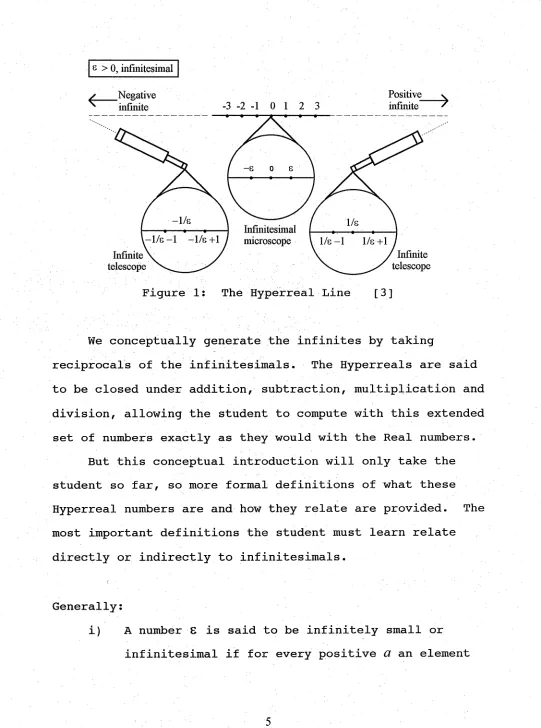
s > 0,infinitesimal
_Negative Positive^
■>
-3 -2 -1 0 1 2 3 infinite
infinite
1/8 1/s
Iimiiitesimai
l/e 1/s +1 microscope 1/8 1/8 +1
Infinite Infinite
telescope telescope
Figure 1: The Hyperreal Line [3]
We conceptually generate the infinites by taking
reciprocais of the infinitesimals. The Hyperreals are said
to be closed under addition, subtraction, multiplication and
division, allowing the student to compute with this extended
set of numbers exactly as they would with the Real numbers.
But this conceptual introduction will only take the
student so far, so more formal definitions of what these
Hyperreal numbers are and how they relate are provided. The
most important definitions the student must learn relate directly or indirectly to infinitesimals.
Generally;
of the Reals, -a < & <a. The only Real number
that is infinitesimal is zero.
ii) If a,h E.^ and a— is infinitesimal then
This is read a is infinitely close to b.
The Hyperreal numbers infinitely close to 0 are
infinitesimal, denoted by These are the only infinitesimals.
iii)
If C is infinitesimal and is positive then -C is
negative infinitesimal, ^ is infinite and
positive, and -—is
infinite and negative. A
8
Hyperreal number that is not infinite is called a
finite number.
Once we have identified what infinitesimals and
infinites are, we need to know that we can compute with
these new numbers in some reasonable way if the Hyperreals
are going to be useful to us in the study of the Calculus.
Three basic principles which establish the relationship
between the Reals and the Hyperreals form the basis of the
i 1 CHAPTER 3: THREE BASIC PRINCIPLES
The three basic principles on which Keisler relies for
his development of the Calculus are the Extension Principle,
the Transfer Principle and the Standard Parts Principle. In
Hurd and Loeb, we should note, these results are actually
presented as theorems. Presentation of these principles
essentially as axioms allows Keisler to use the PPwer they
provide without the burden of detailed technical development
or justification. Requiring such technical development
would defeat the purpose of using the nonstandard approach
to teach the Calculus and do little to enhance student
understanding.
THE EXTENSION PRINCIPLE
The Extension Principle tells us that the Real numbers
are a natural and proper subset of the Hyperreals/ and it
extends all Real functions to the Hyperreal numbers.
I: Extension Principle
a) the Real numbers form a subset of the Hyperreal
numbers, and the order relation X < y for the Real
numbers is a subset of the order relation for
*
.
b) there exists an 8 in such that S>0 but
S<a for all QE:
c) for every Real function of one or more
variables we are given a corresponding Hyperreal
function / of the same number of variables. J
is called the natural extension of f.
From this we formulate a more precise description of
infinitesimals.
Definition: A Hyperreal number b is said to be:
Positive Infinitesimal Lt b is positive but less than
every positive real number.
Negative Infinitesimal if b Ls negative but greater
than every negative Real number.
Infinitesimal if is either positive infinitesimal, negative infinitesimal, or 0.
Negative
Positive
Infinitesimal ✓— Infinitesimal
-3 -2 -I 0 I 2 3
Then we do the same for the infinite numbers.
Definition: A Hyperreal number b is said to be:
Finite if b Ls between two Real numbers.
Positive Infinite if b is greater than every Real
number.
Negative Infinite if b is less than every Real number.
Infinite if^ is either positive infinite or negative
infinite.
100 100 100
100 -1/s
—V —Y
Y
Negative Finite Positive
infinite infinite
Figure 3: The Finites and Infinites [3]
The definitions for finite, infinite and infinitesimal
numbers given above are stated in terms of comparisons to
Real numbers. Usually when we are working with Hyperreal
Theorem:
i) Every Hyperreal number which is between two
infinitesimals is infinitesimal.
ii) Every Hyperreal number which is between two finite Hyperreal numbers is finite.
iii) Every Hyperreal number which is greater than some
positive infinite number is positive infinite. iv) Every Hyperreal number which is less than some negative infinite number is negative infinite.
These results are easy to prove. For instance, consider ii).
Proof of ii):
Let with and a,C finite.
To show Z) finite, i.e. 3
Real such that r<b<S.
Since a,C finite, 3
Real such that Tj < a <
and
3 ^2,^2
such that r2<C<S2
Set r = min(ri,r2) and 5= max(51,52), then
r<ri<a<b<C<S2<S. Thus r<Z)<5 with r,5 Real.
THE TRANSFER PRINCIPLE
The Transfer Principle states essentially that
computations with, and properties of, the Hyperreal numbers
are identical to those of the Real numbers.
Principle II; Transfer Principle
Every Real statement that holds for one or more
particular Real function holds for the Hyperreal
natural extensions of these functions.
The transfer principle basically states that everything
we do with the Reals -- the rules, functions and operations
-- we also can do in the Hyperreals, and they behave the way
we expect them to.
Definition: Real Statement
A combination of equations or inequalities about Real
expressions and statements specifying whether a Real
expression is defined or undefined.
Specifically a Real statement involves real variables
Examples of Real Statements:
1) Associative laws for addition and multiplication
2) Distributive law
3) Properties of equality
4) The fact that division by zero is not defined 5) Additive inverses exist
6) Multiplicative inverses exist for non-zero elements
7) Properties of inequalities
8) Additive and multiplicative identities exist
9) Algebraic and trigonometric identities
Each of these statements transfers to an equivalent statement which holds for the Hyperrealsi
Generally, any statement which you can say is true for
all Real numbers is also true for all Hyperreal numbers, with an appropriate interpretation. For instance, the
statement that
— l=(a+l)(a —l) holds true for all Real
numbers a. Therefore it also holds true if a is any
Hyperreal number. No change in the interpretation of the
statement appeared to be necessary, but we did in fact have
to remember that 1 is both a Real and a Hyperreal number.
We treat 1 as a Real number when interpreting the Real
statements and as a Hyperreal number when interpreting the
For the stateiaent, "It then — exists as a Real
a- .; ■ ■■
number," we have to make a more explicit adjustment in our interpretation of the statement when we transfer it to the Hyperreals. The transferred statement should be, "It a
then ^ exists as a Hyperreal number." Though this seems
obvious and trivial, it shows that being too casual in our handling of the Transfer Principle can lead to an error.
A good example is the Archimedean Principle; "For every Real a there exists an integers such t-haX. a <n." If we
are not careful, an incorrect transfer of this statement
which we might generate could be: "For every Hyperreal a there exists an integer 71 such that a <71." Clearly this is not true because each positive infinite number is larger tha;n any integer, since all integers are Real numbers. The correct transfer would be: "For every Hyperreal a there exists a Hyperinteger 77 such that Cl<n." The specific
definition of Hyperinteger requires the precise construction of the Hyperreals from Hurd and Loeb and thus will be
deferred until this is presented later in this document. In Hurd and Loeb, the definition of the formal language which we must use to describe the Transfer Principle and the
statements to which it applies is rather complicated to
construct and understand, but it essentially says the same
and using the foirmal language, transferring statemehts and interpreting the results becomes a Straight-forward process.
The Transfer Principle basically states that everything
we do with the Reals, be it rules, functions, or operations, behave the way we expect them to in the Hyperreals.
HYPERREAL ARITHMETIC
The arithmetic operation rules for the Hyperreals are
the same as for the Reals with a few added details and
special cases.
Rules for Infinitesimal, Finite, and Infinite Numbers
Assume that 8,6 are infinitesimals; b,C are Hyperreal
numbers that are finite but not infinitesimal; and H,K are
infinite Hyperreal numbers.
i) Real numbers:
The only infinitesimal Real number is 0 Every real number is finite.
ii) Negatives:
-S is infinitesimal
iii) Reciprocals:
If 85^0, ^ is infinite
1- ■
is finite but not infinitesimal
^ is infinitesimal
iv) Sums:';:
8+6 is infinitesimal
6+8 is finite but not infinitesimal
6+c is finite (possibly infinitesimal)
H + £. and H + 6 are infinite
v) Products:
8*6 and 6 *8 are infinitesimal
6 *c is finite but not infinitesimal
H 'b and *11 are infinite
vi) Quotients:
8 8 b
T'>~rT and -fT are infinitesimal
b^H H
b
— is finite but not infinitesimal
c
bH H
— and are infinite, provided that 8 0
vii) Roots:
If S>0, is infinitesimal
There are four combinations which are not covered above
because they may result in a variety of different answers
depending on the relative "size" of the values being
combined. Since we can not say for sure what the actual
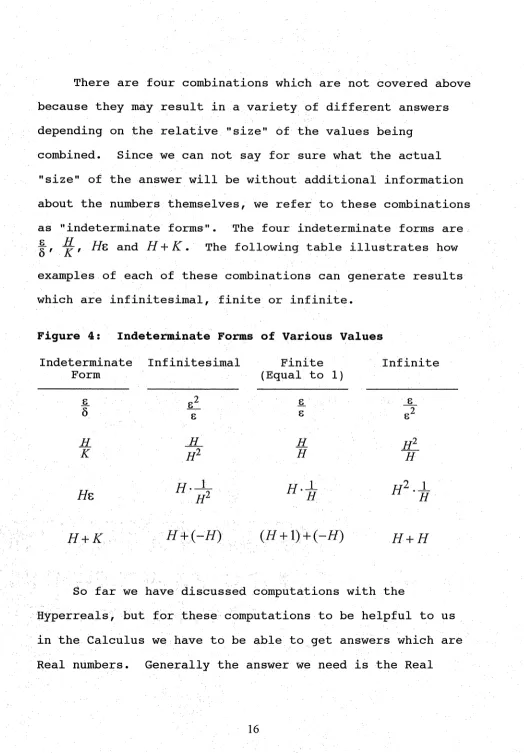
"size" of the answer will be without additional information about the numbers themselves, we refer to these combinations as "indeterminate forms". The four indeterminate forms are
Hz and H+K. The following table illustrates how
examples of each of these combinations can generate results
which are infinitesimal, finite or infinite.
Figure 4: Indeterminate Forms of Various Values
Indeterminate Infinitesimal Finite Infinite
Form (Equal to 1)
5
T
B
K JL. K 7/2
K H H
J~f• —1—
M •-1-
1
Hz
if
H
^ "H
H+x:,;
, ^
h+h
So far we have discussed cbmputations with the
number closest to the Hyperreal number which is the result of our computations. Finding the appropriate Real number,
and even knowing that such exists, involves a concept called
the Standard Part of a number.
STANDARD PARTS
To define the Real number we are looking for, we need to define what it means to be "infinitely close" to a
number.
Definition: Infinitely Close
Two Hyperreal numbers and C are said to be infinitelv
close to each other, in symbols b^C, if their
difference b—C is infinitesimal.
Numbers which are infinitely close to each other
Properties of Hyperreals:
1) If S is infinitesimal then + S
(b is infinitely close to b +Z because
6 —(Z?+s)= -fS is infinitesimal)
2) b is infinitesimal if and only if «0
(this notation is used to indicate that Z> is
infinitesimal)
3) If
and C are real and b ^ C t-hen b = C
{b—C is real and infinitesimal, hence 0)
Theorem:
Let a, and C be Hyperreal numbers.
■i)', ■ ■■
■■■
ii) Tt a ^ b f then b a
iii) If £? «
and b ^ C then a ^ C
Theorem:
Assume b« C
i)
If «0 then so is C
xi) If is finite then so is C
For convenience Real numbers are sometimes called
"standard" numbers while Hyperreal numbers that are not Real are "nonstandard" numbers. This then leads us naturally to
calling the Real number that is infinitely close t.o b the
"standard part" otb.
Definition: Standard Part
Let b be a finite Hyperreal number. The standard part
ofb, denoted by St(^), is the Real number which is
infinitely close to Z?.
Infinite Hyperreal numbers do
not have standard parts.
Example: If b = a + Gf QE. R, then st(^)= <af
Principle III: Standard Part Principle
Every finite Hyperreal number is infinitely close to
exactly one Real number.
1)
st(Z)) is Real
Theorem:
Let a and b be finite Hyperreal numbers. Then:
i)
st(-a)=-st(a)
ii)
st(a +Z))= st(a)+ st(Z>)
iii)
st(a-Z>)= st(a)- st(Z?)
iv)
st(a •^)= st(a)• st(Z))
V)
If st(^)5^0, then st(a/Z>)= st(a)/st(z>)
vi)
st(a")=(st(a))"
vii)
If a>0, then
=^St(a)
viii) If a<bf then St(<3f) < St(Z))
Note: Even Lt a <b, St(cSf) may equal St(Z>)
Examples of Proofs of the Properties:
Given:
r,S are Real numbers, and 8,5 are infinitesimals
a =f+s and b = 5+6
Property (i):
St(—a)= —St(a)
Proof:
St(—a)=
st(-(r+s))=
st(-r+(-8))=
-r =
Property (ii):
St(a +^)= St(£?)+St(&)
Proof:
St(a+Z>)=
St((r +8)+(^+6))=
st(r+^+s+5)=
st((r +5)+(s+8))=
eR «0
r +s=
st(a)+st(Z?)= st(a)+st(^)
Exeimples of Computations Using Standard Parts: Example 1:
Compute the standard part of 2+8+38
1St(2+8+38^)
=St(2)+St(8)+St(38^)
=2+0+st(3)-st(8^)
=2+0+ 3-0
=2 , .
■
Example 2:
St((4+8)2+A/^
=St((4+8)^)+st(V%)
=(st(4+8)f+st(V9)-st(V^
=4^ +3-0 -, „
CHAPTER 4; NONSTANDARD CiLLCULUS
STANDARD PARTS AND LIMITS
Many students have difficulty with limits. The nonstandard approach allows us to dd the Calculus as a
computational exercise with a new set of numbers instead of having to understand what limits are all about.
Yet the algebra involved is virtually identical and the
rules for taking standard parts are the same as those for
taking limits.
If you consider the fdllowing example, you should
recognize the similarity between standard parts and limits. In fact, taking standard parts replaces the operation of taking limits in the Calculus as we shall see.
Example Comparing Rules for Standard Parts and Limits:
Standard Parts Limits
st(a +fr)= st(c)+ st(6)
\
Urn[/(x)+ g(x)]= //ra /(x)+
lim g{x)
x-^a x^a
After getting a basic understanding of how standard
parts computations go, when the students learn about limits,
and even the 8,6 method, they will already have an
understanding of the computations involved and should even
differentiation, OR "LOOK MA, NO LIMITS!"
One of the most interesting aspects of the Keisler text
is that Differentiation and Derivatives are introduced by
using standard parts instead of limits. This, I feel, is
what gives students the edge to a better understanding. Of
course "limits" are introduced in the next chapter of
Keisler's text, but only after a student has had the
opportunity to do some work with derivatives by using
standard parts.
SLOPE OF A LINE
The motivating diagrams and definitions for slope of a
curve and derivative of a function used by Keisler are
virtually identical to the traditional development, with the
exception that limits are replaced by standard parts.
5 is said to be the slope of f
at a if
^/(a+ Ax)-/(a)^
5= St
for every infinitesimal Ax ^0
Ax
y
Infinitesimal microscope makes idea of slope of tangent
Ax
hyperreal
straight line
f(a+Ax)-f(a)
(a +Ax)
y=tw
Figure 5; Slope of a Line [3]
As in the traditional method, there are several ways
the slope of f
at a can fail to exist. The details often
look quite a bit different, though.
The following are all the possibilities that can occur
when computing slopes.
1) The slope of f
at a exists if the ratio
^ f{a + Ax)— f(a)^
is finite and has the same
V
Aa:
y
standard part for all infinitesimal Ax ^ 0
a)
2)
The slope ot f
at a can fail to exist in any of
four ways:
a) /(a) is undefined.
b)
fia+Ax) is undefined for some Ax ^ 0
f(a-\-Ax)—fia)
c) The term — is infinite for some Ax 5!^ 0
f{a + Ax) — f{a)
d)
The term -—^
has different
■ Ax
standard parts for different Ax 0
The following are examples for the cases listed above
of how computations of slopes can fail.
Example a): Slope of fiX) doesn't exist for
—
Example b); fia+Ax) is undefined for some infinitesimal
Ax
0. The construction necessary for this example relies
on a much more detailed knowledge of how functions transfer
into the nonstandard domain. Because of this, it is not
covered in Keisler and is not likely to be presented in a
Calculus course. This will be covered in detail during the more formal discussion of nonstandard analysis as presented
f(n 4-
—f
iExample G): The term
is infinite for some
Ax infinitesimal Ax 9^ 0
'5 if x>l
'''-3ifx<7
then
5^=^=0
■ Ax-'-': ' - ^.r/Ax
If Ax<0 then
. .
- ^
I':
- infinite
f{a+ Ax)-f(x)
Example d): The term
has different
Axstandard parts for different infinitesimals Ax 9^= 0
/(x)=|x|
Formula for slope at <2 =0,
/(0+At)-/(0) /(Ax)-(O) |Ax|
Ax Ax Ax
.
-
lAxI
Ax .
Case 1:
Ax>0,
■—^ = — =1
Ax Ax
^
lAxl -Ax
.
Case 2:
Ax<0,
^
^ =
=-1
Ax AxDERIVATIVES
Once the slope of a line is defined, the definition of
the derivative is exactly the same as in the traditional
Definition:
Let f
be a real function of one variable. The
derivative of f
Ls the new function
whose value at
X is the slope of f
at X
■
f fix + Ax) — fix)^
f'fx) = St — wherever the slope exists
V
Ax
J
f'(x) is undefined at X if the slope of f
does not
exist at X
For a given point Q, the slope of
at Q and the
derivative of f
at Q are the same.
If we write A>'=/(x + Ax)-/(x), we can identify
as
a real function of two variables X and Ax.
The transfer principle implies that this equation also
determines A^ as a Hyperreal function of the same two
variables.
Ay is called the increment of y.
Sometimes we write y'= jf'ix} so that
takes the form y = st —
vAx
Example: Compare finding the derivative of f{x)=^ using
■ Ji/ 'the limit concept to using standard parts,
Standard Parts
Using Limits
-m= lim
=
l/(x+/?)-l/x
Ay l/(x+ At)-l/x
Ai
limh Ax ~ Ax
(k X h-^0
x-(x +Ax)
x-(x+h)
lim j) ,,{
l^^^xh(x+h)
x(x'+ Ax)Ax
-Ax
-h
_
= lim
^^Qxhipc+h)
x(x + Ax)Ax
-1 . ■ ■ ■
- lim
h-^Qxix+h)
x(x + Ax)
i
1 ^
St
f^l =
St\Ax
x(x*+ At)
1-1
x(x +0)
st(x:)st(x + Ax)
fi^y =
X'X XNote that the algebra involved in the two different
approaches is virtually identical. The only real difference
is a conceptual one; the real question is will the student
student, but it is known that limits cause some students
difficulty* Perhaps other students would grasp limits, but
have difficulty with standard parts. This would seem
Unlikely, but it may still happen. Until more classes are
taught using the nohstandard approach, though, we will not
be able to answer ttxis question.
DERIVATIVES OF SIN AND COS
The computation of derivatives of the transcendental
functions is another challenge which is made easier by use
of the nonstandard method.
Many students have a very difficult time accepting that
the derivative of the sin(jc) is the COS(r), even after seeing
the proof, because of two things: i) it is non-intuitive,
and ii) it relies on the use of the Pinching Theorem, which
involves an interesting property of limits which makes
little sense unless you understand limits, which many of the
students don't.
The nonstandard approach addressed both of these
problems. It provides a nice, intuition-supporting image
for why the derivative of the sin(ji:) is the COS(j[:) and, when
you finally get around to the proof, it eliminates the need
COS
sinO A0
s n
cos
Figure 6; Derivatives of Sin(x) Under Microscope [3]
By looking at the above drawing, through the
infinitesimal microscope one can see that by increasing 0 by
an infinitesimal amount, one moves an infinitesimal distance
from point A to point B. In doing this, AsinG is a small
positive value and AcosG is a small negative value. Thus
we get COS0=^^^=^sinG and sinG=~^^Q^^=-^COS0, which are
exactly the results we want.
If we desire, though, we can still do the complete
proof. Like the traditional method, the key element of the
proof that ^sin(x)-cos(x) is the result that;
st(^)= 1
analogous to //7w(^^)=l
The same geometrical area comparison is used to prove
gt^sin0j
for any infinitesimal 0, as is used in the
traditional approach. The difference is in the nonstandard
method a simple standard parts computation i6 used, while
the traditional method relies on the use of the Pinchirig Theorem. The inequality involves the areas of a nested
sequence of objects, a triangle, a pie slice, and another
triangle, determined by the same angle 0.
, ■ y .
D B
tan0
s n
□ A
O G
.Proof..: ■
Area(triangle OAB)<Area(pie slice OAB)<Area(triangle OAD)
OA*BC <^* 0* <^;OA* AD
^^•BC<|*e<^*AD (OA=r=l)
^ BC<0<AD
sin0 <0 < tan0
• \ 1 < 0 < : 1
^ ^
sin0
COS0
1 > si^ > COS0
taking standard parts with 0 infinitesimal
(linear ordering is preseryed)
—> st(l)> st(^^)> st(cos0
COS0 is continuous by definition, so
st(cos0)= cos(st(0))= cos0= 1
l >st(2i|ft)> i
■;
—> st(^'^) = 1 for any infinitesimal 0
As we have come to expect, the algebra for the proof is
identical to the traditional method.
The primary difference
is that we did not need the Pinching Theorem (see below) to
complete the proof. In the nonstandard method, the Pinching
Theorem is an automatic result of the linear ordering
Theorem: Pinching Theorem
Given /(;c)<g(;v)</2(jc) on an interval around C
if lim f(x)= lim h(x)=L ^ then Urn g{x)=L
X— x->c x->c
This Theorem is often stated and used in Calculus texts
when computing the derivatives of the trigonometric
functions, but rarely, if ever, is it proven in these texts.
Instead it is treated as if it were intuitively
obvious, which it probably is to people well versed in the
theory of limits, but to many students it is not. These
students often will find it easier and more understandable
to do a simple computation using the rules of the Hyperreals
than to even learn where to begin in applying the Pinching
Theorem.
DIFFERENTIALS AND INCREMENT THEOREM
One of the nice, and reassuring, things about the
nonstandard approach to the Calculus is that all of the
properties and applications of the derivative are unchanged
from the traditional approach. This makes it relatively
easy for instructors experienced in teaching using the
traditional approach to understand, accept and teach the
Calculus using the nonstandard method. In some cases, the
easier to understand not only the theory, but also the
applications of the derivative.
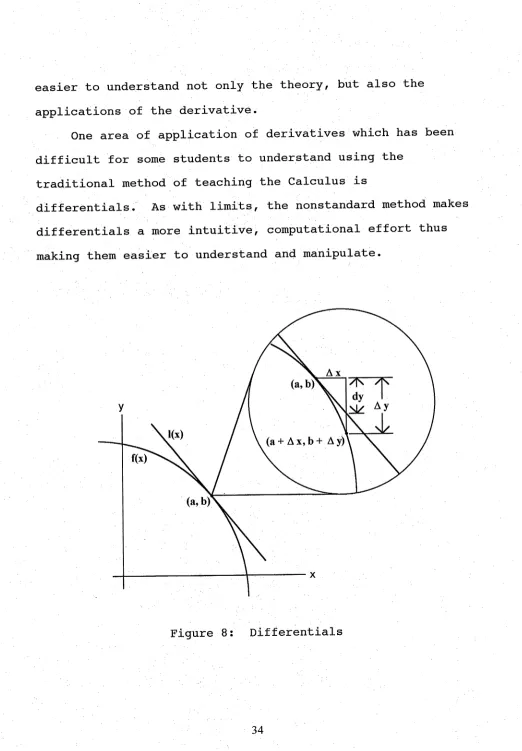
One area of application of derivatives which has been
difficult for some students to understand using the
traditional method of teaching the Calculus is
differentials. As with limits, the nonstandard method makes
differentials a more intuitive, computational effort thus
making them easier to understand and manipulate.
a b) 7^
dy
Ix)
(a y)
f(x)
(a,b)
Theorem: Increment Theorem
1,et y =f{x^-
Suppose f'ix^ exists at a certain point
X, and At is infinitesimal. Then A_y is infinitesimal,
and Ay =/'(x)Ax +sAt for some infinitesimal £ / which
depends on X and Ax.
Proof: .
Case I:
Ax =0
.
In this case. Ay =/'(x)Ax =0,
and we put 8=0
Case 2: At5^0i
Then^«/'(t), so for some
infinitesimal £, ^
Multiplying both sides by Av, we get,
Ay =/'(x)Ax +£At
That is, the increment theorem provides us with a
method for finding a good approximation of the change in the
value of the function for small changes in the value of the
variable. Intuitively, we can see that if Ax,
an
infinitesimal, is conceptually "very small"> then £At, the
product of infinitesimals, is "extremely small" or "very
In doing so, though, we must remember that our computations
not actually use infinitesimals and thus can only give
us a good approximation if the change in X is kept as small
as possible.
Example of Differentials
Find an approximation for /(4.01), where /(;v:) =
•
, X =4, /(x)= V4 =2, and Ax = 0.01 , so
2\X
Ay=/'(x)Ax=^(0.01)=0.0025
and then y= yQ + A_y =2+0.0025= 2.0025
(Note: y= 2.00249843945 by the calculator)
Notice that except for the nonstandard analysis style
used in the statement of the Increment Theorem, as usual
differentials are manipulated the same way as in the
traditional method. The advantage of the nonstandard method
to the student is that it provides a solid, intuitive basis
CHAPTER 5: FOUNDATIONS OF NONSTANDARD ANALYSIS
The Hyperreal number system can help students learn and
understand the Calculus without relying on a deep, technical understanding of why they work (or even real proof that such things as infinitesimals exist).
Unfortunately new methods are usually not adopted by
the mathematical community just because "they seem to work".
This is why a more rigorous development of the Calculus than
Leibniz's was pursued, Abraham Robinson's development of
infinitesimals in the I960's finally provided the rigorous
foundation for infinitesimals and the Hyperreals that allowed their use in the teaching of the Calculus, and
mathematics generally, to be seriously considered.
FILTERS AND ULTRAFILTERS
In order to understand the construction of the
Hyperreal number system, it is necessary to establish some
basic definitions and methods related to filters and ultrafliters.
To begin with we heed to understand what an ultrafliter
is, and more importantly what a free ultrafilter might be.
Definition: Filter
Let I be a nonempty set. A filter on I is a nonempty
collection U of subsets of 1 having the following
properties.
i) :0 m
'
ii) AeZI and BeZL^AnBeZl
iii) A eZI and Aq^ B=> B eU
A filter is an ultrafilter if
iv) for any subset ^
of I either A eU ox its
Compliment
^ e'Zi (but not both)
By conditions i) and ii), an ultrafilter cannot contain
both A and A'^, since if both were elements of U, then by
ii), Ar\A^EZlf hut Ar^A^ =0f which contradicts i).
A filter therefore is closed under the operations of
intersection and "supersetting", and does not contain the
empty set. An ultrafilter has the additional property that
either a set or its complement is always an element of the
ultrafilter.
An alternate and equivalent definition for an
ultrafilter is a maximal filter.
Definition: Maximal Filter
Proposition: A filter F
on I is maximal if and only if for
every subset
of 7 either ^ or J^=I — AeF
Proof:
=>
Suppose either Ae^F or A^eF \/AcI
Let G be some filter containing F, G'^F, and suppose
B eG and B ^F then B^ eF but since G'^F then B^eG.
B eG and B^ eG implies Br\B^ eG, But Br\B^ =0, by
definition, which implies 0eG, a contradiction to G being
a filter. Therefore there is no filter G properly
containing 7?. Thus 7^ is maximal.
^
Suppose 7^ is a maximal filter on 7 and A ^F
'To'':show;'''^; eF:
Suppose \fBEF Ar^B^0
Let G ={X^F.Ar\HQX for some 77 G7^}
H eG V77gF since
77c 77, therefore F(^G
A eG since Ar^HcA
Therefore F
is a proper subset of G
Check properties of filters:
i)
0^G by construction, Ar^H^0 \/H eF
ii) Pick Gj,G2sG. Then 377[,772 sF9^P»77[cGj
, arid A
T!hen A0^
n(AnH2)cGjnG2
since Hi0H2^F, therefore GinG2eG
Therefore G is a filter. This contradicts our
assumption that is a maximal filter, therefore the
assumption of this case cannot occur.
since the previous case failed, 3B E.F3 Ar\ B =^0. This
implies B <^A
c,
which implies vl
c&F,
which is exactly what
we wanted to show.
Definition: Fixed Ultrafilter
An ultrafilter ^ is principal or fixed if
Ax elA VB
x <sB
Fox: each X £/, then, there is a fixed ultrafilter
={/^c I\x e B}
We will call X the aeneratinq element of the fixed ultrafilter U.
Some collections of sets may satisfy some but not all of the conditions to be a filter (or ultrafilter), so one
must be careful to verify the conditions accurately.
Given the set iS'={l,2,3}, its power set is
P(S)={0,{1},{2},{3},{1,2},{1,3},{2,3K{1,2,3}}
Clearly P(<S), the power set of S, satisfies the
intersection (ii) and superset (iii) conditions for a
filter. It even satisfies the maximal condition for an
ultrafilter (though not the mutual exclusiveness result).
But it does contain the empty set. The empty set is a
therefore the power set of a set is not a filter (and thus
is certainly not an ultrafilter).
Let/={a,
and consider the sets of subsets of /;
Claim that A and B are filters on /.
Check the properties for A:
i)
A does not contain the empty set
ii) Intersection of two elements of A is still an
element of A, e.g. {a,Z>,c}P*
={a,c} EA
iii) If a set is an element of A and that set is
contained in a larger set then the larger set is
also cbntained in A. That is,
I={a,b,C,d^ and let
a ={^,c} and J3={a,^,c}
Obviously p ZD(X and /ZD P Z)OC
and since Ot eA
■/..P/eA ■
By exhaustively checking all possible combinations, it
can be verified that all the conditions hold, A is a filter
on I. The set B is also a filter by the same properties, in
Fixed ultrafliters are of limited interest to us since
they generate nothing new in our construction of the
Hyperreals. Our construction requires the use of free
ultrafliters. Free ultrafliters contain the Frechet Filter.
FRECHET FILTER
The Frechet Filter (5^j) is a special filter defined on
infihite sets. It is also called the cofinite filter and it is defined by:
jFi ={^c/:/—
is finite}
The Frechet filter is a large collection of infinite
sets. The base set must be infinite or the Frechet
"filter" is not a filter at all, since if I is finite then contains the null set (since it is cofinite) and thus is
not a filter.
Proposition:
—
— A is finite} is a filter if I infinite
Proof:
By definition of jFj, I is an infinite set.
i) Suppose
then 7-0=7 would be finite which
would contradict the condition that 7 is infinite.
ii)
Let ^
and 5 £^7}
(i.e., show that the intersection of the sets ^ and B
in
is itself an element of ^j)
By DeMorgan's Laws
^
i^A r\ Bi)^
Qo{I-A)Kj{I-B)=I-{AnB)
finite finite finite
(Ap>B)^ is finite and Ar\B
iii) If AeS-\ SLiid I"^ B"^A
To show i? sjTi
:6 3>4— but is finite
is finite which satisfies definition of an element of the Frechet filter
Examples of Elements of !Bi on N
Let C={all primes less than 100}, C
is finite and
D=N—Ce^Ti. D is one element of the Frechet filter.
Other examples of elements of the Frechet filter N for each k eN
A? -{1,2,3}
N
—{all numbers between 4 million and 5 billion which
contain no 3's in their decimal form}
N
—{all non-prime numbers with less than 487 digits}
N —{all specific natural numbers humans have ever
An ultrafilter U on I which contains the Frechet
filter is called free. A free ultrafilter cannot contain
any finite set yl, since then
would be cofinite and hence
in
and then ylo ^4*^ =0 would be in U, contradicting the
first property of filters. Note that the Frechet filter is
not an ultrafilter itself since we can always construct a
set
such that both yl and yl'^ are infinite. Thus
neither A nor
is an element of !Fi-
For example/ any
ultrafilter on iV would have to contain either the Set of
even numbers or the set of odd numbers, but not both since
they are complements in iV, but neither set is in
Theorem '
If is an ultrafilter on /, I infinite, then is
free if and only if 'Z/ not fixed at any X G/
■ ■Proot: ', '
=> U free —> not fixed
Suppose
free and fixed at X g7,
:
\€/;=
i.e
In specific {x} e^^ =Zl
But if Zl is free —> it contains the Frechet filter
contains /-{x}
contains {;v} n ^ -{■^} = 0/ a contradiction to the
<= Zl not fixed free
To show if
not fixed
—>■ contains jFi
Pick arbitrary A g
is finite, i.e.,
Not fixed -> Vxe/ 3AxEZ13X^Ax
Consider f]
nA^ = A, A eZI, A
A
. '
AqA->A eU
Zl contains jFj
Zl is free
We have yet to prove that free ultrafilters exist.
These, however, are the important ultrafilters for our construction.
THE ULTRAFILTER AXIOM
In order to obtain an understanding of ultrafilters one
needs to learn some of the mathematics supporting and
proving the Ultrafilter Axiom. Zorn's Lemma, which is a
variation of the Axiom of Choice, will be used in the proof of the Ultrafilter Axiom. Zorn's Lemma involves the idea of
a partially ordered set and related concepts as described
Defini'bion:
A partially ordered set is a pair (X,<), where X is a
nonempty set and < is a binary relation on X which is
i)
reflexive, i.e.,
for all X sX
ii) antisymmetric, i.e., if X^y and y <X then X — y
iii) transitive, i.e., if X<y and y<Z then X <Z
A subset C of X
is a chain if for all X,y gC either
X<_y or y<X, The element X is an upper bound for a subset
B<^X if b<,X for all BgE. An element MeX is maximal
if, for any X eX,
m<X implies X = m .
Zorn's Lemma
Let (X,<) be a partially ordered set. If each chain in
X has an upper bound then X has at least one maximal
element.
Zorn' s lemma is equivalent to the Axiom of Choice and
both can be used to prove the Ultrafilter Axiom but the preferred proof is the one that uses Zorn's Lemma.
Ultrafliter Axiom
If F is a filter on / then there is an ultrafilter Zl
Proof:
Ak As.
Let F be the set of all filters which contain F, F is
As
nonelnpty since F gF. Be partially order F Joy inclusion;
i.e., Lt A,B gF then we say that
5
if X e^ implies
X sB. It is easy to check that < is a partial ordering on
As
F.
Now let C be a chain in F. To show that C has an upper
bound consider F= yCCC e C)
. Then C<F for all C< C.
Also F is a filter.
Check Properties of Filters
i) 0^C for any C so 0^[JC.
ii) If X,Y e F then X eQand Y eC2 for some Q and
C2 in C. Since C is a chain, we may assume
without loss of generality that Cj < C2, and so
X,YeC2 and XnYE QcF^Ye F.
iii) If X g F
and Xc Y then
3Gi3XeCi->YeCi ^YgF.
As
By Zorn's Lemma F has a maximal element, call it F^^^
As
which both contains F, by construction of F, and is an
ultrafilter because maximal filter.
Theorem:
Free ultrafliters exist on any infinite set I.
Proof:
Since / is infinite, construct the Frechet filter
on I. By the Ultrafliter Axiom, there exists a maximal
filter containing is the desired free
ultrafilter.
CHAPTER 6: CONSTRUCTING THE HYPEHREAL NUMBERS
The construction of the Hyperreals, denoted is
similar to the construction of the Reais from the rational
numbers by means of equivalence classes of Cauchy sequences.
To begin the construction, let N denote the natural
numbers, R denote the Reals, and R denote the set of all
sequences of Real numbers indexed by N.
Each element in R is of the form > —
r2,r3,...)
, where
/}• eR V/. For convenience we will denote
r2,r3j.
by (r^).
Operations of addition, ©/ and multiplicatidn,
can be
defined on R as follows:
Defihition:
If and S — are elements of R, We define
r0s^{ri+Si) and
=
It is clear that (R,©,®) is a commutative ring with an
identity (l,!)...) and a zero (O,0,...) (where 1 and 0 are the
unit and zero in R.
For instance, to verify that the operations are
distributive:
(l,0,1> 0,1,...)®(o,1,0,1,0,...)=(o,0,0,...), so the product of
nonzero elements can be zero. This problem can be
/V '
eliminated by introducing an equivalence relation on R and
defining operations and relations +, * , and < on the
resulting set, R, of equivalence classes which make
,+,•,<) into a linearly Ordered field.
THE HYPERREAL BTUMBERS
The elements of the nonstandard or the Hyperreal
numbers are equiyalence classes of the elements of R
relative to the equivalence relation defined below.
Definition:
If r = a.nd S= are in R, then r=5 if and only if
{/ eN'.ri=si\&U, where U is some free ultrafilter on
N. We then say that
almost everywhere (a.e.).
Since Ls a free ultrafilter, not just a Frechet
filter, note that (1^^=(^SiY a.e. does not mean simply fj ^Si
for only a finite number of ;'s. This is a common error.
Certainly two sequences that differ at only a finite number
of places are alwavs equivalent under =. In fact, for convenience, when comparing sequences one can always disregard any finite number of terms at the start of the
sequence as long as you ignore the same number of terms for
Sequences which are the same at only a finite number of
places are never equivalent under =. Sequences which are
the same at an infinite number of indices and also different
at an infinite number of indices mav or mav not be
equivalent under =, depending on the ultrafilter. [2]
For example
is equivalent to either
(1,14,1,...) or (2,2,2,2,...), depending on whether Zl contains
the set of odd numbers or the set of even numbers,
respectively.
Lemma:
■ ■ ' /V
The relation = is an equivalence relation on R
Proof:
We need to show that the relation = is reflexive
(r = r), symmetric (if r = S then S=r), and transitive (if
r = S and ( then r =().
i)
To show r=T is trivial since
[i eN:rj= ri}= N eZl
ii) To show if r = S then S=r
{ieN:rj=Sj}={ieN:Si=ri}
iii) To show if r =5 and S= t then r = t
If Ui=[i EN:ri=Si},
U2={i ^NlSj= tj}f and
U3={i eN:rj= tj}
r =S^UiEtl and S=t->U2etl
Then Uir\U2^U, and since
Uir\U2={} eNiVj =s^
therefore U^eU and r = t
Definition:
Let R denote the set of all the equivalence class of
R induced by =. The equivalence class containing n
particular sequence 5—^^ is denoted by [s] or S.
Thus if r=S in R then r =[r]=[5']= S.
Please note that two sequences can have the same limit
as i approaches infinity and not be equivalent.
For example,
is not equivalent to (0,0,0,^^*)
since 1/ e N',\= q\=0 , though lim 7=0= Um 0.
^ /->oo /^oo
Thd
^
divided into disjoint subsets called
equivalence classes by =. Each equivalence class consists
of al1 sequences equivalent to any given sequence in the
class.
Thus r and S are in the same equivalence class iff
One of the difficulties with free ultrafilters is that
you cannot completely determine which infinite sets with
infinite complements are in the ultrafilter. For instance,
how does one know, for a given ultrafilter U on N, whether
the set of odd numbers or the set of even numbers is xn Ul
One of these sets must be in U, since these sets are
complements, yet ultrafilters on exist for either case.
Fortunately this really does not matter. The ability
to identify the exact equivalence class that one of these "borderline" sequences belongs to is generally irrelevant.
- ' ' ■ /V ' '
We just need to know that every sequence in R belongs to
some equivalent class so that = actually satisfies the
definition for an equivalence relation on N.. This is why
we caiKnot use just the Frechet filter to construct the
Hyperreals. We heed a. structure which satisfies the mutual
exclusivity property which characterizes an ultrafilter.
OPERATIONS AND FIELD STRUGTURE
We define the arithmetic operations and inequalities on
the Hyperreal numbers as follows;
Definition:
Let **"[('/•)] ^nd
Then:
iii) r<s(s>r) if and only if {z S N:q < s^} sZl, and
r<s(s>r) if arid only if r<S or r = S. The
structure is denoted by
with the operations defined this way/ we can proceed to
prove that the Hyperreal number system is a linearly ordered
field.
Theorem:
The structure is a linearly ordered field.
Proof:
It is ea&y to prove that is a commutative ring with
unit. We will prove some of the properties as examplesi
To show that multiplication is associative
(r-s)•t= r-(s-1)
~ associative property of Reals
= r-(s-t)
QED
To Show that addition is commutative
r+s =s+r
=[{';■+«()]
To show that multiplicative identity exists
Define; 1 =
=[(?j)]
multiplicatiye identity of Reals
■
-r'
. ••o '.QED
Clearly the prdofs are similar for commutative property
of multiplication, associative property of addition,
distributive property and the additive inverse.
To complete the proof that is a linearly ordered
field we need to prove additionally that every nonzero
element in R has a multiplicative inverse and that the
field is ordered.
To show that if 1*9^0 then there is an element r ^
in R such that r-1'"* = 1.
Suppose that
«
Then {i E N'.T} —0}
and
so {/e A^:^-
0} e'Zi by the fourth property of filters. Define
r
, where^ ^ if
0, and =0 if 7J =0.
Then r*f
^'^ — 1 if ^- ^0, and ^• •^ =0 if
rj =0, so {i eN'.rj -Fi
eN'.rj ^0}eU.
Therefore r-r~^ —1
Finally we must show that 5^ is a linearly ordered
We must show that;
i)
the sum of two positive elements is positive
ii) the product of two positive elements is positive
iii) Law of Trichotomy
By positive element we mean r>0, where 0=
,
that is r >0 if and only if {/ e NiTj > O}eII
The first two properties are easy to prove and follow
directly from some of the previous sections.
To show, for example, that the sum of two positive
elements is positive, pick r,S €R with r>0 and S>0. That
is Ui ={/ E NiTi >6}efl and Uj={/' eNlSf > O} E%1.
To show r+s>0, i.e., {i E Nir^ +Si> 6}eU.
Clearly on Uir\U2, fj and
are both positive, so by the
properties of the Reals, ^ + >0 on Uif^U2-
But
={/ eN:r^ + >0}3\i eNiv^ > 0,^,- >0}=I/jnU29
So, since Ui r\U2 ^Uf
Therefore r +S>0.
On the other hand, to prove the Law of Trichotomy we
use the following theorem.
Theorem: Selection Theorem
Let Zl be an ultrafilter on 1, be a finite
number of subsets of /, with Aj O Aj —0 for i^ J and
i.e. A^l
=
[}Aj =I, and
■ i=\
A^ nAj=0 V/^J
-> 3!/ 34"
Proof:
Suppose there is no A^ ^AA,
Since
an ultrafilter then
e U \fi.
This would imply that 0^4^)^
/=1 / \C
n i _\ ( n \
Then H(4^/~ {}Ai \ =I^ = Q)e.U.
i=l V/=l J
But this would contradict %1 being an filter.
Therefore 3i3 Aij E .
Now suppose Ai,Aj e 11, i^J. Then 4
=0e'Zi ^ again
a contradiction to 11 being a filter.
Therefore 31/34 S ^/.
Proof of the Law of Trichotomy:
(i.e. if r eR then r<0,r =0, or r>0)
Fix 11 on N
Define
Ui=[i eNirf <0}
1/2 ={/ eNirj =0}
t/3 ={/6JV:^ >0}
Clearly Uj^N V/
By Law of Trichotomy for the Reals, every >• satisfies
3 .
one, and
only one, of these conditions. Thus [JUi = N and
Therefore either r<0,r =0, or r>0 depending on
whether t/j, Uji or U^, respectively, is an element of .
So far all of this development could have been done whether the ultrafliter selected was free or fixed. We
would like to understand why the use of a free ultrafliter
is required. As we will see, using a fixed ultrafliter will
generate nothing new beyond the standard Real numbers. To
see why, it is necessary to better understand how the Real
numbers themselves appear in the Hyperreals.
EMBEDDING MAP
The Reals can be embedded in the Hyperreals using what
is called the embedding map. As we did earlier for the
multiplicative identity 1=
and zero
o=[(o)]=[(o,0.0,...)], in general we will associate a Real
number r with the equivalerice class in the
Hyperreals.
Definition:
If rsRf we define *(r)=*r, where *r =
eR
Thus if r =*r=
for some TGi? and S—[(5,)] then
r=S if and only if [i eN'.Si =r}eU. in many of our examples,
though, the terms of the sequences we use are all different/
Real number, forcing the sequence to be different than any
embedded Real number.
For example, S = is not equal to any
embedded Real number T =*r=[(r,r,r,...)] with r Gi? since
{/e
= r}, has at most one member and thus cannot possibly
be an element of any free ultrafliter.
Theorem:
The mapping * is an order-preserving isomorphism of R
into R.
Proof:
The mapping * is 1-1, for if *r = *5" then
[(r,r,...)]=[(^,5',...)] and so r=S. It is a trivial matter to
show that * preserves the field and order properties.
For example, the mapping preserves addition,
[{r,r,..)]+[(5,5,..)]=[{r+^,r+^^
*(r H-^)=*r+%.
And also preserves ordering: If r < .S' then
< *5
Considei: [i e Nirf < Si}=[i e N:r <s}= N eZl
Hence *r<*S.
QED
For convenience we will occasionally use r for both the
Definition; standard Number
The image of the set of Real numbers under the
embedding map, is called the set of standard numbers.
Any Hyperreal number which is not a standard number, if
any, is called a non-standard number.
The term "nonstandard Real numbers" is already being
used for the entire set of Hyperreal numbers. Now we are
defining the term "nonstandard number" to mean a Hyperreal
number which is hot "standard". Since these terms are so
similar, we must be careful to distinguish between the two
forms when used.
This brings us back to the notion pf an ultrafilter.
We can only build the extension of the Reals called the
Hyperreals by using a free ultrafilter.
Fixed ultrafliters, "generated" by a single element,
are inadequate for the construction of Hyperreals because
comparing arbitrary sequences reduces to comparing them on
the single element of each sequence which corresponds to the
generating element of the ultrafilter.
If the ultrafilter on N
is U=Uj,={A^N:kEA},
r=[(/;•)] and S=[(5-)] then r=S if and only if
because
A =[i eN:rj <Si} eZl}^ if and only if keA.
Thus, using the same sequences as in an earlier
example, if the generating element. A:, for the fixed
ultrafilter is odd, then is equal to
[(l,!,!,!?—)]/ otherwise it is equal to [<[2,2,2j2,..,)j.
For another example, consider the fixed ultrafilter
^73 ={yi C 7V:3 e yl} (i.e. =3). The sequences r =
and S^[(l3,10,7,4,...^j are equal because {i ENlTj =^j={3},
(^3=53 —7) and {3}6^73. r i^^^^
equal to t=[(7,10,7,10,
because {/€
={3,6}£^73 and S=t because
{/e
={2,3}€773. In fact r =S=t=*7. The important
thing to notice is that every sequence in a given
equivalence class relative to *7/3 must have the same value
in the third element of the sequence. So,
V=[(;r,0,1.9,73,...)]=*(1.9)— 5,-N/2,1.9,4e^,...^j= W, no matter what
the other terms are, because |iGiV:
at least contains
the index 3, and thus is an element of 773.
Therefore, for fixed ultrafilters, = is simply a
mapping from R to R,
the Real numbers, and every element
of the new "Hyperreals" we are trying to construct would in
fact be equal to some embedded Real number, i.e. we have gained nothing. Hence the requirement that we use a free
ultrafilter for this construction.
But do we actually gain something by using a free
thus must be in some liew equivalence class. Therefore the
Hyperreal numbers are a proper superset of the (embedded)
Real numbers.
In fact, S is our first non-trivial example of what we
call infinitesimal numbers.
The definitions of infinite, finite, and infinitesimal
numbers in Hurd and Loeb are equivalent to those given in
Keisler, but are now described in terms of their absolute
values in comparison to Real numbers.
The definition of absolute value for the Hyperreals is
identical to that for the Reals.
Definition: Absolute Value
If r eR, then the absolute value of r, denoted by |r[,
is defined as follows: r if r > 0
r = 0 if r — 0
-r if r<0
By the Law of Trichotomy, the absolute value of every
Hyperreal number is defined. Often one will be manipulating a specific Hyperreal number, usually represented in the
equivalence class as a sequence which is the result of a
specific computation, or a sequence which is simply
Theorem:
If
then jr|=
Proof:
Pick r eR and define Ui,U2 and t/3 as in the proof of
the Law of Trichotomy. Exactly one of these sets is in Zl .
Which one determines whether r < 0, r =0, or r > 0,
respectively.
?=[(|^i|)].
To show |r|= r: .
Case 1: r<0 i.e., Ui&ZL
|r|= — r = r if and only if Ui ={/ G N'.—r^ — |}e .
But U\ = UiUU2, U^eU,
Therefore |r|=f.
Case 2:
r =0, i.e., U2
|r|=0= r if and only if U2=^{i ^N:0=\ri'^ GU.
But C/^ —
.
Therefore |r|i= r.
Case 3: r > 0, i.e., f/3 E.U
|r|=r=r if and only if 6^3 ={/'eiV";/} =|/-|}e/Zi.
But Z./3 = U2
,
f/3
,
f/3 c IJ2,
,
Therefore |r|=F.
Since all possible cases verify, the theorem is true. We now use absolute values to define the concepts of
Definition:
i) A number seR is infinite if «<|s| for all
standard natural numbers 77.
ii) A number S gR is finite if |s|<77 for all standard
natural numbers 77.
![Figure 2: The Infinitesimals [3]](https://thumb-us.123doks.com/thumbv2/123dok_us/1139049.1615673/15.576.36.551.17.772/figure-the-infinitesimals.webp)
![Figure 3: The Finites and Infinites [3]](https://thumb-us.123doks.com/thumbv2/123dok_us/1139049.1615673/16.576.32.562.21.764/figure-the-finites-and-infinites.webp)
![Figure 5; Slope of a Line [3]](https://thumb-us.123doks.com/thumbv2/123dok_us/1139049.1615673/31.576.11.558.35.732/figure-slope-of-a-line.webp)
![Figure 6; Derivatives of Sin(x) Under Microscope [3]](https://thumb-us.123doks.com/thumbv2/123dok_us/1139049.1615673/37.576.12.560.31.754/figure-derivatives-of-sin-x-under-microscope.webp)
![Figure 7; Diagram for the Geometric Inequality [3]](https://thumb-us.123doks.com/thumbv2/123dok_us/1139049.1615673/38.576.22.556.4.772/figure-diagram-geometric-inequality.webp)