http://www.sciencepublishinggroup.com/j/ajasr doi: 10.11648/j.ajasr.20170304.13
ISSN: 2471-9722 (Print); ISSN: 2471-9730 (Online)
G
2
EDPS's First Module & Its First Extension Modules
Burak Omer Saracoglu
Independent Scholar, Istanbul, Turkey
Email address:
To cite this article:
Burak Omer Saracoglu. G2EDPS's First Module & Its First Extension Modules. American Journal of Applied Scientific Research.
Vol. 3, No. 4, 2017, pp. 33-48. doi: 10.11648/j.ajasr.20170304.13
Received: February 27, 2017; Accepted: March 29, 2017; Published: November 28, 2017
Abstract:
100% renewable worldwide power grid (Global Grid) system needs a Global Grid Electricity Demand Prediction System (G2EDPS) with very short, short, medium and long term forecasting consoles. This paper presents the 1st core module and its 10 extension modules in the long term prediction console. A type 1 Mamdani like Fuzzy Inference System (FIS) with 7 triangle membership functions and 49 rules is designed for 2 input and 1 output variables for a 100 year forecasting period. The maximum absolute percentage errors (MAP), the mean absolute percentage errors (MAPE), and the Symmetric MAPE (SMAPE) of the best core module and its extension modules are respectively 0, 24; 0, 08; 0, 05 and 0, 22; 0, 07; 0, 05.Keywords:
Global Grid, Electricity Demand, Fuzzy Inference System, Mamdani, Prediction1. Introduction
Electricity is the center of our modern daily life. It is consumed in homes, on streets, and at factories at most of our daily activities. The electricity can be generated from either non-renewable energy sources or renewable energy sources within the current electricity generation technologies. Oil, coal, gas, and nuclear are grouped in the non-renewable energy sources. Hydropower, geothermal, wind, solar, and ocean are grouped in the renewable energy sources. Non-renewable energy sources shall run out in the future. Hence, the scientific studies on modeling and developing of 100% renewable energy sources should be more important than the studies on non-renewable energy sources in near to mid future.
There are some conceptual 100% renewable power grids (e. g. European Supergrid Concept [1], Global Grid Concept [2], Supergrid Concept for America [3], DESERTEC Concept [4], Gobitec Concept, Asian Super Grid Concept [5, 6]). The Global Grid is described by Chatzivasileiadis et. al. as "a grid spanning the whole planet and connecting most of the large
power plants in the world" [2] (see “Fig. 1” for Global Grid). The Global Grid Prediction Systems (G2PS) [7] are developed to serve them (specifically to Global Grid). It has two major units (Global Grid Electricity Demand Prediction System: G2EDPS, Global Grid Peak Power Prediction System: G2P3S) [7] (please be informed that projection, prediction, forecast are used in same meaning in this study). These systems shall work with all provinces, sub-regions, countries, large regions, multinational grids, Supergrids and Global Grid in all time horizons (e.g. immediate: less than 1 month, short-run: l−3 months, medium-term: 3 months−2 years, long-run: 2 years or more; some electricity grid related forecasting studies short-range: up to a week a head, medium-range: up to 10 years ahead, long-range: 50 years ahead) [7] (see [8, 9, 10, 11, 12].
Figure 1. Global Grid* (see [2], basemap by the Johomaps http://www.johomaps.com/, generated by Apache OpenOffice 4.1.1 Draw http://www.openoffice.org/ & Paint.NET http://www.getpaint.net/index.htm) (*not to scale, fictitious and for information purposes only so that no representation of power plants locations and transmission lines).
This study presents an interim milestone (part) of an ongoing research, development and demonstration (RD3) program (project, effort) as publicized the G2EDPS's 1st core module and its extension modules in the long term prediction console, which run on Scilab [13], R [14], RStudio [15], Microsoft Office Excel [16], Apache OpenOffice Calc [17] (long range period: 100 years ahead).
2. Literature Review
The current literature review was completed on only some of the academic publication online database and journals by only some key terms and phrases in June 2015 (from 11th of June to 01st of July: 20 days period). The keywords were first selected from some previous research studies and documents in the literature. Then new key terms were added by the author and connected with others. They were used in a narrowing content manner (from large to narrow scope or general to specific). The keywords were (1) "Fuzzy Logic Inference System" and "Electricity", (2) "Fuzzy Logic Inference System" and "Forecast", (3) "Fuzzy Logic Inference System" and "Demand", (4) "Fuzzy Logic Inference System" and "Electricity" and "Forecast", (5) "Fuzzy Logic Inference System" and "Electricity" and "Demand", (6) "Fuzzy Logic Inference System" and "Electricity" and "Forecast" and "Demand", (7) "Fuzzy Inference System" and "Electricity", (8) "Fuzzy Inference System" and "Forecast", (9) "Fuzzy Inference System" and "Demand", (10) "Fuzzy Inference System" and "Electricity" and "Forecast", (11) "Fuzzy Inference System"
Figure 2. Literature review summary (1: ACM Digital Library-ACM [18], 2: ASCE Online Research Library-ASCE [19], 3: American Society of Mechanical Engineers-ASME [20], 4: Cambridge Journals Online-CJO [21], 5: Directory of Open Access Journals-DOAJ [22], 6: Emerald Insight-EI [23], 7: Google Scholar-GS [24], 8: Hindawi Publishing Corporation-HPC [25], 9: Inderscience Publishers-IP [26], 10: Journal of Industrial Engineering and Management- JIEM [27], 11: Science Direct-SD [28], 12: Springer-S [29], 13: Taylor & Francis Online/Journals-TFJ [30], 14: Wiley-Blackwell/Wiley Online Library-WB [31], 15: World Scientific Publishing-WSP [32]), visualization generated by the bubble graph of Microsoft Office Excel 2007 & Paint. NET (left: top, right: bottom).
The detailed review was performed only on English documents. The documents in other languages were
It was understood that these studies could be grouped according to their scope such as smart grids (e. g. [33]), classical or conventional grids (transmission and distribution) (e. g. [34]), and household applications (e. g. [37]). Moreover, the power systems forecasting horizons in the literature were diversified as the real time/very short term (minutes to a day) (e. g. [36]), the short term (a day to a week) (e. g. [37]), the medium term (a week to a year) (e. g. [38]) and the long term (more than a year often upto ten years) (e. g. [39]) (see [40]). Hence, only the long term studies were investigated in detail in this review. There were more than 40 studies. Some of these studies were compared their models with the actual historical data (model and comparison on historical data). There weren't any future projections in these studies. On the other hand, some of the studies presented the future forecast. Al-zahra et. al. tried to forecast (next 2 years: January 2012 to December 2013) the demand of Basra city by Box-Jenkins and Neuro-Fuzzy Modeling [41]. Tasaodian et. al. projected the following 8 years (2008-2015) demand in the Group of Eight (G8) Industrialized Nations (U. S. A, Canada, Germany, United Kingdom, Japan, France, Italy) by an adaptive network based fuzzy inference system (ANFIS) [42]. Azadeh et. al. worked on an ANFIS model for the next 7 years (2009-2015) in the Netherlands, Luxembourg, Ireland, and Italy [43]. Bazmi et. al. studied on an ANFIS network for predictions (next 19 years: 2012 to 2030) in Malaysia [44]. There were also some other important and interesting studies within the similar topics, approaches, scopes and forecasting horizons. The maximum forecasting period was 20 years in these documents (future projection studies).
The literature review was finalized in 25 days (11/06/2015 to 01/07/2015: search, review, classify; 01/07/2015 to
05/07/2015: investigate, prepare). This detailed and widened literature review exposed that some researchers were interested in the power systems forecasting subject, however there weren't any publications found on the long term forecasting of the Global Grid Concept.
This study is most probably the first research on this concept, so that it has its own very unique difficulties. The main challenge is the concept itself. Another challenge is its forecasting horizon (long term: 100 years).
3. G
2EDPS, Its First Core Module &
Core Module's Extensions
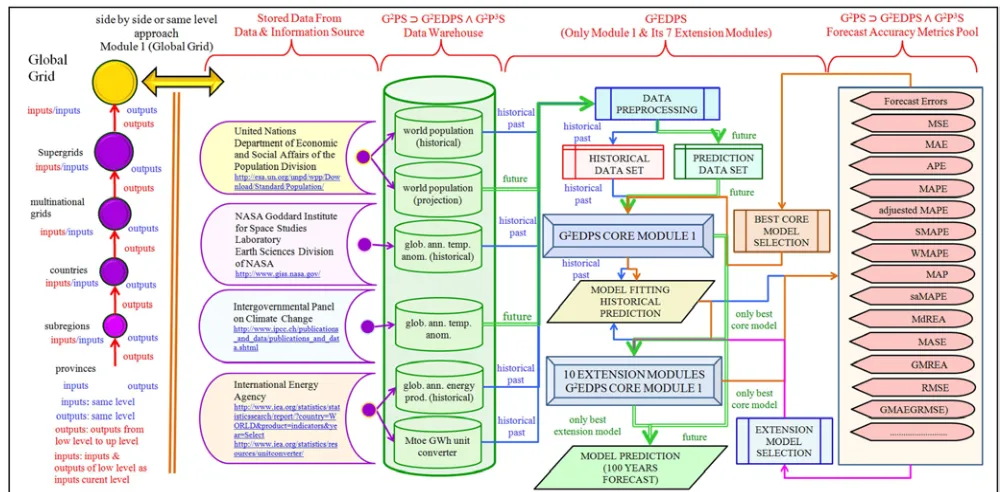
The G2EDPS consists of several consoles and modules with bottom up and side by side level approaches [7]. On the bottom up designs, the future electricity consumption (G2EDPS) will be predicted from one of the smallest units up to the largest units (i. e. provinces to countries, to regions, finally to the world). On the side by side (SS code) level approaches, the future electricity demand shall be predicted directly. It has simple, backwards and forwards computation considerations. It shall be a generic system (flexible, intelligent, self-enlargeable, self-expanding, self-reporting, self-learning). It will have direct connection and relation to the data and information sources. It has a globally unique data warehouse (e. g. temperature, population, time, and consumption) (common for G2PS), a global unique forecast accuracy metrics pool (common for G2PS), several different prediction core modules and their extension modules with heuristics and optimizations (different or common for G2EDPS and G2P3S) “Fig. 3”.
Figure 3. G2EDPS system level description (left), 1st Module: GGED-SS-C-T1MFIS7TMF-2VPGATA-100YPP-2015 description (right) by Excel 2007 & Paint.
NET.
Global Grid electricity demand with a one node type 1 (fuzzy) Mamdani [45, 46] like fuzzy inference system (FIS) with 7 triangle fuzzy membership functions (MF) and 2 input (world population, global annual temperature anomalies) and 1 output (Global Grid annual electricity demand) variables on the international basis for a 100 years ahead prediction period. This type of FIS is preferred in this study, because of its expert knowledge capturing capability [45, 46, 47].
This core module has its own data preprocessing, knowledge base (database, rule base), fuzzifier, inference system, defuzzifier, best core model defuzzifier selection, extension improvements generation, best extension model, and 100 year projection reporting units.
The world population (both sexes combined, as of 1 July in thousands) is employed as the input variable. It is employed as the first input variable in this module, because of its influencing power on the electricity consumption. Its historical and future projection data are directly gathered from the Department of Economic and Social Affairs of the Population Division at the United Nations [48]. The description of this variable is exactly presented as it is on the official website "Total Population - Both Sexes. De facto population in a country, area or region as of 1 July of the year indicated" [48].
The historical data (year, world population (both sexes combined, as of 1 July (thousands))) is gathered and presented in “Tab. 1”.
Table 1. World Population Historical.
Year Population Year Population Year Population
1950 2.525.779 1971 3.766.754 1992 5.494.900 1951 2.572.851 1972 3.842.874 1993 5.578.865 1952 2.619.292 1973 3.919.182 1994 5.661.086 1953 2.665.865 1974 3.995.305 1995 5.741.822 1954 2.713.172 1975 4.071.020 1996 5.821.017 1955 2.761.651 1976 4.146.136 1997 5.898.688 1956 2.811.572 1977 4.220.817 1998 5.975.304 1957 2.863.043 1978 4.295.665 1999 6.051.478 1958 2.916.030 1979 4.371.528 2000 6.127.700 1959 2.970.396 1980 4.449.049 2001 6.204.147 1960 3.026.003 1981 4.528.235 2002 6.280.854 1961 3.082.830 1982 4.608.962 2003 6.357.992 1962 3.141.072 1983 4.691.560 2004 6.435.706 1963 3.201.178 1984 4.776.393 2005 6.514.095 1964 3.263.739 1985 4.863.602 2006 6.593.228 1965 3.329.122 1986 4.953.377 2007 6.673.106 1966 3.397.475 1987 5.045.316 2008 6.753.649 1967 3.468.522 1988 5.138.215 2009 6.834.722 1968 3.541.675 1989 5.230.452 2010 6.916.183 1969 3.616.109 1990 5.320.817 - - 1970 3.691.173 1991 5.408.909 - -
Note 1: Data & Information: United Nations Population Division Department of Economic and Social Affairs, Website: http://esa.un.org/unpd/wpp/Download/Standard/Population/, File: WPP2015_POP_F01_1_TOTAL_POPULATION_BOTH_SEXES.xls, Year: 1950 – 2015, UN File: POP/DB/WPP/Rev.2015/POP/F01-1, Accessed On: 24.01.2016
Note 2: 2011-2014 World Population (both sexes combined, as of 1 July (thousands)) and 1950 - 1989 energy production (TWh) and 2014 data are not available, so that 1990 - 2010 period is selected for model fitting (green shading color) during data preprocessing.
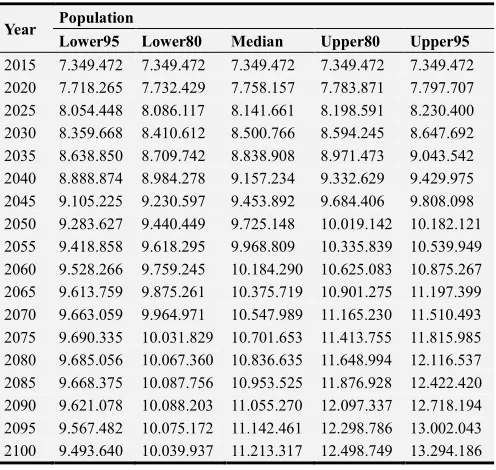
The future projection data is taken from the same website. The projection data (year, population (both sexes combined, as of 1 July (thousands))) is gathered and presented in “Tab. 2”.
Table 2. World Population Projection.
Year Population
Lower95 Lower80 Median Upper80 Upper95
2015 7.349.472 7.349.472 7.349.472 7.349.472 7.349.472 2020 7.718.265 7.732.429 7.758.157 7.783.871 7.797.707 2025 8.054.448 8.086.117 8.141.661 8.198.591 8.230.400 2030 8.359.668 8.410.612 8.500.766 8.594.245 8.647.692 2035 8.638.850 8.709.742 8.838.908 8.971.473 9.043.542 2040 8.888.874 8.984.278 9.157.234 9.332.629 9.429.975 2045 9.105.225 9.230.597 9.453.892 9.684.406 9.808.098 2050 9.283.627 9.440.449 9.725.148 10.019.142 10.182.121 2055 9.418.858 9.618.295 9.968.809 10.335.839 10.539.949 2060 9.528.266 9.759.245 10.184.290 10.625.083 10.875.267 2065 9.613.759 9.875.261 10.375.719 10.901.275 11.197.399 2070 9.663.059 9.964.971 10.547.989 11.165.230 11.510.493 2075 9.690.335 10.031.829 10.701.653 11.413.755 11.815.985 2080 9.685.056 10.067.360 10.836.635 11.648.994 12.116.537 2085 9.668.375 10.087.756 10.953.525 11.876.928 12.422.420 2090 9.621.078 10.088.203 11.055.270 12.097.337 12.718.194 2095 9.567.482 10.075.172 11.142.461 12.298.786 13.002.043 2100 9.493.640 10.039.937 11.213.317 12.498.749 13.294.186
Note 1: Data & Information: United Nations Population Division Department of Economic and Social Affairs, Website: http://esa.un.org/unpd/wpp/Download/Probabilistic/Population/, File: UN_PPP2015_Output_PopTot.xls, Year: 2015-2100, UN File: POP/DB/PPP/Rev.2015/PPP/POPTOT, Accessed On: 24.01.2016.
Note 2: 2025, 2035, …, 2095, 2100 Global Annual Temperature Anomalies Projection (degrees Celsius) data are not available, so that 2020, 2030, …, 2080, 2090 are selected for model prediction (blue shading color) during data preprocessing.
The historical and future projection data of this module will concurrently be updated with the updates of the United Nations (UN).
Table 3. Global Annual Temperature Anomalies Historical (degrees Celsius).
Year Anomalies Year Anomalies Year Anomalies
1880 -0,19 1926 -0,09 1972 0,01 1881 -0,10 1927 -0,20 1973 0,15 1882 -0,08 1928 -0,21 1974 -0,08 1883 -0,19 1929 -0,35 1975 -0,01 1884 -0,26 1930 -0,13 1976 -0,11 1885 -0,30 1931 -0,08 1977 0,18 1886 -0,29 1932 -0,15 1978 0,07 1887 -0,32 1933 -0,27 1979 0,17 1888 -0,19 1934 -0,12 1980 0,28 1889 -0,10 1935 -0,18 1981 0,33 1890 -0,35 1936 -0,14 1982 0,13 1891 -0,23 1937 -0,01 1983 0,31 1892 -0,25 1938 -0,01 1984 0,16 1893 -0,28 1939 -0,02 1985 0,12 1894 -0,29 1940 0,09 1986 0,19 1895 -0,20 1941 0,13 1987 0,34 1896 -0,14 1942 0,10 1988 0,40 1897 -0,10 1943 0,14 1989 0,29 1898 -0,27 1944 0,26 1990 0,44 1899 -0,15 1945 0,13 1991 0,42 1900 -0,08 1946 -0,03 1992 0,23 1901 -0,14 1947 -0,04 1993 0,24 1902 -0,27 1948 -0,09 1994 0,32 1903 -0,35 1949 -0,09 1995 0,46 1904 -0,43 1950 -0,18 1996 0,34 1905 -0,27 1951 -0,07 1997 0,47 1906 -0,21 1952 0,01 1998 0,63 1907 -0,39 1953 0,08 1999 0,42 1908 -0,42 1954 -0,12 2000 0,42 1909 -0,46 1955 -0,14 2001 0,54 1910 -0,42 1956 -0,19 2002 0,63 1911 -0,44 1957 0,04 2003 0,62 1912 -0,34 1958 0,06 2004 0,54 1913 -0,33 1959 0,03 2005 0,69 1914 -0,15 1960 -0,03 2006 0,63 1915 -0,10 1961 0,05 2007 0,66 1916 -0,33 1962 0,02 2008 0,53 1917 -0,39 1963 0,06 2009 0,64 1918 -0,25 1964 -0,21 2010 0,72 1919 -0,22 1965 -0,10 2011 0,60 1920 -0,25 1966 -0,05 2012 0,63 1921 -0,20 1967 -0,03 2013 0,65 1922 -0,26 1968 -0,07 2014 0,74 1923 -0,23 1969 0,06 2015 0,87
1924 -0,27 1970 0,03 - -
1925 -0,19 1971 -0,09 - -
Note 1: Data & Information: National Aeronautics and Space Administration Goddard Space Flight Center Sciences and Exploration Directorate Earth Sciences Division, Website:
http://data.giss.nasa.gov/gistemp/graphs_v3/Fig.A2.txt, File: Fig.A2.txt, Year: 1951-1980, NASA File: "Global Land-Ocean Temperature Index (C) (Anomaly with Base: 1951-1980), Accessed On: 24.01.2016.
Note 2: 2011 - 2014 World Population (both sexes combined, as of 1 July (thousands)) and 1950 - 1989 energy production (TWh) and 2014 data are not available, so that 1990 - 2010 period is selected for model fitting (green shading color) during data preprocessing.
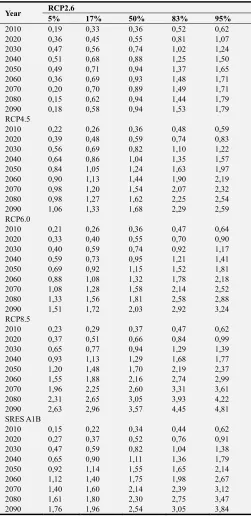
Its future projection data is gathered from the Intergovernmental Panel on Climate Change (IPCC), Annex II: Climate System Scenario Tables, Table AII.7.5. [51]. The projection data (Global Annual Temperature Anomalies Projection (degrees Celsius)) is gathered and presented in “Tab. 4”.
Table 4. Global Annual Temperature Anomalies Projection (degrees Celsius).
Year RCP2.6
5% 17% 50% 83% 95%
2010 0,19 0,33 0,36 0,52 0,62 2020 0,36 0,45 0,55 0,81 1,07 2030 0,47 0,56 0,74 1,02 1,24 2040 0,51 0,68 0,88 1,25 1,50 2050 0,49 0,71 0,94 1,37 1,65 2060 0,36 0,69 0,93 1,48 1,71 2070 0,20 0,70 0,89 1,49 1,71 2080 0,15 0,62 0,94 1,44 1,79 2090 0,18 0,58 0,94 1,53 1,79 RCP4.5
2010 0,22 0,26 0,36 0,48 0,59 2020 0,39 0,48 0,59 0,74 0,83 2030 0,56 0,69 0,82 1,10 1,22 2040 0,64 0,86 1,04 1,35 1,57 2050 0,84 1,05 1,24 1,63 1,97 2060 0,90 1,13 1,44 1,90 2,19 2070 0,98 1,20 1,54 2,07 2,32 2080 0,98 1,27 1,62 2,25 2,54 2090 1,06 1,33 1,68 2,29 2,59 RCP6.0
2010 0,21 0,26 0,36 0,47 0,64 2020 0,33 0,40 0,55 0,70 0,90 2030 0,40 0,59 0,74 0,92 1,17 2040 0,59 0,73 0,95 1,21 1,41 2050 0,69 0,92 1,15 1,52 1,81 2060 0,88 1,08 1,32 1,78 2,18 2070 1,08 1,28 1,58 2,14 2,52 2080 1,33 1,56 1,81 2,58 2,88 2090 1,51 1,72 2,03 2,92 3,24 RCP8.5
2010 0,23 0,29 0,37 0,47 0,62 2020 0,37 0,51 0,66 0,84 0,99 2030 0,65 0,77 0,94 1,29 1,39 2040 0,93 1,13 1,29 1,68 1,77 2050 1,20 1,48 1,70 2,19 2,37 2060 1,55 1,88 2,16 2,74 2,99 2070 1,96 2,25 2,60 3,31 3,61 2080 2,31 2,65 3,05 3,93 4,22 2090 2,63 2,96 3,57 4,45 4,81 SRES A1B
2010 0,15 0,22 0,34 0,44 0,62 2020 0,27 0,37 0,52 0,76 0,91 2030 0,47 0,59 0,82 1,04 1,38 2040 0,65 0,90 1,11 1,36 1,79 2050 0,92 1,14 1,55 1,65 2,14 2060 1,12 1,40 1,75 1,98 2,67 2070 1,40 1,60 2,14 2,39 3,12 2080 1,61 1,80 2,30 2,75 3,47 2090 1,76 1,96 2,54 3,05 3,84
Note 1: Data & Information: Intergovernmental Panel on Climate Change United Nations Environment Programme (UNEP) and World Meteorological
Organization (WMO), Website:
http://www.ipcc.ch/report/ar5/wg1/docs/WG1AR5_AIISM_Datafiles.xlsx, http://www.ipcc.ch/report/ar5/syr/,
http://www.ipcc-data.org/syn/tar_scatter/csiro_error.html,
http://www.climatechange2013.org/, File: WG1AR5_AIISM_Datafiles.xlsx, Year: 2010-2090, IPCC File: IPCC, 2013: Annex II: Climate System Scenario Tables [Prather, M., G. Flato, P. Friedlingstein, C. Jones, J.-F. Lamarque, H. Liao and P. Rasch (eds.)]. In: Climate Change 2013: The Physical, Accessed On: 25.01.2016. Note 2: 2025, 2035,…., 2095, 2100 Global Annual Temperature Anomalies Projection (degrees Celsius) data are not available, so that 2020,
The historical and future projection data of this module will concurrently be updated with the updates of the NASA (see [50], and the IPCC (see [51]).
The annual electricity demand of Global Grid (terawatt hour: TWh) is the output variable. Its historical data are based
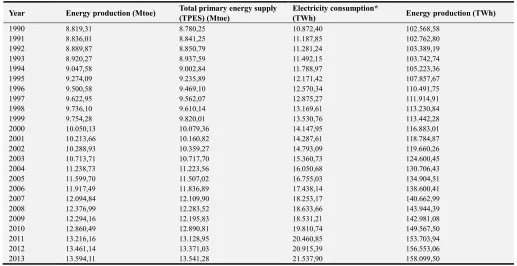
on the official records at the International Energy Agency (IEA) [52]. The historical data (year, energy production (Mtoe), total primary energy supply (TPES) (Mtoe), electricity consumption (TWh), energy production (TWh)) is gathered is gathered and presented in “Tab. 5”.
Table 5. Annual Electricity Demand of Global Grid Historical Data Calculation.
Year Energy production (Mtoe) Total primary energy supply (TPES) (Mtoe)
Electricity consumption*
(TWh) Energy production (TWh)
1990 8.819,31 8.780,25 10.872,40 102.568,58
1991 8.836,01 8.841,25 11.187,85 102.762,80
1992 8.889,87 8.850,79 11.281,24 103.389,19
1993 8.920,27 8.937,59 11.492,15 103.742,74
1994 9.047,58 9.002,84 11.788,97 105.223,36
1995 9.274,09 9.235,89 12.171,42 107.857,67
1996 9.500,58 9.469,10 12.570,34 110.491,75
1997 9.622,95 9.562,07 12.875,27 111.914,91
1998 9.736,10 9.610,14 13.169,61 113.230,84
1999 9.754,28 9.820,01 13.530,76 113.442,28
2000 10.050,13 10.079,36 14.147,95 116.883,01
2001 10.213,66 10.160,82 14.287,61 118.784,87
2002 10.288,93 10.359,27 14.793,09 119.660,26
2003 10.713,71 10.717,70 15.360,73 124.600,45
2004 11.238,73 11.223,56 16.050,68 130.706,43
2005 11.599,70 11.507,02 16.755,03 134.904,51
2006 11.917,49 11.836,89 17.438,14 138.600,41
2007 12.094,84 12.109,90 18.253,17 140.662,99
2008 12.376,99 12.283,52 18.633,66 143.944,39
2009 12.294,16 12.195,83 18.531,21 142.981,08
2010 12.860,49 12.890,81 19.810,74 149.567,50
2011 13.216,16 13.128,95 20.460,85 153.703,94
2012 13.461,14 13.371,03 20.915,39 156.553,06
2013 13.594,11 13.541,28 21.537,90 158.099,50
Note 1: Data & Information: International Energy Agency, Website:
http://www.iea.org/statistics/statisticssearch/report/?country=WORLD&product=indicators&year=Select, File:
http://www.iea.org/publications/freepublications/publication/KeyWorld_Statistics_2015.pdf, Year: 1990-2013, IEA File: Website, Accessed On: 31.01.2016, Unit converter http://www.iea.org/statistics/resources/unitconverter/.
Note 2: 2011 - 2014 World Population (both sexes combined, as of 1 July (thousands)) and 1950 - 1989 energy production (TWh) and 2014 data are not available, so that 1990 - 2010 period is selected for model fitting (green shading color) during data preprocessing.
There are two important assumptions and approximations in this output. First, the annual energy production (Mtoe: million tonnes of oil equivalent) data on the IEA [53] can represent the annual electricity consumption of%100 Global Grid. Second, the direct conversion of annual energy production (Mtoe) to the total global annual electricity demand (tera: T: 1012) can be made by the IEA's unit convertor [53].
As a result, two input variables and one output variable are defined and used accordingly with an international basis for this one node Mamdani [45, 46, 47] like FIS in this G2EDPS core module “Fig. 3”.
The data preprocessing (cleaning, integration, transformation, reduction) unit investigates the annual data for two inputs and one output from their data files. When all input and output annual historical data is available, they are marked as available (historical) (green shading color). When at least one of the input and output data is not available, they are marked as not available (historical). The earliest and latest year in these classified data are found and all of the data (year, inputs, output) are extracted as historical data for model fitting (i.e. tearliest.historical, tlatest.historical, t: year, inputt, outputt ϵ model
fitting set) of this G2EDPS core module (historical data set:
green shading color). The same approach is performed for the model prediction (blue shading color) of this G2EDPS core module (prediction data set: tearliest.prediction, tlatest.prediction) (“Fig.
3”, “Tab. 1”, “Tab. 2”, “Tab. 3”, “Tab. 4”, “Tab. 5”).
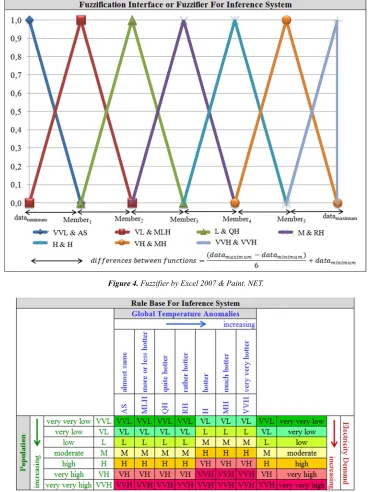
The fuzzification interface or fuzzifier unit of this core module works with 7 triangular MF based on the data preprocessing unit's outcomes (“Fig. 4”, “Fig. 5”). The minimum and maximum values for the input and output in the historical and prediction data set are found and used for the minimum and maximum of the fuzzy membership functions' values (dataminimum, datamaximum for inputs and dataminimum for
output). The maximum value of the output is calculated and defined as a sufficiently large value found by the linear regression approximation calculation (datamaximum for output:
largest regression value by all or some of the data). After the dataminimum, datamaximum for inputs and output is defined the
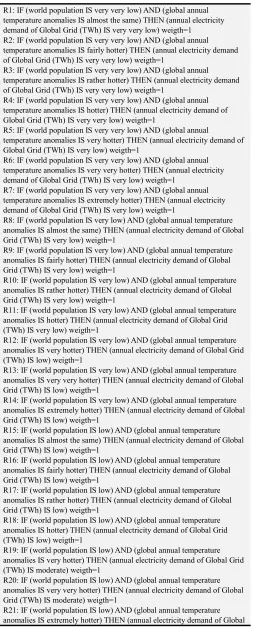
The rule base of the inference system or decision making unit has predefined 49 rules (fixed, permanent) as follows “Tab. 6”:
Table 6. GGED-SS-C-T1MFIS7TMF-2VPGATA-100YPP-2015 49 rules for 2 inputs and 1 output on Scilab 5.5.2 Script for Core Model.
R1: IF (world population IS very very low) AND (global annual temperature anomalies IS almost the same) THEN (annual electricity demand of Global Grid (TWh) IS very very low) weigth=1
R2: IF (world population IS very very low) AND (global annual temperature anomalies IS fairly hotter) THEN (annual electricity demand of Global Grid (TWh) IS very very low) weigth=1
R3: IF (world population IS very very low) AND (global annual temperature anomalies IS rather hotter) THEN (annual electricity demand of Global Grid (TWh) IS very very low) weigth=1
R4: IF (world population IS very very low) AND (global annual temperature anomalies IS hotter) THEN (annual electricity demand of Global Grid (TWh) IS very very low) weigth=1
R5: IF (world population IS very very low) AND (global annual
temperature anomalies IS very hotter) THEN (annual electricity demand of Global Grid (TWh) IS very low) weigth=1
R6: IF (world population IS very very low) AND (global annual temperature anomalies IS very very hotter) THEN (annual electricity demand of Global Grid (TWh) IS very low) weigth=1
R7: IF (world population IS very very low) AND (global annual temperature anomalies IS extremely hotter) THEN (annual electricity demand of Global Grid (TWh) IS very low) weigth=1
R8: IF (world population IS very low) AND (global annual temperature anomalies IS almost the same) THEN (annual electricity demand of Global Grid (TWh) IS very low) weigth=1
R9: IF (world population IS very low) AND (global annual temperature anomalies IS fairly hotter) THEN (annual electricity demand of Global Grid (TWh) IS very low) weigth=1
R10: IF (world population IS very low) AND (global annual temperature anomalies IS rather hotter) THEN (annual electricity demand of Global Grid (TWh) IS very low) weigth=1
R11: IF (world population IS very low) AND (global annual temperature anomalies IS hotter) THEN (annual electricity demand of Global Grid (TWh) IS very low) weigth=1
R12: IF (world population IS very low) AND (global annual temperature anomalies IS very hotter) THEN (annual electricity demand of Global Grid (TWh) IS low) weigth=1
R13: IF (world population IS very low) AND (global annual temperature anomalies IS very very hotter) THEN (annual electricity demand of Global Grid (TWh) IS low) weigth=1
R14: IF (world population IS very low) AND (global annual temperature anomalies IS extremely hotter) THEN (annual electricity demand of Global Grid (TWh) IS low) weigth=1
R15: IF (world population IS low) AND (global annual temperature anomalies IS almost the same) THEN (annual electricity demand of Global Grid (TWh) IS low) weigth=1
R16: IF (world population IS low) AND (global annual temperature anomalies IS fairly hotter) THEN (annual electricity demand of Global Grid (TWh) IS low) weigth=1
R17: IF (world population IS low) AND (global annual temperature anomalies IS rather hotter) THEN (annual electricity demand of Global Grid (TWh) IS low) weigth=1
R18: IF (world population IS low) AND (global annual temperature anomalies IS hotter) THEN (annual electricity demand of Global Grid (TWh) IS low) weigth=1
R19: IF (world population IS low) AND (global annual temperature anomalies IS very hotter) THEN (annual electricity demand of Global Grid (TWh) IS moderate) weigth=1
R20: IF (world population IS low) AND (global annual temperature anomalies IS very very hotter) THEN (annual electricity demand of Global Grid (TWh) IS moderate) weigth=1
R21: IF (world population IS low) AND (global annual temperature anomalies IS extremely hotter) THEN (annual electricity demand of Global
Grid (TWh) IS moderate) weigth=1
R22: IF (world population IS moderate) AND (global annual temperature anomalies IS almost the same) THEN (annual electricity demand of Global Grid (TWh) IS moderate) weigth=1
R23: IF (world population IS moderate) AND (global annual temperature anomalies IS fairly hotter) THEN (annual electricity demand of Global Grid (TWh) IS moderate) weigth=1
R24: IF (world population IS moderate) AND (global annual temperature anomalies IS rather hotter) THEN (annual electricity demand of Global Grid (TWh) IS moderate) weigth=1
R25: IF (world population IS moderate) AND (global annual temperature anomalies IS hotter) THEN (annual electricity demand of Global Grid (TWh) IS moderate) weigth=1
R26: IF (world population IS moderate) AND (global annual temperature anomalies IS very hotter) THEN (annual electricity demand of Global Grid (TWh) IS high) weigth=1
R27: IF (world population IS moderate) AND (global annual temperature anomalies IS very very hotter) THEN (annual electricity demand of Global Grid (TWh) IS high) weigth=1
R28: IF (world population IS moderate) AND (global annual temperature anomalies IS extremely hotter) THEN (annual electricity demand of Global Grid (TWh) IS high) weigth=1
R29: IF (world population IS high) AND (global annual temperature anomalies IS almost the same) THEN (annual electricity demand of Global Grid (TWh) IS high) weigth=1
R30: IF (world population IS high) AND (global annual temperature anomalies IS fairly hotter) THEN (annual electricity demand of Global Grid (TWh) IS high) weigth=1
R31: IF (world population IS high) AND (global annual temperature anomalies IS rather hotter) THEN (annual electricity demand of Global Grid (TWh) IS high) weigth=1
R32: IF (world population IS high) AND (global annual temperature anomalies IS hotter) THEN (annual electricity demand of Global Grid (TWh) IS high) weigth=1
R33: IF (world population IS high) AND (global annual temperature anomalies IS very hotter) THEN (annual electricity demand of Global Grid (TWh) IS very high) weigth=1
R34: IF (world population IS high) AND (global annual temperature anomalies IS very very hotter) THEN (annual electricity demand of Global Grid (TWh) IS very high) weigth=1
R35: IF (world population IS high) AND (global annual temperature anomalies IS extremely hotter) THEN (annual electricity demand of Global Grid (TWh) IS very high) weigth=1
R36: IF (world population IS very high) AND (global annual temperature anomalies IS almost the same) THEN (annual electricity demand of Global Grid (TWh) IS very high) weigth=1
R37: IF (world population IS very high) AND (global annual temperature anomalies IS fairly hotter) THEN (annual electricity demand of Global Grid (TWh) IS very high) weigth=1
R38: IF (world population IS very high) AND (global annual temperature anomalies IS rather hotter) THEN (annual electricity demand of Global Grid (TWh) IS very high) weigth=1
R39: IF (world population IS very high) AND (global annual temperature anomalies IS hotter) THEN (annual electricity demand of Global Grid (TWh) IS very high) weigth=1
R40: IF (world population IS very high) AND (global annual temperature anomalies IS very hotter) THEN (annual electricity demand of Global Grid (TWh) IS very very high) weigth=1
R41: IF (world population IS very high) AND (global annual temperature anomalies IS very very hotter) THEN (annual electricity demand of Global Grid (TWh) IS very very high) weigth=1
R42: IF (world population IS very high) AND (global annual temperature anomalies IS extremely hotter) THEN (annual electricity demand of Global Grid (TWh) IS very very high) weigth=1
temperature anomalies IS fairly hotter) THEN (annual electricity demand of Global Grid (TWh) IS very very high) weigth=1
R45: IF (world population IS very very high) AND (global annual temperature anomalies IS rather hotter) THEN (annual electricity demand of Global Grid (TWh) IS very very high) weigth=1
R46: IF (world population IS very very high) AND (global annual temperature anomalies IS hotter) THEN (annual electricity demand of Global Grid (TWh) IS very very high) weigth=1
R47: IF (world population IS very very high) AND (global annual temperature anomalies IS very hotter) THEN (annual electricity demand of Global Grid (TWh) IS very very high) weigth=1
R48: IF (world population IS very very high) AND (global annual temperature anomalies IS very very hotter) THEN (annual electricity demand of Global Grid (TWh) IS very very high) weigth=1 R49: IF (world population IS very very high) AND (global annual temperature anomalies IS extremely hotter) THEN (annual electricity demand of Global Grid (TWh) IS very very high) weigth=1
These predefined 49 rules are designed as unchangeable in the current design of this G2EDPS 1st core module (long term prediction console) (fixed, permanent).
The defuzzification interface or defuzzifier unit performs concurrently by all defuzzification methods (e. g. shortest of maximum, mean of maximum, bisector of area, centroide, largest of maximum). When new defuzzification methods will be presented in the literature, they will be integrated into the defuzzifier unit of this G2EDPS 1st core module.
The fuzzifier, rule base and surface graph of this G2EDPS 1st core module's model is presented in “Fig. 4”. “Fig. 5”. and “Fig. 6”.
Figure 4. Fuzzifier by Excel 2007 & Paint. NET.
Figure 6. Surface View GGED-SS-C-T1MFIS7TMF-2VPGATA-100YPP-2015, Fuzzy Logic Toolbox 0.4.6 Scilab 5.5.2 (sciFLT) & Paint. NET.
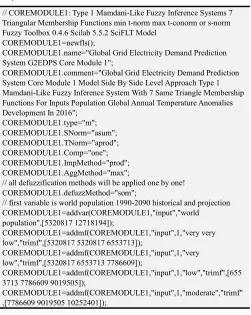
The main Scilab script is as follows “Tab. 7”:
Table 7. GGED-SS-C-T1MFIS7TMF-2VPGATA-100YPP-2015 Scilab 5.5.2 Script For Core Model.
// COREMODULE1: Type 1 Mamdani-Like Fuzzy Inference Systems 7 Triangular Membership Functions min t-norm max t-conorm or s-norm Fuzzy Toolbox 0.4.6 Scilab 5.5.2 SciFLT Model
COREMODULE1=newfls();
COREMODULE1.name="Global Grid Electricity Demand Prediction System G2EDPS Core Module 1";
COREMODULE1.comment="Global Grid Electricity Demand Prediction System Core Module 1 Model Side By Side Level Approach Type 1 Mamdani-Like Fuzzy Inference System With 7 Same Triangle Membership Functions For Inputs Population Global Annual Temperature Anomalies Development In 2016";
COREMODULE1.type="m"; COREMODULE1.SNorm="asum"; COREMODULE1.TNorm="aprod"; COREMODULE1.Comp="one"; COREMODULE1.ImpMethod="prod"; COREMODULE1.AggMethod="max";
// all defuzzification methods will be applied one by one! COREMODULE1.defuzzMethod="som";
// first variable is world population 1990-2090 historical and projection COREMODULE1=addvar(COREMODULE1,"input","world population",[5320817 12718194]);
COREMODULE1=addmf(COREMODULE1,"input",1,"very very low","trimf",[5320817 5320817 6553713]);
COREMODULE1=addmf(COREMODULE1,"input",1,"very low","trimf",[5320817 6553713 7786609]);
COREMODULE1=addmf(COREMODULE1,"input",1,"low","trimf",[655 3713 7786609 9019505]);
COREMODULE1=addmf(COREMODULE1,"input",1,"moderate","trimf" ,[7786609 9019505 10252401]);
COREMODULE1=addmf(COREMODULE1,"input",1,"high","trimf",[901 9505 10252401 11485298]);
COREMODULE1=addmf(COREMODULE1,"input",1,"very high","trimf",[10252401 11485298 12718194]);
COREMODULE1=addmf(COREMODULE1,"input",1,"very very high","trimf",[11485298 12718194 12718194]);
// second variable is global annual temperature anomalies 1990-2090 historical and projection
COREMODULE1=addvar(COREMODULE1,"input","global annual temperature anomalies",[0.15 4.81]);
COREMODULE1=addmf(COREMODULE1,"input",2,"almost the same","trimf",[0.15 0.15 0.93]);
COREMODULE1=addmf(COREMODULE1,"input",2,"fairly hotter","trimf",[0.15 0.93 1.71]);
COREMODULE1=addmf(COREMODULE1,"input",2,"rather hotter","trimf",[0.93 1.71 2.48]);
COREMODULE1=addmf(COREMODULE1,"input",2,"hotter","trimf",[1. 71 2.48 3.26]);
COREMODULE1=addmf(COREMODULE1,"input",2,"very hotter","trimf",[2.48 3.26 4.03]);
COREMODULE1=addmf(COREMODULE1,"input",2,"very very hotter","trimf",[3.26 4.03 4.81]);
COREMODULE1=addmf(COREMODULE1,"input",2,"extremely hotter","trimf",[4.03 4.81 4.81]);
//output variable is annual electricity demand of Global Grid TWh 1990-2010 historical
// projection is calculated by this module 2015-2090 with 5 to 10 years periods
COREMODULE1=addvar(COREMODULE1,"output","annual electricity demand of Global Grid (TWh)",[102569 325730]);
COREMODULE1=addmf(COREMODULE1,"output",1,"very very low","trimf",[102569 102569 139762]);
COREMODULE1=addmf(COREMODULE1,"output",1,"very low","trimf",[102569 139762 176956]);
9762 176956 214149]);
COREMODULE1=addmf(COREMODULE1,"output",1,"moderate","trimf ",[176956 214149 251343]);
COREMODULE1=addmf(COREMODULE1,"output",1,"high","trimf",[21 4149 251343 288536]);
COREMODULE1=addmf(COREMODULE1,"output",1,"very high","trimf",[251343 288536 325730]);
COREMODULE1=addmf(COREMODULE1,"output",1,"very very high","trimf",[288536 325730 325730]);
scf();clf();
plotvar(COREMODULE1,"input",[1 2]); scf();clf();
plotvar(COREMODULE1,"output",1);
COREMODULE1=addrule(COREMODULE1,[ 1 1 1 1 1; 1 2 1 1 1; 1 3 1 1 1; 1 4 1 1 1; 1 5 2 1 1; 1 6 2 1 1; 1 7 2 1 1; 2 1 2 1 1; 2 2 2 1 1; 2 3 2 1 1; 2 4 2 1 1; 2 5 3 1 1; 2 6 3 1 1; 2 7 3 1 1; 3 1 3 1 1; 3 2 3 1 1; 3 3 3 1 1; 3 4 3 1 1; 3 5 4 1 1; 3 6 4 1 1; 3 7 4 1 1; 4 1 4 1 1; 4 2 4 1 1; 4 3 4 1 1; 4 4 4 1 1; 4 5 5 1 1; 4 6 5 1 1; 4 7 5 1 1; 5 1 5 1 1; 5 2 5 1 1; 5 3 5 1 1; 5 4 5 1 1; 5 5 6 1 1; 5 6 6 1 1; 5 7 6 1 1; 6 1 6 1 1; 6 2 6 1 1; 6 3 6 1 1; 6 4 6 1 1; 6 5 7 1 1; 6 6 7 1 1; 6 7 7 1 1; 7 1 7 1 1; 7 2 7 1 1; 7 3 7 1 1; 7 4 7 1 1; 7 5 7 1 1; 7 6 7 1 1; 7 7 7 1 1])
printrule(COREMODULE1);
Note 1: Script for Smallest Of Max in Scilab 5.5.2 (Fuzzy Logic Toolbox 0.4.6 Scilab 5.5.2 (sciFLT)): see COREMODULE1. defuzzMethod="som" Note 2: For Mean Of Max COREMODULE1. defuzzMethod="mom"; Bisector "bisector"; Centroide "centroide"; Largest Of Maximum "lom" script lines and codes are used instead of "som".
Note 3: open electronic supplementary files COREMODULE1bisector. fls, "centroide", "lom", "mom", "som".
This G2EDPS 1st core module works with a common global unique forecast accuracy metrics pool, which includes the prediction scale-dependent error metrics (e. g. Mean Absolute Error: MAE, Geometric Mean Absolute Error: GMAE, Mean Square Error: MSE), percentage error metrics (e. g. Minimum Absolute Percentage Error: MinAP, Maximum Absolute Percentage Error: MAP, Mean Absolute Percentage Error: MAPE, symmetric MAPE: SMAPE), relative error metrics (e. g. Median Relative Absolute Error: MdRAE, Geometric Mean Relative Absolute Error: GMRAE), scale-free error metrics (e. g. Mean Absolute Scaled Error: MASE) [54, 55, 56, 57, 58]. The current version of the forecast accuracy metrics pool covers the following error metrics. Nowadays, they are calculated by Microsoft Office Excel [16] or Apache OpenOffice Calc [17]:
Forecast Errors:
= − (1) Mean Absolute Error (MAE):
= ∑ | | (2)
Geometric Mean Absolute Error (GMAE):
= ∏ | | / (3)
Mean Square Error (MSE):
= ∑ (4)
Absolute Percentage Errors (APE):
= | !"#$%&'() ()$|
!"#$ (5)
Minimum Absolute Percentage Error (MinAP):
* = + * (6)
Maximum Absolute Percentage Error (MAP):
= + , (7)
Mean Absolute Percentage Error (MAPE):
= ∑ (8)
Symmetric MAPE:
= ∑ |&'() ()$% !"#$|
-|./0123$01|$4|53$678|$9 : (9)
Relative Error:
= ($
(∗$ (10)
Median Relative Absolute Error (MdRAE):
< = + * | | (11)
Geometric Mean Relative Absolute Error (GMRAE):
< = ∏ | | / (12)
where Actual, Predicted, t, n, * represents respectively historical annual electricity demand of the Global Grid, forecasted/predicted annual electricity demand of the Global Grid, year, total number of years and benchmark model.
This G2EDPS 1st core module has a best core model defuzzifier selection unit. The minimum SMAPE valued defuzzification model is first selected for the predictions. The minimum MAPE and MAP valued ones are selected after the minimum SMAPE valued ones. If there are more than one minimum SMAPE, MAPE and MAP valued models, all of them will be run for the 100 year projections.
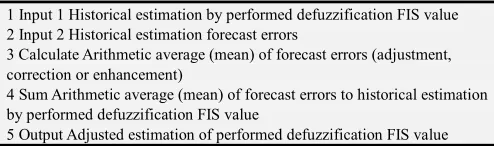
The G2EDPS 1st core module has 10 extension modules. These extensions try to find some model fitting improvements by some simplistic procedures (adjustment, correction or enhancement) based on the arithmetic average, mode, median, minimum, maximum and percentage of the forecast errors and absolute forecast errors. The first procedure calculates the arithmetic average (mean) of the forecast errors (et) and sum the prediction values with this
calculated value. The second and third procedures work with the most repeated, observed, frequent value (mode) and the mid value (median) of the forecast errors (et) and the
summation operator. The fourth and fifth procedures find the minimum and maximum of the absolute forecast errors (|et|)
and sum the prediction values with the non-absolute values. The sixth procedure calculates the arithmetic average of the percentage values (actualt/predictedt) and multiply by this
(“Tab. 8”) is presented for only the first one as representative for each one (all of them):
Table 8. First extension module adjustment, correction or enhancement procedure (general procedure, free of coding and scripting languages).
1 Input 1 Historical estimation by performed defuzzification FIS value 2 Input 2 Historical estimation forecast errors
3 Calculate Arithmetic average (mean) of forecast errors (adjustment, correction or enhancement)
4 Sum Arithmetic average (mean) of forecast errors to historical estimation by performed defuzzification FIS value
5 Output Adjusted estimation of performed defuzzification FIS value
Note 1: 10 extension modules have their own procedures. Note 2: open electronic supplementary files for these modules
There is also a small best core model extensions model selection unit working with the same principles of the G2EDPS 1st best core model defuzzifier selection unit (“Fig. 3”).
4. Analysis and Results (Module Fitting
& 100 Year Forecasting)
The first input variable's historical data (1950-2010) and future projection (2015-2100) are directly gathered from the UN (see [48]). The historical and future projection data will concurrently be updated with the UN (1950-2010→1950-2011 and so on; 2015-2100→2020-2105). The second input variable's historical data (1880-2015) is taken from the NASA (see [50]). Its future projection data (2010-2090) is gathered from the IPCC Annex II: Climate System Scenario Tables, Table AII.7.5. (see [51]). The historical and future projection data will concurrently be updated with the NASA, and the IPCC (1880-2015→1880-2016 and so on; 2010-2090→2020-2100). The output variable's historical
data (1990-2013) is based on the official records at the IEA (see [52]). The Fuzzy Toolbox 0.4.6 for the Scilab 5.5.2 (sciFLT) [13] is used for the FIS computations. The model fitting or historical prediction report is gathered by sciFLT [13], Excel [16], Calc [17] (“Tab. 9”.). The shortest of maximum defuzification method is selected for future forecasting/prediction based on the best core model defuzzifier selection unit (“Tab. 9”). The bisector and centroide defuzification methods presents errors, so that they are eliminated during the analysis (open electronic supplementary files).
Table 9. Forecast accuracy metrics (performance measures) for G2EDPS 1st
core model.
Accuracy Metrics shortest of maximum
mean of maximum
largest of maximum
MAE 9032 14345 148778
GMAE 3004 5441 139665
MSE 3524780760 15975083517 564777853326
MinAP 0,00 0,00 -100,07
MAP 0,24 1,09 896,12
MAPE 0,08 0,13 44,07
SMAPE 0,05 0,07 1,01
Note 1: The best performance is selected by the best core model defuzzifier selection unit (yellow shading color)
Note 2: open electronic supplementary files
The G2EDPS 1st core model 10 extension modules are run on Excel [16], Calc [17] for model fitting. 2nd and 7th extensions can't present any numerical value in this study, because of their approaches (error for division by zero in current data set). Other extensions can work on the current data values and their performance measures are calculated by Excel [16], Calc [17]. Only 8th extension approach gives better performance in this study. The model fitting predictions are presented in “Fig. 7”.
According to this model fitting study of the G2EDPS 1st core model and its extensions, the best core model (shortest of maximum) and its 8th extension are run for 2015, 2020, 2030, 2040, 2050, 2060, 2070, 2080 and 2090 for global population (Lower95, Lower80, Median, Upper80, Upper95) according to the UN (see [48]) and global annual temperature anomalies (5%,
17%, 50%, 83%, 95% predictions for each RCP2.6, RCP4.5, RCP6.0, RCP8.5, SRES A1B) according to the IPCC (see [51]). The 100 year forecast report is plotted for as such 2015, 176212; 2020, 176212; 2030, 176212; 2040, 214150; 2050, 214150; 2060, 214150; 2070, 252087; 2070, 252087; and 2090, 214150 by R [14], RStudio [15] (“Figure 8”, “Table 10”).
Table 10. RStudio Version 0.99.491 Scripts historical (top), projection (bottom).
Year.Historical=c(1990,1991,1992,1993,1994,1995,1996,1997,1998,1999, 2000,2001,2002,2003,2004,2005,2006,2007,2008,2009,2010)
World.Electricity.Demand.TWh.Historical=c(102568.58,102762.80,10338 9.19,103742.74,105223.36,107857.67,110491.75,111914.91,113230.84,11 3442.28,116883.01,118784.87,119660.26,124600.45,130706.43,134904.51 ,138600.41,140662.99,143944.39,142981.08,149567.50)
World.Electricity.Demand.TWh.Historical.Prediction.G2EDPS.CoreModul eSOM=c(102569.00,104800.61,104800.61,104800.61,104800.61,104800.6 1,104800.61,104800.61,140506.37,140506.37,140506.37,140506.37,14050 6.37,140506.37,140506.37,140506.37,140506.37,140506.37,140506.37,14 0506.37,140506.37)
World.Electricity.Demand.TWh.Historical.Prediction.G2EDPS.CoreModul eSOM.Extension8=c(101187.6327,103389.1881,103389.1881,103389.188 1,103389.1881,103389.1881,103389.1881,103389.1881,138614.0741,1386 14.0741,138614.0741,138614.0741,138614.0741,138614.0741,138614.074 1,138614.0741,138614.0741,138614.0741,138614.0741,138614.0741,1386 14.0741)
plot(Year.Historical, World.Electricity.Demand.TWh.Historical, xlab="Year (historical)", ylab="World Electricity Demand (TWh) (historical)", pch=1, col="darkgreen")
points(Year.Historical,World.Electricity.Demand.TWh.Historical.Predictio n.G2EDPS.CoreModuleSOM, pch=2, col="green")
points(Year.Historical,World.Electricity.Demand.TWh.Historical.Predictio n.G2EDPS.CoreModuleSOM.Extension8, pch=3, col="green")
legend(1990,135000,c("World Electricity Demand (TWh) (historical)","Prediction G2EDPS Core Module SOM"," Prediction G2EDPS Core Module Extension 8"),col=c(1,2,3),pch=c(1,2,3)) *********************************************************** Year.Prediction=c(2015,2020,2030,2040,2050,2060,2070,2080,2090) World.Electricity.Demand.TWh.Prediction=c(176212,176212,176212,2141 50,214150,214150,252087,252087,214150)
plot(Year.Prediction, World.Electricity.Demand.TWh.Prediction, xlab="Year (prediction)", ylab="World Electricity Demand (TWh) (prediction)", pch=1, col="blue")
points(Year.Prediction,World.Electricity.Demand.TWh.Prediction, pch=3, col="blue")
legend(2020,200000,c("World Electricity Demand (TWh)(prediction)"),col=c(4),pch=c(3))
4. Conclusions
This paper presents the concepts of G2PS, G2EDPS, G2P3S and the details of designed G2EDPS 1st core module's forecasting model and its extensions. This RD3 study shall continue for reaching new enhancements of this module and designing new modules and extensions.
It is believed and hoped that the concepts of G2PS, G2EDPS, G2P3S can be developed under the Open Source Initiative (OSI) (see [59]) and the Free Software Foundation (FSF) (see [60]) approaches by freewill supportive RD3 engineers from all over the world.
Acknowledgements
The author would sincerely like to express his deepest thankfulness to The Beneficent, The All-Compassionate and to Bernadetta Kwintiana Ane, Reto A. Ruedy, Pierre Boileau, Riswan Efendi for guidance and help.
References
[1] Friends of the Supergrid, “Roadmap to the Supergrid Technologies Final Report 2012”
http://www.cesi.it/news_ideas/ideas/Documents/FOSG%20% 20WG2%20Final-report.pdf (2012).
[2] Chatzivasileiadis S, Ernst D, and Andersson G, “The Global Grid, Renewable Energy”, Vol.57, pp.372–383 (2013) doi:10.1016/j.renene.2013.01.032.
[3] Overbye, T. J., Starr, C., Grant, P. M., and Schneider, T. R., “National Energy Supergrid Workshop Report. Crowne Plaza Cabana Palo Alto Hotel, Palo Alto, California”. www.supergrid.illinois.edu/sg1/SuperGridReportFinal.pdf. (2002)
[4] DESERTEC Foundation: http://www.desertec.org/ accessed by 11/06/2015. (2015)
[5] Mano, S., Ovgor, B., Samadov, Z., Pudlik, M., Jülch, V., Sokolov, D., and Yoon, J. Y., “Gobitec and Asian Super Grid for renewable energies in Northeast Asia. Spotinov print Ltd.” (2014)
[6] Seliger, B., and Kim, G. E., “Tackling climate change, increasing energy security, engaging North Korea and moving forward Northeast Asian integration – “Green Growth” in Korea and the Gobitec project. Gobitec Outline Paper 1-03 10112009.” (2009)
[7] Saracoglu B. O, “Global Grid Prediction Systems”, ResearchGate DOI: 10.13140/RG.2.1.3575.3040, 2016. [8] Soliman S. A, and Al-Kandari A M, “Electrical load
forecasting: modeling and model construction (Elsevier)” (2010).
[9] Makridakis, S., Wheelwright, S.: Integrating forecasting and planning. Long Range Planning, Vol:6, No:3, pp.53–63. (1973) [10] Das, J. K.: Statistics for Business Decisions, Academic
Publishers, Bhawani Dutta Lane, Kolkata. (2012)
[11] Jain, C. L., Malehorn, J. eds.: Practical guide to business forecasting. Institute of Business Forec. (2005)
[12] Chaturvedi, D. K.: Soft computing: techniques and its applications in electrical engineer-ing. Vol. 103. Springer. (2008)
[13] Scilab (Scilab 5.5.2), http://www.scilab.org/ (accessed 02/02/2016), 2016.
[14] R (R version 3.2.2), https://www.r-project.org/ (accessed 02/02/2016), 2016.
[15] RStudio (RStudio Version 0.99.491), https://www.rstudio.com/ (accessed 02/02/2016), 2016
[16] Microsoft Office Excel (Microsoft Office 2007), https://products.office.com/en-in/excel (accessed 02/02/2016), 2016
[17] Apache OpenOffice Calc (Apache OpenOffice 4.1.2), http://www.openoffice.org/product/calc.html (accessed 02/02/2016), 2016
[19] ASCE Online Research Library, http://ascelibrary.org/ [20] American Society of Mechanical Engineers,
http://asmedigitalcollection.asme.org/
[21] Cambridge Journals Online, http://journals.cambridge.org [22] Directory of Open Access Journals, http://doaj.org [23] Emerald Insight, http://www.emeraldinsight.com/ [24] Google Scholar, http://scholar.google.com.tr/
[25] Hindawi Publishing Corporation, http://www.hindawi.com/ [26] Inderscience Publishers, http://www.inderscience.com/ [27] Journal of Industrial Engineering and Management,
http://www.jiem.org/index.php/jiem
[28] Science Direct, http://www.sciencedirect.com [29] Springer, http://www.springer.com/gp/ [30] Taylor & Francis Online/Journals,
http://www.tandfonline.com/
[31] Wiley-Blackwell/Wiley Online Library, http://onlinelibrary.wiley.com/
[32] World Scientific Publishing, http://www.worldscientific.com/ [33] More, B. R.: Electric Load Forecasting in Smart Grid
Environment and Classification of Methods. International Journal of Scientific & Engineering Research, Vol: 5, No: 7, pp.49–52. (2014).
[34] Kaur, J., Brar, Y. S.: Short Term Load Forecasting using Fuzzy Logic of 220kV Transmission Line At PSTCL 220kV Sub-Station Pakhowal, Ludhiana, Punjab. International Journal of Engineering Research & Technology, Vol: 3, No: 9, pp.336– 343. (2014).
[35] Ciabattoni, L., Grisostomi, M., Ippoliti, G., Longhi, S.: A Fuzzy Logic Tool for Household Electrical Consumption Modeling, Industrial Electronics Society, IECON 2013 - 39th Annual Conference of the IEEE, pp. 8022– 8027. (2013). [36] Sachdeva, S., Singh, M., Singh, U. P., Arora, A. S.: Efficient
Load Forecasting Optimized by Fuzzy Programming and OFDM Transmission. Advances in Fuzzy Systems, Vol: 2011, Article ID 326763, doi: 10.1155/2011/326763 (2011). [37] Aggarwal, S. K., Kumar, M., Saini, L. M., Kumar, A.:
Short-Term Load Forecasting in Deregulated Electricity Markets using Fuzzy Approach. Journal of Engineering and Technology, Vol: 1, No: 1, pp.24–30. (2015).
[38] Moreno-Chaparro, C., Salcedo-Lagos, J., Rivas, E. yOrjuela Canon, A.: A method for the monthly electricity demand forecasting in Colombia based on wavelet analysis and a nonlinear autoregressive model. Ingeniería, Vol.16, No.2, pp.94–106. (2011).
[39] Arfoa, A. A.: Long-Term Load Forecasting of Southern Governorates of Jordan Distribution Electric System. Energy and Power Engineering, Vol.7, 242–253. (2015).
[40] Arif, M., Nadeem, T., Ali, H., Ali, S. W., Khalid, U., Baseer, M.: Short Term Load Forecasting Solution Methodologies: Literature Review 2013 Survey Paper. IOSR Journal of Electrical and Electronics Engineering, Vol: 9, No: 3, pp. 44– 47. (2014).
[41] Al-zahra, K. A., Moosa, K., Jasim, B. H.: A comparative Study of Forecasting the Electrical Demand in Basra city using Box-Jenkins and Modern Intelligent Techniques. Iraq Journal Electrical and Electronic Engineering, Vol. 11, No. 1, pp. 97– 110. (2015).
[42] Tasaodian, B., Anvarian, N., Azadeh, A., Saberi, M.: An Adaptive-Network-Based Fuzzy Inference System for Long-Term Electricity Consumption Forecasting (2008-2015): A Case Study of the Group of Eight (G8) Industrialized Nations: U. S. A, Canada, Germany, United Kingdom, Japan, France and Italy. The 11th Asia Pacific Industrial Engineering and Management Systems Conference, The 14th Asia Pacific Regional Meeting of International Foundation for Production Research. pp. 1–12. (2010).
[43] Azadeh, A., Saberi, M., Nadimi, V., Iman, M., Behrooznia, A.: An Integrated Intelligent Neuro-Fuzzy Algorithm for Long-Term Electricity Consumption: Cases of Selected EU Countries. Acta Polytechnica Hungarica, Vol.7, No.4, pp.71–90. (2010). [44] Bazmi, A. A., Davoody, M., Zahedi, G.: Electricity Demand
Estimation Using an Adaptive Neuro-Fuzzy Network: A Case Study from the State of Johor, Malaysia: 1st Congress on Applied Chemical Sciences International Conference on Energy and Environmental-ICEE (2012).
[45] Mamdani E. H, “Application of fuzzy algorithms for control of simple dynamic plant, Proceedings of the Institution of Electrical Engineers”, Vol.121, No.12, pp.1585–1588, (1974). [46] King P. J, and Mamdani E. H, “The application of fuzzy control
systems to industrial processes”. Automatica, Vol.13, No.3, pp.235-242, (1977).
[47] Kaur A, & Kaur A, Comparison of Mamdani-Type and Sugeno-Type Fuzzy Inference Systems for Air Conditioning System, International Journal of Soft Computing and Engineering (IJSCE), 2 2, (2012).
[48] United Nations Department of Economic and Social Affairs, Population Division Population Estimates and Projections Section, World Population Prospects: The 2012 Revision Excel Tables-Population Data (2016).
[49] GISS Surface Temperature Analysis,
http://data.giss.nasa.gov/gistemp/abs_temp.html (2016). [50] NASA Goddard Institute for Space Studies Laboratory, Earth
Sciences Division, National Aeronautics and Space Administration, Goddard Space Flight Center (2016).
[51] IPCC, 2013: Annex II: Climate System Scenario Tables [Prather, M., G. Flato, P. Friedlingstein, C. Jones, J.-F. Lamarque, H. Liao and P. Rasch (eds.)]. In: Climate Change 2013: The Physical Science Basis. Contribution of Working Group I to the Fifth Assessment Report of the Intergovernmental Panel on Climate Change [Stocker, T. F., D. Qin, G.-K. Plattner, M. Tignor, S. K. Allen, J. Boschung, A. Nauels, Y. Xia, V. Bex and P. M. Midgley (eds.)]. Cambridge University Press, Cambridge, United Kingdom and New York, NY, USA (2013).
[52] The International Energy Agency, Statistics, World Indicators (2016).
[53] The International Energy Agency, Unit Converter (2015). [54] Armstrong J S & Collopy F, Error measures for generalizing
[55] Hyndman R J, Another look at forecast-accuracy metrics for intermittent demand. Foresight: The International Journal of Applied Forecasting, 4 4 (2006) 43-46.
[56] Kolassa S & Martin R, Percentage Errors Can Ruin Your Day (and Rolling the Dice Shows How). Foresight: The International Journal of Applied Forecasting, 23 (2011). [57] Makridakis S, Hogarth R M & Gaba A, Why forecasts fail.
What to do instead. MIT Sloan Management Review, 51 2 (2010) 83.
[58] Institute for Research and Applications of Fuzzy Modeling, University Ostrava, Computational Intelligence in Forecasting (CIF) 2016.
[59] Open Source Initiative (OSI), http://opensource.org/ (accessed 02/02/2016), 2016
![Figure 1. Global Grid* (see [2], basemap by the Johomaps http://www.johomaps.com/, generated by Apache OpenOffice 4.1.1 Draw http://www.openoffice.org/ & Paint.NET http://www.getpaint.net/index.htm) (*not to scale, fictitious and for information purposes o](https://thumb-us.123doks.com/thumbv2/123dok_us/1159017.1618051/2.595.52.545.78.361/johomaps-generated-openoffice-openoffice-getpaint-fictitious-information-purposes.webp)
![Figure 2. Literature review summary (1: ACM Digital Library-ACM [18], 2: ASCE Online Research Library-ASCE [19], 3: American Society of Mechanical](https://thumb-us.123doks.com/thumbv2/123dok_us/1159017.1618051/3.595.92.507.87.661/literature-digital-library-research-library-american-society-mechanical.webp)