Use of a Computerized Decision Aid for ADHD
Diagnosis: A Randomized Controlled Trial
WHAT’S KNOWN ON THIS SUBJECT: Despite the existence of authoritative guidelines to assist primary care physicians in identifying and managing attention-deficit/hyperactivity disorder (ADHD), ample evidence demonstrates that they continue to diagnose and treat this disorder suboptimally.
WHAT THIS STUDY ADDS: The introduction of a clinical decision support module resulted in higher quality of care with respect to ADHD diagnosis including a prospect for higher quality of ADHD management in children.
abstract
OBJECTIVE:To determine if implementing attention-deficit/hyperactivity disorder (ADHD) diagnosis and treatment guidelines in a clinical decision support system would result in better care, including higher rates of adherence to clinical care guidelines.
METHODS: We conducted a cluster randomized controlled trial in which we compared diagnosis and management of ADHD in 6- to 12-year-olds after implementation of a computer decision support system in 4 practices.
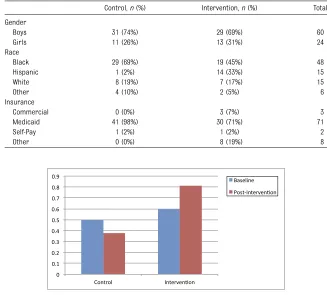
RESULTS:Eighty-four charts were reviewed. In the control group, the use of structured diagnostic assessments dropped from 50% in the baseline period to 38% in the intervention period. In the intervention group, however, it rose from 60% to 81%. This difference was statis-tically significant, even after controlling for age, gender, and race (odds ratio of structured diagnostic assessment in intervention group versus control group = 8.0, 95% confidence interval 1.6–40.6). Significant differences were also seen in the number of ADHD core symptoms noted at the time of diagnosis. Our study was not powered to detect changes in care and management, but the percent of patients who had documented medication adjustments, mental health referrals, and visits to mental health specialists were higher in the intervention group than the control.
CONCLUSIONS:The introduction of a clinical decision support module resulted in higher quality of care with respect to ADHD diagnosis in-cluding a prospect for higher quality of ADHD management in children. Future work will examine how to further develop the ADHD module and add support for other chronic conditions. Pediatrics2013;132:e623– e629
AUTHORS:Aaron E. Carroll, MD, MS,a,bNerissa S. Bauer,
MD, MPH,aTamara M. Dugan,aVibha Anand, MS, PhD,a,b
Chandan Saha, PhD,cand Stephen M. Downs, MD, MSa,b
aChildren’s Health Services Research, andcDepartment of
Biostatistics, Indiana University School of Medicine, Indianapolis, Indiana;bThe Regenstrief Institute for Health Care, Indianapolis,
Indiana; anddRichard M. Fairbanks School of Public Health,
Indiana University, Indianapolis, Indiana
KEY WORDS
ADHD, CHICA, screening, computer decision support system
ABBREVIATIONS
ADHD—attention-deficit/hyperactivity disorder CDSS—clinical decision support system
CHICA—Child Health Improvement through Computer Automation EMR—electronic medical record
RMRS—Regenstrief Medical Record System
Dr Carroll conceptualized and designed the study and drafted the initial manuscript; Dr Bauer assisted in the
conceptualization and design of the study, assisted in acquisition of the data, and critically reviewed the manuscript; Ms Dugan coordinated and supervised data collection and critically reviewed the manuscript; Dr Anand assisted in the conceptualization and design of the study and critically reviewed the manuscript; Dr Saha carried out the initial analyses and reviewed and revised the manuscript; Dr Downs assisted in conceptualization and design of the study and reviewed and revised the manuscript; and all authors approved thefinal manuscript as submitted.
This trial has been registered at www.clinicaltrials.gov (identifier NCT01351064).
www.pediatrics.org/cgi/doi/10.1542/peds.2013-0933
doi:10.1542/peds.2013-0933
Accepted for publication Jun 21, 2013
Address correspondence to Aaron E. Carroll MD, MS, 410 West 10th St, HITS 1020, Indianapolis, IN 46202. E-mail: aaecarro@iupui. edu
PEDIATRICS (ISSN Numbers: Print, 0031-4005; Online, 1098-4275).
Copyright © 2013 by the American Academy of Pediatrics
FINANCIAL DISCLOSURE:The authors have indicated they have nofinancial relationships relevant to this article to disclose.
FUNDING:This project was supported by grant 5R01LM010031 from the National Library of Medicine. Funded by the National Institutes of Health (NIH).
POTENTIAL CONFLICT OF INTEREST:The authors have indicated they have no potential conflicts of interest to disclose.
nosed pediatric behavioral disorder.1 The gold standard for diagnosis is standardized assessments of behavior based on specific diagnostic criteria defined in theDiagnostic and Statisti-cal Manual of Mental Disorders.2 Be-cause there is no definitive diagnostic test for ADHD, diagnosis can be diffi -cult. The core symptoms that char-acterize the disorder (inattention, hyperactivity, and impulsivity) lie on a spectrum; moreover, many other medical, psychiatric, and learning conditions can present with similar symptoms.2,3
Primary care physicians, especially pediatricians, have historically played a large role in the diagnosis and treatment of ADHD.4,5Despite the exis-tence of authoritative guidelines to assist primary care physicians,6–10 ample evidence demonstrates that they continue to diagnose and treat this disorder suboptimally.2,11–13This is due, in part, to a lack of training and cumbersome delivery system designs.14 Modern computer decision support strategies offer the best hope of equip-ping general practitioners to deal with the mental health epidemic of ADHD.
We have developed a novel computer decision support system (CDSS) for implementing clinical guidelines in pediatric practice. The CHICA (Child Health Improvement through Computer Automation) system collects informa-tion directly from patients, delivers “just-in-time” patient-relevant guide-lines to physicians during the clinical encounter, and accurately captures structured data from all who interact with it. Previous work with CHICA has demonstrated the feasibility of using the system to implement and evaluate clinical guidelines,15,16In 2010, we en-hanced the CHICA system to include the American Academy of Pediatrics guidelines to assist physicians in the
delivery of ADHD guidelines via a CDSS would result in better care, specifically higher rates of adherence to clinical care guidelines and improved patient functioning.
METHODS
Setting
This study took place in 4 primary care practices in the Indiana University Medical Group-Primary Care practice network. In 2010, these 4 clinics hosted 37 425 patient visits. Of these, 77% to 88% of visits were for pediatric pa-tients who were on Medicaid. Two of these clinics served as intervention sites, and the other 2 clinics functioned as control sites. This study took place between 2010 and 2012.
Participants
Patients between the ages of 5 and 12 years were automatically placed into either the control or intervention group based on which of the 4 pediatric clinics they attended. No potential subjects were contacted by researchers, their physician, or other staff personnel re-garding the study.
Study Design
We conducted a cluster randomized controlled trial in which we compared diagnosis of ADHD in the intervention practices to the control practices. The 2 intervention clinics used the “ en-hanced”CHICA system, which included guidelines for ADHD diagnosis and management (ie, the ADHD module), and the 2 control clinics used the “traditional”CHICA system that did not include ADHD guidelines. To achieve randomization, the 4 clinics were ranked by their size, where size was defined by the number of physicians and residents in the clinic. At random-ization, thefirst and last ranked clinics
assigned to the other group (control). In total, there were 60 clinicians prac-ticing at the 2 intervention sites, and 50 clinicians practicing at the 2 control sites.
Although randomization at the physi-cian or patient level may have been sample-size efficient, we chose to ran-domize by clinic because contamination was a major concern. If we randomized at the physician level, physicians in the same clinic who were assigned to dif-ferent treatment arms might com-municate regarding the CHICA ADHD module in terms of its operation and consequences. Similarly, if we random-ized at the patient level, the on-and-off use of the CHICA ADHD module might confuse or frustrate the physician and even lead some physicians to think that CHICA was malfunctioning. We have found previously that randomization at the patient level can lead to irritation and inconvenience for both physicians and clinic staff.18
CHICA System
to a child’s age and data stored in the child’s EMR, the Regenstrief Medical Record System (RMRS).16 The RMRS contains additional information, such as diagnostic codes, physician orders,
filled prescriptions, and laboratory data from the statewide health in-formation exchange, the Indiana Net-work for Patient Care.22
Intervention: The CHICA ADHD Module
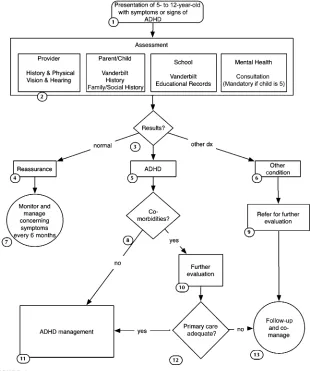
The functioning of the CHICA ADHD module is described in Fig 1 and is based on the American Academy of Pediatrics guidelines to assist physi-cians in the diagnosis6and treatment17 of ADHD. Thefirst step concerned case
finding. On the prescreening form, par-ents of children 5 to 12 years of age were asked the following 3 screening questions:
Does [CHILD’S NAME] OFTEN make careless mistakes or not pay close attention to details, causing prob-lems at home or school? Does [CHILD’S NAME] OFTEN have difficulty remaining seated when asked to do so, causing problems at home or school? Does [CHILD’S NAME] OFTEN have a hard time paying attention to tasks or play, causing problems at home or school?Positive answers to any of these 3 screening questions alerted CHICA to
potential ADHD. Additionally, the CHICA system was also programed to de-termine whether the child had a pre-vious diagnosis of ADHD by looking for the presence of ADHD diagnostic codes in the patient’s EMR. In the control group, screening was left to the dis-cretion of the physician. No screening questions were included on the pre-screening form for parents to answer in the control group.
The diagnosis of ADHD requires a com-bination of symptoms including inat-tention, distractibility, or hyperactivity that impairs the child’s function in.1 setting. One of the most practical ways to assess these criteria is to have the family complete a standardized instru-ment, for example, the National Initia-tive for Children’s Healthcare Quality ADHD Vanderbilt Assessment Scales.23 To achieve this, the CHICA ADHD mod-ule automatically printed customized and scannable Vanderbilt assessment scales. The Vanderbilt assessment scales were printed if a child was suspected of having ADHD based on parent an-swers to the screening questions. Ad-ditionally, the Vanderbilt assessment scales were printed at appropriate intervals for those children already diagnosed with ADHD based on the child’s age and based on information contained in their EMR. For example, if a follow-up assessment was needed, CHICA would automatically print the parent and teacher follow-up Vander-bilt forms.
The CHICA ADHD module also instructed the physician in the proper distribution and completion of the Vanderbilt forms. For example, the parent assessment forms were completed by the family in the waiting room and scanned in during the office visit; in rare cases, they were faxed directly to the CHICA system. The teacher Vanderbilt assessment forms were given to the family and could be faxed by the teacher to a standard phone number in the CHICA system.
FIGURE 1
Algorithm of diagnosis under the CHICA ADHD module.
by CHICA and recorded in the system. As a convenience for the clinician, CHICA generated a summary sheet with all subscores and interpretations from each assessment form. The interpre-tations were also made available as prompts on the physician worksheet at subsequent follow-up visits.
The CHICA ADHD module also made treatment recommendations based on established guidelines. This included appropriate starting doses for med-ications and suggested medication changes if treatment goals were not met. As an aid for the clinician, the patient and family, and teachers, CHICA also provided age-appropriate“ just-in-time”handouts that included behavior management suggestions.
Main Outcomes
We used manual chart abstractions to assess each practice’s adherence to clinical care guidelines before and af-ter implementing the CHICA ADHD mod-ule. Data collection began 6 months after the CHICA ADHD Module was turned on in the CHICA system, and data collection occurred until 6 months after the last patient included was di-agnosed with ADHD. Data were col-lected on a revised version of a data abstraction form, which was developed for previous studies by members of our research group.12Research assistants were trained on the use of this form by the study investigators. Our primary outcome of interest was the percent-age of patients who were diagnosed with ADHD who had a completed struc-tured diagnostic assessment, defined as an initial Vanderbilt rating scale completed by both the parent and the teacher, before the diagnosis of ADHD being assigned. The number of core symptoms noted at the time of diag-nosis was also recorded during the chart review process. Other data were
of symptoms, medication adjustments, and mental health referrals. A random sample (20%) of the charts was ab-stracted twice to assess the reliability of chart abstraction. The agreement on overall chart abstraction in these cat-egories was found to be 89%, with ak of 0.76.
Data Analyses
Characteristics of the study partic-ipants at baseline were summarized by using descriptive statistics (ie, fre-quency counts and percentages by treatment groups). Baseline categori-cal variables were examined usingx2 tests or Fisher’s exact test, and con-tinuous measures were examined with Wilcoxon rank-sum test.
A logistic regression model including clinic as a cluster variable was used for comparison of dichotomous variables, for example, to examine whether a pa-tient had a structured diagnostic as-sessment at postintervention. Poisson regression with clinic as a cluster variable was used to model the count variables (eg, the number of inattention behaviors recorded at home). Because we observed overdispersion in the distribution of count variables, we used a generalized Poisson distribution to model these outcomes. Group com-parisons in all models were adjusted for age, gender, and race.
All calculations were performed by using the SAS Version 9.2 statistical package.
Sample Size Calculation
Because patients were nested within clinic, responses from the patients within clinic were likely to be corre-lated. This intracluster correlation was taken into account in the calculation of sample size and in the analyses. By using ax2test and settingaat .05, the probability of detecting a statistically
effective sample size of 35 chart re-views per group. Hence, the total effec-tive sample size was 70. Using 2 clinics in the intervention group and 2 clinics in the control group, a random review of 21 charts per clinic would have 90% power to detect a difference of 40%.
Institutional Review Board
This study was reviewed and approved by the Institutional Review Board of the Indiana University School of Medicine.
RESULTS
We queried the RMRS for patients who received a new diagnosis of ADHD during the study period. One hundred eighty-three patients were identified as being eligible for the study; 101 patients from the intervention clinics and 82 from the control clinics. By using a ran-dom number generator, we then se-lected 42 charts from the intervention and from the control clinics to review.
Characteristics of the patients included in this study can be seen in Table 1. There were no significant differences between the intervention and control groups with respect to gender for struc-tured diagnostic assessment, although some differences were seen in insur-ance and race because the clinics serve different areas of Indianapolis, Indiana.
was 50% for the control group and 60% for the intervention group. During the course of our study, the use of struc-tured diagnostic assessment dropped to 38% in the control group (see Fig 2). However, it rose to 81% in the inter-vention group. In a logistic regression model, this difference was statistically significant, even after controlling for age, gender, race/ethnicity, and insur-ance (odds ratio of structured diagnos-tic assessment in intervention group = 8.0, 95% confidence interval 1.6–40.6).
In a Poisson regression model, differ-ences were also seen in the number of ADHD core symptoms noted at the time of diagnosis. Figure 3 shows the aver-age number of inattentive or hyperactive/ impulsive symptoms noted at home and school. Although the numbers of hy-peractive symptoms at school did not achieve statistical significance (P = .075), increases in the 3 others mea-sured were significant to P , .05 (Fig 3).
Although our study was not powered to detect changes in ADHD care and management, we also did preliminary analyses in these areas (Fig 4). There were no statistically significant differ-ences in the percent of patients who had documented medication adjust-ments between the intervention and the control groups (45% vs 33%, P= .45). The percent of patients who had documented reassessment of symp-toms at the 3-month follow-up visit was also higher in the intervention group, but it was not statistically significant (50% vs 33%,P = .36). More patients in the intervention group also had a mental health referral (74% vs 55%,P= .09) and a visit to a mental health specialist (67% vs 48%, P = .054); however these changes were also not statistically significant.
DISCUSSION
Evidence-based guidelines recommend that physicians conduct a structured
diagnostic assessment and document ADHD symptoms resulting in impaired functioning in 2 settings. This study showed that the introduction of a clini-cal decision support module for ADHD could significantly improve the use of standardized rating scales from both a parent and teacher for the diagnosis of ADHD. Differences were also seen in the number of ADHD core symptoms noted at the time of diagnosis. This is an
important finding because it demon-strates that our automated process can improve the specificity with which parents and teachers are accurately reporting symptoms. In addition, we saw trends toward improvements in areas of management, including time-liness of reassessment and medica-tion titramedica-tion. We also noted trends indicating that children in the inter-vention group were referred for TABLE 1 Demographic Characteristics of Study Population
Control,n(%) Intervention,n(%) Total
Gender
Boys 31 (74%) 29 (69%) 60
Girls 11 (26%) 13 (31%) 24
Race
Black 29 (69%) 19 (45%) 48
Hispanic 1 (2%) 14 (33%) 15
White 8 (19%) 7 (17%) 15
Other 4 (10%) 2 (5%) 6
Insurance
Commercial 0 (0%) 3 (7%) 3
Medicaid 41 (98%) 30 (71%) 71
Self-Pay 1 (2%) 1 (2%) 2
Other 0 (0%) 8 (19%) 8
FIGURE 2
Change in percent of patients diagnosed with ADHD who had a structured diagnostic assessment performed.
FIGURE 3
Number of core symptoms noted at the time of diagnosis.
comanagement with a mental health specialist more often than children in the control group. This is important because although treatment of ADHD symptoms with stimulant medication can reduce the number of core symp-toms, children may continue to have impaired daily functioning, which requires comanagement with a mental health specialist.24
Pediatricians are busy and often over-whelmed in clinical care due to time and resource constraints.25It is often diffi -cult for them to properly screen for every condition, and things can get missed.26Even when they try to follow guidelines, care can be suboptimal. Some past CDSS approaches have been specific to mental health issues27and, as a result, may have been intrusive and disruptive to the usual processes of care.28The CHICA system developed by our group is unique in that respect. CHICA allows us to introduce guideline-based care into existing clinic prac-tices and prioritize which care modules are most relevant for which children in a tailored fashion. Using a holistic
CDSS like CHICA holds much promise for introducing better evidence-based care and ongoing chronic care man-agement into busy pediatric practices. Another benefit to using a CDSS like CHICA is the ability to adjust clinical guidelines easily as the evidence sup-porting their use changes.
As with all such studies, there are limits to this study that warrant consider-ation. It is possible that existing clinical practice differences (eg, baseline rates of structured diagnostic assessments in the intervention and control groups) accounted for some of the differences that we found, although we did control for them in our analyses. Randomizing at the clinic level could also lead to biases due to knowledge of ADHD di-agnosis and management by physi-cians, socioeconomic status of patients, and so on. To our knowledge, however, there is no reported significance and scale of the effect of these factors. After weighing the limitations and advan-tages of each option, we decided to al-locate 2 clinics to each of the 2 arms of the study. Generalizability of this study
system is built with open-source tools and can be adopted relatively easily and installed cheaply. Although most EMRs may lack the sophistication of CHICA, it is possible to implement the same al-gorithm with existing commercially available systems. Practices without CDSS would have difficulty implement-ing this algorithm, but the number of such practices should become fewer as more achieve meaningful use through the HITECH Act.29 Moreover, through CHICA, we are also testing a long-term theory: that the best way to introduce new guideline-based interventions is to make them a part of existing opera-tions in a transparent and unobtrusive manner. We believe that much of the success of the system is based on this. We are not studying the ADHD forms in isolation. Instead we are studying a combination of improved screening, improved document management, and improved CDSS. We were studying this intervention holistically, not pushing any 1 piece above another.
Changing physician behavior can be difficult. This study proved that a CDSS using direct patient input and data-driven algorithms to prioritize and deliver personalized, evidence-based recommendations to physicians at the point of care can accomplish higher quality of care with respect to ADHD diagnosis, as well as the prospect of higher quality for ADHD management. Future work will examine how to de-velop the CDSS further and support care for other chronic conditions.
REFERENCES
1. Rowland AS, Lesesne CA, Abramowitz AJ. The epidemiology of attention-deficit/ hyperactivity disorder (ADHD): a public health view. Ment Retard Dev Disabil Res Rev. 2002;8(3):162–170
2. Chan E, Hopkins MR, Perrin JM, Herrerias C, Homer CJ. Diagnostic practices for at-tention deficit hyperactivity disorder: a na-tional survey of primary care physicians.
Ambul Pediatr. 2005;5(4):201–208
3. Diagnostic and Statistical Manual of Men-tal Disorders. 4th ed. (DSM-IV).Washington, DC: American Psychiatric Association; 1994 4. Hoagwood K, Kelleher K, Feil M, Comer D. A national perspective on treatments and
FIGURE 4
services for children with attention deficit hyperactivity disorder. Paper presented at the National Institutes of Health Consensus Conference on Diagnosis and Treatment of ADHD; November 16–18, 1998; Bethesda, MD
5. Wolraich M. Current assessment and treatment practices. Paper presented at the National Institutes of Health Consensus Conference on Diagnosis and Treatment of ADHD; November 16–18, 1998; Bethesda, MD
6. American Academy of Pediatrics. Clinical practice guideline: diagnosis and evalua-tion of the child with attenevalua-tion-deficit/ hyperactivity disorder. Pediatrics. 2000; 105(5):1158–1170
7. Hill P, Taylor E. An auditable protocol for treating attention deficit/hyperactivity dis-order.Arch Dis Child. 2001;84(5):404–409 8. Goldman LS, Genel M, Bezman RJ, Slanetz
PJ; Council on Scientific Affairs. Diagnosis and treatment of attention-deficit/ hyperactivity disorder in children and adolescents. Council on Scientific Affairs, American Medical Association.JAMA. 1998; 279(14):1100–1107
9. Pliszka S; AACAP Work Group on Quality Issues. Practice parameter for the as-sessment and treatment of children and adolescents with attention-deficit/hyperactivity disorder.J Am Acad Child Adolesc Psychiatry. 2007;46(7):894–921
10. Wolraich M, Brown L, Brown RT, et al; Subcommittee on Attention-Deficit/ Hyperactivity Disorder; Steering Commit-tee on Quality Improvement and Manage-ment. ADHD: clinical practice guideline for the diagnosis, evaluation, and treatment of attention-deficit/hyperactivity disorder in children and adolescents.Pediatrics. 2011; 128(5):1007–1022
11. Rushton JL, Fant KE, Clark SJ. Use of practice guidelines in the primary care of children with attention-deficit/hyperactivity disorder.Pediatrics. 2004;114(1). Available at: www.pediatrics.org/cgi/content/full/114/ 1/e23
12. Vreeman RC, Madsen KA, Vreeman DJ, Carroll AE, Downs SM. Compliance with guidelines for ADHD: a pilot study of an evaluation tool.J Pediatr. 2006;149(4):568– 571
13. Olson BG, Rosenbaum PF, Dosa NP, Roizen NJ. Improving guideline adherence for the diagnosis of ADHD in an ambulatory pedi-atric setting.Ambul Pediatr. 2005;5(3):138– 142
14. Leslie LK, Weckerly J, Plemmons D, Landsverk J, Eastman S. Implementing the American Academy of Pediatrics attention-deficit/hyperactivity disorder diagnostic guidelines in primary care settings. Pedi-atrics. 2004;114(1):129–140
15. Biondich PG, Downs SM, Anand V, Carroll AE. Automating the recognition and priori-tization of needed preventive services: early results from the CHICA system.AMIA Annu Symp Proc. 2005;51–55
16. Downs SM, Biondich PG, Anand V, Zore M, Carroll AE. Using Arden Syntax and adap-tive turnaround documents to evaluate clinical guidelines.AMIA Annu Symp Proc. 2006;214–218
17. American Academy of Pediatrics. Sub-committee on Attention-Deficit/ Hyperactivity Disorder and Committee on Quality Improvement. Clinical practice guideline: treatment of the school-aged child with attention-deficit/hyperactivity disorder.Pediatrics. 2001;108(4):1033–1044 18. Carroll AE, Biondich P, Anand V, Dugan TM, Downs SM. A randomized controlled trial of screening for maternal depression with a clinical decision support system. J Am Med Inform Assoc. 2013;20(2)311–315 19. Anand V, Biondich PG, Liu G, Rosenman M,
Downs SM. Child Health Improvement through Computer Automation: the CHICA system.Stud Health Technol Inform. 2004; 107(pt 1):187–191
20. Anand V, Carroll AE, Downs SM. Automated primary care screening in pediatric wait-ing rooms. Pediatrics. 2012;129(5). Avail-able at: www.pediatrics.org/cgi/content/ full/129/5/e1275
21. Downs SM, Zhu V, Anand V, Biondich PG, Carroll AE. The CHICA smoking cessation system. AMIA Annu Symp Proc. 2008;166– 170
22. McDonald CJ, Overhage JM, Barnes M, et al; INPC Management Committee. The Indiana network for patient care: a working local health information infrastructure. An ex-ample of a working infrastructure collab-oration that links data from five health systems and hundreds of millions of entries. Health Aff (Millwood). 2005;24(5): 1214–1220
23. Wolraich ML, Lambert W, Doffing MA, Bick-man L, Simmons T, Worley K. Psychometric properties of the Vanderbilt ADHD di-agnostic parent rating scale in a referred population. J Pediatr Psychol. 2003;28(8): 559–567
24. Epstein JN, Langberg JM, Lichtenstein PK, et al. Attention-deficit/hyperactivity disor-der outcomes for children treated in community-based pediatric settings. Arch Pediatr Adolesc Med. 2010;164(2):160–165 25. Cabana MD, Rand CS, Powe NR, et al. Why
don’t physicians follow clinical practice guidelines? A framework for improvement.
JAMA. 1999;282(15):1458–1465
26. Mangione-Smith R, DeCristofaro AH, Setodji CM, et al. The quality of ambulatory care delivered to children in the United States.N Engl J Med. 2007;357(15):1515–1523 27. Sturner R, Howard B, Morrel T, et al. The
Child Health and Development Interactive System (CHADIS). Paper presented at the 7th Annual National Institutes of Health SBIR/STTR Conference; July 28–29, 2005; Bethesda, MD
28. Bergman DA, Beck A, Rahm AK. The use of internet-based technology to tailor well-child care encounters. Pediatrics. 2009; 124(1). Available at: www.pediatrics.org/ cgi/content/full/124/1/e37
29. Office of the National Coordinator for Health Information Technology. HITECH Act. Available at: www.healthit.gov/policy-researchers-implementers/hitech-act-0. Accessed May 29, 2013
DOI: 10.1542/peds.2013-0933 originally published online August 19, 2013;
2013;132;e623
Pediatrics
and Stephen M. Downs
Aaron E. Carroll, Nerissa S. Bauer, Tamara M. Dugan, Vibha Anand, Chandan Saha
Services
Updated Information &
http://pediatrics.aappublications.org/content/132/3/e623 including high resolution figures, can be found at:
References
http://pediatrics.aappublications.org/content/132/3/e623#BIBL This article cites 21 articles, 9 of which you can access for free at:
Subspecialty Collections
activity_disorder_adhd_sub
http://www.aappublications.org/cgi/collection/attention-deficit:hyper
Attention-Deficit/Hyperactivity Disorder (ADHD)
al_issues_sub
http://www.aappublications.org/cgi/collection/development:behavior
Developmental/Behavioral Pediatrics
following collection(s):
This article, along with others on similar topics, appears in the
Permissions & Licensing
http://www.aappublications.org/site/misc/Permissions.xhtml in its entirety can be found online at:
Information about reproducing this article in parts (figures, tables) or
Reprints
DOI: 10.1542/peds.2013-0933 originally published online August 19, 2013;
2013;132;e623
Pediatrics
and Stephen M. Downs
Aaron E. Carroll, Nerissa S. Bauer, Tamara M. Dugan, Vibha Anand, Chandan Saha
Controlled Trial
Use of a Computerized Decision Aid for ADHD Diagnosis: A Randomized
http://pediatrics.aappublications.org/content/132/3/e623
located on the World Wide Web at:
The online version of this article, along with updated information and services, is
by the American Academy of Pediatrics. All rights reserved. Print ISSN: 1073-0397.