145 |
P a g e
COMPARATIVE STUDY OF AODV AND DSR MANET
ROUTING PROTOCOL
Priyanka Goel Rajvanshi
1, Yashi Rajvanshi
2, Shekhar Pundir
31
(Student of M.Tech, RF & Microwave branch, SITE, Meerut, India)
2, 3
(Department of ECE, Vidya College of Engineering, Meerut, India)
ABSTRACT
A mobile Ad-hoc network is self-organized wireless network which are able to connect on a wireless medium
without the use of a infrastructure or any centralized administration. The mobile nodes perform both as a host
and a router forwarding packets to other nodes routing in these network is highly complex nodes within each
other’s radio range communication directly via wireless links while those that are far apart use other nodes as
relays in a multi-hop routing fashion. This paper present performance comparison of two mobile ad-hoc
network routing protocols i.e. Ad-hoc On-Demand Distance Vector (AODV) and Dynamic Source
Routing(DSR), using Qualnet 5.0.2 The performance analysis is based on different network metrics such as
End-to-End delay(s), Average Jitter(s), Total packet received and Throughput.
Keywords-
AODV, DSR, QUALNET, MANETI. INTRODUCTION
An ad-hoc network is a collection of wireless mobile hosts forming a temporary network without the aid of any
stand-alone infrastructure or centralized administration [1]. Mobile Ad-hoc networks are self-organizing and
self-configuring multihop wireless networks where, the structure of the network changes dynamically. This is
mainly due to the mobility of the nodes [3]. Nodes in these networks utilize the same random access wireless
channel, cooperating in a friendly manner to engaging themselves in multihop forwarding. The node in the
network not only acts as hosts but also as routers that route data to/from other nodes in network [2].
II. AD-HOC ROUTING PROTOCOLS
2. TYPES OF ROUTING PROTOCOLS
Ad-hoc routing protocols can be divided into three categories, Proactive (Table driven) routing protocol,
Reactive (On demand) routing protocol and Hybrid routing protocol.
2.1 PROACTIVE (TABLE DRIVEN) ROUTING PROTOCOL
Proactive routing protocols maintain information continuously. Typically, a node has a table containing
information on how to reach every other node and the algorithm tries to keep this table up-to-date. Changes in
146 |
P a g e
2.2 REACTIVE (ON DEMAND) ROUTING PROTOCOLOn demand protocols use two different operations to Route discovery and Route maintenance operation. In this
routing information is acquired on-demand. This is the route discovery operation. Route maintenance is the
process of responding to change in topology that happen after a route has initially been created.
2.3 HYBRID ROUTING PROTOCOL
Hybrid routing protocols are a new generation of protocol, which are both are Proactive and Reactive in nature.
Most hybrid protocols proposed to date are zone based, which means that the network is partitioned or seen as a
number of zones by each node. Normally, Hybrid routing protocols for MANETs exploit hierarchical network
architectures.
III. The Protocols Studied here are:
3.1 AODV
AODV has the merits of DSR and DSDV protocol. DSDV maintains routes to all destinations with periodical
route information flooding and uses sequence numbers to avoid loops. AODV inherits the sequence numbers of
DSDV and minimizes the amount of route information flooding by creating routes on-demand, and improves the
routing scalability and efficiency of DSR, which carries the source route in the data packet.
In AODV protocol, to find a route to the destination, the source broadcasts a route request packet (RREQ). Its
neighbors relay the RREQ to their neighbors until the RREQ reaches the destination or an intermediate node
that has fresh route information. Then the destination or this intermediate node will send a route reply packet
(RREP) to the source node along the path from which the first copy of the RREQ is received. AODV uses
sequence numbers to determine whether route information is fresh enough and to ensure that the routes are loop
free. If any node receives already processed RREQ, nodes discard the RREQ and do not forward it. If the source
node later receives a RREP containing a greater sequence number or contains the same sequence number with a
smaller hop-count, it may update its routing information for that destination node and begin using the better
route. As long as the route remains active, it will continue to be maintained. A route is active if there are data
packets periodically travelling from the source node to the destination node along that path.
3.2 DSR
The Dynamic Source Routing protocol (DSR) is a simple and efficient routing protocol designed specifically for
use in multi-hop wireless ad hoc networks of mobile nodes. DSR allows the network to be completely
self-organizing and self-configuring, without the need for any existing network infrastructure or administration All
aspects of the protocol operate entirely on-demand, allowing the routing packet overhead of DSR to scale
automatically to only that needed to react to changes in the routes currently in use The DSR protocol allows
nodes to dynamically discover a source route across multiple network hops to any destination in the ad hoc
network. Each data packet sent then carries in its header the complete, ordered list of nodes through which the
packet must pass, allowing packet routing to be trivially loop-free and avoiding the need for up-to-date routing
147 |
P a g e
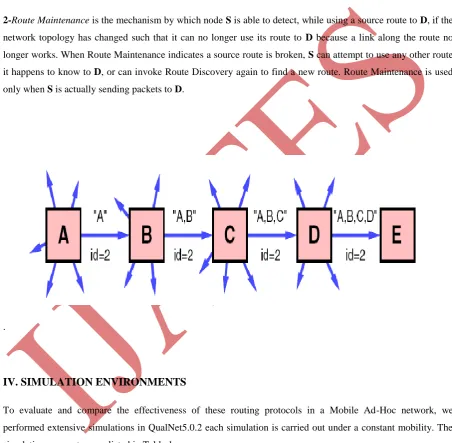
the header of each data packet, other nodes forwarding or overhearing any of these packets may also easilycache this routing information for future use. The DSR protocol is composed of two mechanisms that work
together to allow the discovery and maintenance of source routes in the ad hoc network:
1-Route Discovery is the mechanism by which a node S wishing to send a packet to a destination node D
obtains a source route to D. Route Discovery is used only when S attempts to send a packet to D and does not
already know a route to D.
2-Route Maintenance is the mechanism by which node S is able to detect, while using a source route to D, if the
network topology has changed such that it can no longer use its route to D because a link along the route no
longer works. When Route Maintenance indicates a source route is broken, S can attempt to use any other route
it happens to know to D, or can invoke Route Discovery again to find a new route. Route Maintenance is used
only when S is actually sending packets to D.
.
IV. SIMULATION ENVIRONMENTS
To evaluate and compare the effectiveness of these routing protocols in a Mobile Ad-Hoc network, we
performed extensive simulations in QualNet5.0.2 each simulation is carried out under a constant mobility. The
simulation parameters are listed in Table 1.
Table 1: Simulation Parameters
PARAMETER VALUE
Data Rate 1 Mbps
148 |
P a g e
Antenna Steerable
Terrain Range 1500mx1500m
Traffic Type CBR
No. of nodes 50
Channel Type Wireless channel
Protocol AODV,DSR
V PERFORMANCE METRICS
The following performance metrics are used to compare the performance of the routing protocols in the
simulation:
5.1 AVERAGE JITTER
Average Jitter is the variation (difference) of the inter-arrival times between the two successive packets
received.
5.2 AVERAGE END-TO-END DELAY(s)
End-to-end delay refers to the time taken for a packet to be transmitted across a network from source to
destination
5.3 TOTAL PACKET RECEIVED
It is the number of packets received by the server.
5.4 THROUGHPUT (bit/s)
Throughput is the average rate of successful message delivery over a communication channel The throughput is
measured in bits per second (bit/s or bps), and rarely in packets per second or packets per time slot
VI. RESULT and CONCLUSION
I have studied the performances of routing protocols AODV, DSR, and DSR at a data rate of 1Mbps & Steerable
antenna is used in place of Omni directional antenna. As per the results the average jitter is high in AODV as
compared to other three. The overall comparative study based on the performance parameters (such as average
jitter, total packets received, delay & throughput) show that the overall performance of AODV protocol is better
149 |
P a g e
6.1 Average Jitter:
6.2 Total Packet Received
6.3 Average End-To-End Delay(s):
Protocols Value
AODV
0.0219704
DSR
0.0343434
Protocols Value
AODV 20
DSR 20
Protocols Value
AODV
0.07361861
150 |
P a g e
6.4 Throughput (bit/s):
REFERENCES
[1] David B. Johnson and David A. Maltz. Dynamic source routing in ad hoc wireless networks. Technical
report, Carnegie Mellon University, 1996.
[2] Mehran Abolhasan, Tadeusz Wysocki, and Eryk Dutkiewicz. A review of routingprotocols for mobile ad
hoc networks. Technical report, Telecommunication and Information Research Institute, University of
Wollongong, Wollongong, NSW 2522; Motorola Australia Research Centre, 12 Lord St., Botany, NSW
2525, Australia,2003.
[3] Xiaoyan Hong, Kaixin Xu, and Mario Gerla. Scalable routing protocols for mobile ad hoc networks.
2002.
[4] Dr. G. Padmavati, Dr. P. Subashini, and MS. D. Devi Aruna, “Hybrid routing Protocols to Secure Network
Layer for Mobile Ad hoc Networks”.
[5] Harish Shakywar, Sanjeev Sharma, Santoh Sahu, “ Performance Analysis of DYMO, LANMAR, STAR
Routing Protocols for Grid Placement model with varying Network Size”
[6]Crossbow Technologies, XMesh 2.0 Manual (Draft) Revision A, e-mail attachment from Alan Broad, dated
13 October 2005.
[7] Hass Z.J, Pearlman, M.R and Samar, P, “The Zone Routing Protocol (ZRP) for Ad Hoc Networks”
draft-ietf-manet-zone-zrp-04.txt, 2002.
[8] Vincent D. Park and M. Scott Corson, “Adhoc On demand Distance Vector (AODV)version 4: Functional specification,” Internet- Draft,draft-ietfmanet- AODV-spec-04.txt, July2001.
[9] Zygmunt J. Haas, Marc R. Pearlman,Prince Samar, “The Intrazone Routing Protocol (IARP) for Ad Hoc
Networks,” draft-ietf-manet-zone- iarp-01.txt, June 2001.
[10] Yashi Rajvanshi, Seema Rahul, Sanjay Kumar Maurya , Prof. Sandip Vijay,” Study of Proactive Routing
Protocol for different Buffer Size”, International Conference on Telecommunication and Networks
(TEL-NET 2013), 27-28 Feb 2013 at Amity University Noida, ISBN- 978-93-81583-93-7, Page No.173-176.
Protocols Value
AODV
3782
151 |
P a g e
[11] Mario Gerla, Li Ma and Guangyu Pei, “Landmark Routing Protocol (LANMAR) for Large Scale Ad HocNetworks <draft-ieft-manet-lanmar-05.txt>. November 2002.
[12] Azzedine Boukerche, Mohammad Z. Ahmad, Begumhan Turgut and Damla Turgut, “A Taxonomy of
Routing Protocols in Ad hoc Networks
[13] Sukant Kishoro Bisoyi, Sarita Sahu, “ Performance analysis of Dynamic MANET On-demand (DYMO) Routing protocol.”, IJCCT Vol.1, International Conference [ACCTA-2010], August 2010.
[14] Niranjan Kumar Ray, and Ashok Kumar Turuk, “PERFORMANCE EVALUATION OF DIFFERENT WIRELESS AD HOC ROUTING PROTOCOLS”
[15] Manoj Rana,Shubham Kumar,Upasana Sharma, “Improvement the Performance Of Mobility Pattern In
Mobile Ad-Hoc Sensor Network using Qualnet 5.0”
[16] Yeng-Zhong Lee, Jason Chen, Xiaoyan Hong, Kaixin Xu, Teresa Breyer, Mario Gerla, “Experimental
Evaluation of LANMAR, a Scalable Ad-Hoc Routing Protocol”
[17] Suresh Kumar and Jogendra Kumar “Comparative Performance Analysis of Routing Protocols in MANET using Varying Pause Time”
[18]Sukant Kishoro Bisoyi, Sarita Sahu, “Performance analysis of Dynamic MANET Ondemand (DYMO)
Routing protocol”
[19] Satveer KaurPerformance Comparison of DSR and AODV Routing Protocols with Efficient Mobility
Model in Mobile Ad-Hoc Network
[20] Suhua TANG†and Bing ZHANG“A Robust AODV Protocol With Local Update”International Journal of
Computer Applications (0975 – 8887) Volume 12– No.2, November 2010
[22] “Yashi Rajvanshi, Seema Rahul, Sanjay Kumar Maurya , Prof. Sandip Vijay “ Study of different parameters of Bellman-Ford Routing Protocol for Different Buffer Size”, International Conference on
Control, Communication, Computer & Mechanical Engineering(ICCCCME), 4th November 2012, Delhi,
ISBN: 978-93-82208-33-4
[23] “DSR: The Dynamic Source Routing Protocol for Multi-Hop Wireless Ad Hoc Networks” David B.