1 | P a g e
MULTI CRITERIA DECISION ANALYSIS BASED ON
WEB USAGE MINING RECOMMENDER SYSTEM
Dr.K.Arunesh
1, A.Maheswari
2, S.Ragasudha
3 1Associate Professor, Department of Computer Science, Sri.S.R.N.M College, Sattur, (India)
2MPhil Scholar, Department of Computer Science, Sri.S.R.N.M College, Sattur, (India)
3MPhil Scholar, Department of Computer Science, Sri.S.R.N.M College, Sattur, (India)
ABSTRACT
Recommender systems (RS) are software applications that attempt to reduce information overload by recommending items of interest to end users based on their preferences, possibly giving books, movie, song, or other product suggestions. In this sense, an accurate recommender system ideally will be able to recommending items based on multi criteria knowledge about the items. Generally most of the existing recommender systems use an explicit single criterion rating value on items for evaluating user’s preference opinions. Such usual single criterion could produce recommendations that do not meet user needs and expectations. In this paper, we propose a mechanism for integrating multiple criteria into the Collaborative Filtering (CF) algorithm.
Keywords : Recommender Systems, Multi Criteria, Decision Making, Collaborative Filtering.
I.
INTRODUCTION
Web Usage Mining is a very interesting research domain in recent research world. The techniques are useful to elicit significant and utilizable knowledge which can be perceived by many users. Web usage mining Recommender systems are active information filtering system attempts to suggest and predict items that target users are likely to be interested in. The RSs are applied in many areas such as: web-browsing, information filtering, net-news, movie recommender, cross-domain and e-Commerce. The central element of all recommender systems is the user model that contains knowledge about the individual preferences which determine user behavior in a complex environment of web-based systems. The most interesting recommendation method is Collaborative Filtering (CF) which predicts the preference of a user by combining feedbacks of other users with similar interests and tasters [1].
Recommender systems have been emerging as a powerful technique of e-commerce. Because web users might express their opinions or feedback based on some specific features of the item. RS solely based on a single criterion could produce recommendations that do not meet user needs. In general, four categories of recommender systems can be enumerated: demographic filtering, collaborative filtering [2], content-based filtering, as well as their hybrid fusions. Demographic filtering approaches use descriptions of users to extract the relationship between an item and groups of persons that find it interesting. The basic idea of CF is that recommendation for the target user is made by predicting the preference of the uncollected items based on the neighbors. Neighbor is a group of persons with similar tastes when they rate the same items. Generally, there are two main types of CF: neighborhood and model based approaches [2]. An accurate recommender system will be able to perform on the web user’s behalf. To achieve this goal, the system must gain knowledge of the user’s value system and decision policy. Most existing recommender systems use a collaborative filtering approach, some are based on a content-based approach, and many have attempted to combine these two methods into hybrid frameworks. Multiple-criteria decision analysis (MCDA) is a well-established field of decision science that aims at analyzing and modeling decision makers’ value systems to support them in the decision-making process [4]. This research work presents a methodological framework that combines techniques from the MCDA field and, the users’ preferences together with the collaborative filtering technique to identify the most preferred unknown items for every user.
2 | P a g e making not only directed to identify alternatives but also to choose an alternative that is consistent with the objectives, goals, desires, or certain values. Multi-criteria decision making is the theory that discussed the decision making process that considers many criteria [3].
II.
LITERATURE REVIEW
Recommender systems help users in the effective identification of items suiting their wishes, tastes, needs or preferences. They have the effect of guiding the users in a personalized way to access relevant or useful objects, in a large space of possible options [5]. These applications improve the information access processes for users not having detailed product domain knowledge. They are becoming popular tools for reducing information overload and improving the sales in e-commerce web sites [6]. Chenguang Pan et.al.,[7] proposed a new born strategy using topic model techniques to make topic analysis or research paper to introduce a thematic similarity measurement into a modified version for item based recommendation approach. The recommendation method could considerably alleviate the cold start problem for recommender system. Authors generated the Gibbs sampling algorithm to process the dataset. The method is proven by the experiment by making the topic analysis on research paper and introducing thematic similarity could recommend the highly relevant paper and considerably alleviating the cold start problem.
Yuyu Yin et.al., [6] proposed a method to transfer model. It has been used to find the common features of the other domain. This technique ignores the difference of rating scales between two domains, and mainly focus on studying the feature tags .The proposed technique extract the different types of users (items) based on non-negative matrix tri-factorization from auxiliary domain. The process is defined to call the user (item) clustering. Through extraction of two sub-matrix with the same standard like MovieLens dataset, the rating ratio of supportive task (Movie) is 55.4%.and destination task (Book) is 9.8%. Guibing Guo et.al.,[8] proposed a novel strategy using Trust SVD. Recommendations can be approached by trust based matrix factorization technique. This technique stands much better than other recommendation in accuracy valuation. To overcome Cold start problem and data sparsity a well-known technique called decomposition of TrustSVD++ algorithm was proposed. To incorporate both trusted and trusting user the data taken in the way called implicit and explicit.
Zhenzhen Xu et.al.,[9]suggested a novel method to solve cross domain recommendations , To avoid data sparsity a trust methodology called Coarse rating Prediction and Refined rating is evolved by new rating matrix technique is to predict the sparsity, transformation of item to item matrix and user to user ratings .One domain is generally related to multiple domain . Paolo Cremonesi et.al., [10] proposed a method called Average UU (User-User) and Average II (Item-Item). The technique used to suggest items related to multiple domain is preformed to classify the data for the state of art algorithm. In order to avoid the overlap the data in the cross domain a new class of cross domain algorithm is used. The new class algorithm based on the concept of closure similarity matrix.
3 | P a g e two system proposed. The page recommendation is based on the concept of the page profile, which represents the system option, type of retrieval mechanisms and search criteria. The recommended page profile selected by a user from a list facilitates with search by moving users directly to the chosen option page with search mechanism the list of last submitted queres is available to each user. Ehuda Koren et.al.,[17] proposes a matrix factorization techniques for Recommender Systems. Recommender System strategies and limitations of the collaborative filtering are also addressed in this paper. The learning algorithms, Netflix prize competition and the basics of the proposed model are also presented.
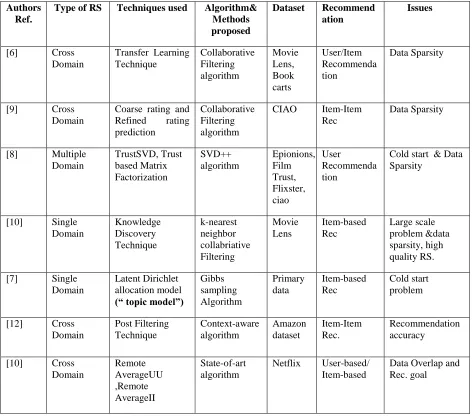
Authors Ref.
Type of RS Techniques used Algorithm& Methods proposed
Dataset Recommend ation
Issues
[6] Cross Domain
Transfer Learning Technique Collaborative Filtering algorithm Movie Lens, Book carts User/Item Recommenda tion Data Sparsity
[9] Cross Domain
Coarse rating and Refined rating prediction
Collaborative Filtering algorithm
CIAO Item-Item Rec
Data Sparsity
[8] Multiple Domain TrustSVD, Trust based Matrix Factorization SVD++ algorithm Epionions, Film Trust, Flixster, ciao User Recommenda tion
Cold start & Data Sparsity
[10] Single Domain Knowledge Discovery Technique k-nearest neighbor collabriative Filtering Movie Lens Item-based Rec Large scale problem &data sparsity, high quality RS.
[7] Single Domain
Latent Dirichlet allocation model (“ topic model”)
Gibbs sampling Algorithm Primary data Item-based Rec Cold start problem
[12] Cross Domain Post Filtering Technique Context-aware algorithm Amazon dataset Item-Item Rec. Recommendation accuracy
[10] Cross Domain Remote AverageUU ,Remote AverageII State-of-art algorithm
Netflix User-based/ Item-based
Data Overlap and Rec. goal
Table. 1. Summary of Various recommender systems and its features
III.
PROPOSED MULTI CRITERIA RECOMMENDER SYSTEM
The majority of existing recommender systems obtains an overall numerical rating r i, j, as input information for the
4 | P a g e In this Section, we examine how our proposed model behaves on real-world rating datasets. Several state-of-the-art single-domain recommendation models and multi criteria recommendation models features are compared and analysis are shown in Table.1.
Algorithm:
I/P: Active user or new user multi criteria ratings for different categories of same items. O/P : Predicted Rating for single criterion representation (Rating Prediction)
Step 1: Find the ratings given by the user rating vector. RV(i,j)X, X ≥ 1 and X ≤ 5
Step 2: Compute the highest and next highest ratings R1,R2,R3 for each user Step3: Add the R1,R2,R3 ratings , AR1,R2,R3
Step4: Find its average,
BA/3
Step5: Update the new ratingsIt is assumed that all users are rated to all items for the different criteria. The User ratings vector (X) should be user ratings between 1 and 5. The first three highest ratings R1, R2 and R3 from the User rating table (i.e multi criteria ratings) are computed. Add the top three highest ratings and find its average. It is considered as overall rating for the particular item. Update the new rating to the original table.
IV.
RESULT and ANALYSIS
In this Section, we examine how our proposed model behaves on real-world rating datasets and compare it with several state-of-the-art single-domain recommendation models and multi criteria recommendation models.
Item User
I1 I2 I3 I4 I5 I6
(True Rate)
U1 5 4 4 4 1 5
U2 5 4 4 3 3 4
U3 3 3 2 4 3 4
U4 2 3 5 1 4 3
U5 2 1 4 5 2 2
Table 4.1 Example Dataset for Five Users Item
User
I1 I2 I3 I4 I5 I6
(True Rate)
CFRT Predicted Rating
U1 5 4 4 4 1 ? 4
U2 5 4 4 3 3 4 0.7
U3 3 3 2 4 3 4 0
U4 2 3 5 1 4 3 -0.4
U5 2 1 4 5 2 2 0.2
Table 4.2 CFRT Prediction for the First User
ItemUser
I1 I2 I3 I4 I5 I6
(True Rate)
CFRT Predicted Rating
U1 5 4 4 4 1 5 0.7
U2 5 4 4 3 3 ? 5
U3 3 3 2 4 3 4 -0.4
U4 2 3 5 1 4 3 0
U5 2 1 4 5 2 2 -0.4
5 | P a g e Item
User
I1 I2 I3 I4 I5 I6
(True Rate)
CFRT Predicted Rating
U1 5 4 4 4 1 5 0
U2 5 4 4 3 3 4 -0.4
U3 3 3 2 4 3 ? 2
U4 2 3 5 1 4 3 -0.8
U5 2 1 4 5 2 2 0.2
Table 4.4 CFRT Prediction for the Third User
ItemUser
I1 I2 I3 I4 I5 I6
(True Rate)
CFRT Predicted Rating
U1 5 4 4 4 1 5 -0.4
U2 5 4 4 3 3 4 0
U3 3 3 2 4 3 4 -0.9
U4 2 3 5 1 4 ? 4
U5 2 1 4 5 2 2 -0.2
Table 4.5 CFRT Prediction for the Fourth User
ItemUser
I1 I2 I3 I4 I5 I6
(True Rate)
CFRT Predicted Rating
U1 5 4 4 4 1 5 0.2
U2 5 4 4 3 3 4 -0.4
U3 3 3 2 4 3 4 0.2
U4 2 3 5 1 4 3 -0.2
U5 2 1 4 5 2 ? 5
Table 4.6 CFRT Prediction for the Fifth User
Users
Predicted
Ratings
Actual
Ratings
MAE
User1
5
4
1
User2
4
5
1
User3
4
2
2
User4
3
4
1
User5
2
5
3
MAE = 1.6
Table 4.7 CFRT- MAE for the First Dataset
No.of
User
5
10
15
20
25
50
75
100
MAE
1.6
1.3
0.4
0.5
0.48
0.2
0.23
0.1
Table 4.8 CFRT- MAE for all the Dataset
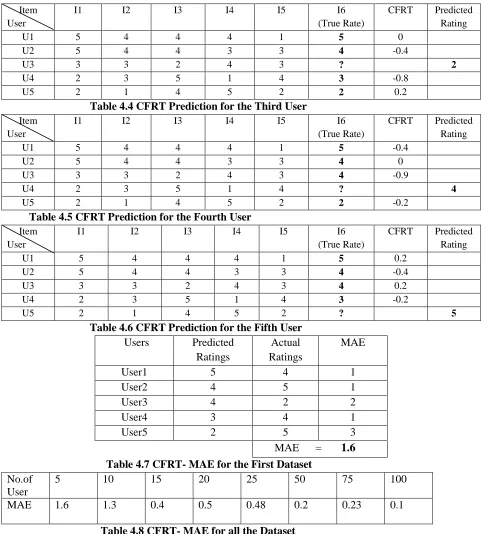
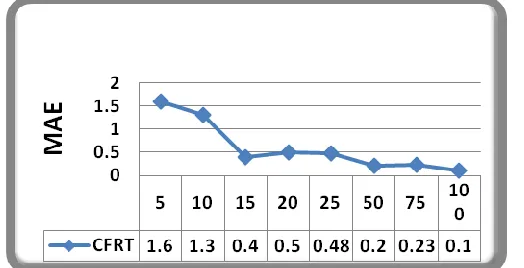
6 | P a g e Predicted ratings using the algorithm and the actual rating hosted by all the five users, User1 to User5 are given in Table 4.7. The Mean Absolute Error is computed for this dataset is 1.6 and respected users such as x=5,10,15,20,25,50,75 and 100 users MAE are given in Table 4.8. Figure 4.1 shows the performance analysis of the CFRT MAE for the entire data set. It is observed that when the rating scale increases the performance of the recommendations also increases.
Figure 4.1.Recommendations based on the model CFRT
V.
CONCLUSION
Recommendation systems play a vital role in social networks and e-commerce to promote the required items and making decisions to analyze web user preferences. Multi criteria user ratings are supports to improve the quality of such recommender systems because a multi criterion provides more user preferences and choices. The proposed work, concentrates on to enhance the quality of the recommender system. The limitation of this strategy is rating sparsity. The user must rate all the criteria. In future we planned to extent the work for Cross Domain Recommendations based on machine intelligence.
REFERENCE
[1] Shulong Tan, JiajunBu, XuzhenQin, ChunChen, DengCai, “Cross domain recommendation based on multi-type media fusion”, Elsevier, Neurocomputing, 127 (2014) 124–134.
[2] Chu-Xu Zhang, Zi-Ke Zhang, Lu Yub, Chuang Li, Hao Liu, Xiao-Yong Yand, Information filtering via collaborative user clustering modeling, Elsevier, Physica A 396 (2014) 195–203.
[3] Insap Santosa, Ari Cahyono, Karina Auliasari, A Multi-Criteria Recommender System For Tourism Destination [4] Kleanthi Lakiotaki and Nikolaos F. Matsatsinis, Alexis Tsoukiàs, Multicriteria User Modeling in Recommender Systems, IEEE INTELLIGENT SYSTEMS, 1541-1672/11 2011 pp 64-76.
[5] R. Burke, Hybrid recommender systems: survey and experiments, User Modeling and User-Adapted Interaction 12 (2002) 331–370.
[6] R. Burke, Hybrid web recommender systems, in: P. Brusilovsky, A. Kobsa, W. Nejdl (Eds.), The Adaptive Web, LNCS 4321, 2007, pp. 377–408.
[7] C Pan, W Li “Research Paper Recommendation with topic model”, IEEE. 2010
[8] Guibing Guo, Jie Zhang, and Neil Yorke-Smith,” A Novel Recommendation Model Regularized with User Trust and Item Ratings”,IEEE , Volume: 28 Issue: 7,pp 1607 – 1620,ISSN 1041-4347,(2016).
[9] Zhenzhen Xu, Fuli Zhang, Wei Wang, Haifeng Liu, Xiangjie Kong, “Exploiting Trust and Usage Context for Cross-Domain Recommendation”, IEEE, pp 2398 – 2407,ISSN 2169-3536, Vol 4(2016).
[10] P Cremonesi, Y Koren, R Turrin “Performance of recommender algorithms on top-n recommendation tasks”Pages 39-46, ISBN: 978-1-60558-906-0
[11] B Sarwar, G Karypis, J Konstan, J Riedl “Item-based collaborative filtering algorithm” Pages 285-295 [12] D Véras, T Prota, A Bispo, R Prudêncio “Cross Domain Recommender System” , 2015
[13] Kleanthi Lakiotaki, Stelios Tsafarakis, Nikolaos Matsatsinis , UTA-Rec: A Recommender System based on Multiple Criteria Analysis, RecSys’08, 2008, ACM 978-1-60558-093-7/08/10
[14] M. Deshpande, G. Karypis, Item-based top-n recommendation algorithms, ACM Transactions on Information Systems 22 (2004) 143–177.