
1099 | P a g e
A STUDY ON THE DEVELOPMENTS IN
MANUFACTURING OF METAL MATRIX COMPOSITE
(MMC) MATERIALS
Dr. G. Poshal
1, M.Venkata Ramana
2 1Professor, Dean and HOD, Department of Mechanical Engineering,
Sphoorthy Engineering College, Hyderabad, (India)
2
Asst. Professor, Department of Mechanical Engineering,
Sphoorthy Engineering College, Hyderabad, (India)
ABSTRACT
Metal Matrix Composite (MMC) is a composite material, with at least two constituent parts. One of the component
(Matrix) being metal and the other material may be a different metal or any other material such as ceramic or
organic compound. Fabrication of MMCs can be done different ways. Some of the MMCs production methods are
discussed. In squeeze casting process, centrifugal casting, Stir casting method, Physical Vapor Deposition,
Impregnation method, Powder metallurgy method, Electrochemical forming method are used. Depending upon our
requirement and the constrains any one of the above MMC manufacturing method can be used. Stir casting method
and Electrochemical method of manufacturing of MMCs are most widely used methods.
Key words: Metal Matrix Composite (MMC), Squeeze casting, Stir casting, Physical Vapor Deposition
(PVD), Electrochemical forming.
I INTRODUCTION
Any Composite material consists of two or three distinct chemical or physical phases. Composites will exhibit
superior properties as compared to their individual constituents. Metal Matrix Composite (MMC) is a composite
material, with at least two constituent parts. One of the component (Matrix) being metal and the other material may
be a different metal or any other material such as ceramic or organic compound. Generally, the reinforced
component is distributed inside the matrix (continuous) component. The matrix holds the reinforcement to obtain the
desired shape and the reinforcement improves the mechanical properties of the materials.
Fabrication of MMCs can be done different ways. Some latest methods MMCs production methods are surveyed
1100 | P a g e
1.
Production of MMCs by Squeeze casting process:
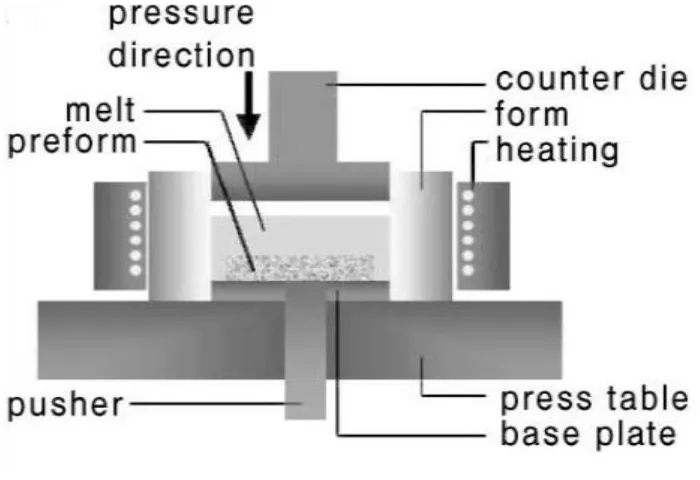
Special type, of casting process known as squeeze forming process, combines advantages of traditional hi
pressure die casting, gravity permanent mold die casting, and common forging technology[1]
Figure 1.0 Direct Squeeze method of producing MMC
Squeeze casting is most commonly used method of manufacturing MMCs. Molten metal is injected into a form with
particulate fibers placed inside of it. A two stage process is often used.
Stage I: The melt is pressed into the required shape at a low pressure in the liquid phase
Stage II: The melt is pressed into the required shape at a high pressure, in the solidus phase.
There are main advantage of squeeze of casting is the damage to the perform is prevented due to the slower
infiltration. Complex profiled parts can be produced, flaw- less way, with the use of squeeze casing method. MMCs
of relatively reactive materials can be produced, since the duration of infiltration and response time are fast.
2.
Production of MMCs by Special centrifugal casting method:
This method was developed by Wannasen [2], capable of achieving high pressure for fabrication of MMCs.
3.
Production of MMCs by MMCs by Stir casting method:
MMCs can be produced by Stir casting operation, which was used by Dinesh M. Pandurange[3], which was
explained in detail in this paper.
The stir casing method involves different steps. They are
1. Raw material cleaning and preparation
2. Place the raw material in crucible and heat the raw material above the liquidous temperature, inside a electric
1101 | P a g e
3. Stir the molten metal to attain homozinige temperature and then, the preheated reinforcement material is addedand stirring is continued.
4. Pour the molten metal into the molds
5. MMC is taken out of the mold.
Figure 1.0 Schematic setup for stir casting [4]
4.
Production of MMCs by MMCs by Physical Vapor Deposition (PVD) method:-
The reinforcement is passed through a thick cloud of vaporized metal, coating over it.In PVD, the solid phase of metal is evaporated to get a gas phase. The metal in gas (vapor) phase is transported and
made to deposit on the fiber or reinforcement. This method is a well proven method and most economical way of
producing MMCs.
5.
Production of MMCs by Diffusion bonding method:
The layers of the meal foil are sandwiched with long fibers of reinforcement. It is then pressed to form MMC . The
arrangement is pressed strongly, for a long period of time, while keeping the temperature little bit high. This forced
contact would lead to the diffusion of atoms of individual metal to diffuse into to the neighboring metal. This
method is used in the fabrication of Bi-metallic strips.
1102 | P a g e
The reinforcement fibers tightly bound together in cylindrical shape. The bundle is immersed in the molten metal,which is maintained at temperature, lower than the softening temperature of the reinforcement.
Due to capillary action the molten metal would be attracted to impregnate and climb up the voids between the fibers.
The bundle is left in the molten metal, until all the voids are filled, with the molten metal.
Impregnation is method is a faster method, so the shape of the fiber will not change. This method can be used to
produce intricate shapes.
7.
Production of MMCs by Powder metallurgy method:-
The following steps will show the manufacturing of MMCs by powder metallurgy method.
1. The matrix metal powder is mixed with the second metal powder or ceramic powder and chopped fiber
(reinforcement).
2. The mixture is thoroughly mixed in a blending machine.
3. Then required form or shape of the part required is formed.
4. The form is sintered in a Owen
5. Finishing of the part is done, after completing any secondary operations required.
8.
Production of MMCs by Electrochemical forming method:-
The steps involved in this process are used.1. This method is most widely used in industry, all types of electric fibers and graphite fibers are fixed and used
on a non conducting plastic frame.
2. The frame with long fibers is immersed in bath containing certain chemical compound that are used in electro
plating, where metallic layers or precipitated onto metal surfaces. Proper salt is chosen in order to precipitate
desired metallic matrix.
3. A DC current is passed for a longer time. During this period, the metallic matrix is accumulated and form a
plate shaped matrix.
II APPLICATIONS OF MMC
MMCs have wide range of applications. They are now a days being used as structural materials in the various types
of industries. Aluminum –Silicon carbide (Al-SiC) MMC, Copper-Silicon Carbide (Cu-SiC), are mainly used
because of low coefficient of thermal expansion better wear resistance and improved mechanical properties.
Aluminum MMCs have wide range of applications in the industry. Because of light weight of aluminum, wherever
1103 | P a g e
III CONCLUSION
Depending upon our requirement and the constrains any one of the above MMC manufacturing method can be used.
BIBLIOGRAPHY
1. Vijayram T.R., Sulaiman. S, 2006,“ Fabrication of fiber reinforced composites by squeeze Casting
technologov, JMPT, pp 34-38
2. J. Wannasin, M.C. Flemings, 2005, “Fabrication of metal matrix composites by a high-pressure centrifugal
infiltration process”, JMPT, pp 143-149
3. Pandurange. et al, 2013, “Development of Alluminum based Metal Matrix Composites”, International journal
of Advanced Engineering Research and Studies,III/I, October-December, 2013, pp 22-25
4. Dunia Abdel saheb, 2011, “Alluminum Silcon Carbide and Alluminum Graphite particulate composite
composites”, ARPN Journal of Engineering and Applied Sciences”, VOL 6, Issue 10, pp 41-46
![Figure 1.0 Schematic setup for stir casting [4]](https://thumb-us.123doks.com/thumbv2/123dok_us/9261234.1464574/3.612.89.480.146.464/figure-schematic-setup-stir-casting.webp)
