A STUDY AND OPTIMAL SOLUTION FOR
PROCESSING EACH OF N-JOBS THROUGH THREE
MACHINES
Dr .Vasudevarao.Kota
1, Dandamudi Srilatha
2, Srinivasarao Mandalapu
3 1Asst Professor, Dept. of Mathematics, Ambo University, Ethiopia
2
Asst.Professor, Dept. of Mathematics, Gudlavalleru Engineering College, Andhra Pradesh, (India)
3
Asst.Professor, Dept. of Computer Science, Vikas Group of Institutions, Andhra Pradesh, (India)
I. INTRODUCTION
Sequencing problems arise when we are concerned with situations where is a choice as to the order in which a
number of tracks can be performed .In such cases; the effectiveness is a function of the order or sequence in
which the tasks are performed. We shall deal with the sequencing problems in respect of the jobs to be
performed in a factory and study the method of their solution.
In the field of operations research, one of the "classic" problems has been that of sequencing "n" jobs through
"m" machines. Sequencing means the determination of the order in which each machine will process the n jobs
so that some specific criteria will be maximized or minimized.In this problem there are n!Possible ways to order
the jobs on each machine and a total of
(
n
!
)
m possible sequences.There are several different optimizing criterions that can be used. A few of these are
1) Minimization of time required from the start of the first job untilcompletion of the last job on each of the
machines.
2) Minimization of the total time required for the entire series of jobs to be completed.
3) Minimization of the total idle time on the machines.
4) Maximization of profit from meeting due dates and not incurring penalties involved in late delivery.
5) Minimization of in process inventory costs In regard to the general sequencing problem very little progress
has been made toward the development of a practical algorithm or set of rules which can be followed to
arrive at an optimal solution. A more detailed history of work in this area will follow.
1.1 Terminology
1) Number of Machines: The number of machines refers to the number of service facilities through which a
job must pass before it is assumed to be completed.
2) Processing Time : It is the time required by a job on each machine.
3) Processing Order : It refer to the order (sequence) in which given machines are required for completing the
job.
4) Idle Time on a Machine : It is the for which a machine does not have a job to process ,i.e, idle time from the
5) Total Elapsed Time : It the time interval between starting the first job and completing the last job including
the idle time in a particular order by the given set of machines.
6) No processing Rule: it refers to the rule of maintaining the order in which jobs are to be processed on given
machines .For example ,if n jobs are to be processed on two machines M1 and M2 in the M1M2, then each
job should go to machine M1 first and then to M2.
Key words: Number of Machines, Total Elapsed Time , Processing Time, Optimal solution .
Types of problem:
1) Processing n jobs on two machines
2) Processing n jobs on three machines
Algorithm for solving Sequence Problems: Johnson’s Rule :
The method shall be discussed in respect of processing of n jobs through (a) two machines ,(b) three machines .
Method 1 :Processing n jobs on 2 jobs :
As mentioned before, the following information is available :
i) Only two machines A and B are involved.
ii) Each job is to be processed in the order AB so that first the work would be performed on machine A
and then on machine B.
iii) The processing times for different jobs on first machine A1,A2………An are given and so are processing
times on the second machine B1,B2...Bn.
The objective is to be determine the sequence in which the jobs should be performed so that the total time taken,
known as the elapsed time(T) is the minimum.
Method of Procedure:
The method of solving the above problem is discussed below.
Step1: Select the smallest processing time, considering A1,A2,…….An and B1,B2,…….Bn together.
Step2: a) if the minimum time is for Ar ,that is to say for rthjon on machine A , do the rth job the first.
b) if the minimum is for B s that is ,for sth job on machine B, do the sth job in the end .
c) if there is a tie between Arand B s ,perform the r th
job first and sth job in the end .
d) if there is a tie between 2 or more times in either of the series ,select either of the jobs involved and perform
the job first or last accordingly as the tie is in A1,A2,………An or B1,B2,…….Bn.
Step 3: After the job (s) has been assigned, apply step1 and 2 to the reduced set of processing times obtained by
deleting the machine times corresponding to the job(s) already assigned.
Step4: continuing in this manner all jobs shall be assigned.
The sequence of jobs to be performed obtained this way shall be optimal .i.e, if shall involve the least aggregate
time for completion of the job.
Example : In a factory ,there are six jobs to perform ,each of which should go through two machines A and B
,in the order AB. The processing timing (in hours) for the jobs is given below .you are required to determine the
Jobs Machine A Machine B
1 7 3
2 4 8
3 4 6
4 5 6
5 9 4
6 8 1
Solution : The least of all the times given in the table is for 6 on machine B . So, perform job 6 in the end .It is
last in the sequence .Now delete this job from the given data.
i) Of all timings now, the minimum is for job 3 on machine A ,so do the job 3 first.
ii) After deleting job 3 also ,the smallest time of 3 hours is for 1 on machine B .thus ,perform job 1 in the
end (before job 6).
iii) Having assigned job1 ,we observe that the smallest value of 4 hours is shared by job 2 on machine A
and job on machine B so, perform job2 first and job 5 in the end.
iv) Now, the only job remaining is job 4,it shall be assigned the only place left in the sequence.
The resultant sequence of jobs is therefore, as follows:
3 2 4 5 1 6
The sequence is the optimal one .the total elapsed time T is obtained in table as equal to 36 hours.
Table: calculation of Total Elapsed Time(T)
Job
Machine
A
Machine
B
In
out
In
Out
3
0
2
2
8
2
2
6
8
16
4
6
11
16
22
5
11
20
22
26
1
20
27
27
30
6
27
35
35
36
As shown in this table, the first job 3, starts at time O on the machine A and is over by time 2. Which o=is
passed to machine B to be worked on till time 8 . The job 2 starts on the machine A at time 2 as the machine is
free at that time . It is completed at time 6 and has to wait 2 hours before it processed on machine B , starting at
time 8 when this machine is free , Similarly ,the various jobs are assigned to the two machines and the in and
out times are obtained.
Method 2 : Processing n jobs on 3 Machines
There is no solution available for the general sequencing problems of n jobs through 3 machines .However we
do have a method under the circumstance that no passingof jobs is permissible and if either or both the
1) The minimum time on machine A is greater than or equal to the maximum time on machine B.
2) The minimum time on machine C is greater than or equal to the maximum time on machine B .
i.e to say if either
Min
.
A
i
Max
.
B
ii i
Max
B
C
Min
.
.
Or both are satisfied that the following method can be applied.
Method of Procedure:
Step1: First of all, the given problem is replaced with an equivalent problem involving n jobs and 2 fictitious
machines G and H .define the corresponding processing times Gi and Hi by
Gi=AI+BI
Hi=Bi+Ci
Step2: to the problem obtained step1 above ,the method for processing n jobs through 2 machines is applied
.The optimal sequence resulting this shall also be optimal for the given problem.
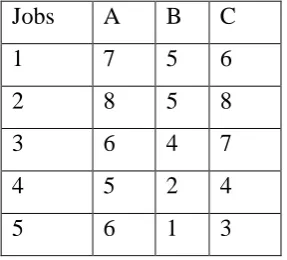
Example: There are five jobs which must go through these machines A,B and C n th order ABC .Processing
times of the jobs on different machines given below.
Determine a sequence for 5 jobs which will minimize elapsed time(T) .
Solution: according to given information
Min.Ai=5
Max.Bi=5
Min.Ci=3
Here since Min.Ai=Max.Ci, the first of the conditions is satisfied.
We shall now determines Gi and Hi and from them find the optimal sequence.
In accordance with the rules for determining optimal sequence in respect of n jobs processing on 2 machines ,
the sequence for above shall be :
3 2 1 4 5
Table : Calculation of Total Elapsed Time(T) .
Jobs
A
B
C
1
7
5
6
2
8
5
8
3
6
4
7
4
5
2
4
5
6
1
3
Jobs
Machine A
In out
Machine B
In out
Machine C
Total elapsed time (T) =40 hours.
REFERENCES
[1]. Brooks, George H. , and White, Charles R., "An Algorithm for Finding Optimal or Near Optimal Solutions
to the Production Scheduling Problem," Journal of Industrial Engineering,, 16, no. 1, 34-40 (1965).
[2]. Dudek, R. A., and Teuton, 0. F. Jr., "Development of M-Stage Decision Rule for Scheduling n - Jobs
Through M Machines," Operations Research, 12, 471 -497 (1964).
[3]. Giglio, R. J., and Wagner, H. M., "Approximate Solutions to the Three-Machine Scheduling Problem,"
Operations Research, 12, 305-324 (1964),
[4]. Hardgrave, W. W., and Nemhauser, G, L., "A Geometric Model and a Graphical Algorithm for a
Sequencing Problem," Operations Research, 11, 889-900 (1963).
[5]. Ignall, E., and Schrage, L., "Application of the Branch and Bound Technique to Some Flow-Shop
Scheduling Problems," Operations Research, 13, 400-412 (1965),
[6]. Johnson, S- M. , "Optimal Two and Three Stage Production Schedules With Set-up Times Included," Nav.
Res. Log. Quart,, 1, 61-68.
[7]. Karush, W., "A Counter-Example to a Proposed Algorithm for Optimal Sequencing of Jobs," Operations
Research, 13, 323-325 (1965).
[8]. Lomnicki, Z, A,, "A 'Branch and Bound' Algorithm for the Exact Solution of the Three-Machine
Scheduling," Operations Research Quarterly, 16, 89-100 (1963).
[9]. Little, J, D, C, Murty, K. G,, Sweeney, D. W., and Karel C,, "An Algorithm for the Traveling Salesman
Problem,"' Operations Research, 11, 972-989 (1963).
[10].Palmer, D. S., "Sequencing Jobs Through a Multistage Process m the Minimum Total Time--A Quick
Method of Obtaining a Near Optimum," Operations Research Quarterly, 16, 101-107 (1965).
3 0 6 6 10 10 17
2 6 14 14 19 19 27
1 14 21 21 26 27 33
4 21 26 21 28 33 37