SCITECH
Volume 13, Issue 1RESEARCH ORGANISATION
May 04, 2019Journal of Research in Business, Economics and Management
www.scitecresearch.com
BIG DATA MANAGEMENT- A FINACIAL INSTITUTION
APPROACH
Yusuf, S.D.
a,*1, Lumbi, W.L.
1, Umar, I.
1, Loko, A.Z.
1, and Odii, J.
21
Department of Physics, Faculty of Natural and Applied Sciences, Nasarawa State University
Keffi, Nigeria. 2
Ministry of Education, Saint Williams Primary School Lafia, Nasarawa State, Nigeria.
Abstract
This study investigates the role of Big Data Management (BDM) on the competitive financial sector, its importance and effective adoption for Nigerian banks. A survey was used to collect primary data from branches of one of the leading banks in Nigeria and 796 usable questionnaires from bank customers, employees and managers were used for analysis. A descriptive research method and correlational study was used to determine the link between Big Data elements such as use of customers’ data and predictive analysis of customer trends and patterns in form of differentiation, increased sales, customer engagement as well as cost leadership. The research focused on customer’s rate of reviews of Big Data as the independent variables with repeat engagement and interaction as the dependent variables. Descriptive statistics using SPSS program specifically mean and standard deviations was employed for the analysis. Results show that banks create differentiation by introducing a variety of products and product mix from the analysis of customer feedback, trends and pattern which has driven customer satisfaction due to easy access to information and banking, access to products online, pay for bills via mobile banking platform, and response on various social media platforms. However, even though most customers use ATM cards and are on the mobile banking platform, Bank management should focus more on staff training and use of Diagnostic and descriptive statistics in understanding why and how some customers behave especially those who express their concerns on social media.
Keywords:
Big Data; Analytics; Management; Financial institution.1 Introduction
Big Data, like any other commodity, only has real value when it‟s refined: in this case combined with enhanced analytics to provide insights that help identify opportunities or develop solutions [1]. According to Moreet al. [2] without big data analytics, companies are blind and deaf, wandering out onto the web like deer on a freeway. Big Data by itself cannot be useful to an organization, it is only when it is utilized to draw out information that an organization benefits. It has been estimated that, the volume of business data worldwide, across almost companies, doubles every 1.2 years [3]. In the retail industry, Chen and Zhang [4] found that there are around 267 million transactions per day in Wal-Mart‟s 6000 stores worldwide. However it is important to determine how easy it is for companies to mine data and obtain analytics. Brown et al.
many organizations across the globe are putting it to use and in which way. They demonstrated that Big Data Analytics is increasingly emerging as a new technology that increases overall efficiency of management and better decision-making. When compared to traditional analytics system, Big Data analytics is able to enhance the productivity and performance of organizations in real-time.Chen and Zhang [4] recently revealed that, while seeking for higher competitiveness, Wal-Mart recently collaborated with Hewlett Packard to establish a data warehouse which has a capability to store 4 petabytes of data, i.e., 4000 trillion bytes, tracing every purchase record from their point-of-sale terminals. Adding that, they successfully improve efficiency of their pricing strategies and advertising campaigns by taking advantage of sophisticated machine learning techniques to exploit the knowledge hidden in this huge volume of data. Many studies on adoption of Big Data Analyticshave focused on telecommunication [7,8,9,10] and how companies gain by assimilating Big Data Analytics in full scale and in decision making and for operations [11,12,13,14,6,15]. There is limited research on the adoption of Big Data Analytics in the financial sector for marketing of products.
IDG Connect [16] revealed that infrastructure readiness is already very high, on the move towards Big Data projects across core African markets in Kenya and Nigeria,yet skills still seem fairly low. Also, for smaller organizations with 100 – 499 employees only a small percentage of 40 percent were looking to fully outsource big data projects. Adding that,there is lack of local information on Big Data which certainly need to be addressed for the technology to be implemented effectively. Wamba et al. [15] found out that the majority of companies in Africa have barely considered the implication of social media, e-mail and multimedia on the marketing of their products and how they can use the data to communicate with their consumers. Studies on Big Data Analytics in Nigeria and specifically on financial institutions are limited. In spite of these, banks are known to accumulate a lot of data from different sources.
“Big data” are data sets that are too big to be handled using the existing database management tools and are emerging in many important applications, such as Internet search, business informatics, social networks, social media, genomics, and meteorology [17]. Oracle [18] pointed out that the financial services industry is amongst the most data driven of industries as the regulatory environment that commercial banks and insurance companies operate within requires these institutions to store and analyze many years of transaction data, and pervasiveness of electronic trading. Hence, the need to diversify the means of storing, managing these data as bulky and important they can be in the financial system. Russom [19] hinted that big data is forcing numerous changes in businesses and other organizations. Many struggle just to manage the massive data sets and non-traditional data structures that are typical of big data. Others are managing big data by extending their data management skills and their portfolios of data management software. This empowers them to automate more business processes, operate closer to real time, and through analytics, learn valuable new facts about business operations, customers, partners, and so on.
Big Data now has the power to help businesses succeed; but this can only be achieved through appropriate and proper analysis, through the use of what is called „analytics‟ of these big volumes of data [13]. The impact or potential impact of this has been (or could be) widespread in many different sectors across the business including Supply Chain, Information Technology, Human Resource as well as Sales and Marketing. Kaoutaret al. [20] estimated that by the year twenty twenty (2020), forty three (43) trillion gigabytes of data will have been generated. This will be one thousand (1000) times more than what we currently have. This data is mostly unstructured but represents an immense potential source of information that can be utilized to unlock the competitive edge of an organization if exploited. According to Press [21] the turning point on Big Data is the Internet and the coming into the market improved and more powerful Personal Computers and mobile phones. He had estimated that by the year 2002, data on the internet would overlap voice data. The internet and improved accessibility o f the Internet on Personal Computers and mobile phones spurned the use of social media such as Facebook, WhatsApp,Twitter,Instagram and other web platforms that have played a big role in information growth explosion currently being experienced [22].
In terms of key business challenges, Oracle [18] observed that companies in the consumer banking and financial services industry typically have data warehouses and business intelligence tools for reporting on and analyzing customer behavior to better anticipate their needs, and for optimizing operations. By deploying Big Data Management Systems that include data reservoirs (featuring Hadoop and / or NoSQL databases), greater benefits in these areas can be achieved as the business gains more predictive capabilities and becomes more agile, therefore gaining much higher levels of insight into data faster and enables more effective decision making.
on virtually all sectors of the Nigerian economy. Therefore, the following questions are raised: Why is Big Data colliding with Data Management and what is driving its technology adoption in the financial services? What are the ripple effects and benefits of Big Data Management and the future trends in user practices? And what are the big data challenges in Nigeria?
Ogwang [12] noticed that ever changing tastes of customer always play a significant role, that to reach the business pinnacle, one needs to have radical data concerning the merchandise, its competitors and also the dynamic trends within the environment. In line with this, Richyet al. [24] posit thata lot of businesses has used the ability of big data to realize success and speed up their businesses in numerous aspects, for example Amazon. Ogwang [12]urges that Big Data have helped companies to be plenty of responsive and responsible towards her customers. By combining consumer data with purchase data, banks can section their customers in fine detail. They will in addition target their customers with made-to-order promoting and targeting. Davenport [13]emphasized that Business Intelligence and big data analytics incorporate a positive impact on industries. Big data facilitates a lot of intelligent promotions that is key to driving sales. I n line with this, Johnson [1] stated that Big Data Analytics is being used in Africa by many institutions as part of the Corporate Strategy to create competitive edge. In this study therefore, we shall look at the integration and knowledge of what is driving big data technology adoption, which is the role of Big Data Management on the competitive financial services, its importance and effective adoption.
The study will focus on the monitoring and ensuring the availability of all big data resources through a centralized interface/dashboard in Nigeria. The study will focus on the management team within financial systems that is the leadership team as well as lower level management who are in charge of day to day operations. The third category of focus will be financial systems (banks) customers and this will be sampled from one of the biggest financial houses in Nigeria. The study will look at the trends and performance of financial bodies in monitoring and ensuring the availability of all big data resources through a centralized interface/dashboard, performing database maintenance for better results, implementing and monitoring big data analytics, big data reporting and other similar solutions.
This paper is organized as follows: the next section presents the research methodology, followed by the experimental design and data collection method. We then present the empirical analysis and findings. Finally, the interpretation of the findings and both theoretical and practical implications are described. The paper concludes by presenting the research limitations and proposing avenues for future research.
2
Method
This research adopted descriptive research method and specifically, the correlational research study. Descriptive research involves observing and describing behavior of a subject without influencing it in any way and contributes to high response rate[25]. Correlational design was chosen as this study will aim to determine the link between the Big Data elements such as use of customers‟ data and predictive analysis of customer trends and patterns to provide the competitive edge in the financial institutions in Nigeria in the form of differentiation, increased sales, customer engagement as well as cost leadership. The research focused on branches of Guarantee Trust Bank (GTB), in Nigeria guided by numbers of customer‟s rate of reviews of Big Data as the independent variables with repeat engagement and interaction as the dependent variables.The collected data was analyzed for the descriptive statistics using Statistical Package for Social Sciences (SPSS) program, specifically mean and standard deviations.
2.1 Population and Sample
The targeted population in this study involved all the management staff and employees at the various financial institutions in the 231 branches of Guarantee Trust Bank (GTB) and all the customers that are in the system. This study adopted the stratified random sampling technique to select 10 (4.33%) Branches out of 231 Branches. We selected 10 (14.49%) managers out of 69 managers that is, one (1) manager from each of the 10 branches. In addition, 200 (0.02%) out of 10,000 Employee and 600 (0.01%) out of 6,000,000 Customers.The population and sample can be represented in Table I.
Table I: Population a nd Sample of t he Study
Target Population Sample Size
GTB Managers 69 10
GTB Customers 6,000,000 600
Total 6,010,069 810
3 Experimental Design and Data Collection
3.1 Experimental Design
The self-structured questionnaire was developed in English. The questionnaires contained closed ended questions. Closed ended questions ensure that the respondents are restricted to certain categories in their responses. The questionnaire was divided into four (4) parts. First, was on general information provided to all participants and this section looked at background information about the respondent such as Age, Sex and Education.The second part looked at customers banking behaviors and online services availability to customers. The third part looked at use of BDM in assessing customer trends and patterns with specialfocus on the employees in trying to understand whether Big Data is used within the organization to align the firm to customer needs. The fourth part focused on the customers and gathered information on how they impact repeat purchases. The last part focused on the senior managers and focused on obtaining data on the use of BDA and BDM to assist management in establishing a customer leadership model in GTB.The Research instrument was validated by two senior lecturers from FederalUniversity, Lafia and one measure and evaluation expert with the Ministry of Education Lafia, Nasarawa State.This was done to improve the face validity and content validity of the instrument. A pilot survey with Ten (10) employees who were randomly selected and were not to be part of the final data collection process to ensure that the questionnaires are complete, precise, accurate and clear. This is important to ensure reliability of the data collection instrument [26].This was followed by the main survey conducted using a face-to-face interview led by research assistants who were adequately instructed on what to do, however, administered carefully and skillfully without boring the respondent.
3.2 Data Collection
Fig. I: Map of Nigeria showing locations of sampled study area [27].
Table II: Demographics of the Respondents
Categories Percentage Categories Percentage Categories Percentage
Designation Marital status Customer occupation
Manager 01.26 Single 25.63 Student 14.68
Employee 25.12 Married 53.14 Civil Servant 45.22
Customers 73.62 Divorced 08.92 Farming 06.48
Gender Widow 12.31 Businessmen 33.62
Male 46.61
Female 53.39 Education Use of ATM cards
Age range (21-70 yrs) PHD 01.26 0-6 months 06.66
21-30 39.70 Masters 02.89 7-12 months 20.65
31-40 41.83 BSc. Diploma 31.03 1-3 years 43.17
41-50 14.20 Diploma 28.64 4-6 years 15.87
4 Result and Discussion
4.1 Employees View of Customer Banking Details
Table III shows the employee view of customers banking details. An interview with the managers and employees of the bank have revealed that the predominant customers account type is savings 54.76 percent against current 45.24 percent.Of the number of customers that subscribe to notification via email about 37.14 percent of the employee are of the view that the number is within the range of 5001-10,000, followed by 25.24 percent who said 1-5000, 16.19 percent said 10,001-15,000, 11.43 percent said 15,001-20,000, 8.10 percent said 20,001-25,000, while the least 1.90 percent said 25,001-above. Among the number of customers that subscribe to notification via SMS about 34.29 percent of the employee are of the view that the number is within the range of 10,001-15,000, 27.14 percent said 5001-10,000, 14.76 percent said 1-5000, 12.86 percent said 15,001-20,000, 7.14 percent said 20,001-25,000, while the least 3.81 percent said 25,00-above. Only few employee 10.95 percent agreed to the fact that some customers do come to the bank due to received bulk SMS while 89.05 percent did not agreed to that. Of the employee that agreed, 86.96 percent said the number is 1-500, while 13.04 percent said 501-1000. About 62.86 percent of the employee agreed that majority of the customers prefer self-service, while 37.13 percent did not agree to the fact. Of the employee that agreed 48.48 percent said the number is 1501-2000, 21.21 percent said 1001-1500, 19.70 percent said 501-1000, and 10.61 percent settled for 1-500.
Table III: Employee Response on Customers Banking Details
Categories Percentage Categories Percentage Categories Percentage
Account type No. Sub. to notification via SMS No. Visiting bank due to bulk SMS
Savings 54.76 1-5000 14.76 1-5000 86.96
Current 45.24 5001-10,000 27.14 5001-10,000 13.04
No. Sub. to notification via email 10,000-15,000 34.29 Customers prefer self-service
1-5000 25.24 15,001-20,000 12.86 Yes 62.86
5001-10,000 37.14 20,001-25,000 07.14 No 37.13
10,000-15,000 16.19 25,001 above 03.81 No. that Prefer self-service
15,001-20,000 11.43 Visiting bank due to bulk SMS 1-5000 10.61
20,001-25,000 08.10 Yes 10.95 5001-10,000 19.70
25,001 above 01.90 No 89.05 10,000-15,000 21.21
15,001-20,000 48.48
4.2 Bank Services Available to Customers
26.19 percent of the employee chose Yahoo mail, 21.91 percent chose Gmail, 20.95 percent chose Facebook, 15.24 percent chose twitter, 10.00 percent chose Instagram, and 5.71 percent chose others. On customer response to the use of social media network, majority of the employee 66.67 percent said customer respond excellently, 16.19 percent said the response is average, while 17.14 percent said the response is poor.
Table IV: Bank Service Available to Customers
Categories Percentage Categories Percentage Categories Percentage
Availability of Mobile banking App Customer response to mobile App Social Media mostly used for advert
Yes 100.00 Poor 0.00 Instagram 10.00
No 0.00 Average 7.14 Twitter 15.24
No. of Customer using mobile App Excellent 92.86 Facebook 20.95
1-500 0.00 Most frequent transaction Gmail 21.91
501-1000 0.00 Pay utility bills 32.38 Yahoo mail 26.19
1001-1500 0.00 Book flight 16.19 others 05.71
1501-2000 10.00 Shopping 07.14 Customer response to social media advert
2001-2500 34.76 Fund transfer 44.29 Poor 17.14
2501 above 55.24 Use of social media for advert Average 16.19
Yes 72.38 Excellent 66.67
No 27.62
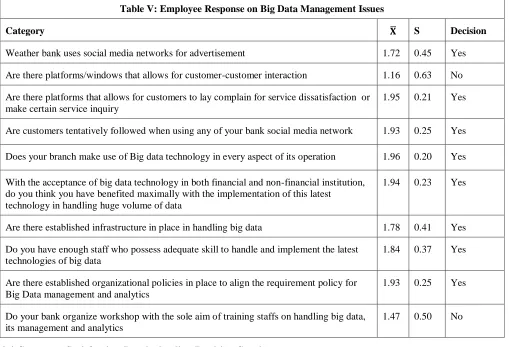
4.3 Big Data Management Issues
Table V: Employee Response on Big Data Management Issues
Category 𝐗 S Decision
Weather bank uses social media networks for advertisement 1.72 0.45 Yes
Are there platforms/windows that allows for customer-customer interaction 1.16 0.63 No
Are there platforms that allows for customers to lay complain for service dissatisfaction or make certain service inquiry
1.95 0.21 Yes
Are customers tentatively followed when using any of your bank social media network 1.93 0.25 Yes
Does your branch make use of Big data technology in every aspect of its operation 1.96 0.20 Yes
With the acceptance of big data technology in both financial and non-financial institution, do you think you have benefited maximally with the implementation of this latest technology in handling huge volume of data
1.94 0.23 Yes
Are there established infrastructure in place in handling big data 1.78 0.41 Yes
Do you have enough staff who possess adequate skill to handle and implement the latest technologies of big data
1.84 0.37 Yes
Are there established organizational policies in place to align the requirement policy for Big Data management and analytics
1.93 0.25 Yes
Do your bank organize workshop with the sole aim of training staffs on handling big data, its management and analytics
1.47 0.50 No
4.4 Customer Satisfaction Level of online Banking Services
Table VI shows the mean and standard deviation of the customer satisfaction level with online banking service. From Table VI it shows that in generalmajority of the customers are satisfied with the online banking service especially when using their cards for online shopping (77 percent). They also believe that the bank has good quality of online banking and are satisfied with the online products and services (72 percent). Customers can get services with ease (70 percent) and are also satisfied with the cost of online banking services at GT Bank (65 percent) as shown inFigure II.
Table VI: Mean and Standard Deviations for Customer Satisfaction Level
Category 𝐗 S Decision
Customers response to mobile banking application 4.52 0.63 Good
Customer‟s response to using social networks 3.73 1.20 Good
Ease of getting services 3.86 1.21 Agree
Use of ATM card regularly while shopping 4.02 1.15 Agree
Satisfaction with the quality of online banking 3.91 1.17 Agree
Satisfaction with the variety of products and services 3.91 1.17 Agree
4.52
3.73 3.86
4.02
3.91 3.91
3.73
0 0.5 1 1.5 2 2.5 3 3.5 4 4.5 5
response to mobile banking
app
response to using social networks
Ease of getting services
Use of ATM for shopping
quality of online banking
Online products and
services
cost leadership
Fig. II: Customer Satisfaction Level
4.5 Customer Satisfaction Level and ATM Card Usage
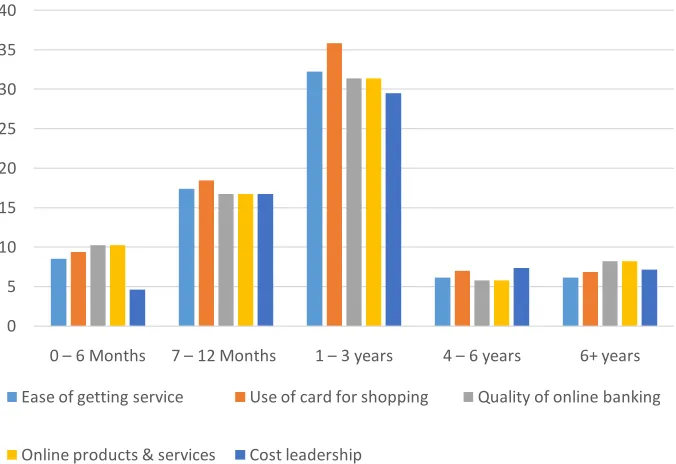
Over time, there has been a gradual increase in the number of loyalty card holders at GTBank. This has led to subsequent increase in the number of shoppers. From Table VII, a cross tabulation of the customer satisfaction level and duration of ATM card usage shows that GTBank management also points to an equally a strong correlation between increased sales and increased loyalty card numbers at GTBank branches especially those that have used their cards for an average of 1-3 years. Increase in Sales at GTBank driven by increased loyalty card holders has helped GTBank take advantage of scale to reduce on its per capita costs as shown in Figure III. Therefore, this gives GTBank advantage in terms of higher margins per product sold as compared to other competitors.Most customers (65 percent) are satisfied with the pricing of online banking services at GT Bank, thus driving the repeat purchases.
Table VII: Customer Satisfaction Level According to Duration of ATM Card Usage
Category Length with ATM Card
0 – 6 Months 7 – 12 Months 1 – 3 years 4 – 6 years 6+ years
Ease of getting service 8.53 17.41 32.25 6.14 6.14
Use of card for shopping 9.38 18.43 35.84 6.99 6.82
Quality of online banking 10.24 16.72 31.40 5.80 8.19
Online products & services 10.24 16.72 31.40 5.80 8.19
Fig. III: Customer satisfaction level with duration of ATM card usage
5 Theoretical Implications
The findings from the study indicate that despite the fact that most of the surveyed respondents use ATM cards and are on the mobile banking platform, there were divergent views on the measured attributes regarding repetitive buying driven by use of ATM cards online. Customers response to mobile banking has been very good, the attribute have a high mean (4.519) and the least standard deviation (0.626). Customers clearly use their ATM cards regularly while shopping, the attribute had a fairly high mean of (4.022) and standard deviation (1.151). Moreover, the study found consistency that the consumers who have had their ATM card for 1-3 years were likely to give a positive rating on the surveyed parameters as shown on the cross tabulations between the attributes and the length of having the ATM card and online banking. Majority of the customers state that Guaranty Trust Bank has good quality products compared to other similar banks with a mean of (3.908) and standard deviation of (1.169). With a wider standard deviation though at (1.187), the extent of customers using their ATM card at other POS averaged at (3.667) score which was marginally below the mean mark (3.914). This positive customer experience at Guaranty Trust Bank that is ease of getting what they want, satisfaction with measured attributes that has been made possible by the analysis of Big Data at the company and also the regular use of ATM card when shopping and online/mobile banking has driven repetitive buying on the web.
ATM cards was introduced to Nigerian banking customers in 1991 for withdrawals, while using the ATM cards for electronic bill payments was not until 2011 [28]. Following the Implementation of „cashless policy‟ in Nigeria in 2012 led to the adoption of mobile banking [29,30]. Findings of Figure III for customers that adopt use of ATM cards for online shopping and transactions can be explained in line with the adoption model explained by Rogers [31] who explain the rate of adoption (the relative speed with which an innovation is adopted by members of a social system) as S-shaped curve. According to Rogers [31], the categories of adopters are: innovators (2.5%), early adopters (13.5%), early majority (34%), late majority (34%), and laggards (16%). From Figure III, those that have used their cards for 6 years and above (6.82 percent) could be categorized as the innovators. According to Rogers [31], they are the first to adopt technology due to a desire for the rash, daring, risky and willingness to accept an occasional setback when a new idea proves unsuccessful. Such customers control substantial financial resources which help in absorbing the possible losses from an unprofitable innovation and are able to cope with a high degree of uncertainty about an innovation at the time they adopts. Those that have used their cards for 4 – 6 years (6.99 percent) could be categorized as the early adopters. Rogers [31] explained that such customers have the highest degree of opinion leadership and potential customers look up to them for advice and information about an innovation. These customers are considered by many to be “the individual to check with" before adopting a new idea because they are not too far ahead of the average individual in innovativeness, hence, they serve as a role model for many other customers which help trigger the critical mass when they adopt an innovation. Those that have used their cards for 1 – 3 years (35.84 percent) could
0 5 10 15 20 25 30 35 40
0 – 6 Months 7 – 12 Months 1 – 3 years 4 – 6 years 6+ years
Ease of getting service Use of card for shopping Quality of online banking
be categorized as early majorities. According to Rogers [31], such customers interact frequently with their peers but seldom hold positions of opinion leadership in a system. They are one of the most numerous customer categories, making up one third of all customers. They may deliberate for some time before completely adopting a new idea. Those that have used their cards for 7 – 12 months (18.43 percent) could be categorized as late majorities. Rogers [31] explained that these customers adopt new ideas just after the average customer and could also form one third of the members of a system. Adoption may be both an economic necessity and the result of increasing peer pressures. Innovations are approached with a skeptical and cautious air, and they do not adopt until most customers have already done so. Those that have used their cards for 0 – 6 months could be categorized as laggards (9.38 percent). According to Rogers [31], suchcustomers‟ innovation-decision processes are relatively lengthy, with adoption and use lagging far behind awareness knowledge of a new idea, very suspicious of innovation, and therefore, are last customers to adopt an innovation (maybe due to fear of online fraud). Their decisions are often made in terms of what has been done previously, and these customers interact primarily with others who also have relatively traditional values.
With respect to creating cost leadership, the findings show that Big Data management has had a relative advantage on the adoption of banking ideas coming from Guaranty Trust Bank as the management makes decisions based on the data collected and analyzed and this has improved the company‟s understanding of customer trends and customers as a whole. This data also helps them decide on when and how to introduce a new service idea or product and make decisions on slow moving trends. Guaranty Trust Bank management is focused on embracing technology to achieve its strategic goal. Part of technology is use of Big Data Management and this has been made possible by the management investing in the right infrastructure, technical skills and IT platforms to implement Big Data Management and Analytics technology and on overall, the company finds it relatively easy to implement and use Big Data Management supported by top management although there is more to be done to reach the scale.
6 Managerial Implications
Some implications can be drawn based on the above result. The Bank‟s Management should understands the need for a timely, reliable and accurate information flow within the Bank, for effective decision making and enhanced financial reporting. Carry out continuous upgrade of their card systems to ensure optimum security, absolute efficiency, cost effectiveness and customer satisfaction is of utmost importance. Also implementation of stringent fraud control measures to reduce financial loss to the bank and customers is very necessary. Bank managers can position themselves a notch higher than their competitors by creating differentiation by introducing a variety of products as they analyze customer feedback and act on it. This is a driver for customer satisfaction as seen from very high ratings of the attributes. The company can arrange services systematically, with some having combinations from customer feedback. This can make it easy for customers to access services online thus improving the customer experience across the bank and its branches.
Gartner [32] stated that thirteen (13) percent of organizations are using predictive analysis but only 3 percent are using prescriptive analytics. According to Marr [14] predictive Analytics uses big data to identify past patterns to predict the future.Our findings indicate that Guaranty Trust Bank are part of the 13 percent that are using predictive analysis to analyze trends and patterns of customers thus being able to anticipate the customer needs. Managers most understand that using Big Data Management and Analytics on a large scale can help to inform business decisions in the company like introduction of new services, or getting rid of old platforms and alsoarrange products systematically, with some having combinations from customer feedback. Managementshould create an action log track for end to end implementation and review the data collected regularly for the company to be able to optimize on Big Data Management. This is in line with Marr [14] who stated that properly tuned predictive analytics can be used to support sales, marketing, and for other complex forecasts.
On a small scale though, Guaranty Trust Bank also uses prescriptive analysis that gives a laser-like focus to answer specific questions. For example, at Guaranty Trust Bank, they are able to “prescribe” the needs of some specific customers‟ that is introducing specific item mainly for a particular targeted group. The bank have not fully embraced Diagnostic Analytics that is used for discovery i.e. to determine why something happened [33]. This could be because they are not really focused on the social media marketing campaign that can adopt descriptive analytics to assess the number of posts, mentions, followers, fans, page views, reviews, pins, etc. There can be thousands of online mentions that can be distilled into a single view to see what worked in the past campaigns and what didn‟t. Therefore, management needs to focus on the use of Diagnostic and descriptive statistics to now go further into understanding why and how some customers behave or do what they doso as to also target their customers who express their concerns on social mediain terms of customer feedback point.
transactions done internationally, raking in 47,350 on ATM, 81,305 on POS/Web and local transactions on ATMs reaching a total of 1,570,148 which culminates and proves where and how their result-oriented use of big data management and analytics has carefully reflected in repetitive buying by their customers locally and internationally.
Guaranty Trust Bank also stores and shares information on purchasing trends allowing GTBank to target and personalize the offers they make, this was validated by the study as findings indicate that GTBank collects ATM card, POS/Web data on a large scale and the data is analyzed to understand the trends i.e. customer spent, the combinations of items bought, frequency, amount spent etc. In line with Philipet al.[7]who explained that data is all around us and that organizations need to be able to pick on what scope of data will be relevant for its use. Therefore, Bank management have to be able of prioritize on the type of data to pick for analysis such that they do not get overwhelmed with so much data that is not actionable. According to Baesens [34]Big Data Analytics requires experienced analysts able to analyze and decipher data to churn out the requisite information. These skills are still scarce and organizations need to build the capability required.
Finally, the management should continue to proactively work ahead of technological innovations so as to deal wit h the changing dynamics in the big data analytics.In line with Hoffman and Podgurski [35] the company can also focus on using Big Data for management that involves understanding the meaning of big data in a company databases using pre-determined queries and multidimensional analysis. This can be done by use of transactional data like years of customer purchasing activity, and inventory levels and turnover by asking questions and getting answers in real-time that can be used to help make short-term business decisions and longer term plans.
7 Conclusions
The study was intended to analyze the role of Big Data Management (BDM) from a financial approach in Nigeria. Specifically, the focus was placed on customer needs and trends, customer loyalty and use of big data in creating cost leadership for bank and financial managers. The findings for each of these are as summarized hereunder;
From the study, we can conclusively say that Guaranty Trust Bank (GTB) uses Big Data Management and Analytics on a large scale, and this analysis is done at the head office and results cascaded downwards, that is to the branches through the branch managers. Fundamental Big Data at Guaranty Trust Bank are mobile banking data and Sales Data and is done on a large scale. The company also collects social media data though is done on a fairly midlevel scale. The data collected is reviewed by a team of analysts, and findings used to inform business decisions in the company like introduction of new items, or getting rid of unrealized ideas. It is from this analysis that Guaranty Trust Bank has been able to position itself a notch higher than its competitors, thus creating differentiation by introducing a variety of products, this is from the analysis of customer feedback and acting on it. This has driven customer satisfaction as seen from very high ratings of the attributes. The company has also been able to arrange products systematically, with some having combinations from customer feedback, making ample use of the web and creating a level playing ground for customers to easier access information, help thereby having a ripple effect on the ease of banking with the institution. This has made it easy for customers to access products online, pay for bills via the ever improving mobile banking platform, response on various social media platform, thus improving the customer experience at Guaranty Trust Banks which in return has given them the upper edge of differentiation from their competitors. All this is because of Big Data Management, where there were able to analyze trends and patterns.
Use of big data has enabled GTBank to have a clear differentiation amongst its competitors by anticipating the customer needs and addressing them in time before the customer sees the need to switch to competitor banks thus helping them retain most of their customer base and earn new ones. They have been able to drive satisfaction amongst their customers thus clearly winning over competition. ATM cards incentivizes for customers as seen with the high rate of repeat purchases as consumers are motivated by interest they earn, customers are motivated by the fact that the more the shop at GTBank, the more they earn the points and therefore the more the returns. This has driven regular use of the ATM cards. The ease with which they do banking has also encouraged customers to continue banking either online or physically.
8 Limitations
understanding of the nature or interpret analytics of Big Data Management based on meta-data. An analysis based on a combination of stated preference and bank-supplied online customer banking data would reveal more information and extend the study‟s applicability. Furthermore, a study comparing the performance of foreign banks and local Nigerian banks in terms of Big Data Management is recommended.
References
[1]. Johnson, J.E. (2012). Big data + big analytics = big opportunity: big data is dominating the strategy discussion for many financial executive s. As these market dynamics continue to evolve, expectations will continue to shift about what should be disclosed, when and to whom. Financial Executive, 28(6), 50-54.
[2]. More, P., Chaudhary, L., Panmand, S., & Shah, N. (2013). The Big Data: A growing torrent of technology. International Journal of Advanced Computer Technology.Compusoft, 2(5), 130-135.
[3]. Manyika, J., Chui, M., Brown, B., Bughin, J., Dobbs, R., Roxburgh, C., & Byers, A.H. (2012). Big data: The Next Frontier for Innovation, Competition, and Productivity. McKinsey Global Institute.
[4]. Chen, C.P., & Zhang, C.Y. (2014). Data-intensive applications, challenges, techniques and technologies: A survey on Big Data. Information Sciences, 275(1), 314-347.
[5]. Brown, B., Chui, M., &Manyika, J. (2011). Are you ready for the era of „big data‟.Mckinsey Quarterly, 4(1), 24-35.
[6]. McAfee, A., &Brynjolfsson, E. (2012). Big data: The management revolution. Harvard Business Review, 90(10), 60–66.
[7]. Philip, T.M., Schuler-Brown, S., & Way, W. (2013). A framework for learning about big data with mobile technologies for democratic participation: Possibilities, limitations and unanticipated obstacles. Technology, Knowledge and Learning, 18(3), 103-120.
[8]. Russell Neuman, W., Guggenheim, L., Mo Jang, S., & Bae, S.Y. (2014). The dynamics of public attention: Agenda-setting theory meets big data. Journal of Communication, 64(2), 193-214.
[9]. Oghuma, P. (2013). Big Data Analytics Adoption in Telecommunications Industry: The KoreanTelecoms Perspectives (Conference paper).
[10]. Chua. H.N., Chang, Y., Wong, S.F., & Tan, C.M. (2015). Privacy Protection Policy for Big Data Analytics in the Malaysian Telecommunications Sector (Conference paper).
[11]. Agrawal, K.P. (2013). The Assimilation of Big Data Analytics (BDA) by Indian Firms: a Technology Diffusion Perspective.
[12]. Ogwang, K.P. (2016). Strategic Role of Big Data Analytics on the Competitive Advantage of Supermarket Chain: A Case Study of Nakumatt Holdings Limited (Doctoral dissertation, United State International University-Africa).
[13]. Davenport, T. (2016). Benefits of Big Data Analytics. Database Systems Journals, 1(1), 1-12.
[14]. Marr, B. (2016). Big data in practice: how 45 successful companies used big data analytics to deliver extraordinary results. John Wiley & Sons. United Kingdom.
[15]. Wamba, S. F., Akter, S., Edwards, A., Chopin, G., &Gnanzou, D. (2015). How „big data‟ can make big impact: Findings from a systematic review and a longitudinal case study. InternationalJournal of Production Economics, 165, 234-246.
[16]. IDG Connect (2013). 60% Kenyans & Nigerians on the Road to Big Data. Accessed on 4th Dec., 2018 from http://www.idgconnect.com/abstract/4149/-kenyans-nigerians-road-big-data.
[17]. Prachi, A., Fatima-Zahra, B., &Ayoub, A. (2013). An Overview of Big Data Opportunities, Applications and Tools: IEEE.
[18]. Oracle. (2012). Financial Services Data Management: Big Data Technology in Financial Services, White Paper: Oracle.
[20]. Kaoutar, B.A., Mohammed, B., & Mohamed, B.A. (2014). Age of Big Data and Smart Cities: Privacy Trade-Off. International Journal of Engineering Trends and Technology (IJETT), 1(1), 1-10. ISSN: 2231-5381 (Print).
[21]. Press, G. (2013). A very short history of big data. Forbes Tech Magazine, May, 9.
[22]. SAS. (2013). Big Data: Lessons from the Leaders, Economist Intelligence Unit Report. Accessed on 28th Nov., 2018 from http://www.sas.com/reg/gen/corp/1774120.
[23]. Kale, V.A., Deshmukh, R.K., &Khiste, G.P. (2017). A bibliometric survey of the literature published by Web of Science on „Consortia‟ from 1989-2016. The New Man International Journal of Multidisciplinary Studies, 4(10), 75-82.
[24]. Richey, G., Morgan, T., Lindsay, K., & Yoon, A. (2014). Big data. CSCMP Hot topics. Accessed on 16th November 2018 from https://cscmp.org/member-benefits/hot-topics.
[25]. Cooper, D.R., & Schindler, P.S. (2014). Business Research Method. The McGraw-Hill Companies. New York.
[26]. Collis, J., & Hussey, R. (2013). Business research: A practical guide for undergraduate and postgraduate students (3rd Ed.). Macmillan International Higher Education. Palgrave Macmillan, VHPS, Gordonsville, USA.
[27]. Wikipedia (2018). Map of Nigeria. Accessed online on 22nd August, 2018 from http://www.wikipedia.
[28]. Vinne, M. (2018). History of e-banking in Nigeria. Message posted to Information Guide in Nigeria. Accessed on 14th January, 2019 from https://infoguidenigeria.com/history-of-e-banking-nigeria/.
[29]. Odumeru, J.A. (2013). Going cashless: Adoption of mobile banking in Nigeria. Arabian Journal of Business and Management Review(Nigerian Chapter), 1(2), 9-17.
[30]. Agwu, E.M., & Carter, A.L. (2014). Mobile phone banking in Nigeria: Benefits, problems and prospects. International Journal of Business and Commerce, 3(6), 50-70.
[31]. Rogers, E.M. (2003). Diffusion of Innovation (5thEd.). Free Press. New York, 280-284.
[32]. Gartner, (2014). Big Data. Accessed on 15th Nov., 2018. Available at http://www.gartner.com/newsroom/id/2684616.
[33]. Al-Sakran, H. (2014). B2C E-Commerce Fact-Based Negotiation Using Big Data Analytics and Agent-Based Technologies.International Journal of Advanced Computer Science and Applications, 5(12), 30-37. DOI 10.14569/IJACSA.2014.051204.
[34]. Baesens, B. (2014). Analytics in a big data world: The essential guide to data science and its applications. John Wiley & Sons. United Kingdom.