240
The Optimized Algorithm For Prioritizing And
Scheduling Of Patient Appointment At A Health
Center According To The Highest Rating In
Waiting Queue
Afsaneh Samimi Golgoun, Ghodrat Sepidnam
Abstract: By the advancement of technology, most healthcare queue management systems assign a turn number to the patients online. In traditional healthcare queue management systems, all patients are considered to be in the same priority, and only the amount of doctors and patients' wasted time is optimized. While the lives of humans are more important than time. Therefore, in the proposed method in this study, the most important issue that is considered is to give priority to patients who are already in worse conditions. At the same time, it has been tried to minimize the waiting time for doctors and patients. The proposed system prioritizes patients to receive their services according to their health and vital status, and then optimizes the visit scheduling of patients using the genetic algorithm. The results implemented in Visual Studio and SQL Server software show the effectiveness of the proposed mechanism in scheduling and prioritizing.
Index Terms: Genetics, Optimization, Patients, Prioritizing, Scheduling.
————————————————————
1
I
NTRODUCTIONAT the present time, many of healthcare information systems are being developed and they include several modules, each of which is devised into separate units at therapeutic centers. Many healthcare information systems have been designed and implemented in recent years. With regard to the efforts in providing a complete and flawless system, and to eliminate the problems of healthcare systems in therapeutic centers, these systems still do not meet all the needs of users and patients' satisfaction. One of the most important and challenging issues in the discussions on health information systems is scheduling patient's turns in different departments of therapeutic centers. Time scheduling and assigning turn to the patients can be considered as an important issue in healthcare systems. One of the most important and challenging issues in therapeutic centers is the high number of attendees and help them take turns. In some cases, the person goes to the health center from a far distance and cannot take a turn to visit the related physician. Therefore, this will be a source of dissatisfaction among many attendees and will put pressure on staff as well. Today, by the advancement of technology, many people are more interested in doing things through the Internet and phones. Most of the healthcare queue management systems in hospitals are giving turn to the patients online. Although these online queue management systems can draw the satisfaction of patients who cannot take turn in person, they still could not satisfy the majority of patients.
These days, giving turn in a therapeutic center has been highly put under consideration of software developers in most parts of the world, and the reason for this is quite clear [2]. Without the use of day-to-day information technology and technologies in this chapter, patients may spend a lot of time on receiving the desired services due to poor organization of health centers. The shortage of hospital resources, including manpower, supplies and equipment, has put restriction on the way of the patients not to be able to receive care services. Therefore, the best solution to increase efficiency is to use the resources correctly and reasonably. Doing this request will be impossible except through proper management and rational assessment [3]. Since waiting time is one of the effective factors of patient satisfaction from the quality of services offered, it is important to provide a distinct queue management system to the patient and the rest of the population. In fact, waiting time represents the criterion of access to therapeutic center services and is measurable as one of the indicators of hospital performance and is often the main reason for patients’ dissatisfaction with the services provided at health centers. On the other hand, assessment of the patient satisfaction level is an appropriate criterion for assessing the method of treatment, its quality as well as the relationship between doctor and patient. If the patient is not happy with the turn-giving process at a therapeutic center, this discontent will result in leaving the referral to the treatment center. Many researchers believe that patient satisfaction with the services provided by healthcare institutions is one of the most important tools for evaluating a system of treatment that has been used to ensure their quality [4]. By focusing on identified effective factors including waiting time for patients, reviewing all existing processes in health centers, enhancing and developing beneficial processes, benefiting from the planning and using appropriate quality techniques, can help to reduce the waiting time of patients. Providing a robust system based on an optimal algorithm can greatly enhance the quality of services provided at a health center. The purpose of this study is to improve the turn-giving module in hospital information systems. In this research, we try to provide an optimal scheduling algorithm to improve the problems discussed above and enhance part of this module. This algorithm allocates different scheduling to different patient _____________________________
Afsaneh Samimi Golgoun, Ghodrat Sepidnam
Department of Industrial Engineering, Faculty of Engineering, Shirvan Branch, Islamic Azad University, Khorasan Shomali, Iran. Email: [email protected]
241 according to different indexes. By considering the type of turn
and recognizing their types and royalties for each referral, we can determine the status of the patients and provide a timely schedule for patients in the treatment center. In addition, we examine cases or problems that disturb the situation and proper turn-giving to the patient. It is also important to take into account the various turn-giving indexes, including the type of referral to the treatment center, the types of turns, the types of patient status, the receipt of para-clinical services, and the consultation service with the other physician and so on. According to the abovementioned cases, the patient's turn is indicated in different parts of the treatment center and ultimately, the patient's waiting time will also be significantly affected, and the patient's satisfaction from the received services will also have the consent of the physician and the personnel of therapeutic center. This function is also effective in obtaining more services and privileges for the treatment center. This article is organized as follows: Section 2 examines the research and works done in relation to scheduling and prioritizing the turn of patients in health centers. In section three, the question of research is described and the existing shortcomings in previous research, which led to the presentation of the model of this study, are reviewed. The basic model used in modelling the waiting queue of patients is shown in this section, and then the changes and criteria for the study have been added to it. After presenting the model, one of the meta-heuristic algorithms which is called genetic algorithm was used to optimize the patient's visit order and the proposed model's resolution. The genetic algorithm is introduced in this section and its process and implementation stages are described. In Section 4, firstly, by the help of analyzing data, general information about data set and type of data has been obtained. Then the stages of implementation and execution of the model were described in the environment of Visual Studio and SQL Server software. Then, the way of implementing the genetic algorithm for optimizing the queuing of patients is described. In section five, titled Summary and Suggestions, we will have an overall review on the research as well as we will provide suggestions for future work.
2
R
ELATED WORKSIn this part of the research, several articles and researches on the scheduling of patients' turns in health centers have been reviewed. Some of these articles have discussed the factors that make patients wait more at the center of treatment. Others have come up with a solution to this problem and have executed it in simulation software. In some systems, queue management modules including eHospital[5], eClinic[6], and eClinical[7] Work are also designed. We will review some of these studies. According to the studies and research conducted in this paper [8], we studied the question of classical appointment schedules, which most experts encounter in the processes or health care. In such an environment, an appointment refers to a period that determines the moment at which a customer or patient enters on time. Next, the customer receives a service from the service provider. Ideally, the scheduling is in such a way that the patient has no waiting time and the doctor does not have time for idleness. Unfortunately, this state will never be realized, because some factors such as the treatment time for each patient are not constant and is a random variable. Author is trying to find the best appointment schedule to minimize waiting and idleness times for all patients. Many appointment
242 optimization is largely understated compared to
single-objective optimization, however, idleness time remains, however, the cost of idleness can be further reduced to a large future change [10]. In another study [11], which is also considered as the main article of this research, factors such as fluctuations in customer demand and service time, such as waiting time for patients, time of using no resources, and cost / overall benefits affect the performance of appointment scheduling systems. The study implements four scheduling policies, namely, permanent entry, multiple patient entry, three-segment pattern entry, and irregular entry in the ultrasound section of a hospital in Taiwan. By four-side simulation of optimization procedures for implementation of policies, optimal or near optimal solutions can be obtained for each patient during the arrival, time of arrival of patients and the number of slots for incoming patients. In addition, the three functions (function) of the tested target and the results are discussed. Management concepts and discussions are summarized to illustrate how results can be beneficial to hospital managers who are helpful in allocating their health care capacities [11].
3
P
ROPOSEDM
ETHODThen, the basic model used in queuing of patients is shown, and then the changes and criteria of the research were added to it. After presenting the model, a method is presented to optimize the order of patients' visits. Since the optimization of the proposed model involves the examination of all possible permutations, the equation is in the form of np [12]; therefore, one of the meta- innovative algorithms called genetic algorithm has been used. In the paper [11], the following relation has been used to optimize the patient's queue management system:
min 𝐸,*𝑆 − ∑ 𝜉+ + ∑ 𝑊
(1)
In Relation (1), the average waiting time for patients and the waiting time for physicians is minimal, in which SN indicates when the patient N is going to doctor, ξi is the time when the patient i has been before the doctor and Wi was the waiting time for the patient i. This relation can be considered as follows:
min 𝐸*𝑆 − ∑ 𝜉+
∑𝑊
𝑁
≤ the average waiting time for patients 𝑖𝑛 𝑡ℎ𝑒 𝑛𝑜𝑟𝑚𝑎𝑙
(2)
In Relation (2), the waiting time for doctors is minimized and one stipulation is considered which in the case of the minimum waiting time for physicians we should expect patients to wait at a normal rate (without optimizing the waiting time for doctors).
3.1 Prioritization of patients
In the method presented in [11], all patients are considered with the same priority, and only the amount of time lost for doctors and patients is optimized. It is in a case that the lives
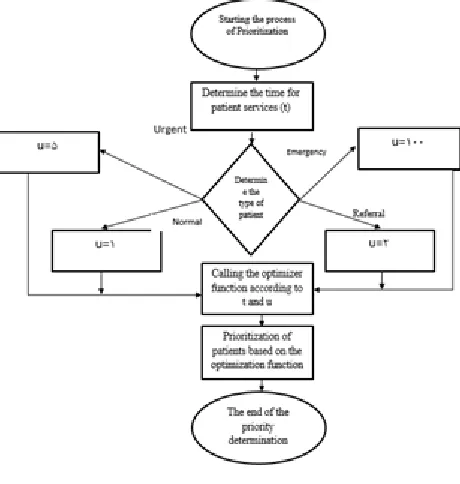
of humans are more important than time. Therefore, in the proposed method in this research, the most important issue that has been taken into account is the patient's life, i.e. to prioritize patients who are more severely affected. At the same time, it has been tried to minimize waiting times for doctors and patients. To do so, patients are prioritized in two steps: First, patients are divided into four groups according to the type of emergency (emergency, urgent, referral or normal). The priority of patients in each category is different from the other categories. In such a way that ―emergency‖ patients have the first and the highest priority. After them, the ―urgent‖ patients are the second priority, the ―referral‖ patients are in the third priority and the ―normal‖ patients are in the least priority. In the second stage, patients are prioritized according to the type of service they require and the time it needs (for example, the time needed to drip in the eye, or the time needed for the laser and etc.). If there was no time required for any of the services in the database, the estimated time period is estimated based on the number of patients who have already visited for that service. The less time a patient needs, the higher priority that patient will be allocated. It is noteworthy that even if patient prioritization is involved in the problem, the problem does not change much. Here, the problem is solved using Relation (1) and optimization. With the difference that the patient's priority is higher, the time and expectation of the patient in the queue are costlier and more dangerous. To implement this mode, we have done as the following:
• For each minute of waiting by ―normal‖ patients, a time unit is added to the total waiting time of the patients.
• For each minute of waiting by ―referral‖ patients, two units of time are added to the total waiting time of the patients.
• For each minute of waiting by ―urgent‖ patients, five units of time are added to the total waiting time of the patients.
• For each minute of waiting by ―emergency‖ patients, 100 units of time are added to the total waiting time of the patients.
In this way, emergency patients, urgent patients, referrals and normal patients should be visited in order to minimize waiting time for patients as per Relation 1. The cost of each patient is considered and determined according to a physician's opinion who works in the hospital. If necessary, this fee can be considered for each category less or more than the prescribed amount. Or, if necessary, you can use the opinions of several expert people and can also use their common ideas with common approaches. The general trend of the proposed method, which is called once every new patient arrives, is shown in Fig. 1. In the provided flowchart to determine the patient's priority, the waiting time coefficient of each patient is determined by u.
3.2 Optimization of waiting time
243 Fig. 1. General priority trend
3.3 Use of the Genetic Algorithm to solve the problem One of the most important evolutionary algorithms is the genetic algorithm that is very useful for solving optimization problems. This algorithm is inspired by the natural fertility of humans and the phenomenon of inheritance in different generations. In this way that several generations of responses are used in the problem-solving process and the characteristics of the best responses in each generation are transmitted to the next generation [13]. In Fig. 2, the general trend of the genetic algorithm is shown in a flowchart. In the present question, several doctors respond simultaneously to patients, so several queues are formed simultaneously. Whenever a patient enters the system, if the patient urge to refer to a specific doctor remains in the same queue and otherwise he/she will be added to a queue whose average waiting time for patients is minimal. This patient should not necessarily go to the end of the queue, as he/she may have a high priority. Therefore, each time a patient is assigned a turn in queue, we use the genetic algorithm to provide a permutation of the patients in that queue in such a way that the average waiting time for it is minimized.
Fig 2. Genetic Algorithm Flowchart
4
I
MPLEMENTATION ANDE
VALUATION244 Prev= List.Rows[0];
List.Rows[0]=0; Sum=0;
For (i = 1; i <= List.Count - 1; i++) {
T = Prev+ List.Rows[i – 1]; Prev = List.Rows[i]; List.Rows[i]=T;
Sum = Sum + List.Rows[i]; }
ave = Sum / List.Rows.Count;
The pseudocode of the determination of the intended doctor is displayed after calculating the cumulative average as follow:
[Index, X]=Min(aveA, aveB, aveC); if (index == 0)
{ res = "A"; }else if(index == 1) {
res = "B"; }else if(index == 2) {
res = "C"; }
In the pseudocode, the values of aveA, aveB and aveC are the cumulative mean of queues. The amount of index is the index of the minimum element among these three values. After determining the minimum and its index, the intended patient is in the corresponding queue. During queuing operations, the genetic algorithm and the proposed model begin to find the best order to minimize cumulative time. The parameters of the genetic algorithm in this implementation are in accordance with Table 1.
Table 1. Parameters and values
Value Parameter
10 The number of generations
7% The rate of mutation
75% Rate of discontinuation of each chromosome
60 Primary population size
In this system, for each physician, an optimization process is performed by genetics and the length of each chromosome is as much as the number of patients present to the intended physician.
Fig. 3. Example of a Chromosome
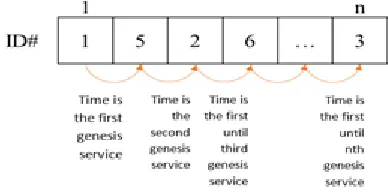
In this model, as shown in Fig. 3, each chromosome only contains patients' identities and we can access to patients and their information in the database according to this identity. According to the order of identification of patients in each chromosome, the cumulative waiting time is calculated by the optimal function. According to the mutation operators and the disconnection of the two good chromosomes, new more optimally chromosomes are produced and they are placed in the population. To calculate each chromosome, genes are read from the beginning, and the amount of time they receive the services is extracted from the table. Each gene should wait as much as the amount of received services by previous
genes to gain the turn. For this case, look at Fig. 4.
Fig. 4. How to Calculate Cumulative Time for Each Gene
Also, one of the parameters used in this system is the matrix of receiving service time. The matrix of receiving service time is a square matrix whose numbers in each row are equal to the amount of time the patient receives the service.
(3)
In Relation 3, each row of the matrix indicates the amount of time that the patient receives the services. This matrix is generated from the patient profile table. For example, the second patient in the system registered on the system requires a time of b minutes to receive the service. Any patient that comes after a second patient in the queue, needs to delay for b min to receive the services. Similarly, in the form of chain, every person in this queue needs to wait for the amount of time to receive its front-end services. Therefore, displacement in the front end of a queue is not decisive for the final queue, but it is important to determine the cumulative waiting time and each shift will change the waiting time of the entire queue. The original diameter of the 3-point matrix is also zero since the presence of a patient will not be repeated in the queue twice, and all patients have the right to attend only one time. According to Relation 4, after calculating and aggregating the desired times, it is enough to divide their sum by their number to obtain the corresponding mean. The only factor in the search is the search for the optimality function answers, which should be chosen as the best value.
𝐵𝑒𝑠𝑡 𝑉𝑎𝑙𝑢
= 𝑀𝑎𝑥(𝐹𝑖𝑡𝑛𝑒𝑠𝑠,1-، 𝐹𝑖𝑡𝑛𝑒𝑠𝑠,2-، …، 𝐹𝑖𝑡𝑛𝑒𝑠𝑠,𝑛-)
(4)
245 Fig. 5. Optimality function fluctuations
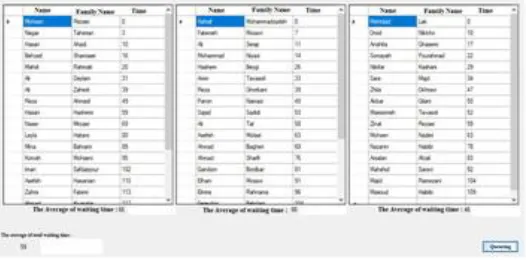
In the final form of this system, three queues will be created, in which the name and surname and the amount of waiting time for each person will be calculated based on the time of the service received by the front members of the individual. The average waiting time for each queue as well as the average waiting time for the entire queue are computed. By implementing the genetic algorithm in all three queues of patients, these patients are categorized in these queues. The average waiting time for the first queue is 63 minutes, for the second queue 74 minutes, and for the third queue is 48 minutes. The total average of waiting time for all three queues is 61 minutes. By implementing of these systems in several times, there may be a slight difference in the final answer. But the answer to the solution will always be in the direction of optimization. The change in parameters such as the percentage of mutation and discontinuation, the number of generations and the change in the primary population will change the final answer. Setting these parameters is very important and has a great impact on the performance of the algorithm. Therefore, in this study, the parameters are carefully adjusted.
Fig. 6. Optimal queuing view
5
C
ONCLUSIONMany health information systems have been designed and implemented in recent years. Despite the efforts made to provide a complete and flawless system, these systems still do not meet all the needs of users and patients’ satisfaction. One of the most important and challenging issues in discussing health information systems is the scheduling and planning of patient visits in different departments of health centers. In this research, the waiting queue of patients is modeled and then the changes and criteria of the research, including the critical priority of patients for receiving emergency services have been added to it. In order to optimize the order of patients' visits with
all possible permutations, the problem is of the np form; then a genetic algorithm is used to optimize the patient's turning system.
R
EFERENCES[1] Riazi H, Biataraf A, Abedian S., Performance Evaluation of Hospital Information Systems, Tehran, Sarve Kian Publication, 155-168 (2013)
[2] Khamseh A, Aghamohamadi S, Kazemi A, Evaluation of the main factors affecting the waiting time of referrers in specialized clinics in one of the public hospitals of Tehran, Journal of Sabzevar University of Medical Sciences, Vol 20, No 1: 71-62. (2012)
[3] Nasiripour A, Jahangiri K, Agha Mohammadi S, Investigating the waiting time of clients to specialist clinics of Shahid Dashtani Hospital, Shariati Hospital in Tehran, Using Six Sigma Pattern, Journal of Paramedical Sciences, Tehran University of Medical Sciences, Vol. 4, No. 3 & 4, Autumn and winter 59-50. (2010)
[4] Didehban a, Kiani M., Improvement of Waiting Time Using Priority Algorithm Based on the Highest Score in the Human Ranges, Journal of Industrial Engineering, Vol. 46, No. 1, 51-39. (2012)
[5] Adroit Infosystems Pvt. Ltd, eHospital Systems, (2008), https:// www. adroitinfosystems.com /products/ehospital-systems [Accessed 1 April 2017].
[6] Adroit Infosystems Pvt. Ltd,eHospital Systems, (2010), https://www. adroitinfosystems.com/products/eclinic-systems [Accessed 1 April 2017].
[7] eclinicalworks company, eclinicalworks, (2015), https://www.eclinicalworks.com [Accessed 10 January 2017].
[8] Kuiper A, Appointment scheduling in health care, MSc thesis, University of Amsterdam. (2012)
[9] Noorshabani, A, Evaluation and Improvement of Clinical Clinic System Using Simulation, National Conference on Accounting and Management, Shiraz, Sep. 14. (2013)
[10]Strahl P.F J, , Patient appointment scheduling system with supervised learning prediction, MSc thesis, Aalto University. (2015)
[11]P. Chen, R. A. C. Robielos, P. Kate, V. C. Palaña, P. L. L. Valencia, and G. Y. Chen, Scheduling Patients’ Appointments: Allocation of Healthcare Service Using Simulation Optimization , Journal of Healthcare Engineering· Vol. 6 · No. 2 · 2015 Page 259–280. (2015)
[12]Imany,genethicalgorithmsandTSPproblems, http:// imany .blogfa.com/ page /tsp1 [Accessed 25 June 2017]. (2017)