Medication Errors in the Home: A Multisite Study of
Children With Cancer
WHAT’S KNOWN ON THIS SUBJECT: Children are taking more medications than ever before. Medication errors in the hospital are common. Less is known about the medication errors that occur in children’s homes, and there are no studies that examine the entire process.
WHAT THIS STUDY ADDS: We reviewed 963 medications in the homes of children with cancer at 3 sites. We found 3.6 errors with injury and 36 errors with potential for injury per 100 patients. Interventions should target common and dangerous errors at home.
abstract
OBJECTIVE:As home medication use increases, medications previously managed by nurses are now managed by patients and their families. Our objective was to describe the types of errors occurring in the home medication management of children with cancer.
METHODS:In a prospective observational study at 3 pediatric oncology clinics in the northeastern and southeastern United States, patients un-dergoing chemotherapy and their parents were recruited from November 2007 through April 2011. We reviewed medical records and checked pre-scription doses. A trained nurse visited the home, reviewed medication bottles, and observed administration. Two physicians independently made judgments regarding whether an error occurred and its severity. Overall rates of errors were weighted to account for clustering within sites.
RESULTS:We reviewed 963 medications and observed 242 medication administrations in the homes of 92 patients. We found 72 medication errors. Four errors led to significant patient injury. An additional 40 errors had potential for injury: 2 were life-threatening, 13 were serious, and 25 were significant. Error rates varied between study sites (40–121 errors per 100 patients); the weighted overall rate was 70.2 errors per 100 patients (95% confidence interval [CI]: 58.9–81.6). The weighted rate of errors with injury was 3.6 (95% CI: 1.7–5.5) per 100 patients and with potential to injure the patient was 36.3 (95% CI: 29.3–43.3) per 100 patients. Nonchemotherapy medications were more often involved in an error than chemotherapy.
CONCLUSIONS:Medication errors were common in this multisite study of outpatient pediatric cancer care. Rates of preventable medication-related injuries in this outpatient population were comparable or higher than those found in studies of hospitalized patients. Pediatrics 2013;131: e1405–e1414
AUTHORS:Kathleen E. Walsh, MD, MSc,a,bDouglas W. Roblin, PhD,cSaul N. Weingart, MD, PhD,dKathleen E. Houlahan, MSN, MHA, RN,d,eBarbara Degar, MD,d,eAmy Billett, MD,d,eChristopher Keuker, MD,aColleen Biggins,b Justin Li,dKaren Wasilewski, MD,fand Kathleen M. Mazor, EdD, MSb,g
Departments ofaPediatrics, andgMedicine, University of Massachusetts School of Medicine, Worcester, Massachusetts; bMeyers Primary Care Institute, Worcester, Massachusetts; cKaiser Permanente Georgia, Atlanta, Georgia;dDana-Farber Cancer Institute, Boston, Massachusetts;eChildren’s Hospital Boston, Boston, Massachusetts; andfEmory Medical School, Atlanta, Georgia
KEY WORDS
antineoplastic agents, medical errors, medication errors, patient safety, pediatric cancer, quality improvement
ABBREVIATIONS
CI—confidence interval
S-TOFHLA—short test of functional health literacy in adults
Dr Walsh conceptualized and designed the study; contributed to the acquisition, analysis, and interpretation of data; performed statistical analysis; obtained funding; drafted the manuscript; critically revised the manuscript for intellectual content; and approved thefinal manuscript as submitted. Dr Roblin contributed to the concept and design of the study, as well as critical revision of the manuscript for intellectual content, and approved thefinal manuscript as submitted. Dr Weingart contributed to the acquisition of data, analysis and interpretation of data, administrative and material support, critical revision of the manuscript for intellectual content, and approved thefinal manuscript as submitted. Ms Houlahan contributed to the acquisition of data, critical revision of the manuscript for intellectual content, and approved thefinal manuscript as submitted. Dr Degar contributed to the analysis and interpretation of data, critical revision of the manuscript for intellectual content, and approved thefinal manuscript as submitted. Dr Billett contributed to the analysis and interpretation of data, critical revision of the manuscript for intellectual content, and approved thefinal manuscript as submitted. Dr Keuker contributed to the analysis and interpretation of data, administrative and technical support, critical revision of the manuscript for intellectual content, and approved thefinal manuscript as submitted. Ms Biggins contributed to the acquisition of data, analysis and interpretation of data, administrative support, drafting of the manuscript, and approved thefinal manuscript as submitted. Mr Li contributed to the acquisition of data, administrative support, critical revision of the manuscript for intellectual content, and approved thefinal manuscript as submitted. Dr Wasilewski contributed to the acquisition of data, administrative and material support, critical revision of the manuscript for
Americans are taking more medica-tions at home than ever before.1,2From
2002 to 2005, the number of children taking medication at home increased in all major drug classes.3Due to
im-proving survival rates for premature infants and those with congenital anomalies, increasing treatment of cancer with oral agents, and increasing survival rates for patients with cancer and other serious illnesses, the number of children requiring ambulatory care is increasing.4,5 In the inpatient setting,
where nurses administer medications, errors are common.6–10Less is known
about error rates in the outpatient setting, where medications are ad-ministered by patients and their fami-lies.11
Literature on outpatient care does not provide a complete understanding of how medicines are used at home. Several studies rely on retrospective, large database analyses, which provide limited information on causality and risk factors.12–14 Medical record
re-views capture only errors documented in the record.15–17Some studies rely on
patient or parent reports of medication errors.18,19 However, parents may
in-accurately report doses given or be unaware of the errors they make. Other studies ask parents to demonstrate proper dosing of home medications while in the clinic.20–22 These
ap-proaches assess only part of the entire process of home medication use and are subject to sampling bias. A com-prehensive investigation of the spec-trum of errors in medication use at home, assessing frequency and sever-ity, is needed to identify vulnerabilities, target education, and design inter-ventions.23
Our previous multisite study of medical records demonstrated that children with cancer are particularly vulnerable to home medication errors.17Ten
per-cent to 40% of oral chemotherapy doses are missed at home.5,24Errors in
the use of home medications for can-cer treatment can be dangerous; un-derdosing may result in failure to treat the cancer, and overdoses can be fatal. We have developed direct observa-tional methods to identify and describe medication errors occurring in the home.11,25 In the current study, our
objective was to describe types of medication errors that occur in the homes of children with cancer. We performed a prospective study at 3 sites in which we reviewed medical records and bottle labels, and directly observed medication use in the home.
METHODS
Study Sites
We identified 3 study sites with different clinical settings in the northeastern and southeastern United States. All study sites had academic affiliations. The visit numbers varied from 2000 patients a year and 40 prescribers to 50 patients a year and 5 prescribers. All 3 sites used electronic health records for drug or-dering. Physicians and nurses at each site performed medication reconcilia-tion at each visit for all medicareconcilia-tions. The study protocol was approved by the institutional review board at each site.
Subjects
Parents (the word parent throughout this article refers to the parent or guardian) and their child, from infants through 20 years old, taking daily home medications and undergoing chemo-therapy for cancer were eligible for the study. A research assistant approached potential participants by telephone or in the clinic and informed them that the study concerned how children with cancer take medications at home to identify problems that can occur. At 1 study site, visits were performed in English or Spanish. At the other sites, visits were performed in English only. Patients living more than a 2-hour drive away from the clinic were excluded;
numbers of patients living .2 hours away varied by site from zero to 20% of patients.
Demographic Characteristics
We abstracted the patient’s age, diag-noses, and insurance status from the medical record. Parents were asked for their race/ethnicity and highest educational level. We used the short test of functional health literacy in adults (S-TOFHLA) and a single-item health literacy screener to assess parent health literacy.26,27
Medical Record Review
Before the home visit, we reviewed the most recent clinic visit note. At 1 site, we reviewed a home medication calendar, which clinicians and families routinely used as the most up-to-date source of information on the patient’s current medication regimen. At the other sites, the medication list and clinic note were used to ascertain the patient’s current regimen. We confirmed each dose by using the patient’s current weight and height and checked allergy lists. Doses .10% different from the recommended dose were considered errors.13,25 When multiple references
existed, including cancer treatment protocols, we considered the maxi-mum and minimaxi-mum dose referenced to represent the normal range. To be conservative in our estimates, giving as much credit as possible to prescribers, doses outside of normal limits that were considered clinically reasonable by physician reviewers (based on re-viewers’ experiences) were not con-sidered errors.25
Home Visits
Methods of direct observation were developed from hospital-based meth-ods to detect errors8,28–30 and were
refined based on pilot testing, as de-scribed elsewhere.11Home visits were
took the most medications and when the person who normally administered the medications was available. Be-cause these times were usually in the morning, daytime, or evening (rather than late at night), it was not difficult for study staff to visit the homes at these times. The home visit included a medication review, brief parent in-terview, and direct observation of med-ication administration by a trained research nurse. We visited each child only 1 time.
Medication Review
A medication was defined as any over-the-counter, prescription drug, or any herbal supplement. We reviewed all of the patient’s medication bottles, includ-ing as-needed medications; recorded the name, strength, use instructions (including dosage and frequency), ex-piration date; and reviewed the bottle contents. Pill counts were not valuable in our pilot study and were therefore not performed.11
Brief Parent Interview
The research nurse asked the parent how each medication was used and how many doses had been missed in the last 7 days. When she found a difference between the current medication regi-men, the bottle label, and how the med-ication was used, she asked the parent to explain. The medical record was re-reviewed, and the patient’s oncologist was consulted as needed for clarifi ca-tion. For example, if a parent gave a dif-ferent amount of chemotherapy than recorded in the medication list but explained that the oncologist called yesterday to change the dose, and this change was confirmed by the medical record, it was not counted as an error.
Direct Observation
The research nurse directly observed medication preparation and adminis-tration. The parent and patient were
asked to administer daily and as-needed medications exactly as they would normally do so. With 2 indepen-dent nurses in the home, interobserver reliability for the detection of errors during home visits was good (k= 0.89 [95% confidence interval (CI): 0.67– 1.0]).11 During the home visit,
infor-mation was gathered about the home environment, such as the use of sup-port tools (eg, pill boxes).
A written protocol outlined procedures for dealing with dangerous errors, concerns regarding child abuse or ne-glect, and spontaneous parental reports of depression. At each site, a clinician was available by page at all times.
Nurse Training
To ensure consistency between sites, nurses received didactic training, in-cluding a review of the literature and examples of possible errors (eg, errors of omission and commission). We cre-ated training and test videos of simu-lated home visits and accompanying labeled medication bottles containing common errors from pilot visits. Nurses identified 100% of the errors on the test video before going on home visits.
Event Description and Classification
The research nurse noted potential errors on an error-reporting form. The nurse also noted whether the clinician or parent seemed aware of the error, based on observation and medical re-cord review. For example, in our pre-vious research, nurses or parents may not have realized that the dose of che-motherapy changed and may have un-knowingly administered the wrong dose.17 At other times, parents are
aware of an error. For example, a par-ent may report that the medication bottle was labeled incorrectly, but they use it correctly or a parent may dis-cover they have been giving the medi-cation dose incorrectly andfix it. Pairs
of pediatricians, including at least 1 oncologist (Drs Billett, Degard, and Walsh) trained in error identification and analysis, made independent judg-ments about whether an error had oc-curred and its severity, as in previous well-established methods.6,8,9,16–18,31 A
medication error was defined as an error in drug ordering, dispensing, administering, or monitoring.6,8,25
Se-verity was rated as life-threatening, serious, significant, or trivial.6,15–17
Sig-nificant injury included minor pain, such as headache, worsening of con-stipation, or vomiting. Serious injury was serious pain or injury that was not life- threatening. The k value for the interrater reliability of independent judgments of whether an error had occurred was 0.94 (95% CI: 0.87–1.0) and its severity was 0.71 (95% CI: 0.54– 0.88). For each error, physician re-viewers selected, from a list of 50 interventions proposed in the litera-ture or used in clinical practice, inter-ventions most likely to prevent the error, as in previous research.32 One
physician (Dr Walsh) qualitatively de-veloped types of errors.
Analyses
patient to account for variations in the number of errors per patient within sites. We performed bivariate analyses for the whole group and for each study site by usingx2or Fischer’s exact tests to test the association between de-mographic characteristics and the risk of having a medication error at home. The S-TOFHLA is scored on a scale of 0–36 where scores of 23–36 are ade-quate, 17–22 are marginal and under 22 are inadequate health literacy.
RESULTS
We invited 167 eligible families to par-ticipate; 118 consented, and 92 home visits were completed. This 71% re-cruitment rate is similar to or better than other home visit studies.33,34
Reasons for declining participation in-cluded no time and the desire to keep the home free of medical personnel. Families consented but were not vis-ited because we were unable to sched-ule a visit after at least 3 telephone calls or the patient completed treat-ment before we could schedule a visit. The age was similar between those who declined, consented but not vis-ited, and those visited: 6.5 years, 7 years, and 7 years, respectively (P= .6). The number of patients with private insurance was similar among the 3 groups: 70%, 75%, and 76% (P= .8). The number of patients with leukemia was also similar: 67%, 70%, and 78% (P= .8).
Demographic Characteristics
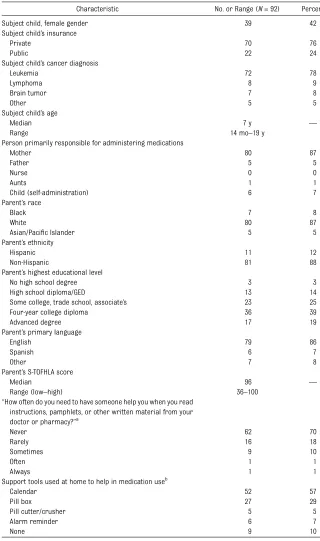
In our 92 home visits, we reviewed 963 medications and observed 242 admin-istrations. Most of the patients visited (78%) had leukemia (Table 1). They took a median of 10 medications at home (range: 3–26). The mother was usually primarily responsible for administer-ing home medications (87%). Parents were well educated: 57% completed a bachelor’s degree and 97% scored in the adequate range (67–100) on the S-TOFHLA, a measure of health literacy.
Behavior During Observation
When asked if they did anything to prepare for the home visit, 94% of parents reported that they did not. To
the statement: “There is nothing dif-ferent today about how I gave my child’s medicine,” 68% strongly agreed, 3% agreed, 9% were neutral, and 20%
TABLE 1 Demographic Characteristics of Home Visit Study Patients and Their Parents
Characteristic No. or Range (N= 92) Percent
Subject child, female gender 39 42
Subject child’s insurance
Private 70 76
Public 22 24
Subject child’s cancer diagnosis
Leukemia 72 78
Lymphoma 8 9
Brain tumor 7 8
Other 5 5
Subject child’s age
Median 7 y —
Range 14 mo–19 y
Person primarily responsible for administering medications
Mother 80 87
Father 5 5
Nurse 0 0
Aunts 1 1
Child (self-administration) 6 7
Parent’s race
Black 7 8
White 80 87
Asian/Pacific Islander 5 5
Parent’s ethnicity
Hispanic 11 12
Non-Hispanic 81 88
Parent’s highest educational level
No high school degree 3 3
High school diploma/GED 13 14
Some college, trade school, associate’s 23 25
Four-year college diploma 36 39
Advanced degree 17 19
Parent’s primary language
English 79 86
Spanish 6 7
Other 7 8
Parent’s S-TOFHLA score
Median 96 —
Range (low–high) 36–100
“How often do you need to have someone help you when you read instructions, pamphlets, or other written material from your doctor or pharmacy?”a
Never 62 70
Rarely 16 18
Sometimes 9 10
Often 1 1
Always 1 1
Support tools used at home to help in medication useb
Calendar 52 57
Pill box 27 29
Pill cutter/crusher 5 5
Alarm reminder 6 7
None 9 10
GED, general equivalency degree.
strongly disagreed. Some adjusted the time of administration to coincide with the home visit. To the statement:“ Dur-ing the home visit, my child took his/ her medications just as he/she usually does,”80% strongly agreed, 17% agreed, and 3% were neutral.
Types of Errors
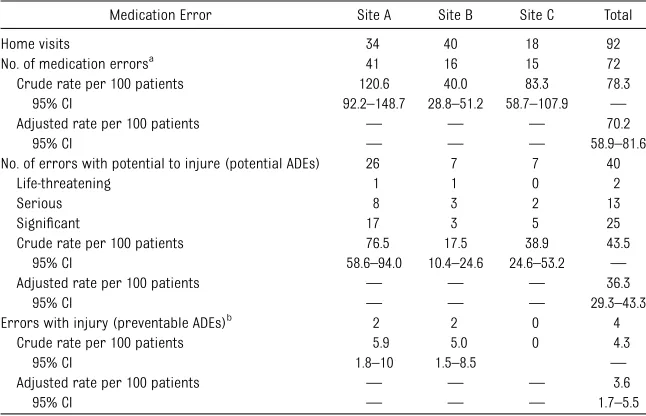
We found 72 medication errors, in-cluding 4 that resulted in injury and 40 with potential for injury (Table 2). All errors with injury were significant. One parent did not taper a psychiatric med-ication as instructed, and the patient suffered severe agitation. Two parents underdosed or failed to fill prescrip-tions for antacids; both patients expe-rienced prolonged untreated chest and abdominal pain. One patient was admin-istered repeated significant under-doses (,20% of the appropriate dose) of acetaminophen, with resulting fail-ure to relieve pain. The research nurse worked with each child’s oncologist to rectify these errors, when possible.
Of those errors with potential for injury, 2 were life-threatening, 13 were serious, and 25 were significant. The 2 life-threatening errors were: (1) a
metho-trexate bottle labeled to give 8 tablets daily rather than weekly; and (2) a par-ent observed administering a large underdose (50% of the prescribed dose) of trimethoprim-sulfamethoxazole for
Pneumocystisprophylaxis.
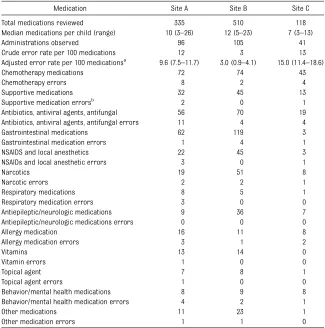
Error rates varied between study sites (40.0–120.6 errors per 100 patients); the weighted overall rate was 70.2 errors per 100 patients (95% CI: 58.9– 81.6) (Table 3). The rate of errors per 100 medications, weighted for differing rates of errors in individual patients, also varied between sites, from 3.0 to 15.0 per 100 medications reviewed. Nonchemotherapy medications were more often involved in an error than chemotherapy.
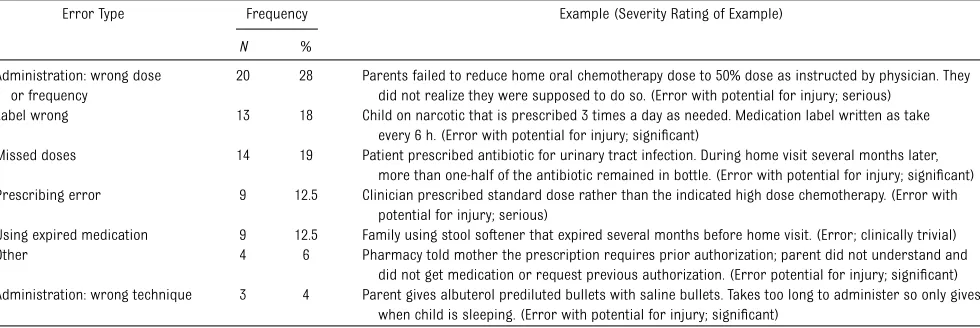
Drug administration was the most common stage of medication use in which an error occurred (63.5% of errors) (Table 4). These sometimes occurred when parents failed to in-crease or dein-crease medication doses as instructed by the oncologist or failed to communicate changes in dose to other caregivers at home. We also found missed doses (by parent report or based on review of bottle contents) and failure tofill prescriptions. There
were several errors in which parents selected the wrong dose of acetamin-ophen for their child. We found no measurement errors. Of note, of the 47 parents we observed administer-ing chemotherapy, only 5 wore gloves when handling these agents to avoid toxicity.35,36These were not counted as
errors because the patient took the medication correctly.
We frequently reviewed medication bottles where, because of changes in dose, the medication label no longer reflected the current dose of the med-icine. For example, a mercaptopurine bottle was labeled“2 tablets orally at bedtime,”but the child was taking one-half tablet at bedtime at the time of the home visit. Errors occurred when parents gave the medication according to the label, rather than instructed, or when parents disregarded the medi-cation label when it was correct. Of the 58 medications for which the label did not reflect the current dose, 11 were associated with a medication error.
During home visits, 47% of patients experienced at least 1 error: 32% had 1 error (n= 29), 8% had 2 errors (n= 7), and 8% had$3 errors (n= 7). In bi-variate analyses, race, ethnicity, insur-ance, health literacy, and use of support tools were not associated with in-creased risk for having a medication error, but the study was not adequately powered to detect these relationships (Appendix). Multiple logistic regression analyses were not performed because we identified no significant (P , .05) bivariate associations.
Physician reviewers judged that im-proved communication about medica-tion use between families and physicians could have prevented 36% of errors. Clinicians were unaware of 82% of the errors we detected, and parents were unaware of 56%. Parents were aware of some errors because they discov-ered the error around the time of the home visit or because the error was in
TABLE 2 Number and Rates of Medication Errors for Children With Cancer Visited at Home
Medication Error Site A Site B Site C Total
Home visits 34 40 18 92
No. of medication errorsa
41 16 15 72
Crude rate per 100 patients 120.6 40.0 83.3 78.3
95% CI 92.2–148.7 28.8–51.2 58.7–107.9 —
Adjusted rate per 100 patients — — — 70.2
95% CI — — — 58.9–81.6
No. of errors with potential to injure (potential ADEs) 26 7 7 40
Life-threatening 1 1 0 2
Serious 8 3 2 13
Significant 17 3 5 25
Crude rate per 100 patients 76.5 17.5 38.9 43.5
95% CI 58.6–94.0 10.4–24.6 24.6–53.2 —
Adjusted rate per 100 patients — — — 36.3
95% CI — — — 29.3–43.3
Errors with injury (preventable ADEs)b 2 2 0 4
Crude rate per 100 patients 5.9 5.0 0 4.3
95% CI 1.8–10 1.5–8.5 —
Adjusted rate per 100 patients — — — 3.6
95% CI — — — 1.7–5.5
aMedication errors include all errors with injury, errors with potential to injure, and clinically trivial errors.
bAll injuries (preventable adverse drug events [ADEs]) were rated significant by physician reviewers; none was serious or
medication labeling, such as an in-correct label where parents ignore the label and give the medicine correctly. In cases in which parents were unaware of errors, they had often misunderstood medication preparation or dosage in-structions that unknowingly introduced mistakes.
DISCUSSION
Medication errors were common in this study of children and adolescents with cancer, with almost 1 in 2 patients ex-posed to$1 error in medications used at home. Administration errors ac-counted for the majority of the errors detected, most often due to the parent administering the wrong dose or missing scheduled doses of
medica-tion. The rate of injuries due to error in our study (3.6 per 100 patients) was high.
To our knowledge, this is thefirst multi-site study of errors in medication use in the homes of pediatric oncology pa-tients. Consistent with previous multisite research,17 there was variation in
er-ror rates between sites. This finding may reflect actual differences in error rates or inconsistent detection of errors during the home visit or medical re-cord review.
Compared with previous medical re-cord review studies, we found a higher rate of errors. In a previous multisite study of medical records, we found that 19% of pediatric oncology clinic visits involved a medication error.17 Gandhi
et al15found that 2% of pediatric
on-cology clinic visits and 3% of adult visits involved an error. Taylor et al20
observed parents measuring chemo-therapy in the clinic and found mis-takes in 10%; we found fewer errors. By using medical record review, bottle review, and direct observation in the home, we were able to identify a broad range of error types that occur in outpatient pediatric oncology care.
Although we detected only 4 injuries due to medication errors, the rate of injury (3.6 per 100 patients) is higher than expected. In hospitalized adults, Bates et al found that 1.8% of admissions had a preventable injury due to medication use. In hospitalized children, rates of preventable medication-related inju-ries ranged from 0.5% to 3.8%.9,37
Children with cancer in our study in the home setting had a comparable or higher rate of medication-related pre-ventable injuries than hospitalized children in other studies.
In our study, parent administration errors were often caused by mis-communication between parents and clinicians or between in-home care-givers regarding changes in oral che-motherapy dose. Frequent changes in dose, which caused the bottle label to be outdated, were often a root cause of parent errors. Many errors occurred in nonchemotherapy medication. Given that children with cancer see their oncologist more frequently than their primary care physician, oncologists may need to inquire more about non-chemotherapy medication use.
Given the variety of error types detected in our study, multiple support tools will likely to necessary to prevent errors in home medication use in children with cancer. Failure modes and effects analysis methods have been used to understand sources of errors in oral chemotherapy use.38,39 Some communication-based
errors may be prevented by using strat-egies developed in hospitals around
TABLE 3 Rates and Numbers of Errors by Medication and Errors in Chemotherapy, Supportive Medications for Safe Administration of Chemotherapy, and Other Medications
Medication Site A Site B Site C
Total medications reviewed 335 510 118
Median medications per child (range) 10 (3–26) 12 (5–23) 7 (3–13)
Administrations observed 96 105 41
Crude error rate per 100 medications 12 3 13
Adjusted error rate per 100 medicationsa 9.6 (7.5–11.7) 3.0 (0.9–4.1) 15.0 (11.4–18.6)
Chemotherapy medications 72 74 43
Chemotherapy errors 8 2 4
Supportive medications 32 45 13
Supportive medication errorsb
2 0 1
Antibiotics, antiviral agents, antifungal 56 70 19 Antibiotics, antiviral agents, antifungal errors 11 4 4
Gastrointestinal medications 62 119 3
Gastrointestinal medication errors 1 4 1
NSAIDS and local anesthetics 22 45 3
NSAIDs and local anesthetic errors 3 0 1
Narcotics 19 51 8
Narcotic errors 2 2 1
Respiratory medications 8 5 1
Respiratory medication errors 3 0 0
Antiepileptic/neurologic medications 9 36 7
Antiepileptic/neurologic medications errors 0 0 0
Allergy medication 16 11 8
Allergy medication errors 3 1 2
Vitamins 13 14 0
Vitamin errors 1 0 0
Topical agent 7 8 1
Topical agent errors 1 0 0
Behavior/mental health medications 8 9 8
Behavior/mental health medication errors 4 2 1
Other medications 11 23 1
Other medication errors 1 1 0
Supportive medications included antiemetic agents and other medications included methylphenidate for attention-deficit disorder or medications forPneumocystisprophylaxis. NSAIDs, nonsteroidal antiinflammatory drugs.
handoffs. In adult patients with chronic disease, pharmacist case-management involving health information technol-ogy has been used to support home medication use.40,41
Although this study used a multisite prospective approach, it is important to consider a few limitations. First, our methodology is unlikely to have detec-ted all errors, and this study was fo-cused on capturing errors, rather than focusing on adverse drug events. Ad-ministration errors that occurred when we were not in the home would not have been detected according to our direct observation methods. The use of direct observation is an excellent approach to
“allow comparison between what peo-ple say and what they actually do,”42
but our presence in the home may have changed behavior. If parents changed their behavior, the effect would most likely be to reduce the number of errors detected. The population we studied was well educated, which may have also led to an underestimate of the error rate. Second, due to the la-borious nature of home visits, our
sample size of 92 patients was smaller than other studies of medical errors that used medical record review. We did review a large number of medi-cations (n = 963) and found many errors (n= 72). Finally, generalizability of the results of this study to other pediatric oncology clinics requires additional study. This study focused on children cared for at medium and large academic health centers. The patients in this study were treated with che-motherapy and support medications according to cancer treatment pro-tocols, including children’s oncology group protocols and others, which may reduce variability across oncology clinics. The use of antibiotics and other medications may have more variability across sites.
CONCLUSIONS
In this multisite study of medication errors in the homes of children with cancer, we found that errors were common, with a rate of 3.6 injuries due to medication error per 100 patients. Parent administration errors were
of-ten due to communication failures. As the use of oral chemotherapy rises, responsibility for the management of these toxic medications shifts from nurses to parents and patients. Although significant resources are aimed at re-ducing inpatient medication errors, we found that children with cancer in the outpatient setting were also at very high risk for preventable injuries due to medication use.
ACKNOWLEDGMENTS
This study was conducted in the context of the HMO Cancer Research Network. This National Cancer Institute–funded project involves a consortium of re-search organizations affiliated with in-tegrated health care delivery systems and works to improve cancer care through a program of population-based research.
We thank Mike Silverstein, MD, Jerry Gurwitz, MD, and Terry Field, DSc, for their thoughtful advice. We also thank Irma Torres, Kendal Temple, RN, Roslin Nelson, Veronica Savage, RN, and Brandi Robinson, MPH, for their hard work on this project.
REFERENCES
1. The Counsel of State Governments. Trend
report: costs of chronic diseases: what are
states finding? Available at:
www.health-
ystates.csg.org/NR/rdonlyres/E42141D1-4D47-4119-BFF4-A2E7FE81C698/0/Trends_Alert.pdf.
Accessed October 3, 2011 TABLE 4 Types of Errors Detected in Children With Cancer
Error Type Frequency Example (Severity Rating of Example)
N %
Administration: wrong dose or frequency
20 28 Parents failed to reduce home oral chemotherapy dose to 50% dose as instructed by physician. They did not realize they were supposed to do so. (Error with potential for injury; serious)
Label wrong 13 18 Child on narcotic that is prescribed 3 times a day as needed. Medication label written as take every 6 h. (Error with potential for injury; significant)
Missed doses 14 19 Patient prescribed antibiotic for urinary tract infection. During home visit several months later, more than one-half of the antibiotic remained in bottle. (Error with potential for injury; significant) Prescribing error 9 12.5 Clinician prescribed standard dose rather than the indicated high dose chemotherapy. (Error with
potential for injury; serious)
Using expired medication 9 12.5 Family using stool softener that expired several months before home visit. (Error; clinically trivial) Other 4 6 Pharmacy told mother the prescription requires prior authorization; parent did not understand and
did not get medication or request previous authorization. (Error potential for injury; significant) Administration: wrong technique 3 4 Parent gives albuterol prediluted bullets with saline bullets. Takes too long to administer so only gives
when child is sleeping. (Error with potential for injury; significant)
2. Gu Q, Dillon C, Burt VL.Prescription Drug
Use Continues to Increase: US
Pre-scription Drug Data for 2007-2008. Vol. 42. NCHS Data Brief. Atlanta, GA: National
Department for Health and Human Serv-ices; 2010
3. Cox ER, Halloran DR, Homan SM, Welliver S, Mager DE. Trends in the prevalence of chronic medication use in children: 2002-2005.Pediatrics. 2008;122(5). Available at: www.pediatrics.org/cgi/content/full/122/5/
e1053
4. Cohen E, Kuo DZ, Agrawal R, et al. Chil-dren with medical complexity: an emerging population for clinical and re-search initiatives. Pediatrics. 2011;127 (3):529–538
5. Ruddy K, Mayer E, Partridge A. Patient ad-herence and persistence with oral
anti-cancer treatment.CA Cancer J Clin. 2009;59 (1):56–66
6. Bates DW, Cullen DJ, Laird N, et al; ADE Prevention Study Group. Incidence of ad-verse drug events and potential adad-verse drug events. Implications for prevention.
JAMA. 1995;274(1):29–34
7. Leape LL, Brennan TA, Laird N, et al. The nature of adverse events in hospitalized
patients. Results of the Harvard Medical Practice Study II.N Engl J Med. 1991;324(6): 377–384
8. Landrigan CP, Rothschild JM, Cronin JW, et al. Effect of reducing interns’work hours on serious medical errors in intensive care units. N Engl J Med. 2004;351(18):1838– 1848
9. Kaushal R, Bates DW, Landrigan C, et al. Medication errors and adverse drug events in pediatric inpatients.JAMA. 2001; 285(16):2114–2120
10. Walsh KE, Adams WG, Bauchner H, et al. Medication errors related to computerized order entry for children. Pediatrics. 2006; 118(5):1872–1879
11. Walsh KE, Stille CJ, Mazor KM, Gurwitz JH.
Using home visits to understand medica-tion errors in children.Advances in Patient Safety: New Directions and Alternative Approaches (Vol. 4: Technology and Medi-cation Safety). Rockville, MD: Agency for Healthcare Research and Quality (US);
2008
12. Daniel S. Budnitz DA, Weidenbach KN, Mendelsohn AB, Schroeder TJ, Annest JL. National surveillance of emergency de-partment visits for outpatient adverse drug events. JAMA. 2006;296(15):1858– 1866
13. McPhillips HA, Stille CJ, Smith D, et al.
Po-tential medication dosing errors in
out-patient pediatrics. J Pediatr. 2005;147(6): 761–767
14. Cohen AL, Budnitz DS, Weidenbach KN, et al. National surveillance of emergency de-partment visits for outpatient adverse drug events in children and adolescents. J Pediatr. 2008;152(3):416–421
15. Gandhi TK, Bartel SB, Shulman LN, et al. Medication safety in the ambulatory che-motherapy setting. Cancer. 2005;104(11): 2477–2483
16. Gandhi TK, Weingart SN, Borus J, et al. Adverse drug events in ambulatory care.
N Engl J Med. 2003;348(16):1556–1564 17. Walsh KE, Dodd KS, Seetharaman K,
et al. Medication errors among adults and children with cancer in the out-patient setting.J Clin Oncol. 2009;27(6): 891–896
18. Kaushal R, Goldmann DA, Keohane CA, et al. Adverse drug events in pediatric out-patients. Ambul Pediatr. 2007;7(5):383– 389
19. Li SF, Lacher B, Crain EF. Acetaminophen and ibuprofen dosing by parents.Pediatr Emerg Care. 2000;16(6):394–397
20. Taylor JA, Winter L, Geyer LJ, Hawkins DS. Oral outpatient chemotherapy medication errors in children with acute lympho-blastic leukemia.Cancer. 2006;107(6):1400– 1406
21. McMahon SR, Rimsza ME, Bay RC. Parents can dose liquid medication ac-curately. Pediatrics. 1997;100(3 pt 1): 330–333
22. Yin HS, Mendelsohn AL, Wolf MS, et al. Parents’medication administration errors: role of dosing instruments and health lit-eracy.Arch Pediatr Adolesc Med. 2010;164 (2):181–186
23. Preventing Medication Errors: Quality Chasm Series.Washington, DC: Institution of Medicine; 2006
24. Tebbi CK, Cummings KM, Zevon MA, Smith L, Richards M, Mallon J. Compliance of pedi-atric and adolescent cancer patients. Can-cer. 1986;58(5):1179–1184
25. Walsh KE, Mazor KM, Stille CJ, et al. Medi-cation errors in the homes of children with chronic conditions.Arch Dis Child. 2011;96 (6):581–586
26. Baker DW, Williams MV, Parker RM, Gazmararian JA, Nurss J. Development of a brief test to measure functional health literacy.Patient Educ Couns. 1999;38(1):33– 42
27. Morris NS, MacLean CD, Chew LD, Littenberg B. The Single Item Literacy Screener: eval-uation of a brief instrument to identify limited reading ability. BMC Fam Pract. 2006;7:21
28. Flynn EA, Barker KN, Pepper GA, Bates DW, Mikeal RL. Comparison of methods for detecting medication errors in 36 hospitals and skilled-nursing facilities.
Am J Health Syst Pharm. 2002;59(5):436– 446
29. Buckley MS, Erstad BL, Kopp BJ, Theodorou AA, Priestley G. Direct observation ap-proach for detecting medication errors and adverse drug events in a pediatric intensive care unit.Pediatr Crit Care Med.
2007;8(2):145–152
30. Dean B, Barber N. Validity and reliability of observational methods for studying medi-cation administration errors.Am J Health Syst Pharm. 2001;58(1):54–59
31. Gurwitz JH, Field TS, Harrold LR, et al. In-cidence and preventability of adverse drug events among older persons in the
ambulatory setting. JAMA. 2003;289(9): 1107–1116
32. Fortescue EB, Kaushal R, Landrigan CP, et al. Prioritizing strategies for preventing medication errors and adverse drug events in pediatric inpatients.Pediatrics. 2003;111 (4 pt 1):722–729
33. Nicolaides-Bouman A, van Rossum E, Kempen GI, Knipschild P. Effects of home
visits by home nurses to elderly people with health problems: design of a rando-mised clinical trial in the Netherlands [ISRCTN92017183]. BMC Health Serv Res. 2004;4(1):35
34. Holland R, Lenaghan E, Harvey I, et al. Does home based medication review keep older
people out of hospital? The HOMER rando-mised controlled trial.BMJ. 2005;330(7486): 293
35. Falck K, Gröhn P, Sorsa M, Vainio H, Heinonen E, Holsti LR. Mutagenicity in urine of nurses handling cytostatic drugs.Lancet. 1979;1(8128):1250–1251
36. Anderson RW, Puckett WH Jr, Dana WJ, Nguyen TV, Theiss JC, Matney TS. Risk of
handling injectable antineoplastic agents.
Am J Hosp Pharm. 1982;39(11):1881–
1887
37. Holdsworth MT, Fichtl RE, Behta M, et al. Incidence and impact of adverse drug events in pediatric inpatients.Arch Pediatr Adolesc Med. 2003;157(1):60–65
38. Weingart SN, Spencer J, Buia S, et al.
Medication safety of five oral chemo-therapies: a proactive risk assessment. J Oncol Pract. 2011;7(1):2–6
39. Walsh KE, Mazor KM, Roblin D, et al. A multisite parent-centered risk assess-ment to reduce pediatric oral chemo-therapy errors. J Oncol Pract. 2013;19
40. Green BB, Cook AJ, Ralston JD, et al. Effectiveness of home blood pressure
monitoring, Web communication, and phar-macist care on hypertension control: a
randomized controlled trial.JAMA. 2008;299 (24):2857–2867
41. Ralston JD, Hirsch IB, Hoath J, Mullen M, Cheadle A, Goldberg HI. Web-based
collabora-tive care for type 2 diabetes: a pilot random-ized trial.Diabetes Care. 2009;32(2):234–239 42. Savage J. Ethnography and health care.
BMJ. 2000;321(7273):1400–1402
(Continued fromfirst page)
intellectual content, and approved thefinal manuscript as submitted. Dr Mazor contributed to the concept and design, mentoring, critical revision of the manuscript for intellectual content, and approved thefinal manuscript as submitted.
www.pediatrics.org/cgi/doi/10.1542/peds.2012-2434
doi:10.1542/peds.2012-2434
Accepted for publication Jan 30, 2013
Address correspondence to Kathleen E. Walsh, MD, MSc, Benedict Second Floor, UMass Medical Center, 55 North Lake St, Worcester, MA 01655. E-mail: [email protected]
PEDIATRICS (ISSN Numbers: Print, 0031-4005; Online, 1098-4275).
Copyright © 2013 by the American Academy of Pediatrics
FINANCIAL DISCLOSURE:The authors have indicated they have nofinancial relationships relevant to this article to disclose.
FUNDING:Dr Walsh was supported by a Robert Wood Johnson Physician Faculty Scholars award. This work was also supported by the Charles H. Hood Foundation and the National Cancer Institute (CRN U19 CA 79689).
APPENDIX: BIVARIATE ANALYSES FOR INSURANCE, HEALTH LITERACY, USE OF SUPPORT TOOLS, AND RACE/ETHNICITY
APPENDIX TABLE 1 No. of Patients With Private or Public Health Insurance Who Have at Least 1 or No Errors
Medication Error Private Insurance Public Insurance Total
At least 1 error 30 12 42
No errors 40 10 50
Total 70 22 92
APPENDIX TABLE 2 No. of Patients With Inadequate, Marginal, and Adequate Health Literacy Who Have at Least 1 or No Errors
Medication Error Inadequate (0–59) Marginal (60–74) Adequate (75–100) Totala
At least 1 error 0 3 39 42
No errors 1 1 47 49
Total 1 4 86 91
aOne parent who had no errors at home declined to complete the S-TOFHLA.
APPENDIX TABLE 3 No. of Patients Using Support Tools at Home or No Support Tools Who Have at Least 1 or No Errors at Home
Medication Error No Support Tool Any Support Tool Total
At least 1 error 1 41 42
No errors 4 46 50
Total 5 87 92
APPENDIX TABLE 4 No. of Patients, by Race, Who Have at Least 1 or No Errors at Home
Medication Error Asian Black or African American White Total
At least 1 error 3 2 37 42
No errors 2 5 43 50
Total 5 7 80 92
APPENDIX TABLE 5 No. of Patients, by Ethnicity, Who Have at Least 1 or No Errors at Home
Medication Error Hispanic Non-Hispanic Total
At least 1 error 5 37 42
No errors 6 44 50
DOI: 10.1542/peds.2012-2434 originally published online April 29, 2013;
2013;131;e1405
Pediatrics
Wasilewski and Kathleen M. Mazor
Barbara Degar, Amy Billett, Christopher Keuker, Colleen Biggins, Justin Li, Karen
Services
Updated Information &
http://pediatrics.aappublications.org/content/131/5/e1405
including high resolution figures, can be found at:
References
http://pediatrics.aappublications.org/content/131/5/e1405#BIBL
This article cites 35 articles, 13 of which you can access for free at:
Subspecialty Collections
http://www.aappublications.org/cgi/collection/toxicology_sub
Toxicology
http://www.aappublications.org/cgi/collection/therapeutics_sub
Therapeutics
http://www.aappublications.org/cgi/collection/pharmacology_sub
Pharmacology
http://www.aappublications.org/cgi/collection/cancer:neoplastic_sub
Cancer/Neoplastic
_sub
http://www.aappublications.org/cgi/collection/hematology:oncology
Hematology/Oncology following collection(s):
This article, along with others on similar topics, appears in the
Permissions & Licensing
http://www.aappublications.org/site/misc/Permissions.xhtml
in its entirety can be found online at:
Information about reproducing this article in parts (figures, tables) or
Reprints
http://www.aappublications.org/site/misc/reprints.xhtml
DOI: 10.1542/peds.2012-2434 originally published online April 29, 2013;
2013;131;e1405
Pediatrics
Wasilewski and Kathleen M. Mazor
Barbara Degar, Amy Billett, Christopher Keuker, Colleen Biggins, Justin Li, Karen
Kathleen E. Walsh, Douglas W. Roblin, Saul N. Weingart, Kathleen E. Houlahan,
Medication Errors in the Home: A Multisite Study of Children With Cancer
http://pediatrics.aappublications.org/content/131/5/e1405
located on the World Wide Web at:
The online version of this article, along with updated information and services, is
by the American Academy of Pediatrics. All rights reserved. Print ISSN: 1073-0397.