Rca Model Case Study: A Step To Develop Risk
Culture In Bpkp
Sally Salamah, M.Prof.Acc, Ristiandi Wijanarko, M.P.A
Abstract: In order to develop a positive risk culture, an organization needs to understand its current culture, the desired risk culture, factors influencing culture, and the way to implement culture change. This paper is prepared to understand and analyze the current risk culture in a BPKP representative office using The IRM‘s Risk Culture Aspect (RCA) model. The model has been adapted to BPKP organizational characteristics. Primary data were collected via surveys and interviews with respecting officers in June 2019. This paper provides a new perspective on the risk management field by focusing on the development of risk culture in the Indonesia government. Our study demonstrates that the Pilot Test Office still has plenty of room for improvement. We recommend that the office has to first devise a specific tone at the top regarding risk management through the arrangement of comprehensive risk management guidelines and subsequently improve their risk culture.
Index Terms: Risk Culture, RCA Model, Risk Management, BPKP, Government
—————————— ——————————
1.
INTRODUCTION
The very organization is susceptible to the fraud risk, being it private or public sector. One type of fraud risk is corruption. Corruption is an enormous problem that has led many businesses to bankruptcy and curbed the growth of many nations, including Indonesia. The Corruption Perception Index 2018 shows that Indonesia is still far from being free from corruption. With a score of 38 out of 100, Indonesia is ranked 89 among 180 countries (Transparency International, 2019). It indicates that corruption remains inherent to Indonesia‘s public sector. This performance might not be surprising as a lot of executives and legislatures are imprisoned for corruption. This contagious disease should be able to be tackled through implementing a robust Government Internal Control System (SPIP). However, the result of SPIP‘s assessment conducted by the BPKP (Financial and Development Supervisory Board) (BPKP, 2019), shows that local governments‘ internal control, particularly their risk assessment, is weak. It indicates that local governments‘ internal control has not been conducted with a proper risk analysis, bringing them more vulnerable to corruption and further from achieving their objectives.
One of the factors causing these failures comes from the human side, the lack of risk awareness in their organizational culture, a poor risk culture. In a poor risk culture, individuals might do the wrong things, even when regulations are well established (Lam, 2017). Poor risk culture indicates that control measures are not formulated nor implemented well. Therefore, it is essential for the government to increase their attention to risk culture, as well as to realize that a poor risk culture was at the base of the misconduct of many public sector institutions. This underlines that building the soft side (attitude) of risk culture is at least as important as the hard side (processes and systems).
In order to build a sound risk culture, many institutions (IRM, 2012; Comcover, 2016) have developed some instruments to measure the level of risk culture in an
organization. These tools are essential in understanding the current state of the organization's risk culture, which will be used in designing an appropriate strategy to attain the target risk culture.
1.1.Study Objective
Previous researches on risk culture are concentrated on the private sectors (i.e., financial institutions) and little if not none are conducted in the public sector, particularly in Indonesia. The lack of studies conducted in the public sector has prompted this research. Therefore, the objective of the study is to understand and analyze the existing risk culture in one of BPKP representative offices. The understanding is beneficial for the improvement of risk culture, especially to achieve maximum effectiveness. In this paper, the authors adapt the instrument developed by the Institute of Risk Management (IRM), named Risk Culture Aspects Model, and use it to assess the level of risk culture in one of the government institutions in Indonesia. BPKP, as a supervisor of the government‘s internal control, is the institution selected for the conduct of the study. Given its responsibility to supervise the internal control of government institutions, it is anticipated that the methodology developed here could be used by BPKP to influence other government institutions in building their risk culture.
1.2.Paper Structure
The rest of the paper is structured as follows: ―Literature Review‖ elaborates the theory underlining the research; ―Research Approach‖ addresses the methodology; ―Case Study‖ presents the findings; ―Analysis‖ and ―Conclusions‖ provide the analysis and conclusions of the study, respectively.
2.
LITERATURE REVIEW
2.1. Risk
The activities of catching the train to work, skydiving, tobacco smoking, employing new technology and investing in a new project have something in common, all of them are associated with taking a risk, whether by individuals or organizations. Risk refers to uncertainty which results from the lack of knowledge in describing events and its future impacts. It is often connoted with any dangerous exposures ————————————————
Sally Salamah, M.Prof.Acc: Human Resources Bureau, BPKP, Indonesia, [email protected]
that lead to undesired results, which is called ―bad risk‖ (Carretta, Fiordelisi, & Schwizer, 2017). This definition is in line with the definition of risk on Government Regulation No.60/2008, which defined risk as any possible event that could threaten the government‘s goals and objectives. Another point of view comes from Power (2007) which states that uncertainty does not necessarily be a risk. The difference is essentially on the ―institutional and managerial‖ element between those events and matters which are presumed as risks within the management system and which are not. Thus, an uncertainty which becomes management‘s object is turned into a risk to be managed. Risks are not always ―bad,‖ there are some ―good risk‖ (Carretta, Fiordelisi, & Schwizer, 2017), but human psychology tends to accommodate loss aversion – a condition where humans are more motivated to take some actions when there is a threat to lose something valuable – which makes risk is often seen as negative being. This tendency makes the study of risk and its possible management are more focused on potential loss in the future, which is translated into a metric of the likelihood that events will occur and its impact. In this context, risk management is focused on mitigating risk by eliminating the probability of occurrence or reducing the impact of the risk events. Discussion about risk should not be isolated to the private sector‘s interest in affecting mega businesses. This, in turn, becomes the concern for many public sector organizations, including government institutions, in a number of different countries, which have been transformed to different levels by talking about risk and risk management (Ahmad & Ahmad, 2018; Power, 2007). This might be due to the urgent in combatting many types of risks faced by government institutions, such as operational (e.g., corruption) and reputational risks. Thus, evolving the study of risk in this sector.
2.2. Risk Culture
The approach to risk that a group or organization has – its risk culture – may or may not be beneficial to the success of risk management (IRM, 2012). This approach affects the methods used by an organization in managing risk but in turn, is also affected by them. Before advancing into the various theories of risk cultures, we should take a step back to see the big picture of culture first. Hillson (2013) describes culture as ―the values, beliefs, knowledge, and understanding, shared by a group of people with a common purpose.‖ This is the result of past experiences that guide individuals‘ attitudes and behaviors. This is also influencing future individuals‘ attitudes and behaviours (Carretta, Fiordelisi, & Schwizer, 2017). Culture can also be understood as ―the social behavior, values, and norms found within a group,‖ which emphasized the notion of behavior, particularly collective behaviour (Durland & Caplan, 2018). The idea of culture can be explained using a simple A-B-C Model, which describes that the Culture of an organization results from the Behaviour of the individuals inside it, and their underlying Attitudes from the Behaviour of the organisation and its members. This model is characterized by its ―feedback loop back from Culture to both Attitude and Behaviour.‖ In this context, organization culture can create shared value and drive the behavior of its members in pursuing organizational goals. These interdependencies show that an organisation can
manufacture a self-reinforcing feedback loop ―to strengthen right attitudes and encourage good behaviors‖ (Hillson, 2013). The underlying concept of organizational culture can be used in explaining the notion of risk culture. Risk culture can be seen as a part of organizational culture; it is the impact of culture on how risks are managed (Power, Ashby, & Palermo, 2013). This is a result of organizational learning about what has and has not worked in the past. It is defined as ―the values, beliefs, knowledge and understanding about risk, shared by a group of people with a common purpose‖ (IRM, 2012). Another definition provided by FSB (2014) is ―the norms, attitudes, and behaviors related to risk awareness, risk-taking and risk management.‖ Risk culture presents a different level in an organization. The question is whether the existing risk culture is supporting the organization‘s goals and objectives. The organization needs to get risk culture right. It does not mean that there is a single recipe for sound risk culture. Unsurprisingly, each organization should develop its own risk culture that best fits its purpose and goals. Thus, there are probably no two risk cultures that are precisely the same as each organization has its unique characteristics. A definition of a sound risk culture will vary between organizations, nevertheless, it is one that is aligned with organization strategy and ensures all organization‘s members approach risk in the way which senior management expects.
2.3. Importance of Risk Culture
effort in establishing a risk culture, and the organization may lack the resources to improve a poor risk culture. An organization with a poor risk culture may demonstrate undesired manifestations in its governance structure, such as ignorance of risk issues, ―failing to delegate risk responsibility,‖ and ―allowing misaligned incentives.‖ Consequently, it can create problems for the organization, such as damaging the reputation (Banks, 2012).
2.2. Measuring Risk Culture
Although there is the abundant number of qualitative literature about risk cultures, there is a limited number of quantitative researches around this topic. This perhaps due to the difficulties of quantifying culture (Banks, 2012), so does risk culture. In the attempts to quantifying risk cultures, a number of institutions offer diagnostic tools, frameworks, and profiling instruments to help improve an organization‘s current risk culture to the target ―ideal‖ risk culture. These instruments simplify the complex concept of risk and culture into some measurable and visible properties that can be acted upon and assessed by others. Once a preliminary assessment of the existing risk culture is done, senior management should consider whether any organizational changes are required and take necessary steps to execute those changes. Amongst them are the Institute of Risk Management (IRM) which designs a diagnostic tool called IRM Risk Culture Aspects Model (IRM RCA Model) based on the instrument developed by Goffee and Jones (1998), Financial Stability Board (2014) that develops a framework in its attempt to assess risk culture at financial institutions, and Comcover (2016) which provides guidance to determine the organization‘s current and target risk culture. These models aim to guide organizations to better understand their risk cultures and provide them with some practical tools to drive change (IRM, 2012). Each model mentioned above has a different approach in assessing risk culture but highlights the same key themes that combine hard (e.g., risk management frameworks, governance structures) and soft aspects (e.g., expectation, organizational values, behavioral norms). Both aspects are equally important and should be mutually reinforced. Hard aspects, such as governance structures, are necessary but not adequate by themselves. They do help in building a sound risk culture, for instance, in enhancing information transparency in an organization. But soft aspects, shown through attitudes and behaviors, are also essential in building an appropriate risk culture. As discussed above, culture systems and behaviours products strengthen each other in a virtuous cycle. Thus, the soft aspects, in turn, will become the foundation of sound risk culture (CIMA, EY & ISCA, 2018). The aspects that have emerged are often classified into four key themes. The first theme is ‗The Tone from the Top‘. The tone from the top holds the central role in shaping an organization‘s risk culture. It includes risk leadership (FSB, 2014; IRM, 2012) and their response to bad news (IRM, 2012). These aspects are essential since senior management is the starting point for setting the fundamental values and expectations for the risk culture of the organization. Senior management must show the proper tone and standard behavior to promote a sound risk culture because it will be followed by the rest of the organization (FSB, 2014). It includes the behavior of the organization leadership – the outside apparent messages,
actions, and decisions. Those are critical to transmitting to all organization‘s members about the organisation‘s attitude towards risk. The second theme is ‗Governance‘. Building a sound risk culture is different from making a risk management framework, yet governance structures, systems and processes provide an important basis that can encourage and support proper attitudes and behaviors as well as to detect and alter poor behaviours (FSB, 2014). Risk governance is related to accountability (IRM, 2012; FSB, 2014; Banks, 2016), where risk ownership policy is established to ensure that employees are held accountable for their actions and are aware of the costs for not upholding the expected behaviors toward risk (FSB, 2014). This includes embedding risk accountabilities in employees‘ role descriptions and targets. Risk governance structures should also be able to accommodate risk transparency, where risk information is timely communicated across the organization (IRM, 2012). An organization with a sound risk culture will promote risk transparency and open discussion between the senior management and the organization‘s members. ‗Competency‘ is the third theme. The soft side of risk culture, the competency for risk, should be taken into consideration when talking about building a sound risk culture. This theme involves risk resources and risk skills, particularly of the personnel of risk function. Risk function personnel must possess the skills and knowledge needed in risk management. These traits must be supported by adequate resources, including authority and status, in order to build credibility, relationships and networks across the organization and to become reliable consultants (IRM, 2012). The last theme is ‗Decision Making‘. The final purpose of managing risk is the ability of all the organization‘s members to make the right decision for the best of the organization. A sound risk culture encourages and supports this purpose by ensuring senior management gets all the risk information necessary to make the right decision: informed decision making. This can be done by integrating key risks into important documents accessible in a timely manner (IRM, 2012). Effective risk information is beneficial for the organization as every decision made is based on a balanced perspective of risk implication. Leaders‘ willingness to accept contrary opinions will also enhance the robustness of decision-making. This would enable senior management to make well-informed risk decisions by engendering open discussions at senior management levels so that risks can be identified at an early stage. Thus, it will not compromise organization decisions (CIMA, EY & ISCA, 2018). Another factor that should be taken into consideration is the use of incentives (IRM, 2012; FSB, 2014). Risk culture is often described as the bridge to understanding how risk and incentive are successfully balanced in the decision-making process (CIMA, EY & ISCA, 2018). In order to lever appropriate risk-taking behavior, an organization may consider integrating risk-taking into the performance management system. It will motivate employees to comply to risk management policy and be mindful in every decision-making process by performing risk analysis.
3.
RESEARCH METHOD
and observation to collect evidences. The quantitative approach is used to quantify the former approach into risk culture level and its score.
2.2. Risk Culture Measurement Model
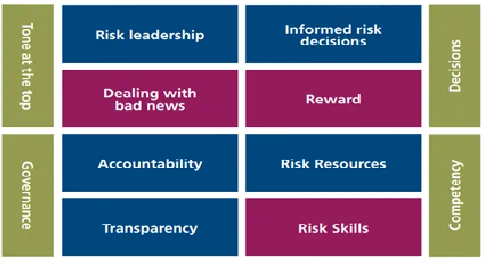
According to Comcover (2016), there are four phases to develop the risk culture effectively. The phases are; understanding factors that influencing culture, assessing current risk culture, determining risk culture target and implementing culture change program. This paper focuses on analysing the assessment of current risk culture in one of the BPKP representative office. The measurement of risk culture is important because it provides a starting line to develop culture change. The author uses the risk culture model introduced by The Institute of Risk Management: The Risk Culture Aspect (RCA) Model to measure an organisation‘s risk culture. The RCA model is shown below:
Figure 1: IRM RCA Model Source: IRM (2012)
The RCA model has four Themes and eight Aspects. Themes, as shown in the figure above are the vertical blocks in the flank of the model; Tone at the Top, Governance, Competency and Decision Making. These themes specified further into eight Aspects shown by blue and purple horizontal blocks; Risk Leadership, Dealing with Bad News, Accountability and Governance, Risk Transparency, Risk Resources, Risk Skills, Informed Risk Decisions and Rewarding Appropriate Risk Taking.
2.3. Risk Culture Measurement Tools Design
IRM provides a set of helpful questions (original question set) in each Aspect as a guidance for the interviewer to assess the level of risk culture in the interviewee‘s organization. The original question set is open-ended inquiries. There are two different types of survey questions; open-ended and closed-ended. Each type has its own advantages and weaknesses (Shaughnessy, Zechmeister, & Jeanne, 2011). Even though the open-ended IRM original question set could give a considerable amount of information regarding the organization‘s culture, Bailar,et.al. (1977) implies that there is a chance that the assessment result would vary due to the difference in the evaluator‘s personal judgment. The difference, which is often referred by the interviewer bias, is a common problem for the free-response question type and has to be managed properly (Boyd Jr. & Westfall, 1965; Shapiro, 1970). As a result, there could be comparability and inconsistency issues related to the valuation and conclusion of the culture
condition. In order to minimize these risks, we deliberately arranged a questionnaire that could only be answered by ‗Yes‘, ‗No‘, or ‗I Don‘t Know‘. As an exempt, there is only one open-ended question which is intended to capture the leader‘s tone at the top. By limiting the answer, we expected that the tool would help the evaluator to reach a conclusion easily. Furthermore, as a way to provide feedback on whether our questionnaire is clear enough, we added the fourth answer option of ‗I don‘t understand this question‘. To reach a conclusion whether a question could be defined as ‗Yes‘, we demanded a minimum of 75% or more respondents having answered ‗Yes‘. The failure to reach the number would be the other way around (‗No‘) regardless of other answers of not knowing and not understand. The reason behind why we set a high 75% of the threshold was the need to ‗sufficiently capture the culture‘. In the aforementioned theory, one of the elements of culture definition is the shared believe/knowledge which shapes attitude and behavior. For this reason, a condition (culture) must be similarly perceived by a significant majority. The original question set is not fully conveyed to the respondent. Rather, only questions directly related to the outcomes or key indicators are included. By doing this, we acknowledge that the evaluator might lose some important information compared to the open-ended question. Nevertheless, based on our consideration, the comparability and consistency issues are priorities since they will aid better the BPKP leaders in developing the desired risk culture. Moreover, we tried to keep this measurement tool as simple as possible. We believe that the questionnaire can still capture the risk culture key indicator while delivering efficient measurement for the organization. Another modification to the model is the conversion of the original question set into Parameter and specifying the respective Parameter more detail into Criteria. We called this measure ‗operationalize‘ the original question set. The approach to answering these Criteria is similar to an audit. The evaluator is expected to collect evidence, observe the situation, or any other necessary measures to ensure themselves whether the culture has conformed to the Criteria.
The summary of our adapted IRM RCA model methodology and its original set of questions is depicted in the table below.
TABLE 1.
Risk Culture Level Measurement Tool
ID THEME AND ASPECT
ORIGIN
AL ADAPTED MODEL
Questio n
Param
eter Criteria
Questio n
1. 1
Tone at The Top -
Risk Leadership 5 5 11 4
1. 2
Tone at the Top - Dealing with Bad News
3 4 5 4
2. 1
Governance - Accountability and Governance
5 5 9 1
2. 2
Governance - Risk
ID THEME AND ASPECT
ORIGIN
AL ADAPTED MODEL
Questio n
Param
eter Criteria
Questio n
3. 1
Competency - Risk
Resources 5 5 8 3
3. 2
Competency - Risk
Skills 4 4 6 -
4. 1
Decision Making - Informed Risk Decisions
3 4 6 3
4. 2
Decision Making - Rewarding Appropriate Risk Taking
4 3 4 -
Total 33 34 58 19
Source: Adapted from Risk Culture Aspect Model (IRM, 2012)
We formulated a matrix of Criteria with its designated culture level. In other words, each Criteria fulfillment is entitled to a specific level of risk culture, either Yellow, Green or Blue. The failure in fulfilling a Criteria will result in an automatic Red level. The arrangement of criteria and its designated level is adapted from and in concordance to IRM‘s risk culture ‗scoring mechanism‘. Reds indicate that there are areas of specific concern, Yellow represents weaknesses in particular areas, Green highlights good practice recognized in the industry are being implemented while Blue shows that the organization is already being a leader in risk management practices. Our tool which is used to measure risk culture in BPKP is provided in Appendix 2, along with the measurement result. In the end, each risk culture Aspect level should be determined from these Criteria. For example, in order to get the Yellow level in one Aspect, all Criteria with Yellow level attribute has to be fulfilled. And so does Green and Blue. If any Criteria required has not been met to reach that level, and Aspect could not ‗level-up‘. The initial level is automatically Red. Each level has its own standard score: Red has scored between 1-2, Yellow has scored between 3-5, Green has scored between 6-8 and Blue has scored between 9-10. The scores will be accumulated later to demonstrate the gaps between current and desired risk culture level. RCA Model also has a weighted scoring system when the scores are accumulated. The Aspect of Risk Leadership and Informed Risk Decision are the most weighed (two times of other Aspects‘ weight) due to their importance in risk culture development. The scores are then calculated to get final scores of risk culture. The maximum accumulated score of risk culture is a perfect 100 while the lowest score is 10.
2.4. Research Data
The study was held in a BPKP representative office (or ―Pilot Test Office‖) which identity we keep confidential of. We tested the aforementioned method to measure the level of its risk culture. The first step was a survey of the Office‘s staff perception regarding the risk culture through the dissemination of the online questionnaire link. There were 16 responses collected from the survey. The respondents are composed of an echelon II, echelon III, and ‗non-functional‘ staff each, two-echelon IVs and 11 ‗‗non-functional‘
staff. One respondent has been working there between 11 to 20 years, two of them between 1 to 5 years, three staffs between 6 to 10 years, and the rest ten of the staffs have been working more than 20 years. The result of questionnaires is provided in Appendix 1. The second step was an interview with a respecting officer (senior management and risk function officer) along with the evidence collection in the Pilot Test Office.
3.
RESEARCH RESULT
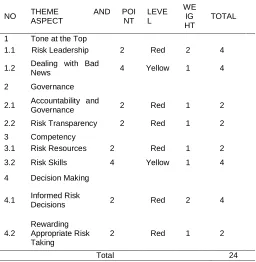
Based on our evaluation, the Pilot Test Office risk culture level is summarised in Table 2. Pilot Test Office scores 24 out of the maximum of 100 using this method. The score will be used to help the organization in setting risk culture targets. However, the maximum score does not necessarily have to be reached because it depends on the desired risk culture level that should be set up by the leader later. For example, if the leader set a Blue level as the desired risk culture for all Aspect, then the score of 80 to 100 would be an accomplishment. If the Green level is set as a target for all Aspect, then the 60 to 80 scores would already be an achievement. The study result is in-line with the nation-wide report made by BPKP which concludes that risk management implementation in government institutions is weak (BPKP, 2019) and strengthens Keban (2017) and Durst, Lindval, & Burns (2018) findings, that risk management practice in the public sector remains limited.
TABLE 2.
Pilot Test Office Risk Culture Score
NO THEME AND
ASPECT
POI NT
LEVE L
WE IG HT
TOTAL
1 Tone at the Top
1.1 Risk Leadership 2 Red 2 4
1.2 Dealing with Bad
News 4 Yellow 1 4
2 Governance
2.1 Accountability and
Governance 2 Red 1 2
2.2 Risk Transparency 2 Red 1 2
3 Competency
3.1 Risk Resources 2 Red 1 2
3.2 Risk Skills 4 Yellow 1 4
4 Decision Making
4.1 Informed Risk Decisions 2 Red 2 4
4.2
Rewarding Appropriate Risk Taking
2 Red 1 2
Total 24
shows that there is an effort to encourage the dissemination of risk information as earliest as possible. However, such an effort is still sporadic. The importance of risk information delivery has been considered as vital, but the process has not been formalised and integrated yet. The Red level in Accountability and Governance indicates that the responsibility in managing risk is not consistently clarified. The person responsible for risk is not known. Risk management is not understood well. The Red level in Risk Transparency shows that risk information is not transparent and is not ready to be transmitted. Managers do not receive adequate risk information as a decision-making source. The Red level in Risk Resources shows that risk unit/function does not have a clear job description and adequate resources. Risk management is attached to several units. The risk management profession is not considered strategic. The Yellow level in Risk Skills indicates that risk management‘s awareness and training program exist in parts of the organisation. Nevertheless, these programs are implemented partially or in a silo‘ed manner. The Red level in Informed Risk Decisions means that business decisions are generally taken without calculating explicit risk factors. The risk and reward evaluation is conducted in a non-structured manner. The Red level in Rewarding Appropriate Risk-Taking demonstrates that the risk-taking behaviors and risk awareness are not perceived as beneficial and are not rewarded explicitly.
3.2.Risk Leadership
Most of the respondents agreed that the leaders had been discussing risk actively in every important meeting. The leaders also have involved risk function (SPIP Taskforce) in every significant discussion. The risk management report (which is included in the SPIP implementation report) always been delivered on time. On the other hand, a specific tone at the top of leaders is not well understood. Based on the result of the open-ended question asking about the description of tone at the top, it shows that many respondents did not recognize the tone at the top in risk management. For example, respondents rather related tone at the top to staff disciplinary. Others even found it difficult to write down what the leader‘s tone at the top is. Another deficiency is the lack of comprehensive risk management guidelines whose role is to regulate the entity‘s risk management in a holistically tone.
3.3.Dealing with Bad News
In this Aspect, the leader has encouraged staff to convey risk information and bad news. According to the survey, the majority of staff perceived that senior management have encouraged the dissemination of issues. The respondent also confirmed that the superior made them feel free to disclose any risk. Nonetheless, respondents were diverse when responding to whether issues rose have been adequately appreciated or not. Many respondents answered yes but another quarter of the respondents admitted that they did not know the existence of such appreciation. There is also the absence of the guidelines of risk information and bad news disclosure.
3.4.Accountability and Governance
In the Aspect of Risk Accountability and Governance, the Pilot Test Office has assigned every key risk to the
respective officers. This can be seen from a risk register document and its control action plan. SPIP Taskforce delivers SPIP implementation report regularly to the BPKP headquarters (BPKP Risk Unit) which is compiled afterward to create a nation-wide BPKP‘s SPIP implementation report. However, the quality of risk management could not be assured due to the lack of a risk management evaluation mechanism. The weakness in risk information quality can be seen from inadequate risk register (e.g., some risks are still defined as the negative of an activity purpose).
3.5.Risk Transparency & Informed Risk Decisions
In the ―Pilot Test Office‖, managers have access to risk information due to their responsibility as a person in charge of managing risk related to their duty. Managers have to identify risks, analyze them, and create an action plan to mitigate those risks. Afterward, the risk function compiles the information in the form of the SPIP implementation report. This report is compiled regularly (quarterly) and presented to senior management and BPKP headquarters. On the other hand, access to risk information is still limited to particular employees (i.e. risk function and management). The information also has not been provided yet in real-time. Risk information and risk analysis have not been integrated yet into organizations‘ strategic planning and work plan. There are no rules and procedures (e.g. risk management evaluation) to ensure that weaknesses in risk management should be followed up.
3.6.Risk Resources
BPKP as an agency has had a unit responsible for risk management. The unit is structured in SPIP and Bureaucratic Reform division. There is also a risk function in the Pilot Test Office (as well as the rest of independent echelon II working units) in the form of SPIP Taskforce. Risk function in the working unit consists of the leader, all managers, and technical staff, including all divisions and sub-division. Therefore, the authority and position of the risk function are sufficient to conduct its role. Moreover, the risk function is believed to have an adequate number of personnel and is supported by enough budget to carry its mission. In addition, according to the survey, SPIP function has been involved in the discussion of key risks. Even though the Risk Resources Aspect has many good points, the respondents do not confident enough to reach a conclusion that the risk function has already got satisfactory credibility and reliability.
3.7.Risk Skills
Pilot Test Office always encourages its employees to take training held by Pusdiklatwas BPKP. For risk-related training, Pusdiklatwas has SPIP and risk management training. Furthermore, the Pilot Test Office has reached level 3 of SPIP maturity. Nonetheless, the employee‘s career development system has not considered risk management as an essential attribute. There is no prerequisite for managers to master risk management skills. There is also no incorporation of risk management capability into employee performance measurement.
3.8.Rewarding Appropriate Risk Taking
rewarding risk management culture. This risk-reward mechanism has not been implemented by the Pilot Test Office and BPKP headquarter. There is no reward mechanism yet to specifically appreciate those (i.e. people and working units) who have managed risks satisfactorily. In the opposite, there is no sign of punishment measures to correct the failure in managing risks. Similar to Risk Skills Aspect, the risk management capability has not become a key indicator to measure employee performance. Related to the employee career development, BPKP and Pilot Test Office have not incorporated risk management competency yet into manager development and selection process.
4.
ANALYSIS
4.1.Risk Leadership
Tone at the top is an important indicator to drive risk culture (FSB, 2014; IRM, 2012). This is because a leader holds the power to steer the organization through policy and allocation of resources. Well-trained leaders in risk management will ensure that there are adequate policies and funds to support a robust risk management system. In this manner, IRM required leaders to establish a clear vision in which the organization manages risks to achieve its objective. This tone at the top needs to be disseminated to the entire organization and be understood as well. Moreover, it has to be converted into applicable decisions and actions (IRM, 2012). In spite of the leader‘s passion for discussing risk and involving risk function in important meetings, the staff still did not clearly understand the tone at the top. What happened in the Pilot Test Office, as is shown in the survey result, exhibits how unspecific tone at the top results in equivocal subordinates‘ perception. It reflects what the leader has done: the leader has not precisely expressed his preferred approach to risk yet. In addition, BPKP-wide also does not have a comprehensive/integrated risk management guideline. As a consequence, good practices in risk management are not fully aware of and are not implemented well.
4.2.Dealing with Bad News
Anderson and Anderson (2002), as cited in IRM (2012), stipulate that concerns or issues that may impede goal achievement should be raised transparently. This requirement is explicitly formulated because many people, usually the manager in charge, does not like to be seen as incompetent or simply demanding work perfection: the manager does not want to hear any failure. The metaphorical phrase is the messenger tends to be shot. In this case, the risk or issue is expected to be resolved later without the acknowledgment of immediate superior. Correspondingly, the subordinate is deterred to inform any issue and rather delivering good news only. As a measure to prevent such a challenge, a regulation should exist to ensure that risk and issue should be delivered transparently and timely (at the very least to the responsible officer and independent risk function). In the Pilot Test Office case, staffs are comfortable in raising concerns or risk information to their superior and senior management. The establishment of this condition is supported by the leader‘s policy. It is a good indicator of how leaders support the transmission of risk information across the office. On the other side, there is still a question whether those
transmitted or raised concerns have been appreciated or not. Moreover, the absence of the guidelines of risk information and bad news disclosure confirmed that the organization still relies heavily on the individual policy, or as in the Pilot Test Office case, the leader is the main driver of such effort. As a consequence, there is no guarantee that the next leader in charge would have the same passion and effort to sustain the adequate level of risk information communication.
4.3.Accountability and Governance
Risk management is implemented to assist the organization in dealing with future uncertainty, particularly factors that hinder objective achievement. IRM stipulates that an organization has to ensure that risk information is acquired and produced ata high-quality degree. Risk information and its analysis needs to be validated and formally challenged to reassure the quality of the results (IRM, 2012). Accordingly, the accountability of risk management is pivotal (IRM, 2012; FSB, 2014; Banks, 2012). Every employee is expected to be held responsible for their actions. They also have to be aware of the cost that could be incurred if they fail to uphold such responsibility (FSB, 2014). Only then the effective decision could be made. One of the methods to do that is the need for the organization to create a quality control mechanism in a form of risk management evaluation. This method will provide the best available option regarding risk analysis and its mitigation. In the case study, the people responsible for managing risks have been determined and assigned. Therefore, there is an assurance that key risks identified in the risk action plan could be managed properly. This illustrates that the Pilot Test Office has sufficiently formed a basis for risk management. The risk function also has conducted one of its roles by reporting the implementation of SPIP to BPKP headquarter. This effort enables the Risk Unit in BPKP headquarter to oversee the SPIP (and also risk management) implementation. Notwithstanding, neither BPKP as a whole nor the Pilot Test Office has evaluated its risk management. Thus, there is a chance that risk information is inadequately reviewed, and its quality becomes sub-standard. For instance, the risk is still seen as a negation of respective activity purposes. This inadequate risk formulation was found in the Pilot Test Office risk register. Subsequently, this basic problem may mislead leaders during decision making and contribute to failure or ineffective risk mitigation.
4.4.Risk Transparency & Informed Risk Decisions
can be put on time. The risk information is also not available in the important organization planning document. In a government institution, these important planning documents should at least include the organisation/working unit‘s Strategic Plan (Rencana Strategies)and Working Plan (Rencana Kerja). The incorporation of key risks analysis into these documents would help senior management to have an adequate understanding of all key risks that are going to impede organization performance. Accordingly, the leaders will ensure the key risks could be mitigated. Nevertheless, the case study circumstance demonstrates that the office did not fully consider the risk that may disrupt its goal achievement. Therefore, the organization may face significant problems in the future. Another weak point is the absence of a process to check whether the weaknesses found in risk management have been corrected. The process should exist as an integral part of risk management evaluation to reassure that the risk information quality is satisfactory. What happened in the Pilot Test Office case, the lack of such monitoring makes the existing risk information might inherently carry an inadequate quality. Correspondingly, the decision-making process would be compromised and the outcomes would be not effective.
4.5.Risk Resources
IRM advises that an organization should establish a risk management function that is respected and trusted. To deliver such values, one of the standards requires the risk function to be adequately structured within the organization. Risk function also has to make sure that risk management is integrated into every organization's decision and operation (IRM, 2012). The aforementioned requirements are needed to meet the quality of risk information. The Pilot Test Office risk function already has a quite strong structure required to deliver quality risk management practices. Its members consist of all managers in the office. Resources wise, risk function is supported by adequate personnel and is provided by a proper amount of budget. In addition to that, leaders often involve risk function in key risk discussions. Despite the strong points possessed by risk function, survey respondents in the Pilot Test Office perceived that SPIP Taskforce still has more to deliver in order to be credible and reliable. The respondents also have limited knowledge about the performance of SPIP Taskforce. As has been explained before, the weaknesses found in the risk register is an evidence of the office‘s risk information quality. Correspondingly, the risk information managed by the function seems not to be effectively used by management in the decision-making process. In other words, the risk function has not been working effectively yet and has not had an effective risk management framework.
4.6.Risk Skills
Risk management skills across the organization are paramount (IRM, 2012). This requirement is a priority for those who responsible for managing risk (e.g. leaders, managers, risk officers). In a wider audience, it is expected that all employees master the basic risk management skills. This indicator will provide a foundation for a positive risk culture within the organization. Skills of risk management are obtained mainly through risk-related training provided by Pusdiklatwas BPKP. Furthermore, every person trained has the obligation to disseminate their training knowledge to
employees in the office through a kind of mini-workshop. The latter procedure is named Independent Training Program (Program Pelatihan Mandiri/PPM). There are also specific courses held by an external provider in the risk management field. For instance, the risk management professional certification. Both pieces of training held by Pusdiklatwas and the external certification provider deliver depth risk management understanding to the participant. Unfortunately, the cost to organize this training is high so that there is limited space available in such training. The PPM could expose the wider audience in the Pilot Test Office and could accelerate the skills sharing. However, the content delivered is usually very limited. PPM often lasts three to four hours thus could not replicate what the on-the-job trainee received during their training. Therefore, more efforts have to be put into action to equip all managers, risk officers, and employees with adequate risk management skills. The Pilot Test Office has reached level 3 in SPIP maturity. In a simple translation of SPIP maturity, level 3 implies that the SPIP elements have been implemented properly.In relation to SPIP and Risk Management, this score provides assurance that the Pilot Test Office has implemented risk management (specifically Risk Identification and Risk Measurement). In terms of the importance of risk skills, organisationexcludes risk management as one factor to determine whether an individual is qualified as a manager. Moreover, risk management did not exist in the employee performance evaluation framework. The condition illustrates how risk skill is still not considered as pivotal for the organization.
4.7.Rewarding Appropriate Risk Taking
Leaders are expected to be supportive of those who understand and positively manage risk (FSB, 2014; IRM, 2012). By doing so, the employee will feel that they are encouraged and supported when investing their time in risk management. In the end, it will proliferate risk management awareness and proficiency within the organization. In the case of the Pilot Test Office and BPKP wide, those that exhibit the expertise of risk management are not sufficiently appreciated, and contrarily, those taking improper risks are not adequately challenged. The risk management skills are not an integral part of employee performance evaluation. The process of managers‘ selection and development do did not account for risk management capabilities. These practices demonstrate that risk management in the Pilot Test Office (which is a part of SPIP implementation) heavily focused to comply with formal requirements. In other words, risk management practices are not mature yet.
5.
RECOMMENDATION FROM THE STUDY
5.1.Study Limitation
In trialing the methodology, we gathered limited information from the research object due to the nature of the close-ended questionnaire. However, the majority of Criteria could be gathered from an in-depth review, observation, and collection of evidence. This approach is slightly reducing the quality but at the same time, pretty strengthen the effectiveness and efficiency of both evaluator and research object.
5.2.The implication of the Study
The study has enriched the understanding of risk culture measurement, especially in the public sector. The study also shows how the method used can reveal risk culture weaknesses and thus open the room to enhance public sector risk management practice in the immediate future. The method is useful for the practitioner and can be applied to other government institutions in general. As a greater implication, the study could help public institutions to deliver more effective services based on well-implemented risk management practices. Nevertheless, we acknowledged that the method still needs to be refined. For future study, we recommend that the trial of risk culture measurement using our methodology includes open-ended questionnaire. Therefore, the difference between both approaches (open versus closed) could be determined. Accordingly, a solid conclusion regarding effective methodology could be figured out.
6.
CONCLUSION
The Pilot Test Office has implemented risk management according to the SPIP implementation protocol but limited to early stage. The lack of comprehensive risk management guidelines made employee and officer responsible for managing risk stay in vagueness. The employee could not demonstrate a clear understanding of the leader‘s tone at the top in risk management. Risk management has not been fully integrated into organisation operations, both strategically and in daily basis. There is no mechanism to evaluate the quality of risk information produced. Risk management behaviour has not been engineered by reward and punishment measures. To conclude, risk culture in the Pilot Test Office has plenty of rooms to be improved.
REFERENCES
[1] Anderson, L. A., & Anderson, D. (2002). The Ten Critical Actions for Leading Successful Transformation. Durango, USA: Being First Inc. [2] Ahmad, I., & Ahmad, S. 2018. Multiple Skills and
Medium Enterprises Performance in Punjab Pakistan: A Pilot Study. The Journal of Social Sciences Research: 44-49: 44
[3] Bailar, B., Bailey, L., & Stevens, J. (1977). Measures of Interviewer Bias and Variance. Journal of Marketing Research (JMR), 14(3), 337–
343. Retrieved from
https://doi-org.ezp.lib.unimelb.edu.au/10.2307/3150772 [4] Banks, E. (2012). Risk Culture: A Practical Guide
to Buiding and Strengthening the Fabric of Risk Management. Hampshire: Palgrave Macmillan. [5] Boyd Jr., H., & Westfall, R. (1965). Interviewer Bias
Revisited. Journal of Marketing Research (JMR), 2(1), 58–63. Retrieved from
https://doi-org.ezp.lib.unimelb.edu.au/10.1177/002224376500 200109
[6] BPKP. (2019). Risk Culture Measurement Pilot Test Report. Jakarta: BPKP.
[7] BPKP. (2019). The 4th Quarter Report: Government Internal Control System (GICS) Implementation on Ministries/Agencies and Local Governments. Jakarta: BPKP.
[8] Carretta, A., Fiordelisi, F., & Schwizer, P. (2017). Risk Culture in Banking. Cham, Switzerland: Palgrave MacMillan.
[9] CIMA, EY & ISCA. (2018). Risk Culture: How to Get It Right. Singapore.
[10] Comcover. (2016). Comcover Information Sheet: Developing a Positive Risk Culture. Canberra, Australian Capital Territory, Australia. Retrieved from https://www.finance.gov.au/comcover/risk-service
[11] Durland, M., & Caplan, M. (2018, January 19). The Secret Life of Culture: Unveiling Culture Risk in the Age of Machine Learning. Retrieved from Global Risk Institute: https://globalriskinstitute.org
[12] Durst, S., Lindvall, B., & Bruns, G. (2018). Knowledge Risk Management in the Public Sector: Insights into a Swedish Municipality. Journal of Knowledge Management.
[13] FSB. (2014). Guidance on Supervisory Interaction with Financial Institutions on Risk Culture: A Framework for Assessing Risk Culture. Financial Stability Board.
[14] Goffee, R., & Jones, G. (1998). The Character of a Corporation: How Your Company's Culture Can Make or Break Your Business. Collins.
[15] Green, P., & Jennings-Mares, J. (2008). IIF's Final Report on Market Best Practices for Financial Institutions and Financial Products. Banking and Financial Services Policy Report.
[16] Hillson, D. (2013). The A-B-C of Risk Culture: How to be Risk-Mature. PMI Global Congress Proceedings. New Orleans.
[17] IRM. (2012). Risk Culture - Resources for Practitioners. London: The Institute of Risk Management.
[18] Keban, Y. T. (2017). Risk Management: A Neglected Vital Instrument in Public Administration in Indonesia. Management Research & Practice. Vol. 9 Issue 4, 5-21.
[19] Lam, J. (2017). Risk Culture. In Implementing Enterprise Risk Management: From Methods to Applications (pp. 115-131). Hoboken, New Jersey: John Wiley & Sons .
[20] Lewis, H., & Corrigan, J. (2013, August 27). Enterprise Risk Culture: From Elusive Phenomenon to Pragmatic Solutions. Sydney: Systemi Consult, Milliman.
[21] Mao, Z. (2019). Digital Media and Risk Culture in China's Financial Markets. New York: Routledge. [22] Power, M. (2007). Organized Uncertainty:
Designing A World of Risk Management. New York: Oxford University Press.
[24] Shapiro, M. J. (1970). Discovering Interviewer Bias in Open-Ended Survey Responses. The Public Opinion Quarterly, 34(3), 412. Retrieved from
https://search-ebscohost-com.ezp.lib.unimelb.edu.au/login.aspx?direct=true &db=edsjsr&AN=edsjsr.2747972&site=eds-live&scope=site
[25] Shaughnessy, J., Zechmeister, E., & Jeanne, Z. (2011). Research methods in psychology (9th ed.). New York: McGraw Hill.
[26] Transparency International. (2019). Corruption Perception Index 2018. Retrieved from
Transparency International:
https://www.transparency.org/cpi2018