University of Pennsylvania
ScholarlyCommons
Publicly Accessible Penn Dissertations
Fall 12-22-2009
Complex Networks: New Models and Distributed
Algorithms
Alireza Tahbaz Salehi
University of Pennsylvania, [email protected]
Follow this and additional works at:http://repository.upenn.edu/edissertations
Part of theControls and Control Theory Commons
This paper is posted at ScholarlyCommons.http://repository.upenn.edu/edissertations/84
Recommended Citation
Tahbaz Salehi, Alireza, "Complex Networks: New Models and Distributed Algorithms" (2009).Publicly Accessible Penn Dissertations. 84.
Complex Networks: New Models and Distributed Algorithms
Abstract
Over the past few years, a consensus has emerged among scientists and engineers that net-centric technology can provide unprecedented levels of performance, robustness, and efficiency. Success stories such as the Internet, distributed sensor networks, and multi-agent networks of mobile robots are only a few examples that support this view. The important role played by complex networks has been widely observed in various physical, natural, and social systems. Given the complexity of many of these systems, it is important to understand the fundamental rules that govern them and introduce appropriate models that capture such principles, while abstracting away the redundant details.
The main goal of this thesis is to contribute to the emerging field of "network science'' in two ways. The first part of the thesis focuses on the question of information aggregation over complex networks. The problem under study is the asymptotic behavior of agents in a network when they are willing to share information with their neighbors. We start by focusing on conditions under which all agents in the network will asymptotically agree on some quantity of interest, what is known as the consensus problem. We present conditions that guarantee asymptotic agreement when inter-agent communication links change randomly over time. We then propose a distributed (non-Bayesian) algorithm that enables agents to not only agree, but also learn the true underlying state of the world. We prove that our proposed learning rule results in successful information aggregation, in the sense that all agents asymptotically learn the truth as if they were completely informed of all signals and updated their beliefs rationally. Moreover, the simplicity of our local update rule guarantees that agents eventually achieve full learning, while at the same time, avoiding highly complex computations that are essential for full Bayesian learning over networks.
The second part of this thesis focuses on presenting a new modeling paradigm that greatly expands the tool set for mathematical modeling of networks, beyond graphs. The approach taken is based on using simplicial complexes, which are objects of study in algebraic topology, as generalizations of graphs to higher dimensions. We show how simplicial complexes serve as more faithful models of the network and are able to capture many of its global topological properties. Furthermore, we develop distributed algorithms for computing various topological invariants of the network. These concepts and algorithms are further explored in the context of a specific application: coverage verification in coordinate-free sensor networks, where sensor nodes have no access to location, distance, or orientation information. We propose real-time, scalable, and decentralized schemes for detection of coverage holes, as well as computation of a minimal set of sensors required to monitor a given region of interest. The presented algorithms clarify the benefits of using simplicial complexes and simplicial homology, instead of applying tools from graph theory, in modeling and analyzing complex networks.
Degree Type
Dissertation
Degree Name
Doctor of Philosophy (PhD)
Graduate Group
First Advisor
Ali Jadbabaie
Keywords
Complex networks, distributed algorithms, distributed control, multi-agent systems
Subject Categories
Acknowledgements
This thesis could not have been written without the support of my advisor, Professor Ali
Jadbabaie. Ali taught me how to think independently while providing me with guidance on
all aspects of research. His encouragement during these years will always be of immense
value to me.
I am also greatly indebted to Professor Robert Ghrist for the many helpful conversations
that we had over the past years. The second half of this thesis would have been impossible
without his guidance. I am thankful to the other members of my committee: Professors
George Pappas, Daniel Koditchek, and Asuman Ozdaglar. Their valuable suggestions and
considerable advice have greatly improved the quality of this thesis. I would also like to
thank Professor Alvaro Sandroni for his contributions in Chapter 3.
An important role was played by my many friends at Penn. Special thanks to Elena,
Nima, Agung, Michael, Farhad, Gil, Antonio, Andreas, and many others. Without them,
my years in Philadelphia would not have been as enjoyable.
Last but not least, my deepest thanks to my parents, Farzaneh and Ali, and my sister,
Ghazaleh, who gave me their unconditional love and support. I owe them much more than
ABSTRACT
COMPLEX NETWORKS: NEW MODELS AND DISTRIBUTED ALGORITHMS
Alireza Tahbaz Salehi
Supervisor: Ali Jadbabaie
Over the past few years, a consensus has emerged among scientists and engineers that
net-centric technology can provide unprecedented levels of performance, robustness, and
efficiency. Success stories such as the Internet, distributed sensor networks, and multi-agent
networks of mobile robots are only a few examples that support this view. The important
role played by complex networks has been widely observed in various physical, natural,
and social systems. Given the complexity of many of these systems, it is important to
understand the fundamental rules that govern them and introduce appropriate models that
capture such principles, while abstracting away the redundant details.
The main goal of this thesis is to contribute to the emerging field of “network science”
in two ways. The first part of the thesis focuses on the question of information aggregation
over complex networks. The problem under study is the asymptotic behavior of agents in
a network when they are willing to share information with their neighbors. We start by
focusing on conditions under which all agents in the network will asymptotically agree on
some quantity of interest, what is known as the consensus problem. We present
condi-tions that guarantee asymptotic agreement when inter-agent communication links change
randomly over time. We then propose a distributed (non-Bayesian) algorithm that enables
agents to not only agree, but also learn the true underlying state of the world. We prove that
our proposed learning rule results in successful information aggregation, in the sense that
all agents asymptotically learn the truth as if they were completely informed of all signals
and updated their beliefs rationally. Moreover, the simplicity of our local update rule
complex computations that are essential for full Bayesian learning over networks.
The second part of this thesis focuses on presenting a new modeling paradigm that
greatly expands the tool set for mathematical modeling of networks, beyond graphs. The
approach taken is based on using simplicial complexes, which are objects of study in
alge-braic topology, as generalizations of graphs to higher dimensions. We show how simplicial
complexes serve as more faithful models of the network and are able to capture many of its
global topological properties. Furthermore, we develop distributed algorithms for
comput-ing various topological invariants of the network. These concepts and algorithms are further
explored in the context of a specific application: coverage verification in coordinate-free
sensor networks, where sensor nodes have no access to location, distance, or orientation
information. We propose real-time, scalable, and decentralized schemes for detection of
coverage holes, as well as computation of a minimal set of sensors required to monitor
a given region of interest. The presented algorithms clarify the benefits of using
simpli-cial complexes and simplisimpli-cial homology, instead of applying tools from graph theory, in
Contents
Acknowledgements ii
Abstract iii
Contents v
List of Figures viii
1 Overview 1
1.1 Information Aggregation over Complex Networks . . . 3
1.2 New Models of Networks: Beyond Graphs . . . 7
I
Information Aggregation Over Complex Networks
9
2 Network Consensus Algorithms 10 2.1 Distributed Consensus Algorithms . . . 112.1.1 Ergodicity . . . 13
2.1.2 Coefficients of Ergodicity . . . 15
2.1.3 Consensus and Joint Connectivity . . . 18
2.2 Consensus over Random Networks . . . 21
2.2.2 Ergodic Stationary Random Networks . . . 32
2.3 Related Literature . . . 37
3 Social Learning 39 3.1 Summary of Results and Related Literature . . . 40
3.1.1 Summary of Results . . . 41
3.1.2 Related Literature . . . 44
3.2 A Model of Non-Bayesian Social Learning . . . 46
3.2.1 Agents and Observations . . . 46
3.2.2 Social Structure . . . 47
3.2.3 Belief Updates . . . 48
3.3 Social Learning . . . 50
3.3.1 Correct Forecasts in Strongly Connected Societies . . . 52
3.3.2 Asymptotic Beliefs . . . 58
3.4 Concluding Remarks . . . 66
II
New Models of Networks: Beyond Graphs
67
4 From Graphs to Simplicial Complexes 68 4.1 Simplicial Complexes . . . 704.1.1 Boundary Homomorphism . . . 73
4.1.2 Simplicial Homology . . . 74
4.1.3 Relative Homology . . . 76
4.2 Combinatorial Laplacians . . . 76
5.2 Problem Formulation . . . 84
5.2.1 Simplicial Coverage Framework . . . 85
5.2.2 Symmetric Coverage Framework . . . 85
5.3 Distributed Coverage Verification . . . 86
5.4 Distributed Hole Localization . . . 92
5.4.1 Computing the Sparsest Generator: IP Formulation . . . 96
5.4.2 LP Relaxation . . . 97
5.4.3 Decentralized Computation: The Subgradient Method . . . 101
5.5 Distributed Detection of Redundant Sensors . . . 102
5.6 Simulations . . . 106
5.6.1 Hole Localization . . . 106
5.6.2 Computing a Sparse Cover . . . 108
6 Summary and Future Work 110 6.1 Thesis Summary . . . 110
6.2 Future Research Directions . . . 112
A Appendix: Graph Theory 115 A.1 Undirected Graphs . . . 115
A.2 Directed Graphs . . . 116
List of Figures
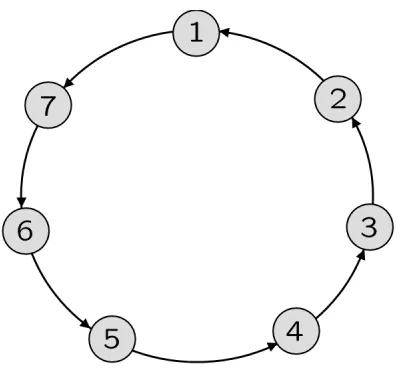
3.1 The figure illustrates a strongly connected social network of 7 agents, which
is of the form of a directed cycle. . . 63
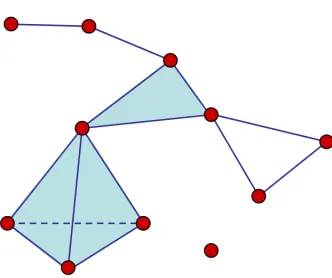
4.1 A simplicial complex. . . 71
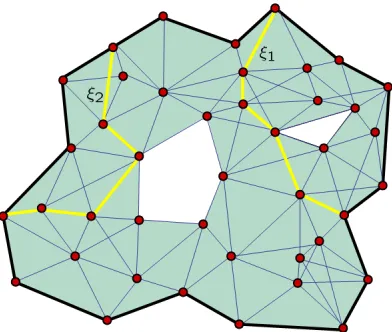
4.2 Relative homology: ξ1 is the representative of a non-trivial element in
H1(X, A). . . 77
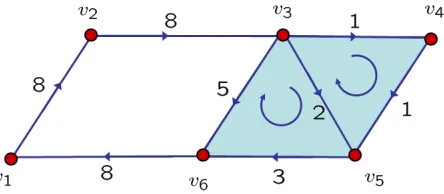
4.3 A simplicial complex of dimension 2. The numbers labeled on the edges
correspond to the components of the eigenvector corresponding to 0
eigen-value, i.e. the kernel, of the first combinatorial Laplacian matrix. . . 79
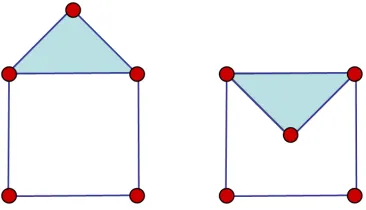
5.1 The simplicial complexes corresponding to the above figures are
combina-torially equivalent. Therefore, in both cases, the shortest cycle encircling
the hole has length 4. . . 93
5.2 The sparsest generator of the homology class of the cycles that encircle
each hole once clockwise is not necessarily tight around both. . . 94
5.3 If the first homology ofRis non-trivial, then the second relative homology
H2(R,F)has no generator with values on the boundary. Conversely, if the
second homology relative to the boundary has a non-trivial generator with
5.4 The eight faces of the octahedron form a non-trivial 2-cycle α such that
[α] ∈ H2(R). However,α has a vanishing boundary∂2α = 0, and
there-fore, does not correspond to a true relative 2-cycle. . . 106
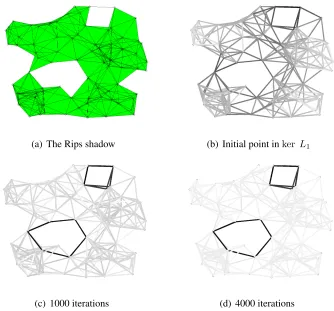
5.5 Subgradient methods can be used to localize the holes in a distributed fashion.108
5.6 Finding the minimal generator of the second relative homologyH2(R,F)
leads to a minimal cover. 32 of the sensors can be turned off without
Chapter 1
Overview
Over the past few years, a consensus has emerged among scientists and engineers that
net-centric technology can provide unprecedented levels of performance, robustness, and
efficiency. Success stories such as the Internet, distributed sensor networks, and
multi-agent networks of mobile robots are only a few examples that support this view. The
important role played by complex networks has been widely observed in various physical,
natural, and social systems. For example, it is widely believed that many phenomena in the
natural world such as swarming in locusts, flocking of birds, and synchronous flashing of
fireflies are due to interaction of these species over a network. Similarly, in social sciences,
the central role played by social and economics networks is well-documented in many
scenarios including consumer choice, spread of rumors, and emergence of fashion and
trends.
The wide range of network phenomena and applications, such as the ones mentioned
above, have sparked a widespread interest in understanding, modeling, and analyzing
net-works in various fields such as engineering, economics, biology, and ecology. In the
con-trols and robotics community, this interest has been coupled with the need for developing
with real-life engineering applications ranging from cooperative control of multiple
au-tonomous agents to mobile sensor networks.
Given the complexity of many networked-systems, the main challenge is to understand
fundamental rules that govern them and introduce appropriate models that capture such
principles, while abstracting away the redundant details. The goal of this thesis is to
con-tribute to the emerging field of complex networks by providing new models and tools for
analysis of network behavior, as well as proposing algorithms and methods for distributed
decision-making and control of dynamical systems.
To this end, the first part of the thesis addresses the question of information aggregation
in complex networks. The problem under study is analyzing asymptotic behavior of agents
in a network when they are willing to share information with their neighbors. We start
by focusing on conditions under which all agents in the network will asymptotically agree
on some quantity of interest, what is known as theconsensusproblem. We present
condi-tions that guarantee asymptotic agreement when inter-agent communication links change
randomly over time. We then propose a distributed (non-Bayesian) algorithm that enables
agents to not only agree on some state, but also learn thetrueunderlying state of the world.
We prove that our proposed learning rule results in successful information aggregation, in
the sense that all agents asymptotically learn the truth as if they were completely informed
of all signals and updated their beliefs rationally. Moreover, the simplicity of our local
update rule guarantees that agents eventually achieve full learning, while avoiding highly
complex computations that are essential for full Bayesian learning over the network.
The second part of this thesis focuses on presenting a new modeling paradigm that
greatly expands the tool set for mathematical modeling of networks, beyond graphs. The
approach taken is based on using simplicial complexes, which are objects of study in
alge-braic topology, as generalizations of graphs to higher dimensions. We show how
global topological properties. Furthermore, we develop distributed algorithms for
comput-ing various topological invariants of the network. These concepts and algorithms are further
explored in the context of a specific application: coverage verification in coordinate-free
sensor networks, where sensor nodes have access to no location, distance, or orientation
information. We propose real-time, scalable, and decentralized schemes for detection of
coverage holes, as well as computation of a minimal set of sensors required to monitor
a given region of interest. The presented algorithms clarify the benefits of using
simpli-cial complexes and simplisimpli-cial homology, instead of applying tools from graph theory, in
modeling and analyzing complex networks.
1.1
Information Aggregation over Complex Networks
Consider a group of agents who are willing to share some privately available information
with one another. An example would be a group of individuals in a social network, each
with limited personal experience about a new product in the market. By communicating
and sharing their information, the individuals expect to reach a better judgment about the
actual quality of the product. As another example, consider a group of simple sensors
deployed over a region of interest, who are responsible for collecting information on room
temperatures in a building, potential fires in a forest, or enemy installations in a battlefield.
In the absence of a centralized information center, and due to their limited sensing range, it
is important that the sensors share their information with one another properly.
The important underlying characteristic of the examples presented above (as of many
others) is that any given agent does not necessarily have access to information held by all
others. Instead, in almost all scenarios, each agent can only communicate with a small
subset of other agents.1 This restriction signifies the importance of studying distributed
1In the social network example this small subset consists of the friends and family members of the given
algorithms that guarantee successful information aggregation over networks, when each
agent can only communicate locally with its neighbors.
Distributed Consensus Algorithms
One of the earliest examples of distributed algorithms for sharing information over
net-works goes back to DeGroot [33]. In the model studied by DeGroot, information held by
each agent, called its belief or state value, is captured by a scalar. He assumes that agents
update their beliefs in each period simply by taking weighted averages of their neighbors’
opinions from the previous period, possibly placing some weight on their own previous
be-liefs. This linear update model captures repeated communication and interactions among
agents and their neighbors. In spite of its simplicity, DeGroot shows that his model
guar-antees that all agents will have asymptotically equal state values, as long as the network
representing the communication links is connected. He refers to this outcome asconsensus
over the network.
Similar models have been studied by researchers in the control theory and robotics
community. The main goal of this line of research is to analyze and design distributed
protocols for motion coordination that use local information and result in a desired global
behavior. A well-known example of such a model is Vicsek’s model of alignment for
self-propelled particles [107], first appeared in the statistical physics literature. The model is a
distributed, iterative scheme in which a set of self-propelled particles moving with constant
velocity update their headings based on the average headings of their neighbors: agents
within a certain pre-specified distance from them. One feature that sharply distinguishes
Vicsek’s model from DeGroot’s is that, due to their mobility, the neighbors of each agent
might change over time. In spite of this, simulations performed by Vicsek [107] clearly
show that, in the absence of noise, all particles will asymptotically align with one another,
that is, a consensus in their headings is achieved. Vicsek’s model was first analyzed by
Jadbabaie, Lin, and Morse [64], who show that if the proximity graphs representing the
interconnection of agents are infinitely-often jointly connected, then all headings converge
to a common value asymptotically. Their work initiated a tremendous amount of interest
in the controls and robotics community. A non-exhaustive list of relevant research in this
field includes [4, 17, 66, 72, 78, 84, 85].
Chapter 2 of this thesis is dedicated to the study of distributed consensus algorithms
over networks. It contains a review of the main known results on necessary and sufficient
conditions for asymptotic agreement over dynamic networks. The review is followed by the
study of consensus algorithms over randomly changing networks, which is the main
con-tribution of the chapter. The importance of studying conditions for consensus over random
networks lies in the fact that, in many real-world network applications, the availability of
communication links between different entities is usually random. This randomness can be
due to link failures, node failures, interference, or existence of physical obstacles
interrupt-ing communication, which are natural features of wireless communications. We conclude
the chapter by computing the statistical properties of the value that all agents agree upon,
when the network changes randomly.
Social Learning
One of the shortcomings of DeGroot’s model and other similar distributed consensus
al-gorithms is that they can only guarantee asymptotic agreement, with limited amount of
control over the value that the agents agree upon. Although sufficient in some applications,
in many scenarios it is important to have the information aggregated correctly, in the sense
that all agents agree on therightvalue, an outcome known associal learning.
Belief update rules that result in asymptotic learning can be categorized to two general
learning literature focuses on scenarios that agents incorporate information provided to
them rationally into their beliefs. Although optimal, rational learning rules require agents
to perform complicated and often not computationally feasible updates. Therefore, for
large and complex networks, one needs to consider coarser learning rules according to
which, agents use simple rule-of-thumbs to incorporate the information provided to them
through their neighbors.
The main contribution of Chapter 3 is to propose a simple non-Bayesian and distributed
belief update rule that results in asymptotic learning over networks. In the presented model,
at every time period, each agent receives a private noisy signal about the true state of the
world and updates her beliefs as a convex combination of the Bayesian posterior belief
generated by the observed signal and the prior beliefs of her neighbors. We show that
under such a boundedly rational model of opinion formation, individuals will eventually
hold correct forecasts about the observations of all agents, as long as the social network is
strongly connected; that is, if there exists an information path connecting any two agents
in the society. Moreover, we show that if the individuals’ observations are conditionally
independent, they asymptotically learn the true underlying state of the world as if they
were completely informed ofallsignalsandupdated their beliefs according to Bayes’ rule.
Our main result therefore establishes that the agents can successfully aggregate information
held by all other agents in the network, even if they are not in direct communication with
one another, or are not aware of each other’s existence. Finally, the simplicity of our local
update rule guarantees that the agents eventually achieve full learning, while at the same
time, avoiding the highly complex computations that are essential for full Bayesian learning
1.2
New Models of Networks: Beyond Graphs
A key step in understanding the common underlying principles of networked systems is to
apply the proper level of abstraction in modeling them. Although graphs are often adequate
discrete abstractions for network phenomena, there are plenty of challenging applications
and scenarios where the abstraction based on binary relations is too crude. More
specifi-cally, in many applications, instead of only looking at pairwise relations between agents,
one might find it useful (or even necessary) to consider 3-way or 4-way relations as well.
For example, a coalition of 3 agents is different from the 3 pairwise relations between any
two of them. In such cases, using a simplicial complex to model the network can
poten-tially lead to extraction of the information buried in higher order relations between different
entities. To this end, the second part of this thesis is focused on presenting the theories of
simplicial complexes and simplicial homology, as well as developing distributed protocols
for extracting topological properties of the network.
Simplicial complexes, which are generalization of graphs to higher dimensions, can
serve as general geometric representation for a broad spectrum of modeling problems [41].
For example, in many situations that a geometrical space is represented by a finite set of
points sampled from it - what is known aspoint cloud data- it is natural to use the
machin-ery of simplicial complexes and homology to recover the attributes of the original space
from the sampled data [20, 28]. More recently, simplicial (and other type of) complexes
have been used in the study of proteins and other molecules: the protein is modeled as a
union of balls, one ball per atom, and the complex used is dual to this union [40–42]. Other
applications range from modeling dynamical systems [5] to configuration spaces of graphs
in robotics [53], as well as compression of data sets and coverage verification in sensor
networks [30, 79].
brief review of simplicial homology theory, which studies the algebraization of the first
layer of geometry in simplicial complexes [61, 112]. Furthermore, we present the theory
of combinatorial Laplacians corresponding to simplicial complexes and show their
appli-cation in implementing distributed algorithms. The other goal of the chapter is to relate the
presented concepts to their more well-known counterparts in graph theory.
In Chapter 5, we apply tools and concepts from algebraic topology presented in
Chap-ter 4 to design and analyze distributed algorithms over networks. More specifically, we
develop distributed algorithms for computation of sparse generators of homologies.
More-over, by focusing on the problem of coverage verification in coordinate-free sensor
net-works, we show how capturing higher order relations (beyond the pairwise relation, as
in graphs) between different entities can lead to extraction of more information from the
network. The chapter contains a distributed algorithm, built on the concept of
combinato-rial Laplacians, that verifies whether the coverage is successful and “hole-free”. We also
present two new distributed algorithms which provide further information about the cover.
The first algorithm, based on the ideas of de Silva and Ghrist [30] and Muhammad and
Egerstedt [79], is capable of “localizing” coverage holes in a network of sensors without
any metric information. Our second algorithm, also based on the tools presented in
Chap-ter 4, is a novel approach for detecting redundancies in the sensor network. The presented
algorithm is a distributed method for computing a minimal set of sensors required to cover
Part I
Information Aggregation Over
Chapter 2
Network Consensus Algorithms
Distributed consensus algorithms are one of the most well-known and widely studied
dis-tributed algorithms for information sharing and aggregation over networks. These
algo-rithms were first introduced by DeGroot in a 1974 paper [33] and were later generalized
by Tsitsiklis [105], Jadbabaie, Lin, and Morse [64] and many others. In consensus
algo-rithms, as in any information aggregation algorithm, a group of agents each with some
partial knowledge about a quantity of interest, share their information with their neighbors
and update their state values accordingly. However, in benchmark consensus algorithms,
agents update their information simply as a linear combination of the information held by
their neighbors at any given time step. The central question in the study of distributed
con-sensus algorithms is whether such simple linear updates can result in asymptoticconsensus;
that is, a state in which all agents eventually agree on the same value.
Distributed consensus algorithms have wide-spread applications, ranging from
dis-tributed and parallel computing [105, 106] to control of robotic and sensor networks [26].
These algorithms have also been suggested as possible explanation of different phenomena
as diverse as flocking in birds [91] and belief formation in social networks [56, 62].
a deterministic switching network sequence. The first section contains necessary and
suffi-cient conditions that guarantee asymptotic consensus. The presented conditions are based
on various concepts borrowed from theory of non-homogeneous Markov chains, such as
weak and strong ergodicity, and coefficients of ergodicity. This is followed by Section
2.2, where discrete-time consensus algorithms over randomly switching networks are
stud-ied. The contents of Section 2.2 are mainly from the works of Tahbaz-Salehi and
Jad-babaie [101–103]. Our results show that for i.i.d. and ergodic stationary random graph
processes, consensus is achieved if and only if the expected network is connected.
2.1
Distributed Consensus Algorithms
Consider a group ofnagents, labeled 1 throughn, each with an initial state value that can
be updated over discrete time stepst ∈ {0,1,2, . . .}. Depending on the application, this
state may correspond to the belief of an individual, the heading of a robot, or an unknown
quantity that needs to be estimated. We denote the state of agentiat timet≥0withxi(t),
and the vector of all states with x(t) = [x1(t). . . xn(t)]T. At a given time step t, each
agent has access to the state value of a subset of other agents called its neighbors. This
neighborhood relation can be captured by a sequence of directed graphsG(t) = {V, E(t)}
indexed by time t: the i-th vertex of graph G(t)corresponds to agent i, and the directed
edge (i, j) belongs to edge set E(t), if agent j has access to information held by agenti
at time t. By definition, the set of neighbors of agent i coincides with the set of vertices
adjacent to vertexiinG(t), denoted byNi(t) ={j ∈V|(j, i)∈E(t)}.
In the benchmark network consensus algorithm, each agent updates its state value as
More formally, the state value of agentifollows the linear iterative update
xi(t+ 1) =Wii(t)xi(t) + X
j∈Ni(t)
Wij(t)xj(t), (2.1)
whereWij(t)≥ 0is the weight that agentiassigns to the state value of agentj at timet.
Note that the above update is local and distributed in the sense that agenti’s state value at
timet+ 1is only a function of the state values of its neighbors at timet. Moreover, since
it is assumed that the update in (2.1) is a convex combination, it has to be the case that
P
j∈Ni(t)Wij(t) = 1.
The central question regarding equation (2.1) is whether such a local update results in
asymptotic consensus over the network. Clearly, it is as important to understand how this
consensus value is related to the initial information held by each agent at timet = 0.
Before investigating the answer to these questions, in order to simplify the notation, we
setWij(t) = 0forj 6∈ Ni(t)∪ {i}, and write the state update equation (2.1) in the more
compact matrix form
x(t+ 1) =W(t)x(t). (2.2)
In the above equation,W(t)is an n×nnon-negative matrix whose(i, j)entry is equal to
Wij(t). Note thatW(t)has an entry equal to zero if the corresponding entry in the matrix
A(t) +Inis zero, whereA(t)is the adjacency matrix ofG(t)andInis the identity matrix
of sizen. It is also useful to note thatW(t)is stochastic for allt.1
We now formally define the concept of reaching asymptotic consensus for the
dynami-cal system given in (2.2).
Definition 1. Dynamical system (2.2) reaches asymptoticconsensus, if for any initial state
valuex(0) ∈Rn, there existsx∗ ∈
Rsuch thatxi(t)→x∗ast→ ∞for alli∈ {1, . . . , n}.
1A matrix is said to bestochasticif it is entry-wise non-negative and all its row sums are equal to one. A
As the name suggests, reaching asymptotic consensus requires the state values of all
agents in the system to converge to the same common valuex∗astgrows. Note that this is
stronger than requiring the difference between state values of any two agents to converge
to zero. It might be the case that the differences between the state values of any two agents
converge to zero, while the state values themselves do not converge.
2.1.1
Ergodicity
If we denote the vector of initial state values byx(0), (2.2) implies
x(t+ 1) =W(t). . . W(1)W(0)x(0). (2.3)
Therefore, in order to study conditions for asymptotic consensus, we need to investigate
the behavior of infinite products of stochastic matrices. For this purpose, we borrow the
concept ofweak ergodicityof a sequence of stochastic matrices from the theory of Markov
chains. Weak ergodicity, first introduced by Kolmogorov [68] in 1931, is the main concept
that is used in proving convergence of infinite products of stochastic matrices.
Definition 2. The sequence{W(t)}∞
t=0 =W(0), W(1), . . . , ofn×nstochastic matrices
isweakly ergodic, if for alli, j, s= 1, . . . , nand all integerp≥0
Ui,s(t, p)−Uj,s(t, p)→0
ast→ ∞, whereU(t, p) =W(p+t)· · ·W(p+ 1)W(p)is the left product of the matrices
in the sequence.
As the definition suggests, a sequence of stochastic matrices is weakly ergodic if the
difference between any two rows of the product matrix converges to zero, as the number
sequence.
Definition 3. A sequence ofn×nstochastic matrices{W(t)}∞
t=0isstrongly ergodic, if for
alli, s = 1,· · · , nand all integerp≥0,Ui,s(t, p)→ds(p)ast→ ∞, whereU(t, p)is the
left product andds(p)is a constant not depending oni.
Strong ergodicity of a matrix sequence means that not only the difference between any
two rows of the product matrix converges to zero, but also all entries ofU(t, p)converge to
some limit. Therefore, weak ergodicity of a matrix sequence is a necessary condition for
strong ergodicity and is implied by it. The following proposition, however, shows that the
two concepts are equivalent [23, 97].
Proposition 1. Given a matrix sequence {W(t)}∞
t=0 and their left products U(t, p) =
W(t+p)· · ·W(p+ 1), weak and strong ergodicity are equivalent.2
Proof: Clearly, any strongly ergodic sequence is also weakly ergodic. So, it is sufficient
to prove that weak ergodicity implies strong ergodicity. For any > 0, weak ergodicity
implies that for large enought, we have−≤ Ui,s(t, p)−Uj,s(t, p) ≤ uniformly for all
i, j, s= 1,· · ·, n. SinceU(t+ 1, p) = W(t+p+ 1)U(t, p), we have
Ui,s(t, p)− ≤Uh,s(t+ 1, p)≤Ui,s(t, p) +,
which by induction implies that
Ui,s(t, p)−≤Uh,s(t+r, p)≤Ui,s(t, p) +,
2To be more precise, Definitions 2 and 3 correspond to weak and strong ergodicityin the backward
for alli, s, h= 1, . . . , nandr≥0. By settingh=i, it is evident thatUi,s(t, p)is a Cauchy
sequence and therefore,limt→∞Ui,s(t, p)exists.
As the above proposition suggests, weak ergodicity describes a tendency to
consen-sus as defined in Definition 1. Under weak ergodicity, matrix product U(t, p) converges
to some rank one matrix 1d(p)T, where d(p) is a normalized vector and1is a the vector
with all entries equal to one. Therefore, linear dynamical system (2.2) reaches asymptotic
consensus for all initial conditions x(0)if matrix sequence {W(t)}∞
t=0 is weakly ergodic.
Note that the converse of this statement is not true in general. In other words,
conver-gence of dynamical system (2.2) to consensus does not necessarily imply weak ergodicity
of the matrix sequence. For instance, existence of a rank one matrix in the sequence
im-plies asymptotic consensus, while it does not guarantee weak ergodicity. Nevertheless, in
what follows, we investigate conditions for weak ergodicity of the sequence as it provides
sufficient conditions for asymptotic consensus.
2.1.2
Coefficients of Ergodicity
We now present the definition of coefficients of ergodicity, which are key concepts in
prov-ing weak ergodicity results.
Definition 4. The scalar continuous function τ(·)defined on the set of n ×n stochastic
matrices is called acoefficient of ergodicity if it satisfies0 ≤ τ(·) ≤ 1. A coefficient of
ergodicity is said to beproper if, τ(W) = 0 ⇔ W = 1dT, wheredis a vector of size n
satisfyingdT1= 1.
The notion of coefficient of ergodicity was first introduced in a paper of Doeblin in
1937 and was later developed in the works of Dobrushin [35] and Hajnal [58]. It is an
extremely useful and effective tool in dealing with infinite products of stochastic matrices.
to
τ(U(t, p))−→0 ∀p∈N∪ {0}
ast → ∞for some proper coefficient of ergodicityτ.
Some of the more widely used examples of coefficients of ergodicity are:
τ1(W) = 1 2maxi,j
n X
s=1
|Wis−Wjs|,
a(W) = max
s maxi,j |Wis−Wjs|,
b(W) = 1−
n X
j=1
min
i Wij
c(W) = 1−max
j (mini Wij).
Note thatc(·)is an improper coefficient of ergodicity, whileτ1(·),a(·), andb(·)are proper.
It is also straightforward to verify that for any stochastic matrixW,
a(W)≤τ1(W)≤b(W)≤c(W)
More examples can be found in the works of Seneta [96, 97].
The next proposition outlines necessary and sufficient conditions for weak ergodicity of
a sequence of stochastic matrices, in terms of the coefficients of ergodicity of the matrices
in the sequence. Moreover, since weak ergodicity implies consensus, it also provides a
sufficient condition for asymptotic consensus of linear dynamical system (2.2). The proof
of the theorem is from [23].
Proposition 2. Suppose τ(·) is a proper coefficient of ergodicity that for any m ≥ 1
stochastic matricesFk,k = 1,2,· · · , msatisfies
τ(Fm. . . F2F1)≤
m Y
k=1
Then the sequence{W(t)}∞
t=0is weakly ergodic if and only if there exists a strictly
increas-ing sequence of non-negative integers{tr},r= 0,1,2,· · · such that
∞
X
r=1
[1−τ(W(tr+1)· · ·W(tr+ 1))] =∞. (2.5)
Proof: Suppose that there exists a strictly increasing sequence of positive integerstrsuch
that (2.5) holds. Then, the inequalitylogx≤x−1implies that
∞
X
r=1
log [τ(W(tr+1)· · ·W(tr+ 1))] =−∞,
and as a result, Q∞
r=1τ(W(tr+1)· · ·W(tr+ 1)) = 0. Sinceτ is proper, (2.4) guarantees
that the sequence is weakly ergodicity. This proves that (2.5) is a sufficient condition for
weak ergodicity of{W(t)}.
If we assume weak ergodicity, then it must be the case that τ[U(t, p)] → 0ast → 0,
forp≥0. Let0 < <1be fixed. Then define the sequence{tr}recursively by choosing
t0 arbitrarily, andtr+1 oncetr has been determined so that
τ[U(tr+1−tr−1, tr+ 1)]≤.
Note that sinceτ[U(t, p)]converges to zero for allp, giventr, one can always findtr+1such
that the above inequality is satisfied. Therefore, for the given sequence of integer{tr}, the
sum in (2.5) diverges whenever the matrix sequence{W(t)}is weakly ergodic.
The above proposition, by stating a necessary and sufficient condition for weak
ergod-icity, provides a sufficient condition for asymptotic consensus in terms of the coefficient
of ergodicity of the matrices in the sequence. However, it is silent on the properties of the
consensus value that all agents eventually agree on. In fact, except for a few special cases,
problem. The special case for which one can analytically compute the consensus value is
when all weight matricesW(t)share the same left eigenvector corresponding to their unit
eigenvector; that is, there existsa ∈ Rnsuch that aTW(t) = aT for allt ≥ 0. In such a
case, aTU(t,0) = aT for all t. Therefore, if the matrix sequence satisfies (2.5) for some
proper coefficient of ergodicityτ, then, ast grows to infinity,x(t) →
aTx(0)/ aT1
1.
Clearly, when all weight matrices are doubly stochastic, the consensus value will be equal
to the average of the initial conditions.
2.1.3
Consensus and Joint Connectivity
Proposition 2 provides a necessary and sufficient condition for the weak ergodicity of the
sequence{W(t)}∞t=0, as well as a sufficient condition for asymptotic consensus, when the
agents update their state values according to (2.1). However, it is important to interpret
condition (2.5) in terms of the properties of the matrix sequence and eventually (and more
importantly), in terms of the properties of the underlying network.
In order to explore this relationship, we focus on a specific coefficient of ergodicityτ1,
defined asτ1(W) = 12maxi,j
Pn
s=1|Wis−Wjs|, which is proper and satisfies the
submulti-plicative property (2.4). We also impose a simplifying assumption on the weights that each
agent assigns to the state of its neighbors.
Assumption 1. The weight matrices in the sequence {W(t)}are such that for all t > 0,
Wij(t)∈ {0} ∪[α,1]andWii(t)> αfor someα >0.
This assumption is meant to guarantee that whenever τ1(W) < 1 for some stochastic
matrix W, then, τ1(W) < 1− for some > 0. Therefore, under Assumption 1, for
condition (2.5) to hold, it is sufficient that there are infinitely many contractive matrices
with respect toτ1 in the sequence{W(t)}. Note that sinceτ1(W) ∈ [0,1], the rest of the
this idea of contraction can be taken one step further, in the sense that as long as there are
infinitely many intervals over which the product matrix is contractive with respect to τ1,
then the sum in (2.5) diverges and therefore,U(t, p)converges for allp.
Notice that for a given stochastic matrix W, τ1(W) is subunit if and only if W is
scrambling.3 Moreover, it is well-known that a weight matrix is scrambling if and only if
its corresponding graph isneighbor-shared, that is, every pair of verticesi, j ∈V are either
neighbors, or there existsk ∈V which is a neighbor of bothiandj. Therefore, if the graph
representing the underlying network of the system is neighbor-shared infinitely often, and
Assumption 1 holds, then the agents in the network reach asymptotic consensus. However,
as stated earlier, it is not necessary to have scrambling matrices (and hence neighbor-shared
graphs) appearing infinitely often: as long as there are infinitely many intervals over which
the matrix products are scrambling, weak ergodicity is implied. This statement can be
interpreted in terms of the graph sequence as well. For this purpose, we need the following
two definitions [64].
Definition 5. The union of a collection of (possibly directed) graphs {G1, G2, . . . , Gm}
each with the vertex setV, is a graphGwith the same vertex setV, and edge set equaling
the union of the of the edge sets of all the graphs in the collection; i.e.,E =∪m
k=1Ek, where
Ekis the edge set of graphGk.
Definition 6. A collection of graphs is said tojointlysatisfy some propertyP, if the union
of its members satisfies that propertyP.
The following lemma relates the above definitions with the scrambling property of the
product matrices. The proof is omitted and can be found in [64].
Lemma 1. The product Wm. . . W2W1 of stochastic matrices is scrambling if and only if
3A matrixW is scrambling if for each pair of indices(i, j)there existsksuch thatW
ikandWjkare both
the collection of graphs {G1, G2, . . . , Gm} are jointly neighbor-shared, where Gk is the
graph corresponding to matrixWk.
Thus, one can state the following proposition:
Proposition 3. Suppose that the weight matrices in the sequence{W(t)}satisfy
Assump-tion1. Then the sequence is weakly ergodic if and only if there exists a sequence of
pos-itive integers {tr}, r = 0,1,2, . . . such that the collection of graphs {G(tr+ 1), G(tr+
2), . . . , G(tr+1)}are jointly neighbor-shared.
To summerize, as long as the collection of graphs are infinitely often neighbor-shared,
the sequence of weight matrices representing them is weakly ergodic, and therefore,
asymp-totic consensus is guaranteed. The following theorem, which is simply a consequence of
Proposition 3, formalizes this statement as a sufficient condition for asymptotic consensus
in terms of the properties of the underlying network.
Theorem 1. Consider the network of agents that update their states based on (2.1). Also
suppose that the weights assigned by the agents satisfy Assumption1. Then the agents reach
asymptotic consensus, if there exists a sequence of positive integers {tr}, r = 0,1,2, . . .
such that the collection of graphs{G(tr+ 1), G(tr+ 2), . . . , G(tr+1)}are jointly
neighbor-shared.
As a final remark, note that most results in the literature, such as [64, 78, 85], state
the existence of infinitely often jointly strongly rooted graphs as a sufficient condition for
asymptotic consensus. It is trivial to verify that a sequence of graphs is infinitely often
2.2
Consensus over Random Networks
In the previous section, we studied the network consensus problem, when the underlying
communication network of the system changes over time. The main standing assumption
was that changes in the network topology were deterministic. The relation between
con-vergence of consensus problems and weak ergodicity was discussed, and Proposition 2
provided a sufficient condition for reaching asymptotic consensus in terms of the
coeffi-cients of ergodicity of the matrices in the sequence. Moreover, the interpretation of weak
ergodicity in terms of joint connectivity of the graph sequence was explored.
In this section, we present conditions under which a group of agents who update their
state values according to dynamical system in (2.2) reach a consensus, when the network
changes randomly over time. The importance of studying such problems is due to the fact
that, in many real-world network applications, the availability of communication links
be-tween different entities is usually random. This randomness, in a sensor network scenario,
can be due to link failures, node failures, interference, or existence of physical obstacles
in-terrupting communication. Due to the sensors’ reliance on battery power and their typically
minimal communication capabilities, distributed ad hoc sensor networks are prone to such
random failures. Similarly, in social networks, communication and information exchange
between individuals is subject to the randomness inherent to social interactions.
The results of this section are presented in two parts: The first part, mainly based on
Tahbaz-Salehi and Jadbabaie [102], focuses on convergence of consensus algorithms under
the condition that the random process defining the underlying network of the system is an
i.i.d. process. The presented results generalize the works of Hatano and Mesbahi [60],
Wu [109], and Porfiri and Stilwell [90]. The second part is dedicated to deriving necessary
and sufficient conditions for asymptotic consensus when the graph sequence is ergodic and
2.2.1
Independent and Identically Distributed Random Networks
We start the formal analysis of consensus algorithms over randomly switching graphs by
defining the underlying stochastic process. Let (Ω0,B, µ) be a probability space, where
Ω0 = Sn ={set of stochastic matrices of order nwith strictly positive diagonal entries},
B is the Borelσ-algebra ofΩ0, andµis a probability measure defined on Ω0. Define the
product probability space as (Ω,F,P) = Q∞
t=0(Ω0,B, µ). By definition, the elements of
the product space are of the following form:
Ω ={(ω0, ω1,· · ·) :ωt ∈Ω0}
F =B×B× · · ·
P=µ×µ× · · ·
The above equations mean that the coordinates of the infinite dimensional vectorω ∈Ωare
independent and identically distributed (i.i.d.) stochastic matrices with positive diagonals.
Now consider the following random discrete-time dynamical system:
x(t+ 1) = (W(t)[ω])x(t), (2.6)
where t ∈ {0,1,2,· · · } is the discrete time index, x(t) ∈ Rn is the state vector at time
t and the mapping W(t) : Ω → Sn is the t-th coordinate function, which for all ω =
(ω0, ω1,· · ·) ∈ Ω is defined as W(t)[ω] = ωt. As a result, similar to update (2.2) in
the previous section, the above equation defines a stochastic linear dynamical system, in
which the weight matrices are drawn independently from the common distributionµ. For
notational simplicity,W(t)[ω]is denoted byW(t).
The next two definitions state what we mean by convergence to consensus in
proba-bilistic terms.
state value x(0) ∈ Rn, there exists a random variable x∗ ∈
R such that xi(t) → x∗ in
probability for all i ∈ {1, . . . , n}. That is, for any > 0, P(|xi(t)−x∗| > ) → 0, as
t→ ∞for alli.
This notion of reaching state agreement asymptotically, which is addressed in [109], is
weaker than reaching consensus almost surely, defined below.
Definition 8. Dynamical system (2.6) reaches consensus almost surely, if for any initial
state valuex(0) ∈ Rn there exists a random variablex∗ ∈
Rsuch thatxi(t)→ x∗ almost
surely.
Reaching almost sure consensus is stronger than reaching consensus in probability. In
this case, not only the probability of the events {|xi(t) −x∗| > } goes to zero for an
arbitrary >0ast → ∞, but also such events occur only finitely many times [37]. Note
that even under almost sure consensus, there are realizations of the matrix sequence that do
not lead to asymptotic consensus, but such sample paths are of measure zero.
As stated in Section 2.1.1, asymptotic consensus is closely related to the concept of
weak ergodicity of the matrix sequence capturing the weights used in the belief update
equations. In what follows, we examine conditions for weak ergodicity of a random matrix
sequence. However before presenting our results, it is constructive to note that weak
ergod-icity of a sequence is atail event; that is, changing finitely many matrices in the sequence
does not affect its ergodicity properties. To see this, notice that by definition, {W(t)} is
weakly ergodic if U(t, p)converges to a rank one matrix for allp ≥ 0. Clearly, if a finite
subset of these matrices are changed and new products U˜(t, p)are formed, there still
ex-ists a large enoughp¯for whichU(t,p¯) = ˜U(t,p¯). Therefore, the new sequence is weakly
ergodic, if only if the original one is.
The fact that weak ergodicity is a tail event has an important consequence for i.i.d.
eventB is trivial; i.e.,P(B) ∈ {0,1}. As a result, a sequence{W(t)}of independent and
identically distributed matrices is weakly ergodic either almost surely or almost never. In
the next theorem, we state the criterion that distinguishes these two cases. We show that
information in the average weight matrix suffices to predict the long-run behavior of the
left product matricesU(t, p).
Theorem 2. Let {W(t) : t ≥ 0} = W(0), W(1), . . . denote a sequence of stochastic
matrices with positive diagonals which are independent and identically distributed. This
random sequence is weakly ergodic almost surely, if and only if|λ2[EW(1)]| <1, where
λ2 is the eigenvalue with the second largest modulus.4
Proof: First, we prove the necessity. Suppose|λ2[EW(1)]|= 1. Since all weight matrices
have positive diagonals, EW(1) has strictly positive diagonal entries as well. Hence, if
EW(1) is irreducible, then it is primitive and as a result of the Perron-Frobenius theorem
[10], |λ2[EW(1)]| < 1, which contradicts our assumption. Therefore,|λ2[EW(1)]| = 1
implies reducibility of EW(1). As a result, without loss of generality, one can label the
vertices of the graph such thatEW(1)gets the following block triangular form
EW(1) =
Q11 0 · · · 0
Q21 Q22 · · · 0
..
. ... . .. ...
Qs1 Qs2 · · · Qss
,
where eachQiiis an irreducible matrix corresponding to the vertices in thei-th
communi-cation class, which we denote byαi.5 Sinceλ1[EW(1)] = |λ2[EW(1)]| = 1, submatrices
corresponding to at least two of the classes have unit spectral radii (because of
irreducibil-4Note that
EW(1) =EW(t)for allt, because of the i.i.d. assumption.
5A set of vertices form acommunication classif there exists a directed path connecting every vertex in
ity and aperiodicity ofQii’s, the multiplicity of the unit-modulus eigenvalue of each one
cannot be more than one). Therefore, Lemma 7 in the Appendix implies,
∃i6=j s.t.αi andαj are both initial classes,6
or equivalently, Qir = 0 for all r 6= i and Qjl = 0 for all l 6= j. In other words,
matrix EW(1) has two orthogonal rows. Since all weight matrices are non-negative,
EW(1) has the same type7 as W(t) does for all timet, with probability one. Therefore,
U(t,0) = W(t)· · ·W(1)W(0) has two orthogonal rows almost surely for any t.8 This
means that there are initial conditions for which random discrete-time dynamical system
(2.2) reaches consensus with probability zero. Since weak ergodicity of{W(t)}is a subset
of convergence of (2.2) to consensus, the random sequence of weight matrices is weakly
ergodic almost never.
Now consider the reverse implication. When |λ2[EW(1)]| < 1, Lemma 7 in the
Ap-pendix implies that the graph of the network has exactly one initial class. In other words,
there exists an agenti, such that for allj 6=i, there exists a sequencei=j(1), . . . , j(sj) =
j of agents for which [EW(1)]j(q+1),j(q) > 0. Equivalently, there exists a path of length
sj −1from some node ito any other node j in the expected graph of the network. As a
result, there exists >0such that
P(W(1))j(q+1),j(q)>
>0 ∀q= 1,2, . . . , sj −1.
6A set of vertices form an initial class if there is no directed path connecting any vertex outside of that set
to the vertices of the class. For a more detailed treatment, see Section A.2 in the Appendix.
7The type of a matrix refers to its pattern of zero and non-zero elements.
for all verticesj. Hence, the second Borel-Cantelli lemma [37, p.49] implies
P(W(t))j(q+1),j(q) > infinitely often
= 1 0< q < sj
for allj 6= i. Any countable intersection of these events also occurs with probability one.
As a result, there exists a deterministic timeT for which
P[δ(W(T −1). . . W(1)W(0))> ζ]>0
for some ζ > 0, where δ(W) = maxj(miniWij). In other words, there exists a
deter-ministic time T, for which all the entries of at least one column of the matrix product
U(T −1,0) =W(T −1). . . W(1)W(0)is bounded away from zero with positive
proba-bility. Now, once again the second Borel-Cantelli lemma implies that such an event occurs
infinitely often almost surely, i.e.,
P[δ(W((r+ 1)T). . . W(rT + 1))> ζ for infinitely manyr] = 1.
Consequently, by definingtr =rT, we have
δ(W(tr+1). . . W(tr+ 1))> ζ infiniely often, almost surely
Sinceδ(W) = 1−c(W)≤1−τ1(W)for any stochastic matrixW, we have,
∞
X
r=1
[1−τ1(W(tr+1). . . W(tr+ 1))] =∞ almost surely,
which is exactly (2.5), the sufficient condition for weak ergodicity. Therefore, the sequence
is weakly ergodic almost surely. Note that, as stated earlier,τ1(·)is a proper coefficient of
Theorem 2 suggests that the information in the average weight matrixEW(1) suffices
to predict the long-run behavior of left product matricesU(t, p). The following corollary
states that the same information is sufficient to extract the asymptotic convergence
proper-ties of linear dynamical system (2.6).
Corollary 1. Distributed update (2.6) reaches consensus almost surely, if and only if
|λ2(EW(1))|<1. Otherwise, it reaches asymptotic consensus almost never.
Proof: According to Theorem 2, |λ2(EW(1))| < 1 guarantees weak ergodicity with
probability one. As a result, the event of asymptotic consensus occurs on a full-measure
set, as it is a superset of the weak ergodicity event. To prove the reverse implication, note
that whenEW(1)has more than one unit-modulus eigenvalues, as in the proof of Theorem
2, its corresponding graph has more than one initial class, which implies thatEW(1) has
two orthogonal rows. SinceΩ0is a subset of nonnegative matrices,W(t)has the same type
asEW(1) for all time t, with probability one. Therefore,U(t,0) = W(t). . . W(1)W(0)
has two orthogonal rows almost surely for anyt. This means that the random discrete-time
dynamical system (2.2) reaches a consensus with probability zero.
In summary,|λ2(EW(1))|<1provides a necessary and sufficient condition for almost
sure asymptotic consensus in (2.6). It is important to note the difference between the
de-terministic and the i.i.d. case. While in the i.i.d. case asymptotic consensus occurs almost
surely if and only if weak ergodicity occurs almost surely, in the deterministic case weak
ergodicity is only a sufficient condition for consensus. This difference is due to the fact that
although the set of matrix sequences which result in consensus but are not weakly ergodic
is non-empty, it has zero measure when weight matrices are independent and identically
distributed.
As a final remark, note that condition |λ2(EW(1))| < 1 as a necessary and
|λ2(EW(1))| is sub-unit, as was shown in the proof of Theorem 2, there exists a
se-quence of integer numbers tr, r = 0,1,2,· · · such that τ1(W(tr+1). . . W(tr+ 1)) <
1− ζ infinitely often with probability one. As a consequence, the product of matrices
{W(tr+1), . . . , W(kr+ 1)} is scrambling infinitely often. This means that the collection
of graphs{G(tr+ 1), . . . , G(tr+1)}is jointly neighbor-shared for infinitely manyr, almost
surely. This infinite often connectivity over time guarantees the possibility of information
flow in the network over time, and therefore results in asymptotic consensus with
probabil-ity one. On the other hand, whenλ2(EW(1))is on the unit circle, no such sequence exists
and therefore, there are at least two classes of vertices in the network which never have
access to each other. Clearly, in such a case, reaching consensus is not in general possible.
Asymptotic Mean of the Consensus Value
As stated in Theorem 2, the i.i.d. process{W(t) :t ≥0}of stochastic matrices is weakly
ergodic almost surely, if and only if, |λ2[EW(1)]| < 1. In other words, if the expected
weight matrix has a unique unit-modulus eigenvalue, then left products of the stochastic
matrices in the sequence converge to a rank one matrix on almost all sample paths; that is,
there exists a random non-negative vectordsatisfying1Td = 1such that U(t,0) → 1dT
almost surely, ast→ ∞. Thus, the asymptotic consensus value of linear dynamical system
(2.6) is the random variablex∗ =dTx(0).
A natural question to ask is whether one can determine the distribution of this random
consensus value. Unfortunately, except for some very special cases, computing the
distri-bution of the consensus value is far from trivial. Nonetheless, it is possible to compute its
first two moments. In the remainder of this section, we compute the mean and variance of
the random consensus valuex∗ =dTx(0)for a general i.i.d. process.
Computing the mean of the consensus value is straightforward. We showed that
random stochastic vector d. By taking expectations and applying the dominated
conver-gence theorem [37], one obtains
E[W(t). . . W(1)W(0)]→E1dT,
which implies [EW(1)]t+1 → 1(EdT), due to independence. Therefore, by the
Perron-Frobenius theorem, Ed is simply equal to the normalized left eigenvector ofEW(1),
cor-responding to its unit eigenvalue.9 Thus, the mean of the asymptotic consensus valuex∗
conditional on the initial conditionx(0)is given byE[x∗|x(0)] =x(0)T v1[EW(1)], where
v1(·)denotes the normalized left eigenvector corresponding to the unit eigenvalue. For
ex-ample, if the expected weight matrix is symmetric (and hence, doubly stochastic), then the
expected consensus value is equal to the average of the initial conditions.
Asymptotic Variance
In order to compute the variance, first note that
1
n[W(t). . . W(0)]
T
[W(t). . . W(0)]→ddT a.s.,
which can be rewritten as
1
nvec
(W(t). . . W(0))T(W(t). . . W(0))=
= 1nW(0)T ⊗W(0)T W(1)T ⊗W(1)T
. . .W(t)T ⊗W(t)T
vec(In)
−→vec(ddT) almost surely,
9The assumption|λ
2[EW(1)]| < λ1[EW(1)] = 1guarantees that such an eigenvector exists and is
where vec is the vectorization operator, ⊗ denotes the Kronecker product and In is the
identity matrix of size n.10 By applying the dominated convergence theorem once again,
and using the assumption that the weight matrices are independent, we get
1 n
E(W(1)T ⊗W(1)T)t+1vec(In)−→E[vec(ddT)] =E(d⊗d).
Hence, the Perron-Frobenius theorem implies
E(d⊗d) = 1
nv1(E[W(1)⊗W(1)]) (1
T
n2vec(In)) =v1(E[W(1)⊗W(1)]),
where again,v1(·)denotes the normalized left eigenvector corresponding to the unit
eigen-value. Therefore, the covariance matrix of the random vectordsatisfies
vec(cov(d)) = vec EddT−vec EdEdT
= E(d⊗d)−Ed⊗Ed
= v1(E[W(1)⊗W(1)])−v1[EW(1)]⊗v1[EW(1)].
By combining all the above, one can compute the conditional variance of the random
con-sensus valuex∗ =dTx(0)in terms of the moments of the weight matrices:
var [x∗|x(0)] = [x(0)⊗x(0)]T v1(E[W(1)⊗W(1)])−
x(0)T v1(EW(1))
2
(2.7)
Given the expression for variance in (2.7), we can now derive conditions under which
the asymptotic consensus value is deterministic, even though the network switches
ran-domly over time. We have the following proposition.
Proposition 4. The consensus value x∗ has a degenerate distribution, if and only if all
weight matrices share the same left eigenvector corresponding to the unit eigenvector with
probability one.
Proof: We first prove the sufficiency. Suppose that all weight matrices share the same
common left eigenvector a, with probability one; that is, aTW(1) = aT almost surely.
Therefore,aT
EW(1) =aT. Moreover,
aT ⊗aT[W(1)⊗W(1)] =aT ⊗aT almost surely.
Thus, aT ⊗aT
E[W(1)⊗W(1)] = aT ⊗ aT. Consequently, vec(cov(d)) = 0,
im-plying that the conditional variance of the consensus value in (2.7) is zero. Therefore,
P x∗ =aTx(0)|x(0)= 1.
To prove the reverse implication, assume thatvar [x∗|x(0)] = 0for all initial conditions
x(0). We denote the left eigenvector ofEW(1)bya. Equation (2.7) implies that
v1(E[W(1)⊗W(1)]) =v1[EW(1)]⊗v1[EW(1)] =a⊗a.
Therefore,
aTEW(1)
⊗
aTEW(1)
= (a⊗a)TE[W(1)⊗W(1)]
= E(aTW(1))⊗(aTW(1)),
which implies that
E
aTW(1)−E aTW(1)⊗
aTW(1)−E aTW(1)
= 0,
and as a result,aTW(t) =
EaTW(1)=aT almost surely.
In such a case, all matrices have vector1as their common left eigenvector at all times and
therefore, all entries of the state vector converge to the deterministic value n1 1Tx(0), the
average of the initial state values, with probability one. This special case, known asaverage
consensus, is studied by Boydet al.in [15].
2.2.2
Ergodic Stationary Random Networks
Theorem 2 and the results presented so far concentrated on consensus algorithms over
randomly switching graphs, with the assumption that the graphs are independent and
iden-tically distributed over time. However, in most realistic cases, there exists a strong
cor-relation between the realizations of the graph capturing the network’s topology over time.
For example, the existence of a communication link in a wireless network at a given time
instance is highly correlated with the existence of that link at the previous time steps.
Sim-ilarly, in a social network scenario, it is plausible to assume that the probability of two
individuals communicating on a given instance depends on whether they have
communi-cated before or not. In what follows, we relax the i.i.d. assumption and assume that the
weight matricesW(t)are generated by an ergodicandstationaryprocess. The reason for
concentrating on ergodic and stationary models of network evolution is that not only these
models can capture correlations over time, but also the fact that they contain a lot of
impor-tant frameworks, such as i.i.d., Markovian and ARMA models, as special cases. The results
of this section are mainly from the paper of Tahbaz-Salehi and Jadbabaie [103] which is
based on the work of Picci and Taylor [88].
Similar to the i.i.d. case, let(Ω0,B)be a measurable space, whereΩ0 ={set of
onΩ0. Consider a probability measurePdefined on the sequence space(Ω,F)defined as
Ω ={(ω0, ω1, . . .) :ωk ∈Ω0}
F =B × B ×. . . ,
so that (Ω,F,P) forms a probability space. If we let ϕ : Ω → Ω be the shift operator
defined asϕ(ω0, ω1, . . .) = (ω1, ω2, . . .)and letW(ω) =ω0, then we can define a sequence
of stochastic matrices as [W(t)] (ω) = W(ϕtω). For notational simplicity, we denote
[W(t)] (ω)byW(t).
Definition 9. The sequence of random stochastic matricesW(0), W(1), . . . isstationary
if the families{W(t1), W(t2), . . . , W(tr)}and{W(t1 +h), W(t2 +h), . . . , W(tr +h)}
have the same joint distribution for allt1, t2, . . . , trand allh >0.
The above definition states that process {W(t) : t ≥ 0} is stationary if all of its
fi-nite dimensional distributions are invariant under time shifts. Equivalently, one can define
stationarity as the case that the shift operator is ameasure-preservingtransformation, i.e.,
P(ϕB) = P(B)for all sets B ∈ F. Clearly, any i.i.d. sequence of random matrices is
stationary.
Definition 10. Consider the probability space(Ω,F,P)and suppose that the shift operator
ϕ: Ω → Ωis measure-preserving. ϕis said to beergodicif every invariant setB ∈ F is
trivial.
In other words, the transformation ϕ is ergodic if for any event B ∈ F satisfying
P(B∆ϕ−1B) = 0, we have P(B) ∈ {0,1}, where ∆ denotes the symmetric
differ-ence between the two sets.11 Given the above definitions, we say random matrix
pro-cess {W(t) : t ≥ 0} is ergodic stationary, if the shift operator defined over (Ω,F,P)
is measure-preserving and ergodic. For example, a time-invariant Markov chain with its



![Figure 5.4: The eight faces of the octahedron form a non-trivial 2-cycle αsuch that [ α ] ∈2( R )](https://thumb-us.123doks.com/thumbv2/123dok_us/9249542.1461513/118.612.291.357.76.179/figure-faces-octahedron-form-non-trivial-cycle-asuch.webp)