Licensed under Creative Common Page 1
http://ijecm.co.uk/
ISSN 2348 0386
HUMAN RESOURCES DEVELOPMENT AND CHALLENGES
FACED DURING TRANSITION IN DEVELOPING ECONOMIES
Faruk Ahmeti
FAMA University, Kosovo [email protected]
Abstract
The paper intends to enlighten the challenges of human resources development, faced by post
conflict counties that are passing the transition phase from closed to open economies. The
study has been developed through an extensive literature survey of Kosovo’s organizations to
determine the most common challenges that are being faced through the transition stage.
Further, the purpose of this paper is to explore the standing and challenges of human resources
development by Kosovo’s organizations. As enlighten by literature review, many challenges
may be overcome by different methods and forms that modern (developed) economies are
implementing, such as government intervention, vocational and education, social awareness,
and also changes within organizations themselves, are the vital aspects that affect human
resources and its development. As the era of global economy is reaching all European
countries, Kosovo must prepare its human resources potential to face and to be able to
overcome new challenges that will be faced, when going global. To be able to unleash the full
potential of human capital in Kosovo, the HRM initiative needs to be undertaken, such as its
educational system, enhancement of training and development activities, in particularly in
management, development, and foremost creating new knowledge based on information and
communication technology.
Licensed under Creative Common Page 2
INTRODUCTION
Amongst the most complex issues and challenges that businesses and governments in post conflict countries face is the development of competent, modern, effective and knowledge based human resource. Every transition phase that emerges with the need to open the economies, form many countries that undergo the transition from closed and centralized to open global economy, superior human resources are a critical part in order to succeed. A new way of doing business, communication methodologies, cultural and demographic changes, are the most important issues that any business or organization have to be prepared to face and determine the performance of its human resources (Dawson, 2012).
Not only countries open their economies for foreign companies, the most important issues is that domestic (local) companies have the possibility (chance) to prove their strength by competing with other competitors, in both local and foreign markets (Dibrell, Englis, & Kedia, 2008). This pushes companies to prepare strategies that will improve their structure of human resource and the way it operates, which is crucial in supporting businesses to run efficiently and to be more competitive. Regardless the expenditure an organization makes in developing human capital, it remains the fundamental factor of an organization's success.
The Objectives and Importance of the Study
Given that empirical evidence on human resources development and challenges faced form economies, especially during the transitional changes from closed to open economy, this study seeks to provide such information that will be of interest to many parties part of that change. The study aims at identifying the factors that determine the level of awareness of the private businesses in developing countries (more specific in Kosovo) and the emerged need for new knowledge for employees in order to be able to meet the needs that arise with the new economic system. In particular, the study seeks to analyze how factors such as decision-making firms policies, long term employment and specific sector development. The study is significant concerning labor market policy formulation and evaluation, which also includes government institutions that are dealing with education.
LITERATURE REVIEW
Defining HR Development
Licensed under Creative Common Page 3 of development, nothing can minimize the fact that values are created by humans; even the technology itself is or represents the knowledge or imagination of human resources (Sims, 2006). Hence, the quality of human resource and their knowledge directly affects the quality of goods or services that an organization offers. As the economic and business environment changes continuously, organizations should be committed to ensure their personnel get continuous experience and access to information and skills that can enhance their performance. Human resource development comprises efforts that make available knowledge and training opportunities to teams and individuals inside establishments, to be able to advance and expand their performance. There are many strategies that can be implemented in human resources development, such as different learning programs which meets market requirements, developing policies which encourages employees to attend and participate in training, etc.
As the HR development as a notion s quite old and mentioned also in the past, the best development strategies can be developed if knowing what HR development means and contains. Many authors have provided miscellaneous statements pertaining to human resource development (Singh, 2007; Werner & DeSimone, 2011; Swart, Mann, Brown, & Price, 2005; Ortigas, 1997; Martin, 2006; Holton & Swanson, 2011; Wilson, 2005; Sims, 2006; Joy-Matthews, Megginson, &Surte, 2004; Tseng & McLean, 2008; Gilley and Eggland, 1989; Lee, 2003; McCracken and Wallace, 2000; McLean, 2005). According to many authors, which have treated human resources development, there are specific areas of professional practice that outline HR development practice and are largely categorized into three groups:
1. The learning process and strategies; 2. The performance and added value; and
3. The change and adaptation to the new global requirement.
Licensed under Creative Common Page 4 For some authors, who have studied human resources management, one of the most important elements to reveal was human resources development (Swart, et. al. 2005). Hence, the intention and objective of the HRM and its policies relies on the development of the human resource. There are many terms that human resources development can be treated. But, for Ortigas (1997), who considered HRD as a process of improving knowledge, professional abilities and capacities of human resource in the organization. Furthermore, Ortigas (1997) defines or divides HRD in two major spheres, development of human resources in economic terms, and in political or social terms. They are both equal important. However, according to author it is the revenue or added value that is required by employees the only difference. From the economic point of view, added values that can be transmitted to customers and in return to gain profit, are the characteristics that development strives to achieve. Whereas, in political terms people are prepared the individuals (without specifying the sector) for involvement in the political, countries democratic process (Ortigas, 1997).Every change that emerges within the market, it provides the chance to improve performance and increase the competitiveness. According to Martin (2006), development means modernization of human resource and all other processes that involves human resources.
Many authors (Hansen &Wethal, 2014; Batra, 1999; Briscoe, Schuler, &Tarique, 2012; Fink & Kraus, 2009; Lawler & Hundley, 2008) have identified some of the most common challenges that organizations face during the transition process, which are also seen as the most common reason that many companies fail to transform and adopt to new needs when entering new markets, or during the transition from closed to an open economy within their present markets.
Human Resources Development Challenges
As the new era of doing business is reaching the post-communisms or countries in transition, which are facing the change and shift from a closed market to open economies, the need for different or new workforce emerges. Not only is the knowledge for foreign markets needed by the employees, but also for the domestic market. As the markets are becoming more open toward other bidders (from different countries and from different cultures) the entire economy changes, including and foremost, the local – domestic market (Ahmeti, 2014).
Licensed under Creative Common Page 5 who individually and collectively contribute to the achievement of its objectives’ (Armstrong,
2006, p. 1). The most important issue that Armstrong (2006) has enlightened is that it is important to link the objectives of HRM with the overall organizational performance.
This paper aims at addressing the activities of HRM, therefore a definition from Kleiman (1997) seems more appropriate. He defines HRM as a ‘The organizational function that consists
of practices that help the organization deal effectively with its people during the various phases
of the employment cycle’ (Kleiman 1997, p. 3). Furthermore, the author describes the HRM as a
process of managing organizational employees in an effective way toward reaching organizational goals. To implement the management process, HRM cannot be separated from the HR practices comprising selection and recruitment, training, rewarding, expatriate management, etc. and general HR policies and procedures (Machado, 2013, p. 403).
Furthermore, this research paper aims also to cover the key critical aspects of the changes the Kosovo organizations facing human resource management through the shift from centralized planned to a market economy. Companies in whole Eastern Europe and particularly in Balkans are going through a rough transition for more than a decade. New countries emerged from the ex-Yugoslavia, including Kosovo, have been forced to understand, launch and execute the new real rules of during business, which are already implemented in more developed countries and are crucial to survive in the global market (King, Marginson, & Naidoo, 2011). There are two major transformation needed to be carried by Kosovo’s companies (organization)
in order to meet two general requirements - the force of the international markets and competitors and the internal process of privatization. The changes did not only affected the knowledge needed to perform new jobs, but the majority of the population had to adapt themselves to a new, quite different reality, which means also losing the economic and social security that was carried by the state in the past.
The transition toward open market economy in transitional/developing countries carries with it economic, political and social crisis (McBride, Dobuzinskis, & Cohen, 2012, p. 157; Simai, 2006, p. 4). This was also what Kosovo had in the past and is still facing, and it is training place in the conditions of continuous economic, political and social crisis. Due to the changes in technology and the needs for change, many companies have changed their working processes and due to this, the number of unemployment has increased up to 50% (World Bank Group, 2014).In addition, Kosovo doesn’t possess its own currency and is using Euro as its official
currency. However, this means that any change in the global market, regardless where or when, it affects Kosovo financial sector and with this also other sectors.
Licensed under Creative Common Page 6 institutions (i.e. heals care, education, etc.) are worsening; with this also, the quality of life is getting lower. Statistical data show that food expenses represent more than half of individual expenses.
RESEARCH METHODOLOGY
Research Design
In general, there are two methods which enable research of different cases, qualitative and quantitative. Research methodology used in this paper is a combination of the two methods. Quantitative research methodology, which generates statistics through the use of survey (questionnaire) scale, uses methods such as questionnaires or structured interviews (Maddox, Richmond, &McCroskey, 2012). Moreover, this form of research reaches more people or organizations, but with less information compared to qualitative research qualitative way. So, provides quantitative data on the phenomenon explored by not providing the information on the causes or reasons for the appearance of these phenomena (Panter&Sterba, 2011, p. 51).
On the other hand, qualitative research focuses on the attitudes, behaviors and experiences through various methods such as interviews, questionnaires, semi-structured or focus groups (Hennink, Hutter, & Bailey, 2010). Qualitative way is more convenient to take a deep thought by the participants and enables researchers to create an opinion (opinion) clear on the subject of research, and also obtained information about the causes of the appearance of the phenomenon under study (Taylor, 2005, p. 252).
Instruments
Licensed under Creative Common Page 7
Sampling Design
There are many forms and tools used to create the most proper sample for a research purpose. Many authors have discussed about the importance of the form of selecting the respondents. The researcher has used the simple random form to select the respondent’s in this research. As
noted by Gravetter & Forzano (2015), random sampling is the purest form of probability sampling and is obtained using a random process to select the population. This form ensures that each individual will have the chance to be selected; however, in the sit are the individuals that have the possible information pertaining to the subject that is studied (Gravetter & Forzano, 2015, p. 149). This method allows for more precise philosophies to be established and is overall a more detailed form of data collection, though it is more time intense and commonly more expensive than other types of sampling (McBurney& White, 2009).
On the other hand, the less consuming form of sampling is the convenience sampling methods, which is used in exploratory research where the investigator is concerned in receiving an inexpensive estimate of the facts related to the subject, studied Gravetter & Forzano, 2015, p. 149). However, as the term implies, the sample is selected since they are convenient.
Therefore, due to the specific information needed, the researcher has implied the simple random form to select the respondent’s in this research; the companies are more specific, as
they are part or belong to a specific group of companies. Also, many companies have not given (with or without purpose) the right number of their employees to the agency that has offered the list to the researcher. This is a part that makes the random sampling more proper for this research over the convenience sampling method (Trochim, Donnelly, & Arora, 2015).
A sample of 19private small and medium companies listed at ARBKO part of Ministry of Finance of Kosovo (MIF) and located in Major cities within Kosovo has been chosen. The respondents are mainly owners or managers in high levels with decision making responsibilities. Questionnaire distributed to 25 and 19 replies were received which were used for study and research analysis.
ANALYSIS AND RESULTS
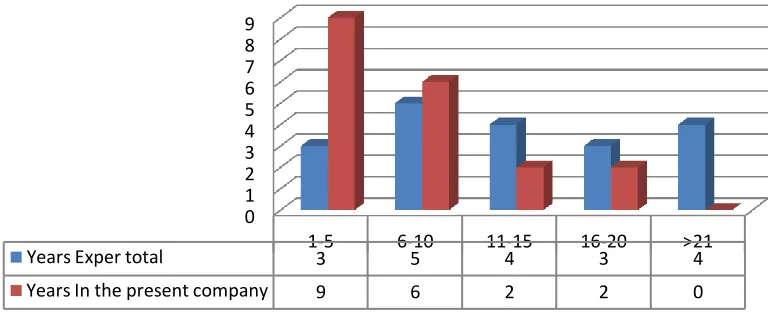
Licensed under Creative Common Page 8 Furthermore, according to the findings, shows that 6 (or 32%) of the respondents, are engaged in the same company for between 6-10 years. The analysis further revealed that of the respondents, representing 11% had worked with the organization for 11 to 15 or/and 16 to 20 years. It is clear from the analysis that majority of the respondents had worked with the organization for between 1 and 5 years and the number of respondents reduces as the years of service increase (Table 1).
Table 1, Number of years that respondents employed in the company
Years in service Frequency Percent (%)
1-5 9 47%
6-10 6 32%
11-15 2 11%
16-20 2 11%
>21 0 0%
Of the 19 companies that have returned the questionnaires, three (3), representing 16% were drawn from Human Resources department or/*and form Internal Audit department whilst 1 of the respondents, representing 5% were from the projects department,which haveemphasizedthe importance of individuals with specific knowledge that is related to organizational behavior and human management (HRM). 2 of the respondents, representing 11% were from the financial department, which haveemphasized the importance of knowledge that is related to the new financial system present in Kosovo, which was introduced after the changes in last 15 years and which differ from the past (centralized) financial system. Expectedly, the majority of the respondents, 13of them that represent 68% were from the operations department, including top managers and decision-making individuals (Table 2).
Table 2, Departments providing the information within the companies
Department No %
Operations department 13 68%
Finance department 2 11%
Project department 1 5%
Audit/HR department 3 16%
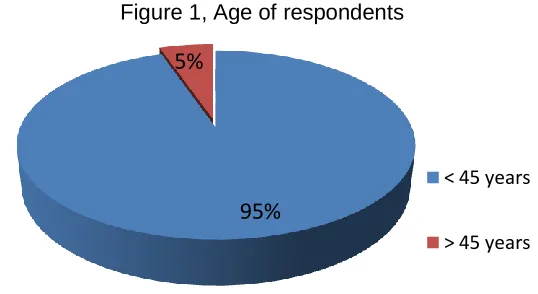
Licensed under Creative Common Page 9 other hand, 9of the respondents (representing 47%) were between 26 and 35 years, and 7 were between the ages of twenty 36 and 45 (representing 37%). This shows that the most successful individuals are between 26 and 45 years. The analysis further revealed that only 1 of the respondents; representing 5% were 45 years and above (Table 3).
Table 3, Age of respondents
Age No %
18-25 2 11%
26-35 9 47%
36-45 7 37%
>45 1 5%
The study shows that the majority of the workforces of the organization are younger than 45 years representing 95% of the respondents. Being more precise, the study have reviled that the majority of them were between 35 and 40 years, as all of respondents have given their exact age (Figure 1).
Figure 1, Age of respondents
The study has reviled that the companies have an interest to engage people that have created their professional knowledge and have achieved professional maturity in the last 15 years, since the war in Kosovo in 1999. The main reason, according to respondents, is that the knowledge that is created before the Kosovo gained its independence, in both terms, politically and economically. The independence meant also transformation of economic system from closed centralized, to open market economy; hence, the new knowledge was needed in the Kosovo’s
market, in order to be more competitive (Figure 2).
95%
5%
< 45 years
Licensed under Creative Common Page 10 Figure 2, Years of experience and years in the present company
Therefore, the ‘new” knowledge or people that have created their experience in open market
share more preferred for private firms in Kosovo, especially for SMEs. As shown in Figure 2, the majority of respondents has between 6 and 15 years of working experience and is the key decision-making individuals within the company’s part of this research.
HRM culture and overall processes in Kosovo organizations
As the studying of the HRM culture and overall processes in Kosovo organizations indicates, that there is a lack of a specialized person, or more precise, there are no positions of human resources manager. Mainly in their managerial structure within Kosovo’s organizations (in
particular in the private sector), the position of the HRM department/manager has not been appraised and the role of the HR manager is carried by the owner or the CEO. Even the fact that the changes have taken place in Kosovo’s economy, the majority or the private
organizations have not changed their number and staff qualification despite the needs that have emerged.
Even if all of organizations/companies discus and are aware of the importance of human resource management within their organizations, in reality, the process of managing human resources is being carried out in very complicated conditions:
the high dynamics of changes within the microenvironment where the organizations operate;
constant changes in the society, as a result of change in the market,
aggravated motivation climate as a result of job cuts, demographic changes, lac of financial power, cuts in social programs, higher prices for basic consumption products;
0 1 2 3 4 5 6 7 8 9
1-5 6-10 11-15 16-20 >21
Years Exper total 3 5 4 3 4
Licensed under Creative Common Page 11
changes in the executive level of the organizations, frequently triggered by political reasons and lack of proper educational system, missing experience in the field of international business, and lack of willingness to implement qualitative changes in HR management;
insufficiency and lack of managerial qualification for identifying and applying the changes in organizations;
lack of flexibility due to different mindset of entrepreneurs;
excessive bureaucracy and administrative methods in enterprise management and government institutions.
Accordingly, human resource management in Kosovo in the transitional period is suffering damages that can bring devastating consequence in the future. Furthermore, the HRM is being carried out in the circumstances of a rough undesirable impact of numerous internal and external factors. In a pursuit for adequate managerial attitudes in the complex circumstances of the transition in Kosovo, a representative assessment of the state of HRM in organizations, have emerged in several important indicators for the development of HRM that needs special treatment by all, private sector and government institutions.
Education System
The biggest challenge that appears also to be the major obstacle to overcome by the countries in the transition phase is the education system. The education system is considered by many as the main factor for absence and the lack of practical aspect of knowledge in the developing countries. As noted by Budhwar and Debrah (2004), the most of the technical education that is delivered to the student in developing countries lacks the practicality aspect and therefore largely it is hypothetical in nature as experience is the fact of knowledge. This is also evident in Kosovo as the results has shown the majority (more than 90%) of respondents have emphases that they were or are not ready to take the responsibility and were not able to commit the duties in their first job due to the lack of practical knowledge. Therefore, they all need practical training for the job they were assigned to. Hence, education is crucial and beside the theoretical part of learning, there must be involved a practical part of know how to implement the theory, in order to develop sustainable and more knowledgably HR (Budhwar & Debrah, 2004, p. 60).
Training and further development for present employees
The training that is usually provided to employees, especially in Kosovo’s government
Licensed under Creative Common Page 12 fact that, off job training were not as effective as the training provided on the job or in other words, learning-by-doing (Noe, 2010). As most of the organizations do not engage straight their workers to the assigned position, employees have to undergo special training prepared and customized according to the needs of the employee or the working environment.
The best way to learn, if not the only way to learn and to develop employees to its fullest, is by getting continuous learning opportunities (Wang, 2006, p. 54). Even if companies are trying to provide to their employees training, it is not enough compared to advancement in technology. Thus, if the employees are not in the process of continuous learning, they will face hitches that may occur as the technology changes, a process which is for shore unstoppable.
Lack of funds dedicated to staff development
Having in mind the crisis and the situation that the organizations are faced now days; the majority of companies are decreasing their budget dedicated to human resources development. As majority of companies in Kosovo are small and have limited income possibilities and are small scale companies, their budget does not permit them to devote a large amount of money in human resource development.
Decision-making in organizations in Kosovo pertaining to HRM
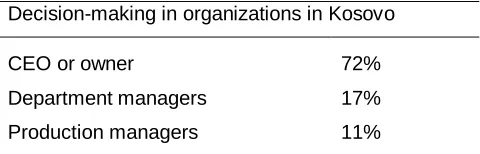
Even if the majority of responsible individuals for making decisions have indicated that human resources department is an important part of every organization, the several has reviled that the main responsibility for decisions on personnel management in the majority (round 72%) of Kosovo’s private companies lies on the CEO or owner, followed by the administrative directors
or department managers with 17%, and production managers with round 11% (Table 4).
Table 4, Decision-making in private organizations in Kosovo Decision-making in organizations in Kosovo
CEO or owner 72%
Department managers 17% Production managers 11%
Licensed under Creative Common Page 13 the transition phase towards market economy. Due to this fact, there are no priorities set and structural reforms are missing, as well as harsh modifications of the legal regulation related to private sector and incentives that may be initiated by the government, explains the unwillingness or hesitation for framing supportive strategies. In these circumstances the expounded strategies frequently become not applicable. An additional reason for the absence of strategic approaches and methods in managerial practice is the sluggish changing managerial attitude of individuals and hesitating to change.
The study also reviled that the majority of respondents’ teams evaluate the importance
of the activities on training and development of the employees. The majority of the surveyed institutions (56%) in the private sector have no proper policies for training and development (Figure 3).
Figure 3, Policies for R&D in private organizations in Kosovo
Even if the education seems to be developed based on EU standards, there are many differentiations that characterize the priorities in the education in Kosovo from those in developed countries, especially in European counties. The respondents have mentioned and listed the T&D areas that are more significant and important for the future development of employees, as are considered based on the needs that have emerged during the transition phase and based on the needs emerged in the new market system (Table 5).
Table 5, The importance of future HR development areas
Sector %
IT technology 27%
Marketing and sales 23%
Quality management 16%
Customer service skills 15%
Business administration 9%
Health and safety of the work environment 10%
56%
44%
Licensed under Creative Common Page 14 The skill for business administration that contained also the strategy formulation is poorly valued, due to the lack of the benefits that organizations have through developing and implementing of proper business strategies (Chadraba & Springer, 2008; Peng & Meyer, 2000). Comparing with other developing countries where the significance of management and administration as a training area is seen as very important and is implemented by many organizations, in Kosovo this is undervalued. In the past five years the biggest of all is the dynamics of computer training, which has increased by more 30% and education through coaching – or learning by-doing-it, respectively round 20%.
Even if the purpose of training is further staff development, at the end the knowledge gained by employees needs to be measured and evaluated (Aswathappa, 2007, p. 68). In practice, the survey has shown that even if the responsible managers are aware of the importance to evaluate training, only the minority of companies make after training evaluation. The majority of respondents have said that their companies don’t even have an evaluation
program. Those that use training evaluation, or at least tend to evaluate it, use methods that may not give realistic results.
For this purpose, owners, CEOs, or the responsible manager gather information through an informal feedback form line or responsible mangers, formal evaluation instantly after training and informal feedback from trainees, and through implementation by-doing. However, the respondents enlighten the fact that even if the training are implemented and organized, solicitation of the structure approach is not observed. There is a big possibility that the selected or organized training may not be the right one, and this is one of the directions, where most effort must be put in order to achieve a greater level of effectiveness of training and employee education.
CONCLUSION
As enlighten by research and information gathered through the survey, there are many reasons that indicate that there is a need in the private sector to design the main guidelines, in which exertion has to be put with much more priority from the decision-making level in Kosovo’s
organizations, in order to elevate up the process of transition to a more contemporary form of human resource management. On one side, respondents put forth as the major challenges in human resources management to be linked with specific staff training and development, development of a new and more contemporary recruitment system and selection. On the other side, the capacities, where Kosovo’s executive approaches and practices fall behind those of
Licensed under Creative Common Page 15 more informed decisions, even when deciding for future employee training. Most instantly needed efforts are:
1. Establishing a more focused and contemporary training and education system for all levels within Kosovo’s organizations;
2. Active involvement of the HRM in the development of institutional strategies from the beginning;
3. An extensive introduction of modern methods and approaches for recruitment and selection of employees;
4. Expansion of the flexible recruitment system in all its organizations;
5. Implementation new contemporary methods and approaches of performance appraisal and assessment of employee satisfaction.
6. Creating new contemporary systems and practices for business communications, externally and internally.
The practical improvement of training systems and modalities will enable the organization to shape a more effective system for HR management and can resolve with more integrated and sustainable human resources structure. Furthermore, decision-makers should apply more dedication to the importance of particular learning and developing systems doe individuals and also for groups. By implementing the best practices in developing its employees, organizations can increase staff retention and satisfaction, as most satisfied employees are the skilled one. As noted above, the more developed and trained the employee will become, the level of motivation will rise, and more knowledge will be applied in their day-to-day work. Therefore, in order to become more competitive and to in the line with new needs emerged by new markets and globalized economy, human resource development is absolutely mandatory.
LIMITATIONS
Licensed under Creative Common Page 16
REFERENCES
Ahmeti, F. (2014). HRM: Developing Organizational Communication Culture in Transitional Economies. European Scientific Journal, vol.10(10), pp. 301-312.
Armstrong, M. (2006). A Handbook of Human Resource Management Practice (10th edition ed.). London, UK: Kogan Page Publishers.
Aswathappa, K. (2007). International HRM. New Delhi: Tata McGraw-Hill Education.
Batra, R. (1999). Marketing Issues in Transitional Economies. Norwell, USA: Springer Science & Business Media.
Briscoe, D., Schuler, R., & Tarique, I. (2012). International Human Resource Management, 4E: Policies and Practices for Multinational Enterprises. New York, USA: Taylor & Francis.
Budhwar, P., & Debrah, Y. (2004). Human Resource Management in Developing Countries. OXON: Routledge.
Chadraba, P., & Springer , R. (2008). Business Strategies for Economies in Transition. Newcastle, UK: Cambridge Scholars Publishing.
Dawson, R. (2012). Developing Knowledge-Based Client Relationships (2nd edition ed.). Burlington: Routledge.
Dibrell, C., Englis, P., & Kedia, B. (2008). Privatization and Economic Liberalisation:. In T. R. Economies, Transition Economies: 21st Century Issues and Challenges (pp. pp. 169-188). New York: Science Nova Publishers, Inc.
Fink, M., & Kraus, S. (2009). The Management of Small and Medium Enterprises. New York: Routledge. Gilley, J., & Eggland, S. (1989). Principle of Human Resource Development. Cambridge: Perseus.
Gravetter, F., & Forzano, L.-A. (2015). Research Methods for the Behavioral Sciences. Stamford: Cengage Learning.
Hansen, A., & Wethal, U. (2014). Emerging Economies and Challenges to Sustainability: Theories, Strategies, Local. New York, USA: Routledge.
Hennink, M., Hutter, I., & Bailey, A. (2010). Qualitative Research Methods. London: SAGE Publications. Holton, E., & Swanson, R. (2011). Foundations of Human Resource Development. ReadHowYouWant.com, Limited.
Joy-Matthews, J., Megginson, D., & Surte, M. (2004). Human Resource Development (3rd edition ed.). London: Kogan Page Publishers.
King, R., Marginson, S., & Naidoo, R. (2011). Handbook on Globalization and Higher Education. Glos, UK: Edward Elgar Publishing.
Kleiman, L. S. (1997). Human Resource Management -A Tool for Competitive Advantage, Ohio: South-Western
Lawler, J., & Hundley, G. (2008). The Global Diffusion of Human Resource Practices: Institutional and Cultural Limits. Emerald Group Publishing.
Lee, M. (2003). HRD in a Complex World. New York: Routledge.
Machado, C. (2013). Effective Human Resources Management in Small and Medium Enterprises: Global Perspectives. USA: IGI Global.
Maddox, C., Richmond, V., & McCroskey, J. (2012). Quantitative Research Methods for Communication. Oxford: Oxford University Press.
Licensed under Creative Common Page 17 McBride, S., Dobuzinskis, L., & Cohen, M. (2012). Global Instability: Uncertainty and new visions in political economy. Dordrecht: Springer Science & Business Media.
McBurney, D., & White, T. (2009). Research Methods. Belmont: Cengage Learning.
McCracken,, M., & Wallace, M. (2000). Towards a redefinition of strategic HRD. Journal of European Industrial Training, Vol. 24(5), pp. 281-90.
McLean, G. (2005). Organization Development: Principles, Processes, Performance. San Francisco: Berrett-Koehler Publishers.
McLean, G., & McLean, L. (2001). If we can’t define HRD in one country, how can we define it in an international context? Human Resource Development International, Vol. 4(3), pp. 313-26.
Noe, R. (2010). Employee Training and Development. McGraw-Hill.
Ortigas, C. (1997). Human Resource Development: The Philippine Experience : Readings for the Practitioner (nd Edtion ed.). Manila: Ateneo University Press.
Panter, A., & Sterba, S. (2011). Handbook of Ethics in Quantitative Methodology. New York: Taylor & Francis.
Peng, M., & Meyer, K. (2000). Business Strategies in Transition Economies. JIBS Book Review, 1-3. Rosser, J., & Rosser, M. (2004). Comparative Economics in a Transforming World Economy. USA: MIT Press.
Simai, M. (2006). Poverty and Inequality in Eastern Europeand the CIS Transition Economies. DESA, 1-21.
Sims, R. (2006). Human Resource Development: Today and Tomorrow. Charlotte: Information Age Publishing Inc.
Singh, S. (2007). Human Resource Development. New Delhi: Atlantic Publishers & Dist.
Swart, J., Mann, C., Brown, S., & Price, A. (2005). Human Resource Development: Strategy and Tactics. Oxford: Routledge.
Taylor, G. (2005). Integrating Quantitative and Qualitative Methods in Research. Maryland: University Press of America.
Trochim, W., Donnelly, J., & Arora, K. (2015). Research Methods: The Essential Knowledge Base. Cengage Learning.
Tseng, C.-C., & McLean, G. (2008). Strategic HRD practices as key factors in organizational learning. Journal of European Industrial Training, Vol. 32(6), pp. 418–432.
Wang, P. (2006). Human Resource Management Plays a New Role in Learning Organizations. The Journal of Human Resource and Adult Learning, pp. 52-56.
Werner, J., & DeSimone, R. (2011). Human Resource Development. Mason: Cengage Learning.
Wilson, J. (2005). Human Resource Development: Learning & Training for Individuals & Organizations (2nd edition ed.). Sterling.