United Kingdom
Vol. II, Issue 4, 2014
Licensed under Creative Common Page 1
http://ijecm.co.uk/
ISSN 2348 0386
ANALYSIS OF BALANCE SHEET AND EQUIVALENT DOCUMENTS IN ASSESSING
FINANCIAL PERFORMANCES OF THE COMPANIES JOINING IN TURKISH PUBLIC
TENDERS
Bozkurt, Orhan
Uludag University, Inegol Faculty of Business , Bursa, Turkey
Apan, Mehmet
Bartın University, Faculty of Economic and Administrative Sciences, Bartın, Turkey
Abstract
This study aims to analyze financial performance analysis method of companies used in
assessing the companies, which join bids according to the existing public procurement system
in Turkey, and to offer new solutions that can be used in financial performance assessment of
companies. According to the existing public procurement law, three main ratios are considered
in analyzing the performances of public procurement supplier companies. These ratios are used
for all companies and periodical differences are not taken into account. While the current study
examines the functionality of these ratios used in financial analysis, it looks into the effect of
periodical differences on company estimation on the other hand. In addition, the study sheds
light on practice in financial performance assessment and ratio. When the assessments of the
companies who join public procurement bids was examined, it was seen that a large number of
the companies listed in Public Disclosure Platform satisfy the three main prerequisite ratios
easily. On the other hand, the analyses carried out for small-scale companies revealed that
these ratios were not fulfilled sufficiently. Another result obtained from the study was that
different analyses should be carried out according to the structure of the sector. Other results
are given in the results section of the article.
Keywords: Balance Sheet, Income Statement, Financial Analysis, Ratio, Firm Qualification
INTRODUCTION
The increase in public procurement today led to an increased importance in bidding for these
procurements and the qualification criteria for the companies to attend to these bids. In this
Licensed under Creative Common Page 2
adequacies. Carrying out public procurements in a more transparent procedure is closely
related to whether the participant can easily access the bidding conditions and relevant
information. In addition, it is necessary that the companies joining the bids should satisfy the
bidding conditions at a sufficient level. The financial performances of the companies joining
public procurements are analyzed via theoretical and applied studies both in Turkey and
abroad. The reason behind that is that the public procurements have a significant share in gross
national product (GNP). According to OECD (2007) data, an important amount of public
spendings and 15-20% of the gross national product of developed countries is reserved for
public procurements. While the ratio of public procurements in GNP in Turkey is 11%, the same
ratio is 6% for Switzerland, 11% for the USA and 21% for the Netherlands. The increasing
importance of public procurements is not only because of the increase that the public sector
attaches to the procurements but also because of the fact that the procurements are considered
to be important elements in providing cost advantage to the public (Bedri et al., 2008).
The increase in privatization in Turkey necessitated the public sector to turn towards private procurements in goods and service procurements. Likewise, the practices of TOKİ
(Housing Development Administration of Turkey) which has a significant share in housing
development in recent years, and the urban transformation projects raised the importance of
public procurements. Despite the increasing importance of public procurements, the issue has
not been discussed adequately in theoretical terms. The main reason behind this is that the access to data sets covering the whole economy is limited (Kamil and Taş, 2011). Although the
issue has not been emphasized much in theoretical terms, public procurements has gained
significant importance in practice in recent years.
According to the Public Procurement Monitoring Report (2011) of Public Procurement
Agency, when the classification of the bids of the Public Procurements carried out in
accordance with the tendering procedures identified within the Law no 1.3.1 4734 is made, in
2011 the 44,61% (44.720.000 TL) of the bids within the scope of the law no 4734 belonged to
product purchase while 33,60% (33.685.000 TL) belonged to service procurement and 21,79%
(21.841.000 TL) belonged to works. According to the same report, 76,96% of the bids (in terms
of the number) sent to the Public Procurement Agency in 2011 and carried out within the scope
of the Law no 4734 were carried out via open tender procedure while 22,42% were carried out
via negotiated tendering and 0,61% were carried out via tendering procedure among certain
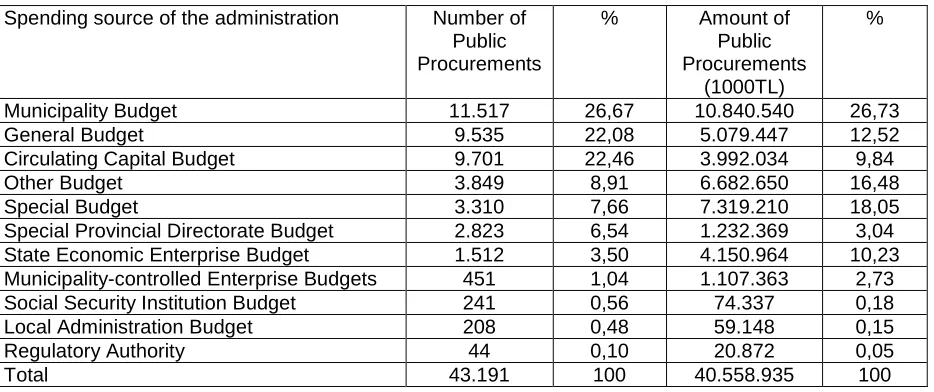
participants. In Table 1 public procurements carried out within the scope of the Law no 4734 are
classified according to the financial resource of the bid. The results show that in the first 6
months of 2012, 26,73% of the bids whose contract information was delivered to the Agency
were supplied from the municipality budget, while 12,52% were supplied from the general
Licensed under Creative Common Page 3
Table 1.Conducting auctions of administration expenditure breakdown by his sources of funding
Spending source of the administration Number of
Public Procurements
% Amount of
Public
Procurements (1000TL)
%
Municipality Budget 11.517 26,67 10.840.540 26,73
General Budget 9.535 22,08 5.079.447 12,52
Circulating Capital Budget 9.701 22,46 3.992.034 9,84
Other Budget 3.849 8,91 6.682.650 16,48
Special Budget 3.310 7,66 7.319.210 18,05
Special Provincial Directorate Budget 2.823 6,54 1.232.369 3,04
State Economic Enterprise Budget 1.512 3,50 4.150.964 10,23
Municipality-controlled Enterprise Budgets 451 1,04 1.107.363 2,73
Social Security Institution Budget 241 0,56 74.337 0,18
Local Administration Budget 208 0,48 59.148 0,15
Regulatory Authority 44 0,10 20.872 0,05
Total 43.191 100 40.558.935 100
According to the most recent data of Public Procurement Agency within the scope of the
information collected from the Public Procurement Monitoring Report for 1 January- 30
September 2012 period, 11 thousand 944 public institutions organized 92 thousand 343 tenders
using Public Procurement Platform and Electronic Public Procurement Platform. In these
tenders, a total number of 131 thousand 188 contracts were signed with 41 thousand 693
contractors for service or goods procurement and works. The amount of public purchasing in the
tenders organized increased by 23% compared to the same period of the previous year and
rose up to 73 billion 850 million 492 thousand liras. While 60,4 billion liras of this amount
belonged to the purchases made within the scope of tendering procedures stated in the law, 4,9
billion liras belonged to the purchases within the scope of exceptions and 8,5 billion liras were
recorded related to the purchases within the scope of tendering procedures stated in the law.
As it is seen above, public procurements form substantial amounts. In this respect,
companies need to have sufficient amount of financial sources when joining public
procurements. According to the Public Procurement Law companies to join the public
procurement tenders are required to have sufficient financial sources and to prove this
qualification based on concrete data. Otherwise, the companies will have difficulty in completing
the business. Therefore, increasing the number of participants effects the price formation (Kamil and Taş, 2011). As Pavel and Kubík says the efficiency of public spendinds depends on
adequate competition. Wihardja (2010), on the other hand, states that competition-based public
procurements will be effective in terms of cost however, that will not mean purchasing a
high-quality service. According to the same study, high participation in public procurements will be
efficient in terms of cost. In another study, it is stated that there are two important criteria in
assessing the participants: one is price and the other is time (Mateus et al., 2010). In a different
Licensed under Creative Common Page 4
choice of company (Watt vd, 2009). While the Law no 4734 instructs to choose the company
that offers the best price in financial and economic terms while assessing the offers in bids, it
also looks for quality among the bidders (Gencer, 2003). Public Procurement Legislation
accepts the rejection of offers excessively lower than the approximate cost. Within this
framework, it is possible to choose suppliers considering not only price factors but also other
factors. At this stage, using subjective statements reflects as stain on procurements and results
with the complaints of those companies offering the lowest price (Gencer, 2003).
In this study, periodical differences in the assessments of companies joining public
procurements will be discussed. Besides, the functionality of the financial analyses ratios which
are grounded on the assessments will be examined and new suggestions will be made. The
existing analysis method will be looked into in order to measure the business adequacies of the
companies that will take public procurements. To do that, first of all, a general literature review
will be made and the legal structure important in public procurements will be discussed. Later,
the ratios and documents used in company assessments in public procurements will be
searched and their features will be revealed. And in the last section, current situation will be
analyzed and a model will be suggested.
GENERAL FRAMEWORK
State Bidding Law no 2886 that entered into force in 1984 in Turkey was replaced with Public
Procurement Law no 4734 as of 22.1.2002. In the following year, many laws that made change
in this law have been passed. These are the law no 4761 in 2002, law no 4964 and 5020 in
2003, law no 5148, 5226 and 5255 in 2004, law no 5312 and 5436 in 2005, law no 5583, 5615,
5625 and 5680 in 2007, law no 5726, 5737, 5763, 5784 and 5812 in 2008, law no 5917 in 2009
and law no 6093 in 2010. And finally in 2011, changes were made with the decree law no 6111 –The general clauses of Public Procurement Law With the Public Procurement Contracts Law
no 4735 which was enacted.
The increase in public procurement today and thus, (e.g. Kaplan, 2012 ; Kuruoğlu at all.,
2003; Blome et all., 2014) effects on supplier performance, (Tai et all.,, 2010) performance of
implementing procurement systems, (Haruvy & Jap, 2013) behavior in procurement auctions,
(Weisheng et all., 2013) procurement innovation for public construction projects, (Prince et all.,
2013) procurement allocation planning (Nelson et all., 2014) Governments procurement, (Tai,
2013) procurement management capabilities have become an attractive and focused issue in
literatüre.
Changes in laws is made both in order to remove the problems that the existing laws
have in practice (Gencer, 2003) and to adapt to the changing and globalizing world. However,
despite some certain innovations, Public Procurement Law did not remove certain existing
Licensed under Creative Common Page 5
Along with the above-mentioned laws, Public Procurement General Comminique dated 2009
and numbered 27327, Comminique on the Applications to Tenders dated 2009 and numbered
27124, Comminique no.1 on the Utilization of Electronic Public Procurement Platform dated
2010 and numbered 27788 were passed. In addition, in order to regulate the service, good and
work tenders, Goods Procurement Tender Application Regulation dated 2009 and numbered
27159, Service Procurement Tender Application Regulation dated 2009 and numbered 27159,
Works Procurement Tender Application Regulation dated 2009 and numbered 27159,
Consultancy Services Procurement Tender Application Regulation dated 2009 and numbered
27159 were enacted.
Also, the Public Procurement Board Decisions and Profession Ethics to be followed by
Public Procurement Agency Staff were published. Application Regulations and its annexes
(goods, service, works, consultancy), Regulation on the Applications to Tenders, Regulations on
Examination and acceptance procedures, Decision of the Council of Ministers that regulates the
basics to be followed in price difference (goods, services, works), General Comminique of
Public Procurement, Comminique on the Applications to Tenders, Public Procurement Agency
Regulatory Decisions regulate tender phases and practices.
As stated in the first article, the purpose of Public Procurement Law no 4734 is to
establish the principles and procedures to be applied in any procurement held by public
authorities and institutions governed by public law or under public control or using public funds.
With this Law, Public Procurement Agency which has public entity status has administrative and
financial autonomy was established in order to fulfil given duties. Public Procurement agency is
responsible for and authorized to implement the basis, procedures and operations stated in the
Law.
As it is stated in the second article of this Law, the law includes public administrations
included in the general budget, administrations with special budget, special provincial
administrations and municipalities and their related revolving funds organizations, associations
(except those operating as professional organizations and their supreme institutions), legal
persons, state economic enterprises, consisting of public corporations and state economic
establishments. On the other hand, the same law states the exceptions to Public Procurement
Law. The outstanding exceptions in the Law can be listed as below:
Procurements to be made from development cooperatives of forest villages and from
villagers; goods, services and works procurement which are decided by the relevant ministry
that these are related to the defence, security or intelligence or that these require to be treated
confidentially, or procurements requiring special security measures during the performance of
Licensed under Creative Common Page 6
works, which are to be realized with foreign financing pursuant to international agreements;
goods or services procurements which necessarily to be made in place for means of transport
during their presence in foreign countries; and procurements of technological goods of some
social security institutions and punishment execution institutions. In addition, it is implemented in
tenders to be made in order to cover the needs relating directly to production of goods and
services or to their principal activities.
Within the scope of Ministerial Decrees concerning the Coal Aid for the Poor Families,
regardless of who the operator is, the goods and services procurements by the General
Directorate of Turkish Coal Enterprises from coal fields belong to itself or its subsidiaries or
affiliates shall not be governed by this Law except prohibition and criminal provisions.
Public procurements is divided into three as goods, services and works. According to Public
Procurement Law article 18, pne of the following procedures shall be applied in procurement of
goods, services and works by contracting authorities;
a) Open procedure,
b) Restricted procedure.
c) Negotiated procedure.
Public Procurement Law defines tender as the price offer with the document and/or information
submitted by a tender to a contracting authority for the procurement carried out pursuant to the
provisions of this Law. Pursuant to the 5th article of the Public Procurement Law, contracting
authorities are liable for ensuring efficient use of resources. In this respect, tenders that will put
economic and financial burden on contraction authorities should not be joined.
ECONOMIC AND FINANCIAL CAPABILITY CRITERIA IN COMPANY ASSESSMENT
Economic and financial qualification criteria asked from the participating companies for the
goods, services and works tenders by public agency and institutions are stated in the relevant
tender regulations in detail. These issues are stated in the tender document by the agencies
and institutions calling for tenders and the participating companies to the tenders are expected
to prepare their tender files accordingly. The latest versions of the regulations relating to the
methods to be implemented in goods, services and works tenders are published online at Public Procurement Agency’s website, www.ihale.gov.tr . Thus, both the agencies and institutions that
call for tenders and the companies which will join these tenders can reach the updated
regulation on this website. The issues to be considered in determining the participant
qualification are given in the 26th article of the Goods Procurement Application Regulation, 28th
article of the Service Procurement Application Regulation and 29th article of the Works
Procurement Application Regulation.
In the common provisions of the above-stated regulations, it is stated that competition
Licensed under Creative Common Page 7
companies should be stated in the prerequisite specifications and that scoring among the
participating companies should be made. In addition, the companies joining to public tenderers
are financially adequate is highly important in terms of the completion of the project that is put in
a tender. The qualifications for the companies that will participate in tender are stated in the
10th article of the Public Procurement Law. This law no 4734 identified economic, financial and
professional qualifications. In line with the aim of this study, we will discuss economic and
financial qualifications.
Economic and Financial Capability Documents
Pursuant to the 10th article of the law no 4734 the sub-criteria of economic and financial criteria
are as given below:
1. Bank statements relating to the financial standing of the tenderer
The document that will be taken from the banks to show the financial standing of the tenderer is
only the reference letter from the bank. The reference letter should be written after the first
announcement or invitation date. The required criteria for tendering can be provided with a letter
from the bank. In business partnership, on the other hand, criteria can be ensured by one of the
partners. In this scope, tendering companies should be up to 10% of the total tender bids for
certification are required to guarantee
2. The Balance Sheet of the Tenderer
In tenders in which the balance sheet of the tenderer which is obligatory to be published in
accordance with the related legislation, or required sections of the balance sheet, if those are not available, equivalent documents, is obligatory; (alttaki cümlenin başlangıcı)
In short, year-end balance sheet belonging to the previous year or certain sections of the
balance sheet, and if those do not exist, equivalent documents are demanded from the
tenderers.
2.1. Current ratio; That the current ratio (current assets/ short term debts) which
enables the required liquidity for ensuring the cash flow at certain periods and
which shows whether the tenderer has the ability to pay debt in short term (one
year) is at least 0,75 (while making calculations, construction costs-if any-
allocated to years will be reduced from current assets while progress income will
Licensed under Creative Common Page 8
2.2. That the equity capital ratio (equity capital/ total active) showing how much of the
active assets is formed of equity capital should be at least 0,15 (while making
calculations, construction costs-if any- allocated to years will be reduced from total
actives),
2.3. The rate of short-term bank debts to equity capital should be smaller than 0,50. In
the balance sheets provided, it is obligatory to show construction costs allocated
to years and progress income, if there is any.
Tenderers which do not satisfy the above-given criteria in the last two years can submit their
documents belonging to the last two years. In this case, whether they fulfill the criteria is
checked according to whether they provide qualification criteria over the monetary amount
averages of the last two years.
In tenders whose tendering or deadline for application is in the first four months of the
year, those tenderer which do not submit their documents belonging to the previous year could
submit the documents belonging to two years before. And those which can not meet the
qualification criteria in these documents can submit documents belonging to three years before
along with the documents belonging to two years before. In this case, whether the qualification
criteria is ensured over the monetary amount averages of the years from which the documents
are submitted is checked.
Besides, information and documents that serve as basis to the tenderers’ analysis are;
a. Proforma invoices taken from suppliers or producers,
b. Price offers,
c. Announced price tariffs of producers for cement and iron goods,
d. Announced price tariffs relating to goods and services provided by public agencies and
institutions or price offers taken from them
e. Announced minimum prices by public agencies and institutions relating to the relevant
good
f. Cost/sales amount investigation reports relating to the produced, purchased or sold
goods,
Licensed under Creative Common Page 9
h. Supplementary analysis in case demanded by the administration etc.
Among the documents listed above, tenderers will provide the documents that are applicable to
them within the scope of their explanations. In cases in which it is not actually possible to
explain with the above-listed documents and information, an explanation pursuant to the
relevant regulation can be made by the tenderer using other documents and information
prepared in the last 12 months (Köse, 2011).
Tender committee assesses the tenders given according to the 37th article. The
commission determines the tenders that excessively low price offers based on the approximate
cost calculated by the administration. Not only the low price offers will be rejected but also the
administration has the right to reject all tenders and close the tender upon the decision of the
tender committee. According to the 63th article of this Law, in tenders, in which it is stated that
price advantage will be ensured in support of domestic tenderers, the most economically
advantageous offer is identified and the tender is concluded. In tenders in which the lowest price
is considered to be the most advantageous offer economically, if it is determined that the same
price is offered by more than one tenderers and that this offered price is the most advantageous
price in economical terms, the most advantageous offer is determined and the tender is
concluded.
3. Statement of the tenderer's overall turnover
Threshold values to be used considering the approximate cost in the implementation of the 13th
and 63rd articles of the Law no 4734 are given below. In tenders in which approximate cost is
equal to and over the threshold value, the tendered is obliged to document its statement of
income (the total of net sales of the relevant year) showing the overall turnover for the last three
years and volume of the work being carried out and completed by the tenderer relating to the
subject matter of the procurement proceedings.
In addition, the tenderer is also required to present progress reports if there is any.
Self-employed tenderers are required to self-employment earning book summary for their business
volume. Prior to the procurement proceedings of goods, services or works, the contracting
authority shall conduct all necessary price research and shall determine an estimated cost
excluding the value added tax and shall be indicated on a priced bill of quantities with its
justifications. Estimated cost shall not be stated in tender or prequalification advertisements and
shall not be explained to the tenderers or to the others who do not have any formal relationship
with the tender processing.
The criteria relating to the documents showing business volume are determined pursuant to the
Licensed under Creative Common Page 10
a) In tenders done via open procedure and in tenders carried out pursuant to the (b) and (c)
clauses of the 21st article of the Law the total turnover should not be less than 25% of the price
offered; and not less than 15% of the actualized part of the ongoing works contracted or of the
monetary amount of the work completed. Tenderer fulfilling one of these criteria and submitting
the relevant document related to the criteria shall be considered adequate.
b) In the pre-qualification phase of the tenders carried out via tendering procedure among
certain tenderers and in the qualification phase of the tenders carried out according to the (a),
(d) and (e) clauses of the 21st article of the Law, monetary amount set by contacting authority
that is between 25% to 35% of the approximate cost is estimated to be minimum qualification
criteria for the total turnover; while 15% to 25% of the approximate cost for the ongoing works
contracted or the work completed. Candidate or tenderer which satisfy one of these criteria and
present the relevant document related to the criteria shall be considered adequate. In special
cases, for the balance sheets of candidates and tenderers for whom a different accounting
period that is different from the calendar year is determined pursuant to the 174th article of Tax
Procedural Law, this accounting period is based upon. According to the regulation the balance
sheet shall be approved by a certified public accountant or independent accountant and
financial advisor or by the tax authority. According to the 61st article of the Public Procurement
Law, considering the subject matter of the work in tender, such factors as company and
maintenance cost, cost efficiency, productivity, quality and technical value can be set as
non-price factors. In tenders in which economically the most advantageous offer can be determined
considering not only price but also non-price factors, the monetary values of non-price elements
or their relative weights and calculation method and documents to be submitted required for
making assessments about these elements shall be clearly stated in the administrative
specifications.
QUALIFICATION CRITERIA IN ASSESSING THE FINANCIAL PERFORMANCE OF A
COMPANY AND PERIODICAL DIFFERENCE ANALYSIS
While assessing the qualification of a company in joining public tenders, the main financial data
given above are taken into account. Current ratio shows the ability of a company to cover its
current expenses. Because all current assets are included in the calculation, it does not exactly
show the ability to pay short-term debts. Instead of using this ratio, the use of acid-test ratio,
which is obtained by deducting stocks from current assets and dividing it by short-term foreign
resources, could be more functional. On the other hand, equity capitals should be at least as
much as tangible assets. This ratio should be used particularly in long-term and extensive works
Licensed under Creative Common Page 11
Besides, long-term debt state should be checked in building-construction work tenders. In
addition to short-term responsibilities, long-term debts also closely effect the ability of a
company to contract a business and to complete it. In this respect, as it is given below, the
amount of tangible assets should be more than long-term debts.
the ratio is expected to be bigger than 1.
This study examines the functionality of the ratios used in financial analysis, on the one hand,
and looks into the effect of periodical differences on company assessment on the other hand. In
addition, the study sheds light on implementations in assessing and measuring the financial
performance of a company. In assessing the companies which join public tenders, it is seen that
most of the companies listed in Public Disclosure Platform provided three main ratios easily. In
analysis carried out for smaller companies, on the other hand, it is seen that this ratio can not be
adequately provided. Another result of the study is that different analysis should be made
considering the sectoral structure. Other results are given in the results section of the study.
IMPLEMENTATION
With the presumptive and accessible real data given below, it is presumed that a “Textiles Goods Tender” is carried out via Open Procedure. In order to make the implementation easily
understandable, it is presumed that three (3) companies joined the tender. And the next
implementation processes are carried out and analyzed using these data.
The companies that join public tenders are obliged to buy “Tender File” within the scope of the
tender advertisement. This file includes documents related to the tender. The companies that
will join the tender will prepare the required documents within the scope of these documents. This “Tender File” shall be returned to the address that the contracting authority advertised no
later than the date and hour specified in the tender documents.
The Relationship between Tender and Letter of Guarantee
According to the 34th article of the Public Procurement Law no 4734 the values accepted as
tender security are as follows: The current Turkish Lira,
Letters of guarantee from banks and special financing institutions,
Domestic Borrowing Bills issued by the Undersecretariat ofTreasury and documents
arranged for replacing these bills,
The bonds required in tenders are divided into two groups: preliminary letter of guarantee and
Licensed under Creative Common Page 12
Law that in procurements, a tender security shall be given in amount determined by the
tenderer, not being less than 3 % of the tender price. Also, in the 43rd article of the law, it is
stated that a performance bond is a bond, calculated as 6 % of the contract value and taken
from the successful tenderer prior to the signing of the contract, in order to ensure that the
commitment is carried out in accordance with the provisions of the contract and tender
documents.
Letters of guarantee are guarantee agreements issued by banks to addressee organizations
in favor of local or oversea natural or legal persons under an obligation to deliver some goods,
perform any work, complete any project or pay any debt, etc., and containing a warranty that the
bank will conditionally or unconditionally pay the amount of the guarantee if the obligation is not
performed. Companies that will join tenders within the scope of public tenders are obliged to
provide Preliminary Letter of Guarantee, Performance Bond and Advance Payment Guarantee.
In letters of guarantee prepared by banks for the companies that will join the tender, “addressee” represents the party to which guarantee is provided and “beneficiary” represents
the bank customer for whom letter of guarantee is provided (Kaya, 2010).
Exchange Differences in Tenders
In case there is an option in tender documents for providing an offer with foreign currency,
tenderers can give price offers in different foreign exchanges. In case a company offering a
tender with foreign exchange gets the tender, the contract will be signed over the foreign
currency. Each pricing within the scope of each progress will be invoiced in TL that
corresponds to the foreign exchange. The exchange differences that might arise for and against
will be recognized in the relevant account records. Especially during inflationionary periods
exchange differences will effect the parties. In this respect, the exchange difference for
companies and sectors using input in foreign exchange will remove the foreign exchange risk of
the subject matter work of the tender. This should be stated in detail in the tender file.
Accounting records of the tender processes
The companies that will join the tender was assumed to be Bisaş Textiles Industry and Trade Inc., Diriteks Diriliş Textiles Industry and Trade Inc. and Lüks Kadife Industry and Trade Inc. within the scope of BİST SME INDUSTRY Index on www.kap.gov.tr All tender assessment and
accounting records are carried out within this framework. In addition, because it was not
possible to access the financial statements regarding the Pecuniary Guarantee and Non-cash
Guarantee Credits of these companies, these values for these three companies were accepted
to be equal.The financial data for 2012 and 2013 for these companies were accessed from
www.kap.gov.tr
Licensed under Creative Common Page 13
Tender file price was announced as 100 TL+ VAT by the revelant institution. Tender file price was paid in cash by the three companies, Bisaş Textiles Industry and Trade Inc., Diriteks Diriliş
Textiles Industry and Trade Inc. and Lüks Kadife Industry and Trade Inc., which would join the
bid.
100 CASH 354
649 TENDER DOCUMENT FOR
SALE 300
BİSAŞ TEXTILE INDUSTRY AND TRADE INC. 100 DİRİTEKS DİRİLİŞ TEXTILE INDUSTRY AND TRADE INC. 100 LÜKS KADİFE INDUSTRY AND TRADE INC. 100
391 VAT PAYABLE 54
Recognition of the preliminary guarantee submitted for the tender
In this section, it is assumed that all three companies provided preliminary guarantee and that
the amounts of these guarantees were 3% of the offered price.
902 OFF-BALANCE SHEET 216.075
PROVISIONAL RECEIVED LETTERS OF GUARANTEE
BİSAŞ TEXTILE INDUSTRY AND TRADE INC. 77.400 DİRİTEKS DİRİLİŞ TEXTILE INDUSTRY AND TRADE INC. 70.950 LÜKS KADİFE INDUSTRY AND TRADE INC. 67.725
903 OFF-BALANCE SHEET
PROVISIONAL RECEIVED LETTERS OF
GUARANTEE 216.075
BİSAŞ TEXTILE INDUSTRY AND TRADE INC. 77.400 DİRİTEKS DİRİLİŞ TEXTILE INDUSTRY AND TRADE INC. 70.950 LÜKS KADİFE INDUSTRY AND TRADE INC. 67.725
Assessment of the offers for the tender by the institution
Offers of the companies and preliminary guarantees
AMOUNT DATE
THE BIDDERS IN THE TENDER BID COST
(TL)
2 DİRİTEKS DİRİLİŞ TEXTILE INDUSTRY
AND TRADE INC. 2.365.000 70.950
3 LÜKS KADİFE INDUSTRY AND TRADE
INC. 2.257.500 67.725 31.03.14
31.03.14
1 BİSAŞ TEXTILE INDUSTRY AND TRADE
INC. 2.580.000 77.400 31.03.14
TEMPORARY GUARANTEE
Financial information of the companies relating to the tender
THE PREVİOUS YEAR'S TURNOVER
the bid cost must be greater than 25% of the previous year's turnover
0,59 0,45 0,24
0,79 0,43 0,36
1,85 0,66 0,21
1,75 0,57 0,21
1,35 0,57 0,16
3,04 0,56 0,00
THE BIDDERS IN THE TENDER
8.449.436 1,80 0,61 0,21
0,56 0,08
2 DİRİTEKS DİRİLİŞ TEXTILE INDUSTRY
AND TRADE INC.
3 LÜKS KADİFE INDUSTRY AND TRADE
INC. 24.376.003 2,19
1 BİSAŞ TEXTILE INDUSTRY AND TRADE
INC. 11.686.841 0,69 0,44 0,30
CURRENT RATİO EQUITY RATIO SHORT-TERM BANK LOANS / EQUITY
0,75 must be greater than
0,15 must be greater than
Licensed under Creative Common Page 14
As a result of the examination of financial statements of the companies in the tender by contracting authority, Bisaş Textiles Industry and Trade Inc.’s current ratio average for the last
two years does not meet 0,75 criteria. However, because only the current ratio for 2013 is taken
into account, which is 0,79 for this company, the current ratio meets the qualification criteria. It is
also found that the financial ratios of the other two companies for 2012-2013 value averages
meet the qualification criteria. Among the companies that gave an offer in the tender Diriteks Diriliş Textiles Industry and Trade Inc. was determined to provide the qualification criteria and to
offer the lowest price and therefore, the company secured the tender. Accounting procedures related to the goods delivery is considered to take place between Diriteks Diriliş Textiles
Industry and Trade Inc. and the relevant institution.
Recognition of the preliminary guarantee letter both for the companies that lost the
tender and secured the tender
Because Bisaş Textiles Industry and Trade Inc., and Lüks Kadife Industry and Trade Inc. lost
the tender their preliminary guarantee letters were returned. And since Diriteks Diriliş Textiles
Industry and Trade Inc. secured the tender, its preliminary guarantee letter was returned
because the company was asked to bring performance bond.
903 OFF-BALANCE SHEET 216.075
PROVISIONAL RECEIVED LETTERS OF GUARANTEE
BİSAŞ TEXTILE INDUSTRY AND TRADE INC. 77.400 DİRİTEKS DİRİLİŞ TEXTILE INDUSTRY AND TRADE INC. 70.950 LÜKS KADİFE INDUSTRY AND TRADE INC. 67.725
902 OFF-BALANCE SHEET
PROVISIONAL RECEIVED LETTERS OF
GUARANTEE 216.075
BİSAŞ TEXTILE INDUSTRY AND TRADE INC. 77.400 DİRİTEKS DİRİLİŞ TEXTILE INDUSTRY AND TRADE INC. 70.950
LÜKS KADİFE INDUSTRY AND TRADE INC. 67.725 Recognition of the
return of tender guarantees
903 OFF-BALANCE SHEET 216.075
PROVISIONAL RECEIVED LETTERS OF GUARANTEE
BİSAŞ TEXTILE INDUSTRY AND TRADE INC. 77.400 DİRİTEKS DİRİLİŞ TEXTILE INDUSTRY AND TRADE INC. 70.950 LÜKS KADİFE INDUSTRY AND TRADE INC. 67.725
902 OFF-BALANCE SHEET
PROVISIONAL RECEIVED LETTERS OF
GUARANTEE 216.075
BİSAŞ TEXTILE INDUSTRY AND TRADE INC. 77.400 DİRİTEKS DİRİLİŞ TEXTILE INDUSTRY AND TRADE INC. 70.950 LÜKS KADİFE INDUSTRY AND TRADE INC. 67.725
Signing of the contract and recognition of performance bond
Diriliş Textiles Industry and Trading Inc., which won the tender, presented 141.900 TL
Licensed under Creative Common Page 15
903 OFF-BALANCE SHEET 141.900
PROVISIONAL RECEIVED LETTERS OF GUARANTEE
DİRİTEKS DİRİLİŞ TEXTILE INDUSTRY AND TRADE INC. 141.900
902 OFF-BALANCE SHEET
PROVISIONAL RECEIVED LETTERS OF
GUARANTEE 141.900
DİRİTEKS DİRİLİŞ TEXTILE INDUSTRY AND TRADE INC. 141.900
Delivery of the goods that are the subject of the tender and recognition of the payment
transaction
The textiles products within the scope of the tender amounting 1.100.000-USD+ VAT were
delivered on 1 February 2014.
154 INVENTORIES 2.420.000
Textile Products 2.420.000
191 DEDUCTIBLE VAT 435.600
100 CASH 2.855.600
Recognition of exchange difference
While 1 USD=2,15 TL was during the tender date, it was 1 USD=2,2 TL on the delivery date.
100 CASH 2.800.600
656 LOSS ON FOREIGN CURRECY
EXCHANGE 55000
100 CASH 2.855.600
Foreign exchange differences to be transferred to the account of the period
690 INCOME OR LOSS FOR THE
PERIOD 55.000
656 LOSS ON FOREIGN CURRECY
EXCHANGE 55.000
Recognition of textiles products as expense
Textiles products were taken out of the stocks and recognized as expense on 31.03.2014
770 GENERAL ADMINISTRATION
EXPENSES
2.420.000
Textile Products 2.420.000
154 INVENTORIES
2.420.000
Recognition of the Return of Performance Bond
Licensed under Creative Common Page 16
902 OFF-BALANCE SHEET 141.900
PROVISIONAL RECEIVED LETTERS OF GUARANTEE
DİRİTEKS DİRİLİŞ TEXTILE INDUSTRY AND TRADE INC. 141.900
903 OFF-BALANCE SHEET
PROVISIONAL RECEIVED LETTERS OF
GUARANTEE 141.900
DİRİTEKS DİRİLİŞ TEXTILE INDUSTRY AND TRADE INC. 141.900
Within this framework, performance bond was returned to the company.
Recognition of period-end procedures of the textile products within the scope of tender
Expense recording on 31.12.2014
771 REFLECTED GENERAL AND ADMINISTRATIVE EXPENSES
ACCOUNT 2.420.000
Textile Products 2.420.000
770 GENERAL ADMINISTRATION
EXPENSES 2.420.000
Textile Products 2.420.000
690 INCOME OR LOSS FOR THE
PERIOD 2.420.000
771 REFLECTED GENERAL AND ADMINISTRATIVE EXPENSES
ACCOUNT 2.420.000
RESULTS AND EVALUATION
The same ratios are used for all periods within the year in analyzing the financial statements of
the companies applying to public tenders. This could be a problem for both the companies and
the public section. In other words, fluctuations in periodical differences could increase or
decrease the level of the ratios. This case could have a negative impact on the companies
applying to the tenders. In addition, the current ratio, equity capital ratio and equities ratio
required from the companies that will enter the tenders are not enough to reflect the
performance of the company. Because among the given ratios, especially current ratio is
inconstant. The ratio could be high because the company borrowed a loan, or could be low due
to periodical payments. Therefore, ratio analysis expanding to periods should be carried out in
order to learn the current state of the company. Qualification criteria mentioned are considered
as main assessment both in big companies and in small ones classified as SMEs. This can be
seen as an instability. In company assessment, on the other hand, there is no differentiation.
There is no such differentiation as production company or trading company. Therefore,
proportional differences should be projected. In the analysis and field study, it is seen that the
companies which secured a tender also attends to one or even five other tenders and won
those tenders as well. It is found that the company examined did not fulfil the tender conditions
Licensed under Creative Common Page 17
assessing the capacity of the company in tenders. Companies which already secured many
other tenders should not be given a new tender. Supporting and encouraging SMEs, which have development potential in sectors strategic for the country’s economy, for participating in tenders
is important. The development levels of these companies should be determined according to the
sector. In addition, supporting companies accredited by or supported by such institutions as
KOSGEB will ensure coordination among institutions and thus, create a synergy for the
development of the country. Thus, these companies with a big potential will be supported to
grow and as a result, it will be a breakthrough in forming added value.
As a result of this study, it is found that most of the companies listed in Public Disclosure
Platform can easily meet the preliminary qualification of tenders. In analysis for small
companies, on the other hand, it is found that these ratios could not be provided at adequate
level. In this respect, it is not only the transaction volume and size of the companies that is
effective in participation in company assessments but also the sector they are active in. To
remove these limitations, ratio implementation at sectoral level and carrying out different
analysis according to the structure is necessary.
REFERENCES
Bedri, K. O. Tas, Rasim Ozcan ve Ilke, Onur (2008), Public Procurement Auctions and Competition in Turkey, October 30,Working Paper No: 08-14.
Blome, C., Hollos, D., & Paulraj, A (2014). Green procurement and green supplier development: antecedents and effects on supplier performance. International Journal Of Production Research, 52(1), 32-49. doi:10.1080/00207543.2013.825748
Gencer, H (2003), "4734 Sayılı Kamu İhale Kanununa Alternatif Olarak En Ekonomik Teklifin Analitik Hiyerarşi Süreci (AHP) İle Seçimi", İnşaat Mühendisleri Odası İstanbul Bülten, Sayı: 64, Sh.:9-14, İstanbul.
Gencer, H (2004), "Kamu İhale Kanununa Göre Yapım İşleri İhalelerinde Aşırı Düşük Tekliflerin Tespitine Yönelik Yaklaşımlar", İnşaat Mühendisleri Odası İstanbul Bülten, Sayı: 72, Sh.:10-14, İstanbul.
Haruvy, E., & Jap, S. D (2013). Differentiated Bidders and Bidding Behavior in Procurement Auctions. Journal Of Marketing Research (JMR), 50(2), 241-258.
Kamil, Bedri. Taş, Onur (2011), Türkiye Kamu Alımı İhalelerinde Rekabetçi Ortamı Etkileyen Faktörler, Tobb Etü, İktisat Bölümü, Ankara Sanayi Odası Yayın Organı Temmuz / Ağustos Sh 40-45.
Kamu İhale kurumunun Kamu Alımları İzleme Raporu, Dönem 01.01.2011-31.12.2011.
Kaplan, S (2012). İdeal bir Kamu İhale Kanunu ve İdeal Bir Kamu İhale Kurumu ve kurulu nasıl olmalıdır? Fonksiyonel bir model çalışması. Maliye Dergisi, (162), 18.
Kaya, Ferudun (2010), Uluslararası Finansman, 2.Baskı, İstanbul;Beta Basım Yayım Dağıtım A.Ş.,
s.134-135.
Köse, Ömer (2011), Mali İhale İşlemlerinde Proforma Fatura İbrazı, Çözüm , 144, Mart – Nisan.
Kuruoğlu, M., & Hiperlink (. (Firm). (2003). İnşaatçılar için yeni ihale düzeninde pratik teklif fiyatı belirleme yöntemi. İstanbul: İstanbul Ticaret Odası.
Licensed under Creative Common Page 18 Nelson, E. S., Bloom, D. E., & Mahoney, R. T (2014). Monitoring What Governments “Give for” and “Spend on” Vaccine Procurement: Vaccine Procurement Assistance and Vaccine Procurement Baseline. Plos ONE, 9(2), 1-8. doi:10.1371/journal.pone.0089593
OECD National Accounts Database and Eurostat, Data for Australia are based on a combination of Government Finance Statistics and National Accounts data provided by the Australian Bureau of Statistics, Public procurement size of Public procurement market version, Data extracted on 28 February - © OECD 2011.
Organisation for Economic Co-Operation and Development (OECD) (2009) Policy Roundtables: Public Procurement.2007. Retrieved August 24, from http://www.oecd.org/dataoecd/25/48/39891049.pdf
Pavel, Jan Ve Kubík, Rudolf (2011), Impact Of E-Auctions On Public Procurement Effectiveness, International Conference On Innovation, Management And Servic,IPEDR Vol.14.IACSIT Press, Singapore.
Prince, M., Geunes, J., & Smith, J (2013). Procurement allocation planning with multiple suppliers under
competition. International Journal Of Production Research, 51(23/24), 6900-6922.
doi:10.1080/00207543.2013.807956
Tai, Y (2013). Competitive advantage impacts of direct procurement management capabilities and Web-based direct procurement system. International Journal Of Logistics: Research & Applications, 16(3), 193-208. doi:10.1080/13675567.2013.811481
Tai, Y., Ho, C., & Wu, W (2010). The performance impact of implementing Web-based e-procurement
systems. International Journal Of Production Research, 48(18), 5397-5414.
doi:10.1080/00207540903117915
Watt, D.J., Kayis, B., Willey, K (2009), Identifying key factors in the evaluation of tenders for projects and services, International Journal of Project Management, 27, 250–260.
Weisheng, L., Liu, A. M., Hongdi, W., & Zhongbing, W (2013). Procurement innovation for public construction projectsA study of agent-construction system and public-private partnership in China. Engineering Construction & Architectural Management (09699988), 20(6), 543-562. doi:10.1108/ECAM-09-2011-0084