4101
Malay Arts Via Multimedia Elements
Salmah Jan Noor Muhammad, Jacqlyn Patricia Anak Jelani
Abstract: This study is about multimedia elements in learning among university students. In recent years, it is not an easy task to implement the use of technology in education as an additional tool to further enhance language learning and competency as well as to equip students with a critical skill. The effect of modern-day innovation has shown that the use of information and communication technology is considered as fast and new each day. The dependence on easy, fast and economical information and communication technology has forced users to use the service. The increasingly modern and challenging way of life requires the public to use a variety of information to improve their skills and knowledge in all areas of engagement. Hence, the objective of this study is to identify and analyze multimedia elements among Malay Arts students at Universiti Putra Malaysia. This study uses the Technology Acceptance Model (TAM) theory by Davis (1989) and the questionnaires were used by using the monkey survey. The findings showed that the role of multimedia elements in the teaching and learning process towards the students has a great impact on the development of their knowledge and the interests of the subjects. In view of this, it is hoped that this study will benefit the community on the advantages and disadvantages of information and communication technology in teaching and learning.
Index Terms: Malay literature, Technology Acceptance Model (TAM), Universiti Putra Malaysia, multimedia elements, e-Learning, teaching and learning, critical skill
—————————— ——————————
1
INTRODUCTION
The effect of modern-day innovation, the use of information and communication technology is now growing and changing every day. Its user consists of children up to senior citizens. The dependence on easy, fast and economical information and communication technology has forced users to use the service. The increasingly modern and challenging way of life requires the public to use a variety of information to improve their skills and knowledge in all their areas of engagement. Based from the above statement, the use of technology in educational institutions is now getting a place in education at higher education institution level, upper and lower secondary to preschool. This is because the development of information and communication technology has led the learning and teaching journey to run smoothly and easily. According to Salmah J. N. Muhammad,Che N. C. Puteh and Normaliza Abd Rahim (2019), technology is a need among modern community that ensures new knowledge and can be shared and utilized together. While Mohamed Amin Embi and Mohd Najib Adun (2010) stated that e-Learning is a challenge for Higher Education Institutions (HEIs) to make changes in the teaching and learning process and this way many teaching materials can be accessed through the website. In fact, Che Su Mustaffa and Nan Zakiah Megat Ibrahim (2014) noted that rapid technological developments have now caused the scholars to break the distribution of society based on the mastery technology. Furthermore, Siti Zulaidah Salsidu, Mohamed Nor Azhari Azman and Mai Shihah Abdullah (2017) supported that multimedia module based teaching is one of the necessary reinforcement tools in the process of teaching and learning.
This is because the use of multimedia in teaching and learning can attract and stimulate students to be more motivated and enthusiastic. In addition, this method will be the added value of the teacher's teaching technique and indirectly the teacher can learn the latest methods in the process of delivering knowledge. Hence, in order to empower the field of literary science the use of technology becomes the medium of dissemination of literary science more quickly and effectively. That is multimedia element that includes the use of video, text, audio, animation and even graphics. The use of multimedia elements in literature has had a great impact on the development of the world literary science. According to Arba'ie Sujud (2016), the multimedia function in literature is to provide added value to literature, as a medium to spread literature, cultural boundaries, language and religion, creativity and lastly the choice of audience expression. At the same time, the knowledge of literature is quickly and easily spread out and accessible by many people rather than using books, presentations and so on. Therefore, the use of multimedia elements in literature is capable of raising the name and image of the literary comparable to science, engineering and the possibility that Malay literature can last even longer. In Malaysia, the use of computers and multimedia is still in its infancy stage in the Malaysian education system due to the limited infrastructure as well as the high cost of access. Malaysia lags far behind businesses in using tools like computers and the Internet in their daily work (Puteh and Shukor, 2010). Puteh and Shukor (2010) also mentioned that
the preparation for globalization, information and
communication revolution in developing country is also another example of challenge faced by the society and government in our education system. High technology gadgets such as mobile phones, computer and multimedia have been the examples of beneficial instruments in education system all over the world. Furthermore, the high technology gadgets have made individuals and companies played a majorrole in creating new ideas such as gamification, new application for the use of technology users (Normaliza Abd Rahim, Awang Azman Awang Pawi & Nik Rafidah Nik Muhamad Affendi, 2018).
2
LITERATURE
REVIEW
The study focuses on the positive impact of technology ————————————————
• Salmah Jan Noor Muhammad, Department of Malay Language, Faculty of Modern Languages and Communication, Universiti Putra Malaysia, MALAYSIA. E-mail: [email protected] • Jacqlyn Patricia Anak Jelani, Department of Malay Language,
4102 utilization in teaching and learning (T & L). Among the study
findings by Robiatul A'dawiah Jamaluddin and Halimah Badioze Zaman (2015) found that all modules that use multimedia in MyScience applications have many benefits and goods for the development of science and teaching skills related to solar systems among current preschoolers. Hence, using multimedia applications in the T & L process in early childhood education is able to connect and improve their knowledge faster rather than using the traditional teaching at their stage. In addition, study by Nor Shahila Mansor, Hazlina Abdul Halim and Normaliza Abd Rahim (2017) focused on the students’ view of language teaching and learning technology revolution. The findings showed that 100% of the respondents tend to choose teaching and learning based on media and using computer and other media as teaching and learning aids. Study by Salina Husin, Muhd Zulkifli Ismail and Norazmi Danuri (2016) focused on the current use of technology in teaching and learning foreign languages. This study discussed the use of blogs as a new method among Spanish students as foreign languages. The findings showed that the results of writing on blogs based on teaching and learning in the classroom were able to enhance the knowledge of Spanish foreign-language students based on Piaget's view (1952). Additionally, the potential of students to write in blogs using Spanish well has proven that using a variety of teaching platforms is able to enhance and increase the knowledge and development of Spanish language among students. Hence, all studies have shown that the adoption of technology among students can increase student learning interest and performance indirectly and provide many benefits to the current rapid education teaching and learning innovation with fast and effective information technology. Additionally, previous studies focused on the role of educators using technology in teaching and learning. Among them are the study by Norhiza Fadila, Zamri Mahamod and Wan Mun Ruzanna (2016) which is to identify the capabilities, attitudes and use of Web 2.0 on the teaching and learning of Malay language and the attitude of teachers. The findings found that there was no difference in using web 2.0 with the attitude of teachers with their teaching experience. In fact the use of web 2.0 provides benefits to the teaching and learning process of teachers as well as adding points to the students' knowledge. Further research by Hashiroh Hussain and Norshuhda Shiratuddin (2016) related to teaching using multimedia elements and interface teaching among educators. The findings showed that half of the respondents agreed on the use of multimedia elements and interface learning is appropriate to use in teaching and learning among students now is in line with the rapid development of technology. This is because, the high trust ability and transformation from traditional storytelling to multimedia form is best suited for interacting with interface teaching. All of these studies showed the role of educators in using technology as teaching and learning can improve students’ performance and interest in all subjects. Next, the challenge of using technology is the study by Ahmad Fauzi Mohd Ayub, Norhasni Zainal Abidin and Andi Suwirta (2014). This study is to identify the impact of internet usage among students. The findings showed that unlimited use, invites various problems to the students. In addition, the problem of loneliness causes students to make decisions to surf the internet to cover the problems that they are facing. Therefore, parents need to take into account the use of internet among their children, especially the aspects that are being surfed.
Study by Naquiah Nahar, Sahrunizam Sangi, Dharsigah Baniear Salvam, Nurhidayu Rosli and Abdul Hafiz Abdullah (2018) is on the negative impact of technology on life and the development of childhood age to teenagers. Studies have found that the use of uncontrollable modern technology has had negative effects on interpersonal skills, as well as the deterioration of academic performance and the physical and muscular students’ development. Hence, the above study discussed the bad impact of technology explosions in students in terms of emotionally, academically and their physical development is alarming. As for multimedia, it is one of the important innovations in the field of educational technology to improve the process and product of teaching and learning. The multimedia approach consisting of the use of many appropriate and carefully selected devices, techniques and media in such a combination as to yield in the most effective realization of the teaching and learning objectives in the best possible way. Reghu (2014) states that the term multimedia approach to teaching and learning may be referred to the use of appropriate and carefully selected varieties of learning experiences which when presented to the learner through selected teaching strategies will reinforce and strengthen one another in such a way that the learner will achieve predetermined objectives in an effective way. Other than that, multimedia is the exciting combination of computer hardware and software that allows you to integrate video, animation, audio, graphics, and test resources to develop effective presentations on an affordable desktop computer (Fenrich, 1997). Multimedia approach is an approach of teaching in which different mediums are incorporated to make the teaching-learning more effective, enthusiastic, inspirational, meaningful and interesting. It is one of the important innovations in the field of education technology to improve the process and product of education or teaching. Multimedia is characterized by the presence of text, pictures, sound, animation and video; some or all of which are organized into some coherent program (Phillips, 1997). In conclusion, there are many studies on the use of information and communication technology that have been addressed in the past study including the importance, the role of educators and the technological challenges. This justification makes this study a guide and reference in continuing research related to multimedia elements in learning. The objective of this study was to identify and analyze multimedia elements in learning among Malay Arts students at Universiti Putra Malaysia.
3
METHODOLOGY
4103 Next, item 7 represents this online course integrating
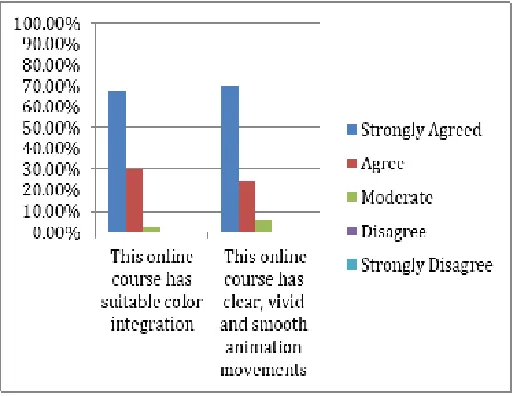
multimedia elements (text, audio, video, animation or graphics) in harmony with the prescribed teaching strategies, item 8 is this online course has a compatible layout, item 9 is this online course has an attracted multimedia element integration. Lastly is item 10 representing the multimedia element provided works well. This study contains 5 Figures in which there are items 1 to 10. In addition, this study contains a guideline that represents the respondents' selections of the multimedia elements which are 5 likert. Likert consists of five which are (1 = Strongly Agree), (2 = Agree), (3 = Moderate), (4 = Disagree) and (5 = Strongly Disagree). The five likerts are given different colors to facilitate analysis and to be identified. Furthermore, the study’s procedure was conducted by using an online questionnaire using monkey survey application. This questionnaire was chosen randomly among Universiti Putra Malaysia, Serdang students. The length of time the student conducted this questionnaire is for 5 minutes for item 1 to 10.
4
THEORY
The theory used in this study is the Technology Acceptance Model (TAM). This model was developed by Davis in writing and was published in 1989. According to Kock (2017) this model has been widely distributed and is one of the most popular models in the development of information technology. Consumers' access to technology is now increasingly popular and well-known in today's research. TAM is a model that focuses on the ultimate goal of information technology. The TAM theory has two main objectives, firstly is to empower the understanding of the technology model acceptance process and to get a picture of the theory for the implementation of information system design. Secondly, is that TAM proves the theory is the basis for the user to accept a trial attempt that enables the planning and execution of the system to evaluate the new system before its implementation. In addition, this theory was the adaptation of the Theory of Reasoned Action by Ajzen and Fishbein (1980) which is a psychological model. TAM describes the behavior of the computer users based on intention, belief, attitude, and user behavior relationship. At the same time, the purpose of this model is to explain the main factors of user behavior towards technology and user acceptance. More detail explains the acceptance of information technology with certain views that may affect the acceptance of information technology by the user. This model has positioned attitudes towards each other's consumer behavior with two variables of interest and ease of use. Both of these variables will explain the aspects of user behavior. The conclusion is that TAM can explain the perceptions of users in determining their use of information technology. Hence, this model illustrates the acceptance of the use of information technology influenced by the usefulness and ease of use. Based on TAM, this study is able to indirectly uncover all beliefs, desires, attitudes, and user behavioral relationship on the assessment of multimedia elements.
5
RESULT
AND
DISCUSSION
Part D: Assessment of Multimedia Elements
Figure 1. Assessment of Multimedia Elements for
Items 1 and 2
4104
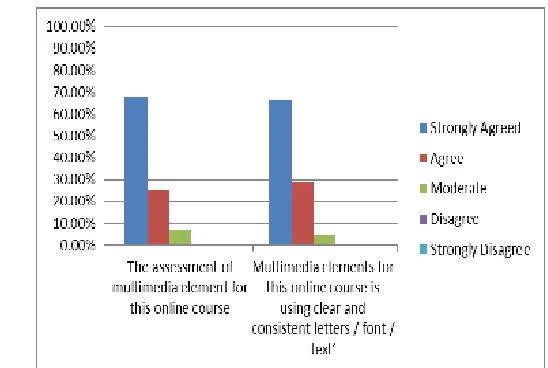
Figure 2. Assessment of Multimedia Elements for
Items 3 and 4
Item 3, ‘the assessment of the multimedia element for this online course has vivid and clear pictures’. This item gets 56 students (67.47%) choose to strongly agreed with multimedia element to have a vivid and clear picture. While 23 people (27.71%) feel to only agreed. Next, there are 4 students (4.82%) choose that this online course has a vivid and clear picture and the quality is just moderate of this course assessment. Based on the above results, multimedia elements that have vivid and clear pictures give a positive impact to the learning process of the students. This is due to the fact that there is a vivid and clear multimedia element to provide information directly and indirectly to the enhancement of the knowledge of the students. Based on TAM it can be seen that the behavior of the user wants a belief in what they see. If the use of the pictures contained in the course is broken and unclear it will result in the delivery of teaching not reached in the classroom to the students well and effectively. In the meantime, the multimedia evaluation of figure 2 item 4 which is ‘this online course has appropriate and clear sound effects’. Item 4 found that 54 students (65.06%) strongly agreed with the statement. While 22 students (26.51%) choose to agree with the multimedia elements in this course has appropriate and clear sound effects and 7 students (8.43%) choose moderate. Based on the findings, it is clear that the use of sound effects that are appropriate and clear give interest and influence to the students. This is because the use of sounds comprising of songs, background noise and sound from a video recording can deliver information more quickly and effectively. In addition, it is able to address the boredom and gloom of the online course. It is then able to cheer students’ emotions to be more passionate and excited about the courses learned. The use of sound effects can attract the use of technology; this is in parallel with the TAM theory that describes the behavior of computer users to occur when there is a user’s intention.
Figure 3. Assessment of Multimedia Elements for
Items 5 and 6
4105
Figure 4. Assessment of Multimedia Elements for
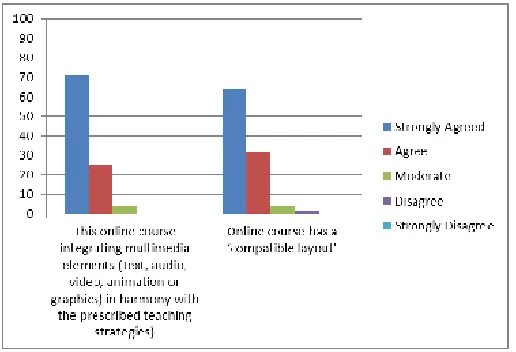
items 7 and 8
Item 7 is ‘this online course integrating multimedia elements (text, audio, video, animation or graphics) in harmony with the prescribed teaching strategies)’. Item 7 found that 59 students (71.08%) chose to strongly agree, while 21 students (25.30%) chose to agree. Next, only 3 students (3.61%) choose moderate. Based on this analysis it can be concluded that four multimedia elements namely text, audio, animation and graphics have a great impact in teaching and learning process for Y and Z generation. This is because their development and growth are parallel to the development of modernity, which is the use of electronics that is modern and sophisticated. In addition, the use of multimedia has many benefits and has a positive impact on students as well as instructors as it saves time, tackles tedious situations with the use of text, audio, video, animation or graphics in teaching and learning presentations and it can empower this online courses to be more popular among students. By using the TAM theory, it can answer the decision that the user is in need of something useful and provides a lot of ease of use indirectly to the person. Next, item 8 is this online course has a ‘compatible layout’. 53 students (63.86%) chose to strongly agree. In addition, 26 students (31.33%) who choose to agree with this course's statement that has a compatible layout. Whereas for the compatible layout there are 3 students (3.61%) choose moderate for the statement. Furthermore, one student (1.20%) chose to disagree with the multimedia element layout, stating that the layout of this multimedia element is not compatible in the classroom. The above results show that there is one student who does not like the layout of multimedia elements and the possibility of the Malay Art online course layout. In addition, half of the students liked the layout of the multimedia elements provided in this course. It is also possible that there are students with different tastes in the creativity provided by the lecturers in preparing the multimedia elements layout and the potential for creativity provided does not reach the students’ level of desire so it can cause the interest and concentration of the students in teaching and learning. The teaching and learning will also be disturbed because the environment does not give positive effects to the students. Based on TAM's theory of attitude, the user can influence the good and bad of the technology to consumers themselves.
Figure 5. Assessment of Multimedia Elements for
items 9 and 10
4106
6
SUMMARY
Based on the above items, there are respondents’ chose to disagree. While for the strongly disagree likert does not have any selection for each item. For items which get disagree feedback is item 8. Item 8 ‘this online course has a compatible layout’. There is one student (1.20%) who opted to disagree with the multimedia element layout, stating that ‘this multimedia element layout is not compatible’ in the Malay Arts online course. In addition, Figure 5 item 10, the multimedia element provided works well found that one student (1.20%) opted to disagree with the statement stating that the multimedia elements provided were working properly. Additionally, for the most moderate likert of items 1 to 10, item 4 gets (8.43%) equivalent to 7 students that mostly preferred that button. Item 4 is about ‘this online course has appropriate and clear sound effects’. While the lowest percentage is item 1 and item 10 with each has the same percentage of one student (2.41%) chose to state that this online course has suitable color integration and the multimedia element provided works well is only moderate. Next is for strongly agree and agree likert. The highest percentage of items for strongly agree likert is item 7, which is ‘this online course integrating multimedia elements (text, audio, video, animation or graphics) in harmony with the prescribed teaching strategies presented’ by 59 students (71.08%) choose to strongly agree with that statement. In line with the study by Mohd Firdaus Che Yaacob and Nasirin Abdillah (2017: 33) which stated that multimedia software such as text, graphics, audio, video and animation elements play an important role in documenting the Malay literature to be more interesting and effective. In addition, the use of information and communication technology plays an important role as a medium for preserving Malay literature in Malaysia in various forms. While for the lowest likert for strongly agree is item 8 which represents ‘this online course has a compatible layout’ of 53 students (63.86%) who choose to agree with the statement. In addition, the agree likert that got the highest percentage is item 8, which is ‘this online course has a compatible layout’ of 26 people with (31.33%) to agree. Meanwhile the lowest percentage item for the agree likert is item 2 for ‘this online course has clear, vivid and smooth animation movements’ of 20 students (24.10%) choosing the statement. This is in line with Hashiroh Hussain and Norshuhada Shiratuddin (2016: 29) opinion, in order to make multimedia persuasion more effective, the use of storytelling tools in the development of multimedia products is crucial in determining the media material produced is in keeping with the purpose of multimedia being used in teaching and learning. Interpretation based on the above analysis can be concluded that the students desperately want the combination of multimedia elements used such as audio, text, animation, video or graphics to play an important role in the Y-generation learning and teaching process because they are technology-sustainable movements. In addition, educational
development now supports e-Learning that includes
information and communication technology based education in higher education institutions in order to be competitive and competitive education globally. This is supported by the study by Nailul Azmi Ismail and Zaleha Ahmad zaleha (2016), Normaliza Abd Rahim, Awang Azman Awang Pawi & Nik Rafidah Nik Muhammad Affendi (2018), Noraien Mansor & Normaliza Abd Rahim (2017a; 2017b; 2017c) stating that the use of technology elements in teaching and learning can provide the continuous two-way information between
computers and students so that they can see the relevance of the lessons learned. Finally, it can be concluded from the above statement that the analysis of multimedia elements in learning towards the students has greatly contributed to the improvement of their knowledge performance. In addition, the use of online courses also has a positive effect in order for students to be more aware of all the multimedia elements provided by the instructors. The use of multimedia elements is also capable of highlighting student creativity and saving their time rather than learning traditionally.
7
CONCLUSION
In conclusion, this study is important for the community. This is because there are important inputs that should be taken primarily by parents such as the advantages and disadvantages of the use of information and communication technology for students if not properly utilized. In addition, this study also benefits the Ministry of Education. Among them are overseeing the use of extreme internet usage among students, empowering a better teaching and learning at the same time as the explosion of information and communication technology modernity and putting educators to passion for exploring new T & L ways for the benefit of the Malaysian education system. Next, this study is important for literature students. This is because through this study we are able to measure the methods of T & L that they desire, interest and enjoy. The importance of this study is lastly for researcher and future study. As such, this study can be used as a reference to support their study and as a measure of improvement in the past study.
8
REFERENCES
[1] Ahmad Fauzi Mohd Ayub, Norhasni Zainal Abidin & Andi Suwirta. (2014). Hubungan Antara penggunaan internet bermasalah umum dan kesunyian dalam kalangan pelajar sekolah menengah. Jurnal Kajian Pendidikan, 4(2), 189-200. [2] Ajzen, I. & Fishbein, M. (1980). Understanding Attitudes and
Predicting Social Behavior. Englewood Cliffs, NJ: Prentice-Hall. [3] Arba’ie Sujud. (2016). Multimedia dalam Sastera. Kuala
Lumpur: Open University Malaysia (OUM).
[4] Che Su Mustaffa & Nan Zakiah Megat Ibrahim. (2014). Persepsi dan penggunaan media sosial dari perspektif ibu bapa: Satu Analisis Kualitatif. Malaysian Journal of Communication, Jilid 30 (Special Issue) 2014, 43-74.
[5] Davis, F. D. (1989). Perceived Usefulness, Perceived
Ease of Use, and User Acceptance of Information Technology. MIS Quarterly, 13(3), 319‐339.
[6] Fenrich, P. (1997). Practical Guidelines for Creating
Instructional Multimedia Applications. Forth Worth: The Dryden Press.
[7] Hashiroh Hussain & Norshuhada Shiratuddin. (2016).
Kebolehpercayaan dan Korelasi Elemen Multimedia dan Antara Muka Tablet dalam Menilai Penceritaan Digital. Asia Pacific Of Educators and Education, 31, 27-45.
[8] Kock, J. (2017). The Technology Acceptance Model (TAM)
An Overview. German National Library.
[9] Mohamed Amin Embi & Mohd Najib Adun. (2010).
e-Pembelajaran di IPTA Malaysia. Bangi : Universiti Kebangsaan Malaysia.
4107 Creative Future and Heritage (TENIAT), 5(2), 21-35.
[11]Nailul Azmi Ismail & Zaleha Ahmad Zaleha. (2016). Keberkesanan Penggunaan Quizlet dan Kahoot IT dalam Memperkasakan Pengajaran Guru dan Memperkaya Pembelajaran Murid. Seminar Bahasa Melayu.
[12]Naquiah Nahar, Sahrunizam Sangi, Dharsigah A/P
Baniear Salvam, Nurhidayu Rosli & Abdul Hafiz Abdullah. (2018). Impak Negatif Teknologi Moden Dalam Kehidupan Dan Perkembangan Kanak-Kanak Hingga Usia Remaja. International Journal of Islamic and Civilizational Studies, 5(1), 87-99.
[13]Normaliza Abd Rahim, Awang Azman Awang Pawi & Nik
Rafidah Nik Muhamad Affendi. (2018). Integration of Values and Culture in Malay Folklore Animation. Pertanika J. Soc. Sci. & Humanities, 26 (1): 359 – 374.
[14]Noraien Mansor & Normaliza Abd Rahim. (2017a).
Implicature in Students’ Perception towards Language Learning. Man In India, 97 (2), 329-336.
[15]Noraien Mansor & Normaliza Abd Rahim. (2017b). Digital
Written Discourse. Man in India, 97 (20), 115-124.
[16]Noraien Mansor & Normaliza Abd Rahim. (2017c).
Instagram in ESL classroom. Man in India, 97 (20), 107-114.
[17]Nor Shahila, Hazlina Abdul Halim & Normaliza Abd Rahim. (2017). Student’s Perspectives Towards Innovation of Technology and Teaching And Learning of Language. Indonesian Journal of EFL and Linguistics, 2 (2), 121-132. [18]Norhiza Fadila, Zamri Mahamod & Wan Muna Ruzanna Wan Mohammad. (2016). Kompetensi, Sikap dan Penggunaan Aplikasi Web 2.0 Sebagai Bahan Bantu Mengajar dalam Kalangan Guru Bahasa Melayu Sekolah Rendah. Jurnal Pendidikan Bahasa Melayu, 6(2), 52-58.
[19]Phillips, R. (1997). The Developers handbook to
Interactive Multimedia: A Practical Guide for Educational Applications. London: Kogan Page.
[20]Piaget. J. (1952). The Origins of Intelligence in Children. New York: International Universities Press.
[21]Puteh, F. & Shukor, S. S. (2010). The Integration of Multimedia Elements in Classroom Teaching Among TESL
Teacher-Trainees. Retrieved 25.11.18 at
https://core.ac.uk/download/pdf/11786151.pdf.
[22]Reghu, R. (2014). Multimedia Approach. Retrieved
25.11.18 at
https://www.slideshare.net/rahulreghu714/multimedia-39347104.
[23]Robiatul A’dawiah Jamalludin & Halimah Badioze Zaman.
(2015). Multimedia Fusion dalam Perisian Penceritaan Interaktif Visual Bagi Aplikasi Sains Peringkat Prasekolah. Jurnal Antarabangsa Creative Futures and Heritage, 3(2), 33-48.
[24]Salina Husin, Muhd Zulkifli Ismail & Norazmi Danuri. (2016). Trend Pembinaan Blog dalam Pembelajaran Bahasa Sepanyol. Jurnal Kemanusiaan, 25 (1), 59-69. [25]Salmah J. N. Muhammad, Che N. C. Puteh & Normaliza
Abd Rahim. (2019). Malay Epic and Historiography Literature Students’ Perception Towards Interactive Online
Interaction. Asian Social Science; 15 (5),23-33,
doi:10.5539/ass.v15n5p23.
[26]Sidek Hj Ab Aziz. (2009).Reka Bentuk Pembangunan,
Aplikasi dan Penilaian Sistem Pengurusan Pembelajaran. Pusat Pembangunan Akademik (CADe). Serdang: Universiti Putra Malaysia.
[27]Siti Zulaidah Salsidu, Mohamed Nor Azhari Azman & Mai
Shihah Abdullah. (2017). Tren Pembelajaran
Menggunakan Multimedia Interaktif dalam Bidang