University of Pennsylvania
ScholarlyCommons
Dissertations (ASC) Annenberg School for Communication1972
Genetic and Sociocultural Influence on Language
Development
Lynn Harding Waterhouse
Follow this and additional works at:http://repository.upenn.edu/dissertations_asc
Part of theCommunication Commons
This paper is posted at ScholarlyCommons.http://repository.upenn.edu/dissertations_asc/16
For more information, please [email protected].
Recommended Citation
Waterhouse, Lynn Harding, "Genetic and Sociocultural Influence on Language Development" (1972).Dissertations (ASC). 16.
Abstract
The present study was designed to assess the relative contribution of genetic and environmental variance to the phenotypic expression of language skills. The classical twin method is used, comparing intrapair similarity for identical and like-sexed fraternal twins on measures of phonological, morphological, syntactic and semantic development. In addition, the mother's interactions with her child are measured, both in terms of the verbal complexity of her speech and her speaking style. Comparisons will he made for all measures: one, between children reared by the . same mother but who differ in genetic relatedness (MZ vz. DZ pairs); and two, between children reared in different families whose mothers vary in I.Q., speaking styles, and speech complexity (between families).
Degree Type
Dissertation
Degree Name
Doctor of Philosophy (PhD)
Department
Communication
First Advisor
Dell Hymes
Subject Categories
Communication
GENETIC Al'iD SOCIOC.ULTURAL INFL.UEHC~E
ON LANGUAG.E DEVBLOPTvlENT
Lynn
Harding Wat.erhouse
A DISSEHTATION
in
COHHlJNICATIONS
Presented to the Faculty of the Graduat.e School
of A.rts and
Sciences ofthe
University
ofPennsylva!1ia
in
Partial Fulfillrr,ent
o.fthe
Requi1:ernents for the
Degree of Doctor of Phi.losophy
1972
:;;;
)
COPYRIGHT
Lynn Harding Waterhouse
and Dr. Dell Hymes for their support throughout the
.duration of this research.
For the day-to-day
con-tributions of stamina, good-will and well-focused
efforts, Mrs. Karen Fischer deserves more than
gratitude.
Further thanks go to Dr. Larry Gross, Dr. Klaus
Krippendorff and Dr. Charles Wright for their
careful readings of this dissertation.
Above all, I would like to thank my husband
whose thoughtful discussions and persistent
en-couragement helped me through every phase of this
study.
LW
INDEX
Adaptation , :3, 4
Behavioral C70rh~_t.ics, 1, 19
Birth Order, 9, 90, 91-93
Blood Typing~ 22, 29, 33, 54, 55
Content Analysis, 19, 20, 25, 26
Ethnography of
Cornmunicd'tior.s j 2, 20, 26 .... 28
Heritability, 20-25, 57, 68, 81, 94-108, 111, 117, l/iO-142
IQ j IS, 28J 33
Irina t-e LanQU<3.QE:
~;lechan.i",r[l, -1, 5, 12, 17, 117, 118, 120, 12"), 110 Inter'coder Agreement, 40-45
lIlean Leng·th of utterance, 67, 94-96
Horpholoqy, 1, J.1-13, J.8, 39, 58, 70-72, 75, 9'.~
OVen)eneralization , 6, 7
Socioeconomic
SY1'1+-"" 1 7
.... \pu~ ... , } ,
Index, 32, 3:?,
11, 12, 18, 39~ T'I'li n Study Method" 10, 13, 19
58, 70, 75, 96
Vocabulary, 10, 11, 34. 35, 69, 75, 79, 86, 96
Zygosity, 10, 14, 16, 22, 48, 55, 100, 130-132
BIBLIOGRAPHY
.
.
~ ".
·
, • • • • • ~ e ~ "Chapter
I. REVIEv"l OF HESJiJ.ARCH • • • • •
,
II. RESEARCH HYPOTHESES " '" '"
.
'" " ~ '".
.
. III" METHODOLOGY • " • • " • • • • t '" • .. ()Introduction Design
Sample l1easures
IV. PROCEDURE • •
.
~...
.
'" '" .. ~• • •
.
.
.
'".
.
.
~.
.
~VI.
Heritahilities
Intercorrelat.ions of Skills Hother's Speech Style
Influer,ce of Mother I s POl:c"ption
DISCU8SION • •
•
• • •· . . .
.
.
~Overview
'Hle Question of Hm:·i tahili ty Nature of J"anguage Skills Influence of the Mother
VII. CONCLUSION • • •
· .
_.
.
'". .
• • •
•
APPENDIX A HYPOTHESES • "
. . .
.
.
". .
'"APPENDIX B BL00D-GROTJPING RESULTS ' . ' • • • • • •
Al'PE}.11)IX C t1EA.NS, STANlJAHD DEVIATIONS A}1D KANGES FOR RAW SCORES ON
•
MEHRZUlIAN KtEASURES • • • • • •
v
• • •
.
.
.
Page
viii
1
13
19
S7
139
JA6
153
157
Tl\HLES
Table
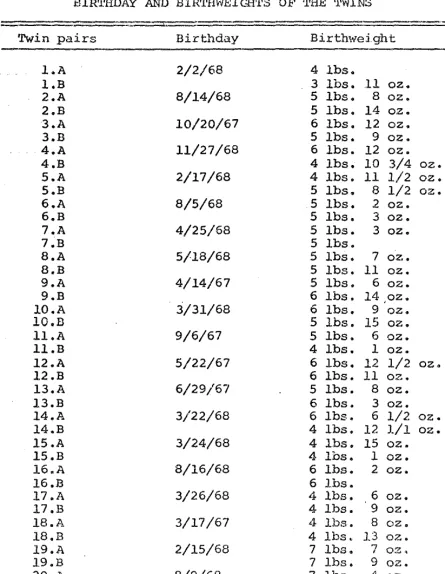
1. Birthday and Birthweights of t.he '];wins • •
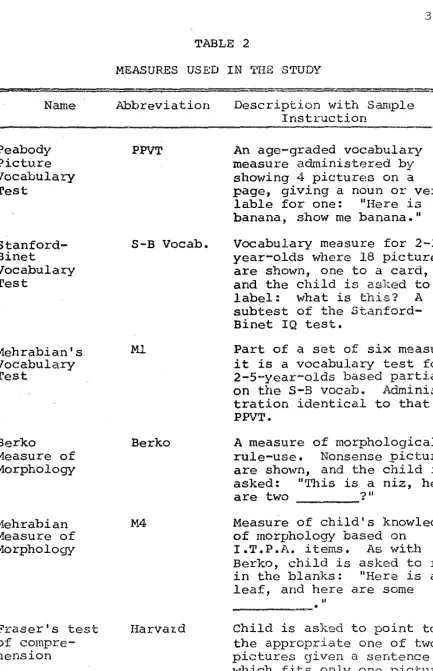
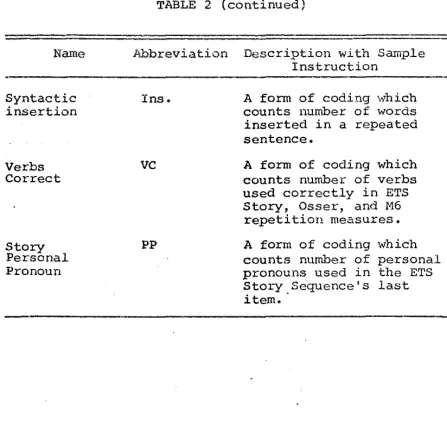
2. . Measures Us(~d in the Study • • • • 3. Actual cmd Perceived Zygosities of the Twins Dlood-Grouped for' the' Present S tt .... dy .. .. " .. '. .. .. . " .. .. .. .. ., ..
4.
•
.. <;I .. ..
Correctly and Incorrectly Perceived
Zygosity ... .. .. .. .. .. .. ..
..
.. .. ..
..
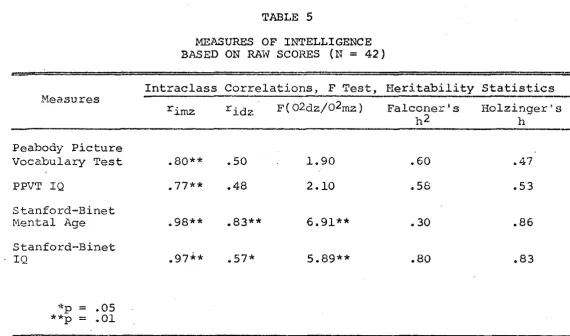
5. Heasurec of Intelligence Based on
6. 7. 8. 9. 10. 11.
12.
13.
14.
15.
16.Ra\'/ Scores
.
.
• • • • • • • • • • •Measures of Vocabulary • • •
·
• • • •Heasures of Morphology • • • • • • • • •
M(~asures of Ability to Deal With Syntax
Measures of Morphophonemic TransfoJ:1nation •
Measures of Syntact.ical Deletions and Insertions
.
•. .
· .
.
• •·
• •Measures of the Con:ect Use of Verbs
Neasures Based on the Child's Behavior
on
E.T.S.
Story Sequence • • • • •Correlations of Language Neasures with Child and Mother's IQ • • • .• • •
Intercon:elations of the Measures for CA-Adjusted Z Scores • • • • • • •
• • • •
• •
.. .. fI ..
.. .. 'II •
" ., ..
..
Positive Correlations of Nother's
Speech with Child Language . , , ..
..
.... ..
Negative Correlations of He-ther's Speech with Child IJanguage • •
vi
..
.. " ....
..
Table
17. Significant Intercorr'elations of FactoJ~S
in Bother's Speech Style •
18. Factors in Mother's Speech Style
19. T Tests on Heans of Factors in HZ HothexB' Speech to First-Borns
•
•
and Later-Borns . . 'O.. ' O . . " ..
.
..
..
..
20. ':l'est~ of Lan9uage Abili i:y:
MZE/HZW D~fferences • . ..
.. ..
....
.
....
21. The HZ and DZ Between-Family Variance
on All Measures • .. • .. .. .. •
22. Geschwind's Hodel with Present Data • •
23. Chomsky Model with Present Data
·
.
•A. Results of Antisera Blood Group
Analysis
.
• • • • • • • • • • • • • • •B. Results of Privately Conducted Blood
Group Analysis • • • • •
,
• • • • • • •C. Means, Standard Deviations, Ranges for
'l'otal Raw Scores: 23 ftleasux'es • • •
·
·
D. Means, Standard Deviations, Ranges for
HZ Raw Scores: 23 Measures •
·
• •·
• •E. Heans, Standard Deviations, Ranges for
DZ Raw Scores: 23 Heasures
· ·
•·
• • •vii
Page
85
89
92
101
104
143
144
154-156
158
159
BIBLIOGRl-WHY
Alland, Alexander (1967). EvQ],l!tion and HllI!:@.!1 Behavior. Garden City, 'New York: 'l'he Natural History Press.
Bar-adon, A., and Leopold, W. F. (eds.). ghild ~an~~gg:
A Bog]s of F.eadi~. Englewood Cliffs, N. J'.: Prentice-Hall, Inc., 1971.
Bellugi, U. The emergence of inflections and negation systems in the speech of two children. Paper read at New Bng. Psychol. Assoc., Chicopee, Mass., 1964. (Revised fonn to appear in T. Bever and W. Weksel, eds., The str'ucture and J2§ychology 9f language. New York: Holt, Rinehart
&
Winston, in press)._________ , The development of interrogative structures in
children's speech, In K. F. Riegel (ed.), T.f!g £'Ievelopment of language functioIls. Ann Arbor: University of Michigan Center for Human Growth and DeVelopment, Report no. 8, 1965.
Berko, J. The child's learning of English morphology. Word, 1958, 14, 150-177.
Bernstein, B. Aspects of language and genesis of the social process. Psychiat., 1961, 1, 313-324.
learning in the
!I..
Qhlld PsychoJ,..Elaborated and restricted codes: Their social origins and some consequences. Gumperz and Hymes
(eds.), The Ethnography of Communication, brn~rican
Anthrop-ologist, 11, No.1, part 2, 1964, 66, 37-53.
_ _ _ _ _ • Elaborated and restricted codes: An outline.
Bever,
Bloom,
Sociological Inquiry, 1966, 36, 254-261.
T.
In of
The cognitive basis for linguistic structures. J. R. Hayes, ed., pogni tioD and ,!:he, development 1 <:lnqu agE).. New York: Wiley, 1970.
L. b~nCJ11£!g,,,,,, Dqyelopment: .foIT:] and Foundation in Ernerginq Grammars. Cambridge: 'i'f-ie H.I.T". Press, 1970.
Braine, H. D. S. The ontogeny of English phrase structure: The first phase, La ngg£)£ill, , 1963, 39, 1-13.
children: The influence of socioeconomic status and task st~Jcture on teaching specificity. Child DeveloIiment, 41, 79-94, 1970,
Brown, R. and Berko, J. Word association and the acquisition of grammar. Child Dev., 1960, 31, 1-14.
Brown, R. and Fraser, C. l~e acquisition of syntax. In C. N. Cofer and B. S. Musgrave (eds.), Verbal behavior
s.n9.
learning: problems and processes.Brown, R. (ed.). Psycholinguistics. New York: Free Press, 1970.
B~ggemann, C. E. Twins: Early Grammatical Development. Folia Phoniatr. (Basel), 22, 1970, 197-215.
Bullowa,
M.,
Jones, L. G.,&
Duckert,A. R.
The acquisition of a word. Language and Speech, 1964,1,
107-111.Bulmer,
11. A.
The Biology of Twinning in.t:lilll. Oxford: Clarendon Press, 1970. .Burt, C. The inheritance of mental ability. Arner. Psychol., 1958, 13, 1-15.
_________ • The genetic determination of differences in intelligence: A study of monozygotic t.wins raised together and apart. ~. J. Psychol., 1966, 57, 137-153.
Cattell, P. The measurement of intelligence in infants and young children. The Psychological Corporation, 1940.
Cazden, C. B., Subcultural Differences in Child Language, Merrill-Palmer Quarterly, 1966, 12, 185-219.
_ _ _ _ _ , A neglected source of differences in language use. ~rnal of Social Issues, 1970, 26, 35-60.
• The Psychology of r,anguage. In Lee Travis - - - ( e d . ) . Handbook of Speech, Hearinq and LanC@age
Disorders. (Rev. ed.), 1969.
Chomsky, N. Aspects of the tJleOIT. of syntax. Cambridge: The M.LT. Press, 1965.
_ _ _ _ _ • The formal nature of language. Appendix to
1i!.
H. Lenneberg, .3iol.2£i£al foundations of Janffi!age. New York: Wiley, 1967._ _ _ _ _ • . Language and mind. Ne\v York: HarcouI·t, Brace
&
World, 1968.Davis, E. A. The DeveloPlnent of Lillmd..istic Skill in. Tvrins, Singletons with Siblinas, Nod Only Children fro.!!!
~ ~ j;Q Ten Years. Ninneapolis: University of Ninnesota Press, 1937.
Dickie, J., and Ragur, J. Considerations for the study of language in young low income minority group
children, Nerrill-Palmer Quartr·'rly, 1972, 18, 25-37.
Dobzhansky, T. Nankind human species.
Press, 1962.
evolving: The evolution of the New Haven, conn-;:-YaI-e-Urliversity
Dunn,
L.
N. Peabody Picture Vocabulary Test: Nanual. JYIinneapolis. Minn.: Arnerican Service, 1965.Expanded Guidance
Entwistle, D. L. Word associations of young children. Baltimore, Md.: Johns Hopkins Press, 1966.
Erlenmeyer-Kimling, L., and Jarvik, L. F. intelligence: a review, Science, 1477-1479.
Genetics and 1963, 142,
Ervin, S. N. Changes with age in the verbal determinants of word association. Amer.~. Psychol., 1961, 74, 361-372.
Ervin-Tripp, S. An analysis of the. int.eraction of language, topic, and listener. In J. J. Gumperz and D. Hymes
(eds.), The ethnography of communication, Amer. Anthropology, 1964, 66(6), Part 2, 86-102.
_ _ _ _ _ • Language development. In M. Hoffman and L. Hoffman (eds.), Reviifrl ot: child develo.Qment research. Vol. 2. Ann Arbor: University of
¥~chigan Press, 1966.
Discourse agreement: How children learn to answer questions. In J. R. Hayes (ed.),
90
..
£Lni tion and development of 1anquagg. New York: Wiley, 1970.Essays 9J1 the occasion of his sIXtiethlDirthda~. The Hague: Houton, 19:;6.
Baby talk in six languages. In J. J. Gumperz and D. Hymes (eds.); The §thnography of communication. Amer. l1nthropo logy , 1964, 66(6), Part 2, 103-114.
Flavel, J. H. The developmental psychology of Jean Piaget. Princeton, N. J.: Van Nostrand, 1963.
Flores d'Arcais, G. B., and Levelt,
W.
J.M.
Advances in Psycho1inguistics. American Elsevier, 1970.Freedle, R. 0., Keeney, T. J., and Smith, N. D. Effects of Mean Depth and Grammaticality on Children's
1mitations of Sentences. JVLVB, 1970, 9, 149-154.
Freedman,
D.
G. The Ethological study of man. In J.H.
Thoday and A. S. Parkes (eds.), Genetic
£l.llii
Environmental Influences on ~ehavior. New York: Plenum Press, 1968, pp. 37-63.
Geschwind, NOrlTtan. Language and the Brain, Scientific
Ameri~, 1972, 226, 76-84.
Gottesman., 1. Heritability of Personality: A Demonstration. Psych. Monog., 1963, 77, N.9.
Greenberg, J. H. Some universals of grru~ar with particular references to the order of meaningful elements.
In J. H. Greenberg (ed.), Universals of lanWlage. Cambridge: The M.I.T. press, 1963.
Gruber, J.
s.
Playing with distinctive features in the babbling of infants.M.X.%.
Res. lab. Electronics, Quart. Prog. ~., 1966, 81, 181-186.Hayne, W. R., and Lipsitt, L. P. Experimental Child R£ychology. New York: Academic Press, 1970.
Hebb, D. O. p_~redity a~g ~nvironment in animal behavior. Brit. J. Animal Behavior, 1:43-47.
Herriot, P.
!ill
Introduction to the Psychology of 1anauage. London: Methuen, 1970:Hess, R. D. and Shipman, V. C. Early experience and the sociali.z2tion of cognitive modes in children. Child k.relopmen1;, 1965, 36, 869-886.
Hill, J. P. (ed.). Minn~sota
Vol. 2, Minneapolis: 1969.
~osia 2.n Child Psychol'2SlY.. University of Hinnesota Press,
Holsti, Ole. Content Ana~§is trom the Social Sciences pnd Humanities. Reading, Mass.: Addison-Wesley, 1969.
Huxley, R., and Ingram, E. Language !,cguisition: Models and ~ethods. New York: Academic Press, 1971.
Hymes, D. H. The ethnography of s:r;>eaking. In T. Gladwin and W. C. Sturtevant (eds.), Anthropology ~nd
human behavior. Washington, D.
c.:
Anthrop. Soc. Wash., 1962, pp. 13-53.Hymes, D. (ed.). Lanffijage in !=ulture ~nd §ociej;y:
b.
reader in linguistics §nd anthropology. New York: Harper
&
Row, 1964.Jensen, A. "HO\~ much can we boost I. Q. and scholastic achievement?" Harv. Ed. Rev., 39:1-123, 1969.
Kirk, S. A., and McCarthy, J. J. The Illinois test of . psycho1inguistic abilities: An approach to
differential diagnosis. l'.merican Journal of Mental Deficiency, 1961, 66, 399-412.
Kaelber, Charles and Thomas F. Pugh. Influence of Intrauterine Relations on the Intelligence of Twins, 1~e New England Journal of Medicine, 1970, 280, N. 19, 1030-1034 • .
Koch, Helen. ~ins and twin r~lations. Chicago, Ill.: University of Chicago Press, 1966.
Krippendorff, Klaus. Coefficients Unpub.
b.
Family of Bivariate Agr~entfor ~ Heliabili tv of.llilll, 1969.
Lehrman, D. S. A Cri t.ique of instinctive behavior. 337-363.
Konrad Lorenz's theory of
~. Rev. BioI., 28;
I,enneberg, E. H. The capacity for lan.;]Uage acquisition. In J. A. Fodor and J. J. Katz (eds.), 1~e
§tnJcj,J.1Y-.,Sl. of 1!3.nguage: Readings in the philosophy of l.anguag£?. Englewood Cliffs, N. J.: Prentice-' Hall, 1964, pp. 579-603.
Smith and G. Miller (eds.), The genesis of languaqe. Cambridge: The M.I.T. Press, 1966.
Biological foundations of languag§.. New York: Wiley, 1967.
Lorenz, Konrad. Evolution and Modification of Behavior. Chicago: U. C. Press, 1965.
Luchsinger, R. Die Vererbung von Sprach-und Stimmstoerungen. Folia illLoniat., 1959, 11, 7-64.
_____ • Die Sprachentwicklung von ein-und-zweieligen
Zwillingen und die Vererbung von Sprachstoerungen in den ersten drei Lebensjahren. Folia £Doniat., 1961, 13, 66-76.
Luria, A. R. The role of. speech in the regula·tion of nOITnal and abnormal behavior. Oxford, Eng.: Pergamon, 1961.
Speech development and th<;l. formation of mental Rrocesses. In Cole and .Mal tzman.
Hanual for Test Administration: Eight block sorting 1:ask. 'Princeton: Educational Testing Ser.vice, 1969.
Manual for Test Administration: Story Seguence Task. Princeton: Educational Testing Service, 1969.
Manual for Test Administration: Toy-Sorting Task. Princeton: Educational Testing Service, 1969.
McAlister, I. R. Interference, immoderation, inconsistency and dependency: differences in the behaviors of mothers toward first and later-born children, Dissertation Abstracts, 1965, 26.
HcCarthy, D. Language development in children. In L. Cannichael (ed.), Nanu.al of child psychology. 2nd ed. New York: Wiley, 1954, pp. 492-630.
McNeill, D. J:he Acquisition of Language. New York: Harper and Row, 1970.
The creation of l.anguage by children. In J. Lyons andR. J. \Vales (eds.). Psycholinguistis. papers:
The proceedings of the 1966 ~dir~urgh conference. Edinburgh! Edinburgh Dniv. Press, 1966.
_ _ _ _ _ • Developmental psycholinguistics. In F. smith and G. A. Miller (eds.), The genesis of language. Cambridge: The M.l.T. Press, 1966.
HcCall, R. B. Intelligence quotient patterns over age; Comparisons among siblings and parent-child pairs. Science, 1970, 170, 644-647.
Mehrabian, A. Measures of vocabulary and gramnatical skills for children up to age six. Developmental Psychology, 1970, 2, 439-446.
Menyuk, P. A preliminary evaluation of granrnatical capacity in children. ~. Verb. Learn., Verb. Behav., 1963, 2, 429-439.
_________ • The Role of Distinctive Features in Children's Acquisition of Phonology, Journal of Speech and
H~arinq Res, XI (1968), 138-146.
________ ~. Sentences Children Use. CMabridge, Mass.: MIT Press, 1969.
_ _ _ _ • Syntactic structures in the language
of
children. Child Development, 1963, 34, 407-422.Mittler, P. Biological and Social Aspects of Language Development in Twins. Dev. Med. Child. Neurol., 1970, 12, 741-757.
_________ • Genetic Aspects of Psycholinguistic Abilities.
Morton,
JI.
Child Psychol. Psychiat., 10, 1969, 165-176.John, ed. Biological and Social Factors Language Acquisition. Urbana, Illinois: of Illinois Press, 1970.
in
University
Moskowitz, A. The Two Year Old Stage in the Acquisition of English Phonology. Languagg, 46 (1970), 426-441.
Nelson, K. Pre-syntactic stratggies fQ.r. Learning to Talk, Paper given at the S.C.C.D. convention, Minneapolis, Minnesota, November, 1970.
Nixon, '01. L.. B. OJl
t.D'&'
s:l.i.s.gno-"-2,_£ of ,twin-12SLll ovu1a.£it'l and th~ ll;i:~ of dennat.2,glvphic da·t;l~ Institute Greqoria Hendel, Roma, 1952, pp. 235-245.Modelling Cues, re\vard, and attentional sets of the production of grammatical and ungrammatical syntactic constructions.
!I • .!2..C.,:!:.,
1968, 6, 131-140.Osborne, R. T., Gregor, J. A., and Miele, F. The
heritability of visualization, perceptual speed and spatial orientation. Perc. Not. Skills, 1967, 24, 659-666.
Osser, H., Wang, M. and F. Zaid. The Young Child's Ability to Imitate and Comprehend Speech: A Comparison of Two Subcultural Groups. Child Dev., 1969, 40, 1063-1075.
Piaget, J. 'l'he Language and Thought of the £hild. London: Routledge and Kegan, 1969.
Pittenger, R. E., Hockett, C. F., and Danehy, J. J. The first ~ luinutes. New York: Nartineau, 1960.
Reiss, Albert J., Jr. Decunations ~ Social Status • . New York: The Free Press, 1961.
Rodd, L. and Martin Braine. Children's Imitations of
Syntactic Constructions as a Heasure of Linguistic Competence. J.y.b.y.g., 10, 1970, 430-443.
Ruke-Dravina, V. The process of acquisition of apical/r/ and uvular /R/ in the speech of children.
Linguistics, 1965, 17, 58-68.
Scarr, S. Genetic factors in activity motivation. Child Development, 1966, 37, 663-673.
_ _ _ _ _ • Environmental bias in twin studies. Eugenics Quarterly, 1968, 15, No.1, 34-40.
• Social introversion-extraversion as a heritable response. Child Develonment, 1969.
Scarr-Salapatek, S. Race, Social Class, and IQ, Scienc~,
1971 (Dec.), 174, 1285-1295.
Schacter, Stanley. The Psychology o~ Affiliation:
},:xperimental Studies o~ the .§ources pf Gregariousness. Stanford, California: Stanford U.P., 1959.
Schaie, K. W. A Cross-sequential Study of Age Changes in Cognitive Behavior. Psyc~. Bull., 1968, 70,
No.6, 671-680.
Seeman, M. Die Bedeutung der Zwillingspathologie fur die Erforschung von Sprachleiden. Arch. Sprach
Stimmheilk, 1937, 1, 88.
Slobin, Dan, ed. h, field .!lillnual for cross £.'dltural study of ~ glcguisi tion of ,gornrnunicat.ive compet.ence. 1967. University of California, Berkeley.
S1obin, D. I. (ed.). The Ontoqenesis of Grammar. New York: Academic Press, 1971.
Staats, A. W. and Staats, C. K. Comple~ human behavior: A systematic extension of 1.§.9rninq principles. New York: Holt, Rinehart
&
Winston, 1963.Sutton, H. E., Vandenberg, S. G. and Clark, P. J. The hereditary abilities study: selection of twins, diagnosis of zygosity, and program of measurements. Arner. ~. ~. Genet., 1962, 14, 52-63.
Terman, L. M. and Merrill, M. A. Stanford-Binet Intel-ligence Scale: Manual for the third revision, form LftM. Boston; Houghton--Mifflin, 1960.
Uzgiris, I. C. and Hunt, J. McV. An Instrument jor Assessing lDj:ant Psychological Development. University of Illinois Press, 1966. Mimeo.
Vandenberg, S. Progress in, human behati.m;: genetics. Baltimore, Md.: Johns Hopkins Press, 1968.
_________ • Contributions of Twin research to psychology. Psych. Bul~., 66, 327-352.
Wachs, T. D., Uzgiris, 1. G., and Hunt, .J. McV. Cognitive Development in Infants of Different Age Levels and from Different Environmental Backgrounds: An Explanatory Investigation, Nerri11··Pa1mer Quarte£lY., 1971, ,309-315.
Warren, R. Verbal TLansfonnations and Auditory
Processing, Psych. ~y11., 1968, 70, 261-267.
Scale. New York: The Psychological Corporation, 1955.
Weir, R. H. Languaollil,' in the
£LiQ.
The Hague: Mouton, 1962.Winitz, H. Articulatorv Acquisition: Some Behavioral Considerations. - First Lincolnland fpnfer-ence
~ialect., 1970, 81-96.
Winitz, iI., and Irwin, O. C. Syllabic and structure of infants' early words.
~. Res., 1958,
1,
250-256.phonetic ~. Speech
Vygotsky, L. S. Thought and language. Cambridge, Mass.: MIT Press, 1962.
CHAP'rER I
REVIEW OF RESEARCH
Recent advances in empirical and theoretical work
in linguistics, psycholinguistics, and sociolinguistics
have shed light on the process of language acquisition.
Most current studies on the acquisition of language have
been concerned with two central problems. The first prob16Q
or major consideration has been the possibility of invariant
developmental sequences. Work has been done in relation
to every level or aspect of linguistics: intonation
(Menyuk, 1963), phonology (\'iinitz, 1958; Gruber, 1966),
morphology (Berko, 1958, and Bellugi, 1964), lexicon
(Bullowa, 1964; Ferguson, 1956, 1954; Casagrande, 1964;
Weir, 1962), semantics (Ervin, 1961; Entwhistle, 1966;
Bever, 1970), and syntax (Braine, 1963, 1965; Brown and
Berko, 1960; Brovm and Fraser, 1963; Ervin-Tripp, 1966,
1970: HcNeill, 1966).
The second problem has been to provide a meaningful
theoretical eh"Planation for the observed evidence of invari .-,:
process in language acquisition. Surprisingly, although a
number of theories have been put forth, including a
mentalistic language acquisition device (McNeill, 1969),
Staats, 1963), invariant percep1:ual strategies (Bever.
1970), as well as the idea of innate language universals
(Chomsky, 1968), there has been little or no exploration
of two extremely relevant theoretical systems of explanation:
the ethnography of communication dnd behavioral genetics.
As emergent sciences which ex~~ine the origins of
pattern, generality, and individual variation in behavior
within population groups--one from a purely cultural vantage
point, and one from a biological stance--both theoretical
systems can provide explanatory causal hypotheses for the
development of language behavior in the child.
The genetic hypothesis as applied to language
dev-elopment would argue that
(1)
the course of development oflanguage behavior is genetically determined (Lenneberg,
1967); (2) that individual variations in heretofore observed
invariant general patterns of language development serve
to express what are really genetic differences between
individuals: and (3) that the heritability of perceived
traits in the behavior of individuals can be determined
comparatively between individuals where the traits appear
proportionately in populations (Dobzhansky, 1967). Roughly
then the causal situation is this: there is developmental
unfolding of the genotype within the environment "to produce
resultant phenotypic language behavior in the child
An a:r"gument for language development coming from the
3
of development of language is socioculturally determined by
communication between the child and its siblings, peers,
parents, and other adults, with variations in effective
influence differing with different cultures; (2) that
indiv-idual differences are largely "a matter of recomb.ination of
separately acquired cultural patterns" (Pittenger, Hockett,
Danahey, 1960); and (3) that the major determinant of a
child's language behavior are the communicative behavior
patterns posited as el~~ents of culture, which are
trans-mitted to the individual by enculturation from other members
of his community. In general, the causal steps of this
hypothesis are that cultural communication patterns,
oper-ating within individuals through speech acts and
communi-cation habits in the course of interaction serve to foster
both language development and corr~unication competence in
the child.
Though separate and distinct, both the above systems
share the underlying assumption central to evolutionary
thinking, that the process of adapting is important for
all human behaviors. According to Alland (1967):
There is only one evolutional.'Y process--adaptation.
~lrthermore, in any adaptive system, cultural and biological factors can each modify behavior and each other. l
For Alland, human cultural adaptation consists of two
factors: (1) a given string of innate responses, and
(2) learning, where likely responses to stimuli become
invariant patterns of behavior.
For Hebb (1953), Lehrman (1953), and Freedman (1968),
Alland's two factors are so mixed in the actual development of an individual as to be indistinguishable. Hebb argues
that the creation of any kind of distinction between innate
and environmentally-determined behavior patterns can be
misleading because the effects of heredity and environment
are not really exerted on different units of a particular
piece of behavior but are effective· in differing ways, on
the course and development of the ~ units of behavior.
Free&nan in turn, argues that there is no logical dividing
line between environmentally controlled and learned
be-haviors, except for behaviors such as reflexes.
Lehrman's argument is almost Piagetian, being
couched in terms of a stage interaction model:
The interaction out of which the organism develops is not one, as is so often said, between heredity and enviror~ent. It is between organism and en-vironment! And the organism is different at each different stage of its development. 2
Clearly, i t would seem that sociocultural factors
and the child's linguistic environment feed into the child's
genetically directed development to yield what appears to
be a largely invariant (across and within cultures) process
2
D. S. Lehrman (1953),
1::.
Critique of Konrad5
of language acquisition. Of course, despite Lehrman's
general statement, little is known about the nature of such
an interaction.
Many behavior geneticists have agreed on the
im-portance of studying both genetic and environmental effects
on behavior (e.g. Vandenberg, 1965, 1967: Dobzhansky, 1967).
However, the problem of possible system-within-system
inter-actions has not been fully considered in terms of language,
for many theorists have yet to realize (at least in
publi-cation) the essential falseness of the nature-nurture
ques-tion (Morton, 1970). In fact, most theories constructed so
far have taken one position or the other, arguing either
that language development is triggered Vj some particular internal mechanism, or
is
fully learnedby
the child.Chomsky (1965) and Lenneberg (1967) and McNeill
(1969) believe that the child possesses specific innate
predispositions for acquisition, including certain
pro-syntactical neUl:'al substrates, pre-set attention for the
frequency of human speech tones, and a mentalistic device,
called LAD (lan~lage acquisition device) which does all the
acquiring for the child. McNeill feels that the child is
born with the concept of sentence somehow pre-imprinted.
Support for this nativist hypothesis comes largely from the
facts as follows: (1) the child acquires language rapidly,
(2) there is a uniformity in such development across children,
unrevealing of the rules that i t is hard to believe that
such material allows the child to aCcllrately infer the
rules, something the child apparently does.
An opposing position is represented by theorists
like Mowrer (1960) and Skinner (1957) who have suggested
an imitation-reinforcement model, where the child imitates
an adult speech model, and the reinforcement a child receives
from an adult for such behavior serves to foster language
development. Though Rheingold, ~ a1. (1959) and Salzinaer
(1962) have been able to show evidence of some shaping by
reinforcement for speech sounds, no work has been done with
the complex patterns which supposedly are built on the base
of such reinforcement. Braine (1965) has offered a theory
of context generalization, which he found some empirical
evidence for, in which he argues that a child learns
primi-tive word classes. According to Brai-ne, the child learns
that a certain word is right in a certain context, and so
through context generalization the child learns to use that
word in that position in all further generated utterances.
Some linguists (Berko, Brown) have proposed a
rule-learning model wherein the child is continually
creating rules for the input which he hears, and from such
rules is able to shape a granmar of his own. Support for
such a model comes largely from work done which shows that
in fact children do overgeneralize rules about the material
over-regularization has been the classic study. Weir's
Lanmlage in the Crib suggests that. rule-practice also
takes place.
'7
Staats and Staats (1963) have offered the only
comprehensive learning theory model. Their theory serves
to describe many types of language associations which they
feel are important to the acquisition situation, and they
employ the concepts of response hierarchies, word
associ-ations and complex envirorunental stimulus control to
explain the process of language acquisition.
The cultural viewpoint is exemplified by the work
of Bernstein. Bernstein (1967) hypothesizes that the form
taken by social relations is often transmitted in terms of
certain syntactic and lexical selections. The individual
is
socialized into using particular structures or codes,and the codes he has available in turn structure many of his
cognitive and even emotional capabilities. Bernstein's work
suggests the possibility that there are two types of
acqui-sition taking place at the same time--the acquiacqui-sition of
grammar and the acquisition of the rules for speaking.
Although sociolinguistics has yet to discover exactly
what the rules of speaking are in different cultures (not
to mention A~erican cultQro), it is nonetheless possible
that those theorized rules may in fact be acquired
differ-ently than l-ules about: the internal make-up of the code
interconnected, and thus developmental acquisition might
be assumed to be so interconnected. If the acquisition
processes can be isolated, i t may be that one is directed
by predominately genetic control, and the other rnight
operate as predicted by learning theory models.
Some specific environmental variables that are
hypothesized to affect rates and patterns of language
acquisition are the complexity and intellectual coherence
of maternal speech. While the mother may verbalize relevant
attributes in a task situation, the complexity of simplicity
of her utterance can contribute to the effectiveness of her
teaching style. Bernstein (1964) concluded that the
elabo-rateness of maternal speech elicits more "elaborated" or
"restricted" code in the child. Haternal intelligence is
also thought to be important for structuring the child's
environment.
Brophy's work (1970), predicated on the work of
Hess and Shipman (1965), claims that mothers may utilize
verbal behavior in teaching situations in one of two ways:
proactively or reactively. In assessing a structured
teaching situation, two aspects of the mother '.s
communi-cation wex'e coded: (1) verbalization of task-specific
discriminations, and (2)' focusing behavior, where the
mother focuses the child's attention on salient attributes
of the task object. Brophy found that middle class mothers
9
the child conceptually and discriminate all salient features,
whereas the lower class mothers operated reactively,
crit-icizing their children for mistakes. ~~ough these behaviors
were not unilateral on either side, a significant difference
between the groups was found. ~ese forms of language
be-havior were correlated not only with socio-economic status,
but also with mother's and child's 1.Q.
Nelson (1971) has correlated mother-to-child speech
in the second year of life with the child's facility in
com-bining words in phrases. Mothers whose children showed
rela-tive ease with combinatorial skills spoke about objects more,
were non-directi.ve with their children, spoke in shorter and
more coherent sentences, and addressed more questions to the
child, as well as using fewer simple stereotyped routi.nes
of language (such as "D'you wanna?," or "How about"). ~e
children of these mothers used phrases that seemed to be
derived from productive rules rather than unanalyzed
frag-ments. ~ese patterns in the child's speech were correlated
with both SES and child's birth order. Nelson concludes
that early environmental input results in children learning
language that differs in form as well as content.
It is obvious that none of these theories fully
consider th.at both learning and genetic control operate to
foster language development. Nonetheless, the relative
contribution of genetic and environmental variance to
The classical twin I:esearch method has been used by
a number of researchers i:l various attempts to disambiguate
genetic and environmental variance. In much resear'ch the
central assumption is that the variance between identical,
or monozygotic twins is environmental variance, while
dizygotic twins reveal. differences based on genetic and
environmental variation.
Lenneberg (1967) has summarized the mostly anecdotal
reports of twin similarity for onset of speech am speech
development history. Over 90% of identical twins
(mono-zygotic, or MZ) are reported to h2lVe the same speech dev-·
e10pment history, while only 40% of fraternal twins
(di-zygotic, or DZ) have the same history. Koch (1966) studied
90 twin pairs of 59 to 86 months of age. Speech form, as
judged by teachers and the investigator, was more sunildr
for MZ groups than for DZ groups. The studies previously
reported on language acquisition in twins do not allow
firm conclusions to be drawn because of methodological
problems in the diagnosis of zygosity, use of retrospective
data and possibilities of observe~ bias (Luchsinger, 1953,
1957, 1961; Seeman, 1937).
In recent research Bruggemann (1970) l1<1s studied
two sets of two-year-old monozygotic twins. The co-twins
differed in the words in their vocabulary, words forming the
pivot cl.ass, as well as manner of negation fonlation. How-'
11
examination of the placentas, and only one serological test
was done.
Mi ttler
(1969', 1970)has done a comparison of
200tvlins and
100singletons which has yielded more definitive
findings on t,oTi.n language abilities.
Comparing
MZto
DZtwins (where zygosity was determined by dermatoglyphic
analysis), and twins to singletons, using the I.T.P.A. and
the Peabody Picture Vocabulary Test, Mittler found that
while
MZand
DZtwins' language development is approximately
six months behind that of singletons, there is no
differ-ence in the Rattern of their development.
Mittler also found
that even as there was no significant difference between
MZ
and
DZintrapair variance on the Peabody and I.T.P.A.,
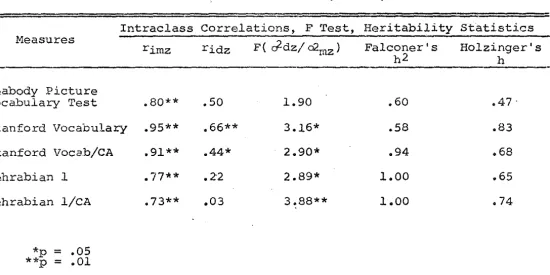
nonetheless the heritability of language skills (as measured
by Holzinger's
H)ranged between
44and
56percent of the
total variance of the subtest of the I.T.P.A. Hittler's
study is not definitive, however, in that the measures used
did not test for phonological, morphophonemic, and syntactic
language skillS, but merely looked at vocabulary and
audi
to~yperception.
Genetic influenc(! is not time-bound or static,
but can be assumed to have a pattern of influence over an
individual's development.
f'urt.hermore, estimating the
genetic and environmental variance for trait at one point
in time does not shed light
onthe substrates
ofpatterns
MZ twins in the Pels Longitudinal Study were more similar
than
DZpairs on
1. Q.measures taken at any point in time.
However, patterns of change in
LQ.scores did not show
significant heritabilities.
Fraternal twins
1rlereno more
dissimilar than identicals in patterns of change in
intel-ligence test scores. However, more recently Wilson
(1972)has found that there are genetic influences on patterns of
development.
Using the Bayley scale as a test of mental
development, Hilson found that identical twins had patterns
of change on the test which were significantly similar,
whereas
DZtwin pairs did not show similar patterns of
change.
This suggests, argues Wilson, a genetic blueprint
for the course of development.
The combination of genetic and environmental
variance to language development is a complex problem with
many unsolved questions.
Factors in ·the child's
environ-mental situation such as mother's language, I.Q., approach
to the child, and the child's own endowment--memory, I.Q.,
personality characteristics and, possibly, a special
language acquisition mechanism all may influence the
course of development.
FU.rthe:nTIore, different aspects
of language (morphology, phonology, syntax) may be subject
to genetic and cultural influences at different time
periods within development.
(For further discussion of
CHAPTER II
RESEARCH HYPOTHESES
The present study ,,;as designed to assess the
rela-tive contribution of genetic and environmental variance to
the phenotypic expression of language skills. The classical
twin method is used, comparing intrapair similarity for
identical and like-sexed fraternal twins on measures of
phonological, morphological, syntactic and semantic
devel-opment. In addition, the mother's interactions with her
child are measured, both in terms of the verbal complexity
of her speech and her speaking style. Comparisons will he
made fot all measures: one, between children reared by the
. same mother but who differ in genetic relatedness (MZ vz.
DZ pairs); and two, between children reared in different
families whose mothers vary in I.Q., speaking styles, and
speech cornpley~ty (between families).
The central hypotheses of the twin research were
as follows:
1) 1bere are measurable aspects of lan~lage which
are heritable, and thus identical twins 'viII show
signif-icantly smaller intrapair variance than fraternals on the
language development measures.
2) Not all aspects of language will show evidence
of genetic contl-ol--ru,les for use of langllage and elements
involved in the child's discourse operations are
hypothe-sized to be under environmental control, and so identical
twins "l'lill not show significantly smaller intrapair variance
than fraternals on measures of such abilities.
3) While mothers may both respond to, as well as
influence the development of differences and similarities
in language skills between co-twins, mothers
Iinfluence on
differential development--when disanmiguated from respor£es
to such development--will be shown to be significant.
A
critical t.est of the two implied hypotheses--one being that
rnothe:r:s adjust their language input to the child
Is general
comprehension level (implying that the child's behavior cues
the mother's behavior), and the other being that the mothers'
differential stimulation to their children causes different
levels of child comprehension and speech production (thus
implying that the mothers' behavior cues the child's
be-havior)--is provided by an
~~-DZtwin study.
Mothers are
frequently incorrect in their aS5umptioI1..'l of their tl>lins
Izygosi ty.
Domothers of identicals who mistakenly think
they have DZ children, provide differential input to the
two co-twins?
If this is the case, do these genetically
identi.cal tHi.ns show language patterns similar to tl:l.l8 }1Z
pairs, or is their language development--du8 to thE" mother's
15
fraternal twins believed by the mother to be identical.
Since over one fifth of twin pairs are misclassified by
their mothers i t can he determined if mothers automatically
adjust their language input to the child's true genotype
or provide variable input regardless of genotype (see
Scarr, 1968).
OJt of these three major hypotheses the following
specific hypotheses were developed:
1. Monozygotic twins will be found to be
signif-icantly more similar in patterns of language development
than same-sex dizygotic twins.
2. General intelligence, as 'measured by the
Stanford-Binet will be significantly correlated "lith
measures of language development.
3. Skill on tests of syntax, semantics, and
morphology will be significantly correlated: tests of
syntax (the Osser measure, Mehrabian's syntax measures),
tests of morphophonemic skill.s (Berko's test, and
Mehrabian's inflection test), and vocabulary measures
(Peabody and Mehrabian) will have higher within test
group correlations than between test group correlations.
4. Level of verbal complexity as measured by MLU
(mean length of utterance) will show more intrapair variance
between DZ than HZ co-twins.
5. HZ twins and DZ twins wil.l show equal similarity
frequency of verbalizations, amount of verbalization,
frequency of verbs, use of personal pronouns.
6. Mother's speech style will be significantly
correlated with her children's
~LU(mean length of
utter-ance) and aspects of her children's language behavior.
7.
MZ twins whose mothers misperceived their twins
will show more variation in verbal complexity and speech
style thar, MZ' s whose mothers correctly perceived their
zygosities.
Possible Outcomes
Considering the above hypotheses, at the outset
of the present study a number of different outcomes were
possible.
If MZ co-twins were found to be generally more
similar than DZ pairs on measures of language acquisition,
this would support a genetic hypothesis to account for
individual differences in language development.
A second possibility was that both MZ and DZ
co-twins would be found to be very similar in language
per-formances but that large differences will be found among
twin pairs.
'l'his outcome could support an environmental
hypothesis based on within-family similarity versus
between-family difference:? in language environment.
In
such case measures of maternal. behavior would probably
correlate with intra- and bl~t7.1een-pair varianc:es ..
17
in language a.cquisition will be found either within or
bet,,'een families.
It could be that la.nguage environments
represented by a small twin pair sample would be sufficient
to support similar patterns of language acquisition in all
of the children, regardless of genotypic differences.
Since
individual variation is the general rule of behavioral
development, this seemed a remote possibility, but such
an outcome could lend support to the idea of a
species-specific, genetically determined language acquisition
pattern with little individual variation (Lenneberg, 1966,
1967).
A fourth possibility, also remote, was that a great
deal of variation in language acquisit,ion will be found
both wi thin and between fan'J.lies for both !,lZ and DZ pairs.
If maternal behavior is also uncorrelated with variability
within- and between-pairs then the standard measures of
language acquisition might be said to be unreliable or,
to have been unreliably used in this study.
A fifth possibility was that MZ pairs would show
greater variability in language skills t.han DZ pairs.
This
finding, if correlated with a sample bias--more
between-falllily variance in MZ t.han DZ groups--would sw:rgest
(1) that l'anguage is und'er environmental control, and
(2) that parents nullify differences in DZs through
envir-onment, but, for psychological.
n~asonsallow MZ variability
Finally, it may be that different skills,
morphology vs. syntax, phonology vs. semantics, will show
different patterns of' heritability and differentiable
patterns of variance.
This would support a Lorenz model
of genetic cum envi.ronmental influence wherein different
aspects of a behavior fall under different control.
This
would also lead to an understanding of language as a much
CHAPTER III
METHODOLOGY
Introduction
Given the problem of establishing the relative
causality of (l}genotypic identity and (2) discourse
features of the cormnunication environment, in determining
th.e course of language acquisition in a sample of children,
there are not only substantive theoretical considerations,
but there are important methodological issues as well.
The experimental design of this study incorporates
a research paradigm from behavior genetics, the t,win study
method (Vandenberg, 1968) with a paradigm from
cormnunica-'tions research, content analysis (Holsti, 1969). In this
study of children's lan~lage skills, an estimate of the
heritability of individual behaviors is done by means of
MZ and DZ co-twin analysis of variance, while the
corre-lation of the mother's language behavior to such skills is
estimated following a content analysis of her speech.
Furthel~ore, examination of aspects of the children's
particular skills on a given measure of language ability
has been effected through a content analysis of the child's
thus combined the two distinct methodological paradigms into
one design in order to obtain information about processes
which affect language development. A third aspect of the
design is the ethnography of communications, the study of
rules in communication and interaction patterns. It
pro-vides a means to discuss the mother-child interaction
situation.
Before the specifics of the research design are
considered, i t is important that the concept of heritability
and the twin study method be fully explained, the technique
of content analysis discussed, and the elements of the
ethnography of communication be presented.
He ri tabi l i ty
Heritability, relative across environments and
across populations, is the concept which represents the
degree to which variance in a particular, quantitatively
measured behavior may be accounted for as coming from a
genetic rather than environmental component. Following
Jensen (1969) the variance of the phenotypes, which is the outcome of genetic and environmental interaction, can be
separated 'into a number 'of variance components, where each
represents a source of vari.ance. The components, taken
21
Vp
=
(V G+V Ai\1)+VD+V i + VE+2CoVHE+Vr
+ VeVH VE
Heredity Environment Error
where:
Vp
=
phenotypic variance in the populationVG
=
genic (or additive) variance. VAM - variance due to assortive mating. V
AM
=
0 under random mating (parunixiaiVD
V.
~V
e
=
dominance deviation variance=
epistatis (interaction among genes at 2 or more loci),=
environmental variance=
covariance of heredity and environment=
true statistical interaction of genetic and environmental factors= error of measurement ,( unreliabili ty) (Jensen, 1969).
Again, following Jensen, the technical formula definition
of heritability is
The 'Twin Stu9x' Method
Vandenberg (1966) states that while the twin study
method cannot be used to trace genetic mechanisms, i t does
permlt the investigation of the comparative contribution
(\ariables, where those behavioral variables are all tested
~or
on the same twin population.
I
/
The research design of twin studies involves the
!belection of a sample of same sex twins, whose zygosity is
lunknown to the experimenter.
MZ(identical twins) share a
\::ommon genetic trait endowment, while
DZ(fraternal) twins
\
h'aye only
50%of their genes in common.
It can thus be
argued that measuI:able differences between two members of
an
HZt,,,in pair must result from environmental factors alone,
while differences in the
DZpair are the result of
environ-mental and genetic differences.
Blood typing (Gottesman,
1961)and fingerprint
analysis (Nixon,
1952)are used to determine zygosity of
the twins.
(This infomlation is not collected by the
experimenter until after all analyses have been
~ade).The heritability measures often used in twin study
?
research are Holzinger's
h~based on within pair variance
of the twins:
' )
and Falconer's
h~;h 2
=
WDz2 _ wMz2Dz2 W
h 2 '" Z (r. J.mz - r
idz
)based on tne difference between
MZand DZ intraclass
correlation.
\
\of total phenotypic
v'~riance
in a population where
herita-.
\,bility is considered
~11the broad sense, that is, all possible
factors are included i'n the formula.
In the present research
heritability is determined in the narrow sense as an
esti-mate of the proportion of genetic variance without any
consideration of dominance, epistasis, or assortative mating.
The technical formulas used here estimate heritability
in the narrow sense using VH x VE, or the statistical
inter-action of environment and heredity, and VE, or true
environ-mental influence, in order to determine Vh • (heritability in
the narrow sense),
For Holzinger's h 2 statistic, and
Falconer's h statistic, the assumptions are (1) that any
differences between DZ co-twins' behaviors are the result
of the interaction of heredity and environment, VH x VE,
and (2) differences between members of an identical or
MZ twin pair are purely environmental or VE, Thus any
statistical test of the differences between the two
variances should yield that portion of the variance which
is accounted for by genetic control.
Holzinger's h 2 tests for the difference between MZ
and DZ within-pair variances as a statistical measure of
heritability, arld Falconer's h tests for the difference
between MZ and DZ intI:aclass correlations as a statistical
measure of heritability.
In tenus of Jensen's fOl::mula,
therefore,
J.tcan be seen that the broad factors are used
no determination is made separately for the factors
indi-cated above t,he line in the formula.
Where h 2
=
1, 'the effect is totally genetic,~nlere h 2
=
0, the effect is wholly environmental. ThisfOITflula holds where the followinJ assumption can be met:
that the amount of within-pair variance contributed by the
environment to the trait under question is the same for the
fraternal (DZ) and identical (MZ) twin pairs studied
(Vandenberg, 1966). The question as to whether this
assumption can be met has been discussed by Scarr (1968).
~le corresponding F test for Holzinger's h 2 is
DZ2
F=W
.:.:---MZ2 W
Also used in the analysis of co-twin data is the
intraclass correlation. This statistic (Wilson, 1968)
=
between family variance-within pair variance between family variance+within pair variancecompares the variance between co-twins with the variance
expressed between twin pairs in the sample. The intraclass
r
i is a one-way analysis of variance, and as such
repre-sents the proportion of the total variance which stems
from differences between twin pairs. If co-twins' scores
on a given measure are the same, the within-pair variance
25
co-twins will lessen the ri: if co-twins' scox'ed behaviors
are no more alike than that, of random individuals, clearly
ri <= .00 (Scarr, 1969).
A heritable behavior might then be expected to
show a high intraclass correlation for MZ pairs, and a low
intraclass correlation for DZ pairs, given the asmlmption
of homogeneity of between-family variance for both MZ and
DZ groups taken together. But if both MZ and DZ pairs sho",
significant intraclass correlations i t may turn out either
that the particular trait is either highly heritable, or
i t may be under considerable environmental control.
The test for the significance of the difference
between r. and r. is done by an F test of the
~ mz ~ dz
within-pair variances.
Content Analysis
Important aspects of the methodology of content
analysis of language behavior are the following: coding
categories, or the scheme of labelling and isolating
ele-ments in the speech as data because of their participation
in such a category; second, the unit.§.
2f.
speech which maybe placed in such a category, whether morphemes, phonemes,
words, phrases, sentences or units of discourse: and thi~d,
12rocedul"es of giving value or weight to coded
units--frequency of presence, or'der of position, power of t,h(~
Involved in the process of developing a content
analytic scheme are the further questions of sampling,
reliability, and validity (Holsti, 1969). A proper de
term-ination of coding categories will help to establish validity
and reliability. If a coding scheme is not only eXhaustive,
and based on a unified principle of classification, but the
categories are also mutually exclusive, independent and
most importantly reflect the purposes of the research, and
further, if the variables involved are clearly defined, not
only in the researcher's mind, but stated, presentable and
interpretable by others, then i t may be that the researcher's
ideas will be represented validly in the final data, and
that coders may be able to do a reliable job (Holsti, 1969).
Ethnography of Communication
A third element in the present design--one which
operates by means of content analytic methodology--is the
ethnography of communication. Susan Ervin-Tripp in her
discussion in the Ethnography of Communication (1964),
states that sociolinguists study verbal behavior in terms
of the relation between Hymes' (1962) categories which are:
(I) the setting
.(2) the participants
{3} the topic
(4) t.he functions of the interaction
(5) the form