DOI 10.1007/s13173-013-0103-0 O R I G I NA L PA P E R
Ambiguity and context-dependent overloading
Rodrigo Ribeiro · Carlos Camarão
Received: 1 October 2012 / Accepted: 7 February 2013 / Published online: 15 March 2013 © The Brazilian Computer Society 2013
Abstract This paper discusses ambiguity in the context of languages that support context-dependent overloading, such as Haskell. A type system for a Haskell-like programming language that supports context-dependent overloading and follow the Hindley-Milner approach of providing context-free type instantiation, allows distinct derivations of the same type for ambiguous expressions. Such expressions are usu-ally rejected by the type inference algorithm, which is thus not complete with respect to the type system. Also, Haskell’s open world approach considers a definition of ambiguity that does not conform to the existence of two or more distinct type system derivations for the same type. The article presents an alternative approach, where the standard definition of ambi-guity is followed. A type system is presented that allows only context-dependent type instantiation, enabling only one type to be derivable for each expression in a given typing context: the type of an expression can be instantiated only if required by the program context where the expression occurs. We define a notion of greatest instance type for each occurrence of an expression, which is used in the definition of a stan-dard dictionary-passing semantics for core Haskell based on type system derivations, for which coherence is trivial. Type soundness is obtained as a result of disallowing all ambigu-ous expressions and all expressions involving unsatisfiability in the use of overloaded names. Following the standard def-inition of ambiguity, satisfiability is tested—i.e., “the world is closed” —if only if overloading is (or should have been) resolved, that is, if and only if there exist unreachable
vari-R. Ribeiro (
B
)·C. CamarãoDepartamento de Ciência da Computação, Instituto de Ciências Exatas, Universidade Federal, de Minas Gerais, Brazil
e-mail: [email protected] C. Camarão
e-mail: [email protected]
ables in the constraints on types of expressions. Nowadays, satisfiability is tested in Haskell, in the presence of multi-parameter type classes, only upon the presence of functional dependencies or an alternative mechanism that specifies con-ditions for closing the world, and that may happen when there exist or not unreachable type variables in constraints. The satisfiability trigger condition is then given automatically, by the existence of unreachable variables in constraints, and does not need to be specified by programmers, using an extra mechanism.
Keywords Ambiguity·Type systems·Semantics
1 Introduction
Parametric polymorphism allows instantiation of quantified variablesα,in quantified types∀α.σ,toalltypes[α:=τ]σ, that is, every type generated fromσ by replacing free occur-rences of type variable αinσ by an arbitrary type τ (the notion of free and bound variables is well known; see, e.g., [1,2]). Type τ is restricted in ML and Haskell to be any simple (unquantified) type, characterizing an important restriction of the so-called ML-style or Let-polymorphism. Constrained polymorphismallows instantiation of quantified type variables to be restricted tosome, instead of being pos-sible to occur for all simple types. The set of types to which a type variable can be instantiated depends on the types of definitions of overloaded names (or symbols) that exist in the relevant context.
expression f e,the decision of which f is called or whiche is applied depends not only on the types of f ande,but also on the context in which f eis used.
In such systems, ambiguity becomes a concern. The exis-tence of ambiguous expressions prevents a coherent seman-tics to be defined by induction on type system derivations, where coherence establishes a single well-defined meaning for each expression. That is, acoherentsemantics is such that, for any well-typed expressione:
“ifandare derivations of typing formulase: σ and e: σ,respectively, andandgive the same type to everyxfree ine,then
[[e:σ]]η= [[e:σ]]η
where the meanings are defined usingand, respec-tively.” [1]
An expressioneof typeσ for which there exist two dis-tinct syntax-driven derivations (and,for which distinct semantic values might be assigned toe) is called ambiguous, in a typing context that gives the same type to everyx free ineasand.The restriction to syntax-driven derivations avoids differences that are neither related to the syntax of terms nor to the used typing information.
A type system for a Haskell-like programming language, that supports context-dependent overloading and follow the Hindley-Milner approach of providing context-free type instantiation, allows distinct derivations of the same type to be derivable for some expressions, which are then ambigu-ous. Such expressions are usually rejected by the type infer-ence algorithm, which becomes then not complete with respect to the type system. This article addresses this issue by considering an alternative approach that disallows context-independent type instantiation for type systems that support context-dependent overloading.
Ambiguity in the presence of context-dependent overload-ing is discussed, in the traditional way of allowoverload-ing context-independent type instantiation and by characterizing ambi-guity as a syntactic property of constrained types, by Jones [3] and by Stuckey and Sulzmann [4]. The unfortunate lack of completeness of type inference algorithms and incoherence of semantics definitions are reported by Vytiniotis et al. [5]. Faxén [7] expresses wishes for a deterministic way to outlaw ambiguity in the type system, at the same time recognizing the need for the description to remain more abstract than that obtained directly from the type inference algorithm. In our view, the abstract view is provided by the fact that the type system is defined in terms of relations, not functions, and the type inference algorithm can be obtained by transforming these relations into functions.
presents an alternative approach to type inference in the presence of Haskell-style constrained type classes. The key
feature of the type system is that it allows only context-dependent instantiation, so an expression, if typeable, has a unique type derivation. We can therefore define the semantics over these type-derivations, thereby ensuring coherence. The declarativeness of the specification of the type system is, in our view, equivalent to it being given by a relation (between typing contexts, expressions and polymorphic constrained types), not as a function. In order to transform it into a type inference algorithm, it suffices to transform all used relations (used in the definition of such a relation) into functions.
The fact that the type system allows only context-dependent type instantiation eliminates the problem of the lack of principal type caused by user-specified type signa-tures, reported by Faxén [6, Sect.3].
The article also presents an alternative approach for dealing with ambiguity in the context of Haskell’s open world approach. In Haskell, an expression is considered as ambiguous without conformance to the existence of two or more distinct derivations of the same type for this expres-sion. Ambiguity is considered in Haskell as a syntactic condition on type expressions, conflicting with the stan-dard semantically-related definition given above. This occurs because Haskell uses an open world approach to over-loading, according to which new definitions of overloaded names might be inserted without altering the typability of expressions. This paper presents an alternative approach where there is no conflict with the standard semantic def-inition of ambiguity, built upon the distinction between ambiguity and resolved overloading. In this approach, the possibility of inserting new definitions (i.e., openness of the world) is restricted to cases when overloading is not resolved. When overloading is resolved, existing definitions of overloaded names are then considered, in order to check ambiguity.
With the purpose of clarifying these issues, namely that ambiguity is distinct from resolved overloading, and that ambiguity should be considered if and only if (or when and only when) overloading is resolved, we present and dis-cuss examples in the next section which consider ambigu-ity in the presence of multi-parameter type classes, where ambiguity becomes more relevant. In Sect. 3 we define a mini-language called core Haskell that supports context-dependent overloading and multi-parameter type classes, and define a type system that avoids ambiguous expressions to be well-typed. In Sect.4 we define a semantics by induc-tion on core Haskell’s type system derivainduc-tions. Secinduc-tion 5 concludes.
2 Ambiguity and overloading resolution
f::I nt → I nt f::I nt → Float f::Float → Float o::I nt
o::Float
In Haskell extended with multi-parameter type classes, referred to as Haskell+MPTC in the sequel, this can be achieved by considering that there exist declarations of type classesF a bandO awhere f andohave been annotated in these classes with typesa → banda,respectively, and there exist also instance definitions F Int Int, F Int Float, F Float Float, O IntandO Float.
In Haskell+MPTC, expression f o is not ambiguous, because overloadings of f andohave not been resolved.
The main purpose of this example is to show that we can have, if context-independent type instantiation is allowed, two derivations of the same type (Float) with distinct seman-tics, for an expression that is not ambiguous: one deriva-tion for f of type I nt → Float,and another for f of type Float→ Float.
This example also illustrates that this occurs despite the fact that f ohas type(F a b,O a)⇒b,where type vari-ablea occurs in the constraints but not in the simple type (b), considering that f is a member of type class F with two parametersa,b, having (implicitly quantifiable) type F a b⇒a → b,andois a member of type classOwith (implicitly quantifiable) typeO a⇒a.
In Haskell, a syntactic condition on type expressions that characterizes overloading whose resolution cannot be further deferred (i.e., must have occurred), which we call overload-ing resolution conditioncharacterizes also “type ambiguity”. It is a syntactic condition, that conflicts with the standard def-inition of ambiguity, based on the existence of distinct type system derivations of the same type for an expression.
The overloading resolution condition used in Haskell (Haskell 98 or Haskell 2010), which supports only single parameter type classes, has been changed in Haskell imple-mentations that support multi-parameter type classes. In the case of single parameter type classes, the overloading res-olution condition for constrained type P ⇒ τ is simply tv(P)⊆ tv(τ)(i.e., there is a type variable that occurs in Pbut not inτ). In the case of multi-parameter type classes, the condition considers so-called reachable type variables. A type variable occurring inP is reachable, from a set of type variablestv(τ)in a constrained type P ⇒τ,if it occurs in τ or if it occurs in a constraint in P where another able type variable occurs (if a type variable is not reach-able, it is, of course, unreachable). In the example above, type variablea in(F a b,O a) ⇒ b occurs in the set of constraints ({F a b,O a}) but not in the simple type (b). This does not characterize that overloading must have been
resolved, because type variableais reachable, since it occurs in constraint F a b,where another reachable type variable (b) occurs. This idea, used nowadays in Haskell implemen-tations that support multi-parameter type classes, appeared firstly in [8], as far as we know.
If used in a program context that requires f oto be of type I nt—in an expression such as, for example, f o+ (1::Int) —overloadings of f andoin f oare resolved, with f ando having typesI nt,→I nt andI nt,respectively.
If used in a program context that requires f oto be of type Float,overloadings of f andoin f ocannot be resolved, and then, in the context of this example, we have ambiguity. If used in a program context that requires f o to be of a typeτ distinct from I ntandFloat,overloadings of f and oin f ocannot be resolved either, but we have then, in the context of this example, unsatisfiability, since we cannot have a derivation of such typeτ forein this context.
Example 2 Lete0be the expressionshow.read(where”.”
denotes function composition, soe0can be written also as
(λx->show(readx)). In Haskell, this expression is con-sidered as ambiguous, irrespective of the context in which it occurs (see, e.g., [3,5]).
When used in a context with two or more instance def-initions, of classes Show and Read, that give functions showandr ead types, say,show : I nt → Str i ng,show: Bool → Str i ng,r ead : Str i ng → I nt and r ead : Str i ng → Bool, expressione0 is ambiguous: there exist
two distinct derivations of type Str i ng → Str i ng for e0 (one using read and show with types read:String→
Intand show:Int→String, and the other using read and show with typesread:String→ Boolandshow: Bool→ String, respectively), and each one would give it distinct meanings.
However, if e0 is used in a context with a single
instance for bothshowandread, sayshow:Int→Stringand read:String→Int, then there is no ambiguity, since there exists only one derivation fore0of typeString→String. If
there are no definitions ofshowor no definitions ofreadin the typing context, again there is an error, but of unsatisfiability, not ambiguity.
Example 3 Consider expression[] == [], where (==) is overloaded and[]denotes an empty list.
The expression is ambiguous (according to the stan-dard definition), if and only if there exist two or more distinct type system derivations—each given (==) dis-tinct types, say [T1] → [T1] → Bool and[T2] →
[T2]→ Bool—that may thus assign distinct meanings to
([] == []) : : Boolin the relevant context. We could have instances of(==)for types[T1]and[T2]for which
In Haskell this is not possible without overlapping instances or without hiding the Haskell prelude definition of(==)for lists.
Example 4 Lete1be the expressionfst(True, o), whereois
overloaded (or is an expression with a constrained type). This expression has typeBool. Overloading ofois not resolved, but it need not be fore1to be well-typed (and evaluated, as
equal toTrue).
The ambiguity or not ofe1in GHC [9] and its interactive
interpreter counterpart GHCi, the most widely used imple-mentations of Haskell, depends on whichois used and on whether the compiler, GHC, or an interactive session of the interpreter, GHCi, is used. In GHC and in non-interactive sessions of GHCi,e1is not well-typed. In an interactive
ses-sion (i.e., if it is typed at the GHCi’s prompt), ifohas only constraints on some particular type classes (namelyEq,Ord, NumandShow), it has typeBool.
3 Core language
We use a context-free syntax of core Has-kell expressions, given in Fig.1, where meta-variablexrepresents a variable. We use meta-variablesx,y,zfor variables, andefor expres-sions, possibly primed or subscripted. The language of terms is called here core Has-kell (not core ML) because expres-sions occur in a global context with information about over-loaded symbols.
A context-free syntax of constrained types is presented in Fig.2, where meta-variable usage is also indicated. For sim-plicity and following common practice, kinds are not con-sidered in type expressions and type expressions which are not simple types are not explicitly distinguished from simple types. Also, type expression variables are called simply type variables.
Fig. 1 Context-free syntax of core Haskell expressions
Fig. 2 Types, constraints and meta-variable usage
xdenotes the sequencex1, . . . ,xn,wheren ≥ 0.When used in the context of a set, it denotes the corresponding set of elements in the sequence ({x1, . . . ,xn}).
We assume for simplicity that overloaded definitions are predefined, and form a global overloading environment (cf., e.g., [3,10,11]). The global overloading environment is always a fixed set of closed constraints, being an unchanged part of typing contexts. We write to mean a fixed, global overloading environment that is assumed to be a part of typ-ing context.
A substitution, denoted by meta-variable S, possibly primed or subscripted, is a function from type variables to simple type expressions. The identity substitution is denoted byid.Sσ represents the capture-free operation of substitut-ingS(α)for each free occurrence of type variableαinσ.Sθ and sets of types and constraints are defined analogously. Symbol◦denotes function composition, anddom(S)= {α| S(α)=α}.
S[α→τ]denotes updating ofS,that is, the substitution Ssuch thatS(β)=τiifβ =αi,fori =1, . . . ,n,otherwise S(β).We use this function updating notation for other func-tions other than substitufunc-tions. Also,[α→τ] =i d[α→τ]. The restrictionS|V ofStoV denotes the substitutionS such thatS(α)=S(α)ifα∈V,otherwiseα.
A substitutionSis said to be more general than a substi-tutionS,written S ≤ S,if there is a substitutionS1such
thatS=S1◦S.
We use:
(x)= {σ |(x:σ)∈,for someσ} ,x :σ =(x)∪ {x:σ}
x=− {(x:σ)∈}
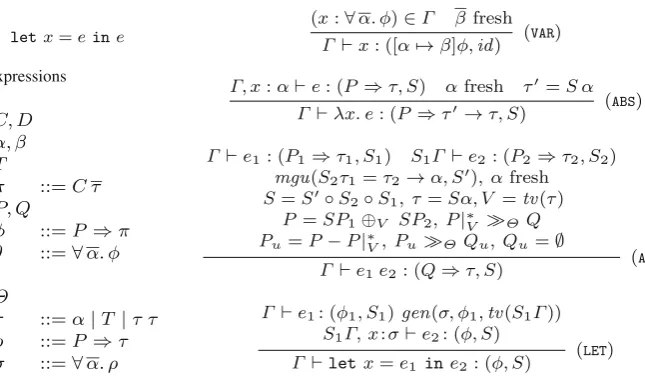
A type system for core Haskell is presented in Fig.3, using rules of the forme:(φ,S),which means thatehas type
Fig. 4 Partial order on types, constraints and typing contexts
φin typing context.We have thatSe:(φ,S)holds whenever e : (φ,S)holds, where S ≤ S.Program contexts in whicheoccurs may instantiatee’s type, as stated in Theorem (1) below.
Example 5 As an example of a program context requiring type instantiation, which occurs as a result of function appli-cation, consider expressionx and typing context = {f : I nt→ I nt,x:α}; we can derive f x :(I nt,S),where S = [α→I nt].FromS= {f :I nt → I nt,x :I nt}; we can deriveSe:(I nt,i d).
In general, we have the following, where a program con-textC[e]is an expression which haseas a subexpression, and orderings on types and typing contexts are as defined in Fig.4.
Theorem 1 If e: (φ,S)holds then S e: (φ,S0)
holds, where S0≤S.
Furthermore, for all program contexts C[e] in which e occurs and all typing contexts such that ≤ and C[e] : (φ,S)is derivable, for someφ,S,we have
that S≤S.
For each expression e, there is a unique typeφ deriv-able forein a typing context.However, expressionecan have though a set of instance-types, in program contexts that require instantiation ofφin(in fact, in all typing contexts such that≤,cf. Theorem1). Consider the following
example whereBandCrepresents abbreviations ofBooland Char, respectively.
Example 6 Let((==) : ∀a.Eq : a ⇒ a → a → B) ∈ ,{EqB,EqC} ⊆ ande=((==)True,(==) ’*’). Then e : ((B → B,C → B),S)is derivable, where S = [a → B,b → C], anda,b are fresh type variables. Instance-types of(==)in program contexts(==) Trueand (==)’*’are respectivelyB→B→BandC→C→B.
Instance-types are formally defined as follows.
Definition 1 Given expression eand typing context,we have thatSφis aninstance-type for e in ife:(φ,S) andC[e] :(φ,S)hold, where≤.
Furthermore,Sφis a greatest (most specific) instance-ty-pe for anoccurrenceofeinifSφis an instance-type fore inand there is no instance-typeS1φdistinct fromSφfor
einsuch thatS1≤ S.
Distinct occurrences of an expression can have distinct greatest instance-types. For example, the instance-types given in Example6are greatest instance-types for the corre-sponding occurrence of(==).
mgu is the most general unifier relation [12–14]: mgu(T,S)is defined to hold between a set of pairs of simple types or a set of constraintsT and a substitutionSif the fol-lowing hold: i)Sτ =Sτfor every(τ, τ)∈T (analogously, Sπ =Sπfor every(π, π)∈T), and ifSis a unifier ofT, thenS≤S.
When the parameter of mgu is a singleton set, follow-ing common practice it is written simply as an equality; e.g.,mgu(π=π,S)is written instead of using a set notation like this:mgu{(π, π)},S.
gen(σ, φ,V)holds ifσ = ∀α. φ,whereα=tv(φ)−V. The set of constraints P|∗V denotes the subset of con-straints of P with reachable type variables with respect to the set of type variables V [8]. A type variable α ∈ P is called reachable with respect to a set of type variables V if α ∈ V or α ∈ tv(π) and there exists β ∈ tv(π) such thatβ is reachable (otherwise it is an unreachable type variable). Reachability is considered always with respect to V =tv(τ)for a constraint setPthat occurs on a constrained typeP ⇒τ.For example, type variablesa,bare reachable andcis unreachable in constraint set {C a b,D c}of con-strained type{C a b,D c} ⇒a.Reachability is defined in Fig.5.
Given any set of type variables V,the constraints of a constraint setP can be partitioned into two disjoint subsets P|∗V and P −P|∗V,the first containing constraints with at least one reachable type variable and the second constraints with only unreachable type variables.
P⊕V Q denotes the constraint set obtained by adding fromQonly constraints with type variables reachable from V,i.e.,P⊕V Q=P∪Q|∗V [8,15]. This takes into account that, in an application of a function with type, sayτ1 →τ,
to an expression with typeP ⇒τ1,it is not always adequate
to include in the constraint set of the result all constraints from Q.This occurs because constraints in P may refer to disregarded, non-selected parts of the argument. Consider for example expression f st(True,o)(cf., Sect.2), whereo has any type with non-empty constraints. The type of this expression should beBool, that is, constraints on the type of oshould not be part of the set of constraints on the type of
f st(True,o).
Relation>> is a simplification relation on constraints, defined as a composition of improvement and context reduc-tion, defined respectively in Sects. 3.3 and 3.4. Firstly, the more basic relations of entailment and satisfiability are defined, in Sects.3.1and3.2, respectively, which are used in the definitions of improvement and context reduction.
Qu in rule (APP) represents the set of constraints with unreachable type variables (subscriptuinQuis an abbrevia-tion ofunreachable). The side-condition of ruleAPPexpresses thatQushould be empty. An empty set of constraintsQuis obtained after checking satisfiability on the set of constraints Pu,ifPuhas unreachable variables, and after removing these constraints with unreachable variables, by context reduction, if there exists a single satisfying solution for such constraints (cf., Definition of>> in Fig.6).
The article proposes to treat ambiguity by following a standard definition of ambiguity, that consists in: test satisfi-ability (i.e., “close the world”) if overloading is resolved (or should have been resolved), that is, if there exist unreachable variables in the constraints. Nowadays, satisfiability is tested in Haskell, in the presence of multi-parameter type classes, only upon the presence of functional dependencies (or a sim-ilar mechanism), that closes the world when there existor not unreachable type variables. Our treatment of ambiguity thus restricts the cases where satisfiabilty is tested, in case, say, a mechanism such as that of functional dependencies is used, and allows to avoid the use of such mechanism (of functional dependencies, or a similar one). In the latter case, the satisfia-bility trigger condition becomes the existence of unreachable variables, which may then be instantiated if there exists a sin-gle satisfying substitution.
The type system uses relations (mgu,gen, >> ). The facts that it is syntax-directed and type instantiation occurs only if required by a program context allow a sound and complete type inference algorithm to be obtained by transforming these relations into computable functions.
The fact that the type system does not allow context-free type instantiation and allow the derivation of a single type for an expression in a given typing context makes it look closer to a type inference algorithm. Context-dependent notions of instance-types and most specific instance-type for each occurrence of an expression, in a given typing context, are introduced and used in the paper, instead of the standard context-independent notion of principal type.
Typability of function application f ein this type system considers f eto be well-typed, where f has typeτ1andehas
typeτ2,if there exists typesτ →τandτthat are respective
subtypes ofτ1andτ2,where subtyping is simply a matching
relation, as defined in Fig.4.
Fig. 6 Constraint set simplification
Fig. 7 Constraint set entailment
3.1 Entailment
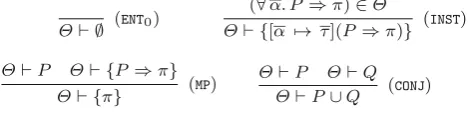
The property that a set of constraintsP can be proven from (are entailed by) constraints in an overloading environment ,written as P,is defined in Fig.7. Following [11,16], entailment is obtained from closed constraints only, con-tained in a fixed set of constraints .
3.2 Satisfiability
Following [17],P is used to denote the set of satisfiable instances of constraint setPwith respect to :
P = {S P| S P}
Example 7 As an example, consider:
= {∀a,b.Dab⇒C[a]b,D Bool[Bool]}
Then, we have that C a a = C [Bool] [Bool] . Both constraints D Bool[Bool] ⇒ C [Bool] [Bool] andC[Bool] [Bool]are members ofC a a (and of
C [Bool] [Bool] ). A proof that {C [Bool]: [Bool]}holds can be given from the entailment rules given in Fig.7, since this is the conclusion of rule (MP) with premises {D Bool [Bool]} and {D Bool[Bool] ⇒ C[Bool] [Bool]},and these two premises can be derived by using rule (INST).
Equality of constraint sets is considered modulo type vari-able renaming. That is, constraint setsP,Qare also equal if there exists a renaming substitutionSthat can be applied to Pto makeS P andQequal.Sis a renaming substitution if for allα∈ dom(S)we have thatS(α) =β,for some type variableβ∈dom(S).
If S P ∈ P thenS is called a satisfying substitution for P.
Constraint set satisfiability is in general an undecidable problem [18]. It is restricted and redefined here by using a constraint-head-value finite function, in order to obtain decidability, as described below.
is such that either the sizes of types of each constraint in this sequence is decreasing or there exists at least one type parameter position with decreasing size.
Constraint set satisfiability is defined so that we can obtain a sound and complete type inference algorithm, by just trans-forming the relations defined in the type system into func-tions.
The definition of the constraint-head-value function is based on the use of a constraint valueν(π)that gives the number of occurrences of type variables and type construc-tors inπ,defined as follows:
ν(Cτ1. . . τn)=
n
i=1ν(τi) ν(T)=1
ν(α)=1
ν(τ τ)=ν(τ)+ν(τ)
Consider computation of satisfiability of a given constraint setPwith respect to constraint axioms .Consider that, for checking satisfiability of a constraintπ ∈ P,a constraintπ unifies with the head of constraint∀α.P0⇒π0∈ ,with
unifying substitutionS,and suppose also that satisfiability ofπ requires also that some constraintπ1 unifies withπ0,
giving corresponding unifying substitution S1.We require
the following in order for satisfiability ofπto hold:
1. ν(Sπ)is less thanν(S1π1)or, ifν(Sπ)=ν(S1π1),then
Sπ=π,for anyπthat has the same constraint value asπand unification withπ0is required for satisfiability
ofπto hold, or
2. Sπis such that there is a type argument position 0≤i≤ nsuch that the number of type variables and constructors, in this argument position, of constraints that unify with π0is always decreasing.
More precisely, constrain-head-value-function asso-ciates a pair(I, )to each constraint(∀α.P0 ⇒π0)∈ ,
where I is a tuple of constraint values and is a set of constraints. Let0(π0)=(I0,∅)for each constraint axiom ∀α.P0 ⇒ π0 ∈ ,where I0 is a tuple ofn +1 values
equal to∞,a large enough constraint value defined so that
∞> ν(π)for any constraintπ ∈ .
Decidability is guaranteed by defining the operation of updating(π0)=(I, ),denoted by[π0, π],as follows,
whereI =(v0, v1, . . . , vn)andπ=Cτ1 . . . τn:
[π0, π] =
Fail ifvi= −1 fori =0, . . . ,n otherwise
where
(π0)=((v
0, v1, . . . , vn), ∪ {π}) (x) =(x)forx =π
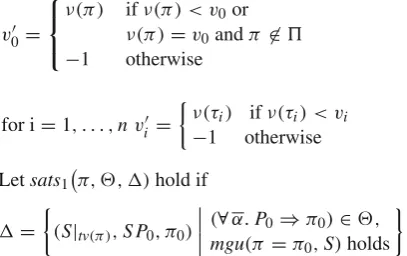
Fig. 8 Decidable constraint set satisfiability
v0= ⎧ ⎨ ⎩
ν(π) ifν(π) < v0or ν(π)=v0andπ ∈ −1 otherwise
for i=1, . . . ,nvi =
ν(τi) ifν(τi) < vi −1 otherwise
Letsats1
π, , )hold if
=
(S|tv(π),S P0, π0) (∀α.P0⇒π0)∈ ,
mgu(π=π0,S)holds
The set of satisfying substitutions for constraint set P with respect to the set of constraint axioms is given byS,such that P ,0
sats Sholds, as defined in Fig.8.
The following examples illustrate the definition of con-straint set satisfiability as defined in Fig.8. Let(π).I and (π). denote the first and second components of(π), respectively.
Example 8 Consider satisfiability ofπ =Eq[[I]]in =
{EqI, ∀a.Eq a ⇒ Eq[a]},letting π0 = Eq[a]; we
have:
sats1(π, ,{(S|∅,Eq[I], π0)}) , S= [a1→[I]] S0= {S1◦id| S1∈S1, Eq[I] ,sats1 S1}
π ,0 satsS0
where 1 = 0[π0, π], which implies that 1(π0) = ((3,3),{π}),sinceν(π) = 3,anda1is a fresh type
vari-able; then:
sats1(Eq[I], ,{
S|∅,{EqI}, π0
}), S= [a2→I] S1= {S2◦i d| S2∈S2, EqI ,sats2 S2}
Eq[I] ,1 sats S1
where2=1[π0, Eq[I]], which implies that2(π0)= ((2,2), 2),with2= {π,Eq[I]}), sinceν(Eq[I])=
sats1
EqI, ,{(id,∅,EqI)}
S2= {S3◦id| S3∈S3, ∅ ,sats3 S3}
EqI ,2 sats S2
where3=2[EqI,EqI]andS3= {id}by(SEmpty1).
The following illustrates a case of satisfiability involving a constraintπ that unifies with a constraint headπ0such
thatν(π)is greater than the upper bound associated toπ0,
which is the first component of(π0).I.
Example 9 Consider the satisfiability ofπ =CI(T3I)in
= {C(T a)I,∀a,b.C(T2a)b⇒C a(T b)}.We have, whereπ0=C a(T b):
sats1
π, ,{(S|∅,{π1}, π0)}
S = [a1→I,b1→T2I] π1=C(T2I) (T2I)
S0= {S1◦i d |S1∈S1, π1 ,sats1 S1} π ,0
sats S0
where 1 = 0[π0, π], which implies that1(π0).I = (5,1,4); then:
sats1
π1, ,{(S|∅,{π2}, π0)}
S= [a2→T2I,b2→TI] π2=C(T4I) (TI)
S1= {S2◦ [a1→T2a2] | S2∈S2, π2 ,sats2 S2} π1 ,sats1 S1
where 2 = 1[π0, π1]. Since ν(π1) = 6 > 5 = 1(π0).I.v0,we have that2(π0).I =(−1,−1,3).
Again, π2 unifies with π0, with unifying substitution
S= [a3→T4I,b2→I],and updating3=2[π0, π2]
gives3(π0).I =(−1,−1,2).Satisfiability is then finally
tested for π3 = C(T6I)I, that unifies with C(T a)I,
returningS3 = {[a3 → T5I]|∅} = {id}.Constraint π is
thus satisfiable, withS0= {id}.
The following example illustrates a case where the infor-mation kept in the second component of(π0)is relevant.
Example 10 Consider the satisfiability ofπ = C(T2I)F in = {CI(T2F),∀a,b.C a(T b)⇒C(T a)b}and let π0=C(T a)b.Then:
sats1(π, ,{
S|∅,{π1}, π0
}) S = [a1→(TI),b1→F] π1=C(TI) (T F)
S0= {S1◦id| S1∈S1, π1 ,sats1 S1} π1 ,sats0 S0
where1 =0[π0, π],giving1(π0) =((4,3,1),{π});
then:
sats1(π1, ,{
S|∅,{π2}, π0
})
S= [a2→I,b2→TF], π2=CI(T2F) S1= {S2◦id| S2∈S2, π2 ,sats2 S2}
π ,1 S
where2=1[π0, π1].Sinceν(π1)=4,which is equal to
the first component of1(π0).I,andπ1is not in1(π0).,
we obtain that S2 = {id}andπ is thus satisfiable (since
sats1(CI(T2F), )= {(id,∅,CI(T2F)}).
Since satisfiability of type class constraints is in general undecidable [18], there exist satisfiable instances which are considered to be unsatisfiable according to the definition of Fig.8. Examples can be constructed by encoding instances of solvable post correspondence problems by means of con-straint set satisfiability, using Smith’s scheme [18].
To prove that satisfiability as defined in Fig.8is decid-able, consider that there exist finitely many constraints in , and that, for any constraintπ that unifies withπ0,we have,
by the definition of[π0, π],that (π0)is updated so as
to include a new value in its second component (otherwise [π0, π] =Failand satisfiability yields∅as the set of
sat-isfying solutions for the original constraint). The conclusion follows from the fact that(π0)can have only finitely many
distinct values, for anyπ0.
3.3 Improvement
Improvement is a satisfiability preserving relation: improve-ment of constraint set P is the process of finding a least general substitutionSsuch thatS Ppreserves the set of sat-isfiable instances ofP[3].
In this paper, improvement is used to remove unreachable type variables for resolving overloading, when overloading resolution cannot be further deferred, and for detecting ambi-guity or unsatisfiability, if unreachable type variables cannot be removed (that is, overloading resolution is not possible). For any constrained typeP ⇒τ,improvement is tested only upon the presence of unreachable type variables, that is, if
Pu=P−P|∗tv(τ)= ∅.
This is a consequence of the side-condition (Qu = ∅) in rule (APP), Fig.3.
If the setSof satisfiable instances of Pu has more than one element, we have ambiguity; if S is empty, we have unsatisfiability; otherwise, ifSis a singleton{S},thenPis improved toS P,which can is then reduced to a set of con-straints without unreachable type variables (that is, the set of constraints inS Pu can be removed, since overloading is resolved).
Improvement is defined in Fig.9, where0is as defined
in Sect.3.2, page 16.
3.4 Context reduction
Informally speaking, context reduction is a process that reduces a constraintπintoQif there is amatching instance forπ in ,that is, there exists(∀α.P ⇒ π) ∈ such thatSπ=π,for someS,andS Preduces toQ.If there is no matching instance forπor no reduction of S Pis possi-ble, thenπreduces to itself. Note that constraint sets can be reduced into larger constraint sets.
As an example of a context reduction, consider an instance declaration that introduces∀a.Eq a ⇒ Eq[a]in ; then Eq[a]is reduced toEq a.
Context reduction can also occur due to the presence of superclass class declarations, but we only consider the case of instance declarations in this paper, which is the more complex process. The treatment of reducing constraints due to the existence of superclasses is standard; see, e.g., [3,7,10].
Context reduction usesmatches,defined as follows:
matchesπ, ( , ), )holds if =
(S P0, π0, )
(∀α.P0⇒π0)∈ ,
mgm(π0=π,S), =[π0, π]
wheremgmis analogous tomgubut denotes the most general matching substitution, instead of the most general unifier.
The third parameter ofmatchesis either empty or a single-ton set, since overlapping instances [19] are not considered. Context reduction, defined in Fig.10, uses rules of the form P ,red Q;,meaning that either P reduces to Q under the set of closed constraints and least constraint value function,causingto be updated to,orP ,redFail P;Fail.
Failure implies that a constraint set is updated to itself. The least constraint value function is used as in the defini-tion ofsatsto guarantee that context reduction is a decidable relation.
An empty constraint set reduces to itself (RED0). Rule (CONJ) specifies that constraint set simplification works, unlike
con-Fig. 10 Context reduction
straint set satisfiability, by performing a union of the result of simplifying each constraint in the constraint set, separately.
To see that a rule similar to (CONJ) cannot be used in the case of constraint set satisfiability, consider a simple example, of satisfiability of P = {C a,D a} in =
{C Int,C Bool,D Int,D Char}.The results of computing satisfiability ofPyields a single substitution whereamaps toInt,not the union of computing satisfiability forC aand D aseparately.
Rule (INST) specifies that if there exists a constraint axiom ∀α.P ⇒Cτ,such thatCτmatches with an input constraint π,thenπreduces to any constraint setQthat Preduces to. Rules (STOP0) and (STOP) deal with failure due to updating of the constraint-head-value function.
4 Semantics
A type class declaration defines overloaded names, also called class members, with corresponding types, and an instance declaration gives a value for each class member, referred to as amember value(sometimes also referred to in the literature as a “member function”).
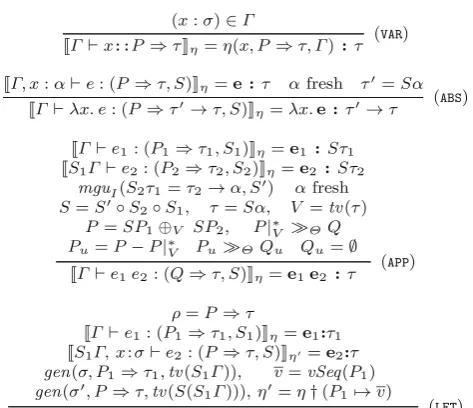
The semantics of core Haskell, given in Fig.11, is based on the application of (so-called)dictionariesto overloaded names a standard core Haskell semantics [3,10,20]. A dic-tionaryis a tuple that corresponds to an instance declaration, and contains values that correspond to the definitions given in the instance declaration for each class member. A dictio-nary of a superclass contains also a pointer to a dictiodictio-nary of each of its subclasses, but the treatment of superclasses is standard and is omitted in this paper (see, e.g., [3,7,10]).
Figure11defines the semantics of core Haskell by induc-tion on type system rules, with greatest instance-types of variables explicitly annotated, that is, typing formulas for variables have the form x :: φ whereφ is the great-est instance-type of this occurrence ofxin typing context (cf. Definition1). The translation of the types of expressions are also defined in Fig.11.
For each class declarationclassP ⇒αwherex::τ, a sequence of selection functions is generated, one for each overloaded name inx.The selection function corresponding toxi simply selects thei-th component of the tuple parame-ter (…, xi,…) (ifn = 1,selection is done by the identity function).
For example, classEqgenerates a pair of selection func-tions(==)and(/=), defined as equal tofstandsnd. Mod-ule scope visibility rMod-ules of these generated names are not considered in this paper. See also Example11below.
LetPdenote a sequence of constraints inPin a standard, say lexicographical order.
Each instance declarationinstanceP ⇒πwherex
Fig. 11 Core Haskell semantics
indπis a function that takes one dictionary for each constraint in the (possibly empty) sequencePand yields the translation ofei,the value bound byxi in the instance declaration. The instance declaration makes valuesη(Sπ)andη(xi,Sτi)to be equal todπ,for all substitutionsS,whereτiis the simple type in the type ofxi.
Letη†(P →v)be equal toη[π1→v1, . . . , πn →vn], whereP = {π1, . . . , πn}.
vSeq(P)denotes a sequence of fresh variablesvi,one for eachπiin the sequenceP.
mguIis a functional counterpart of the most general unifier relation (mgu).
We have thatη(x,P⇒τ, )gives the semantics of pos-sibly overloaded name x,with instance-type P ⇒ τ and quantified typeσ;ηis overloaded to be used also on unqual-ified constraints (as inη(π)) and to yield dictionaries (as in η(x, τ)). In the translation,xrepresents a selection function, η(x, τ)a dictionary, andwa sequence of arguments of the selected function, where arguments are themselves dictionar-ies:
η(x,P ⇒τ, )=
x if P0= ∅
xη(x, τ) w otherwise where:∀α.P0⇒τ0=(x),
S=mguI(τ, τ0), π1. . . πn=P0,
fori =1, . . . ,n:vi =η(πi),
wi =
vi ifπi ∈ P η(Sπi) otherwise
Theorem 2 For any derivations, of typing formulas e:φande:φ,respectively, whereandgive the same type to every x free in e,we have
[[e:φ]]η= [[e:φ]]η
where the meanings are defined usingand,respectively.
Proof Sinceandgive the same type to everyxfree ine and the type system rules are syntax-directed,andare
the same.
Consider the following Haskell program extract:
Example 11
The translation of the first occurrence of teq in line (1) above is equal tot eq dT Eq L v1v2,where teq’s translation
is the identity function, teqL is a function that receives the two dictionary argumentsv1 andv2 passed to t eqww
and yields the translation of function teq for lists defined above. The translation is given with respect to environment η0 † (P → v), where P = {Showa,T Eqa}, v is the
sequencev1v2, andη0 is such thatη0(t eq, τ) = dT Eq L, where τ = [[a]] → [[a]] → (Bool,Str i ng), and dT Eq L is a dictionary with just one componentteqL.
We have also that η0(T Eq I nt) is equal to a
dictio-nary with just one member (say,dT Eq I nt), and similarly for η0(ShowI nt).The translation of the second occurrence of
teqin line(1)above is equal to:
t eq dT Eq L dT Eq I ntdShowI nt
Note that constraints on types of expressions are con-sidered in the semantics only in the cases of polymorphic and constrained overloaded variables. Consider for example expressioneqStargiven by:
leteq=λx. λy.(==)x y in eq’*’
in a context where(==)has typeEq a ⇒ a → a → Bool(we have not written a simpler expression because we want to contrast the semantics of(==)with those of expres-sions(==)xand(==)x y); the translation ofeqStaris given by:
leteq=λv. λx. λy.(==)vx y in eqdi ct EqC har’*’
We have that (==) dictEqChar (as well as eq dictE-qChar) returns a primitive equality function for characters, sayprimEqChar. Expression(==)is itself a function that takes a dictionary of typetand returns the equality function from that dictionary, of typet →t → Bool.The translation of each occurrence of(==)passes a pertinent dictionary value to(==)so that the type obtained is the expected type for an equality function on values of typet.Both expres-sions(==)xand(==)x yhave also constrained types, but a dictionary is passed only in the case of(==). The seman-tics of an expression with a constrained type where the set of constraints is non-empty only considers this set of con-straints if the expression is an overloaded variable; other-wise constraints are disregarded in the semantics. Further-more, since each occurrence of an overloaded variable has a translation that is the application of pertinent dictionary values to that variable, translation oftypeswith constraints are never input or output values of the translation function (see Fig.11).
Type soundness follows directly from the fact that if
[[ e : P ⇒ τ]]η = e :τ holds or, if e is a vari-able, if [[ x :: P ⇒ τ]]η = e :τ holds, then e :τ is derivable, where is appropriately defined
so as to remove overloading-related data from. This can be done by creating dictionaries and selection functions as described above, and inserting corresponding type assump-tions
in.
Type soundness is obtained as a result of disallowing all ambiguous expressions and all expressions involving unsat-isfiability in the use of overloaded names. For example, let-tinge0 ≡ (λx− > show(r ead x)), we would not have a
derivation of e0: Str i ng→ Str i ngcorresponding to e0 : String→ Stringif dReadt : String→ t is not derivable, which would happen ift is a fresh type vari-able ort can be more than one simple type. In other words, dReadt : String → t is derivable if and only ift is a
unique simple type.
5 Conclusion
This paper discusses ambiguity in the context of languages that support context-dependent overloading, such as Haskell. A type system is presented that does not follow the Hindley-Milner approach of providing context-free type instantiation, as usually done in type systems for such lan-guages. As a consequence, ambiguous expressions can be considered to be not well-typed, in conformance with type inference algorithms.
The type system does not allow context-free type instan-tiation and allows only a single type to be derived for an expression, in a given typing context, making it look closer and easier to be converted into a type inference algorithm. There is no notion of principal type (and thus no notion of “principal translation” of a term), in a given typing context. Related notions of instance type and most specific instance type for each occurrence of an expression, dependent on pro-gram contexts, are instead defined and used in the paper.
A semantics is defined by induction on the type sys-tem rules, for which coherence is trivial. Type soundness is obtained as a result of disallowing all ambiguous expres-sions and all expresexpres-sions involving unsatisfiability in the use of overloaded names.
A standard definition of ambiguity is followed in the sup-port for context-dependent overloading, where satisfiability is tested —i.e., “the world is closed”—if only if overloading is resolved (or should have been resolved), that is, if and only if there exist unreachable variables in the constraints on types of expressions. Nowadays satisfiability is tested in Haskell, in the presence of multi-parameter type classes, only upon the presence of functional dependencies or an alternative mech-anism that specifies conditions for closing the world, and that may happen when there exist or not unreachable type variables in constraints. The satisfiability trigger condition is then given automatically, by the existence of unreachable variables in constraints, and does not need to be specified by programmers, using an extra mechanism.
References
1. Mitchell J (1996) Foundations of Programming Languages. MIT Press, Cambridge
2. Pierce B (2002) Types and Programming Languages. MIT Press, Cambridge
3. Jones M (1994) Qualified Types: Theory and Practice. Ph.D. thesis, Distinguished Dissertations in Computer Science. Cambridge Univ. Press, Cambridge
4. Stuckey P, Sulzmann M (2005) A Theory of Overloading. ACM Trans Prog Lang Syst (TOPLAS) 27(6):1216–1269
6. Faxén K (2003) Haskell and Principal Types. In: Proceedings 2003 ACM SIGPLAN Haskell, Workshop, pp 88–97
7. Faxén K (2002) A static semantics for Haskell. J Funct Program 12:295–357
8. Camarão C, Figueiredo L (1999) Type Inference for Overloading without Restrictions, Declarations or Annotations. In: Proceeding 4th Fuji International Symp. on Functional and Logic Programming (FLOPS’99), LNCS 1722, Springer-Verlag, New York, pp 37–52 9. Jones SP, et al (2012) GHC—the Glasgow Haskell compiler.http://
www.haskell.org/ghc/
10. Hall C, Hammond K, Jones S, Wadler P (1996) Type classes in Haskell. ACM Trans Program Lang Syst 18(2):109–138 11. Chakravarty MG, Keller SP, Jones S (2005) Marlow: associated
types with class. In: Proceeding ACM Symp. on Principles of Programming Languages (POPL’05), ACM Press, Florida, pp 1–13 12. Robinson J (1965) A machine-oriented logic based on the
resolu-tion principle. J ACM 12:32–41
13. Eder E (1985) Properties of substitutions and unification. J Sym Comput 1:31–46
14. Palamidessi C (1990) Algebraic properties of idempotent substitu-tions. Lect Notes Comput Sci 443:386–399
15. Camarão C, Ribeiro R, Figueiredo L, Vasconcellos C (2009) A Solution to Haskell’s Multi-Parameter Type Class Dilemma. In: Proceeding 13th Brazilian Symp. on Programming Lan-guages (SBLP’2009), pp 5–18.http://www.dcc.ufmg.br/camarao/ CT/solution-to-mptc-dilemma.pdf
16. Chakravarty M, Keller G, Jones S (2005) Associated type syn-onyms. In: Proceeding 10th ACM SIGPLAN International Con-ference on Functional Programming, pp 241–253
17. Jones M (1995) Simplifying and improving qualified types. In: Proceeding ACM Conf. on Functional Programming and Computer Architecture (FPCA’95), Cambridge University Press, Cambridge, pp 160–169
18. Smith G (1991) Polymorphic type inference for languages with overloading and subtyping. Ph.D. thesis, Cornell University, NY 19. Jones SP, others (2011) GHC—The Glasgow Haskell Compiler
7.0.4 User’s Manual.http://www.haskell.org/ghc/
20. Wadler P, Blott S (1989) How to make ad-hoc polymorphism less ad hoc. In: Proceeding 16th ACM Symp. on Principles of Program-ming Language (POPL’89), ACM Press, Florida, pp 60–76 21. Peterson J, Jones M (1993) Implementing type classes. In:
Pro-ceeding ACM Conference on Programming Language Design and Implementation, SIGPLAN Notices 28(6), Florida, pp 227–236 22. Jones M (1994) Dictionary-free Overloading by Partial