DOI 10.1007/s12651-013-0151-0 A RT I C L E
The IAB Establishment Panel—methodological essentials and
data quality
Peter Ellguth·Susanne Kohaut·Iris Möller
Published online: 22 November 2013
© Institut für Arbeitsmarkt- und Berufsforschung 2013
Abstract The IAB Establishment Panel was launched to obtain information on the demand side of the labor market. This data meets two requirements: providing high quality data for the scientific aims and having an information sys-tem for policy makers and practitioners. As it started in 1993 a rich data set of 20 years establishment survey is available now. This article provides information about methodologi-cal issues of sample design and data sampling and changes that have taken place in recent years. We focus on quality issues, efforts to improve the survey and on some ongoing discussions about methodological adjustments of the survey mode.
Das IAB-Betriebspanel: Methodische Grundlagen und Datenqualität
Zusammenfassung Das IAB-Betriebspanel wurde vor 20 Jahren gestartet, um einen umfassenden Datensatz für die Nachfrageseite des Arbeitsmarkts zu generieren. Damit soll-ten sowohl der Wissenschaft hochwertige Dasoll-ten mit ent-sprechendem Analysepotenzial zur Verfügung gestellt, als auch ein zuverlässiges Informationssystem für politische Entscheidungsträger etabliert werden. Dieser Beitrag gibt einen Überblick über die methodischen Grundlagen des IAB-Betriebspanels angefangen von der Stichprobenzie-hung über die Datengewinnung bis hin zu Fragen der Hoch-rechnung. Besonderes Augenmerk wird dabei auf Verände-rungen im methodischen Design gelegt, die in den letzten Jahren vorgenommen wurden, sowie auf Fragen der Da-tenqualität. Zudem werden Überlegungen hinsichtlich eines
P. Ellguth (
B
)·S. Kohaut·I. MöllerInstitute for Employment Research, 90478 Nuremberg, Germany e-mail:[email protected]
möglichen Umstiegs der Erhebungsmethode auf computer-gestützte Formen präsentiert.
1 The IAB establishment panel
20 years ago the first wave of the IAB Establishment Panel1 was launched in West Germany after a period of extensive conceptual work and testing. Declared objective of this un-dertaking was to establish a comprehensive dataset on the demand side of the labor market. From the beginning the project had to meet two requirements: generating high qual-ity data with high analytical potential for the scientific com-munity and providing an information system for policy mak-ers and practitionmak-ers.
From this some essentials for the kind of data asked for emerged:
– Coverage of all sectors and establishment sizes – Topicality and fast availability of the data – Longitudinal data for causal analysis
– High response rates especially among the repeatedly questioned establishments
– Dynamic panel that mirrors structural changes in the economy.
The twofold orientation towards scientific research and pol-icy making presents a permanent challenge for the annual revision of the questionnaire. The task is to balance the obli-gation to provide a wide range of unaltered questions each year to enable panel analysis and the need for up to date information on recent topics of labor market policy.
This paper complements existing papers on the IAB Es-tablishment Panel, especially the 2009 article by Fischer et al. to which some references will be made here. After five years an update of the methodological basics and de-velopments is asked for particularly in a special issue of this journal dedicated to that data set.
While providing a comprehensive overview of the method-ology (the sample design and sampling process, the survey methodology, the data processing and weighting) we focus on the data sampling process and the measures taken to as-sure a high data quality. We also pay special attention to the changes that have taken place since 2007 which was the last wave covered by the 2009 article by Fischer et al. (2009).
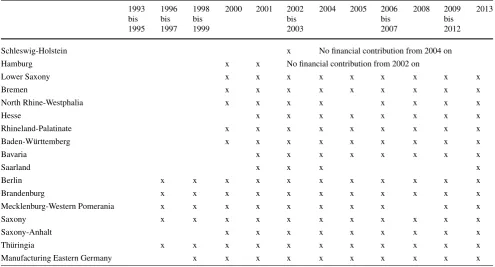
A specific feature of the IAB Establishment Panel is the (main) funding by the German Federal Employment Agency. Therefore, the money is coming from the contrib-utors to the social security system. Additional financial re-sources come from the federal states (Bundesländer) to carry out state-specific supplementary samples. In 2012 13 out of 16 federal governments took part in the project and paid for about 35 % of the sample.2In return they are free to use not
only their supplementary sample but the IAB-financed re-gional basic sample for their own analysis. This distribution of the financial load makes it possible to achieve a huge sam-ple size (between 15.500 and 16.000) and to apply a rather costly survey method to ensure high data quality.
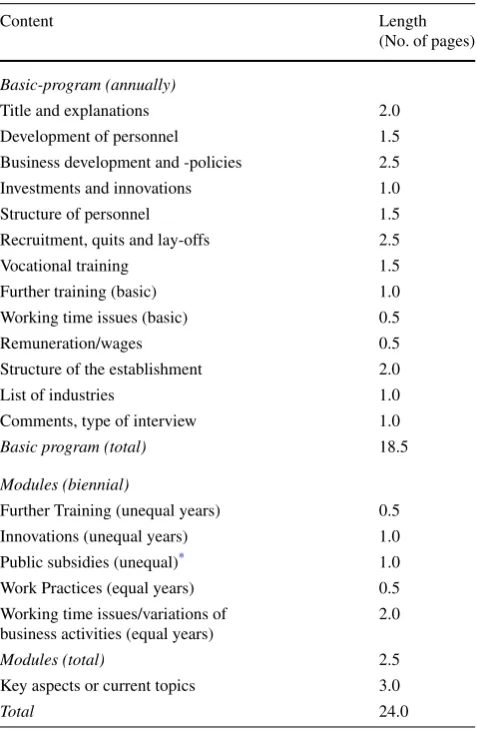
However, the co-financing is accompanied by some influ-ence of the federal states in the design of the questionnaire which is generally focused on important topics of labor mar-ket policy. To implement suitable questions the stakeholders make proposals for new topics or additional questions on ex-isting topics for which as a rule about 3 of the 24 pages of the questionnaire are reserved. In the remaining major part the annual standard program of questions is conducted.
2 The questionnaire—content and survey questions
The major part of the questionnaire consists of questions asked annually in an identical form (Table 1). These are about the structure of the workforce (qualification level, part time work, temporary employment, recruitment, quits and lay-offs etc.) and establishment characteristics like business figures and policies, remuneration and working time issues, training activities and further structural information.
Some of these modules are complemented by biennial asked questions, which aim to broaden and accentuate the annual basic information and enrich the potential for empir-ical analysis. These questions are about further training and
2For further information on the participating federal states see Ta-ble11.
Table 1 Structure of the questionnaire—topics and modules
Content Length
(No. of pages) Basic-program (annually)
Title and explanations 2.0
Development of personnel 1.5
Business development and -policies 2.5
Investments and innovations 1.0
Structure of personnel 1.5
Recruitment, quits and lay-offs 2.5
Vocational training 1.5
Further training (basic) 1.0
Working time issues (basic) 0.5
Remuneration/wages 0.5
Structure of the establishment 2.0
List of industries 1.0
Comments, type of interview 1.0
Basic program (total) 18.5
Modules (biennial)
Further Training (unequal years) 0.5
Innovations (unequal years) 1.0
Public subsidies (unequal)* 1.0 Work Practices (equal years) 0.5 Working time issues/variations of
business activities (equal years)
2.0
Modules (total) 2.5
Key aspects or current topics 3.0
Total 24.0
*No longer part of the questionnaire (latest in 2009)
innovation activities (asked in uneven years) and work prac-tices and working time issues (asked in even years). More-over, in every questionnaire there is room for focal subjects that are determined by the stakeholders of the IAB Estab-lishment Panel survey. These questions often cover current political topics and therefore ensure that the IAB Establish-ment Panel not only provides data for longitudinal analy-ses but also up-to-date information on new political devel-opments.
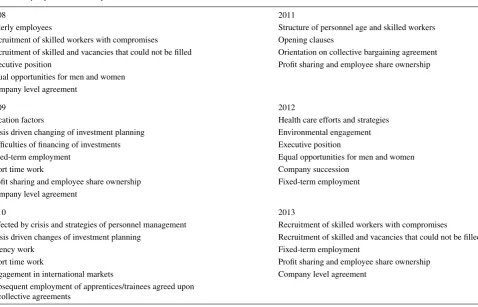
Table2shows the focal points and current topics for the last five years. Topics that made it into the questionnaire on account of the federal states and had quite an impact on the political debate were e.g. demand or shortage of skilled la-bor, location factors, employment of older workers or com-pany level agreements.
Table 2 Key aspects or current questions 2008–2013
2008 2011
Elderly employees Structure of personnel age and skilled workers
Recruitment of skilled workers with compromises Opening clauses
Recruitment of skilled and vacancies that could not be filled Orientation on collective bargaining agreement
Executive position Profit sharing and employee share ownership
Equal opportunities for men and women Company level agreement
2009 2012
Location factors Health care efforts and strategies
Crisis driven changing of investment planning Environmental engagement Difficulties of financing of investments Executive position
Fixed-term employment Equal opportunities for men and women
Short time work Company succession
Profit sharing and employee share ownership Fixed-term employment Company level agreement
2010 2013
Affected by crisis and strategies of personnel management Recruitment of skilled workers with compromises
Crisis driven changes of investment planning Recruitment of skilled and vacancies that could not be filled
Agency work Fixed-term employment
Short time work Profit sharing and employee share ownership
Engagement in international markets Company level agreement
Subsequent employment of apprentices/trainees agreed upon in collective agreements
Source: IAB Establishment Panel
– temporary agency workers, freelancers, casual work-ers/trainees (2002);
– company-specific forms of staff representation (2003); – highly qualified workers (2003);
– jobs subjected to reduced social security contributions (midi-jobs) (2004);
– turning fixed-term contracts into regular contracts (2005); – “one-euro-job holders” (2005);
– marginal part-time workers (2006); – annual result (net profit or net loss) (2007); – process innovations (2007);
– managed by (family of) proprietors or employed man-agers (2007);
– non profit (charitable, religious) organization (2007); – pressure from competition/competitive situation (2008); – failing to fill vacancies for qualified jobs (2008); – prolonging of expired fixed-term contracts (2009); – private or public ownership (2011);
– age of the works councils (2012);
– differentiation of working time accounts and lifetime working time accounts (2012);
– differentiation of wages above and beyond (non-tariff) collectively agreed rates (2013).
All changes are aimed to improve the analytical capacity of the dataset either by adding new contents or by provid-ing additional structural information useful for econometric analysis.
In other cases questions were removed or their com-plexity reduced, either because of unacceptable problems with the data quality or because the question was outdated by legal or structural developments: For example the num-ber of annual overtime hours was discarded (2002) because the share of missing values remained over one third of the sample despite several attempts to improve responsiveness. The distinction between blue- and white-collar workers was abandoned as respective changes in legislation and collec-tive agreements were adapted by the establishments (2006). Furthermore, some changes in existing questions were in-duced by the results of our pretests. For example in the pro-cess of developing a more differentiated retrieval of the ge-ographical origin of purchased raw materials, commodities and supplies the pretest results revealed fundamental prob-lems of the respondents to deliver reliable and comparable answers. As a consequence the initial question was removed from the questionnaire (2004).3
2.1 Cognitive pretest
To ensure the quality of the survey new questions have to pass an assessment procedure to be accepted for the ques-tionnaire. The first step of this procedure is an evaluation by the research staff. It is checked e.g. if the research concern is appropriate for this kind of survey and whether the respon-dents might be able to answer these questions, meaning the information should generally be available at establishment level. When these criteria are met questions are tested in a cognitive pretest. At least 100 interviews are conducted in establishments of different sizes and industries. These inter-views are not conducted by TNS Infratest but by employees of the IAB who are located in the Regional Directorates of the Federal Employment Agency and form the Regional Re-search Network of the IAB with special knowledge about the establishments in their region.
At first, the respondent of the pretest interview is asked to complete the questionnaire. In a second step, the respondent and the interviewer discuss the questionnaire. The respon-dents are asked to give their comments on the interview for instance whether the questions were difficult to understand or the information was easily enough available or could be retrieved with reasonable effort. Finally, there is room for a kind of qualitative interview about special topics. For ex-ample, in the pretest interview 2012 respondents were asked about energy costs in the previous business year. The aim was to explore the accounting of energy costs and to find out how energy costs are monitored on firm level. The re-spondents were asked to tell whether it is possible to give an overall sum in a given period of time and which effort would be necessary to calculate a respective figure. In this special case the results and comments of the respondents made clear that this topic is too complicated to be answered in a face-to-face interview and therefore is not suitable for the questionnaire of the IAB Establishment Panel.
The results of the pretest interviews and the comments of the respondents and interviewers are the basis for the re-search staff of the IAB Establishment Panel to discuss and evaluate together with the team of TNS Infratest which ques-tions are to be included in the questionnaire and which must be altered or discarded altogether.
3 Methodological basics
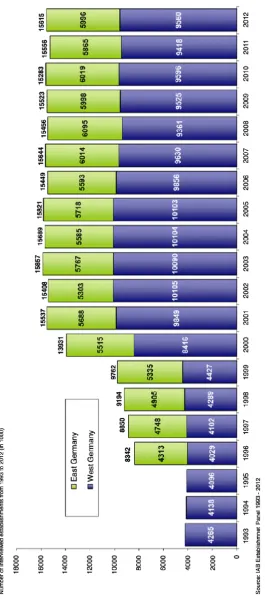
The IAB Establishment Panel is conducted among estab-lishments from all sectors and establishment size classes in Germany. It started in western Germany in 1993 with valid interviews from 4,265 establishments. In 1996 eastern Ger-man firms were added to the sample. 8,342 establishments were interviewed. Another major increase in the sample size was in 2000 when most of the western federal states (with
the exception of Hamburg, Hesse and Saarland) started to support the survey financially. Since 2001 the survey is con-ducted in around 15,500 establishments every year (Fig.1). The survey is designed for longitudinal as well as cross-sectional analyses (for details see Fischer et al.2009: 142– 147). Researches should be enabled to follow the develop-ment of the same firms over time. Therefore, every year each establishment with an interview in the previous year is con-tacted again. The interviewer is given the address of the es-tablishment and the number of employees of the previous year and has to ascertain that the same unit actually exists and is interviewed. If there are differences in the number of employees or the address the interviewer has to follow a spe-cial procedure to find out why the differences occur. In case of remaining inconsistencies these establishment are inter-viewed never the less but they lose their panel status and are only used in cross-sectional analyses.
The sampling frame of the IAB Establishment Panel is the Establishment File of the Federal Employment Agency (Bundesagentur für Arbeit—BA), which is aggregated from the employment statistics and contains all establishments/ agencies with at least one employee covered by social secu-rity. One-person establishments or establishments with only marginal part-time employees or only civil servants are not included. The establishments are drawn in accordance with the principle of optimum stratification, whereby the proba-bility of selection increases with the size of the establish-ment.
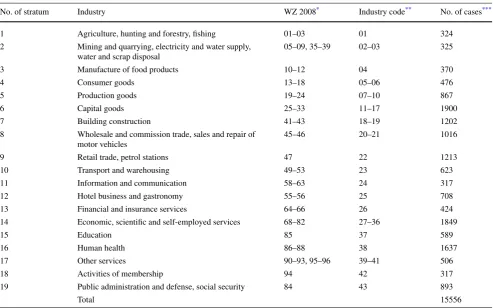
Ten establishment size classes, 19 sectors (Table3) and the federal states serve as stratification variables. The ten size classes remained the same over the years while there were important changes in the classification of industries in 2000, 2003 and 2008. The modifications became necessary because the German classification of industries (WZ 2008) of the German Federal Statistical Office was revised to meet European standards (NACE) (Kössler2009). Since 2012 19 strata for the industries are distinguished.
In econometric estimations it is common practice to in-clude the stratification criteria as independent variables (see: Winship/Radbill 1994). First and foremost the establish-ment size is of great importance with sample-population-ratios (2012) between 0.406 (5,000 and more employees) and 0.004 (1 to 4 employees). In comparison the sector-specific disproportionate stratification ranges rather moder-ately between 0.035 (producer goods) and 0.005 (hotel busi-ness and gastronomy). Slightly more important are the dif-ferences with respect to the federal states which range from 0.053 (City/State of Bremen) to 0.004 (Bavaria).
Fig
.
1
The
IAB
Establishment
P
Table 3 Classification of Industries
No. of stratum Industry WZ 2008* Industry code** No. of cases***
1 Agriculture, hunting and forestry, fishing 01–03 01 324
2 Mining and quarrying, electricity and water supply, water and scrap disposal
05–09, 35–39 02–03 325
3 Manufacture of food products 10–12 04 370
4 Consumer goods 13–18 05–06 476
5 Production goods 19–24 07–10 867
6 Capital goods 25–33 11–17 1900
7 Building construction 41–43 18–19 1202
8 Wholesale and commission trade, sales and repair of motor vehicles
45–46 20–21 1016
9 Retail trade, petrol stations 47 22 1213
10 Transport and warehousing 49–53 23 623
11 Information and communication 58–63 24 317
12 Hotel business and gastronomy 55–56 25 708
13 Financial and insurance services 64–66 26 424
14 Economic, scientific and self-employed services 68–82 27–36 1849
15 Education 85 37 589
16 Human health 86–88 38 1637
17 Other services 90–93, 95–96 39–41 506
18 Activities of membership 94 42 317
19 Public administration and defense, social security 84 43 893
Total 15556
*Industry code of the German Federal Statistical Office (Statistisches Bundesamt2008) **Industry code as in the questionnaire of the IAB establishment panel survey ***No. of cases (cross-sectional) of the 2012 survey
sample by using the cross sectional weighting factor in-cluded in the dataset.4
Descriptive results can be obtained within the system-atic of the sampling and weighting process (19 branches, 10 size classes and 16 federal states5). For more differenti-ated descriptive analyses or such with other compositions of the sampling frame one has to leave the solid ground of the weighting systematic. This means that users have to keep in mind that even if the number of cases is sufficient for such analyses, no information on the results regarding the preci-sion and level of confidence can be obtained.
In theory this enables descriptive analysis on all combi-nations of the sampling frame(19×10×16). But this dif-ferentiation is restricted because of rapidly falling case num-bers. Already on the national level there are some of the 190
4Each firm that can be used in cross-sectional analyses is indicated “Q” in variable QUERXXXX and has a cross-sectional weighting fac-tor HRFXXXXQ, where XXXX stands for the respective year. For a description of the weighting process see Fischer et al. (2009: 142ff). 5There is also an oversampling for the establishments in the manufac-turing industry in East Germany which is financed externally.
weighting cells with no or just a few cases in the sample.6 For single federal states the restrictions due to small case numbers are of course amplified. Therefore before com-mencing descriptive analysis the underlying case numbers have to be checked even within the sampling framework.
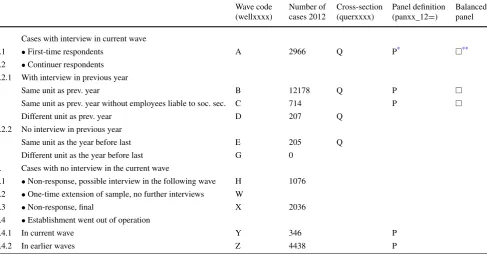
In order to depict the change in the economy and to com-pensate for the effects of panel mortality, establishments are added to the sample every year. Each establishment is char-acterized by a letter (wave code7) that indicates for instance whether it was interviewed for the first time, has been in the survey the year before or was closed down. There are also codes for establishments which are not able or willing to take part in the survey. Table4shows the wave codes of the establishments.
As mentioned before researchers can either perform cross-sectional or longitudinal analysis. For the former all establishments with a valid interview and at least one
em-6For the actual weighting process cells are aggregated when necessary to reach sufficient case numbers.
Table 4 Wave Codes
Wave code (wellxxxx)
Number of cases 2012
Cross-section (querxxxx)
Panel definition (panxx_12=)
Balanced panel 1 Cases with interview in current wave
1.1 •First-time respondents A 2966 Q P* **
1.2 •Continuer respondents 1.2.1 With interview in previous year
Same unit as prev. year B 12178 Q P
Same unit as prev. year without employees liable to soc. sec. C 714 P
Different unit as prev. year D 207 Q
1.2.2 No interview in previous year
Same unit as the year before last E 205 Q
Different unit as the year before last G 0
2. Cases with no interview in the current wave
2.1 •Non-response, possible interview in the following wave H 1076 2.2 •One-time extension of sample, no further interviews W
2.3 •Non-response, final X 2036
2.4 •Establishment went out of operation
2.4.1 In current wave Y 346 P
2.4.2 In earlier waves Z 4438 P
Source: IAB Establishment Panel *Only “new” enterprises
**“New” enterprises only in the starting wave
ployee under social security in the previous year are in-cluded in the sample. Thus the continuer respondents (wave code: B) and the first time respondents (wave code: A) are considered valid cross-sectional cases. The latter consist of those replacing panel attrition and those replacing establish-ments going out of operation.8In addition continuer estab-lishments which could not be identified as the same unit as last year (for example because of major structural changes) (wave code: D) and establishments that did not participate in the last wave but the wave before (wave code: E) are in-cluded.
In a longitudinal framework the development of individ-ual establishments in the survey can be traced over a longer period of time. If that framework is chosen several defini-tions of a panel dataset are offered depending on the pe-riod considered. According to this panel definitions respec-tive panel weighting factors for longitudinal description are
8Those new establishments that replace closed plants are characterized by an identification number which didn’t show up in the BA Establish-ment File the previous year. This does not necessarily mean the actual formation of a new establishment. An identification number can also turn up and disappear in firms that have employees liable to social se-curity in some years and don’t in others. Furthermore there might be structural changes in the establishment that lead to an allocation of a new identification number (for further information on the allocation of Establishment Identification Numbers see Fischer et al.2009: 135).
available.9 In the starting wave all first time respondents (wave code: A) are included as valid panel cases, as are all continuer respondents no matter whether the same unit was interviewed as last year (wave code: B) or a different unit (wave code: D) and units with no interview the previous year but the year before (wave code: E). In all following waves only first time respondents (wave code: A) which appear in the BA Establishment File and did not the year before and the continuer respondents with (wave code: B) and without (wave code: C) employees liable to social security are in-cluded. Furthermore, establishments that went out of oper-ation in the current wave (wave code: Y) or earlier waves from the starting wave on (wave code: Z) are panel cases, because the termination of establishments is considered a panel information, reflecting the dynamic of the economy.
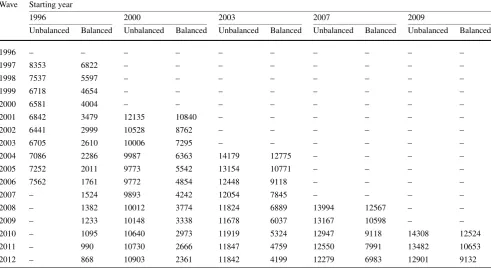
Up to 2012 there are six starting points for panel def-initions (1993, 1996, 2000, 2003, 2007, and 2009). Those started 1993 and 1996 were not continued after 2006 be-cause not enough cases were left. For all the defined starting points to every following wave there are weighting factors available enabling descriptions of the establishments
Table 5 Number of cases—unbalanced and balanced panels
Wave Starting year
1996 2000 2003 2007 2009
Unbalanced Balanced Unbalanced Balanced Unbalanced Balanced Unbalanced Balanced Unbalanced Balanced
1996 – – – – – – – – – –
1997 8353 6822 – – – – – – – –
1998 7537 5597 – – – – – – – –
1999 6718 4654 – – – – – – – –
2000 6581 4004 – – – – – – – –
2001 6842 3479 12135 10840 – – – – – –
2002 6441 2999 10528 8762 – – – – – –
2003 6705 2610 10006 7295 – – – – – –
2004 7086 2286 9987 6363 14179 12775 – – – –
2005 7252 2011 9773 5542 13154 10771 – – – –
2006 7562 1761 9772 4854 12448 9118 – – – –
2007 – 1524 9893 4242 12054 7845 – – – –
2008 – 1382 10012 3774 11824 6889 13994 12567 – –
2009 – 1233 10148 3338 11678 6037 13167 10598 – –
2010 – 1095 10640 2973 11919 5324 12947 9118 14308 12524
2011 – 990 10730 2666 11847 4759 12550 7991 13482 10653
2012 – 868 10903 2361 11842 4199 12279 6983 12901 9132
Source: IAB Establishment Panel
viving” the respective time period and those that went out of business or were “newly founded” in the meantime.
In a longitudinal perspective analysis is often focused on establishments surviving a certain period of time and their individual development. Units that can be included in those studies in the sense of a balanced panel need a valid inter-view every year. Table5shows for the defined starting points the respective case numbers declining steadily from year to year despite the high response rates for continuer respon-dents in the IAB Establishment Panel.
Of course users can define their own panel dataset ac-cording to their particular needs and their focus of research. All necessary information especially on the wave codes is available in the dataset (Table5).
4 Survey method and field work
High data quality is one of the main concerns of the IAB establishment panel. The survey is supported by the Federal Employment Agency and the German Employers’ Associa-tion. The establishments are first contacted by mail with let-ters from both institutions asking to take part in the survey. After the first contact in mid-June the interviews are sched-uled with the firm representatives and they are carried out throughout the summer. The field work ends around mid-October.
To achieve high response rates face-to-face interviews are conducted whenever possible. Usually the questionnaires are filled in during the interview by the interviewer, but it is also possible to leave the questionnaire with the represen-tative of the firm if that is necessary to complete parts of the questionnaire or if it is preferred by the person interviewed. Almost 7 % of the interviews are completed partly with-out the interviewer and 13.6 % of the interviewees prefer to complete the whole questionnaire on their own. A cer-tain number of the interviews (around 1100 in 2012) have to be carried out by mail due to organizational reasons. These mail interviews are only conducted in Schleswig-Holstein and Saarland (Table6).
Table 6 Face-to-face, self-completed and mail questionnaires/
interviews (sample values)
Interviewmode Share of responses (basis: all establishments)
Number of questionnaires/ interviews Entirely face-to-face 70.2 % 11419
Mainly face-to-face 2.5 % 401
Mainly self-completed 4.1 % 668
Entirely self-completed 13.6 % 2220 No information available 2.9 % 476 Printed questionnaire via mail 6.7 % 1086
Overall 100 % 16270
Source: IAB Establishment Panel 2012
mortality and attrition is a special challenge for the IAB Es-tablishment Panel because in some of the strata—especially among big establishments—a very large part of the popula-tion has already been contacted in the past so that there are limited possibilities for adding fresh addresses to the gross sample.
5 Data editing and paradata from field work
After the data is collected and entered into a database a pro-cess of assessing the quality of the responses (editing) is started. In this process a computer program checks the data for errors, implausible answers and inconsistencies. Three types of errors are checked: Firstly, is the firm really the one that should be interviewed (see Fischer et al.2009for a comprehensive description). Secondly, are the filters used correctly in the questionnaire? Depending on the respective year up to 50 different error codes for filters are analyzed. The most complex testing concerns inconsistencies and im-plausible responses. Again depending on the year of the sur-vey about 150 checks are conducted. In almost 26 % of all interviews no errors are reported, another 26 % show only one of these errors. 10 or more errors occur in less than 1 % of all interviews. If the computer program detects an error a code is reported in the database. In the case of reported er-rors the establishment is contacted once again by telephone for clarification. If this results in any corrections the entire data control process is started again to check consistency and plausibility of the new entries.
As for other surveys paradata is produced for the IAB Establishment Panel. The most important paradata are the information on the interviewer, the person interviewed and as mentioned above about the data collection mode. Further-more, reasons why establishments were not able or willing to answer the questionnaire are collected. For the contin-uer sample it is also reported whether the interviewer has changed in the previous year.
Table 7 Status of respondents 2012 (sample values)
Status of respondents Share of responses (basis: all establishments)
Number of responses
Member of the executive board/deputy
47.8 % 7784
Head of department 16.7 % 2720
Employee 2.7 % 432
No information available 26.1 % 4248
Mail survey 6.7 % 1086
Overall 100 % 16270
Source: IAB Establishment Panel 2012
Qualified interviewers are an important asset for any face-to-face survey. Therefore data about the interviewers are collected every year. This data allow evaluating basic demographics of the interviewers. There is a wide variation between the numbers of interviews per person with an aver-age of 24 interviews per person. 87 % of the 620 interview-ers have at least 10 year of school education and 30 % even have a university degree. Half of the interviewers are part of the TNS Infratest staff for eight years or longer. On average the interviewer is 63 years old. 61 % of the interviewers are men.
So far the data were used in methodological analyses to assess non-response bias and interviewer effects (for details see Janik and Kohaut2012). The results show that age and sex of the interviewer have no influence on the non-response rate. They also confirm the significance of the interaction be-tween the respondent and the interviewer. If the interviewer changed, the probability of further participation declines.
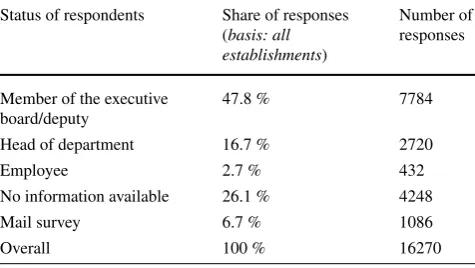
Lately, data on the respondent is collected in more detail, because the quality of data depends on the skills of the inter-viewer but also on the competence of the respondent. Infor-mation is gathered about the age and sex of the interviewee and their status within the establishment. The last variable is very important as only a person with a high status has the authority and the ability to answer the questions of the IAB Establishment Panel. Table7 shows the status of the person interviewed in 2012. When interpreting Table7one has to keep in mind that the data are originally not collected as paradata but to enable the research institute to contact the interviewee again should there be questions during the data editing. Therefore, for quite a lot of establishments the role or status of the respondent is not reported by the interviewer because the name of the respondent is deemed sufficient in this context.
to contact high ranking representatives in the firm is mostly met. To improve the data it is planned for future waves of the IAB Establishment Panel that the status of the respondents should be collected for all establishments in a standardized question.
The paradata are available (on request) for researchers if they want to include them in their multivariate analyses.
6 Linked-employer-employee data and data access The IAB Establishment Panel data can be linked to the in-dividual data of the employees working in the respective es-tablishments, because every individual in the Employment Statistics Register is assigned the identification number of the firm he or she is working for. This integrated employer-employee data set, the so called Linked Employer-Employee Data (LIAB) enriches the analytical potential of the IAB es-tablishment panel data, with information of the supply side of the labor market. The data about the employees is taken from the employment register of the German Federal Em-ployment Agency which is generated via social security data processing. The Linked Employer-Employee Data from the IAB (LIAB) allow for simultaneous analysis of the supply and demand sides of the German labor market.
Data access to the IAB Establishment Panel data for ex-ternal researchers is only possible via the Research Data Center of the German Federal Employment Agency (FDZ) because the establishments were assured complete data protection and anonymity of any published results. Fur-thermore, the Research Data Center makes several LIAB datasets for scientific use available. Access is provided in two ways: on-site use of the data or remote data access. For the remote data access researchers can test their computer programs with test data which are available online. After writing the analysis programs the syntax is sent to the FDZ by email and the analysis is conducted with the real data. After data protection checks the results are returned to the researcher. Additionally the FDZ provides more information about specific data products and working tools for users.10
The access is free of charge.
Another product supplied by the FDZ in the “demand-side context” is the Scientific Use File (SUF) of the wave 2007 of the IAB Establishment Panel. It was developed by the department of Statistical Methods of the IAB (KEM) and is the first SUF of establishment data in Europe (Drech-sler2011). For confidentiality reasons this data file contains fewer and further aggregated variables. After a permission to use the SUF is granted, the Scientific Use File may be
10More information is available at http://fdz.iab.de/de/FDZ_ Establishment_Data.aspx and http://fdz.iab.de/de/Integrated_ Establishment_and_Individual_Data/LIAB.aspx.
downloaded from an exchange server via a secure Internet connection by the user.
7 Internet ‘affinity’ of establishments
To secure the future viability of the IAB Establishment Panel there are ongoing discussions about possible method-ological adjustments. One of these discussions deals with the necessity, possibility and potential implications of a change in the survey mode. Face-to-face interviews with pa-per and pencil (PAPI) were state of the art at the beginning of the 1990th when the IAB Establishment Panel started. It is still the method of choice when high data quality and high-est possible response rates are to be achieved. In addition to the above mentioned properties it has the advantage that the questionnaire can be left in the establishment with the respondent to do some research if necessary and complete questions that couldn’t be answered without further effort.
Meanwhile there are alternative computer aided survey methods available and well established. Computer aided per-sonal interviews (CAPI) as possible alternative have some advantages compared to the traditional method:
– Validation and consistency checks during the interview, – automated skip patterns, so that only relevant parts of the
survey are shown, – dependent interviewing,
– provision of additional information.
With regard to possible changes of the survey mode of the IAB Establishment Panel—besides the necessity to control for possible effects of a mode change—it has to be checked that it would still be possible to complete the questionnaire on site without an interviewer being present. Otherwise re-sponse rates (unit and item) would decrease. There are es-tablishment surveys which use CAPI as the main mode of data collecting but to our knowledge there is no survey that handels the described problem/challenge of self-completing the interview within a computer aided design. There are so-lutions with a switch (back) to a printed questionaire (or part of it) which is left in the establishment (like in PAPI). This recourse to a paper and pencil version of the questionnaire somehow contradicts the whole idea of a computer aided survey mode. If the advantages of a computerized survey are to be fully exploited, a switch from the (then computer aided) face-to-face interview to a web based version of the questionnaire (CAWI) seems to be the only promising solu-tion.
Table 8 Internet access and
willingness to use 2012 (sample values)
Source: IAB Establishment Panel 2012
Establishment size
Internet access? Basis: all establishments
Willingness to use in survey?
Basis: establishments with internet access
Nr. Yes No Nr. Yes No
1–9 2 % 84 % 15 % 1 % 31 % 68 %
10–49 2 % 95 % 3 % 1 % 39 % 60 %
50–499 1 % 99 % 0 % 1 % 44 % 55 %
500 u.m. 2 % 98 % 0 % 1 % 48 % 51 %
Overall 2 % 92 % 6 % 1 % 38 % 61 %
or virtually non-existent.11 As a first step to gain reliable information concerning the access of the establishments to the Internet and especially the willingness to participate via the net and complete the questionnaire online a few corre-sponding questions were included in the 2012 wave of the IAB Establishment Panel. In the following some key results are presented that might also be interesting for the general debate on survey methodology.
To begin with the access to the Internet: Only 6 % of the establishments are not equipped with the technical re-quirements to use the web (about 2 % did not answer the question). As expected this inability to answer/complete a questionnaire online is strongly depending on the establish-ment size. In firms with 10 and more employees it is less than 2 %, with 50 and more employees it is just a handful. However, among small enterprises (less than 10 employees) about 15 % could not participate in a web-survey (Table8). Access to the Internet is of course just a prerequisite for participating in a web survey. The willingness and ability of the respondents to answer questions via the web is ob-viously quite a different story. Not less than 6 out of 10 owners/managers say that they could or would not do so. Like the technical requirements the willingness to partici-pate increases with the establishment size but not as dra-matic. Refusal is most probable among small enterprises (fewer than 10 employees) with 70 % and drops continu-ously to 40 % among large companies (500 and more em-ployees). The overall result might at least partly be driven by the fact that the establishments taking part in the IAB Establishment Panel are used to face-to-face interviewing, especially at the end of the interview when these additional questions were presented (Table9).
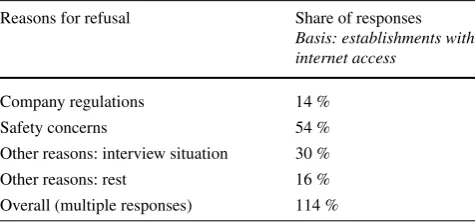
This predisposition/preoccupation is reflected in the an-swers to the follow up question why they wouldn’t com-plete such a questionnaire via Internet. As the main reason
11One of the few papers we found is a kind of practical guideline deal-ing with the introduction of web-based data collection in establishment surveys (Fox et al.2004). Quite different is the situation regarding individual or household surveys for which there is a vast literature about mode changes from PAPI to CAPI to CAWI and mixed-mode approaches.
Table 9 Reasons for a refusal to use the Internet (sample values)
Reasons for refusal Share of responses Basis: establishments with internet access
Company regulations 14 %
Safety concerns 54 %
Other reasons: interview situation 30 %
Other reasons: rest 16 %
Overall (multiple responses) 114 % Source: IAB Establishment Panel 2012
for their refusal the respondents mention “safety concerns” (54 %).12 Among the category “other reasons” (which should be stated as plain text) there were mainly such which refer to the interview situation itself. In 3 out of 10 estab-lishments the respondents obviously appreciate the personal contact with the interviewer and the fact that it is their coun-terpart who is responsible for a successful interview and the necessary organizing. In every 7th firm there are regulations or operating guidelines which do not allow the use of the Internet for such purposes.
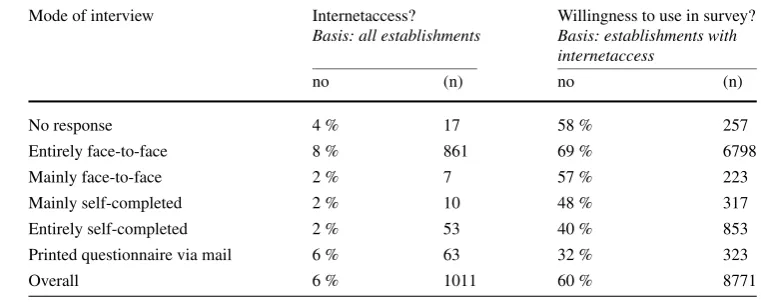
For conducting a web survey among establishments the above figures are rather discouraging. Two thirds of the sam-ple could or would not take part at all or comsam-plete the ques-tionnaire via the Internet most because of safety concerns, some because the respondents prefer the ‘comfortable’ face to face situation. For our concern—a possible change of the survey mode from PAPI to CAPI and CAWI—these figures must be broken down and seen in the context of the mode the interview in the IAB Establishment Panel was conducted (as shown above) (Table10).
With regard to a possible mode change in the IAB Es-tablishment Panel we are not talking about an overall web survey but computer aided personal interviews with an ad-ditional web mode for self completing. So we do not con-sider all the firms which answered completely face-to-face
Table 10 Internet access and
willingness to use by
interviewmode (sample values)
Source: IAB Establishment Panel 2012
Mode of interview Internetaccess? Basis: all establishments
Willingness to use in survey? Basis: establishments with internetaccess
no (n) no (n)
No response 4 % 17 58 % 257
Entirely face-to-face 8 % 861 69 % 6798
Mainly face-to-face 2 % 7 57 % 223
Mainly self-completed 2 % 10 48 % 317
Entirely self-completed 2 % 53 40 % 853
Printed questionnaire via mail 6 % 63 32 % 323
Overall 6 % 1011 60 % 8771
and are the main source of refusals. The interesting cases are those which answer or complete the questionnaire them-selves. All in all there are about 1850 respondents which receive the printed questionnaire either during the interview or via mail and state that they won’t (be able to) participate via the Internet.
For the mainly face-to-face interview a mode change would mean the loss of answers in a few variables and there-fore an increase in item non response depending on how many questions are left with the respondents to complete themselves The mainly or entirely self-completed question-naires would probably be lost in a CAPI/CAWI survey as would be the mail cases (interestingly the mode which shows the least reluctance to use the Internet). Further re-search is necessary to clarify what consequences this would have on the “continuer” sample and the replacement samples with regard to selectivity issues.
However, the at first sight rather discouraging result indi-cating widespread refusal is put into perspective when con-sidering the context of a possible mode change in the IAB Establishment Panel. It is nothing to be ignored but also no knock-out result.
8 Conclusion
The IAB Establishment Panel can look back at 20 years of successful data collection thereby providing the scientific community and policy makers with high-quality data. As a panel survey the methodological basics and conceptual per-spectives were set with its foundation. All efforts to main-tain and enhance the analytical power and data quality have to find the fine line between innovation and continuity.
Despite the fundamentally ‘conservative’ approach, in-novations take place but with caution and often rather in de-tail. Future adaptations of the modular system are a major point of such changes. Integrating new topics (which gained increasing attention in scientific and political debates) like ‘equal opportunities for men and women’ and ‘women in
executive positions’ are discussed. With a given space of the questionnaire and limits of what the establishments are will-ing to endure such intended extensions of the basic program require reductions in other modules.
The future main “field of innovation” will be a possible change in the survey mode of the IAB Establishment Panel. So far, the mainly face-to-face interviews with paper-and-pencil (PAPI) provide above average response rates (espe-cially for continuers). Still, it is important to look for alter-native, more up-to-date survey modes to ensure the viabil-ity of the IAB Establishment Panel. As mentioned before a method with many advantages would be a computer-aided-personal interview with a web questionnaire (CAPI/CAWI) that can be completed by the respondent if necessary. To learn more about the ramifications of a possible mode change first experiments are planned. The results will enable the IAB to decide whether the risk of a change in the survey mode can be taken without endangering the continuity of the panel.
Executive summary
20 years ago the first wave of the IAB Establishment Panel was launched in West Germany after a period of extensive conceptual work and testing. Declared objective of this un-dertaking was to establish a comprehensive dataset on the demand side of the labor market. From the beginning the project had to meet two requirements: generating high qual-ity data with high analytical potential for the scientific com-munity and providing an information system for policy mak-ers and practitionmak-ers.
of these modules are complemented by biennial asked ques-tions to broaden and accentuate the annual basic informa-tion. Moreover, in every questionnaire there is room for spe-cial topics that are determined by the stakeholders of the IAB Establishment Panel. These questions often cover cur-rent political topics and therefore ensure that the IAB Estab-lishment Panel not only provides data for longitudinal anal-yses but also up-to-date information on new political devel-opments.
Although it is crucial for a panel survey to provide com-parable information over the years on the basis of unal-tered questions the standard program of questions (annu-ally or bienni(annu-ally) is not set in stone. All changes are aimed to improve the analytical capacity of the dataset either by adding new contents or by providing additional structural information useful for econometric analysis. In some cases questions were removed or their complexity reduced, either because of unacceptable problems with the data quality or because the question was outdated by legal or structural de-velopments.
To ensure the quality of the survey new questions have to pass an assessment procedure to be accepted for the ques-tionnaire. In a cognitive pretest at least 100 interviews are conducted in establishments of different sizes and industries. The results of the pretest interviews and the comments of the respondents and interviewers are the basis for the research staff of the IAB Establishment Panel to discuss and evalu-ate together with the team of TNS Infrevalu-atest which questions are to be included in the questionnaire and which must be altered or dropped altogether.
The IAB Establishment Panel is conducted among estab-lishments from all sectors and establishment size classes in Germany. The survey is designed for longitudinal as well as cross-sectional analyses. In order to depict the change in the economy and to compensate for the effects of panel mor-tality, establishments are added to the sample every year. In a longitudinal framework the development of individual es-tablishments in the survey can be traced over a longer pe-riod of time. If that framework is chosen several definitions of a panel dataset are offered depending on the period con-sidered. According to this panel definitions respective panel weighting factors for longitudinal description are available. Of course users can define their own panel dataset according to their particular needs and their focus of research.
High data quality is one of the main concerns of the IAB-establishment panel. To achieve high response rates face-to-face interviews are conducted whenever possible. Usually the questionnaires are filled in during the interview by the interviewer, but it is also possible to leave the questionnaire with the representative of the firm if that is necessary to com-plete parts of the questionnaire or if it is preferred by the person interviewed.
As for other surveys paradata is produced for the IAB Es-tablishment Panel. The most important paradata are the in-formation on the interviewer, the person interviewed and the data collection mode. Furthermore, reasons why establish-ments were not able or willing to answer the questionnaire are collected. Data about the interviewers are also collected every year. This data allow evaluating basic demographics of the interviewers. Lately, data on the respondent are col-lected in more detail, because the quality of data depends on the skills of the interviewer but also on the competence of the respondent. Information is gathered about the age and sex of the interviewee and their status within the establish-ment. The paradata are available (on request) for researchers if they want to include them in their multivariate analyses.
To secure the future viability of the IAB Establishment Panel there are ongoing debates about possible methodolog-ical adjustments. One of these discussions deals with the ne-cessity, possibility and potential implications of a change in the survey mode to CAPI/CAWI. Some additional questions in the 2012 questionnaire on the Internet “affinity” of the es-tablishments provide first insights. To learn more about the ramifications of a possible mode change corresponding ex-periments are planned. The results will enable the IAB to decide whether the risk of a change in the survey mode can be taken without endangering the continuity of the panel.
Kurzfassung
Vor 20 Jahren wurde die erste Welle des IAB-Betriebspanels in Westdeutschland auf den Weg gebracht. Erklärtes Ziel war es, einen umfassenden Datensatz für die Nachfrage-seite des Arbeitsmarktes zu etablieren. Von Beginn an standen zwei Ziele im Mittelpunkt: einen Datensatz von ho-her Qualität mit weitreichendem Analysepotenzial für die Wissenschaft zu erzeugen und den politischen Entschei-dungsträgern ein zuverlässiges und belastbares Information-ssystem an die Hand zu geben.
Ein Panel-Datensatz steht und fällt zwar mit den Informa-tionen, die in jeder Befragungswelle in identischer Weise er-hoben werden. Nichts desto weniger ist auch das Standard-programm des IAB-Betriebspanels nicht in Stein gemeißelt. Die Veränderungen, die über die Jahre vollzogen wurden, zielten alle darauf ab das analytische Potenzial des Daten-satzes zu erhöhen, indem entweder neue Inhalte oder zusät-zliche Strukturinformationen für ökonometrische Analysen ergänzt wurden. In einigen Fällen sind auch Fragen entfernt oder deren Komplexität reduziert worden. Dies geschah en-tweder auf Grund von Problemen mit der Datenqualität oder weil die Fragen durch Entwicklungen im Feld obsolet wur-den.
Zur Sicherung der Datenqualität werden neu in das IAB-Betriebspanel aufzunehmende Fragen intensiv getestet und zwar im Rahmen eines kognitiven Pretest in über 100 Betrieben verschiedener Größenklassen und Branchen. Die Ergebnisse dieses Pretests mit den Kommentaren der Befragten und der Interviewer bilden die Basis für die Entscheidungsfindung, welche Fragen integriert, verändert oder gänzlich aussortiert werden.
Grundgesamtheit des IAB-Betriebspanels sind die Be-triebe aller Sektoren und Größenklassen mit mindestens einem sozialversicherungspflichtig Beschäftigten. Die Er-hebung ist sowohl für Längs- als auch Querschnittsanaly-sen konzipiert. Um die Dynamik in der Wirtschaft abzu-bilden und um die Panelmortalität auszugleichen, wer-den jedes Jahr neue Betriebe in die Stichprobe aufgenom-men. In der Längsschnittperspektive kann die Entwicklung des einzelnen Betriebs über einen längeren Zeitraum ver-folgt werden. Hierzu stehen verschiedene Paneldefinitio-nen im Datensatz zur Verfügung in Abhängigkeit des an-visierten Analysezeitraums. Für alle diese Paneldefinitionen stehen Längsschnitt-Gewichtungsfaktoren zur Verfügung. Die Nutzer des IAB-Betriebspanels können aber natürlich ihre eigenen Paneldatensätze erzeugen entsprechend ihrer spezifischen Forschungsperspektiven.
Eine hohe Datenqualität ist eines der zentralen Anliegen des IAB-Betriebspanels. Um hohe Response-Raten zu erre-ichen, werden so weit möglich persönlich-mündliche Inter-views durchgeführt. Grundsätzlich werden die Fragebögen während des Interviews vom Interviewer ausgefüllt. Es ist aber auch möglich, den Fragebogen im Betrieb zu hinter-lassen, wenn dies für dessen Komplettierung notwendig ist oder von der befragten Person so gewünscht wird.
Wie in anderen Erhebungen auch werden im IAB-Betriebspanel verschiedene Paradaten produziert. Die wichtig-sten davon beinhalten Informationen über den Interviewer, die befragte Person und die Erhebungsmethode. Darüber hinaus, werden die Gründe erhoben, weshalb ein Betrieb nicht in der Lage oder willens war zu antworten. Daten über die befragte Person werden gesammelt, nicht zuletzt um sicher zu stellen, dass die Befragten auch über die notwendige Kompetenz zur Beantwortung der Fragen ver-fügen. Die Paradaten stehen externen Wissenschaftlern (auf Nachfrage) zur Verfügung.
Appendix: Table11
Table 11 Regional extensions of the sample 1993 to 2013
1993 bis 1995
1996 bis 1997
1998 bis 1999
2000 2001 2002 bis 2003
2004 2005 2006 bis 2007
2008 2009 bis 2012
2013
Schleswig-Holstein x No financial contribution from 2004 on
Hamburg x x No financial contribution from 2002 on
Lower Saxony x x x x x x x x x
Bremen x x x x x x x x x
North Rhine-Westphalia x x x x x x x x
Hesse x x x x x x x x
Rhineland-Palatinate x x x x x x x x x
Baden-Württemberg x x x x x x x x x
Bavaria x x x x x x x x
Saarland x x x x
Berlin x x x x x x x x x x x
Brandenburg x x x x x x x x x x x
Mecklenburg-Western Pomerania x x x x x x x x x x
Saxony x x x x x x x x x x x
Saxony-Anhalt x x x x x x x x x
Thüringia x x x x x x x x x x x
Manufacturing Eastern Germany x x x x x x x x x x
Source: IAB Establishment Panel
References
Drechsler, J.: Methodenreport: Synthetische Scientific-Use-Files der Welle 2007 des IAB-Betriebspanels. In: FDZ-Methodenreport 01/2011 (2011)
Fischer, G., Janik, F., Müller, D., Schmucker, A.: The IAB estab-lishment panel * things users should know. Schmollers Jahrb. Wirtsch.- Soz.wiss. 129(1), 133–148 (2009)
Fox, J.E., Mockovak, W., Fisher, S.K., Rho, C.: Usability issues asso-ciated with converting establishments surveys to web-based data collection. Statistical policy working paper 38, Federal Commit-tee on Statistical Methodology (2004)
Janik, F., Kohaut, S.: Why don’t they answer? Unit non-response in the IAB establishment panel: quality and quantity. Int. J. Methodol.
46(3), 917–934 (2012)
Kössler, R.: WZ 2008: Die neue Ordnung der wirtschaftsstatistischen Welt. In: Statistisches Monatsheft Baden-Württemberg, vol. 8, pp. 23–32 (2009)
Statistisches Bundesamt: Klassifikation der Wirtschaftszweige (2008). https://www.destatis.de/DE/Methoden/Klassifikationen/ GueterWirtschaftklassifikationen/klassifikationwz2008_erl.pdf?__ blob=publicationFile. Zugriff 08.05.2013
Winship, C., Radbill, L.: Sampling weights and regression analysis. Sociol. Methods Res. 23, 230–257 (1994)
Peter Ellguth studied sociology at the University of
Erlangen-Nürnberg. Since 1996 he is a senior researcher at the Institute for Employment Research in Nuremberg. He is part of the research team responsible for the IAB Establishment Panel. His current fields of spe-cialization include industrial relations, working time regulations, pub-lic sector employment and firm flexibility.
Susanne Kohaut is a senior researcher at the Institute for
Employ-ment Research in Nuremberg. She studied business economics at the University of Bamberg where she received her Ph.D. She is part of the research team responsible for the IAB Establishment Panel. Her current fields of research include industrial relations, public sector em-ployment and gender diversity in top management.
Iris Möller is a senior researcher at the Institute for Employment