R E S E A R C H
Open Access
Publicly verifiable and
efficiency/security-adjustable outsourcing
scheme for solving large-scale modular
system of linear equations
Panpan Meng
1, Chengliang Tian
1,2,3*and Xiangguo Cheng
1Abstract
Solving large-scale modular system of linear equations (LMSLE) is pervasive in modern computer and communication community, especially in the fields of coding theory and cryptography. However, it is
computationally overloaded for lightweight devices arisen in quantity with the dawn of the things of internet (IoT) era. As an important form of cloud computing services, secure computation outsourcing has become a popular topic. In this paper, we design an efficient outsourcing scheme that enables the resource-constrained client to find a solution of theLMSLEwith the assistance of a public cloud server. By utilizing affine transformation based on sparse unimodular matrices, our scheme has three merits compared with previous work: 1) Our scheme is
efficiency/security-adjustable. Our encryption method is dynamic, and it can balance the security and efficiency to match different application scenarios by skillfully control the number of unimodular matrices. 2) Our scheme is versatile. It is suit for genericm-by-ncoefficient matrixA, no matter it is square or not. 3) Our scheme satisfies public verifiability and achieves the optimal verification probability. It enables any verifier which is not necessarily the client to verify the correctness of the results returned from the cloud server with probability 1. Finally, theoretical analysis and comprehensive experimental results confirm our scheme’s security and high efficiency.
Keywords: Cloud computing, Secure computation outsourcing, Modular system of linear equations, Unimodular
matrix transformation, Privacy-preserving
Introduction
With the rapid development of 5G technologies, the Internet of things (IoT) era is coming. More and more intelligent devices are connected to the internet and com-municate with each other, which will greatly facilitate peo-ple’s life [1–3]. It is predicted by the technology research firm Gartner that there will be 26 billion smart devices on
the Internet of Things (IoT) by 2020 [4]. However,
quanti-ties of these devices, such as wearable devices, home appli-ances, and RFID cards, suffer from limited computing ability, low storage space and constrained communication bandwidth. It is unrealistic for these resource-constrained
*Correspondence:[email protected]
2Business School, Qingdao University, Qingdao 266071, China 3State Key Laboratory of Information Security, Institute of Information Engineering, Chinese Academy of Sciences, Beijing 100093, China Full list of author information is available at the end of the article
devices to perform large-scale data computation and storage task. Fortunately, cloud computing, as a type of Internet-based computing, offers availably abundant processing resources to electronic devices on demand. Under this promising computing paradigm, the resource-constrained clients can outsource their overloaded com-putations and storages to the resource-abundant cloud servers without the investment of purchasing and main-taining their own computing facilities. Although it brings many advantages, the fact that clients and cloud servers are not necessarily in the same trusted domain brings
many security issues and challenges [5–7]. On the one
hand, the clients’ outsourcing data may contain their sen-sitive information such as proprietary research data, pri-vate asset records, and personal health information, etc. The exposure of these critical information could incur the severe loss of clients’ credit, economic, spirit, life
and asset. On the other hand, the physical isolation from the clients and external ill-disposed economic incentives may make cloud servers curious, lazy and even mali-cious, and then steal clients’ private information and return random, or deliberately forged results to the clients. Therefore, a security outsourcing scheme should fulfill the
following properties [8, 9]: (1) Correctness. The clients
should obtain the correct computation results if the cloud servers conduct the assigned computation task honestly. (2) Input/output privacy. The curious or even malicious cloud servers can not steal or speculate clients’ actual input/output information. (3) Verifiability. The clients can verify the correctness of the results returned from the cloud servers. (4) Efficiency. The scheme must be effi-cient. That is, the clients’ time/space cost of performing the large-scale data computation/storage task should be substantially cheaper than that of performing the task by themselves.
For some given integerq, a vectorb∈Znqand a full
(col-umn or row) rank matrixA∈Zmq×n, solving the modular
systems of linear equations
Ax≡b modq (1)
is a fundamental computational problem in modern com-puter algebra [10]. It has various applications in informa-tion and communicainforma-tions fields. For example, in coding
theory, we needs to solve this problem to decode q-ary
linear code [11,12], and, in lattice-based cryptography, it is used for generating signatures and private keys in the signature and encryption/decryption schemes based on
Small Integer Solution (SIS) [13] and Learning with Errors
(LWE) problems [14–16]. Also, it frequently emerges in
machine learning [17]. The classic algorithm of solving
this problem is Gaussian elimination with a time complex-ity ofO(mn2(logq)2). It is efficient when the size ofAis small. However, the exponential growth in the quantity of data generated in IoT era makes us often have to deal with large-scale matrices. For example, the recent
post-quantum key exchange protocol [18] requiresm,n≥1024
andq=232−1, and its improved variant [19] also requires
m,n≥1024 andq=12289. For the large-scale matrixA,
the Gaussian elimination becomes time-consuming which may result in the infeasible for the resource-constrained clients to solve this problem. Therefore, it is of great necessity to design an efficient algorithm to securely out-sourcing the solving of the large-scale modular system of
linear equations(LMSLE).
Obviously, when A is square and invertible modulo
q, the (LMSLE) problem (1) has a unique solution
in Zq which can be denoted as x = A−1b modq.
In this case, we can realize the securely outsourcing of (LMSLE)by designing an efficient method to outsource
the inverse of A modulo q. Although many researches
have considered the outsourcing of large-scale matrix
inversion computation [20–22], they focused on matrices
over the real field R or the finite field Fq and the
probability of verifiability can not achieve the optimal 1. Furthermore, the existing methods only designed for a
square and invertible matrixA, while here we consider a
generalm-by-nmatrixA. Another viable way is directly
considering the secure outsourcing ofLMSLE. Through
imitating the currently most efficient outsourcing
algo-rithm of large-scale system of linear equations (LSLE)
[23], one may want to blind the input (A,b) and the output
xby sparse matrix transformations and translation vector.
However, just as the authors’ mentioned in the paper, their method can not provide strong enough privacy. There-fore, how to design an efficient and strong enough security
outsourcing scheme for a general input matrixAis left as
a meaningfully practical problem.
Our contributions
To address the above-mentioned problem, in this paper, we put forward an efficiency/security-adjustable
out-sourcing scheme to find a solution vector of theLMSLE
problemAx≡b modqin case that the problem is
solv-able. Also, our scheme is publicly variable, i.e. any verifier (not necessarily the client) can assess the correctness of the server’s results. The main technique involved in our scheme essentially can be treated as an improvement of
Zhang et al.’s technique [22] and Chen et al.’s technique
[23], which makes our scheme superior in the following
three aspects:
1) Our scheme provides an adjustable encryption method based on successively sparse unimodular matrix transformations. That is, we can adjust the number of sparse unimodular matrices in the scheme to balance security and efficiency to match the different application scenarios.
2) Our scheme is applicable to any matrixAsuch that Ax≡b modqis solvable, no matter it is square or non-square.
3) Our scheme are publicly verifiable and achieves the optimal verifiability probability 1. In other words, our scheme allows the client to delegate the verification task to any honest or even curious edge server without leaking the client’s private information. Additionally, the verifier (e.g. the client or the third-party edge server) can detect the cloud server’s misbehaviors with optimal probability 1.
Organization
The rest of our paper is arranged as follows: In “Security
model and definitions” section, we illustrate the system model and related definitions in our outsourcing design of
scheme and its correctness, privacy, verifiability and
effi-ciency analysis are presented in “Main scheme” section,
and “Performance evaluation” section evaluates the
prac-tical performance of the proposed scheme by compre-hensive experiments. We survey the related work in “Related work” section. Finally, we conclude our paper in “Conclusion and future direction” section.
Security model and definitions
System model
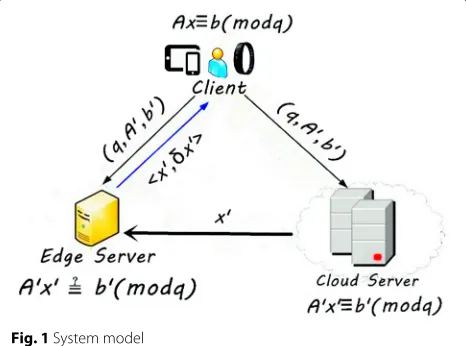
As shown in Fig. 1, the system model of our secure
outsourcing schemeSOSLMSLE (q,A,b)involves three
entities: a resource-constrained clientC, a remote public
cloud serverS, and an edge serverEclosed toC.
Client: The client C is with constrained computing resource and storage space. It intends to securely find a solution of the large-scale modular system of linear
equationsAx≡b modqby leveraging the cloud server’s
computation resource. To keep the privacy of the input (A,b)and the output (solution vector)x,Cfirstly gener-ates a secret keySK and utilizes it to encrypt(A,b)into (A,b), and then sends(q,A,b)toSandE.
Cloud server: The cloud serverSis public and
resource-abundant, yet it is far from the client C and thus
maybe untrusted. After receiving (q,A,b), S performs the assigned computation task that solving another
large-scale modular system of linear equations Ax ≡ b
modq, and returns the solution vectorxtoE.
Edge server: The edge serverEis semi-public and has more computing power and larger storage space than that
of the clientC. However, compared with the cloud server
S, edge server’s resource is also limited, so it cannot sup-port complex computation task. In our outsourcing sys-tem, it mainly assists the client to verify the correctness of
the returned result fromS. Noteworthily, the verification
task also can be conducted by the client itself, and thus
Fig. 1System model
this entity is optional in our system and here mainly used to illustrate the public verifiability of our scheme.
Formally, the framework of our system model consists of the following five probabilistic polynomial time (PPT) algorithms:
1) KeyGen(, 1m, 1n)→ {SK}: On input aLMSLE problem instance=(q,A,b)withA∈Zmq×n, this algorithm performed by the clientC generates a random secret keySK which should be kept secret byC.
2) CEnc(,SK)→ {}: Utilizing the secretSK, the clientC performs this algorithm to encrypt the input instance=(q,A,b)into a blind input
=(q,A,b), and sendsto the cloud serverS and the edge serverE.
3) SCom()→ {x}: After receiving the encrypted input=(q,A,b), the cloud serverS invokes this algorithm to solve the large-scale modular system Ax≡b modq, and returns a solution vectorxto the edge serverE.
4) EVer(x,)→ {x,δx}: This algorithm performed by the edge serverE firstly verifies the correctness of thexreturned fromS. Ifxis correct, thenδx =1. Else,δx =0. At last, the algorithm sends(x,δx)to the clientC.
5) CDec(x,δx,SK)→x∪ ⊥: This algorithm is performed by the clientC. If the inputδx =1, then the algorithm uses the secret keySK to decryptx into the actual solution vectorx. Otherwise, the algorithm outputs⊥.
Threat model
Standing at the client’s perceptive, the threats in our com-putation outsourcing system mainly originate from the
credibility of the cloud server S and the edge server E.
According to the misbehaviors of servers, the threats mainly come from the following two types of servers: the honest-but-curious (HBC)server, and thefully malicious
(FM)server.
HBC server: the server will perform the specified
computation task honestly and return the correct cal-culation result. However, it is curious about the actual input/output information, and tries to steal the client’s valuably private information for selfish purposes.
FMserver: the server not only wants to steal the client’s
private information, but also may arbitrarily deviate from the specified computation task and returns a random or even a tactical forged result to fool the client.
Clearly, For the HBC server, a secure
outsourc-ing scheme must ensure the privacy of the client’s
input/output information. While, For the FM server, an
In the light of the different misbehaviors of the two servers in our system model, there exist four possible
threat models: HBC-cloud + HBC-edge, FM-cloud +
HBC-edge,HBC-cloud +FM-edge, and FM-cloud+FM
-edge. Since the cloud server is remote and out of control, and the edge server is semi-public which can be deemed as an interior small server for a group, we consider the
threat model as the combination of aFMcloud server and
aHBCedge server.
Design goals
To design an efficient outsourcing scheme under theFM
-cloud+HBC-edge servers model, the scheme should at
least fulfill four properties:correctness, privacy, verifiabil-ityandefficiency.
The first requirementcorrectnessmeans that the scheme
enables the client to acquire one solution vector of the
LMSLE problem if the cloud server honestly performs the specified computation task.
Definition 1(Correctness)A secure outsourcing com-putation schemeSOSLMSLE(·)is correct if, for any valid input = (q,A,b), the key generation algorithm pro-duces {SK} ← KeyGen(, 1m, 1n) such that, if { =
(q,A,b)} ←CEnc(,SK),x ←SCom()andAx ≡ b modq, the algorithmCDec(x,δx,SK)outputsx sub-ject toAx≡b modq.
The second requirement is privacy which means the
scheme should guarantee aFMor aHBCserver can not
obtain the client’s actual input/output information with a overwhelming probability.
Definition 2 (Input/Output privacy)A secure out-sourcing computation schemeSOSLMSLE(·)satisfies the input (resp. output) privacy if, for any valid input =
(q,A,b), the key generation algorithm produces{SK} ← KeyGen(, 1m, 1n) such that the probability that the cloud/edge server can recover (A, b) (resp. x satisfying Ax≡ b modq) is negligible even if the cloud/edge server knows { = (q,A,b)} ← CEnc(,SK) and x ← SCom().
The third requirementverifiability means the scheme
can verify the correctness of the result returned from the cloud server with a nonnegligible probability.
Definition 3 ((1 − β)-Verifiability)A secure out-sourcing computation schemeSOSLMSLE(·)is(1−β) -verifiability if, for any valid input = (q,A,b),
the key generation algorithm produces {SK} ←
KeyGen(, 1m, 1n) such that, if { = (q,A,b)} ← CEnc(,SK), and{x} ← SCom(), the probability of EVer(x,)outputtingδxsatisfies
Pr[δx =1←EVer(x,)|Ax≡b modq]=1, Pr[δx =1←EVer(x,)|Ax=b modq]≤β.
Finally, the scheme should be efficient. In other words, the scheme should enable the client to achieve substantial computation savings compared to performing the work on client’s own.
Definition 4(α-Efficiency)A secure outsourcing com-putation scheme SOSLMSLE(·) is α-efficiency if, sup-pose,for any valid input = (q,A,b), the client’s time overhead of solvingAx ≡ b modq on its own is toriginal,
and the local-client’s time overhead of performing the task
by performing the outsourcing algorithmSOSLMSLE()
is tclient,toriginal
tclient ≥α.
It is worth mentioning that the factor α in the above
definition measures the level of outsourcing scheme’s
effi-ciency. Clearly, The larger the factorαbecomes, the more
computational savings the local-client achieves and the
more efficient the schemeSOSLMSLE(·)is.
Preliminaries
In this section, we review the frequently used symbols in this paper and some necessary basic concepts involved the design of our scheme.
Notations and terminologies
Throughout the paper, we use capital and bold (resp. lower-case and bold) letters to denote matrices (resp.
vec-tors). For some matrix A(resp. vectorb), AT (resp.bT)
denotes the transposition of matrix A (resp. vector b),
det(A) denotes the determinant of A. LetZdenote the
set of integers and Zq = {0, 1,· · ·,q − 1} denote the
residue ringZ/qZ.Zmq×nrepresents the set of all them×n
matrices whose entries belong toZq.
Unimodular matrix
Unimodular matrices are a special kind of integer matri-ces, which has wide applications in computer science community, especially in matrix computation theory,
cod-ing theory and lattice-based cryptography [24].
Definition 5(Unimodular matrix [25])An n-by-n inte-ger matrixU is unimodular if and only its determinant det(U)=1ordet(U)= −1.
A very “nice” property of unimodular matrix is that the inverse of an unimodular matrix is still unimodular. Here we list it as a lemma and omit its proof.
UV = In×n and|det(V)| = 1, where In×n denotes the
n-by-n identity matrix.
For instance, for the unimodular matrixU=
3 2 4 3
, its
inverse isV=
3 −2
−4 3
with det(V)=3×3−(−2)× (−4)=1, which is trivially unimodular.
Now, we prove another important result about the unimodular matrix, which is very useful in the forth-coming analysis of our scheme’s input/output privacy in “Input/output privacy” section.
Lemma 2LetPdenote the set
X|X=
x11 x12 x21 x22
∈X2×2anddet(V)= ±1
,
(2)
whereX = Z∩(−2λ, 2λ)denotes the set of the integers with bit length no larger thanλ. Then the size ofPsatisfies
#P≥ 48
π2(2
λ−1)2.
ProofFrom the definition of P, ∀X ∈ T, |det(X)| =
|x11x22−x21x12| =1. Since the number of the unimodu-lar matrices with determinant 1 is the same as that of the
unimodular matrices with determinant−1, we only count
the number of unimodular matrices with determinant 1 (i.e.x11x22−x21x12=1).
Sincex11x22 −x21x12 = 1, we have gcd(x11,x21) = 1. Clearly, for any relatively prime pair(a,b)∈X×X, there
exists at least one unimodular matrix inP. According to
the proof of Theorem 3.9 in reference [27], the number of
relatively prime pairs inX×Xis no less thanπ242(2λ−1)2. Therefore, the number of unimodular matrices with determinant 1 is at leastπ242(2λ−1)2.
Consequently, the size ofPsatisfies
#P≥224
π2(2
λ−1)2= 48 π2(2
λ−1)2.
Main scheme
A bird’s-eye view of the Main idea
Given an integerq, a vectorb ∈Zmq and a large-scale full (column or row) rank matrixA∈Zmq×n, we intend to find
a solution vectorxsuch that
Ax≡b modq (3)
in case that the system is solvable. Since the size ofAis
very large, the resource-constrained client wants to dele-gate such overload work to a public and maybe not trusted cloud server in a secure way.
In case that the system (3) has a unique solution, we
can achieve the above objection by securely outsourcing
the pseudoinverse ofAmoduloq. Then we can recover
the unique solutionx=(ATA)−1ATb modq. However,
this method requires that the matrixAis full column rank
(i.e. m ≥ n) and the product matrix ATAis invertible moduloq (i.e. gcd(det(ATA),q) = 1). Also, the existing
outsourcing algorithms [22,28] for matrix inversion only
detect the cloud server’s misbehavior with a certain prob-ability and thus do not achieve the optimal verifiprob-ability 1. Another direction is along the way of securely outsourcing
LSLE[23,29]. We can blind the inputsA,band the
out-putxsimultaneously by performing random sparse matrix
transformations onAand adding a random vectorrtox.
In other words, we can convert the Eq. (3) into
MANN−1(x+r)≡M(b+Ar) modq, (4)
whereM,Nare two random sparse (or even permutation)
matrices. Briefly, we denote the linear system (4) as
Ax≡b modq, (5)
out of whichA=MAN,x=N−1(x+r)andb=M(b+
Ar). This method can be applied for general (non-square)
matrixAand achieve the optimal verifiability.
Nonethe-less, this kind of simple sparse matrix transformation can not provide strong enough privacy. E.g. it may leak the
statistical information of certain entries in the matrixA.
Therefore, to design an efficient outsourcing algorithm for
general matrix Awith high security, a natural idea is to
combine the above-mentioned techniques.
Different from the encryption method in [23] which
encrypts A by only two sparse matrices, we blind the
matrix A by dense enough matrices. Inspired by the
method introduced in [22], we present a dynamic and
adjustable method to encrypt the original matrix by using a series of sparse and unimodular matrix transformations.
That is, the A in Eq. (5) is obtained by the following
method
A=Uf(m)· · ·U1AV1· · ·Vg(n), (6)
whereUi,Vjare sparse and unimodular matrices for 1 ≤
i ≤ f(m), 1 ≤ j ≤ g(n). To ensure the efficiency of
the encryption operation, thef(m)(resp.g(n)) should be
some linear function of m (resp. n) and the
computa-tion ofA can be efficiently implementation by virtue of
Outsourcing scheme ofAx≡b modq
Concretely, our secure outsourcing scheme
SOSLMSLE(q, A,b) consists of the following five algorithms.
1) Pre-processing: Given a small constantλ >0, this step generates a large resource poolPconsisted of 2-by-2 random unimodular matrices as shown in equation (2).
2) KeyGen: On input a triple(q,A,b)withq∈Z, A∈Zmq×nandb∈Zmq. The clientC generates a random secret key
SK =(U1,· · ·,Uf(m),V1,· · ·,Vg(n),r)as follows: Firstly, this algorithm chooses some non-negative integerc which is adjustable according to different application scenarios, and defines
f(m)=c(m−3)+(c+1)+(m−2)and g(n)=c(n−3)+(c+1)+(n−2).
Secondly, for1≤i≤f(m)and1≤j≤g(n), it randomly chooses 2-by-2 unimodular matrices
U(i)=
u(11i) u(12i) u(21i) u(22i)
andV(j)=
v(11j) v(12j) v(21j) v(22j)
from the
resource poolP. Further, if
i=2k(m−3)+(2k+1)+(−1)or i=2k(m−3)+(2k+1)−(−1)for some 1≤≤m−1and0≤k≤c, this algorithm generates them-by-m unimodular matrix
Ui=
⎛ ⎜ ⎜ ⎜ ⎜ ⎜ ⎜ ⎜ ⎜ ⎜ ⎝
1 · · · 0 0 · · · 0 ..
. . .. ... ... ... ... 0 · · · u(11i) u(12i) · · · 0 0 · · · u(21i) u(22i) · · · 0
..
. ... ... ... . .. ... 0 · · · 0 0 · · · 1
⎞ ⎟ ⎟ ⎟ ⎟ ⎟ ⎟ ⎟ ⎟ ⎟ ⎠
∈Zm×m, (7)
by replacing the entries located in(,),(,+1),
(+1,)and(+1,+1)positions of the identity matrixIm×mwithU(i). Also, if
j=2k(n−3)+(2k+1)+(−1)or j=2k(m−3)+(2k+1)−(−1)for some 1≤≤n−1and0≤k≤c, this algorithm generates then-by-n matrix
Vj=
⎛ ⎜ ⎜ ⎜ ⎜ ⎜ ⎜ ⎜ ⎜ ⎜ ⎝
1 · · · 0 0 · · · 0 ..
. . .. ... ... ... ... 0 · · · v(11j) v(12j) · · · 0 0 · · · v(21j) v(22j) · · · 0
..
. ... ... ... . .. ... 0 · · · 0 0 · · · 1
⎞ ⎟ ⎟ ⎟ ⎟ ⎟ ⎟ ⎟ ⎟ ⎟ ⎠
∈Zn×n (8)
by replacing the entries located in(,),(,+1),
(+1,)and(+1,+1)positions of the identity matrixIn×nwithV(j).
Finally, this step randomly generate a vectorr∈Znq. 3) CEnc: Utilizing the secret keySK=(U1,· · ·,Uf(m),
V1,· · ·,Vg(n),r), the clientC encrypts the original
matrixAand the vectorbinto
A=(Uf(m)· · ·(U1((AV1)· · ·Vg(n)))) modq
(9)
andb=(Uf(m)· · ·(U1(b+Ar))) modq
respectively, and then sends(A,b,q)to the cloud serverS.
4) SCom: After receiving the blinded values(A,b)and q, the cloud server S finds a solution vectorxsuch thatAx≡b modq, then returnsxto the edge serverE.
5) EVer: After receivingx, the edge serverE first verifies whether the equationAx≡b modq holds. If it does, the algorithm definesδx =1. Else, it definesδx =0. Then it sends(x,δx)toC.
6) CDec: After receiving(x,δx)sent fromE, the client C first check the value ofδx. Ifδx =1, the algorithm outputs
x=(V1(V2· · ·(Vg(n)·x)))−r modq, (10) Otherwise, it outputs⊥.
Example 3:To make our scheme more clear, we further
illustrate it with a toy example. Takem= n=3,f(m) =
g(n)=2,q=7, the original matrix
A= ⎛ ⎝1 2 36 0 5
4 6 6 ⎞ ⎠, b=
⎛ ⎝16
0 ⎞ ⎠.
We omit the preprocessing step. Our scheme goes as follows.
1) The clientC invokes the algorithmKeyGento generate a random secret key
SK =(U1,U2,V1,V2,r). Let U1=
⎛ ⎝1 2 02 3 0
0 0 1 ⎞ ⎠, U2=
⎛ ⎝1 0 00 1 3
0 2 5 ⎞ ⎠,r=
⎛ ⎝65
6 ⎞ ⎠,
V1= ⎛
⎝−21 2−3 00
0 0 1
⎞ ⎠, V2=
⎛ ⎝1 00 −1 30
0 2 −5
⎞ ⎠
2) The clientC invokes the algorithmCEncto compute
A=(U2U1((AV1)V2)) mod 7= ⎛ ⎝5 6 25 3 2
2 5 1 ⎞ ⎠,
b=(U2U1(b+Ar)) mod 7=
⎛ ⎝43
ThenC sends the three-tuple(q,A,b)to the cloud serverS.
3) The cloud severS conducts the algorithmSComto find a solution vectorxsatisfyingAx≡b modq. Namely,
⎛ ⎝5 6 25 3 2
2 5 1 ⎞ ⎠·
⎛ ⎝x
1 x2 x3
⎞ ⎠=
⎛ ⎝43
0 ⎞
⎠ mod 7.
ThenS returns the solution
x= ⎛ ⎝x
1 x2 x3
⎞ ⎠=
⎛ ⎝35
4 ⎞ ⎠
toE.
4) The edge serverE performs the algorithmEVerto verify whetherAx≡b modq. Since it holds,E sends(x, 1)toC.
5) Sinceδx =1, the clientC performs the algorithm CDecto decrypt
x=(V1(V2x)−r) mod 7= ⎛ ⎝51
5 ⎞ ⎠.
Remarks 1In the preprocessing step, the set P can be constructed through the following method: for the 2-by-2 unimodularXwith determinant 1, the client C randomly chooses two coprime integers x11,x21 ∈ X, and then runs the well-known extended Euclidean algorithm to compute two integers x12 and x22 subject to x11x22 −x12x21 = 1. Swapping the two columns of the matrix with determinant 1, the client C can obtain the matrix with determinant -1.
Correctness
It is easy to see that our scheme is correct for our toy example. Now, we prove the correctness of the proposed scheme for arbitrary instance.
Theorem 1For any valid inputs q ∈ Z,b ∈ Zmq, andA ∈ Zmq×n, the proposed secure outsourcing scheme SOSLMSLE(q,A,b) is correct according to the defini-tion1.
ProofFor the inputsq ∈ Z,b ∈ Zmq, assume that the SKproduced by the algorithmKeyGenis(U1,· · ·,Uf(m),
V1,· · ·,Vg(n),r). Then, invoking the encryption algorithm CEnc,
A=(Uf(m)· · ·(U1((AV1)· · ·Vg(n)))) modq
andb =(Uf(m)· · ·(U1(b+Ar))) modq. If the resultx
computed by the cloud server satisfiesAx ≡b modq,
the algorithmEVersends(x, 1)to the clientC. Therefore,
the algorithmCDecoutputs
x=V1(V2· · ·(Vg(n)·x))−r modq,
which satisfies
Ax=AV1(V2· · ·(Vg(n)·x))−r modq
=AV1V2· · ·Vg(n)·x−Ar modq
=(Uf(m)· · ·U1)−1(Uf(m)· · ·U1)AV1V2· · ·Vg(n)·x
−Ar modq
=(Uf(m)· · ·U1)−1Ax−Ar modq
=(Uf(m)· · ·U1)−1b−Ar modq
=(Uf(m)· · ·U1)−1(Uf(m)· · ·U1(b+Ar))−Ar modq
=b+Ar−Ar modq
=b modq.
Namely, x = (V1(V2· · ·(Vg(n) · x))) − r modq is
a solution of Ax ≡ b modq. That is, the algorithm
CDec(x,SK)outputs correct result.
Input/output privacy
Now, following the analysis of the work [23], we prove
that the input (A,b) and the actual outputx is private
against theFMcloud server and theHBCedge server in
our scheme.
Theorem 2For any valid inputs q ∈ Z,b ∈ Zmq,A ∈ Zm×n
q ,(A,b)(resp.x) in our proposed secure outsourcing
algorithm SOSLMSLE(q,A,b) satisfies the input (resp. output) privacy according to the Definition2.
ProofFirst, we prove the privacy for the input vectorb and the output vectorx. Sinceb = U−11· · ·U−f(1m)b−Ar modq,x = (V1(V2· · ·(Vg(n)·x)))−r modq,r ∈ Znq
is random andAis full rank, bothbandxare blinded by
rin sense of indistinguishability. That is, the cloud/edge
server has to guess the value ofb(resp.x), and then the
probability is
1 #Zm
q
= 1
qm
resp. 1
#Zn q
= 1
qn
,
which clearly is negligible function ofm(resp.n).
A-privacy: If the cloud/edge server wants to steal the
information of the original coefficient matrixA, since it
knows the ciphertext matrix
A=Uf(m)· · ·U1AV1· · ·Vg(n) modq,
it can recoverAby computing
LetU=U−11· · ·U−f(1m)andV=V−g(1n)· · ·V−11. Then
aij= m
s=1
n
t=1
uisastvtj modq.
Sinceuis,vtjare random,aijis also indistinguishable with
a random number inZq. The cloud/edge server can guess
aijby brute-force attack, in which case the probability of
recoveringA=(aij)1≤i≤m,1≤j≤nis
1 #Zmq+n
= 1
qm+n.
It is clearly a negligible function ofm(resp.n).
Another feasible way of recoveringA is to obtain the
unimodular matrices Ui andVj for 1 ≤ i ≤ f(m) and
1 ≤ j ≤ g(n). Since each Ui (resp. Vj) is constructed
by a 2-by-2 unimdoular matrix randomly chosen from a setP with size #P ≥ π482(2λ−1)2, the probability of the cloud/edge server can guess the correctUi(resp.Vj) is
1
#P ≤
1 48
π2(2λ−1)2 ,
Overall, the probability of the malicious cloud server can
guess the correctAis
1 #P
f(m)+g(n)
≤
1 48
π2(2λ−1)2
f(m)+g(n)
,
which also is negligible function ofm(resp.n).
Verifiability
In this section, we will prove that the edger server and thus the client can detect the cloud server’s misbehaviours with probability 1. Strictly speaking, we have the following result.
Theorem 3For any valid inputs q ∈ Z,b ∈ Zmq, A ∈ Zmq×n, the proposed secure outsourcing algorithm SOSLMSLE(A,q,b) is 1-verifiability according to the Definition3.
ProofBased on the Definition3, we need to prove the following two conditional probability identities:
Pr[δx =1←EVer(x,)|Ax≡b modq]=1,(11) Pr[δx =1←EVer(x,)|Ax=b modq]=0.(12) The identity (11) is straightforwardly from the correctness of our scheme, and the identity (12) is also obviously from the definition of algorithmEVer(x,).
Efficiency
LettKeyGen,tCEnc,tSCom,tEVerandtCDecdenote the time overhead of corresponding algorithm in our scheme.
Overhead of KeyGen. In the key generation step, the
secret keySK = (U1,· · ·,Uf(m),V1,· · ·,Vg(n),r)is gen-erated by randomly chosen operation. Since the size of key space #P ≤28λand the size ofZnqisqn, the time overhead of this step istKeyGen=O((f(m)+g(n))λ+nlogq).
Overhead ofCEnc. In the encryption step, the client can
computeA = (Uf(m)· · · (U1((AV1)· · ·Vg(n)))) modq, and b = (Uf(m)· · ·(U1(b + Ar))) modq by associa-tivity. Therein, computingA requires 4mg(n)+4nf(m)
multiplications over ring Zq, and computingb requires
mn+4f(m)multiplications over ringZq. Since the
multi-plication operation is performed on two integers with bit
length no more than logq, the time overhead of this step
istCEnc=O((mg(n)+nf(m)+mn)(logq)2).
Overhead ofSCom. In the cloud server computation step,
C needs to solve the large-scale modular system of
lin-ear equationsAx modqwhich has a time complexity of
tSCom=O(mn2(logq)2).
Overhead of EVer. In the edge server verification step,
E also needs to compute Ax modq, which requires
mn multiplications over ring Zq. Also, the
multiplica-tion operamultiplica-tion is performed on two integers with bit
length no more than logq. Therefore,tEVer = tSCom =
O(mn(logq)2).
Overhead of CDec. In the client decryption step, the
client needs to computex= (V1(V2· · ·(Vg(n)·x)))−r
modq,which requires 4g(n)multiplications over ringZq.
Also, the multiplication operation is performed on two
integers with bit length no more than logq. Therefore,
tCDec=O(g(n)(logq)2).
Sincef(m)(resp.g(n)) is a linear function ofm(resp.n)
andλis a small constant, the overall time overhead on the
client side is
tclient=tKeyGen+tCEnc+tCDec
=O((mg(n)+nf(m)+mn)(logq)2)
=O(mn(logq)2).
The time overhead of the cloud serverSis
tcloud=tSCom=O(mn2(logq)2),
and the time overhead of the edge serverEis
tedge=tEVer=O(mn(logq)2).
Since, if the client performs the work by itself, the time overhead isto = O(mn2(logq)2). Therefore efficiency in
Definition4is
α= toriginal
tclient = O
mn2(logq)2 mn(logq)2
Theorem 4For any valid inputs q ∈ Z,b ∈ Zmq, A ∈ Zmq×n, the proposed secure outsourcing algorithm SOSLMSLE(A,q,b) is O(n)-Efficiency according to the Definition4.
Performance evaluation
To evaluate the practical performance of our scheme, in this section, we provide a comprehensive experimental analysis.
Evaluation methodology
Our analysis is presented by experimentally simulating the outsourcing process. All the experiments are imple-mented on Mathmatica 11.0 software platform. For the algorithms performed on the client side, we carry out them on a computer with Intel i3-2330M CPU proces-sor running at 2.20 GHz, 2 GB memory. We simulate the edge server on a computer with Intel(R) Core(TM) i5-7200U CPU processor running at 2.71 GHz, 8 GB memory, and simulate the cloud server on a computer with Intel(R)Xeon(R) W-2123 CPU @ 3.60GHz 3.60 GHz, 32.0 GB memory.
To comprehensively evaluate the performance of our scheme, we make comparisons from the following three different perspectives:
• Compare the client’s time cost of outsourcing different computation instances by performing the proposed scheme with that of solving the
corresponding computation instances on its own.
• Compare the total time cost of outsourcing different computation instances by performing the proposed scheme with that of achieving the corresponding computation instances on client’s own.
• Simulate the variance of the client’s time cost of outsourcing different computation instances with differentf(m)andg(n)in our scheme.
Evaluation results
Let toriginal, tCEnc, tCDec, tSCom, tEver, tclient, tcloud, tedge
denote the same meanings as that in “Efficiency” section.
ttotall( ) = tclient+tcloud+tedgerepresents the total cost
of our scheme for solving LMSLE instances. We take
q = 251 and q = 12289 which are common in
learn-ing with errors (LWE)-based cryptosystems [19,30]. The
parameterλis set to 2 in our experiments. The
experi-mental results are shown in Tables1,2,3,4,5,6,7and8.
Noting that the time overhead of the algorithmKeyGenis
negligible compared with other algorithms, we omit it in the tables.
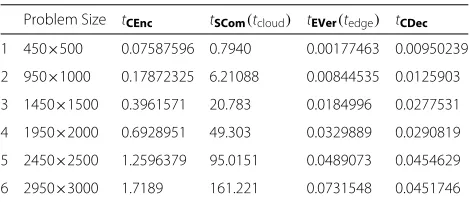
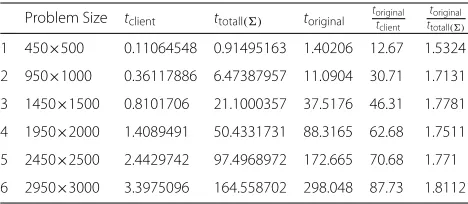
From the tables, we can easily observed the following three results: (1) Our proposed scheme enables the client to achieve decent computational savings compared with conducting the task on client’s own, and the speedup ratio
Table 1 Ax≡b mod 251 with parameters
f(m)=m−1,g(n)=n−1 (unit:s)
Problem Size tCEnc tSCom(tcloud) tEVer(tedge) tCDec
1 450×500 0.07587596 0.7940 0.00177463 0.00950239
2 950×1000 0.17872325 6.21088 0.00844535 0.0125903
3 1450×1500 0.3961571 20.783 0.0184996 0.0277531
4 1950×2000 0.6928951 49.303 0.0329889 0.0290819
5 2450×2500 1.2596379 95.0151 0.0489073 0.0454629
6 2950×3000 1.7189 161.221 0.0731548 0.0451746
Table 2 Ax≡b mod 251 with parameters
f(m)=m−1,g(n)=n−1 (Continue with Table1, unit:s)
Problem Size tclient ttotall( ) toriginal toriginaltclient ttotalltoriginal( )
1 450×500 0.08537835 0.88115298 1.40008 16.40 1.5889
2 950×1000 0.19131355 6.4106389 10.5693 55.25 1.6487
3 1450×1500 0.4239102 21.2254098 36.6499 86.46 1.7267
4 1950×2000 0.721977 50.0579659 86.9538 120.44 1.7371
5 2450×2500 1.3051008 96.3691081 169.814 130.12 1.7621
6 2950×3000 1.7640746 163.058229 293.245 166.23 1.7984
Table 3 Ax≡b mod 251 with parameters
f(m)=2m−3,g(n)=2n−3 (unit:s)
Problem Size tCEnc tSCom(tcloud) tEVer(tedge) tCDec
1 450×500 0.10514155 0.7908 0.0017516 0.0192382
2 950×1000 0.34959892 6.208 0.00861224 0.0395156
3 1450×1500 0.7866935 20.783 0.0182387 0.0443406
4 1950×2000 1.3715709 49.303 0.032109 0.0596953
5 2450×2500 2.3783475 95.0151 0.0488523 0.0828955
6 2950×3000 3.4255175 160.891 0.0721897 0.0802106
Table 4 Ax≡b mod 251 with parameters
f(m)=2m−3,g(n)=2n−3 (Continue with Table3, unit:s)
Problem Size tclient ttotall( ) toriginal toriginaltclient ttotalltoriginal( )
1 450×500 0.12437975 0.91693135 1.34423 10.81 1.466
2 950×1000 0.38911452 6.60572676 10.9535 28.15 1.6582
3 1450×1500 0.8310341 21.6322728 36.8087 44.25 1.70156
4 1950×2000 1.4312662 50.7663752 86.9632 60.76 1.713
5 2450×2500 2.461243 97.5251953 170.006 69.07 1.7432
Table 5 Ax≡b mod 12289 with parameters
f(m)=m−1,g(n)=n−1 (unit:s)
Problem Size tCEnc tSCom(tcloud) tEVer(tedge) tCDec
1 450×500 0.06575108 0.8125 0.00202232 0.00749616
2 950×1000 0.17575052 6.05226 0.00890071 0.0131726
3 1450×1500 0.3993411 20.2893 0.0201133 0.0278017
4 1950×2000 0.6892857 48.2628 0.0346034 0.0350569
5 2450×2500 1.2048372 95.8165 0.0498146 0.0475414
6 2950×3000 1.7189946 161.006 0.0748025 0.0497302
Table 6 Ax≡b mod 12289 with parameters
f(m)=m−1,g(n)=n−1 (Continue with Table5,unit:s)
Problem Size tclient ttotall( ) toriginal toriginaltclient ttotalltoriginal( )
1 450×500 0.07324724 0.88776956 1.40402 19.17 1.5815
2 950×1000 0.18892312 6.25008383 11.121 58.87 1.7793
3 1450×1500 0.4271428 20.7365561 37.3979 87.56 1.803
4 1950×2000 0.7243426 49.021746 89.3161 123.31 1.821
5 2450×2500 1.2523786 97.1186932 172.927 138.08 1.7806
6 2950×3000 1.7687248 162.849527 299.213 169.17 1.83736
Table 7 Ax≡b mod 12289 with parameters
f(m)=2m−3,g(n)=2n−3(unit:s)
Problem Size tCEnc tSCom(tcloud) tEVer(tedge) tCDec
1 450×500 0.09749518 0.8022 0.00210615 0.0131503
2 950×1000 0.33596836 6.1038 0.00890071 0.0252105
3 1450×1500 0.7694877 20.2703 0.0195651 0.0406829
4 1950×2000 1.3436429 48.9895 0.034724 0.0653062
5 2450×2500 2.3465147 95.0048 0.049123 0.0964595
6 2950×3000 3.3026583 161.087 0.074192 0.0948513
Table 8 Ax≡b mod 12289 with parameters
f(m)=2m−3,g(n)=2n−3 (Continue with Table7, unit:s)
Problem Size tclient ttotall( ) toriginal toriginaltclient ttotalltoriginal( )
1 450×500 0.11064548 0.91495163 1.40206 12.67 1.5324
2 950×1000 0.36117886 6.47387957 11.0904 30.71 1.7131
3 1450×1500 0.8101706 21.1000357 37.5176 46.31 1.7781
4 1950×2000 1.4089491 50.4331731 88.3165 62.68 1.7511
5 2450×2500 2.4429742 97.4968972 172.665 70.68 1.771
6 2950×3000 3.3975096 164.558702 298.048 87.73 1.8112
(toriginalt
client ) increases monotonously with the size of the input
instances. For example, when q = 251,f(m) = m−1,
g(n)=n−1, the size of coefficient matrix is 450×500, the client obtains 16.40 times speedup in efficiency, and, when
the size of coefficient matrix increases to 2950×3000,
the speedup ratio achieves 166.23. (2) The total time over-head of our scheme is cheaper than that of conducting corresponding computation instances on client’s own, and the speedup ratio (ttoriginal
total( )) also increases with the
incre-ment of the problem size. For instance, whenq= 12289,
f(m)=m−1,g(n)=n−1, the size of coefficient matrix is
450×500, our scheme obtains 1.58 times speedup in
effi-ciency, and, when the size of coefficient matrix increases
to 2950×3000, the speedup ratio achieves 1.83. (3) The
efficiency/security of our scheme is adjustable and the efficiency decreases with the increment off(m)andg(n).
E.g. whenq=251 withf(m)=m−1,g(n)=n−1, and
the problem size is 2950×3000, the client’s time overhead
can be reduced by 99.40% = (1−1/166)∗100% by
out-sourcing solvingAx≡b mod 251, while, when the same
problem size withf(m) = 2m−3,g(n) = 2n−3, the
client’s time cost is only reduced by 98.82%=(1−1/85)∗ 100%.
As we have observed from the experimental results, the proposed scheme is effective and achieves great ben-efits in efficiency compared with the algorithm without outsourcing.
Related work
Since a wide range of applications of linear algebraic operations in various fields, outsourcing linear algebraic operations, such as matrix multiplication computation
(MMC) [31], matrix determinant computation (MDC)
[32], matrix factorization [33–35], and matrix’s
charac-teristic polynomial and eigenvalues computation [36] has
become a hot topic [8]. Out of which, the closely related
operations with our work are matrix inversion compu-tation (MIC) and large-scale system of linear equations
(LSLE)solving.
Matrix inversion computation outsourcing. In 2012,
Mohassel first investigated the secure outsourcing of
MIC and initialized a secure outsourcing algorithm [20].
The algorithm encrypts the original matrix through a random matrix transformation technique (i.e. multiply-ing the original matrix by a random secret matrix) and invokes the outsourcing algorithm of MMC as a subrou-tine. Since the outsourcing algorithm of MMC needs to perform expensive homomorphic encryption (HE) oper-ations. Therefore, their algorithm suffers from low effi-ciency and then is not practical. To avoid the
time-consuming HE operations, Lei et al. [21] further put
However, this technique is inherently with a severe secu-rity problem of exposing the statistical information of some certain entries in the original matrix, e.g. the
num-ber of zeros. Recently, Zhang et al. [22] presented a
novel matrix encryption method based on consecutive sparse and unimodular matrix transformation, and then exploited this method to design a new MIC outsourc-ing algorithm over finite fields. Their algorithm favor-ably balances the security and efficiency, i.e. it conceals the entries’ statistical information in the original matrix without greatly reducing the efficiency. However, the ver-ification algorithm of all the aforementioned schemes is based on a randomized Monte Carlo verification, which is not deterministic with the optimal probability 1. Also, the outsourcing methods of MIC are only suit for
out-sourcingLMSLEwith a square and invertible coefficient
matrixA.
LSLE computation outsourcing.Atallah et al. [37] ini-tialized the study on secure outsourcing of linear algebraic operations, and presented the first efficient
outsourc-ing scheme for solvoutsourc-ing LSLE by using simple random
permutation matrix transformation. Nevertheless, just as mentioned in Lei et al.’s work [21], this technique leaks the statistic information of entries in the coefficient matrix. Also, their algorithm doesn’t concern the result
verifica-tion. Wang et al. [38] further investigated this problem
and proposed a privacy-preserving, cheating-resilient and effective outsourcing protocol based on iterative method. However, their protocol needs to invoke the
expen-sive homomorphic encryption scheme [39] and requires
multi-round interactions between the client and the cloud server, which incurs large communication and computa-tion overhead. Noticing this deficiency of Wang et al.’s
protocol, Chen et al. [40] proposed an improved scheme
based on a new matrix encryption method which mul-tiplies the coefficient matrix by diagonal and random
permutation matrices. Afterward, Chen et al. [23] put
forward a new secure outsourcing algorithm for solving
LSLE based on a sparse matrix transformation
tech-nique. These sparse matrix encryption methods make their algorithms achieve high efficiency with optimal communication overhead and optimal verifiability
prob-ability 1. Almost at the same time, Salinas et al. [41]
proposed an efficient outsourcing algorithm based on the conjugate gradient method which achieves low com-putational complexity and low memory I/O complexity. Nonetheless, the algorithm also needs multi-round inter-actions and is not security as they claimed. Subsequently, based on Salinas et al.’s matrix encryption method, Yu
et al. [42] proposed a secure non-iterative outsourcing
algorithm for solvingLSLE, but the algorithm calls the
outsourcing algorithm of MMC as a subroutine which leads to be inefficient in practice. Recently, Ding et al. [43] successfully attacked Salinas et al.’s scheme and presents
an efficient algorithm to recover the protected matrix.
Therefore, among these proposals, Chen et al.’s [23]
scheme is the most efficient, but, just as the authors’ men-tioned in their paper, the sparse matrix transformation can not provide strong enough security.
Conclusion and future direction
In this paper, we introduce an efficiency/security-adjustable scheme for publicly verifiable delegation of computation which enable a resource-constrained client
to securely outsource the solving ofLMSLE. We built
our scheme upon a novel dynamic affine transformation by successively utilizing sparse and unimodular matrices which may has potential applications in outsourcing other linear algebraic operations. However, there still exist some open problems deserved for further research. First, in the
case that theLMSLEproblem has multiple solutions, the
presented outsourcing scheme can only ensure the client to securely find one solution. That is, if the cloud server returns multiple solutions, the client or the edge server in our scheme can verify the correctness of each solution, but it can not confirm whether the cloud returns the set of all solutions. Therefore, how to design an efficient out-sourcing scheme that enables the client to securely and correctly find the set of all solutions is an interesting prob-lem. Moreover, for some strong threat model including
outside adversary [44], our scheme may suffer from
unau-thorized attack. It is meaningful to improve our scheme to resist this attack. Adding a simple identity authenti-cation protocol may be a good choice. Also, our scheme does not consider the privacy preservation of the
modu-lusq. In some practical application scenarios, the modulus
may contain sensitive information, such as the bit length of the solution vector, and thus keeping the privacy of the modulus is also very significative. Consequently, how to design a modulus-invisible outsourcing scheme for
solvingLMSLEis also deserved for further research.
Acknowledgement Not Applicable.
Authors’ contributions
The authors equally contributed to this research and the paper initiated by the corresponding author. All authors read and approved the final manuscript.
Authors’ information
Panpan Mengreceived the B.E. degree in computer information
management from Shandong University in 2016. She is currently pursuing the M.S. degree in the College of Computer Science and Technology, Qingdao University. Her research interests include cloud computing security and cryptography.
Funding
This research is supported in part by National Natural Science Foundation of China (61702294), Natural Science Foundation of Shandong Province (ZR2016FQ02), National Development Foundation of Cryptography (MMJJ20170126), the Open Research Project (2016-MS-23) of State Key Laboratory of Information Security in Institute of Information Engineering, Chinese Academy of Sciences, Applied Basic Research Project of Qingdao City (17-1-1-10-jch).
Availability of data and materials
The full experimental data and the description of the experiment setup are provided in the manuscript in sectionPerformance Evaluation.
Competing interests
The authors declare that they have no competing interests.
Author details
1College of Computer Science and Technology, Qingdao University, Qingdao 266071, China.2Business School, Qingdao University, Qingdao 266071, China. 3State Key Laboratory of Information Security, Institute of Information Engineering, Chinese Academy of Sciences, Beijing 100093, China.
Received: 15 July 2019 Accepted: 20 November 2019
References
1. Singh KJ, Kapoor DS (2017) Create your own internet of things: A survey of iot platforms. IEEE Consum Electron Mag 6(2):57–68
2. Xu LD, He W, Li S (2014) Internet of things in industries: A survey. IEEE Trans Ind Informa 10(4):2233–2243
3. Xia H, Zhang S, Li Y, Pan Z, Peng X, Cheng X (2019) An attack-resistant trust inference model for securing routing in vehicular ad hoc networks. IEEE Trans Veh Technol 68(7):7108–7120
4. Rivera J, Goasduff L (2014) Gartner says a thirty-fold increase in internet-connected physical devices by 2020 will significantly alter how the supply chain operates. Gartner.https://www.gartner.com/en/ newsroom/press-releases/2014-03-24-gartner-says-a-thirty-fold- increase-in-internet-connected-physical-devices-by-2020-will-significantly-alter-how-the-supply-chain-operates
5. Brunette G, Mogull R, et al. (2009) Security guidance for critical areas of focus in cloud computing v2. 1. Cloud Security Alliance.http://www. cloudsecurityalliance.org/guidance/csaguide.v2.1.pdf
6. Xia H, Cq Hu, Xiao F, Cheng Xg, Pan Zk (2019) An efficient social-like semantic-aware service discovery mechanism for large-scale internet of things. Comput Netw 152:210–220
7. Xia H, Zhang Ss, Li Bx, Li L, Cheng Xg (2018) Towards a novel trust-based multicast routing for vanets. Secur Commun Netw 2018:1–1
8. Shan Z, Ren K, Blanton M, Wang C (2018) Practical secure computation outsourcing: A survey. Acm Comput Surv 51(2):1–40
9. Zhou Q, Tian C, Zhang H, Yu J, Li F (2019) How to securely outsource the extended euclidean algorithm for large-scale polynomials over finite fields. Inf Sci.https://doi.org/10.1016/j.ins.2019.10.007
10. von zur Gathen J, Gerhard J (2013) Modern Computer Algebra. 3rd edition. Cambridge University Press, New York
11. Moon TK (2005) Error Correction Coding: Mathematical Methods and Algorithms. Wiley-Interscience, New York
12. Ryan W, Lin S (2009) Channel Codes: Classical and Modern. Cambridge University Press, New York
13. Ajtai M (1996) Generating hard instances of lattice problems (extended abstract). In: Proceedings of the twenty-eighth annual ACM symposium on Theory of computing, STOC ’96. ACM, New York. pp 99–108 14. Gentry C, Peikert C, Vaikuntanathan V (2008) Trapdoors for hard lattices
and new cryptographic constructions. In: Proceedings of the 40th annual ACM symposium on Theory of computing, STOC ’08. ACM, New York. pp 197–206
15. Peikert C (2014) Lattice cryptography for the internet. In: Mosca M (ed). Post-Quantum Cryptography. Springer International Publishing, Cham. pp 197–219
16. Gentry C, Halevi S, Vaikuntanathan V (2010) A simple bgn-type cryptosystem from lwe. In: Proceedings of the 29th Annual international
conference on Theory and Applications of Cryptographic Techniques, EUROCRYPT’10. Springer-Verlag, Berlin, Heidelberg. pp 506–522 17. Regev O (2005) On lattices, learning with errors, random linear codes, and
cryptography. In: Proceedings of the thirty-seventh annual ACM symposium on Theory of computing, STOC ’05. ACM, New York. pp 84–93 18. Bos JW, Costello C, Naehrig M, Stebila D (2015) Post-quantum key
exchange for the tls protocol from the ring learning with errors problem. In: 2015 IEEE Symposium on Security and Privacy. IEEE, San Jose. pp 553–570
19. Alkim E, Ducas L, Pöppelmann T, Schwabe P (2016) Post-quantum key exchange-a new hope. In: 25th USENIX Security Symposium (USENIX Security 16). USENIX Association, Austin. pp 327–343
20. Mohassel P (2012) Efficient and secure delegation of linear algebra. Iacr Cryptol Eprint Archive.https://eprint.iacr.org/2011/605
21. Lei X, Liao X, Huang T, Li H, Hu C (2013) Outsourcing large matrix inversion computation to a public cloud. IEEE Trans Cloud Comput 1(1):1–1 22. Zhang S, Tian C, Zhang H, Yu J, Li F (2019) Practical and secure
outsourcing algorithms of matrix operations based on a novel matrix encryption method. IEEE Access 7:53823–53838
23. Chen X, Huang X, Li J, Ma J, Lou W, Wong DS (2015) New algorithms for secure outsourcing of large-scale systems of linear equations. IEEE Trans Inf Forensic Secur 10(1):69–78
24. Newman M (1972) Integral matrices, volume 45. Academic Press, New York 25. Horn RA, Johnson CR (2012) Matrix Analysis. 2nd edition. Cambridge
University Press, New York
26. Schrijver A (1986) Theory of Linear and Integer Programming. Wiley, New York 27. Apostol TM (1998) Introduction to Analytic Number Theory.
Undergraduate Texts in Mathematics. Springer, New York 28. Lei X, Liao X, Huang T, Heriniaina F (2014) Achieving security, robust
cheating resistance, and high-efficiency for outsourcing large matrix multiplication computation to a malicious cloud. Inf Sci 280:205–217 29. Qian C, Wang J (2015) Secure and efficient protocol for outsourcing
large-scale systems of linear equations to the cloud. In: International Conference on Cloud Computing and Security. Springer, Basel. pp 25–37 30. Lu X, Liu Y, Zhang Z, Jia D, Xue H, He J, Li B, Wang K, Liu Z, Yang H (2018)
Lac: Practical ring-lwe based public-key encryption with byte-level modulus. Cryptology ePrint Archive, Report 2018/1009.https://eprint.iacr. org/2018/1009. Accessed 16 Oct 2018
31. Atallah MJ, Frikken KB (2010) Securely outsourcing linear algebra computations. In: Proceedings of the 5th ACM Symposium on
Information, Computer and Communications Security, ASIACCS ’10. ACM, New York. pp 48–59
32. Lei X, Liao X, Huang T, Li H (2015) Cloud computing service: The case of large matrix determinant computation. IEEE Trans Serv Comput 8(5):688–700
33. Zhou L, Zhu Y, Choo K-KR (2018) Efficiently and securely harnessing cloud to solve linear regression and other matrix operations. Futur Gener Comput Syst 81:404–413
34. Luo C, Zhang K, Salinas S, Li P (2017) Efficient privacy-preserving outsourcing of large-scale qr factorization. In: 2017 IEEE Trustcom/BigDataSE/ICESS. IEEE, Sydney. pp 917–924
35. Luo C, Zhang K, Salinas S, Li P (2017) Secfact: Secure large-scale qr and lu factorizations. IEEE Trans Big Data.https://ieeexplore.ieee.org/document/ 8194901
36. Hu X, Tang C (2015) Secure outsourced computation of the characteristic polynomial and eigenvalues of matrix. J Cloud Comput 4(1):7
37. Atallah MJ, Pantazopoulos KN, Rice JR, Spafford EE (2002) Secure outsourcing of scientific computations. In: Advances in Computers, volume 54. Elsevier, Cambridge. pp 215–272
38. Wang C, Ren K, Wang J, Wang Q (2013) Harnessing the cloud for securely outsourcing large-scale systems of linear equations. IEEE Trans Parallel Distrib Syst 24(6):1172–1181
39. Paillier P (1999) Public-key cryptosystems based on composite degree residuosity classes. In: Stern J (ed). Advances in Cryptology — EUROCRYPT ’99. Springer Berlin Heidelberg, Berlin, Heidelberg. pp 223–238
40. Chen F, Xiang T, Yang Y (2014) Privacy-preserving and verifiable protocols for scientific computation outsourcing to the cloud. J Parallel Distrib Comput 74(3):2141–2151
42. Yu Y, Luo Y, Wang D, Fu S, Xu M (2016) Efficient, secure and non-iterative outsourcing of large-scale systems of linear equations. In: 2016 IEEE International Conference on Communications (ICC). pp 1–6
43. Ding Q, Weng G, Zhao G, Hu C (2018) Efficient and secure outsourcing of large-scale linear system of equations. IEEE Trans Cloud Comput:1–1.
https://ieeexplore.ieee.org/document/8531754
44. Wu J, Mu N, Lei X, Le J, Zhang D, Liao X (2019) Secedmo: Enabling efficient data mining with strong privacy protection in cloud computing. IEEE Trans Cloud Comput:1–1.https://ieeexplore.ieee.org/document/8781873
Publisher’s Note