An analytical study of information extraction
from unstructured and multidimensional big
data
Kiran Adnan and Rehan Akbar
*Introduction
Information extraction (IE) process extracts useful structured information from the unstructured data in the form of entities, relations, objects, events and many other types. The extracted information from unstructured data is used to prepare data for analysis. Therefore, the efficient and accurate transformation of unstructured data in the IE process improves the data analysis. Numerous techniques have been introduced for different data types i.e. text, image, audio, and video.
The advancement in technology promoted the rapid growth of data volume in recent years. The volume, variety (structured, unstructured, and semi-structured data) and velocity of big data have also changed the paradigm of computational capabilities of the systems. IBM estimated that more than 2.5 quintillion bytes of data are generated every
Abstract
Process of information extraction (IE) is used to extract useful information from unstruc-tured or semi-strucunstruc-tured data. Big data arise new challenges for IE techniques with the rapid growth of multifaceted also called as multidimensional unstructured data. Tradi-tional IE systems are inefficient to deal with this huge deluge of unstructured big data. The volume and variety of big data demand to improve the computational capabilities of these IE systems. It is necessary to understand the competency and limitations of the existing IE techniques related to data pre-processing, data extraction and transfor-mation, and representations for huge volumes of multidimensional unstructured data. Numerous studies have been conducted on IE, addressing the challenges and issues for different data types such as text, image, audio and video. Very limited consolidated research work have been conducted to investigate the task-dependent and task-inde-pendent limitations of IE covering all data types in a single study. This research work address this limitation and present a systematic literature review of state-of-the-art techniques for a variety of big data, consolidating all data types. Recent challenges of IE are also identified and summarized. Potential solutions are proposed giving future research directions in big data IE. The research is significant in terms of recent trends and challenges related to big data analytics. The outcome of the research and recom-mendations will help to improve the big data analytics by making it more productive.
Keywords: Big data, Information extraction (IE), Literature review, Learning-based
techniques, Multimedia data, Unstructured data
Open Access
© The Author(s) 2019. This article is distributed under the terms of the Creative Commons Attribution 4.0 International License (http://creat iveco mmons .org/licen ses/by/4.0/), which permits unrestricted use, distribution, and reproduction in any medium, provided you give appropriate credit to the original author(s) and the source, provide a link to the Creative Commons license, and indicate if changes were made.
RESEARCH
day. Among these statistics, it was also predicted that unstructured data from diverse sources will grow up to 90% in few years. IDC estimated that unstructured data will be 95% of the global data in 2020 with estimated 65% annual growth rate [1]. The com-mon characteristics of unstructured data are, (i) it comes in multiple formats [2–5] (text, images, audio, video, blogs, and websites, etc.) (ii) schema-less due to non-standardi-zation [2–4] (iii) it comes from diverse sources (e.g. social media, clouds, sensors, etc.) [2–4, 6].
Due to the huge volume and complexity of unstructured data, it became a tedious task to extract useful information from different types of data. In this regard, system-atic literature review have been conducted to identify state-of-the-art challenges. The primary contribution of this work is twofold. First, a systematic review of existing tech-niques for IE subtasks for each data type i.e. text, image, audio and video. The system-atically extracted and synthesized knowledge can be leveraged by the researchers to understand the concept of IE, its subtasks for each data types and state-of-the-art tech-niques. Second, a taxonomy of IE research is designed to identify and classify the chal-lenges of IE in big data environment. The main categories include task-related chalchal-lenges and unstructured data-related challenges. Finally, the IE improvement model is designed to overcome the identified limitations of existing IE techniques for multidimensional unstructured big data.
The remaining document is organized as follows: research methodology with all phases and activities is presented in “Research methodology” section. “Information extraction
from text” section presents detailed discussion on IE subtasks such as NER, RE, EE, their
techniques and comparison of techniques for text data. In “IE from images” section, vis-ual relationship detection, text recognition and face recognition techniques as IE sub-task, recent work, and limitations have been described. “Audio IE” section presents the detailed discussion on IE from audio, its subtasks such as AED and ASR with state-of-the-art techniques and challenges. Text recognition and automatic video summarization are elaborated in “Video IE” section. Results and discussion on this systematic litera-ture review are presented in “Results and discussion” section whereas “Conclusion” and
“Future work” section present the conclusion and future work, respectively.
Research methodology
Systematic literature review (SLR) is a process to identify, select and critically analyzing the research to answer the identified research questions. Transparency, clarity, integra-tion, focus, equality, accessibility and coverage are key principles of SLR. It is a compre-hensive investigation of existing literature on the identified research question. Therefore, SLR has been selected for this review article on IE solutions for unstructured big data and followed the well-formed guidelines [7, 8]. SLR is more suitable for this study because it provides guidelines to conduct review and present findings in more system-atic way. Generally, the process of SLR is divided into three main phases named as plan-ning, conduct and reporting the review. These phases and their corresponding activities followed in this review are depicted in Fig. 1.
Planning the review
A. Research questions
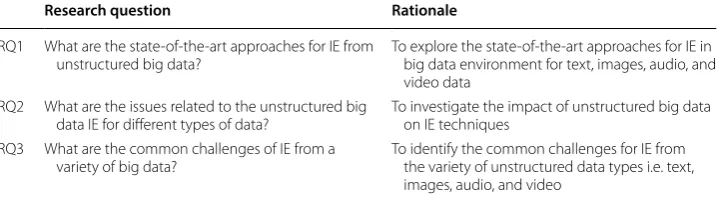
The research questions and their rationale have been given in Table 1. B. Search string and data sources
The following search strings have been used to search the most relevant literature to address the research questions.
TITLE-ABS-KEY ((“information extraction” OR “information extraction system” OR “visual relationship” OR “named entity” OR “relation extraction” OR “event extrac-tion” OR “summarizaextrac-tion” OR “speech recogniextrac-tion”) AND (“big data” OR “large-scale data” OR “large data” OR “volume”) AND (“unstructured data” OR “nonstructured data” OR “nonrelational data” OR “free text” OR “image” OR “audio” OR “video”)). ACM, IEEE Xplore, Springer, ScienceDirect, Scopus, and Wiley online library were
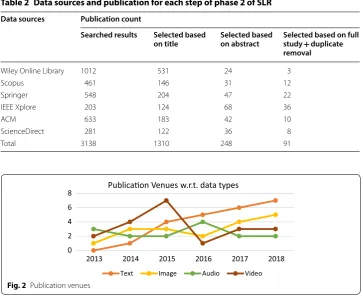
selected as data sources for this review. The search was conducted in April 2019 using advanced search on the identified data sources. The details of searched and selected articles from each data source are presented in Table 2.
C. Inclusion conditions
The inclusion criteria have been defined to select the most relevant research studies according to the research questions. The inclusion criteria for this study are as fol-lows:
i. Research work published between January 2013 and April 2019 inclusively. ii. Studies conducted in the English language.
iii. Studies related to IE for text, images, audio and/or video. iv. Research work on unstructured data.
v. Research work on data analytics.
vi. Research work related to the IE techniques for big data implicitly or explicitly. Plan review
•Identification of research questions
•Selection of data sources •Defining the inclusion and
exclusion criteria
Conduct review
•Defining Quality criteria •Primary study selection •Data Extraction &
Synthesis
Report review
•Documenting the results
Fig. 1 Review process
Table 1 Research questions and rationale
Research question Rationale
RQ1 What are the state-of-the-art approaches for IE from
unstructured big data? To explore the state-of-the-art approaches for IE in big data environment for text, images, audio, and video data
RQ2 What are the issues related to the unstructured big
data IE for different types of data? To investigate the impact of unstructured big data on IE techniques RQ3 What are the common challenges of IE from a
D. Exclusion conditions
i. Studies that used other than the English language. ii. Short papers, presentations, keynotes, and articles. iii. Duplicate or redundant studies.
iv. Studies that are not relevant to the research questions. v. Research work older than January 2013.
Conducting the review
After planning the review, studies were refined and selected based on the inclusion and exclusion criteria. The selected studies have been filtered based on the relevance to the study objectives. The selection process started with reading the “title” of the selected studies. Next, studies were filtered on the basis of “abstract” and “keywords” and finally selected on the basis of “full article reading”. The publication count of each step to select the most relevant studies for this review is presented in Table 2.
Reporting the review
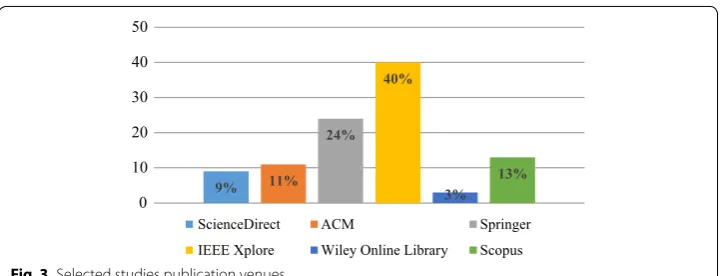
Figure 2 illustrates the publication venues for each data type from 2013 to 2018, and Fig. 3 illustrates the selected studies distribution over data sources.
Table 3 presents a summary of the categorization of selected studies according to each data type.
Table 2 Data sources and publication for each step of phase 2 of SLR Data sources Publication count
Searched results Selected based
on title Selected based on abstract Selected based on full study + duplicate removal
Wiley Online Library 1012 531 24 3
Scopus 461 146 31 12
Springer 548 204 47 22
IEEE Xplore 203 124 68 36
ACM 633 183 42 10
ScienceDirect 281 122 36 8
Total 3138 1310 248 91
0 2 4 6 8
2013 2014 2015 2016 2017 2018
Publicaon Venues w.r.t. data types
Text Image Audio Video
A. Process validation
The key doubts about the SLR process validation depend upon “study selection”, “inaccurate data extraction”, “inaccurate classification” and “potential author bias”. To ensure the process validation for this SLR, two authors were involved in the “selec-tion” and “classifica“selec-tion” of each study. Mutual understanding was developed for con-flict resolution between authors.
Information extraction from text
The term NLP refers to the methods to interpret the data i.e. spoken or written by humans. In order to process human languages using NLP, several tasks like machine translation, question-answering system, information retrieval, information extraction and natural language understanding are considered high-level tasks. The process of
9% 11% 24%
40%
3% 13%
0 10 20 30 40 50
ScienceDirect ACM Springer
IEEE Xplore Wiley Online Library Scopus Fig. 3 Selected studies publication venues
Table 3 Distribution of selected studies w.r.t study type and data types
J journal article, Ch chapter; C conference
Category Sub category Selected studies J Ch C Total
Related to text IE Named entity recognition [9–16] 4 3 1 8
Relation extraction [17–23] 3 3 1 7
Entity + relation extraction [24–29] 4 1 1 6
Event extraction [30–35] 3 0 3 6
Total selected studies for text 14 7 6 27
Related to images IE Visual relationship detection [36–45] 3 0 7 10
Text extraction from images [46–57] 3 1 8 12
Face recognition [58–61] 2 2 0 4
Total selected studies for images 8 3 15 26
Related to audio IE Acoustic event detection [62–68] 4 0 3 7
Automatic speech recognition [69–79] 9 0 2 11
Total selected studies for audio data 13 0 5 18
Related to video IE General information Extraction
from video [80–82] 0 0 3 3
Text recognition [83–92] 4 1 5 10
Automatic video summarization [93–99] 1 2 4 7
Total selected studies for video data 5 3 12 20
information extraction (IE) is one of the important tasks in data analysis, KDD and data mining [100] which extracts structured information from the unstructured data. IE is defined as “extract instances of predefined categories from unstructured data, building a structured and unambiguous representation of the entities and the relations between them” [101].
One of the intents of IE is to populate the knowledge bases to organize and access use-ful information. It takes collection of documents as input and generates different repre-sentations of relevant information satisfying different criteria. IE techniques efficiently analyze the text in free form by extracting most valuable and relevant information in a structured format. Hence, the ultimate goal of IE techniques is to identify the salient facts from the text to enrich the databases or knowledge bases. The following subsec-tions discuss the literature selected in SLR process according to the IE subtasks for text data.
Named entity recognition (NER)
Named Entity Recognition is one of the important tasks of IE systems used to extract descriptive entities. It helps to identify the generic or domain-independent entities such as location, persons and organization, and domain-specific entities such as disease, drug, chemical, proteins, etc. In this process, entities are identified and semantically clas-sified into pre-characterized classes [102]. Traditional NER systems were using Rule-Based Methods (RBM), Learning-Rule-Based Methods (LBM) or hybrid approaches [103]. IE together with NLP plays a significant role in language modeling and contextual IE using morphological, syntactic, phonetic, and semantic analysis of languages. Rich morpho-logical languages like Russian and English make IE process easier. IE is difficult for mor-phologically poor languages because these languages need extra effort for morphological rules to extract noun due to non-availability of complete dictionary [104].
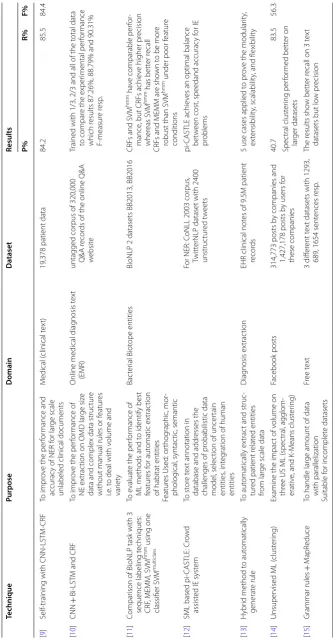
Question answering, machine translation, automatic text summarization, text mining, information retrieval, opinion mining and knowledgebase population are major applica-tions of NER [105]. Hence, the higher efficiency and accuracy of these NER systems is very important but big data brings new challenges to these systems i.e. volume, variety and velocity. In this regard, this review investigates these challenges and explores the latest trends. Table 4 presents related work of NER using unstructured big data sets. It summarizes techniques, motivation behind research, domain analysis, dataset used in the research and evaluation of proposed solutions to identify the limitations of tradi-tional techniques, impact of big data on NER systems and latest trends. Evaluation of proposed techniques for IE is performed using precision, recall and F1-score. Precision and recall are the measures for completeness and correctness, respectively. F1-score measures the accuracy of the system and harmonic combination of precision and recall [106, 107].
Table 4 Named en tit y r ec ognition Technique Purpose Domain Da taset Results P% R% F% [ 9 ]
Self-training with CNN-LSTM
-CRF
To impr
ov
e the per
for
mance and
accurac
y of NER f
or lar
ge scale
unlabeled clinical documents
M
edical (
clinical t
ex
t)
19,378 patient data
84.2 85.5 84.4 [ 10 ] CNN +
Bi-LSTM and CRF
To impr
ov
e the per
for
mance of
NE ex
trac
tion on OMD lar
ge siz
e
data and complex data struc
tur
e
without manual rules or f
eatur
es
i.e
. t
o deal with v
olume and
var
iet
y
Online medical diag
nosis t
ex
t
(EMR)
untagged cor
pus of 320,000
Q&A r
ecor
ds of the online Q&A
w
ebsit
e
Trained with 1/3, 2/3 and all of the t
otal data
to compar
e the exper
imental per
for
mance
which r
esults 87.26%, 88.79% and 90.31%
F-measur e r esp . [ 11 ] Compar
ison of BioNLP task with 3
sequence labeling t
echniques: CRF , MEMM, SVM hmm using one classifier SVM multiclass To e valuat
e the per
for
mance of
ML methods and t
o identify best
featur es f or aut omatic ex trac tion
of habitat entities
Featur
es Used: or
thog raphic , mor -pholog ical , syntac tic , semantic Bac ter ial Biot ope entities
BioNLP 2 datasets BB2013, BB2016
CRFs and
SVM
hmm
ha
ve comparable per
for
-mance
, but CRFs achie
ve higher pr
ecision wher eas SVM hmm has bett er r ecall
CRFs and MEMM ar
e sho
wn t
o be mor
e
robust than
SVM
hmm
under poor f
eatur e conditions [ 12 ]
SML based
pi-CASTLE: Cr
ow
d
assist
ed IE syst
em
To st
or
e t
ex
t annotation in
database and addr
esses the
challenges of pr
obabilistic data
model
, selec
tion of uncer
tain
entities
, int
eg
ration of human
entities
For NER: C
oNLL 2003 cor
pus
,
Twitt
erNLP dataset with 2400
unstruc tur ed t w eets pi-CASTLE achie
ves an optimal balance
bet
w
een cost, speedand accurac
y f or IE pr oblems [ 13 ] H ybr
id method t
o aut omatically generat e rule To aut omatically ex trac
t and struc
-tur
ed patient r
elat
ed entities
from lar
ge scale data
Diag
nosis ex
trac
tion
EHR clinical not
es of 9.5M patient
recor
ds
5 use cases applied t
o pr
ov
e the modular
ity
,
ex
tensibilit
y, scalabilit
y, and flexibilit
y
[
14
]
Unsuper
vised ML (
clust
er
ing)
Examine the impac
t of v
olume on
thr
ee US ML (spec
tral
, agglom
-erativ
e, and K
-M
eans clust
er
ing)
Facebook posts
314,773 posts b
y companies and
1,427,178 posts b
y users f
or these companies 40.7 83.5 56.3 Spec tral clust er ing per for med bett er on lar ger datasets [ 15 ] Grammar rules + M apR educe
To handle lar
ge amount of data
with parallelization Suitable f or incomplet e datasets Fr ee t ex t 3 diff er ent t ex
t datasets with 1293,
689, 1654 sent
ences r esp . The r esults sho w bett er r
ecall on 3 t
ex
t
datasets but lo
w pr
advanced techniques. Variations of deep learning techniques such as CNN are perform-ing better for these NER systems [9, 10].
Relation extraction (RE)
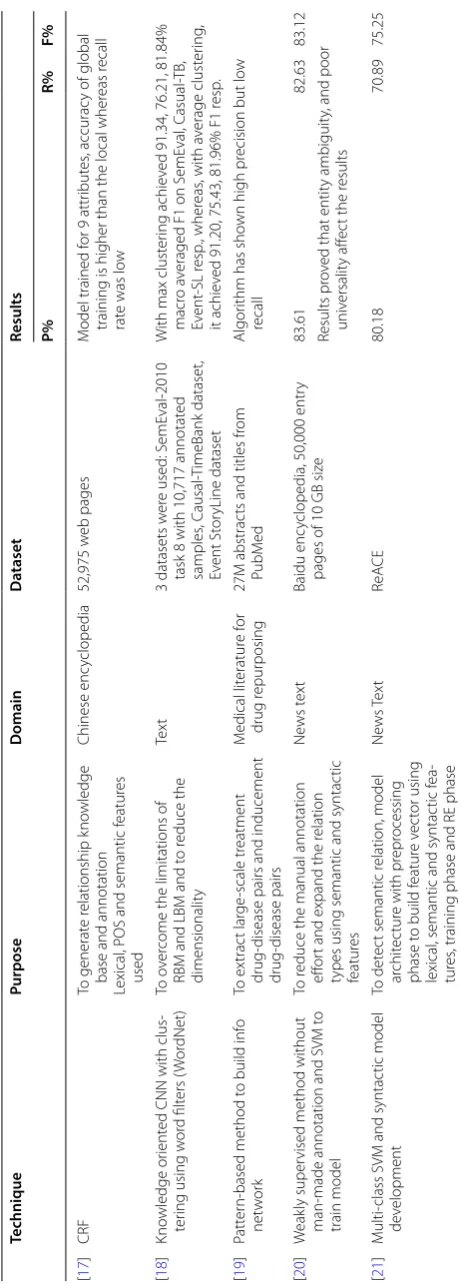
Relation extraction (RE) is a subtask of IE that extracts substantial relationships between entities. Entities and relations are used to correctly annotate the data by analyzing the semantic and contextual properties of data. Supervised approaches use feature-based and kernel-based techniques for RE. DIPRE, Snowball, KnowItAll are some examples of semi-supervised RE [108]. Several supervised, weakly supervised and self-supervised approaches have been introduced to extract one to one and many to many relationships between entities. In the present study, various lexical, semantic, syntactic and morpho-logical features have been extracted and then relationship between entities using learn-ing-based techniques have been identified. Table 5 summarizes the work presented on relation extraction or entities relationship pairs.
Traditional learning-based or rule-based techniques are insufficient to handle the vol-ume and dimensionality of unstructured big data [18]. The supervised LBM needs large annotated corpora and it is very laborious task to annotate large data sets manually. In order to reduce manual annotation effort, weakly supervised methods are more effective [20]. Semantic RE with appropriate features [17, 21] and semantic annotation [17, 20] are two critical challenges of RE.
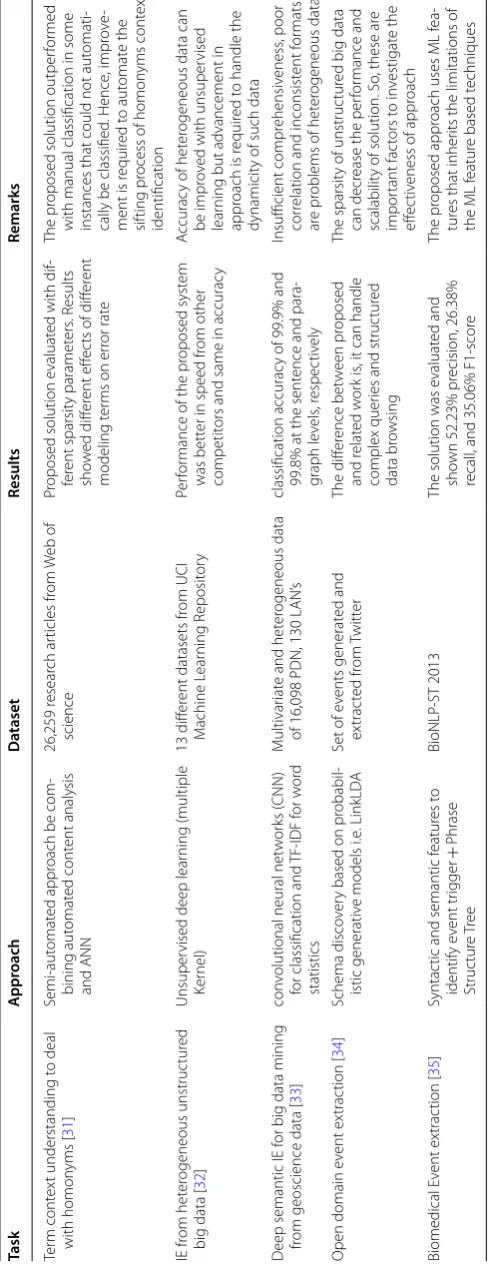
Table 6 presents the research work related to extracted entities and their relation-ship from free text corpora. Most of the traditional RE techniques were extracting one to one relationship between entities due to limited text input. In this regard, many-to-many relations have been identified from the large scale datasets that reduce the time as well as increase the performance efficiency. Apache Hadoop provides a platform to adopt parallelization in many to many relation extraction tasks using MapReduce. The system was evaluated with 100 GB free text and many to many relationships were identi-fied [24]. Traditional methods are ineffective to handle data sparsity and scalability [24]. Distant supervised learning, CNN and transfer learning have outperformed the existing traditional methods [23, 25, 26].
Event extraction (EE) and salient facts extraction
An event represents a trigger and arguments. A trigger is a verb or normalized verb that denotes the presence of an event whereas the arguments are usually entities which assign semantic roles to illustrate their influence towards event description [30]. The literature on event extraction and other salient fact extraction has been summarized in Table 7.
Table 5 Rela tion e xtr ac tion Technique Purpose Domain Da taset Results P% R% F% [ 17 ] CRF To generat e r elationship k no wledge
base and annotation
Lexical
, POS and semantic f
eatur es used Chinese enc yclopedia 52,975 w eb pages M
odel trained f
or 9 attr
ibut
es
, accurac
y of global
training is higher than the local wher
eas r
ecall
rat
e was lo
w [ 18 ] Kno wledge or ient
ed CNN with clus
-ter
ing using w
or d filt ers ( W or dNet) To o ver
come the limitations of
RBM and LBM and t
o r educe the dimensionalit y Te xt
3 datasets w
er
e used: S
emE
val-2010
task 8 with 10,717 annotat
ed samples , C ausal-TimeBank dataset, Ev ent St or yLine dataset W
ith max clust
er
ing achie
ved 91.34, 76.21, 81.84%
macr
o a
veraged F1 on S
emE val , C asual-TB , Ev ent -SL r esp ., wher eas
, with a
verage clust
er
ing
,
it achie
ved 91.20, 75.43, 81.96% F1 r
esp . [ 19 ] Patt er
n-based method t
o build inf
o net w or k To ex trac t lar ge -scale tr eatment
drug-disease pairs and inducement
drug-disease pairs M edical lit eratur e f or drug r epur posing 27M abstrac
ts and titles fr
om
PubM
ed
Algor
ithm has sho
wn high pr
ecision but lo
w recall [ 20 ] W eak ly super
vised method without
man-made annotation and SVM t
o
train model
To r
educe the manual annotation
eff
or
t and expand the r
elation
types using semantic and syntac
tic featur es Ne ws t ex t Baidu enc
yclopedia, 50,000 entr
y
pages of 10
GB siz e 83.61 82.63 83.12 Results pr ov
ed that entit
y ambiguit
y, and poor
univ
ersalit
y aff
ec
t the r
esults [ 21 ] M
ulti-class SVM and syntac
tic model
de
velopment
To det
ec
t semantic r
elation, model
ar
chit
ec
tur
e with pr
epr
ocessing
phase t
o build f
eatur
e v
ec
tor using
lexical
, semantic and syntac
tic f
ea
-tur
es
, training phase and RE phase
Table 6 En tit y and r ela
tion pair e
xtr ac tion Technique Purpose Domain Da taset Results P% R% F% [ 25 ] Transf er lear ning f or
domain dependent clust
er
ing
To adapt the w
or
ld k
no
wledge t
o the
domain-dependent tasks b
y using semantic parsing and
semantic filt er ing Ne ws t ex t 20 Ne wsg roups , R C V1
Case studies conduc
ted t
o pr
ov
e that concep
-tualization based semantic filt
er can pr
oduce mor e accurat e indir ec t super vision [ 26 ] Distant super vised lear n-ing ( deep lear ning) To o ver
come the limitations of t
ex
t mining
methods such as clust
er
ing or rule
-based et c. in k ey w or
d and inf
or mation ex trac tion with technology dependenc y g raph
Scientific lit
eratur
e
473,935 ar
ticles
, labeled 38 r
elation
instances fr
om 20 ar
ticles and expanded
to 573 instances b
y bootstrapping Case study : T echnology dr iv en g raph t o analyz e the t echnology ar chit ec tur
e of DSSC
[ 22 ] M apR educe + semantic methods (attr ibut e based
, isA based and
class based) + log istic reg ression To o ver
come the long tail challenge using Sparse
IE appr
oach
To deal with scalabilit
y and eff
ec
tiv
eness
W
eb pages
1.68 B w
eb pages
M
an
y entit
y pair identified and classified as good
and bad pairs
. R
esults of each entit
y pair with
good and bad r
ecall
, pr
ecision abd F-measur
e is pr esent ed [ 27 ] Super vised K er nel methods To ex trac t mor pho -syntac tic inf or mation fr om mined t ex t
To deal with challenges of data pr
ior itization and curation Biomedical EU-ADR Pr
oposed method using mor
pho syntac tic and dependenc y inf or mation outper for m t o identify entit y r elationship [ 28 ]
Use of declarativ
e rules in
cont ex tual exploration A ut omatic det ec
tion and ex
trac
tion of meaning
from unstruc
tur
ed w
eb using RDF
W or dNet, DBpedia, et c. To b
ypass the limitation of lack of annotat
ed data
semantically and aut
omatically usable using L
OD Fr ee t ex t Lar ge t ex t cor puses pr ovided b
y the labex
OB
VIL and the BNF (National Librar
y of
France)
EC3 sof
twar
e is implement
ed and sho
wn
considerable contr
ibution in det
ec
ting r
eal
meaning of t
ex
t
[
29
]
CRF and dic
tionar y f or NER, w or d clust er ing thr ough Unsuper vised training Chemistr y a war
e NLP pipeline with t
ok
enization,
POS tagg
ing
, NRE and phrase parsing
To populat
e chemical databases with minimal
time
, eff
or
t and expense
Scientific docu
-ments
50 open access chemistr
y ar ticles 89.1 86.6 87.8 [ 24 ] Hadoop (M apR educe)
To identify man
y t
o man
y r
elationships with less
training data Fr ee t ex t 100 GB-siz ed cor pus , baik e.baidu .com: big enc yclopedia ha
ving 700M entr
ies Pr oposed Sno wball ++ achie
ved higher positiv
e
pairs as compar
ed t
o sno
wball and PR
OSPERA [ 23 ] CNN (w eak ly super vised)
To obtain high-pr
ecision data and aut
omatically
generat
e annotat
ed training sample set
M edical Exper iment selec ted se ven medical sit es , generat
e a t
otal of 20,000 labeled
samples at last and fiv
Table 7 E ven t e xtr ac tion and salien t fac t e xtr ac tion Task A ppr oach Da taset Results Remarks Ter m cont ex
t understanding t
o deal with homon yms [ 31 ] Semi-aut omat ed appr
oach be com
-bining aut omat ed cont ent analysis and ANN 26,259 r esear ch ar ticles fr om W eb of science Pr
oposed solution e
valuat
ed with dif
-fer ent sparsit y paramet ers . R esults sho w ed diff er ent eff ec
ts of diff
er
ent
modeling t
er
ms on er
ror rat
e
The pr
oposed solution outper
for
med
with manual classification in some instances that could not aut
omati
-cally be classified
. Hence
, impr
ov
e-ment is r
equir ed t o aut omat e the sif ting pr
ocess of homon
yms cont ex t identification IE fr om het er ogeneous unstruc tur ed
big data [
32
]
Unsuper
vised deep lear
ning (multiple
Ker
nel)
13 diff
er
ent datasets fr
om UCI M achine L ear ning R eposit or y Per for
mance of the pr
oposed syst
em
was bett
er in speed fr
om other
competit
ors and same in accurac
y
A
ccurac
y of het
er
ogeneous data can
be impr
ov
ed with unsuper
vised
lear
ning but advancement in
appr
oach is r
equir
ed t
o handle the
dynamicit
y of such data
D
eep semantic IE f
or big data mining
from geoscience data [
33
]
con
volutional neural net
w
or
ks (
CNN)
for classification and
TF-IDF f or w or d statistics M ultivar iat
e and het
er
ogeneous data
of 16,098 PDN, 130 LAN
’s
classification accurac
y of 99.9% and
99.8% at the sent
ence and para
-graph le vels , r espec tiv ely Insufficient compr ehensiv eness , poor cor
relation and inconsist
ent f
or
mats
ar
e pr
oblems of het
er
ogeneous data
Open domain e
vent ex trac tion [ 34 ] Schema disco ver
y based on pr
obabil
-istic generativ
e models i.e
. LinkLD
A
Set of e
vents generat ed and ex trac ted from T witt er The diff er ence bet w een pr oposed and r elat ed w or k is
, it can handle
complex quer
ies and struc
tur
ed
data br
owsing
The sparsit
y of unstruc
tur
ed big data
can decr
ease the per
for
mance and
scalabilit
y of solution. S
o, these ar
e impor tant fac tors t o in vestigat e the eff ec tiv
eness of appr
oach Biomedical E vent ex trac tion [ 35 ] Syntac
tic and semantic f
eatur es t o identify e vent tr igger + P hrase Struc tur e T ree BioNLP -ST 2013
The solution was e
valuat
ed and
sho
wn 52.23% pr
ecision, 26.38%
recall
, and 35.06% F1-scor
e
The pr
oposed appr
oach uses ML f
ea
-tur
es that inher
its the limitations of
the ML f
eatur
e based t
more critical to extract semantic information from such a huge deluge of unstructured data. Nevertheless, big data bring some challenges also for learning-based approaches which are dimensionality of data, scalability, distributed computing, adaptability and usability [109–111]. In this regard, advancements in learning-based approaches are try-ing their best to handle the complexity of big data.
State‑of‑the‑art IE techniques
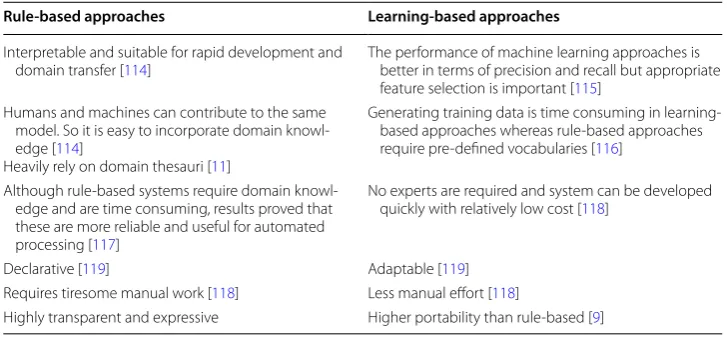
Two major categories of IE techniques are rule-based methods (RBM) and learning-based methods (LBM). It is difficult to identify which method is more popular and effective in IE. In this regard, two studies [112, 113] have shown totally different analy-sis. First, according to a systematic literature review on the popularity comparison of these two methods, it was concluded that more than 60% of the studies included in the review used pure rule-based IE systems. Whereas it was considered that rule-based IE techniques are obsoleted in academic research domain [112]. Another comparison has demonstrated totally different results by examining 177 research papers of four spe-cific conferences on NLP. Among these 177 research papers, only 6 papers relied on pure rule-based IE approach [113]. It was also observed that the IE Systems by large vendors i.e. IBM, SAP and Microsoft are purely rule-based [113]. This review identifies that LBMs are more popular in academic research domain as compared to RBM but the importance of RBM could not be neglected. However, the debate on the comparison of these two approaches is subjective to various factors such as the cost, benefits and task specifications. Table 8 presents a comparison of these two approaches in general.
The comparative analysis explores different pros and cons of both approaches but the selection of approach for any task is highly dependent on the user needs and task at hand because IE is community-based process [100]. In general, learning-based approaches are divided into supervised, semi-supervised and unsupervised techniques. These tech-niques also have limitations to handle large scale big datasets and complexity of huge volume of unstructured data. Supervised techniques require manually labeled training data which is one of the major drawbacks of these techniques. Large scale labeled corpus construction is laborious and time consuming task [9]. These techniques are effective for domain-specific IE where specific information is required to be extracted. The efficiency
Table 8 Rule-based vs learning-based techniques
Rule‑based approaches Learning‑based approaches
Interpretable and suitable for rapid development and
domain transfer [114] The performance of machine learning approaches is better in terms of precision and recall but appropriate feature selection is important [115]
Humans and machines can contribute to the same model. So it is easy to incorporate domain knowl-edge [114]
Heavily rely on domain thesauri [11]
Generating training data is time consuming in learning-based approaches whereas rule-learning-based approaches require pre-defined vocabularies [116]
Although rule-based systems require domain knowl-edge and are time consuming, results proved that these are more reliable and useful for automated processing [117]
No experts are required and system can be developed quickly with relatively low cost [118]
Declarative [119] Adaptable [119]
Requires tiresome manual work [118] Less manual effort [118]
of these techniques also depends on the selected features like morphological, syntactic, semantic and lexical features. Whereas, unsupervised IE techniques do not need labeled data. These techniques extract entity mentions from the text, clusters the similar entities and identify relations [120]. In this case, intensive data preprocessing will be required for big data because unstructured big data sets have missing values, noise and other errors [16] that produce uninformative as well as incoherent extractions. Semi-super-vised techniques use both labeled and unlabeled corpus with small degree of supervision [121]. For large scale data, distant supervised learning [26], deep learning (CNN, RNN, DNN) [9, 10, 18, 23, 31–33], transfer learning [25] techniques are more suitable for IE from free-text data.
Deep learning approaches show better results for large datasets despite its own limita-tions and challenges. It has the ability to generalize the learning and also has a unique characteristic to utilize unlabeled data during training. Deep learning has the ability to learn different features as it has multiple hidden layers. These techniques are more suitable for pattern recognition [122]. Unsupervised learning (deep) have large model capacity/complexity, high learning speed [32]. Feature learning-based systems are com-putationally expensive for large scale data [123]. For the selection of appropriate tech-nique for large scale datasets, computational cost, scalability and accuracy are the key factors [124]. More advanced algorithms and techniques are required to achieve higher accuracy and efficiency [125]. Over-fitting can be resolved with self-training [18] and to overcome the limitation of large annotated dataset availability, reinforcement learning or distant supervision can be used because these techniques use small labeled dataset [26], [126]. Timeliness of distribution of data [126], balance of informativeness, representa-tiveness, and diversity [127], data modeling performance for heterogeneous, dimen-sional, sparse and imbalance data [16] and structuring the unstructured data [10] are open challenges for IE using unstructured big data sets.
Unstructured big data barriers for IE
With huge volume and complexity of unstructured big data, natural language free text data implies various issues for the users to extract the most relevant and required infor-mation. Noisy and low-quality data is one of the major challenges in IE from big data [16, 31, 128, 129]. It causes difficulties in identifying semantic relatedness among entities and terms [130], improving the effectiveness and performance of IE systems [128], extracting contextually relevant information [31], data modeling [16] and structuring the data [10].
the quality and usability of unstructured big data. After preprocessing the data, IE tech-niques i.e. RBM or LBM will be able to produce more effective and efficient results.
IE from images
The IE from images is a field with great opportunities and challenges such as extracting linguistic descriptions, semantic, visual and tag features, context understanding and face recognition. Content and context level IE from different types of images could improve image analytics, mining and processing. Following sections review the IE from images w.r.t. different subtasks.
Visual relationship detection
Visual relationship detection extracts interaction information of objects in images. These semantic representations of the relationship of objects are presented in the form of tri-ples (Subject, Predicate, Object). The semantic tritri-ples extraction from images would benefit various real-world application such as content-based information retrieval [132], visual question answering [133], sentence to image retrieval [134] and fine-grained rec-ognition [135]. Object classification and detection and context or interaction recogni-tion are main tasks of visual relarecogni-tionship detecrecogni-tion in image understanding.
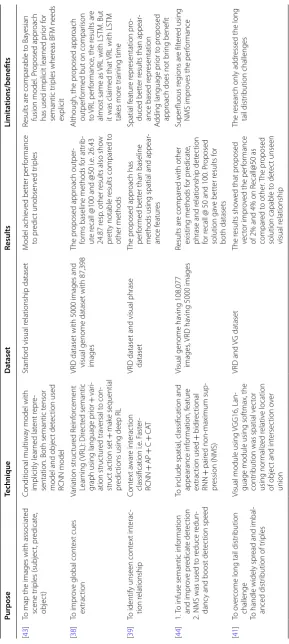
In object detection and classification, objects are recognized based on appearance and its class labels have clear association. CNN based solutions in object classification are outperforming such as VGG [36] and ResNet [37].Whereas, Faster R-CNN and R-CNN achieved great success in deep learning [38, 39]. Unlike object detection, visual relation-ship detection extracts the interaction of objects. For example, “horse eating grass” and “person eating bread” are two visually dissimilar sentences but both are sharing the same interaction type “eating”. Thus, subject, object and interaction are important in relation-ship detection as well as context of the interaction. The model of interaction and its con-text are treated as a single class where images are classified according to the interaction classes [40]. Single class modeling has poor generalization and scalability as it requires training images for each combination of interaction and context. Language priors [41] or structural language [38] are used to overcome the limitations of single class modeling. Intraclass variance, long-tail distribution, class overlapping are three major challenges of visual relationship detection [41]. Long-tail distribution challenges were addressed by introducing spatial vector for imbalance distribution of triples [41]. Long-tail distribu-tion problem causes difficulties in collecting enough training images for all reladistribu-tionships. In this regard, incorporating linguistic knowledge to DNN can regularize the perfor-mance [42]. Several modified state of the art deep learning based techniques to extract context and interaction detection have been discussed Table 9.
Table 9 V isual r ela tionship det ec tion Purpose Technique Da taset Results Limita tions/benefits [ 43 ]
To map the images with associat
ed scene tr iples (subjec t, pr edicat e, objec t) Conditional multiwa
y model with
implicitly lear
ned lat
ent r
epr
e-sentation. Both semantic t
ensor
model and objec
t det ec tion used RCNN model Stanf or
d visual r
elationship dataset M odel achie ved bett er per for mance to pr edic t unobser ved tr iples Results ar
e comparable t
o Ba yesian fusion model . P roposed appr oach
has used implicit lear
ned pr ior f or semantic tr iples wher eas BF M needs explicit [ 38 ] To impr ov
e global cont
ex t cues ex trac tion Var iation struc tur ed R einf or cement Lear ning ( VRL): Dir ec ted semantic
graph using language pr
ior + var i-ation struc tur ed tra versal t o con -struc t ac tion set + mak e sequential pr edic
tions using deep RL
VRD dataset with 5000 images and visual genome dataset with 87,398 images
The pr
oposed appr
oach outper
-for
ms baseline methods f
or attr
ib
-ut
e r
ecall @100 and @50 i.e
. 26.43
24.87 r
esp
. other r
esults also sho
w
pr
ett
y notable r
esults compar
ed t
o
other methods
Although, the pr
oposed appr
oach
outper
for
med but on compar
ison
to
VRL per
for
mance
, the r
esults ar
e
almost same as
VRL with LSTM. But
it was claimed that
VRL with LSTM
tak
es mor
e training time
[
39
]
To identify unseen cont
ex t int erac -tion r elationship Cont ex t a war e int erac tion classification i.e . F ast er -RCNN + AP + C + CA T
VRD dataset and visual phrase dataset
The pr oposed appr oach has per for med bett
er than baseline
methods using spatial and appear
-ance f eatur es Spatial f eatur e r epr esentation pr o-duced bett er r
esults than appear
-ance based r
epr
esentation
A
dding language pr
ior t
o pr
oposed
appr
oach does not br
ing benefit
[
44
]
1.
To infuse semantic inf
or mation and impr ov e pr edicat e det ec tion
2. NMS was used t
o r
educe r
edun
-danc
y and boost det
ec
tion speed
To include spatial
, classification and
appearance inf or mation, f eatur e ex trac tion used + bidir ec tional RNN + pair
ed non-maximum sup
-pr
ession (NMS)
Visual genome ha
ving 108,077
images
, VRD ha
ving 5000 images
Results ar
e compar
ed with other
existing methods f
or pr
edicat
e,
phrase and r
elationship det
ec
tion
for r
ecall @ 50 and 100. P
roposed solution ga ve bett er r esults f or both datasets Super fluous r eg ions ar e filt er ed using NMS impr ov
es the per
for mance [ 41 ] To o ver
come long tail distr
ibution
challenge
To handle widely spr
ead and imbal
-anced distr
ibution of tr
iples
Visual module using
VGG16, Lan
-guage module using sof
tmax, the
contr
ibution was spatial v
ec tor using nor maliz ed r elativ e location of objec
t and int
ersec tion o ver union VRD and VG dataset The r esults sho w
ed that pr
oposed
vec
tor impr
ov
ed the per
for
mance
of 2% and 4% on R
ecall@50 as compar ed t o other . T he pr oposed
solution capable t
o det ec t unseen visual r elationship The r esear
ch only addr
essed the long
tail distr
common features in same predicate category [45]. So, intraclass variance is a challenge for CNN based VRD. In order to overcome the limitation of CNN models in VRD, visual appearance gap between same predicates and visual relationship should be reduced. For this, Context and visual appearance features can be used to overcome the identified limi-tation [44, 45]. Further, modified deep learning techniques are required to overcome the challenges of visual relationship detection for large scale unstructured data. To the best of our knowledge, the impact of volume, variety and velocity of big data is not addressed well in visual relationship detection techniques.
Text recognition
A vast array of information can be extracted from the text content in images. Text within images and videos describes more about the useful information about the visual con-tent and also improves the efficiency of keyword-based searching, indexing, information retrieval and automatic image captioning. Text information extraction (TIE) systems detect, localize and recognize the text in visual data like images and videos. The visual content can be categorized into perceptual content and semantic content. Perceptual content includes color features, shape, texture features, temporal attributes, whereas semantic content deals with the identification and recognition of objects, entities and events [136]. TIE systems follow detection, localization, tracking, extraction or enhance-ment and recognition phases in terms of detecting and identifying text in the visual data. Each subtask of TIE systems has different techniques, challenges and limitations. In TIE systems, text detection and localization tasks are used to identify different features such as color-based, edge based, texture-based and text-specific features [136, 137]. All these subtasks are important to extract useful information from visual data but only recogni-tion task is more relevant to the identificarecogni-tion of objects, entities and characters. Text recognition is a process to identify the character-forming meaningful words. So, recent literature have been discussed, in this section, to identify the potential challenges of text recognition task from images in information extraction.
Text recognition task is tightly coupled with the OCR (Optical Character Recognition) approach to recognize characters from images or scanned documents. Character recog-nition from the Tamil text in ancient documents and palm manuscripts to extract use-ful information from document images using OCR involved a segmentation technique which included different stages: image preprocessing, feature extraction, character rec-ognition and digital text conversion. According to the experimental results, the accuracy of conversion for the Brahmi was 91.57% and 89.75% for the Vattezhuthu [46]. Whereas, character recognition using neural networks from handwritten text has shown differ-ent results. The Radial Basis Function (RBF) with one input layer and one output layer has been used to train RBF network. As compared to back propagation neural network, gradient feature extraction resulted in less accuracy with RBF using directional group values [47]. OCR systems perform better for scanned documents but different variation in images have shown inappropriate results [137]. The underlying reasons could be the geometric variation, complex background, variation of text layout and font, uneven illu-mination, multilingual content, low resolution and low quality [138].
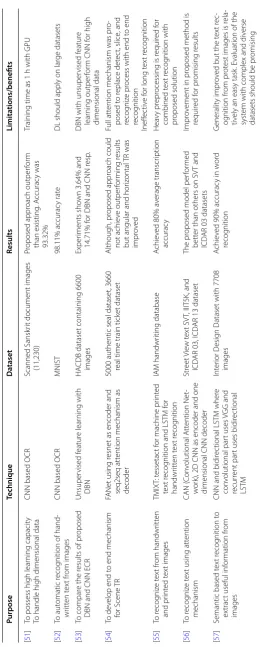
structure or concepts from the features such as Support Vector Machine (SVM) and Bayesian classifier. These classifiers are trained to learn the structure and are tested on the unlabeled regions. In this regard, distorted character recognition using Exempler SVM beat the existing state of the art by over 10% for English and 24% for Kannada on the benchmarked dataset Chars74k and ICDAR [48]. Similarly, CRF classifier was used in a framework to recognize characters with scores, spatial constraint and linguistic knowledge that performed 79.3% on ICDAR2003 and 82.79% on ICDAR2011 accuracy [49]. Another system, Stroklete, was designed to detect and recognize characters from the images using histogram features i.e. bag-of-Strokletes to learn the structure of the letters and train the system with Random Forest classifier. The system was trained and tested on English letters and Arabic numbers. It had shown 80% and 75% supporting results on ICDAR2003 and SVT respectively [50]. However, robustness to distortion and generality to variant language are challenging for these systems. To explore the advance-ment in TIE techniques, Table 10 summarizes the literature on the state of the art TIE techniques for high dimensional or large scale datasets.
Unlike traditional OCR techniques, CNN, RNN and LSTM are achieving high per-formance in text recognition in images. Deep learning techniques are showing preva-lent results to date. CNN as feature extractor to detect, slice and recognize pipeline [57] and as encoder in attention mechanism outperformed others [56]. Although, these tech-niques are showing promising results, but diversity in data sources makes the system complex [55]. The effectiveness of these techniques for complex, diverse, high dimen-sional and heterogeneous datasets must be investigated. The huge volume of unstruc-tured data is creating noisy and low-quality images such that multilingual text in images should be addressed to improve the IE from images [58, 59]. CNN based OCR have also shown pretty good results but the performance of technique on unstructured big datasets is still to be investigated. The attention mechanism is a new approach in text recognition [54, 56]. Initially, the results are satisfactory but there is a huge room for improvement in terms of unstructured and multidimensional big data. It is predicted that OCR with attention mechanism will be the emerging phenomenon in near future for text recognition [54]. In this regard, robust and adaptive techniques are required for unstructured big datasets for semantic understanding of text in images.
Face recognition
Table 10 T ex t r ec ognition fr om images Purpose Technique Da taset Results Limita tions/benefits [ 51 ]
To possess high lear
ning capacit
y
To handle high dimensional data
CNN based OCR
Scanned Sansk
rit document images
(11,230) Pr oposed appr oach outper for m than existing . A ccurac y was 93.32%
Training time as 1
h with GPU
[ 52 ] To aut omatic r ecog
nition of hand
-wr itt en t ex t fr om images
CNN based OCR
MNIST
98.11% accurac
y rat
e
DL should apply on lar
ge datasets
[
53
]
To compar
e the r
esults of pr
oposed
DBN and CNN ECR
Unsuper vised f eatur e lear ning with DBN HA
CDB dataset containing 6600 images
Exper
iments sho
wn 3.64% and
14.71% f
or DBN and CNN r
esp
.
DBN with unsuper
vised f eatur e lear ning outper for
m CNN f
or high dimensional data [ 54 ] To de
velop end t
o end mechanism
for
Scene TR
FANet using r
esnet as encoder and
seq2seq att
ention mechanism as
decoder
5000 authentic seal dataset, 3660 real time train tick
et dataset Although, pr oposed appr oach could not achie ve outper for ming r esults
but angular and hor
iz ontal TR was impr ov ed Full att
ention mechanism was pr
o-posed t o r eplace det ec t, slice , and recog niz e pr
ocess with end t
o end recog nition Ineff ec tiv e f
or long t
ex t r ecog nition [ 55 ] To r ecog niz e t ex t fr om handwr itt en and pr int ed t ex t images TMIX T: t essetac t f
or machine pr
int
ed
tex
t r
ecog
nition and LSTM f
or handwr itt en t ex t r ecog nition IA M handwr iting database A chie
ved 80% a
verage transcr iption accurac y Hea vy pr epr
ocessing is r
equir ed f or combined t ex t r ecog nition with pr oposed solution [ 56 ] To r ecog niz e t ex
t using att
ention mechanism CAN ( Con volutional A tt ention Net -w or
k), 2D CNN as encoder and one
dimensional CNN decoder
Str eet Vie w t ex t SV T, IIIT5K , and ICD
AR 03, ICD
AR 13 dataset
The pr
oposed model per
for
med
bett
er than others on SV
T and
ICD
AR 03 datasets
Impr
ov
ement in pr
oposed method is
requir ed f or pr omising r esults [ 57 ]
Semantic based t
ex t r ecog nition t o ex trac
t useful inf
or
mation fr
om
images
CNN and bidir
ec
tional LSTM wher
e con volutional par t uses VGG and recur rent par
t uses bidir
ec tional LSTM Int er ior D esig
n Dataset with 7708
images
A
chie
ved 90% accurac
y in w
or d recog nition G eneralit y impr ov
ed but the t
ex t r ec -og nition fr om pr ot
est images is r
ela
-tiv
ely an easy task
. E
valuation of the
syst
em with complex and div
erse
datasets should be pr
In the domain of computer vision, face recognition is a holistic method that analyzes the face images. Various techniques have been proposed for face recognition for different datasets but these traditional techniques are inadequate to deal with large scale datasets efficiently. A comparative analysis shows that these traditional techniques have limita-tions to handle low-quality large scale image datasets whereas deep learning methods are producing better results for these datasets but with optimal architecture and hyper-parameters [58]. The face recognition in low quality i.e. blur and low-resolution images degrades its performance. Sparse representation and deep learning methods combined with handcrafted features outperformed in case of low-resolution images [59]. Face rec-ognition techniques should be able to recognize faces with different face expressions and poses in different lighting conditions [58]. Various deep learning based solutions are proposed to address the limitations of traditional techniques. Deep CNN face recogni-tion technique without extensive feature engineering reduces the effort of most appro-priate feature selection. Deep CNN face recognition technique was evaluated on UJ face database of 50 images and the results have shown validation accuracy of 22% goes to 80% after 10 epochs and 100% after 80 iterations [52]. Certain limitations were also asso-ciated with the solution such as overfitting and very small dataset. To reduce overfitting, application of early stopping method will require extra effort. VGG-face architecture and modified VGG-face architecture with 5 convolutional layers, 3 pooling layers, 3 fully connected layers and softmax layer was evaluated using five different image datasets, i.e. ORL face database with 400 images, yale face database with 165 images, extended yale-B cropped face database with 2470 images, faces 94, Feret with 11,338 images and CVL face db. For all datasets, the proposed approach performed better as compared to traditional methods [58]. Although, the proposed technique outperformed five differ-ent datasets but the datasets were not complex and large-scale datasets. Deep learning based face recognition techniques such as deep convolutional network or VGG-face and lightened CNN have capability to handle huge amount of wild datasets [61].
Audio IE
Companies like call centers and music files are the major sources which generate a huge volume of audio data. Different type of information can be extracted from this data to help predictive and descriptive analytics. The subtasks of IE from audio data are classi-fied as acoustic event detection and automatic speech recognition.
Acoustic event detection
Sound event extraction or acoustic event extraction is an emerging field which aims to process the continuous acoustic signals, convert them into the symbolic description. The applications of automatic sound event detection are multimedia indexing and retrieval [141], pattern recognition [62], surveillance [142] and other monitoring applications. This symbolic representation of sound events is used in automatic tagging and segmen-tation [143]. These auditory sounds come from diverse sources and contain overlapping events and background noise [63, 64]. Moreover, parametric accuracy of training model on limited training data is also difficult to achieve [62].
As presented in Table 11, data scarcity and overfitting are common limitations of AED solutions. In this regard, modified data augmentation achieved better results due to modification in frequency characteristics with particular frequency band [65]. Con-text recognition is one of the solutions to overcome the overlapping issue and improve the accuracy of AED but identifying the specific context sound event is one of the criti-cal challenges for AED. Adding language or knowledge prior can help to extract con-text sound events [64]. In recent work on AED, deep neural networks are outperforming traditional techniques. The capability to jointly learn feature representation is one of the major advantages of DNN. Whereas, supported by large amount of training data, DNN is well progressing in the field of computer vision. But non-availability of large scale datasets publically reduces the progress in this research area [64]. Creating large scale annotated data can be a time-consuming process. Therefore, weakly supervised or self-supervised data for training can perform better. In this context, CNN based weakly supervised technique was compared to the technique trained with fully-supervised data. On evaluating both techniques on UrbanSound and UrbanSound8k datasets, weakly supervised performed better for arbitrary duration without human labor for segmenta-tion and cleaning [67]. On the implementation side of AED techniques on large scale, high computational power, efficient parallelism and support for training large models are important factors to consider [68]. The research on automatic AED is hindering by the complexity of overlapping sound events. Improved accuracy to handle overlapping sound events, efficient solutions to achieve labeled datasets, improved processing time with parallelism for large scale data are important dimensions for the development of optimal solutions for AED with unstructured big data.
Automatic speech recognition (ASR)
Table 11 A coustic e ven t det ec tion Purpose Technique Da taset Results Limita tions/benefits [ 62 ] M
odeling data with ex
emplars
To explicitly model the back
gr ound ev ents Ex emplar
-based method with NMF
O
ffice Liv
e r
ecor
dings fr
om 1 t
o
3
min and office synthetic with
bg noise
W
ith time wrapping
, Fscor
e
impr
ov
ed fr
om 50.2 t
o 65.2% in
office liv
e dataset wher
eas in office
synthetic dataset, r
esults w er e not pr omising Pr
oposed solution suff
ers fr
om data
scar
cit
y, and o
ver fitting [ 65 ] To o ver
come the o
ver fitting limita -tion To impr ov
e the per
for
mance f
or
lar
ge scale input
CNN t
o train AED end t
o end
+
data
aug
mentation method t
o pr ev ent ov er fitting A coustic e
vent classification data
-base
A
chie
ved 16% impr
ov
ement as
compar
ed t
o Bag of A
udio W or ds (BoA W
) and classical CNN
Results pr
esent
ed with and without
data aug mentation pr ov ed that aug mentation impr ov
es the per
-for mance [ 63 ] To explor
e the impac
t of f
eatur
e
ex
trac
tion in AED
To explor
e the eff
ec
tiv
eness of deep
lear
ning appr
oaches
M
ultiple single r
esolution r ecog niz -ers + selec
tion of optimal set of
ev
ents
+
mer
ging or r
emo ving repeat ed labels CHIL2007 CNN per for med bett
er with combi
-nation scheme of multi-r
esolution
appr
oach
DNN has the abilit
y t
o model high
dimensional data [ 64 ] To impr ov
e the det
ec tion accurac y by ex trac ting cont ex t inf or mation Cont ex t r ecog
nition phase: UBM
to captur e unk no wn e vents and sound e vent det ec tion stage A
udio database consisting 103 recor
dings of 1133
min duration
Kno
wledge of cont
ex
t as cont
ex
t
dependent e
vent pr
ior can be
used t
o impr
ov
e the accurac
y
Cont
ex
t dependent e
vent selec
tion
and accurat
e sound e
vent modeling ar e t w o impor tant fac tors f or the impr ov
ement in AED
[
66
]
To impr
ov
e the efficienc
y of acoustic
scene classification and acoustic event det
ec tion G at ed r ecur
rent neural net
w or ks (GRNN) + linear discr iminant analysis (LD A)
DCASE2016 task 1
A
chie
ved o
verall accurac
y of 79.1%
on DCASE2016 challenge
. R
elativ
e
impr
ov
ement of 19.8% as com
-par ed t o GMM LD A minimiz
es inner class var
iance
but not efficient f
or high dimen
recognition, sound waves of speaker’s speech are converted into the electrical signal and then transformed into digital signals. These digital speech signals are then represented in discrete sequence of feature vectors [145]. The pipeline of speech recognition system consists of feature extraction, acoustic modeling, pronunciation modeling and decoder. Generally, these automatic speech recognition systems are divided into five categories according to classification methods such as Template-based approaches, Knowledge-based approaches, dynamic time warping (DTW), hidden Markov model (HMM) and artificial neural network (ANN) based approaches [146]. Recently, the exponential growth of unstructured big data and computational power, ASR is moving towards more advanced and challenging applications such as mobile interaction with voice, voice control in smart systems, communicative assistance [147]. For such large scale and real world applications, Table 12 presents the recent literature on ASR to discuss state-of-art classification approaches, its variants, evaluation results and remarks on the proposed solution.
Table 12 A ut oma tic sp eech r ec ognition Purpose A ppr oach Technique Da taset Results/limita tions [ 68 ] To impr ov
e computational po
w
er
To enhance the training capabilit
y of
lar
ger models
To ease the pr
ocess
ANN
M
ar
iana: GPU and CPU clust
ers f or paral -lelism Thr ee frame w or ks w er e de veloped: multi-GPU f
or DNN,
multi-GPU f
or DCNN, CPU
clust
er f
or lar
ge scale DNN
W
ith 6 GPUs
, 4.6 times speedup o
ver one GPU was achie
ved and charac
ter er
ror rat
e
was decr
eased b
y 10% as compar
ed t
o existing t
echniques
DNN frame
w
or
k with GPUs per
for med bett er f or ASR [ 72 ] To in vestigat
e noise r
obustness on DNN
based models
ANN
DNN-HMM: DNN based noise a
war
e
training
A
ur
ora 4 w/o explicit noise compensation
7.5% r elativ e impr ov ement Dr
opout training in DNN with o
ver
lapping
concer
n as compar
ed t
o f
eatur
e space
and model space noise adaptiv
e training
[
73
]
Bilingual ASR syst
em f
or F
risian and Dut
ch
languages
ANN
DNN with language dependent and language independent phone
FA
ME Speech database
Bilingual DNN trained on phones of both languages achie
ved best per
for
mance
yielding
CS-WER of 59.5% and
WER of
38.8%
Code swit
ching ASR combines phones of
tw
o languages outper
for med on WER wher eas lat enc
y of swit
ching is also an
impor
tant fac
tor f
or these syst
ems [ 75 ] To impr ov e per for mance f or lar ge vocabular
y speech r
ecog nition ANN LSTM RNN 2800 utt erance
, each dist
or
ted once with
held-out noise samples
On 25 k w or d v ocabular y, 19.5% WER, and
14.5% in v
ocabular y WER W or d le
vel acoustic models without
language model can achie
ve r easonable accurac y [ 74 ] To compar
e the per
for
mance of
DNN-HMM with CNN-DNN-HMM
ANN
CNN with limit
ed w
eight shar
ing scheme
to model speech f
eatur
es
Small-scale phone r
ecog nition in TIMIT lar ge v ocabular y v oice sear ch task CNN r educe er ror rat e b
y 6% t
o 10% com
-par
ed with DNN
ASR per
for
mance is sensitiv
e t
o pooling
siz
e but insensitiv
e t
o o
ver
lap b/w pool
-ing units The r esults w er e bett er f or v oice sear ch exper
iment but not f
or phone r
ecog
ni
Table 12 (c on tinued) Purpose A ppr oach Technique Da taset Results/limita tions [ 71 ] To de
velop ASR f
or Amazigh language
HMM
GMM and tied stat
es MFC C f or f eatur e ex trac tion, phonetic dic tionar
y, language model using
CMU-Cambr
idge Statistical Language
M
odeling
Toolk
it, HMM based lar
ge vocabular y syst em Ne w cor
pus with 187 distinc
t isolat
ed
w
or
d speech r
ecor
ding b
y 50 speak
ers A chie ved r educed WER t
o 8, 20%
The ne
w cor
pus was collec
ted
. R
esults ar
e
not compar
ed with existing stat
e of the
ar t t echniques [ 69 ] LMS A daptiv e filt er ar e intr oduced t o pr epr
ocess the speech sig
nals and t
o identify speak er Templat e based A daptiv e F ilt er ing + featur e ex trac -tion + dimensionalit y reduc -tion +
ensemble classification model
using LSTM, ICNN, and SVM
IIT
G multi var
iabilit y speak er r ecog nition database A chie
ved 95.69% accurac
y f
or noisy data
Follo
ws sequential pr
ocessing Requir e memor y-bandwidth bound computation Requir ed lar
ge amount of training data f
or each ne w speak er [ 70 ] ASR f or Tunisian dialec t Rule based
G2P rules w
er
e defined t
o build pr
onun -ciation dic tionar ies TARIC, 9.5
h speech f
or training and
43
min f
or t
esting
WER of 22.6% Validat
ed on manually annotat
ed dataset Impr ov ed qualit y pr onunciation dic tionar
-ies can be build using exper
t k
no
wledge
but high linguistic sk
ills ar
e r
equir