R E S E A R C H
Open Access
Efficient parallel spectral clustering algorithm
design for large data sets under cloud computing
environment
Ran Jin
1,2*, Chunhai Kou
1, Ruijuan Liu
1and Yefeng Li
1Abstract
Spectral clustering algorithm has proved be more effective than most traditional algorithms in finding clusters. However, its high computational complexity limits its effect in actual application. This paper combines the spectral clustering with MapReduce, through evaluation of sparse matrix eigenvalue and computation of distributed cluster, puts forward the improvement ideas and concrete realization, and thus improves the clustering speed of the distinctive clustering algorithm. According to the experiment, with the processing data scale being enlarged, the clustering rate is in nearly linear growth, and the proposed parallel spectral clustering algorithm is suitable for large data mining. The research results provide research basis to better design a clustering partition algorithm in large data and high efficiency.
Keywords:Large data; Spectral clustering algorithm; Clustering analysis; Parallel Lanczos; K-means
Introduction
The clustering analysis is an important and active re-search field in data mining, and the rere-search is about the classification of data objects. In order to conveniently ex-pound and understand the data objects and extract inher-ent information or knowledge hidden in the data, it is necessary to use cluster analysis technology. Its main idea is to divide the data into several classes or clusters, so as to make the objects in same cluster become the most similar while objects in different clusters vary greatly. On the whole, the algorithm can be divided into partition method, hierarchical method, density method, and model method and so on [1]. Generally, the traditional clustering algorithm has following drawbacks: low efficiency in clustering, long processing time in large data and difficulty in meeting the expected effect. For these problems, a popu-lar research idea is correspondingly formed: combining clustering analysis, parallel computing and cloud comput-ing, and designing an efficient parallel clustering algorithm [2,3]. This paper adopts the classical spectral clustering
algorithm as the research foundation of clustering partition algorithm as for large-scale data, analyzes how to dig valu-able, understandable data information out of large data in a rapid and efficient way and at low costs. Parallel ing is a process that simultaneously uses various comput-ing resources to solve calculation problem, which has the advantages of speeding up program execution and saving investments. Owing to the clustering, many cheap com-puters can be used to replace the expensive servers, and the data mining services under the parallel computing environment greatly reduces data processing costs. Be-sides, the cloud computing can provide scalability, reliabil-ity and stabilreliabil-ity when operating large-scale application in virtual computing environment. Based on the characteristics of cloud computing in large application, namely -distributivity, isomerism and mass data, it is suitable for data intensive application and processing [3,4].
Clustering analysis has following common problems: difficulty in handling mass data and distribution data, diffi-culty in determining parameters, low efficiency and poor clustering quality. In recent years, some researchers have been focusing on how to accelerate spectral clustering al-gorithm [5-12]. Fowlkes et al. propose to use the Nyström approximation to avoid calculating the whole similarity matrix. That is to say, they trade accurate similarity values * Correspondence:[email protected]
1College of Information Science and Technology, Donghua University, Shanghai, P.R.C
2School of Computer Science and Information Technology, Zhejiang Wanli University, Ningbo, P.R.C
for shortened computational time. Dhillon et al. presup-posed the availability of the similarity matrix and proposes a method which does not use eigenvectors. Although these methods can reduce computational time, they trade clus-tering accuracy for computational speed gain, and they do not address the bottleneck of memory use. To get rid of the memory capacity limit and computational bottleneck, many people like Yang utilized MPI (Message passing Interface) to build a distributed environment. Neverthe-less, MPI mechanism increased the consumption of com-munication between machines and the network. More importantly, it is more complex if realization program uses MPI to deserialize. After all, it requires the whole cluster communication to be controlled, which is not so conveni-ent and easy comparing with Hadoop. The Hadoop is bet-ter in fault tolerance. To make the algorithm work
normally in mass data, researchers like Meng raised the
method of using matrix sparsification - closest method, and finally used the matrix spared through the nearest neighbor method to the parallel implementation of spectral clustering. Finally, by proving the algorithm through learn-ing experience of documents data, they proved that the al-gorithm can effectively cope with the problem of mass data. In this paper, we first calculate the similar matrix and sparsification according to the data point identification seg-mentation, then use Lanczos distributed computing and parallel computing to get the feature vector when we store the Laplace matrix in the distributed file system HDFS for calculating the characteristic vector by way of using, finally get clustering results by efficient parallel K-means cluster-ing in terms of the transposed matrix of the feature vector. At each step, different parallel strategies are used in algo-rithm, and the whole algorithm grows fast.
Paper structure is organized as follows: in Section Rele-vant concepts and description, the MapReduce paradigm is briefly introduced and traditional spectral clustering algorithm is inspected. In Section Parallel spectral clus-tering algorithm design based on Hadoop, our design and implementation of PSCA(Parallel Spectral Clustering Algorithm) are presented. Performance evaluation is presented in Section The analysis of experiment and result. In Section Conclusion, conclusion is drawn and future works are discussed.
Relevant concepts and description
From above analysis, we can know that the parallel algo-rithm design is based on Hadoop, so the users’main job is to design and realize the Map and Reduce functions, in-cluding input and output the type of < key, value > key value and specific logic of Map and Reduce functions, etc.
Hadoop platform
With the appearance of Google’s MapReduce
distrib-uted platform, some calculation of high computational
complexity can be completed in acceptable time. Based
on MapReduce’s thought, Apache foundation developed
Hadoop Open Source Project. As an open source
pro-ject, Hadoop’s distributed computing framework can be
used to construct cloud computing environment (dis-tributed computing). With the help of the computing power, it can be even distributed to many computing nodes in the cluster, thus realizing the huge computation ability about large data. Hadoop has high data through-put, and realizes the high fault tolerance, high reliability and scalability. It is composed of two main parts: HDFS (distributed file system) and MapReduce programming model. At the same time, by combining spectral cluster-ing, serial traditional algorithm and MapReduce program-ming model, it is transplanted into Hadoop platform to conduct distributed data mining calculation by adopting corresponding parallel strategy. However, if the Hadoop platform technology is applied to the data mining algo-rithms, key problem is how to achieve the parallelization implementation of traditional data mining algorithm [13]. Among these modes, MapReduce (mapping and specifica-tion) programming model can make the user conveniently develop distributed computing program without caring about details. In the whole operation process, MapReduce model is always using key value of < key, value > to input and output about the form. It simplifies the programming model of parallel computing, and only provides available interface to upper users. Working processes at each stage of MapReduce calculation model is as follows:
(1) Input: An application based on the Hadoop platform and MapReduce framework that often need a pair of Map and Reduce functions by realizing appropriate interface or providing abstract class. It should also specify the locations of both input and output, and other operating parameters. This stage will divide big data under the input directory into several independent data blocks.
(2) Map: MapReduce framework treats the application input as a group of < key, value > key value pairs. At this stage, the framework will call the Map function that user defines to process each < key, value > key value pairs. At the same time, it will create some new intermediate < key, value > key value pairs. The types of the two groups of key value pairs may be different.
(4) Reduce: This stage will be full of intermediate data, and for each unique key, implement the user-defined Reduce function. The input parameter is“<key, {list of values} >, and the output is a new < key, value > key value pairs. (5) Output: This stage will write the result output
from Reduce in the designated location of output directory. In this way, a typical MapReduce process is completed.
Traditional spectral clustering algorithm
Spectral clustering algorithm is a dot pair cluster algo-rithm, and it is first used in computer vision, VLSI de-sign and other fields, and then it is used in machine learning, and rapidly becomes research focus in the field of international machine learning. It has very promising application prospects for data clustering. The idea of this algorithm is derived from the spectrogram partition the-ory. If each data sample is considered as the vertexVin
the chart, give weight valueWto edge E between vertex
in accordance with similarity degree between samples,
then the undirected weighted graph G=(V, E) based on
similarity degree can be obtained. So in the graph G, the clustering problem can be transformed into partition problem on graph G. The optimal classification criterion based on graph theory is to make the internal similarity degree of the two subgraphs the largest, and similarity degree between subgraphs the smallest.
The standard serial spectral clustering algorithm steps are as follows:
(1) By computation, obtain the similar matrix S∈Rn×n and then sparse it;
(2) Construct diagonal matrixD;
(3) Compute the standard Laplace matrixL;
(4) Compute kminimum eigenvectors of matrix L, and compose matrixZ∈Rn×kwhich containsk
minimum eigenvectors and are regarded as the columns of the matrixZ;
(5) Standardize it asY∈Rn×k
(6) Use K-Means algorithm to cluster the data pointyi∈
Rk(i= 1,…,n) intokclusters.
Parallel spectral clustering algorithm design based on Hadoop
In the standard serial spectral clustering algorithms, we know that algorithm computational complexity is mainly presented in the construction of similar matrix, calculation of k minimum feature vector(s) in Laplace matrix and k-means the clustering. The parallel design of spectral cluster-ing algorithm is processed from the above three aspects.
Calculate similar matrixes in parallelized ways
Because the Hadoop MapReduce can provide outstanding distributed computing framework, we realize our parallel
spectral clustering algorithm in the Hadoop MapReduce. Firstly, we put the data point x1,…,xn in HBase chart,
which can be accessed by each machine, and the line key (row key) of each data pointxiis set as the subscripti∈ {1,…,n} of the data point. Then we use a Reduce function to automatically distribute the similar values between the calculated data points. For each data pointxiwith identifi-cationi, Reduce function will only clear those whose sub-scripts are equal to or bigger thaniwith the data point of
xj(j=i,…,n) and the similar value ofxi. We can call it“the similar value calculation of subscript i”. In this way, the similar value between each pair of data points can be cal-culated only once. The apparent“similar value calculation of subscripti”and“similar value calculation of other sub-scripts”are independent from each other. Therefore, if we distribute different subscripts to different machines, then
“similar value calculation of subscript i” can be operated in distributed environment.
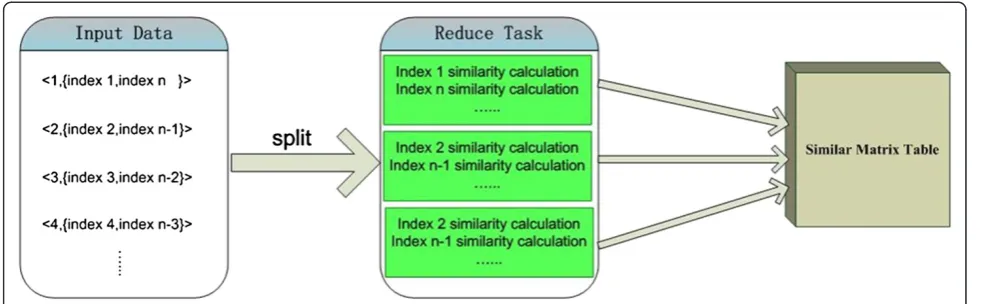
Especially,“similar value calculation of subscripti”needs to calculate the similar value {<xi,xi>, <xi,xi+ 1>,…, <xi, xn>} ofn−i+ 1 data point pairs. That is to say, the first subscript 1 needs to compute similar value ofndata point pairs, and the last subscript nonly needs to compute the similar value of a data point, that itself is <xn,xn>. In order to balance the calculation of similar value, we put the
“similar value calculation of subscript 1”and“similar value calculation of subscriptn”together, and“similar value cal-culation of subscript 2” and “similar value calculation of subscriptn−1” together, and so on (see Figure 1). When the calculation of similar values is completed, put them back on HBase table and they will be used to calculate the Laplace matrix in later steps. The process of parallel con-struction of similar matrix can be shown in Algorithm 1.
Algorithm 1 parallelized constructing the reduce function in similarity matrix
Input: <key, value>, key is the subscript index of data point, and value is supposed as null.
Output:<key’, value’> = < key,value> 1. index = key, another Index = n-key + 1 2. Foriin{index,another Index}
i_content = get Content From HBase(i): For j = i tondo
j_content = get Content From HBase(j); sim = compute Similarity(i_content,j_content); store Similarity(i,j, sim) into HBase table; End For
End For
3. Output < key,null> 4. End.
Parallel computingkminimum eigenvectors
to compute the eigenvalue and feature vector of square matrix, or the singular value decomposition of rectangular matrix [14]. Especially for the very large and sparse matrix, Lanczos’algorithm is very effective [15-17]. When calcu-lating the maximum (or minimum) k feature vector of the matrix, the Lanczos is more suitable, for it can find out the k feature vectors by only iterating k times [15,16].
Lanczos transforms the original Laplace matrix Linto
a real and symmetric tri-diagonal matrix: Tmm¼VmL
Vm with the diagonal elements marked asαj=tjjand the off-diagonal elements as βj=tj−1j. Notice that Tmm is a symmetric matrix, so tj−1j=tjj−1. Lanczos algorithm is
shown in Algorithm 2:
Notice that (x,y) is the dot product of two vectors, and after the iteration, we get a tridiagonal matrix com-posed ofαjandβj:
Tmm¼
α1 β2 0
β2 α2 β3
β3 α3 ⋱
⋱ ⋱ βm−1
βm−1 αm−1 βm
0 βm αm
0 B B B B B B @
1 C C C C C C A
After we get the matrixTmm, becauseTmmis a tridia-gonal matrix, it is easy to obtain its eigenvalues and fea-ture vector through other ways (such as QR algorithm). It can be proved that the eigenvalue (feature vector) is the similar value to original Laplacian matrix L’s eigen-value (feature vector).
Algorithm 2 Lanczos algorithm
1. v1←normis the random vector of 1 v0←0
β1←0
2. Iteration: forj= 1, 2,…,m
wj←Lvj−βjvj−1
αj←wj;vj
wj←wj−αjvj
βjþ1← wj
vjþ1←wj=βjþ1
3. Return
From Lanczos’algorithm, we can see that the
multipli-cation Lvj of matrix and vector is a time-consuming
process. If the matrix is put into memory, then L must
be removed every time when it is multiplied by a vector, thus consuming a lot of time consumes. The distributed function provided by Hadoop MapReduce and HDF adopts an excellent idea: mobile computing to near the data that is to be operated saves time than to calculation program. We adopt a similar Distributed Matrix to store
the matrix L that is to be decomposed on HDFS, and
the storage of matrix L on HDFS is according to
seg-mentation. Then Lanczos’each iteration doesn’t remove
the distributed matrix L on HDFS. On the contrary,
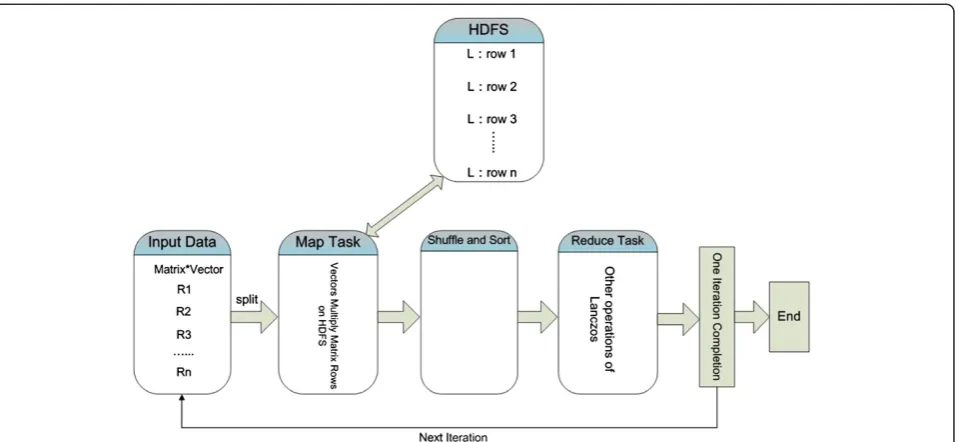
what should be moved is a vector (i.e. mobile comput-ing). Every time, the vector vj, which is going to multiply
matrix, should be sent to the location that matrix L
stores in HDFS, and then the product of vector vj and
matrixLon each line (see Figure 2) should be calculated
in a parallelized way. The productLvjbetween matrix L
and vector vj is the primary time-consuming operation
in Lanczos algorithm. But now with matrix L’s
distrib-uted storage in HDFS, this operation can be completed
by Map/Reduce. If the former k feature vector (s) is
needed, just send the vector forktimes to the data stor-age of matrix for calculation.
Parallelization of K-means clustering
In parallelization of K-means clustering algorithm, a file including initializationkcluster (s) center is created, and can be accessed by each machine in the cluster when it is placed on the HDFS. Obviously, the distance
calcula-tion between a data point and the k center and other
data points and k center is independent of each other.
Therefore, the distance calculation between different
data points andkcenter can be performed in parallel in
the MapReduce framework. In terms of research on par-allel K-means clustering algorithm, there are many achievements, taking literatures [18,19] for instance. In the paper, our designed parallelized K-means clustering algorithm mainly consists of Map function and Reduce function, with Combine operation being added after Map function.
Map function design
The Map function task is to calculate the distance be-tween each record and the center point and remark the focus clustering category. The input is all recorded data for clustering and iterated clustering center from the previous round, with the record data form of < key, value > pairs as < line number, recording line>; each
Map function will read the described file of clustering center, and the Map function will calculate the nearest class center to the input recording point and make a new category marking; the form of output intermediate result < key, value > is < cluster category ID, record at-tribute vector >. The pseudo code of Map function is as follows:
void Map(Writable key, Text point){
The initialization of variable mindis is the possible maximum value;
for(i = 0;i < k;i++){
if (dis(point, cluster [i]) < mind is){ mindis = dis(point, cluster[i]); current cluster ID = i;}} output (current clusterID, point);}
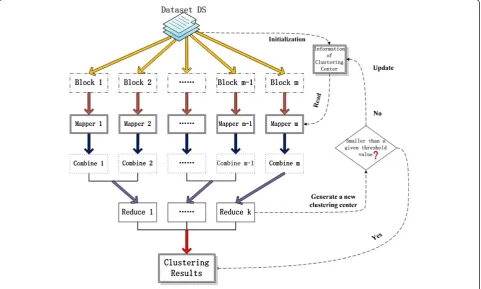
When data is large and those objects of each data subset after partition are rather approximate, the mid-dle k value produced in the process of map will be more likely to be repeated. For example, thousands of such records < key j, value j > produced in Map process will be sent through the network to the designated duce function. It certainly wastes valuable network re-sources, makes the delay increase, and reduces the I/O performance. Therefore, after the map process is exe-cuted, an optional Combiner function is added. Com-biner function will firstly merge the output of map function at locality and output < key j, list (value j) > list, and then make use of the partition function hash
(key) mod R, halve the intermediate key/value
produced by Combiner function into R different parti-tions, and distribute each partition to the designated reduce function. Figure 3 is the K-means parallel process.
Reduce function design
The task of Reduce function is to calculate the new clus-tering center in accordance with the intermediate results of Map function, and is for next round of MapReduce Job. The form of input data < key, value > pair is < cluster category ID, {record attribute vector set} >; all the re-cords with same key (i.e., rere-cords of same category ID)
will receive a Reduce task– accumulate the number of
points with same key and the sum of the records and get the average value and then a new clustering center de-scription file; form of the output result < key, value > pair is < cluster category ID, average vector >. The pseudo code of Reduce function is as follows:
void Reduce(Writable key, Iterator < Point Writable > points){
Initialize the variable num, record the total number of samples distributed to the same cluster, the initial value is of 0;
While (points. Has Next()){
Point Writable current point = points. next(); Num + =current point. get num();
for(i = 0;i < dimension;i++){
sum[i] + =current point. point [i];} for(i = 0;i < dimension;i++)
mean[i] = sum[i]/num; out(key, mean);}
This iteration continues until each class cluster center is not changed any more, or the iterated number reaches a preset value.
Analysis of complexity of algorithm
Parallel computing of similar matrix
Before giving detailed analysis, assume that the time
complexity of computing data points on similar value S
(xi,xj) is O(l), and assume that m is the number of ma-chines in cluster. It is mentioned that“similar value
cal-culation of subscript i” needs to compute the similar
value of n−i+ 1 data points. We can obtain that the
time complexity of“similar value calculation of subscript 1” is O(n), the time complexity of“similar value
calcula-tion of subscript 2” is O(n-1), and the like, the time
complexity of“similar value calculation of subscriptn”is O(l). So the time complexity of computing similar matrix is O(n+ (n‐1)…+ 1) =O((n2+n)/2). Because the
calculation of similar matrix is evenly executed on m
machines, the time complexity of parallel similar matrix calculation isO((n+ (n‐1)…+ 1)/m) =O((n2+n)/(2m)).
Parallel computing of k minimum feature vector(s)
Under the non-parallel condition, the time complexity of
using Lanczos to compute Laplacian L’s k vector(s) of
different characteristics is O(kLop+k2n) [20], in which Lop is the time that matrix L multiplies vector vj.
Be-cause the matrixLhas already been segmented into lines
and stored on HDFS, multiplication of matrixLand
vec-tor vjis distributed and executed on the machines. And
under ideal conditions, the time complexity of each multiplication isLop/m, so the time complexity of paral-lel computation frontkfeature vector(s) isO(kLop+k2n).
Parallelization of K-means clustering
New expression form yi of each data point is k
-di-mensional, hence in each iteration, the distance
cal-culation will be executed between itself andk centers.
In this way, the distance computing time complexity of each data point is O(k2). Therefore, the time com-plexity of iterating the distance calculation of all points each time is O(nk2). If the condition is ideal, then all the distance calculation of data points is evenly distributed to each machine and in parallel exe-cution, so the time complexity is reduced to O(nk2/m) * (numofiterations).
The analysis of experiment and result
Experimental environment
In this experiment, we use 10 computers to set up the Hadoop cluster. Among them, 8 computers are in dual-core 2.6 GHZCPU, 4 GB memory and operating system of Ubuntu10.04; two in quad core 2.8 GHZCPU, 8 GB memory together with the operating system of Ubuntu10.04. The Hadoop version is 0.20.2, and each machine uses gigabit Ethernet card and is connected through switch machine.
The experiments adopts the classic data set DataSet1
provided by KDD Cup’ 99 to test the correctness of the
proposed parallel spectral clustering algorithm; we use respectively 10000(Data Set DS1), 50000(Data Set DS2), 100000(Data Set DS3), 1000000(Data Set DS4), 5000000 (Data Set DS5) to verify the superiority of the proposed
parallel algorithm, and data samples is the multidimen-sional data listed in literature [20,21].
In the experiment, both the speedup ration and sca-leup ration are deemed as evaluation indicators.
Experimental results
Correctness validation
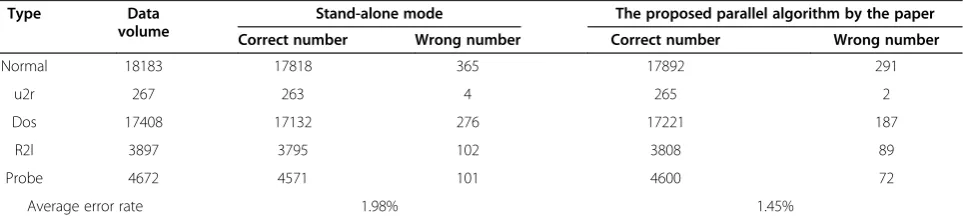
Table 1 shows the clustering results of data set Data-Set1 in stand-alone and the proposed parallel spectral clustering algorithm mode. It can be seen from Table 1, both the proposed parallel spectral clustering algorithm and the serial algorithm have clustering results of higher consistency. The error rate of them is less than 2%, they both achieve a better clustering results and ef-fectiveness, the spectral clustering algorithm proposed in the paper is correct.
Test of speedup ratio
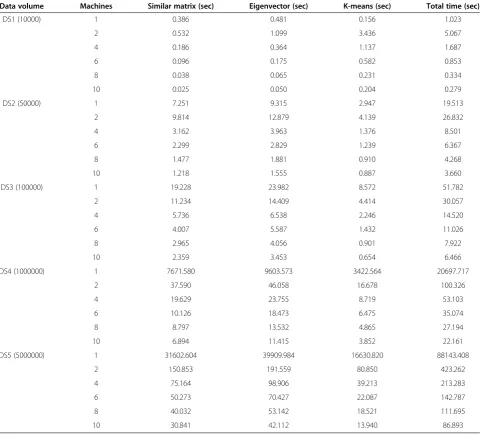
Speedup ratio is defined by parallel computing to re-duce the running time and improve the performance. It is an important indicator to verify the performance of parallel computing. The greater speedup ratio is, the less time parallel computing consume relatively, and the higher parallel efficiency and performance im-prove. Under changing the number of Hadoop cluster nodes, respectively use the results of speedup ratio performance tests according to 10000, 50000, 100000, 1000000, 5000000 pieces of data. Table 2 is the run-ning time of datasets under different nodes. Figure 4 shows the results.
It can be seen from Table 2 and Figure 4, with the in-crease scale of data set, the algorithm speed-up ratio performance is getting better and better. The reasons are mainly as following: 1) in this paper, the set of < key, value > pair in the stage of Map and Reduce of the pro-posed parallel spectral clustering algorithm is rather rea-sonable; 2) we add Combine operation after the stage Map, which greatly reduces the communication costs between the master node and slave nodes. Therefore, as the data quantity becomes large, the speed-up ratio per-formance will be substantially enhanced.
Table 1 Comparison of clustering accuracy of stand-alone mode and parallel algorithm mode proposed in the paper
Type Data
volume
Stand-alone mode The proposed parallel algorithm by the paper
Correct number Wrong number Correct number Wrong number
Normal 18183 17818 365 17892 291
u2r 267 263 4 265 2
Dos 17408 17132 276 17221 187
R2l 3897 3795 102 3808 89
Probe 4672 4571 101 4600 72
When the data volume is less than 50000, because in the parallel process, the data volume of each node is not big enough, the speed is smaller than the serial spec-tral clustering algorithm. However, with the increase of data volume, the speed of parallel algorithm is grad-ually increased, especially when the data volume is over 1000000, the speedup ratio grows significantly. The run-ning time of stand-alone mode is 3.667 times as long as that of ten computers when dataset volume is 10000. However, it is 1014.39 times when dataset is 5000000. But, it can be seen from Figure 4, when the number of nodes increases to 8 or more, the increasing range of speed-up will narrow. It can be illustrated that the execution effi-ciency of the parallel spectral clustering algorithm based
on Hadoop platform is higher than that of conventional spectral clustering algorithm.
Analysis of scalability
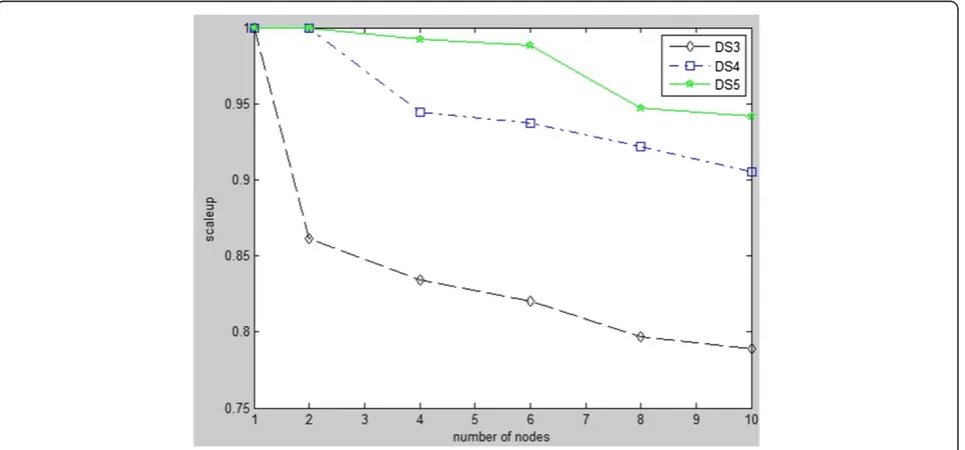
This paper introduces the concept of the efficiency of parallel algorithms. Efficiency of parallel algorithms rep-resents the utilization of a cluster during the execution of parallel algorithms. The formula isn¼SpN, wherein,
Sprepresents the speedup ratio,Nmeans the number of
cluster nodes. Figure 5 shows the efficiency of parallel algorithms proposed in the paper. For a more general, this paper test the scalability of dataset 100000, 1000000 and 5000000.
Table 2 Comparison of running time
Data volume Machines Similar matrix (sec) Eigenvector (sec) K-means (sec) Total time (sec)
DS1 (10000) 1 0.386 0.481 0.156 1.023
2 0.532 1.099 3.436 5.067
4 0.186 0.364 1.137 1.687
6 0.096 0.175 0.582 0.853
8 0.038 0.065 0.231 0.334
10 0.025 0.050 0.204 0.279
DS2 (50000) 1 7.251 9.315 2.947 19.513
2 9.814 12.879 4.139 26.832
4 3.162 3.963 1.376 8.501
6 2.299 2.829 1.239 6.367
8 1.477 1.881 0.910 4.268
10 1.218 1.555 0.887 3.660
DS3 (100000) 1 19.228 23.982 8.572 51.782
2 11.234 14.409 4.414 30.057
4 5.736 6.538 2.246 14.520
6 4.007 5.587 1.432 11.026
8 2.965 4.056 0.901 7.922
10 2.359 3.453 0.654 6.466
DS4 (1000000) 1 7671.580 9603.573 3422.564 20697.717
2 37.590 46.058 16.678 100.326
4 19.629 23.755 8.719 53.103
6 10.126 18.473 6.475 35.074
8 8.797 13.532 4.865 27.194
10 6.894 11.415 3.852 22.161
DS5 (5000000) 1 31602.604 39909.984 16630.820 88143.408
2 150.853 191.559 80.850 423.262
4 75.164 98.906 39.213 213.283
6 50.273 70.427 22.087 142.787
8 40.032 53.142 18.521 111.695
It can be seen from Figure 5, their efficiency curve goes down overall. This is mainly because as the growth of computing nodes in the cluster, the communication overhead increased gradually between nodes. As the data size increases, the efficiency value of parallel algorithm proposed in this paper is larger, namely the better scal-ability is, the more stable efficiency curve is. Experimen-tal results show that the parallel algorithm proposed in this paper has better scalability in large data sets.
Conclusion
Those data on the Internet exist in vast scale and grow rapidly, so it is urgently required in technology to mine high-value information from the mass data. As a kind of unsupervised learning method, clustering algorithm is a technique commonly used in data statistics and analysis which contains data mining, machine learning, pattern recognition, image analysis, and many other areas. The traditional serial clustering algorithm has two problems
Figure 4Speedup ratio performance test.
and it is difficult to meet the needs of practical applica-tions: the first one is that the speed of clustering is not fast enough and the efficiency is not high; the other one is that in the face of mass data, subject to the limits of memory capacity, it often cannot run effectively. This paper studied the traditional spectral clustering algo-rithm and designed efficient parallel spectral clustering algorithm. The strategy of parallel spectral clustering algorithm is to compute similar matrix and sparse ac-cording to data points segmentation; when computing eigenvectors, store the Laplacian matrix on the distrib-uted file system HDFS, use distribdistrib-uted Lanczos to com-pute and get the eigenvectors by parallel computation; at last, in terms of the transposed matrix of eigenvectors, adopt the improved parallel K-Means cluster to obtain the clustering results. Through adopting different paral-lel strategies about each step of the algorithm, the whole algorithm gets linear growth in speed. The experimental results show that the proposed parallel spectral cluster-ing algorithm is suitable for applycluster-ing in mass data min-ing. We hope that the research achievements of this paper can provide inspiration and application value for subsequent research developers.
Competing interest
The authors of this paper have no competing interest.
Authors’contributions
The contributions of the paper are twofold: The use of Hadoop to design an improved parallel spectral clustering algorithm for large data sets. The use of speedup ratio and scalability to verify the superiority of the parallel algorithm. All authors read and approved the final manuscript.
Acknowledgement
This work was supported by the Science and Technology Research Program of Zhejiang Province, under grant No.2011C21036, and by the Shanghai Natural Science Foundation under grant No.10ZR1400100, and by Projects in Science and Technique of Ningbo Municipal under grant No. 2012B82003.
Received: 9 April 2013 Accepted: 28 October 2013 Published: 7 November 2013
References
1. Hartigan, JA (1975) Clustering Algorithms. Wiley, USA.
2. Cui J, Li Q, Yang LP (2011) Fast algorithm for mining association rules based on vertically distributed data in large dense databases. Comput Sci 38:216–220
3. Zheng P, Cui LZ, Wang HY, Xu M (2010) A data placement strategy for data-intensive applications in cloud. Comput Sci 33:1472–1480
4. Wang P, Meng D, Zhan JF, Tu BB (2010) Review of programming models for data-intensive computing. J Comput Res Dev 47:1993–2002
5. Fowlkes C, Belongie S, Chung F, Malik (2004) Spectral grouping using the nyström method. IEEE Trans Pattern Anal Mach Intell 26:214–225 6. Dhillon IS, Guan Y, Kulis B (2007) Weighted graph cuts without
eigenvectors: a multilevel approach. IEEE Trans Pattern Anal Mach Intell 29:1944–1957
7. Kumar S, Mohri M, and Talwalkar A (2009) Sampling techniques for the nyström method [C]. Paper presented at the 12th conference on artificial intelligence and statistics, University of California, 16–18 April 2009 8. Zhang K, Tsang I, Kwok J (2008) Improve nyström low-rank approximation
and error analysis. Paper presented at the 25th International Conference on Machine Learning, Helsinki, 5–9 July 2008
9. Yan D, Huang L, Jordan MI (2009) Fast approximate spectral clustering. Paper presented at the 15th ACM SIGKDD International Conference on Knowledge Discovery and Data Mining, Paris, 28 June-1 July 2009 10. Gropp E, Skjellum A (1999) Using MPI-2: advanced features of the
message-passing interface. MIT Press, USA
11. Song Y, Chen W, Bai H, Lin C, Chang E (2008) Parallel spectral clustering. In: European Conference, ECML PKDD. The joint conference on Machine Learning and Knowledge Discovery in Databases, Belgium, September 2008. Lecture notes in computer science (Lecture notes in artificial intelligence), vol 5212. Springer, Heidelberg, p 374
12. Maschhoff K, Sorensen D (1996) A portable implementation of ARPACK for distributed memory parallel architectures. Paper presented at the 4th Copper Mountain Conference on Iterative Methods, Colorado, 9–13 April 1996 13. Yang C (2010) The research of data mining based on HADOOP. Dissertation,
Chongqing University
14. Cullum J, Willboughby RA (1985) Lanczos Algorithms for Large Symmetric Eigenvalue Computations volume l. Birkhauser Boston Inc, USA 15. Golub GH, Loan CFV (1996) Matrix Computations. The Johns Hopkins
University Press, Maryland
16. Cullum J, Willboughby RA (1981) Computing eigenvalues of very large symmetric matrices: an implementation of a lanczos algorithm with no reorthogonalization. J Comput Phys 44:329–358
17. Mahadevan S (2008) Fast Spectral Learning Using Lanczos Eigenspace Projections. The 23th national conference on artificial intelligence, Chicago, 13–17 July
18. Zhao WZ, Ma HF, Fu YX, Shi ZZ (2011) Research on parallel K-means algorithm design based on hadoop platform. Comput Sci 38:166–176 19. Niu XZ, She K (2012) Study of fast parallel clustering partition algorithm for
large data set. Comput Sci 39:134–151
20. Feng LN (2010) Research on parallel K-Means clustering method in resume data. Dissertation, Dissertation. Yunnan University
21. Jin R, Kou CH, Liu RJ, Li YF (2013) A Co-optimization routing algorithm in wireless sensor network. Wireless Pers Comm 70:1977–1991
doi:10.1186/2192-113X-2-18
Cite this article as:Jinet al.:Efficient parallel spectral clustering algorithm design for large data sets under cloud computing environment.Journal of Cloud Computing: Advances, Systems and Applications20132:18.
Submit your manuscript to a
journal and benefi t from:
7Convenient online submission 7Rigorous peer review
7Immediate publication on acceptance 7Open access: articles freely available online 7High visibility within the fi eld
7Retaining the copyright to your article