Developing an online hate classifier
for multiple social media platforms
Joni Salminen
1,2*, Maximilian Hopf
3, Shammur A. Chowdhury
1, Soon‑gyo Jung
1, Hind Almerekhi
4and Bernard J. Jansen
1Introduction
Online hate, described as abusive language [1], aggression [2], cyberbullying [3, 4], hate-fulness [5], insults [6], personal attacks [7], provocation [8], racism [9], sexism [10], threats [11], or toxicity [12], has been identified as a major threat on online social media platforms. Pew Research Center [13] reports that among 4248 adults in the United States, 41% have personally experienced harassing behavior online, whereas 66% wit-nessed harassment directed towards others. Around 22% of adults have experienced offensive name-calling, purposeful embarrassment (22%), physical threats (10%), and sexual harassment (6%), among other types of harassment. Social media platforms are the most prominent grounds for such toxic behavior. Even though they often provide ways of flagging offensive and hateful content, only 17% of all adults have flagged harass-ing conversation, whereas only 12% of adults have reported someone for such acts [13].
Abstract
The proliferation of social media enables people to express their opinions widely online. However, at the same time, this has resulted in the emergence of conflict and hate, making online environments uninviting for users. Although researchers have found that hate is a problem across multiple platforms, there is a lack of models for online hate detection using multi‑platform data. To address this research gap, we collect a total of 197,566 comments from four platforms: YouTube, Reddit, Wikipedia, and Twitter, with 80% of the comments labeled as non‑hateful and the remaining 20% labeled as hateful. We then experiment with several classification algorithms (Logistic Regression, Naïve Bayes, Support Vector Machines, XGBoost, and Neural Networks) and feature representations (Bag‑of‑Words, TF‑IDF, Word2Vec, BERT, and their combination). While all the models significantly outperform the keyword‑based baseline classifier, XGBoost using all features performs the best (F1 = 0.92). Feature importance analysis indicates that BERT features are the most impactful for the predictions. Findings sup‑ port the generalizability of the best model, as the platform‑specific results from Twitter and Wikipedia are comparable to their respective source papers. We make our code publicly available for application in real software systems as well as for further develop‑ ment by online hate researchers.
Keywords: Online hate, Toxicity, Social media, Machine learning
Open Access
© The Author(s) 2020. This article is licensed under a Creative Commons Attribution 4.0 International License, which permits use, sharing, adaptation, distribution and reproduction in any medium or format, as long as you give appropriate credit to the original author(s) and the source, provide a link to the Creative Commons licence, and indicate if changes were made. The images or other third party material in this article are included in the article’s Creative Commons licence, unless indicated otherwise in a credit line to the material. If material is not included in the article’s Creative Commons licence and your intended use is not permitted by statutory regulation or exceeds the permitted use, you will need to obtain permission directly from the copyright holder. To view a copy of this licence, visit http://creat iveco mmons .org/licen ses/by/4.0/.
RESEARCH
*Correspondence: [email protected]
Manual techniques like flagging are neither effective nor easily scalable [14] and have a risk of discrimination under subjective judgments by human annotators. Since an mated system can be faster than human annotation, machine learning models to auto-matically detect online hate have been gaining popularity and bringing researchers from different fields together [15].
Even though hate has been observed as a problem in multiple online social media platforms, including Reddit, YouTube, Wikipedia, Twitter, and so on [5, 7, 16–18], apart from a few exploratory studies [15, 19], there is a lack of development and testing of mod-els using data from multiple social media platforms. Instead, studies tend to focus on one platform. This mono-platform focus is problematic because there are no guarantees the models that researchers develop generalize well across platforms. It is a reasonable assumption that developing a universal hate classifier could benefit from the informa-tion retrieved from various training sets and contexts. The mono-platform focus is par-ticularly vexing, because the lack of a general hate classifier requires researchers and practitioners to “reinvent the wheel”, meaning that each time carrying out online hate research (OHR) in a specific social media platform, a new classifier needs to be devel-oped. This results not only in repetitive intellectual effort but also to “barriers of entry” for researchers who lack the skills for model development but would be interested in interpretative OHR. Furthermore, the lack of universal classifiers means that the results across studies and social media platforms are not easily comparable. In sum, the frag-mentation of models and feature representations needlessly complicates hate detection across different platforms and contexts.
To address these concerns, we undertake the development of a cross-platform online hate classifier. Our model performs well for detecting hateful comments across multi-ple social media platforms, utilizes advanced linguistic features, namely, Bidirectional Encoder Representations from Transformers (BERT) (see “BERT” section), and is made available for further use and development by researchers and practitioners. While we do not claim to develop the universal classifier that solves all problems in online hate detec-tion, our results are indicative of the promise that this line of work carries for the larger community of OHR and can be further built upon.
Our research questions (RQs) are:
• RQ1 How well do different algorithms and feature representations perform for hate detection in multiple social media platforms?
• RQ2 What are the most impactful features when predicting hate in multiple social media platforms?
• RQ3 How well does a machine learning model learn linguistic characteristics in the hateful and non-hateful language in a cross-platform environment?
Literature review
Theoretical underpinnings of online hate
Human–Computer Interaction, politics, and legislation/regulative aspects. For exam-ple, Kansara et al. [20] present a framework for cyberbullying in social networks that contains harassment (i.e., sending offensive text messages and images), flaming (online violence using harsh messages), outing (personal information dissemination), exclusion (singling or leaving someone out of group), and masquerading (offensive communica-tion using Sybil identities). Marret and Choo [21] present a framework of online victimi-zation that highlights offline perpetration and parental conflict. These studies highlight the complex dynamics of online hate that complicate its automatic detection.
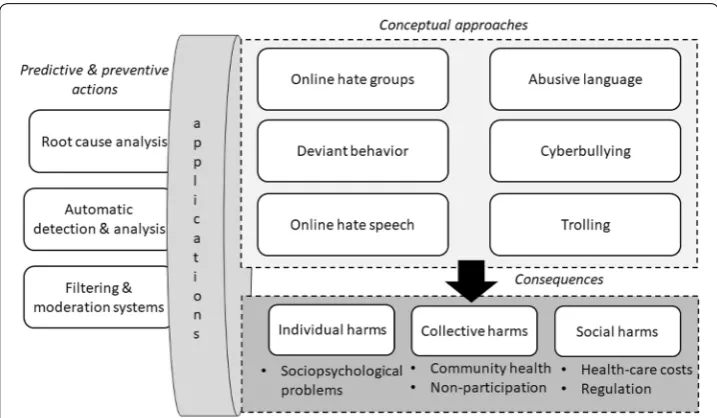
Figure 1 displays our conceptual framework of the focus areas in the extant OHR. First, online is seen as the use of abusive, offensive, or profane language [16, 22–25]. These studies tend to focus on the language aspects of online hate, such as linguistic styles, vocabularies, and ways of expression. Some of these studies deal with “counterspeech”, i.e., ways of defusing the hateful comments with language-based strategies [26–28].
Second, some studies focus particularly on online hate as hate speech [9, 16, 29–31], i.e., “offensive post, motivated, in whole or in part, by the writer’s bias against an aspect of a group of people. [underlining by us]” [32] (p. 87). The focal dimension here is target-ing; i.e., the hate has a specific target such as refugees, women, a race, or religion [5, 33– 35]. Waseem et al. [36] distinguish between different types of abuse segmented by the target of the abuse directed towards an individual/entity or generalized towards a group and the degree to which it is explicit. ElSherief et al. [37] study the relationship of hate instigators and targets and online visibility, finding that high-profile social media users attract more hate. Salminen et al. [5] find media and police to be major targets of hate in online news commenting. Overall, news-related discussions have been considered as a major hotbed for online toxicity [38].
Third, another important aspect of OHR is the consideration of group dynamics, vis-ible in the studies focused on online hate groups and group prejudice [39], persuasive storytelling as hate conditioning [40], radicalization via social media extremist content
[41], cultural transmission of hate [42], social exclusion [43], and so on. Due to a high degree of contextual and subjective factors, these nuances are often studied using inter-pretative methods.
Fourth, some studies focus on the consequences of online hate [12, 44, 45], meaning its effects on individuals and groups, for example, on the health of social media communi-ties [46]. Often, these studies involve a predictive machine learning aspect for the detec-tion and classificadetec-tion of toxicity in specific communities and social media platforms [2, 5, 16, 47, 48]. The central characteristic of toxicity studies is that they perceive online hate not only as the use of language but also as an action having a concrete effect or out-come. These outcomes may include the user leaving the toxic discussion [7], “silencing” or reduced participation in online social media [49], radicalization [40], group polariza-tion where the previously held prejudices are enforced [50], degraded quality (“health”) of an online community [2, 46, 51], offline violence [52] and security threats [53], and decreased feelings of safety and wellbeing of online users [33].
Finally, computer science studies in this field tend to focus on automating the detec-tion of online hate. The posidetec-tioning of this research falls within the computadetec-tional stream of research, meaning experimentation with classifiers and features to improve automatic hate detection.
Definitions of online hate
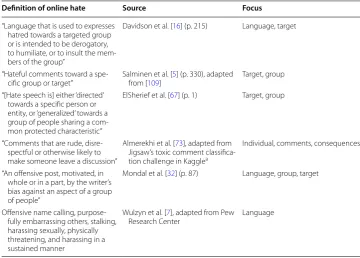
Various authors in OHR cite the lack of commonly acknowledged definition for online hate [7, 16]. Instead of one shared definition, the literature contains many definitions with distinct approaches to online hate (see Table 1).
Table 1 Definitions of online hate
ahttps ://www.kaggl e.com/c/jigsa w-toxic -comme nt-class ifica tion-chall enge
Definition of online hate Source Focus
“Language that is used to expresses hatred towards a targeted group or is intended to be derogatory, to humiliate, or to insult the mem‑ bers of the group”
Davidson et al. [16] (p. 215) Language, target
“Hateful comments toward a spe‑
cific group or target” Salminen et al. [from [109] 5] (p. 330), adapted Target, group “[Hate speech is] either ‘directed’
towards a specific person or entity, or ‘generalized’ towards a group of people sharing a com‑ mon protected characteristic”
ElSherief et al. [67] (p. 1) Target, group
“Comments that are rude, disre‑ spectful or otherwise likely to make someone leave a discussion”
Almerekhi et al. [73], adapted from Jigsaw’s toxic comment classifica‑ tion challenge in Kagglea
Individual, comments, consequences
“An offensive post, motivated, in whole or in a part, by the writer’s bias against an aspect of a group of people”
Mondal et al. [32] (p. 87) Language, group, target
Offensive name calling, purpose‑ fully embarrassing others, stalking, harassing sexually, physically threatening, and harassing in a sustained manner
Wulzyn et al. [7], adapted from Pew
Building from this previous research (Table 1), our definition of online hate is as follows:
Online hate is composed of the use of language that contains either hate speech targeted toward individuals or groups, profanity, offensive language, or toxicity – in other words, comments that are rude, disrespectful, and can result in negative online and offline consequences for the individual, community, and society at large. This definition considers the central elements of the proposed definitions (Table 1): (a) use of language, (b) targeting, (c) individuals or groups, and (d) hate being action with consequences at various levels of society.
Evolution of online hate detection
Keyword‑based classifiers
In general, the evolution of online hate detection can be divided into three temporal stages: (1) simple lexicon- or keyword-based classifiers, (2) classifiers using distributed semantics, and (3) deep learning classifiers with advanced linguistic features. An exam-ple of the first wave of studies is Sood et al. [6] that used a list of profane words, being able to identify 40% of words that are profane and then correctly identifying 52% as hate-ful/not hateful. Mondal et al. [32] used a simple sentence structure “I<intensity><userint ent><hatetarget>” to identify hate targets. To avoid false positives, such as: “I really hate owing people favors”, the researchers used specific hate targets (e.g., Black people, Mexi-can people, stupid people), and 1078 hate words from Hatebase,1 a database of hateful words. In a similar vein, Davidson et al. [16] collected data from the Twitter API using the Hatebase lexicon as keywords. After the data was collected, crowd workers manually classified the 25K comments into hate speech, offensive speech, and neither. This catego-rization was done to ensure the keyword-based method resulted in hateful comments; however, the researchers found a significant mismatch between the hateful tweets and the crowd ratings [16], highlighting the deficiency of keyword searches for detecting hate. Salminen et al. [48] used a combination of manually tagged and keyword-detected training data to develop a neural network that removes hateful passages from comments that were tagged as hateful.
Despite their use in previous research, the limitations of using only keyword-based methods are well known. The main issue is the linguistic diversity of hate, which is not fully captured by a dictionary. For example, keywords cannot detect sarcasm and forms of humor [54]. Moreover, the dictionaries of hateful words and insults require constant updates [23], as new terminology and slang quickly develop in social media [6]. Further-more, standards (i.e., what is interpreted as hate) differ by the online community, so that an expression that is hateful in one community may be considered neutral, humor, or typical discourse in another community [55]. For example, in online Q&A platforms like StackOverflow, a concise form of expression can appear rude to outsiders but be per-fectly acceptable given the community standards [1].
Sahlgren et al. [56] point out another problem with keyword matching, namely, polysemy (i.e., the same word can have several different meanings). They mention the
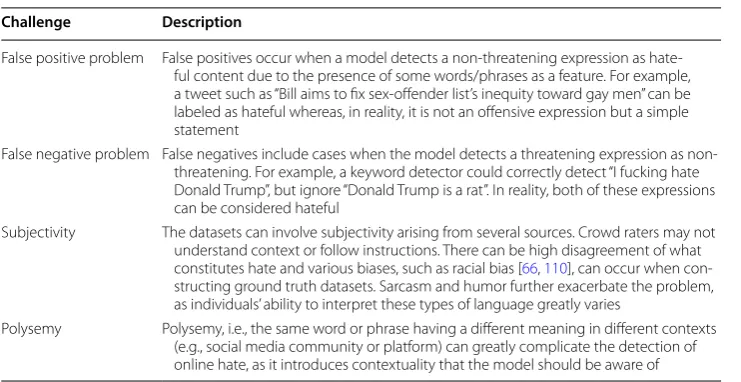
example of “white trash” and “white trash cans”, two instances with the same words but drastically different hate content. Another example is the word “fruit”, which in general is non-abusive; however, when put in a specific context, the word can denote deroga-tory slang for a homosexual person. In Natural Language Processing (NLP), this prob-lem is known as word-sense disambiguation [56], and it is considered highly challenging. Table 2 summarizes some of the challenges of developing online hate classifiers; these are extremely hard to solve with keyword-based methods alone.
Distributional semantics
While prior research indicates that keyword-based methods are not adequate to classify hate speech, language and words are necessary for the detection of online hate. For this rea-son, researchers have deployed a wide range of more sophisticated feature representations, including word n-grams, syntactic features, and distributional semantics (i.e., word embed-dings and word vector space models). For example, Nobata et al. [23] detected hate speech, profanity, and derogatory language in social media using n-grams as well as linguistic, syn-tactic, and distributional semantics, finding that combining all feature sets yielded the best performance. Salminen et al. [5] used a similar set of features to detect hateful comments in a YouTube news channel, adding term frequency (TF), term frequency—inverted document frequency (TF-IDF), and word vectors. TF-IDF performed well in their study [5]. The study by Waseem et al. [36] suggested that features including mentions, proper nouns, other name entities, and co-reference resolution (finding all expressions that refer to the same entity in a text) can be useful for directed abuse detection. In turn, for generalized abuse, they suggested using independent vocabularies per target group to capture the lexical pat-terns. In cases of explicit abuse, both directed and generalized, the authors suggested the use of specific keywords along with polarity and sentiment as features for abuse detection. Djuric et al. [30] detected online hate using word embeddings from a neural network called Paragraph2vec to compare with the Bag of Words (BOW) model. In their study, Paragraph-2vec discovered some non-obvious swearing words and obtained better accuracy than BOW. Saleem et al. [55] used Labeled Latent Dirichlet Allocation (LLDA) to automatically Table 2 Challenges of online hate detection
Challenge Description
False positive problem False positives occur when a model detects a non‑threatening expression as hate‑ ful content due to the presence of some words/phrases as a feature. For example, a tweet such as “Bill aims to fix sex‑offender list’s inequity toward gay men” can be labeled as hateful whereas, in reality, it is not an offensive expression but a simple statement
False negative problem False negatives include cases when the model detects a threatening expression as non‑ threatening. For example, a keyword detector could correctly detect “I fucking hate Donald Trump”, but ignore “Donald Trump is a rat”. In reality, both of these expressions can be considered hateful
Subjectivity The datasets can involve subjectivity arising from several sources. Crowd raters may not understand context or follow instructions. There can be high disagreement of what constitutes hate and various biases, such as racial bias [66, 110], can occur when con‑ structing ground truth datasets. Sarcasm and humor further exacerbate the problem, as individuals’ ability to interpret these types of language greatly varies
infer topics for the classifier, showing that Reddit communities have distinct linguistic prac-tices that affect hate detection. Overall, distributional semantics relies on providing better representations of the hateful comments than keywords can do [56].
Deep learning classifiers
Some more recent work uses neural networks, particularly deep learning, for hate classi-fication. These architectures, including variants of recurrent neural networks (RNN) [14, 24, 57], convolutional neural networks (CNN) [58], or their combination, produce state-of-the-art results. For example, Badjatiya et al. [29] classified the hatefulness of tweets using deep neural networks. They found that a CNN performed better than the baseline methods (character n-grams, TF-IDF, BOW). The best accuracy was obtained when combining deep neural networks with gradient boosted decision trees [29]. Park and Fung [59] detected rac-ist and sexrac-ist language through a two-step approach with convolutional neural networks. They used three CNN models (CharCNN, WordCNN, and HybridCNN) on 20K tweets, achieving the best performance with HybridCNN and the worst with CharCNN. When two logistic regressions were combined, they performed as well as the one-step HybridCNN, and better than one-step logistic regressions [59]. Zhang et al. [58] used a pre-trained word embedding layer to map the text into vector space, which was then passed through a con-volution layer with a max pooling downsampling technique. The output feature vector was then fed into a Gated Recurrent Unit (GRU) layer followed by global max pooling and a softmax layer. The previous studies indicate that CNNs’ potential to capture the local pat-terns of features benefits online hate detection [1].
Finally, while most previous work relies on text features, there are also studies using other features. These include, for example, user features [60] and knowledge graphs [61]. For example, Chatzakou et al. [10] investigated user features (average posts, subscribed list, average session length), network features (the number of friends, followers, reciprocity), and authority, among others. In their study, the authors reported that they found network-based features to be more effective in aggressive user behavior classification. Similarly, Founta et al. [62] designed classifiers using both text and Twitter user metadata as features for the hate detection task. Their study shows that the best performance is obtained when combining the individual network trained jointly using the interleaved approach, indicat-ing the usefulness of other features in addition to text. Qian et al. [63] found that intra-user (historical posts by the user) and inter-user (similar posts by other users) representations substantially improved the performance of hate speech detection.
Even though user features may improve the performance of hate detection, the scarcity of such information—i.e., user and network features are rarely available and not for all social media platforms—reduces researchers’ ability to apply it for cross-platform hate detection.
Research gaps
Despite considerable previous OHR, cross-platform evaluation of online hate classifiers is typically omitted from research articles (see Table 3), even though it is well established that online hate is not restricted to a single platform or context.
of platforms was used by Mondal et al. [32]. Most typically, the use of the second plat-form is for evaluating the model developing using data from another platplat-form. More rarely, data from several platforms is used for both model development and evalu-ation. Chandrasekharan et al. [64] is an exception, as they use comments from four platforms (4chan, MetaFilter, Reddit, and Voat) to predict hate on another platform (MixedBag). The best model of the researchers achieves accuracy of 90.20%, recall of 87.93% and precision of 91.09% [64]. Since this is one of the few models using data from more than two platforms and it is publicly available, we use it as a base-line model in our experiments (see “Experimental design” section). Regarding the use of multiple contexts, Karan and Snajder [19] studied the cross-domain use of abu-sive language in different online contexts, but they did not investigate hate between multiple online social media platforms. Park and Fung [59] used two datasets, but both were from Twitter. Mishra et al. [15] used Twitter and Wikipedia datasets for the detection of non-obvious hateful comments—as such, their approach did not con-sider general detection of all hateful comments.
Overall, the research on hate detection in multiple online social media platforms is scarce and, even the few studies that were published tend to find that the models are non-generalizable across domains [19]. Without cross-platform evaluation, the gen-eralizability of models built on datasets from one online platform is restricted solely to that platform. Research efforts are needed for developing cross-platform online hate classifiers that are more universally applicable.
Furthermore, the replicability of the previous models is hindered by the fact that the resources—including code, algorithms, and datasets—are often not published, or authors promise to release but fail to do so [15]. We stress that there is an acute demand for online hate models that are made publicly available, so that organiza-tions struggling with hateful online comments can leverage state-of-the-art research in their systems and operations. Fortunately, there are exceptions. For example, Table 3 Social media platforms often used in online hate detection research
Typically, researchers use data only from one platform
Source Primary source Secondary source Tertiary source
Hosseinmardi et al. [3] Instagram – –
Almerekhi et al. [73] Reddit – –
Kumar et al. [2] Reddit – –
Davidson et al. [16] Twitter – –
Silva et al. [35], Mondal et al. [32] Twitter Whisper –
Badjatiya et al. [29] Twitter – –
Chatzakou et al. [10, 111, 112] Twitter – –
ElSherief et al. [37] Twitter – –
Unsvag and Gambäck [60] Twitter – –
Agarwal and Sureka [113] YouTube – –
Salminen et al. [5] YouTube – –
Djuric et al. [30] Yahoo – –
Nobata et al. [23] Yahoo – –
Davidson et al. [16] make their code available on GitHub.2 Our experiments show improvement over their results, as shown in “Experimental design and evaluation” section. Other research articles providing source code for hate detection model devel-opment and/or evaluation with links to code implementations that we could locate from our literature review include (implementations in footnotes) Waseem and Hovy [65],3 Davidson et al. [66],4 ElSherief et al. [67],5 Saha et al. [68],6 Qian et al. [69],7 Ross et al. [70],8 de Gibert et al. [71],9 Badjatiya et al. [29],10 and Chandrasekharan et al. [64].11 However, none of these models specifically focus on cross-platform applicability.
Finally, continuous experimenting with NLP technologies and replicating their perfor-mance is important. We address these research gaps by (a) obtaining annotated training sets with ground-truth comments (i.e., known true labels based on human annotation) from four platforms: YouTube, Reddit, Wikipedia, and Twitter; (b) designing different classification models while exploring different feature representations and their combi-nations; and (c) evaluating the performance of the models for each platform separately and compare the outcomes with results reported in previous studies, as well as those obtained using a keyword-based classifier.
Datasets Overview
We applied three criteria to select the datasets for this research: (a) the language is Eng-lish, (b) the dataset was available at the time of conducting the research, and (c) the dataset and available details on the annotation procedure passed a manual evaluation (e.g., there was no high prevalence of false negatives/positives). Note that the previous research has found that online hate interpretation varies between individuals [72]. For this reason, OHR tends to apply aggregation methods such as majority vote, mean score, or consensus to determine if a comment is perceived as hateful or not. This precondition of “hateful on average” applies to all classifiers developed using this data.
In the following sections, we briefly explain each dataset and how they were merged into one online hate dataset. Note that different authors use different terminology when referring to hateful online comments (e.g., “toxic”, “hateful”, “abusive”). These terms may have some nuanced conceptual differences, but for this study, the definitions provided by the authors of the chosen datasets are aligned with our operational definition pre-sented in “Introduction” section. In this research, we refer to all these comments as
2 https ://githu b.com/t-david son/hate-speec h-and-offen sive-langu age. 3 https ://githu b.com/zeera kw/hates peech .
4 https ://githu b.com/t-david son/hate-speec h-and-offen sive-langu age. 5 https ://githu b.com/ben-aaron 188/ucl_aca_20182 019.
6 https ://githu b.com/punya joy/Hatem iners -EVALI TA.
7 https ://githu b.com/jing-qian/A-Bench mark-Datas et-for-Learn ing-to-Inter vene-in-Onlin e-Hate-Speec h. 8 https ://githu b.com/UCSM-DUE/IWG_hates peech _publi c.
hateful comments. When explaining the datasets, we will use the original authors’ terms and then explain how their terms overlap with ours.
YouTube dataset (ICWSM‑18‑SALMINEN)
In this dataset, there are 3221 manually labeled comments posted on a YouTube chan-nel of an online news and media company. Salminen et al. [5] note that many of the comments that are posted as reactions to the content in this channel are hateful, which makes the dataset promising for investigating online hate. The researchers used manual coding to annotate the data into hateful and non-hateful comments (as well as subse-quent themes based on the target of the hate; however, this information is not used for our classifier). They provide detailed coding guidelines as well as inter-rater agreement measurement (agreement score = 75.3%), which the researchers interpret as substan-tial agreement. The agreement score was calculated by dividing the number of labels where two or more coders agreed by the number of possible values. The calculation was done for each coded item, and the item-based agreements were averaged to output the overall agreement. Overall, the dataset includes purposeful (i.e., intentionally hurt-ful) comments. This consideration was made because if hostility is not the purpose of the comment, it should not be classified as hateful. For example, “Trump is a bad presi-dent” was not considered as hateful, but “Trump is an orange buffoon” was considered as hateful. Also, the annotators considered linguistic patterns when annotating, such that swearing, aggressive comments, or mentioning past political or ethnic conflicts in a non-constructive and harmful way, were classified as hateful. When there was uncertainty about an instance, the researchers discussed it to avoid a biased label.
Reddit dataset (ALMEREKHI‑19)
To detect toxicity triggers (i.e., causes) of online discussions in Reddit, the study of Alm-erekhi et al. [73] developed a model that detects the toxicity in the comments posted on Reddit communities (also denoted as subreddits). The dataset consists of relevance judg-ments specifying if a particular comment is hateful or not. Note that Almerekhi et al. [73] used the term “toxicity” as synonymous to “hateful”. They selected for crowdsource labeling a random sample of 10,100 comments from AskReddit (one of the largest Reddit communities), which were obtained the Pushshift API. The designed labeling job asked workers to label a given comment as either toxic or non-toxic according to the toxicity definition provided by the Perspective API, which describes a toxic comment as “a rude, disrespectful, or unreasonable comment that is likely to make you leave a discussion”.12 The labeling results showed that 81.57% of the comments in the collection were labeled as non-toxic, while the remaining 18.43% were labeled toxic. The observed agreement between annotators was 0.85, and the Gwet’s γ [51] was 0.70.
Wikipedia dataset (KAGGLE‑18)
The Wikipedia talk page Corpus [7] includes datasets for three different categories: per-sonal attack, toxicity, and aggression. The corpus is extracted from approximately 63 M
talk page comments processed from the public dump of the full history of English Wiki-pedia dated till 2015. For the annotation of each dataset, a random subset of comments was selected and annotated using CrowdFlower,13 a crowdsourcing platform, with at least ten workers per comment. We refer to this dataset as “KAGGLE-18”, because it was published by Jigsaw (a subsidiary of Alphabet, Google’s parent company) as part of a Kaggle data science competition called “Toxic Comment Classification Challenge”, avail-able online at the time of writing.14
For this study, we used only the toxicity dataset consisting of 159,571 annotated com-ments, publicly available for download.15 As is the case with the Reddit dataset, the Wikipedia dataset uses the term toxicity in the same sense as we use hatefulness in this work. For the toxicity task, the workers annotated comments based on the perceived toxicity and likelihood of making others leave the discussion. As each comment contains at least 10 judgments, a majority voting measure was used to assign the gold label, i.e., abusive or non-abusive. For our study, the abusive class was labeled as “hateful” and the non-abusive class was labeled as “non-hateful”.
Twitter dataset (DAVIDSON‑17‑ICWSM)
This dataset is made available by Davidson et al. [16] who used crowd raters for labeling and provide a detailed description of the data collection principles. The dataset contains 25K tweets, randomly sampled from 85.4 M tweets extracted from the timeline of 33,458 Twitter users, using hate speech lexicon. The lexicon, compiled from Hatebase, contains words and phrases identified by internet users as hate speech. This lexicon was also used by the authors as keywords to extract the 85.4 M tweets. The selected 25K tweets were manually annotated by at least 3 workers using CrowdFlower. The task was to annotate the tweet with one of three categories: hate speech, offensive but not hate speech, or neither offensive nor hate speech. An agreement of 92% was obtained between the work-ers regarding the class labels for the task, and the final gold label for each tweet was assigned using a majority voting approach. The tweets with no majority class were dis-carded, making a total of 24,802 tweets with an assigned label of which 5% was given the hateful label. Note that the authors shared these tweets as “Tweet IDs”, i.e., references to the original tweets. Therefore, we had to utilize the Twitter API to recollect the data-set. We were able to obtain 24,783 tweets (99.9% of the original dataset), with 19 tweets either deleted or otherwise unavailable. The less of only a small number of comments is unlikely to have a significant impact on the results when comparing our performance against that of Davidson et al.
Structuring the datasets into binary classes
Illustrating the datasets, Table 4 shows statistics on the datasets selected for classifier development. Table 5 shows the distribution of samples in the two classes in the aggre-gated dataset. Table 6 provides insights into the distribution of the classes in the test
13 Currently known as Figure-Eight.
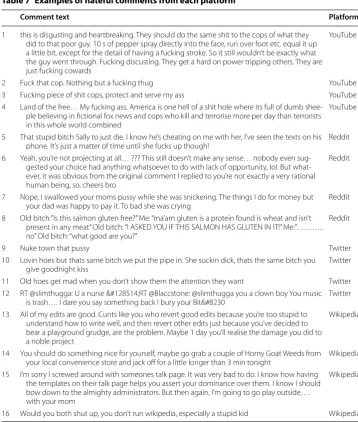
data, grouped by each platform. Table 7 shows examples of hateful and non-hateful comments.
Note that we modified the datasets’ original classes to match the binary classification. In Salminen et al. [5], the authors have two classes—neutral and hateful—to classify You-Tube comments. We changed the first one to “not hateful”. In Davidson et al. [16], the authors labeled tweets containing hate speech (we coded as hateful), offensive language (we coded as hateful), and neither (we coded as non-hateful). In a similar vein, Almerekhi et al. [73] use crowd raters with the majority voting to label toxic (hateful) and non-toxic (not hateful) Reddit comments. Similarly, Wulczyn et al. [7] use trained human raters to annotate toxic (hateful) and non-toxic (not hateful) Wikipedia comments.
Related datasets
In addition to the selected datasets, we considered the following datasets from prior literature: Waseem [9], Fortuna [74], Ross et al. [70], Salminen et al. [48], and the Table 4 Datasets combined for the study
Breakdown under number of comments shows T total comments, NH non-hateful comments, H hateful comments
Source Platform
and domain Number of comments Cum. count % from total (%)
ICWSM‑18‑SALMINEN
[5] YouTube news media T H == 3221 2364 (73.4%) NH = 857 (26.6%) 3221 1.6 ALMEREKHI‑19 [73] Reddit 10 popular
sub‑communities 99911619 (16.2%) 8372 (83.8%) 13,212 5.1 DAVIDSON‑17‑ICWSM
[16] Twitter generic tweets 24,78320,620 (83.2%) 4163 (16.8%) 37,995 12.5 KAGGLE‑18 [7] Wikipedia editor
discussions 159,57115,294 (9.6%) 144,277 (90.4%) 197,566 80.8
Table 5 Samples of the binary hate classes
a Ratio of 75/25 (train/test) was used for model development
Hateful (H) Not hateful (NH) Total
39,897 157,669 197,566
20.2% 79.8% 100%a
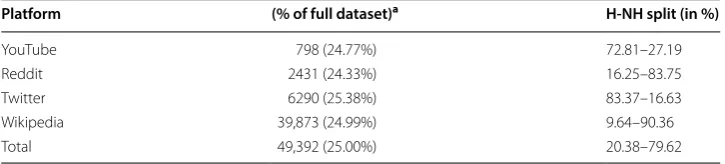
Table 6 Platform-wise description of test dataset used for the study
H represents Hateful comments and NH represents Not-Hateful comments. Test data was randomly sampled from each platform dataset
a Represents the number of instances in each group
Platform (% of full dataset)a H‑NH split (in %)
YouTube 798 (24.77%) 72.81–27.19
Reddit 2431 (24.33%) 16.25–83.75
Twitter 6290 (25.38%) 83.37–16.63
Wikipedia 39,873 (24.99%) 9.64–90.36
StackOverflow dataset [1]. The Waseem dataset, containing 6910 tweets labeled for racism, sexism, or neither, was omitted because our manual inspection revealed a high rate of false positives. For example, the following comments were labeled as sex-ist by most of the raters in the Waseem dataset:
• “@FarOutAkhtar How can I promote gender equality without sounding preachy or being a ‘feminazi’? #AskFarhan”.
• “i got called a feminazi today, it’s been a good day”.
• “In light of the monster derailment that is #BlameOneNotAll here are some mood capturing pics for my feminist pals pic.twitter.com/3pTV0M9qOQ”.
A similar analysis was done to the other datasets, but the same false positive problem was not found. Even though the nature of online hate has been found to Table 7 Examples of hateful comments from each platform
Comment text Platform
1 this is disgusting and heartbreaking. They should do the same shit to the cops of what they did to that poor guy. 10 s of pepper spray directly into the face, run over foot etc. equal it up a little bit, except for the detail of having a fucking stroke. So it still wouldn’t be exactly what the guy went through. Fucking discusting. They get a hard on power tripping others. They are just fucking cowards
YouTube
2 Fuck that cop. Nothing but a fucking thug YouTube
3 Fucking piece of shit cops, protect and serve my ass YouTube 4 Land of the free… My fucking ass. America is one hell of a shit hole where its full of dumb shee‑
ple believing in fictional fox news and cops who kill and terrorise more per day than terrorists in this whole world combined
YouTube
5 That stupid bitch Sally to just die. I know he’s cheating on me with her, I’ve seen the texts on his phone. It’s just a matter of time until she fucks up though! Reddit 6 Yeah, you’re not projecting at all… ??? This still doesn’t make any sense… nobody even sug‑
gested your choice had anything whatsoever to do with lack of opportunity, lol. But what‑ ever, it was obvious from the original comment I replied to you’re not exactly a very rational human being, so, cheers bro
7 Nope, I swallowed your moms pussy while she was snickering. The things I do for money but
your dad was happy to pay it. To bad she was crying Reddit 8 Old bitch:”Is this salmon gluten free?” Me: “ma’am gluten is a protein found is wheat and isn’t
present in any meat” Old bitch: “I ASKED YOU IF THIS SALMON HAS GLUTEN IN IT!” Me:”……….. no” Old bitch: “what good are you?”
9 Nuke town that pussy Twitter
10 Lovin hoes but thats same bitch we put the pipe in. She suckin dick, thats the same bitch you
give goodnight kiss Twitter
11 Old hoes get mad when you don’t show them the attention they want Twitter 12 RT @slimthugga: U a nurse 😂RT @Blaccstone: @slimthugga you a clown boy You music
is trash…. I dare you say something back I bury your Bit… Twitter 13 All of my edits are good. Cunts like you who revert good edits because you’re too stupid to
understand how to write well, and then revert other edits just because you’ve decided to bear a playground grudge, are the problem. Maybe 1 day you’ll realise the damage you did to a noble project
Wikipedia
14 You should do something nice for yourself, maybe go grab a couple of Horny Goat Weeds from
your local convenience store and jack off for a little longer than 3 min tonight Wikipedia 15 I’m sorry I screwed around with someones talk page. It was very bad to do. I know how having
the templates on their talk page helps you assert your dominance over them. I know I should bow down to the almighty administrators. But then again, I’m going to go play outside…. with your mom
Wikipedia
be subjective/interpretative [72, 75], in this case, the large number of false positive indicates that the raters are rating anything that talks about sexism as a sexist tweet, even when the tweets contain sarcasm or humor instead of hate. Possible reasons for a large number of false positives in this dataset are that the raters were given poor instructions, or the instructions were not properly understood. Waseem mentions the problem of false positives in his paper [9]. Here, many of the false positives seem to include sarcasm. Because the distinction between sarcasm/humor and true, inten-tional hate is crucial for OHR [6], and the purpose is defeated if the training data is not valid, we decided not to include this dataset in our study.
The dataset by Fortuna [74], made available through the INESC TEC repository, con-sists of 5668 Portuguese tweets. We omitted this dataset because we are focusing on the English language. The same rationale was applied for the dataset of Ross et al. [70] that contains tweets of refugee-related hate speech in the German language. While these two studies show that there is research on online hate in other languages, most of the current work and datasets are in English. Finally, the StackOverflow dataset, released in conjunction with the 2nd Workshop on Abusive Language Online, is made accessible upon accepted application from the company. This dataset was omitted because previ-ous research has shown it to be inconsistent [1]. This is because the dataset is based on a type of self-selection rather than an objective coding procedure and is thus subjected to social dynamics taking place in the social media platform in question—for example, some users may flag a reply as offensive to retaliate, while others do not bother to flag an offensive response at all. When annotated by independent coders, Castelle [1] found a high disagreement between the original flagging and the ratings of the independent coders. Finally, the dataset by Salminen et al. [48] was omitted because the authors used a keyword-based detection of hateful comments. As mentioned in the literature review, keyword-based techniques have been found be contain many sources of error [25, 55], again, risking misclassification of comments using sarcasm and humor, as well as lacking adaptability to the evolving use of language.
Classification algorithms
In this section, we discuss the classification algorithms. These were chosen based on the nature of the problem (i.e., binary classification) as well as their performance based on prior research.
Logistic regression (LR)
Naïve Bayes (NB)
Another traditional algorithm, often applied as a baseline in machine learning models [79], is the Naïve Bayes (NB) classifier. The algorithm is a simple probabilistic approach based on Bayes’ theorem, with the conditional independence assumption, and the theo-rem of total probability. It calculates sets of probabilities by counting frequencies and combinations of values in the given dataset. Even though the assumption of conditional independence rarely holds in real-world data, the algorithm performs well in various supervised classification problems, including text analysis. In the context of online hate detection, NB has been applied at least by Dinakar et al. [80], Chen et al. [81], and Kwok and Wang [82]. Due to its commonness for text classification problems, it is logical to include NB in our experiments.
Support‑vector machines (SVM)
Support-vector machines (SVM) is another algorithm commonly applied for text clas-sification. The intuition of SVMs is to find a hyperplane that maximizes the marginal distance of the classes. The cases defining the hyperplane are called support vectors. In binary classification, the support vectors produce a hyperplane that divides the cases into two non-overlapping classes. At least the following works have experimented with SVM for online hate detection, with satisfactory results: Xu et al. [83], Dadvar et al. [84], Nobata et al. [23], and Salminen et al. [5]. The computational complexity of SVM is lower compared to deep learning models, and it provides more straight-forward interpretabil-ity [19]. For these reasons, including SVM into our experiments makes sense.
XGBoost
XGBoost (Extreme Gradient Boosted Decision Trees) is an ensemble algorithm that uses decision trees, i.e., structures that split the data into smaller subsets that divide the tar-get. Trees are combined with gradient boosting to build successive models that learn from the previous models’ errors. The models are penalized for growing too complex, thus helping generalization to new data. XGBoost also has a highly optimized imple-mentation and includes a pairwise loss impleimple-mentation, which makes it suitable for a wide range of classification problems [85]. Compared to the other classifiers, XGBoost is slightly rarer in the literature, although we could locate two previous studies using it in the online hate context [27, 68].
Feed‑forward neural network (FFNN)
For designing the online hate classification model, we use a simple feed-forward neu-ral network (FFNN) with two hidden layers of 128 and 64 hidden units followed by an output layer with sigmoid function. In each hidden layer, we use the rectified linear unit (ReLu) activation function [86]. We apply dropout of 0.20, batch size of 64, and we train the network for two epochs, determined with cross-validation (3 epochs were already overfitting, i.e., the validation error increased after 2 epochs16). The network uses the
Adam stochastic optimizer [87] along with binary cross-entropy to approximate the empirical distribution in the training set and the probability distribution defined by the model.
As explained earlier, there is a wide range of studies using deep-learning architectures for online hate classification [1, 24, 29]. An example is Park and Fung [59] who used a neural network for binary classification of online hate, i.e., similar to our approach. Overall, the FFNN serves to provide experimental results on the performance of a con-ventional neural network architecture on our feature sets, as we want to focus on sim-ple architectures that can easily be deployed by researchers and software developers in the field alike. This excludes more complicated deep learning architectures from our comparison.
Feature representation Simple features
Feature engineering and extraction are crucial steps in developing robust text classifiers [60]. For this reason, we experiment with various feature types with an increasing level of complexity.
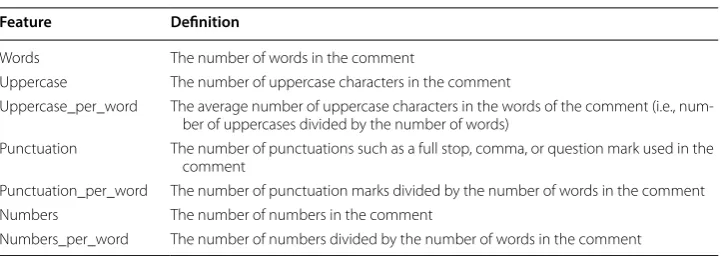
To establish a baseline feature set, we compute some basic features from the com-ments. We surmise that simple features (see Table 8) like the length of the comment, use of uppercase characters and punctuation might help our classifiers because emotional statements are often written in caps lock, and lack punctuation or use it excessively. As our experiments reveal, these features do add information for the models (see “ Experi-mental results” section).
Bag of words
BOW is a counting algorithm that encodes a sentence or a document in the dataset using a vector representation with |V| dimensions where |V| is the size of the selected vocabulary, V. The representation is unordered and encodes the weight of each member of the V, in the given instance, using various scoring techniques. In our case, for each word from a vocabulary, it counts the number of occurrences in the comment. We build the vocabulary on the training set and later use it to create the same BOW features on the test set. A list of English stop words (i.e., common words such as ‘and’, ‘or’ that do Table 8 Simple features
Feature Definition
Words The number of words in the comment
Uppercase The number of uppercase characters in the comment
Uppercase_per_word The average number of uppercase characters in the words of the comment (i.e., num‑ ber of uppercases divided by the number of words)
Punctuation The number of punctuations such as a full stop, comma, or question mark used in the comment
Punctuation_per_word The number of punctuation marks divided by the number of words in the comment Numbers The number of numbers in the comment
not add information for the classification) is excluded because these words appear fre-quently in text and contain little information.
TF‑IDF
Using TF-IDF, instead of simply counting the words, which would overemphasize fre-quent words, each word is weighted by its relative frequency. The TF-IDF features inform the model if a word appears more often in a comment than usually in the whole text corpus. Prior research has found TF-IDF features useful for online hate detection [5]. As with BOW, the TF-IDF vocabulary is built during the training of the model and then reused for the test set. Both BOW and TF-IDF are considered simple and proven methods for text classification [56].
Word embeddings
Word embeddings (also known as word vectors) are numerical representations of words that facilitate language understanding by mathematical operations [88]. Word embed-dings rely on a vector space model that captures the relative similarity among individual word vectors, thereby providing information on the underlying meaning of words [89]. For this reason, word embeddings are widely used for text classification and online hate detection [5, 30, 32]. Previous research has shown that different pretrained word embed-dings, including fastText, Word2Vec, and GloVe perform well for online hate detection [56], so the choice between the models can be seen as arbitrary. For this research, we chose the popular GloVe vectors from the SpaCy, a free, open-source library for NLP in Python.17 Other research papers deploying GloVe for online hate detection include, for example, Mishra et al. [15] and Kshirsagar et al. [90] The GloVe model we apply is publicly available18 and contains 685k keys and 20k unique vectors with 300 dimensions, trained on Common Crawl datasets.19
BERT
Transformers transform one sequence into another by eliminating any recurrence and replaces it with an attention mechanism to handle dependencies between the input and output of the system. With this architecture, a model can be trained more efficiently due to the elimination of sequential dependency on the previous words, increasing effectiveness for modeling long-term dependencies. A state-of-the-art model to utilize the encoder of the transformer is BERT [91], developed by a group of researchers from Google to improve state-of-the-art language representation. BERT has vastly outper-formed previous models, such as the Generative Pretrained Transformer (GPT) [63] and Embeddings from Language Models (ELMo) [24], in tasks such as question answering [92], named-entity recognition [1], and natural language inference [76], among others. BERT has also achieved state-of-the-art results in online hate detection [92–96].
17 https ://spacy .io/.
18https ://spacy .io/model s/en#en_core_web_md.
The success of BERT is enabled by applying bidirectional training of transformers on large computational resources and data, unlike other models where the network was trained from left-to-right or combined left-to-right and right-to-left training sequences. The transformer encoder reads the entire sentence at once, therefore allowing the model to learn the context of a word based on its entire surroundings. Apart from bidirection-ality, BERT also uses masking techniques in the input format before feeding the whole sentence to the transformer. Around 15% of the input words in a sentence are randomly replaced (masked) by a special token ([MASK]) or random words. The model is then optimized by predicting the masked words using the context from the non-masked words. To learn the relationship among two adjacent sentences, the training steps of the model also include a task of predicting if the second sentence, distinguished from the first sentence using end-of-sentence markers, is (not) subsequent of the first input sen-tence in the document. The model is optimized jointly by minimizing the loss of the two tasks mentioned above.
Even though training BERT is computationally expensive, once trained, its deployment for downstream text classification tasks (such as online hate detection) is straight-for-ward. Moreover, the finetuning process that we will apply before classifying is drastically less expensive than the full retraining of BERT (the trainable parameters are ~ 3 M, less than 3% of the total parameters of the network). Due to these favorable properties, we use a pre-trained BERT model (BERTBASE) that has been trained by Google researchers
using Wikipedia and BookCorpus datasets. The model we use has 12 layers, 768 hidden layers, and 110 M parameters and is freely available on GitHub.20 We adopt this model to our hate classifiers using its TensorFlow implementation, finetuning the last 3 BERT layers and adding a fully connected 128-neuron layer and a 1-neuron output layer on top of the BERT model that predicts our comment label. We use this combination of the NN and the BERT model to update the final three layers of the BERT model during the optimization. After this, we can cut off the small neural network again and are left with a BERT model that is finetuned to our task. To be able to use BERT correctly, we preproc-ess our data the same way that the training data of the BERT model was treated, includ-ing the WordPiece tokenization for English.21
Experimental design and evaluation Experimental design
In this study, we train different models using various algorithms (described in “ Experi-mental design and evaluation” section) along with different feature representations (presented in “Discussion” section) and compare their performance. In addition to the different algorithm performance, we also evaluated the performance of the models using two baseline models: a keyword-based classifier (KBC). We choose KBC because it is a quick and easy approach for software developers to implement and, therefore, feasi-ble in practice. We use the list of keywords developed by Salminen et al. [72]; this list contains 200 manually curated hateful phrases and is available online.22 KBC checks if a
21https ://githu b.com/googl e-resea rch/bert.
comment contains hateful phrases defined in the dictionary and classifies the comment as hateful or non-hateful accordingly. We then compare the prediction of the system with the ground truth to calculate the performance. Second, we use the model by Chan-drasekharan [64] that is publicly available as a downloadable Pickle file23 and, equally importantly, was trained on data from several platforms, achieving solid performance when applied to an independent social media platform whose comments the model had not previously seen (accuracy = 75.27%, precision = 77.49%, and recall = 71.24%).
In addition to studying the importance of different feature representations along with different algorithms, we also evaluate and present the results of our two best trained classifiers for each targeted social media platform: Wikipedia, Twitter, Reddit, and You-Tube. For comparison, we group our instances in the test set according to its platform (% of instances in each group along with its distribution of classes as shown in Table 6) and present the results accordingly. For completeness of the study, we also include the results previously published for each platform. However, due to differences in training/ test distribution between the source papers and our work, the results are not entirely comparable.
Evaluation metrics
The classifier performance is measured using the test set (~ 25% of the total dataset) with two metrics: (a) F1 score and (b) receiver operating characteristic—area under the curve (ROC-AUC). The F1 score is the harmonic mean of precision and recall at a deci-sion threshold of 0.50. The ROC computes precideci-sion and recall at all potential decideci-sion thresholds, so the area under the ROC curve is an appropriate metric to measure overall model performance. Equation 1 shows the formula for calculating the F1 score.
where p= precision (i.e., positive predictive value) and r= recall (i.e., true positive rate). In this research, we only report the F1 measure along with ROC-AUC. In addition, the models are compared for statistically significant performance differences using McNe-mar’s test with significance level α = 0.01.
Experimental results
To evaluate different algorithms and features (RQ1), Table 9 (evaluation measure: F1) and Table 10 (evaluation measure: ROC-AUC) present the results obtained using dif-ferent lexical feature representations and classification algorithms. Regarding the model families, XGBoost outperforms the other models on all feature sets except the BOW features, where the FFNN performs slightly better. XGBoost is closely followed by the FFNN on all other feature spaces. The other three model types (LR, NB, and SVM) per-form worse on all feature subsets. On the different training sets, the perper-formance of NB and LR ranks in different orders, while the SVM is always last. As expected, in baseline comparison, the KBC performed the worst.
(1)
F1=2×
p×r p+r
Comparing the feature representations, we observe a linear trend (see Fig. 2) in the performance of the classifiers when moving from simpler features to more advanced ones, with BERT giving the best results when comparing individual features. While the TF-IDF and BOW features perform much worse, their performance is still considera-bly higher than a random guess. The fact that TF-IDF models are only marginally better than the BOW models indicates that TF is not critical for the predictions. Likely, the most substantial information gain comes from the presence of certain words like “fuck”, which can be detected by BOW features as well as by TF-IDF features.
Table 9 F1 scores (the highest scores italicized)
** Significant at p < 0.001 (McNemar’s test comparing predictions from XGBoost-BERT and XGBoost-All
a The features are concatenated into one big vector for each instance and used as input to the classifiers
Simple features BOW TF‑IDF Word2Vec BERT All featuresa
LR 0.062 0.764 0.768 0.828 0.891 0.892
NB 0.130 0.505 0.606 0.601 0.885 0.868
SVM 0.066 0.487 0.648 0.765 0.892 0.883
XGBoost 0.400 0.765 0.774 0.880 0.916 0.924**
FFNN 0.064 0.770 0.769 0.847 0.893 0.894
KBC n/a n/a n/a n/a n/a 0.388
BOC n/a n/a n/a n/a n/a 0.084
Table 10 ROC-AUC scores (the highest scores italicized)
Simple features BOW TF‑IDF Word2Vec BERT All features
LR 0.514 0.819 0.820 0.873 0.925 0.925
NB 0.524 0.738 0.809 0.761 0.938 0.934
SVM 0.515 0.661 0.74 0.818 0.924 0.911
XGBoost 0.782 0.932 0.937 0.986 0.994 0.995
FFNN 0.743 0.934 0.937 0.974 0.988 0.988
0 0.1 0.2 0.3 0.4 0.5 0.6 0.7 0.8 0.9 1
Simple
Features BOW TF-IDF Word2vec BERT All features
Logisc regression NB
SVM XGBoost FFNN Linear (NB)
F1 Scor
e
The results indicate that XGBoost outperforms the other algorithms most of the time, and XGBoost with all features is the highest performing model. This linearly combined feature set significantly outperforms XGBoost using only the BERT features. In contrast, the results using the FFNN shows no significant difference between the performance when using BERT only versus all features.
Baseline comparison shows that the KBC has drastically lower performance than any of the developed models, with an accuracy of 41.4% and F1 score of 0.388. The poor per-formance results from a high number of false positives (Type I error), which is 112,581 (57%) from the test set (recall = 0.25). In other words, the KBC considers many non-hateful comments as non-hateful, conforming with its known limitations [16]. Conversely, the problem of false negatives (Type II error) is much smaller for the KBC, as its preci-sion is 0.919. This stems from the unbalanced dataset. In comparison, the false positive rate for the XGBoost model with all features is 2.0%, and the false negative rate is only 1.0%.
Surprisingly, the BOC model performs even worse than KBC, obtaining an F1 score of 0.084, precision of 0.085 and recall of 0.083. The accuracy is better than for the KBC (63.4% vs. 41.4%), but the results clearly indicate that the BOC model does not general-ize well into these datasets. Unfortunately, we cannot test if our model generalizes to the original data of the BOC model [64], because the researchers are not sharing their data, only the Pickle file of the model. This also means that retraining using a sample of our data to improve their model is not possible. In terms of platform-specific performance, the BOC provides a better-than-chance (> 50%) accuracy for Wikipedia (70.4%) and Red-dit (71.7%), but worse-than-chance accuracy for Twitter (19.6%) and YouTube (25.5%). The raw accuracy of the XGBoost model with all features is 97.0%, which implies a 94% improvement over a random model (κ = (0.97 − 0.50)/(1 − 0.50) = 0.94). Conversely, the performance over a random model is negative for the KBC (− 17.2%) and somewhat
positive (+ 26.8%) for the BOC model.
Platform‑specific analysis
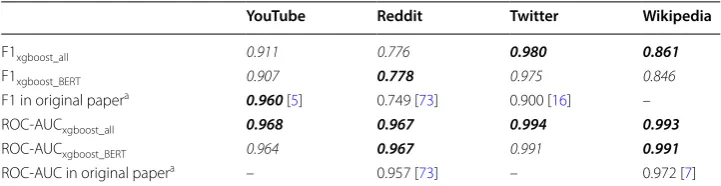
For the platform-specific analysis (see Table 11), we use the XGBoost (All and BERT) models to predict the hatefulness of comments from each social media platform sepa-rately to assess the model’s generalizability. The F1 score of XGBoost (All) outper-forms XGBoost (BERT) significantly for Wikipedia and Twitter platoutper-forms; however, the same could not be said for the other two platforms. The features we use reflect the language being used in the social media platforms, so the difference in performance implies that the use of hateful language somewhat differs by platform (see “Linguistic variable analysis” section for more). Regarding the results, we consider the generaliz-ability to be fair, as we achieve solid F1 and ROC-AUC scores (> 0.70) for each plat-form using XGBoost with BERT and all features (see Table 11).
Interestingly, the best model performs particularly well for YouTube (F1xgboost_ all= 0.91) and Twitter (F1xgboost_all= 0.980). This implies the hateful language is
eas-ier to decipher for the model in these platforms. In contrast, the model performs worse with Reddit (F1xgboost_all= 0.776) and Wikipedia (F1xgboost_all= 0.861). On these
humans, too) to understand the hateful intent in their comments. Regarding the errors of the best model, many of the falsely classified comments can be seen difficult for a human to classify as well. For example, the comment “As usual, Jews and turks try to make famous Lebanese arab christian belong to them, he is Mexican Lebanese Arab christian and thats all!!” (from Wikipedia). This comment is labelled as ‘not hateful’ in the ground truth but the model classifies it as hateful because it probably detects a racist sentiment in the comment. Among the false negatives, there are many similar examples, such as “You WERE NOT REVERTING ALL THOSE TIMES EM. You deleted other contributions, every time something was added you didn’t like. Get lost.” (from Wikipedia). This comment is definitely annoyed or even angry, but it is not clear if it crosses the line of ‘hateful’.
The highest risk for false positives using our model is in the Reddit platform (recall = 0.779). The lowest risk for false positives is when applied to the Twitter plat-form (recall = 0.978). The highest risk for missing hateful comments (false negatives) is again Reddit (precision = 0.813) and the lowest for Twitter (precision = 0.984). Overall, the model is slightly more likely to detect hateful comments when the com-ments are not hateful relative to classifying hateful comcom-ments as non-hateful (+ 3.9%
relative difference).
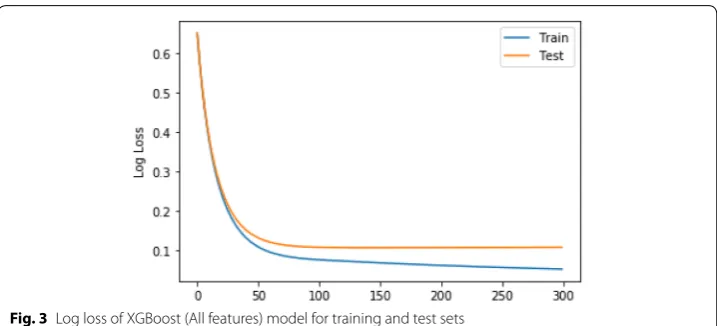
We also analyze the possibility of overfitting by plotting the log loss of the XGBoost model on training and test sets. The model converges after about 75 trees (Fig. 3), after which the test error remains constant, indicating that there is little risk of overfitting.
Linguistic variable analysis
To investigate how well the best model (XGBoost with all features) learns linguistic characteristics in the hateful and non-hateful language (RQ3), we extracted scores on all linguistic variables available in the LIWC (Linguistic Inquiry and Word Count) [97] software. The LIWC taxonomy contains 93 categories that reflect the use of lan-guage at various levels, ranging from simple (word count, use of negations) to more complex (anxiety, tone) variables. To investigate the LIWC properties of the predicted comments, we applied the following procedure:
Table 11 Generalizability of our best models (XGBoost with All and BERT features) across social media platforms
We also present the results from previous research—when not reported, the cell contains (−). To facilitate reading, our results are given in italic. The results between the XGBoost (All vs BERT) in Wikipedia and Twitter platforms are significantly different with p < 0.01 (McNemar’s test). Note that the results from previous studies are not directly comparable with the current study findings
a Brackets refer to sources
YouTube Reddit Twitter Wikipedia
F1xgboost_all 0.911 0.776 0.980 0.861
F1xgboost_BERT 0.907 0.778 0.975 0.846
F1 in original papera 0.960 [5] 0.749 [73] 0.900 [16] –
ROC‑AUC xgboost_all 0.968 0.967 0.994 0.993
ROC‑AUC xgboost_BERT 0.964 0.967 0.991 0.991
1. Extract LIWC variable scores for all hateful and non-hateful comments in train and test set.
2. Create four comment sets:
• hatefulground (containing comments whose ground truth value is hateful). • hatefulpredicted (predicted value == hateful).
• non-hatefulground (ground truth value == non-hateful). • non-hatefulpredicted (predicted value == non-hateful).
3. Calculate the average score for each LIWC variable in each set.
4. Calculate relative difference D between average scores of ground truth and average scores of predicted comments (i.e., (hatefulpredicted− hatefulground)/hatefulground and (non-hatefulpredicted− non-hatefulground)/non-hatefulground for each LIWC variable. 5. Sort D by highest value and examine (a) which linguistic features are replicated well
by the predictive model (i.e., their relative difference is small) and (b) which features are not well captured (i.e., their relative difference to ground truth is high) by the model.
Results (see Fig. 4) indicate that the model’s predictions replicate the linguistic characteristics of both the hateful and non-hateful comments reasonably well (i.e., the difference scores are centered around zero). The average difference across all LIWC categories is M = 0.011 (SD = 0.240) for the Hateful paired comments and
M = 0.002 (SD = 0.020) for the Non-hateful paired comments. Thus, hateful lan-guage is replicated more poorly relative to non-hateful lanlan-guage, and it has a consid-erably higher standard deviation among LIWC categories.
When examining the difference between predicted hateful comments and the ground truth hateful comments, out of the 93 LIWC categories, seven categories are classified as outliers (see Table 12). The predictions show more seldom use of (a) parentheses (− 13.7%, indicating less parentheses in predicted hateful than in ground truth hateful comments), (b) quotation signs (− 8.6%), (c) dashes (− 7.8%), and (d) question marks (− 5.6%). Moreover, the score for word count (WC) was 4.9%
lower for predicted hateful comments relative to ground-truth hateful comments, which can be indicative of the model’s capability to learn Twitter’s short-messag-ing format well (see “Experimental results” section). In contrast, the predicted comments had a higher use of words from the Friends category (+ 6.9% relative to ground truth hateful comments)—this category contains, for example, references to ‘pal’, ‘buddy’, and ‘coworker’. Similarly, the relatively higher scores for the Body (+ 5.3%; examples: ‘ache’, ‘heart’, ‘cough’), Swear words (+ 5.2%), Sexuality (+ 5.1%; e.g., ‘horny’, ‘love’, ‘incest’), and Anger (+ 4.4%; e.g., ‘hate’, ‘kill’, ‘pissed’) categories imply that the model is over-emphasizing the importance of their use when predict-ing hatefulness. Similarly, biological process (e.g., ‘eat’, ‘blood’, ‘pain’) and “netspeak”, consisting of shorthand interpersonal communication (e.g., “lol”, “4ever”) [98], are also over-emphasized (+ 4.7% and + 3.6%, respectively). For some reason, the use of semi-colons (SemiC) takes place more (+ 4.0%) in the predicted hateful comments than ground truth hateful comments.
Fig. 4 Differences of aggregated mean scores of predicted labels’ LIWC scores and ground‑truth labels’ LIWC scores
Table 12 Relative differences of linguistic variables between comments predicted as hateful by XGBoost + All and those labeled as hateful in the ground truth
Relative difference is calculated as Cpredicted− Cground)/Cground, where C is a LIWC category a Outlier: > 1.5 interquartile ranges (IQRs) below the first quartile or above the third quartile
LIWC category Rel. diff. (lower scores) (%) LIWC category Rel diff. (higher scores) (%)
Parentha − 13.4 Frienda + 6.9
Quotea − 8.6 Bodya + 5.3
Dasha − 7.8 Sweara + 5.2
QMark − 5.6 Sexuala + 5.1
WC − 4.9 Bio + 4.7
Risk − 4.7 Informal + 4.6
anx − 4.5 Anger + 4.4
Work − 4.4 Semic + 4.0
Feature importance analysis
Addressing RQ2 (the impact of features on the predictions), we carry out a feature importance analysis by using Shapley values. Shapley values originate from game theory, where they are used to distribute a reward among the players in cooperative games [99]. When applying this concept to machine learning models, the game is the model accuracy, and the players are the different features. The important features, i.e., those that have a large influence on the model performance, will have large Shapley values.
Figure 5 shows the 30 most important features from test set predictions and their contribution to the predicted class. The dots with negative values on the x-axis are predictions where the specific feature had a negative contribution (less likely a hate comment) and vice versa. The most important takeaway is that out of the 30 most important features, 29 come from the BERT model. Only one other feature type (Word2Vec on the second to last row) is present. This outcome illustrates the impor-tance of the BERT model for the classifier. Even though we only trained the last three layers of the model, it still produces better features than all the other approaches in this analysis. Unfortunately, the BERT features are not humanly interpretable, so it