A
Simple
Monte
Carlo
Method
for
the
Calculation
of
Efficiency
Limit
for
Current
‐
Matched
Tandem
Solar
Cells
Abderrahmane Belghachi
Laboratory of Semiconductor Devices Physics, University of Bechar, Algeria
Received 20 Jun 2017; Revised 24 Aug 2017; Accepted 10 Oct 2017
ABSTRACT
Tandem solar cells have demonstrated the potential to increase the efficiency of solar energy conversion. The detailed balance principle introduced by Shockley and Queisser 1961 was later applied by De Vos 1980 to study the tandem structures. Although the mathematical formulation is simple, the mathematical resolution is rather complex but fairly accurate. In this work I describe a simple Monte Carlo (MC) technique to determine the detailed balance limiting efficiency for tandem solar cell stacks. This statistical method used a simple sampling scheme which is adequate to resolve a complex equation system that is depicting a large number of multi‐junction without any further approximations. In current‐matched tandem solar cells, the band gap of each sub‐cell has to be chosen so that the current flowing through each of the sub‐cells is the same. Finding from this study fcus on10 stacked junctions; the algorithm can be applied to a larger number of sub‐cells. The simulation is carried out with four different conditions; under black body, AM1.5G, AM1.5D spectrums and maximum concentration. The method employed in this study provides a useful tool for researchers to assess the optimum band gap arrangements of current constrained solar cell stacks together with a predicted efficiency limit. The results claim that the application of MC technique is in agreement with the finding from previous studies.
Keywords: tandem solar cell, high efficiency, Monte Carlo.
1. INTRODUCTION
Shockley and Queisser (SQ) [1] initially calculated the detailed balance limit efficiency for an ideal solar cell, consisting of the single semiconducting absorber with an energy band‐gap Eg. A single p‐n junction solar cell is illuminated to generate electron hole pairs by using the electronic transition. This phenomenon is known as quantum process and happen due to fundamental absorption of photons with energies which is greater than the energy‐gap (hν >
Eg).. The photogenerated pairs is recombined locally or being circulated in an external circuit and transmit their energy. The approach is conducted based on the following main assumptions:
i)‐ the probability is equal to unity whena photon, with energy hν > Eg is projected on the cell surface and produced a hole‐electron pair. But, photons with lower energy do not produce any effect during the incident. ii)‐ all photogenerated electrons and holes are thermalized to the band edges (photons with energy greater than Eg produce the same effect). and iii)‐ all photogenerated charge carriers are collected at short‐circuit condition and the upper detailed balance efficiency limit is obtained if radiative recombination is the only permitted recombination mechanism.
100
For a single junction solar cell, all photons with energies below the bandgap are not being absorbed. The photons are assumed as becoming transparent because it does not cause any effect on the energy conversion. Whilst the remaining photons which hold energies greater than the gap) carried a certain amount of energy that and contributes to the creation of electron‐hole pairs. Following to this, the extra energy is lost to the surrounding. These two effects, can lead to 50% of the solar radiation energy loss incident on one single junction cell. However, the limitation for maximum solar conversion efficiency is estimated to be around 33.7% by assuming a single p‐n junction. The well known approach on how to surmount such efficiency restraint is through the use of tandem or stacked cells. These sub‐cells consist of multiple p‐n
junctions, where each junction is tuned to a particular energy range of the solar spectrum. But, the utilization of stacked single junction solar cells which is operating in tandem is argued to exceed the performance of one p‐n junction solar cell operating alone. The energy bandgap of each sub‐cell is tuned to absorb a minute part of the solar spectrum. When the number of solar sub‐cells working in a tandem stack are increasing towards infinity, this in turn has increased the upper‐limiting efficiency of the stack to the absolute theoretical maximum efficiency. This alternative will become increasingly feasible with the possible evolution of materials technology over the decades to 2020 [2,3].
2. THEORY
From using the detailed balance principle, in a steady state condition, the flow of current density
J(V) through an external circuit has caused an increase of total algebraic rates of electron‐hole pairs. Due to the recombination (radiative and non‐radiative), the current density is corresponding to the absorption of incoming photons from the sun and surrounding background.) [4,5]. This process yield general current voltage characteristic formula as below:
1 , (1)
where sa and c are the number of photons emitted from sun, ambient atmosphere and the
solar cell (converter), per unit area per second within an interval of frequency dν, with:
∞
(2.a)
∞
(2.b)
, ∞ (2.c)
where Ts, Ta and Tc are the respective temperatures of the sun, ambient background, and solar cell. C and f are represented by the sun concentration and geometrical factors. fRR represents the fraction of radiative recombination rate or radiative recombination efficiency. When URRand UNR
are radiative and non‐radiative recombination rates,hence fRR is defined as:
(3)
To determine the efficiency limit of tandem solar cells, the detailed balance principle is crucial to applied. In this approach, the limit is taken independently from semiconductor properties except for the band‐gap of each single cell. Due to this, a number of assumptions are necessary in order to calculate the theoretical efficiency.
101
Planck law of radiation. Secondly, the sub‐cells are arranged with the largest band‐gap sub‐cell the top of the structure, i.e. nearest to incoming radiation and bottom sub‐cell has the lowest band‐gap (Eg,1 > Eg,2 > Eg,3 …> Eg,n‐1) > Eg,n). Third, each sub‐cell is assumed to absorb all the
photons with energies greater than its band‐gap. Similarly, each sub‐cell is transparent to photons that have energies below its band‐gap. Lastly, the energy selective reflectors are inserted between each pair of sub‐cells for optimum performance. Hence, the electrical current crossing the ith sub‐cell (Eg,i) (i= 2, 3….n‐1) by the detailed balance principle is:
, , , 1 , , , , , , , , (4)
With
, , , ,, (5)
, , , ,, (6)
And
, , , , ,
, (7)
The topmost sub‐cell (i= 1) has the same J(V) expression as a single junction( Eq. 1). For the last sub‐cell, i = n (bottom sub‐cell) upper limit of integration is set to infinity.
The obtained equation system is presented under maximum efficiency conditions for current‐ matched tandem cells with two conditions: first the power output of each sub‐cell is required to be at maximum state Pi=Pm,i, with Pm,i=Jm,iVm,i; second, the maximum current density has to be equal for each sub‐cell, Jm,i =Jm (i = 1, 2, 3….n). With these constrains, the solution of a large equation system is complicated and necessitates to elaborate further the solving techniques [6‐ 11]. In the present work, I used a numerical method from Monte Carlo statistical technique.
3. MONTECARLOMETHOD
Monte Carlo method is a tool used to simulate systems with many coupled degrees of freedom. In this technique, a large number of points are scattered uniformly over a defined interval as inputs before computation is done on each point. The method is useful to obtain numerical solutions for problems which is analytically complicated. The most common application of the Monte Carlo method technique is conducted for integration. Apart from this, it is also used to minimize (or maximize) functions of some vector with a significant number of dimensions. To obtain accurate solutions, a large number of stochastic events is needed to be reproduced. Due to this, the decision lead to an increase of computing time . Therefore, several algorithms are suggested to reduce the variance and execution time. Hence, it is suggested that a proper sampling technique can help to improve enormously the performance of a Monte Carlo program. In importance sampling scheme certain values of the random input variables in a simulation have more impact on the parameter that is being estimated than others. Therefore, if these "important" values are emphasized frequentlythrough proper sampling technique more, it is expected that the estimator variance can be reduced.
102
black body I used the Incomplete Riemann Zeta Integrals (IRZIs). The energy domain is divided into sub‐domains to match with the number of stacked cells by taking a minimum Eg,min and a maximum Eg,max energy values as limits to define useful solar spectrum. In this approach, the optimized energy gaps of preceding (n‐1) sub‐cells stack are used to obtain sampling domain for the present set of n sub‐cells. An optimum value is expected within n
i g
E ,
range, as shown in a schematic representation of Figure 1, where superscript n represents the total number of sub‐ cells in a stack and subscript istands for subscell order within the stack (i =1, 2... n).
Δ , , , (i = 2, 3…n‐1) (8)
Δ , , , (i = 1) (9)
Δ , , , (i = n) (10)
For n tandem cells, firstly a random number r1 is drawn (0 <r1 < 1) to calculate the top most
energy gap , .This is calculated using formula: , Δ , , then the maximum power point
(MPP) for this sub‐cell is determined applying the detailed balance principle. The maximum
corresponding current density is determined using , and taken as that of the whole
stack, as for current matched tandem solar cells. A second random number r2 and an energy gap
, is calculated using equation (8) then , Δ , . After calculating the MPP for this sub‐
cell, if the maximum current density is very close to (in our simulation, less than 0.01 % of is accepted) then a third random number is drawn and so on.
On the contrary, if the sub‐cell maximum current density is different from , a second stage analysis is repeated until I find an energy gap that gives a current density with the order of . The same procedure is repeated until the analysis yield the expected n energy gaps. Once the n
energy gaps are determined I extract a total maximum voltage ∑ , and the
overall efficiency are extracted, the same task is repeated several times (N) and different efficiency values, for each set of energy gaps, are obtained. The set of n energy gaps which gives the highest efficiency is retained; obviously optimized energy gaps with a maximum efficiency are reached when N is large.
103
4. SIMULATIONRESULTSANDDISCUSSION
The first case to be simulated is a single junction cell with anexpected energy gap between maximum and minimum energy values, Emin= 0.35 eV and Emax= 3.3 eV. This simple run is carried out in order to test the program, and find an optimum single energy gap.
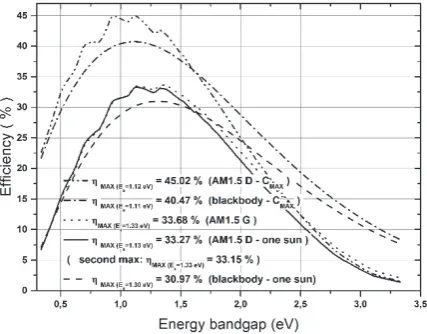
Figure 2 illustrates the efficiency against energy band‐gap of a solar cell when it isusing different spectrums (AM1.5G AM 1.5 D and black body spectrum at Ts= 6000°K, under both natural and concentrated sunlight). For maximum theoretical efficiency, it is assumed that the calculation recombination is only for radiative (fRR = 1) and 100% external fluorescence efficiency. This means that all emitted photons from the cell are allowed to escape [12]. The theoretical maximum efficiency is 45.02% for AM1.5D at highest concentration. Therefore, it can be concluded that in the best of cases, more than 50% of the solar energy is lost because of spectral mismatch; photons with energies below the gap are not absorbed, and the excess energy of absorbed photons with energy higher than the gap is dissipated as heat.
Figure2. Upper limits for single junction solar cell, as a function of band‐gap energy for different solar spectrums (black body, AM1.5G, AM1.5D, un‐concentrated and concentrated conditions).
104
(a) (b)
(c) (d)
(e)
Figure3. Contour plots of calculated efficiency versus sub‐cell band‐gaps of unconstrained two‐sub‐cell tandem for different solar spectrums; panel (a) black body C = 1, panel (b) black body C = Cmax , panel (c) AM1.5D, panel (d) maximum concentrated AM1.5D spectrum and panel (e) AM1.5G spectrum. Series constrained two‐sub‐cell tandems are represented by dotted lines.
105
constrained series connected stacks). The size of samples is increased to investigate convergence and calculating time. If the size of a sample or sampling number for one sub‐cell is
m then, total sampling number is N =mn, with n the number of sub‐cells in a stack. Figure 4
represents upper efficiencies for a number of sub‐cells equal to 2, 4, 6, 8 and 10 versus sampling number of one sub‐cell ( / ). For a stack of two sub‐cells a sample of 50×50 (m = 50) is
sufficient to saturate (converge) to a constant efficiency value. As the number junctions is increased the required sampling size is increased too; to reach about m = 600, that is N = 60010.
Therefore this study conclude that as the number of sub‐cells in a stack is increasing, hence the sampling number is increasing as well to obtain stable value of efficiency. As one can see from Fig.4, a value of 103 is an acceptable value for a statistical technique and the calculation time is
very satisfactory even for a stack of 10 sub‐cells.
Figure4. Maximum efficiency for series constrained tandem solar stacks versus the sampling size under one sun (black body spectrum), with n sub‐cells.
Tables 1 until 5 show the optimum band‐gaps, and upper limit efficiencies for series constrained tandem stacks under conditions; black body, AM1.5 global, AM1.5 direct, un‐ concentrated and concentrated radiations. The simulation technique is applied to a number of sub‐cells from n =1 to 10, taking a sampling number of N= 103n, this size is very satisfactory up
to 10 sub‐cells. The obtained results is presented with the same orders from most published work that employed more elaborate techniques if compared to the application of Monte Carlo method. In previous studies [6], maximum discrepancy of efficiency for cells up to six junctions is less than 2.55% for AM 1.5 global solar spectrum. Whereas, the value for black body spectrum is significantly lesser with onlyis 0.7%.
Table1 Listing of optimum band‐gaps and efficiencies for series constrained tandem stacks, maximum concentration from black body spectrum
n Eg1 Eg2 Eg3 Eg4 Eg5 Eg6 Eg7 Eg8 Eg9 Eg10 (%)
1 1.11 ‐ ‐ ‐ ‐ ‐ ‐ ‐ ‐ ‐ 40.74
2 1.45 0.77 ‐ ‐ ‐ ‐ ‐ ‐ ‐ 55.46
3 1.82 1.14 0.61 ‐ ‐ ‐ ‐ ‐ ‐ ‐ 63.15
4 2.02 1.39 0.94 0.51 ‐ ‐ ‐ ‐ ‐ ‐ 67.88
5 2.17 1.56 1.15 0.79 0.42 ‐ ‐ ‐ ‐ ‐ 71.08
106
Table2 Listing of optimum band‐gaps and efficiencies for series constrained tandem stacks, under one sun black body spectrum
n Eg1 Eg2 Eg3 Eg4 Eg5 Eg6 Eg7 Eg8 Eg9 Eg10 (%)
1 1.31 ‐ ‐ ‐ ‐ ‐ ‐ ‐ ‐ ‐ 30.96
2 1.70 0.98 ‐ ‐ ‐ ‐ ‐ ‐ ‐ ‐ 42.51
3 1.95 1.29 0.81 ‐ ‐ ‐ ‐ ‐ ‐ ‐ 48.64
4 2.14 1.52 1.10 0.72 ‐ ‐ ‐ ‐ ‐ ‐ 52.46
5 2.28 1.69 1.30 0.97 0.65 ‐ ‐ ‐ ‐ ‐ 55.08
6 2.41 1.83 1.45 1.15 0.88 0.61 ‐ ‐ ‐ ‐ 56.99 7 2.51 1.95 1.59 1.30 1.05 0.82 0.57 ‐ ‐ ‐ 58.43 8 2.60 2.05 1.69 1.42 1.18 0.97 0.76 0.54 ‐ ‐ 59.57 9 2.68 2.13 1.78 1.52 1.29 1.09 0.90 0.71 0.51 ‐ 60.48 10 2.73 2.19 1.85 1.59 1.37 1.18 1.00 0.82 0.65 0.44 61.18
Table3 Listing of optimum band‐gaps and efficiencies for series constrained tandem stacks, for an AM1.5 G spectrum
n Eg1 Eg2 Eg3 Eg4 Eg5 Eg6 Eg7 Eg8 Eg9 Eg10 (%)
1 1.33 33.74
2 1.63 0.96 45.74
3 1.90 1.37 0.94 51.57
4 2.00 1.50 1.12 0.72 55.20
5 2.13 1.65 1.30 1.00 0.70 57.56
6 2.23 1.78 1.46 1.19 0.95 0.69 59.51
7 2.32 1.88 1.58 1.35 1.13 0.92 0.66 60.67
8 2.35 1.92 1.63 1.40 1.18 0.97 0.74 0.50 61.65 9 2.41 2.00 1.72 1.49 1.27 1.12 0.94 0.73 0.50 62.50 10 2.47 2.07 1.80 1.58 1.40 1.21 1.04 0.83 0.72 0.49 62.66
Table4 Listing of optimum band‐gaps and efficiencies for series constrained tandem stacks, for an AM1.5 D spectrum
n Eg1 Eg2 Eg3 Eg4 Eg5 Eg6 Eg7 Eg8 Eg9 Eg10 (%)
1 1.33 33.15
2 1.57 0.93 45.29
3 1.85 1.33 0.92 50.91
4 1.93 1.44 1.04 0.69 54.60
5 2.07 1.60 1.26 0.99 0. 70 56.83
6 2.17 1.74 1.43 1.17 0.94 0.69 58.99
7 2.21 1.79 1.49 1.23 1.00 0.76 0.51 59.61
107
Table5 Listing of optimum band‐gaps and efficiencies for series constrained tandem stacks, for an AM1.5 D spectrum at maximum concentration
n Eg1 Eg2 Eg3 Eg4 Eg5 Eg6 Eg7 Eg8 Eg9 Eg10 (%)
1 1.12 45.02
2 1.43 0.69 60.31
3 1.74 1.17 0.69 67.61
4 1.87 1.36 0.95 0.50 72.33
5 2.00 1.53 1.17 0.80 0.49 74.16
6 2.11 1.66 1.35 1.05 0.77 0.47 76.25
7 2.20 1.77 1.47 1.21 0.99 0.75 0.46 77.84
8 2.27 1.86 1.57 1.35 1.14 0.95 0.73 0.45 78.97 9 2.33 1.94 1.66 1.45 1.23 1.05 0.83 0.71 0.44 79.77 10 2.39 2.00 1.74 1.53 1.35 1.17 1.00 0.80 0.70 0.43 80.35
5. CONCLUSION
In this paper, I have calculated the limit efficiency and determined the optimal band‐gaps of a tandem solar cell system, consisting of n (n = 1, 2…10) homojunction cells using the detailed balance approach. The calculation employed Monte Carlo statistical technique to resolve equation system that is significantly potential to describe the current density versus voltage characteristics of each sub‐cell, to determine its maximum power point. The application of rejection technique is a potent tool to reduce the calculating time for current matched tandem solar cells. The highest estimated efficiency in this work is 80.35% reached for a stack of 10 junctions under fully concentrated AM1.5 D solar spectrum. This value is not far away from the upper theoretical efficiency limit of 86.8% predicted for an infinite number of junctions [4]. The obtained optimal energy gaps are in fair accord with most available data from literature [6‐11], though they are achieved using elaborate numerical techniques. Monte Carlo method could be improved by taking into account the sub‐cell thickness and its effect on matching the maximum current density.
REFERENCES
[1] W. Shockley, H. J. Queisser, JournalofAppliedPhysics32(3) (1961) 510‐19.
[2] M.A. Green, Third Generation Photovoltaics: Advanced Solar Energy Conversion. In: Springer Series in Photonics 12, Kamiya T., Monemar B., Venghaus H., Yamamoto Y. (Ed.), Springer‐Verlag Berlin Heidelberg 2003.
[3] S. Ahmad, Int.J.NanoelectronicsandMaterials8 (2015) 129‐202. [4] A. De Vos, J. Phys. D: Appl. Phys., 13 (1980) 839.
[5] P. Baruch, A. De Vos, P. T. Landsberg, J. E. Parrott, Solar Energy Materials and Solar Cells 36 (1995) 201.
[6] A. S. Brown, M. A. Green, Physica E14 (2002) 96.
[7] F. Meillaud, A. Shah, C. Droz, E. Vallat‐Sauvain, C. Miazza, 90, 18–19 (2006) 2952.
[8] S. P. Bremner, M. Y. Levy, C. B. Honsberg, 22nd European Photovoltaic Solar Energy
Conference, 3‐7 September 2007, Milan, Italy, 75‐78.
[9] A. Marti, G. L. Araujo, Solar Energy Materials and Solar Cells 43 (1996) 203.
[10] J. M. Olson, D. J. Friedman S. Kurtz, high‐efficiency III‐V multijunction solar cells, Handbook of Photovoltaic Science and Engineering, Edited by A. Luke and S. Hegedus, John Wiley & Sons, Ltd, ISBN: 0‐471‐49196‐9 (2003) 359.