M. Norsalawani, and R. Bahar
Department of Manufacturing and Materials Engineering International Islamic University Malaysia
PO Box 10, 50728 Kuala Lumpur, Malaysia
Minimum Quantity Lubrication (MQL) and its Effect on Tool Wear During
Miniature Drilling: An Experimental Study
Norsalawani Mohamad, and Rubina Bahar
Received: 06 October 2016 Accepted: 13 December 2016 Published: 20 December 2016 Publisher: Deer Hill Publications © 2016 The Author(s)
Creative Commons: CC BY 4.0
ABSTRACT
Miniature drilling is widely used in industries including electronics and reconstructive surgeries to create small sized holes. Chip removal and effective supply of coolant are the two limiting factors that make the process more complex compared to other meso scale machining processes and also contribute to the tool wear. The tool wear in the process is mainly caused by the interaction, motion and chip production between the tool and work piece. Uniform supply of coolant must be ensured to reach the drilled cavity to keep the tool wear to a minimal level. This study includes experimental investigation of the tool condition after applying Minimum Quantity Lubrication (MQL) system as a greener approach as the name indicates. The tool condition with MQL has also been compared with dry and flood cooling. Two different types of drill bit materials (High Speed Steel and Carbide) have been tested under same experimental condition to drill through Aluminum Alloy 6061 and it has been found that overall performance in terms of tool condition after applying MQL was better compared to the other two methods. The overall wear propagation area was measured for both the conditions. It was seen, the wear propagation covered minimal area with MQL while for flood and dry condition wear was spread over a bigger area on flank.
Keywords: Minimum Quantity Lubrication (MQL), Micro-drilling, HSS drill bit, Carbide drill bit, Tool wear.
1 INTRODUCTION
by [12]. In terms of different coatings of the cemented carbide drill as reported by [13], with a special design of the drill to have better mist distribution , the performance was equivalent to flood cooling.
In this paper, two different material drill bits have been tested for the tool wear condition under three lubrication condition: flood, MQL and dry for drilling on Aluminum alloy 6061. MQL is found to be a better choice for both the tools. The average area of the wear was measured and compared for the tools used under different condition.
2 METHODOLOGY
2.1 Equipment and Material Selection
The micro drilling machine used to conduct the experiment is Mikrotools Multi-Process Machine Tool DT110. This machine can travel in three directions which are X, Y and Z axis. For this project, the Aluminium alloy 6061 has been chosen for the work piece material with medium fatigue strength and good finishing characteristic. Two drill bits of HSS and Carbide with 1 mm diameter, same drill point angle and cutting direction were used.
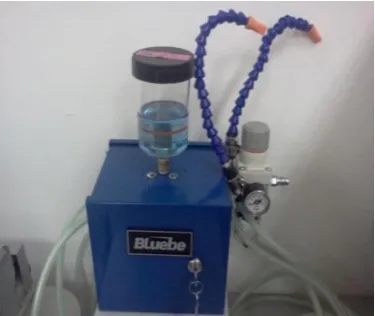
2.2 Minimum Quantity Lubrication System and other equipment
Bluebe MQL system was used with an environment friendly biodegradable lubricant. It also served as the necessary coolant. Bluebe FK type can deliver air and lubricant to the nozzles which can be adjusted separately with lubricant consumption 4-8 ml per hour / per nozzle. Accu-Lube LB-6000 was used as the lubricant with vegetable oil base. Nikon Measuring Microscope model MM-400/L is used to measure the wear obtained on the tool. The microscope is connected to the computer to capture the image of cutting tool by using NIS-Element F3.0 software. Design of experiment (DOE) is required to determine the relationship between the variables and parameters that will affect the response and performance. For this study, two level factorial design was used by using Design-Expert 6.0.8 software.
2.3. Experimental Parameters
This study investigates the performance of MQL over other two methods of lubrication dry lubrication and flood lubrication. Figure 2(a-b) shows flood condition and MQL condition respectively. The Experimental parameters are listed in Error! Reference source not found..
Table 1: Experimental Parameters
Parameter Description
Work piece Material Aluminum Alloy 6061
Cutting tool diameter 1.00mm
Depth of cut 6mm
Feed rate (mm/min) 8.0
Spindle speed (rpm) 25000
Tool material Carbide and high speed steel
Lubrication condition Dry/Flood/MQL
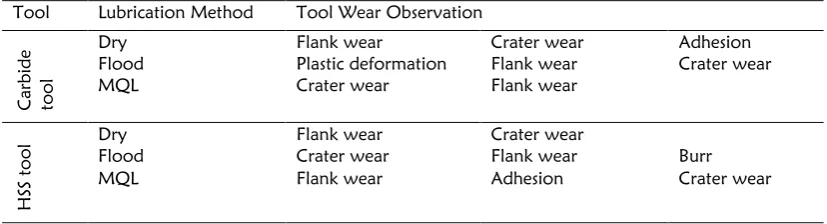
Table 2: Types of wear found on the tools Tool Lubrication Method Tool Wear Observation
C
arbid
e
tool
Dry Flank wear Crater wear Adhesion
Flood Plastic deformation Flank wear Crater wear
MQL Crater wear Flank wear
H
SS
tool
Dry Flank wear Crater wear
Flood Crater wear Flank wear Burr
MQL Flank wear Adhesion Crater wear
3 RESULTS
3.1 The Tool Wear Analysis
The tool wear has been analysed to compare the effect of different lubrication processes on tool wear of different materials drill bits. Initial experiment was conducted on carbide drill bit under dry machining conditions with feed rate of 4 mm/min and spindle speed of 18000 rpm. However, no significant wear was seen on the tool bit. The feed rate and spindle speed are increased to the 8 mm/min and 25000 rpm respectively to obtain clear and significant tool wear. Then all the experiments conditions are conducted with those new cutting parameters. The types of wear observed for two different drill bit is listed in Table 2.
3.2 Observation of tool wear between the processes and tool material
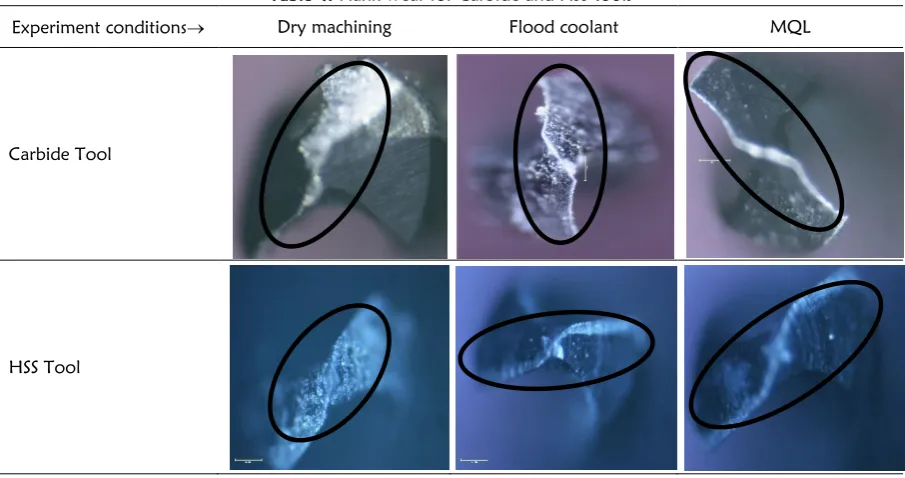
The results of the experiments were compared for the tool wears occurred during dry machining, presence of flood coolant and with MQL for every tool bit. The observations of tool wear is done using Nikon Measuring Microscope. Total area of wear is measured and compared for each condition. Mainly crater wear and flank wear were observed on the tool with presence of adhesion and burr in some cases. Crater wear usually results from the high temperature at the contact zone, or it exceeds the level of resistivity of the cutting materials. It is formed as a concave section on the tool face formed by the sliding action of chips on the surface while flank wear mainly occurs due to high cutting speed, low percentage of oil in fluid flow and insufficient cutting fluid. It occurs on the tool flank as a result of friction between the machined surface of the work piece and the tool flank.
Table 3: Crater wear for Carbide and HSS tools
Experiment conditions Dry machining Flood coolant MQL
Carbide Tool
HSS Tool
Table 4: Flank wear for Carbide and HSS tools
Experiment conditions Dry machining Flood coolant MQL
Carbide Tool
HSS Tool
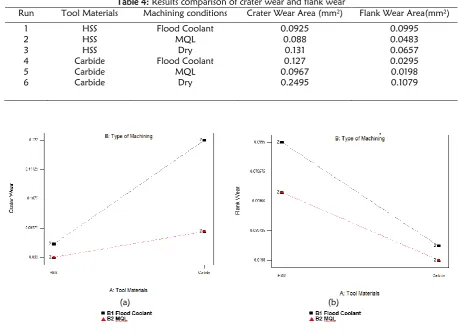
The flute of high speed steel and carbide tool bits were also compared as seen in Error! Reference source not found.. The HSS tool had more obvious tool wear, compared to carbide. This may be attributed to carbide’s inherent higher hardness and toughness which enabled the carbide tool to maintain high hardness at elevated temperature, and therefore, absorbing more energy before fracture. Error! Reference source not found. summarizes the overall wear propagation area considering crater and flank wear. As it can be seen from the table that the propagation of wear over the tool surface was minimum with applying MQL for both the tools. The effect of MQL was more dominant for HSS tool for flank wear and for crater wear, MQL provided better machining condition for the carbide tool.
Adhesion
Deform
Plastic
Adhesion
compared to HSS tool. In terms of lubrication method, still MQL is proven to be the one to provide better tool quality irrespective of tool material used.
Table 5: Flute condition for Carbide and HSS tools
Experiment conditions Dry machining Flood coolant MQL
Carbide Tool
HSS Tool
Table 4: Results comparison of crater wear and flank wear
Run Tool Materials Machining conditions Crater Wear Area (mm2) Flank Wear Area(mm2)
1 HSS Flood Coolant 0.0925 0.0995
2 HSS MQL 0.088 0.0483
3 HSS Dry 0.131 0.0657
4 Carbide Flood Coolant 0.127 0.0295
5 Carbide MQL 0.0967 0.0198
6 Carbide Dry 0.2495 0.1079
Figure 3: Interaction graph between experiment conditions and tool materials on the tool wear [X= A: Tool Material, Y=B: Type of Coolant
4 CONCLUSIONS
An experimental study was conducted to observe the tool condition using three different method of lubrication: Dry, Flood and MQL for drilling miniature holes in Aluminium 6061 alloy. Two different material drill bits (HSS and Carbide) with same geometric parameters have been used. It has been observed after machining that MQL provided better tool condition in terms of flank wear, crater wear and flute condition. The wear propagation was minimal when using MQL method. It is evident from the results that MQL mist had better cooling effect as it could enter the cavity between the drill bit and drilled hole easily due to lower surface tension during machining compared to flood coolant. However, the tools behaved differently for different types of wear. The findings can be summarized as:
MQL is suitable for different type of tool material for miniature drilling.
The tool wear propagation is minimum when using MQL compared to dry and flood coolant condition. Different material tool behaved differently in terms of crater and flank wear; HSS was found to be strong when
crater wear was investigated while Carbide tool had least flank wear under MQL and flood condition.
ACKNOWLEDGEMENTS
The Authors are grateful to the Kulliyyah of Engineering, International Islamic University Malaysia for necessary technical and financial support for the work.
REFERENCES
1. Groover, M. P. (2013). Fundamentals of Modern Manufacturing.
2. Standards (2011) committee tools and clamping devices (FWS) working committee, DIN 69090-1 MQL Maching Technology - Part 1. Terms and Definitions.
3. Walker, T. (2013). The Handbook: A guide to machining with minimum quantity lubrication, V 1.0.3. Unist, Inc. 4. Hadad, M. J., Tawakoli, T., Sadeghi, M. H., & Sadeghi, B. (2012). Temperature and energy partition in minimum quantity lubrication-MQL grinding process. International Journal of Machine Tools and Manufacture, 54-55, 10-17.
5. Da Silva, L. R., Bianchi, E. C., Fusse, R. Y., Catai, R. E., Franca,T. V., & Aguiar, P. R. (2007). Analysis of surface integrity for minimum quantity lubricant-MQL in grinding. International Journal of Machine Tools and Manufacture, 47(2), 412-418.
6. Rahman, M., Senthil Kumar, A., & Salam, M. U. (2002). Experimental evaluation on the effect of minimal quantities of lubricant in milling. International Journal of Machine Tools and Manufacture, 42(5), 539-547. 7. Iqbal, A., Al-Ghamdi, K. A., & Hussain, G. (2016). Effects of tool life criterion on sustainability of milling. Journal
of Cleaner Production, 139, 1105-117.
8. Attanasio, A., Gelfi, M., Giardini, C., & Remino, C. (2006). Minimal quantity lubrication in turning: Effect on tool wear. Wear, 260(3), 333-338.
9. Hadad, M. & Sadeghi, B. (2013). Minimum quantity lubrication-MQL turning of AISI 4140 steel alloy. Journal of Cleaner Production, 54, 332-343.
10. Smith, G. T. (2008). Cutting tool technology: industrial handbook. Springer.
11. Bhowmick, S., Lukitsch, M. J., & Alpas, A. T. (2010). Dry and minimum quantity lubrication drilling of cast magnesium alloy (AM60). International Journal of Machine Tools and Manufacture, 50(5), 444-457.
12. Ahsan, N. M. M., Kibria, G. M., Ahmed, R. M., Islam, A. M., & Hossain, M. M. (2010). Performance evaluation of minimum quantity lubrication (MQL) in drilling operation,” in International Conference on Mechanical, Industrial and Energy Engineering, 1–5.