© Universiti Tun Hussein Onn Malaysia Publisher’s Office
IJIE
Journal homepage: http://penerbit.uthm.edu.my/ojs/index.php/ijie
The International
Journal of
Integrated
Engineering
Data Association Analysis in Simultaneous Localization
a
nd
Mapping Problem
Hamzah Ahmad
1*, Nur Aqilah Othman
1, Mohd Mawardi Saari
1,
Mohd Syakirin Ramli
1, Bakiss Hiyana Abu Bakar
21Faculty of Electrical & Electronics Engineering, Universiti Malaysia Pahang, 26600 Pekan, Pahang, Malaysia
2Politeknik Sultan Ahmad Shah, Semambu, 25350 Kuantan, Pahang, Malaysia
*Corresponding Author
DOI: https://doi.org/10.30880/ijie.2019.11.04.012
Received 25 April 2019; Accepted 31 July 2019; Available online 5 September 2019
1. Introduction
Mobile robotics has gain a lot of attentions nowadays. Its applications have been extensively used for various areas such as military, manufacturing, medical institutions, explorations and even in the household applications. Lawn mower and the vacuum cleaner robot are among those types of mobile robot which commercially available to substitute human in performing works. These mobile robot are mostly designed to be autonomous and can perform their tasks effectively.
In bringing or realizing an autonomous mobile robot, navigation is one of the essential research fields for researcher. Since a number of decades, the research has been focusing on the design of mobile robot which can works in a designated area by considering the uncertainties, and dynamic environment. One of the problem is known as the Simultaneous Localization and Mapping(SLAM)[1-3] which defines a state where a mobile robot must identify its location and its surroundings conditions concurrently. Based on the mobile robot observations, then a map is created to provide information of what the mobile robot believe to be available. There are three methods normally applied to solve the problem either by using mathematical modeling, behavioral based inference or the probabilistics approach. Among those three techniques, probabilitics is the mostly recognized methods as it has fewer computational cost compared to the mathematical model as well as requires fewer information to be available than the behavioral based technique. Extended Kalman Filter(EKF)[4-6], H∞ Filters[7-9], and FAST-SLAM[10-12] are among the celebrated techniques in
the probabilistics and has successfully implemented in several types of applications purposes.
In this paper, EKF and H∞ Filters are analyzed regarding its capability in estimating the mobile robot and
Abstract: This paper examines the data association issues in Simultaneous Localization and Mapping Problem on two different techniques. Data association determines the system efficiency and there are limited numbers of papers attempts to analyze the conditions. Two filters namely the Extended Kalman Filter (EKF) and H∞ Filters are considered in this paper to improved the estimation results of both mobile robot and the environment locations. The updated state covariance is modified to obtain better performance compared to its original state. The simulation results have shown consistency and lower percentage of errors for the proposed technique. However, there are certain cases that showing the updated state covariance becomes unstable and yields erroneous results especially for EKF. Hence, further works are expected to be carried for this matter.
estimation. State covariance mainly describes the system uncertainties that mobile robot posses during observations. If the mobile robot has a big value of state covariance, this encompasses that the system has lower accuracy and efficiency. Looking on this perspective, fortunately EKF has been proven to converge to its initial state covariance conditions[13-14], hence it is expected that the results cannot perform better. Differs to EKF, H∞ Filters has very low
uncertainties which near to zero[15]. However, the system suffers from finite escape time problem. This situation probably makes the estimation has zero uncertainties in mathematical analysis as the state covariance value can instantaneously increased to infinity from zero and then goes to negative definite value during estimation processes. Such conditions has make H∞ Filters sometimes incompetence when compared to its family, the EKF. Thus, some
papers attempts to overcome the problem by presenting a modified version of H∞ Filter. One way of doing that is by
modifying the γ or the state covariance[16]. The state covariance indirectly determines the effectiveness of data association that demonstrates how good and consistent the estimation performance.
Data association determines the efficiency of mobile robot navigation especially in Simultaneous Localization and Mapping problem. It defines how the measurement data is correlated to the actual information in a specific environment. The problem exist in any kind of approach which includes the Extended Kalman Filter, Unscented Kalman Filterand FastSLAMtechniques. Theoretically false data association due to existence of multiple targets, uncertainties or system ambiguities will leads to erroneous estimation[11]. This data association is strongly related to the state covariance in those technique and requires heavy analysis about its behavior during mobile robot estimation. EKF for example is very optimistics and sometimes can yields erroneous results.
It is the objective of this paper to analyze the EKF and H∞ Filter performance considering its data association issue from the state covariance behavior(16-20). Both techniques are modified about its updated state covariance to understand how the estimations behaves. A number of papers have been recognized this issue but none of them relates the analysis to the state covariance behavior. Two distinctive noise types; gaussian and non-gaussian noises are taken into account for analysis purposes.
This paper is organized as follow. Section 2 describes the methodology of the proposed system for both EKF and H∞ Filter with reference to the original techniques. Next followed by section 3 which demonstrates the results and discussion by having the modified version of those two techniques. Finally section 4 concludes the paper.
2.0 Methodology
In SLAM, there are two main references to be executed for estimation purposes. The first process to be carried out is the process model. It is a stage where the mobile robot kinematics are modeled to recognized the mobile robot movements based on its velocity and angular accelerations. The model is best described by the following equation.
(1) where contains the augmented state at time k which defines the mobile robot heading angle and its associated x,y positions with specific landmarks x,y locations. F and B described the transition matrix and control matrix respectively.
U is the control input of mobile robot velocity and angular velocity, while is the process noise of the mobile robot at previous moving time. The measurement process on the other hand explains the measured relative distance between mobile robot and any available landmarks or features. The equation is shown as
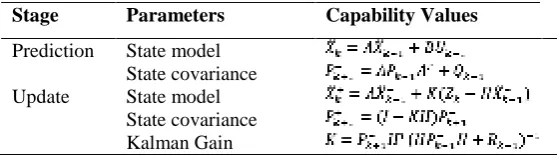
(2) is the measurement matrix providing information about relative distance and relative angle between mobile robot to any landmarks. H is the measurement matrix and ν is the measurement noise exist on the measurement caused by sensors or anything which can affects the mobile robot. Table 1 present the EKF algorithm which consists of the prediction and updated states. These equations will be computed in sequence and iterates every time as long as the mobile robot observes the environment.
Table 1 EKF algorithm
Stage Parameters Capability Values
Prediction State model State covariance Update State model
Table 2 EKF and H∞ Filter algorithms
Type Gain Updated state covariance
EKF � =�(�+���−1��)−1 � = F� (� + ���−1� � )−1f� + �
H∞ Filter � =�(�−�−2 ���−1��)−1 � =F � (�−�−2� +���−1� � )−1f� +�
Based on the above Table 1, is the estimated augmented state and is the state covariance. The superscript contains the sign of “+”, “-“ defines the priori and posteriori estimation at time k. In EKF, Kalman Gain plays important role to improve the estimation by using the innovation covariance which are included in the updated state covariance step. Remarks that, F, B, H are the linearized state matrices. The process noise and measurement noise covariances are presented by Q and R which are uncorrelated at all time during mobile robot observations.
Table 2 differentiate between EKF and H∞ Filter algorithm mainly on the updated state covariance and its gain. These
two techniques are selected and will be analyzed to investigate any significant improvements about estimation by modifying the updated state covariances. Besides, it is expected that by doing this comparison, the effect of γ can be viewed indirectly to evaluate the H∞ Filter performance about the state covariance.
Our main interest is on the state covariance. The state covariance is a positive semidefinite matrix which encompasses the information that the mobile robot has during its movements. Bigger value of state covariance describes that the system has large uncertainties and this is not desired as the estimation will eventually leads to erroneous results. As mentioned in previous section, EKF can finally yields confidence bounded by its initial conditions[13-14]. Though this has been proven to be sufficient and effective for estimation, a slight modification is made on the EKF updated state covariance which its equation was shown in Table 1. The updated state covariance is first calculated as presented on the equation and then being inversed to check the estimation consistency.
The H∞ Filter state covariance is also modified to assess its ability for estimation purposes compared to the original equations. A switching strategy[21][22] is selected to ensure that no finite escape time issue observed during estimation process. The difference of this approach to the available switching strategy is they are more on applying other technique[21] and switched information from other mobile robot[22] when finite escape time occurred. This paper attempts to switch and modify the updated state covariance to produce a positive semidefinite matrix at all time. At the updated state covariance, regardless of the value of , the state covariance is guarantee to produce a positive semidefinite matrix.
Based on above two modifications, simulation is carried to perceive and evaluate the performance of the modified version of EKF and the adaptive type of H∞ Filter.
3.0 Results And Discussion
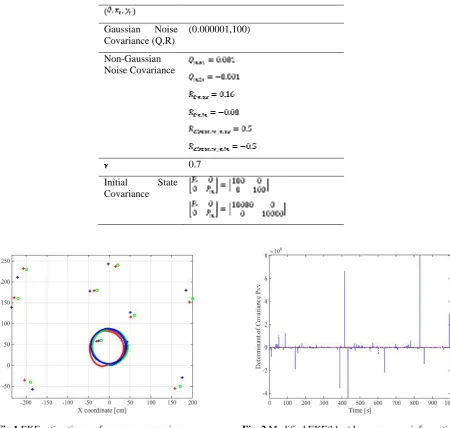
This section presents the simulation results based on the above proposed condition for both methods; EKF and the H∞ Filter. The simulation is done in MATLAB2014 Simulink with references to the parameters being used in our previous experimental works. Table 4 shows the simulation parameters that will be applied to identify and analyze both filter performance in two different noises conditions which are gaussian and non-gaussian noises. The simulation also currently considers indoor environment with specific number of landmarks or features available.
For the first result, the analysis are organized considering a mobile robot in an environment with gaussian noise. The first techniques that will be observed is the EKF estimations. Remark that the first modification is by making the state covariance becomes smaller than its original states. The results for estimation are shown in Figs.1-2 for both estimation and state covariance update.
As presented in Fig.1, as expected the modified EKF has better results than the normal EKF. The comparison of movements and measurements are based on the green color for the ground truth movements.
Table 4 Simulaiton parameters
Variables Parameters
( )
Gaussian Noise Covariance (Q,R)
(0.000001,100)
Non-Gaussian Noise Covariance
0.7 Initial State Covariance
Fig.1 EKF estimation performance comparison. Modified EKF(blue) shows slightly better results than
normal EKF(red).
Fig. 2 Modified EKF(blue) has erroneous information compared to the normal EKF(red)
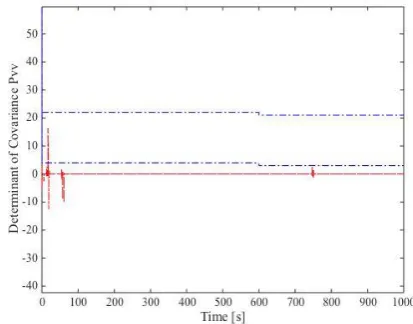
Fig. 3 Modified EKF(blue) has better estimation results compared to the normal EKF(red)
Fig. 4 Modified EKF(blue) has erroneous information compared to the normal EKF(red)
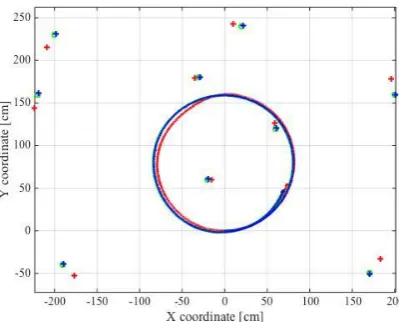
Now, the analysis moves to the condition of non-gaussian noise. The estimation results are presented in Figs.3-4 for both estimation and state covariance respectively. The results are consistence and agreed to the first case of non-gaussian noise where modified EKF performs better in terms of estimation but poor in state covariance analysis. Next, the H∞ Filter performance will be evaluated. The performance of H∞ Filter in non-gaussian noise is more
interesting to be viewed as the filter is said to be robust than EKF. Based on Figs.5-6, for the mobile robot and landmarks estimation, modified H∞ Filter surpassed the normal H∞ Filter performance. The state covariance is also
better than normal H∞ Filter which do not possess any finite escape time problem. This switching strategy is one of the alternative solution for estimation but seldomly used for applications.
For further analysis, both modified EKF and H∞ Filter is compared about its estimations. Figs.7-8 demonstrates the
results. From these figures, it can be concluded that H∞ Filter is more robust and can be a good solution for non-gaussian noise conditions. To be fair, modified H∞ Filter is also being compared to normal EKF in Fig.9. The results
are still consistent and proving that modified H∞ Filter can be a better alternatives for SLAM solutions.
Fig. 5 Modified H∞ Filter (blue) has better estimation results compared to the normal H∞ Filter (red)
Fig. 7 Modified H∞ Filter (blue) has better estimation
results compared to the modifed EKF (red)
Fig. 8 Modified H∞ Filter (blue) has better confidence
compared to the modified EKF (red)
Fig. 8 Modified H∞ Filter (blue) has better estimation results compared to the normal EKF (red)
4.0 Conclusion
This paper has presented an analysis of data association issues in SLAM problem focusing on two techniques, EKF and H∞ Filter. For EKF, the state covariance is reduced by randomly makes the values smaller than its original algorithm.
This action has consequently makes the state covariance becomes erroneous even though good estimation results can be obtained. For H∞ Filter, the modified version by using switching strategy has better results than the normal H∞ Filter.
Both estimation and state covariance preserves good results and positive semidefinite matrix without any occurrence of finite escape time. From these two cases, it is understood that the state covariance cannot be modified easily without refering to the information obtained during mobile robot observations in the environment.
Acknowledgement
References
[1] Durrant-Whyte, H., Bailey, T. 2006, Simultaneous Localization and Mapping: part I, IEEE Ro-botics & Automation Magazine, 13(2), 99–110.
[2] Bailey, T., Durrant-Whyte, H, 2006, Simultaneous Localization and Mapping(SLAM): Part II, IEEE Robotics & Automation Magazine, 13(3), 108–117
[3] C.Smith, R., Cheeseman, P. 1987, On The Representation and Estimation of Spatial Uncertain-ty, Journal of Robotic Research, 5(4), 56-68
[4] Eric B. Quist, Peter C. Niedfeldt, Randal W. Beard, 2016, Radar odometry with recursive-RANSAC, IEEE Transactions on Aerospace and Electronic Systems, 52(4), 1618-1630.
DOI: 10.1109/TAES.2016.140829
[5] Aleksandr A. Konolov, 2016, Target Tracking Algorithm for Passive Coherent Location, IET Radar, Sonar & Navigation, 10(7), 1228-1233.
DOI: 10.1049/iet-rsn.2015.0482
[6] Jinwoo, C., Yeongjun, L., Taejin, K., Jongdae, J., Hyun-Taek, K., 2016, EKF SLAM using acoustic sources for autonomous underwater vehicle equipped with two hydrophones, OCEANS 2016, 1-4.
DOI: 10.1109/OCEANS.2016.7761439
[7] Nan-Hu, Chendong W, Tong, J, Peng, J, 2015, Hybrid filter localization algorithm based on the selection mechanism, The 27th Chinese Control and Decision Conference (2015 CCDC), 1128-1131.
DOI: 10.1109/CCDC.2015.7162086
[8] Mária Š, Dušan K, Juraj K, 2016, Target tracking algorithms for UWB radar network, 2016 26th International Conference Radioelektronika (RADIOELEKTRONIKA), 319-324.
DOI: 10.1109/RADIOELEK.2016.7477358
[9] Joan, S. 2010, Consistency of the monocular EKF-SLAM algorithm for three different landmark parametrizations, 2010 IEEE International Conference on Robotics and Automation, 3513-3518.
DOI: 10.1109/ROBOT.2010.5509518
[10] J.Nieto, J.Guivant, E.Nebot, S.Thrun, 2003, Real Time Data Association for FastSLAM”, 2003 IEEE International Conference on Robotics and Automation, (2003) 1, 412-418.
[11] Y.Tian, A.Dehghan, M.Shah, 2018, “On Detection, Data Association and Segmentation for Multi-Target Tracking”, IEEE Transaction on Pattern Analysis and Machine Intelligence, (2018), Early Access, 1-14.
[12] Thallas, A., Tsardoulias, E., Petrou, L., 2016, Particle Filter-Scan Matching SLAM Recovery Under Kinematic Model Failures, 24th Mediterranean Conference on Control and Automa-tion, pp. 232-237
[13] Huang, S., Dissayanake, G, 2007, Convergence and Consistency Analysis for Extended Kalman Filter based SLAM, IEEE Transaction on Robotics, 23(5), 1036-1049
[14] Dissayanake, G. Newman, P., Clark, S., Durrant-Whyte, H., Csorba, M, 2001, A Solution to the Simultaneous Localization and Map Building(SLAM), IEEE Transaction on Robotics and Automation, 17(3), 229-241.
[15] 18. Ahmad, H., Namerikawa, 2010, T.: "Feasibility study of partial observability in H∞ filtering for robot localization and mapping problem", American Control Conference (ACC) 2010, 3980-3985
[16] Charkhgard, M., Haddad Zarif, M. 2015, Design of Adaptive H∞ Filter for Implementing on State-of-Charge Estimation based on Battery State-of-Charge varying Modelling, IET Power Electronics, 8(10), 1825-1833 [17] Zhao, F., Zhang, Q., Zhang, Y. 2015, H∞ Filtering for a Class of Singular Biological Systems, IET Control
Theory and Applications, 9(13), 2047-2055.
[18] Nazamzade, P., Fontanelli, D., Macii, D., Palopoli, L. 2017, Indoor Localization of Mobile Ro-bots Through QR Code Detection and Dead Reckoning Data Fusion, IEEE/ASME Trans-action on Mechatronics, 22(6), 2588-2599 [19] Bolzern, P., Colaneri, P., De Nicolao, G,, 1997, H∞ differential Riccati equations: Convergence Properties and
Finite Escape Phenomena, IEEE Transaction of Automatic Control, 42(1), 113-118
[20] P. Bolzern, M. Maroni, 1999, New conditions for the convergence of H/sub /spl infin// filters and predictors", IEEE Transaction on Automatic Control, 44(8), 1564-1568,
DOI : http://dx.doi.org/10.11113/jt.v79.9987
[21] S.J. Williams, W.B. Marshfield, 1991, A switched H/sub infinity / strategy for control of a submarine, International Conference on Control 1991. Control '91, pp.487-491.