Using Personalized Model to Predict Traffic Jam in
Inbound Call Center
Rafiq A. Mohammed
11Victoria University of Wellington, New Zealand
Abstract
In this paper, I describe a general approach to scaling data mining applications in a call center environment. A call center operates with customers calls directed to agents for service based on online call traffic prediction. Existing methods for call prediction exclusively implement inductive machine learning, which often gives inaccurate prediction for call center during abnormal traffic jam. This paper proposes an agent personalized call prediction method that encodes agent skill information as the prior knowledge to call prediction and distribution. The developed call broker system is tested on handling a telecom call center traffic jam happened in 2008. The results show that the proposed method predicts the occurrence of traffic jam earlier than existing depersonalized call prediction methods. The empirical results of cost-return calculation indicate that the ROI (return on investment) is enormously positive for any call center to implement such an agent personalized call broker system as a scalable solution. This paper focussed primarily on issues related to the accuracy of call predictions during abnormal events happen in a call center environment.
Keywords: data mining, predictions, scalability, personalized call broker, call center traffic jam.
Received on 16 August 2016, accepted on 06 September 2016, published on 19 January 2017
Copyright © 2017 Rafiq A. Mohammed, licensed to EAI. This is an open access article distributed under the terms of the Creative Commons Attribution licence (http://creativecommons.org/licenses/by/3.0/), which permits unlimited use, distribution and reproduction in any medium so long as the original work is properly cited.
doi: 10.4108/eai.18-1-2017.152101
1. Introduction
In today’s world call centers are operated as service centers and means of revenue generation. The key trade-off between customer service quality and efficiency of business operations faced by an operations manager in a call center is also the central tension that a human resource manager needs to manage (Aksin, Armony, & Mehrotra, 2007). By looking at the importance of providing efficiency at service quality, this paper describes forecasting approaches that can be applied to any call center. A case study research (Mohammed, 2008) is conducted on Telecom New Zealand (TNZ) call center data for the years 2007 and 2008 during the period of normal and abnormal (i.e. traffic jam) call distributions. This paper proposes a personalized call prediction method considering the importance of agent skill information for call center staff scheduling and management. Applying the proposed method, two call broker models: (1) personalized agent software broker, and (2) supervisor involved personalized software broker are further developed during the research
to construct a call center IT solution for small size companies, and as well for large companies such as Telecom New Zealand.
2. Statement of the problem
The existing methods for call predictions implement inductive systems and are based on global models and thus cannot generate consistently good prediction accuracy, especially when traffic jam is confronted and/or if there is an abnormal increase of call volume which in turn makes calls to be abandoned affecting the service levels in the call center.
capacity more efficiently, even when faced with highly fluctuating demand.
According to Shu-guang et al., (2007)
telecommunication call center often use the queuing model like Erlang A & Erlang C for the operations of optimization. However, Erlang C model might not be a right approach for forecasting calls and agent prediction during the period of traffic jams as evidenced with the high call abandonments at TNZ call center. Furthermore, researchers Zeltyn & Mandelbaum (2006) advise that Erlang C exclude abandonments during call predictions. With predictive modeling such as decision-tree or neural network based techniques, it is possible to predict customer behavior. Furthermore, the analysis of customer behavior with data mining aims to improve customer satisfaction [8]. Looking at the works of researcher Shu-guang et al. (2007) use of OLAP (On-Line Analytical Processing) and data mining manage to mine service quality metrics such as Average Speed of Answer (ASA), recall, Interactive Voice Response (IVR) system optimization to improve the service quality. However, if we include agent database within the DWH it is possible to monitor and evaluate the performance of agents to improve call quality and customer service satisfaction.
Forecasting call arrivals is based on time series prediction, which implies to ascertain the predicted calls at any single point of time. Calls arrive at non-homogeneous interval of time measured by Poisson process. Hence, prediction of future arrival rates will be a crucial step for staffing decisions and will draw attention for complicated statistical task to the management [12]. The researchers Robbins et al., (2006) claim that only a limited amount of research has been carried out so far to investigate the cause-effect relationship with the uncertainty of call arrivals. The uncertainty with calls subsequently results in a highly variable demand of resources generally expressed in terms of call forecasts. These are typically comprised of varied call arrival distributions and service time distribution. This in turn requires forecasting and queuing models to play an important role in modeling resource deployment decision [1].
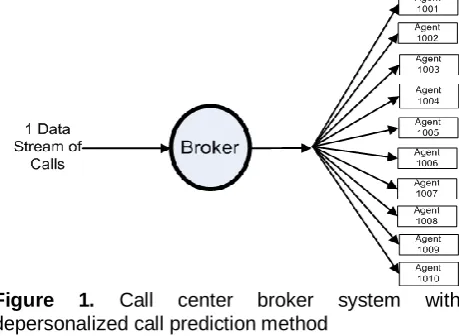
Figure 1. Call center broker system with
depersonalized call prediction method
2.1. Existing Call Prediction Methods
In literature, several inductive machine learning methods has been investigated and used for call volume prediction of call center. This includes, (1) DENFIS (Dynamic Evolving Neural-Fuzzy Inference System), a method of fuzzy interface systems for online and/or offline adaptive learning [5]. DENFIS adapts new features from the dynamic change of data, thus is capable of predicting the dynamic time series prediction efficiently; (2) MLR (Multiple Linear regressions), a statistical multivariate least squares regression method. This method takes a dataset with one output but multiple input variables, seeking a formula that approximates the data samples that can be in linear regression. The obtained regression formula is used as a prediction model for any new input vectors; (3) MLP (Multilayer Perceptron’s), a standard neural network model for learning from data as a non-linear function that discriminates (or approximates) data according to output labels (values). Additionally, it is worth noting that the experience-based prediction is popularly used for call prediction. Such methods use an estimator drawn from past experience and expectations to forecast future call traffic parameters. Fig. 1 illustrates the scenario of de-personalized broker, where the stream of calls is allocated by an automatic call distributor (broker) to the available agents irrespective of the skills of the agents. In other words, call is equally distributed to agents, regardless of the skill differences amongst agents. In practice, such de-personalized model could be suitable for a call center of 5-6 agents. However for a call center greater
than 50 agents, such depersonalized call
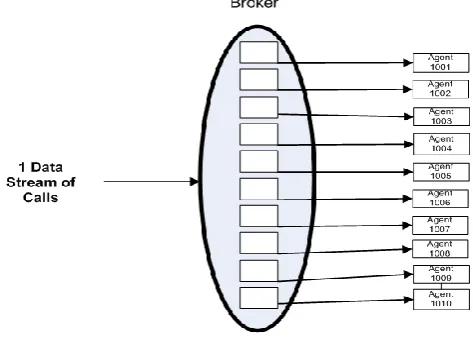
prediction/distribution actually deducts the efficiency of business operations, as well as the customer service quality of the call center. In the scenario of handling large number of agents, an alternative approach is to introduce an agent personalized call prediction method (as shown in Fig.2) at the automatic call distributor (broker) software system.
Figure 2. Call center call processing with
3. Proposed Call Prediction Method
The idea of personalized call broker is depicted in Fig. 3. with this agent personalized call prediction, the broker system works virtually as having a number of brokers personalized to each agent, rather than a single generalist broker for all the agents. This makes the problem simpler to predict the appropriate calls to the each individual agent of the whole agent team [7]. Implementing such system at ACD is expected to improve the functionality of broker and will bring us real time approaches to automatic call distribution. This idea is supported by Shyam et al., (2015) who suggests that the personalized decision-path models contain features specific to the current person; and this can lead to better call prediction.
Figure 3. Agent personalized call center broker
system
3.1. Agent Personalized Prediction
Assume that a call center has total m agents, traditional
broker system maintains as in Fig. 1 one general call volume prediction, and distribute calls equally to m agents.
Obviously, this is not an efficient approach as the skill of each agent is different from one another.
Given a data stream D = {y(i), y(i + 1), . . . , y(i + t)},
representing a certain period of historical call volume confronted by the call center, depersonalized call prediction can be formulated as,
y(𝑖 + 𝑡 + 1) = 𝑓(𝑦(𝑖), y(𝑖 + 1), … , y(𝑖 + 𝑡)) (1)
Where y(i) represents the number of calls at a certain time
point i, f is the base prediction function, which could be a
Multivariate Linear Regressions (MLR), Neural Network, or any other type of prediction method described above. Introducing the skill grade of each agent S = {s1, s2, . . . , sm} as the prior knowledge to the predictor, I have the call
volume decomposed into m data streams accordingly.
Then, the number of call on each agent is calculated as, 𝑧(𝑗)(𝑡) = 𝑦(𝑡)𝑠𝑗
∑𝑖=1𝑆𝑖, j ∈ [1; 𝑚]. (2)
Partitioning data stream D by (2) and applying (1) to each
individual data stream obtained from (2), we have, 𝑧(1)(𝑖 + 𝑡 + 1) = 𝑓(1)(𝑧(1)(𝑖), 𝑧(1)(𝑖 + 1), … , 𝑧(1)(𝑖
+ 𝑡))
𝑧(2)(𝑖 + 𝑡 + 1) = 𝑓(2)(𝑧(2)(𝑖), 𝑧(2)(𝑖 + 1), … , 𝑧(2)(𝑖
+ 𝑡))
… … …
𝑧(𝑚)(𝑖 + 𝑡 + 1) = 𝑓(𝑚)(𝑧(𝑚)(𝑖), 𝑧(𝑚)(𝑖 +
1), … , 𝑧(𝑚)(𝑖 + 𝑡)). (3)
Since 𝑦(𝑡 + 1) = ∑𝑚𝑗=1𝑧(𝑗)(𝑡 + 1), a personalized prediction model for call traffic prediction can be formulated as,
𝑦(𝑖 + 𝑡 + 1) = 𝛺(𝑓(1), 𝑓(2), … , 𝑓(𝑚), 𝑆)
=𝑚1∑𝑚 𝑧(𝑗)(𝑖 + 𝑡 + 1)
𝑗=1 (4)
Where Ω is the personalized prediction model based on the
prior knowledge from agent skill information.
4. Experimental Results and Evaluation
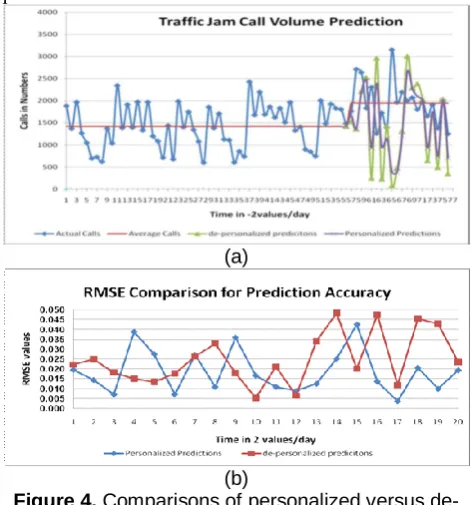
In order to build, validate and calibrate the personalized prediction model I have developed an experimental design. The datasets were originated from a New Zealand telecommunication industry call center. The call data consists of detailed call-by-call histories obtained from the faults resolve department. The call data to the system arrives regularly at 15 minutes intervals and for the entire day. The queues are busy mostly between the operating hours of 7 AM and 11 PM. In order to bring a legitimate comparison, data from 07:00 to 23:00 hours will be considered for data analysis and practical investigation. For traffic jam call prediction, the dataset consists of 40 days of call volume data between dates of 22/01/2008 till 01/03/2008. The first 30 days have a normal distribution and the last 10 days depict a traffic jam. A sliding window approach is implemented to predict the next day’s call volume, whereby for each subsequent day of prediction the window will be moved one day ahead. This time series modelling approach will predict the call volume for 10 days of traffic jam period. This idea of pseudoperiodic time series is supported by Jiangang et al., (2016) which refers to a time-indexed data stream in which the data present a repetitive pattern within a certain time interval. To exhibit the advantages of my method, I used a standard MLR as the base prediction function, and evaluate prediction performance by both call volume in terms of the number of calls, and the root mean squared error (RMSE).
Table 1. Call volume in terms of the number of calls, and the root mean squared error (RMSE) Methods Tr
(days) Tp
(days) S
t (days)
Cost Saving (%)
De-personalized
3.60 8.60 1.40 (52,700-38,419)/ 52,700=27% Personalized 3.48 8.487 1.52 (52,700-45,308)/
52,700=14%
a superior call volume prediction accuracy and lower RMSE than the typical prediction method. Assuming that the 10 days traffic jam follows generally a Gaussian distribution, then the traffic jam reaches its peak on the 5th day, which is the midpoint of the traffic jam period. Consider 5 days as the constant parameter, I calculated the predicted traffic jam period as Tp = Ts+Tr. Here, Ts is the starting point of traffic jam, which is normally determined by, if current 5-day average traffic volume is greater than the threshold of traffic jam average daily call volume. Tr is the time to release the traffic jam calculated by (A−N/P), where A is actual calls during the traffic jam period; N is calls for the period in the case of normal traffic; and P is average daily predicted calls by each method during traffic jam period. The time saving due to call prediction St is calculated by subtracting the total time of prediction from traffic jam period, which is 10 − Tp.
Table 1 presents the traffic jam release time and time savings due to call prediction. It is evident that personalized call predictions save us 1.52 days, which is better than the 1.40 days from typical de-personalized call predictions.
(a)
(b)
Figure 4. Comparisons of personalized versus
de-personalized methods for traffic jam period call prediction, (a) call volume predictions and (b) root
mean square error (RMSE)
4.1. Cost & Benefit Evaluation
According to Gans et al., (2003) the operating cost in a call center includes, agent’s salaries, network cost, and management cost, where agent’s salaries typically account for 60% to 70 % of the total operating costs. Considering an additional cost of $52,700 for the 10 days traffic jam, introducing traffic jam problem solving, the de-personalized call prediction release the traffic jam in 8.60 days with a total cost of $45,308. This is in contrast to the agent personalized prediction that releases the same traffic jam in 8.48 days with a total cost of $38,419 and a saving
of 27%. Table. 1 records the traffic jam cost saving due to call prediction by different methods.
On the other hand, while computing the cost of single supervisor, it will incur an additional cost of $1151 for a 10-day period to hire a new supervisor to manage the call center. According to Hillmer et al., (2004) the cost of hiring additional supervisor amounts to $42,000 per year to manage a call center. Thus from the cost and return calculation, it is beneficial for any call center to implement personalized call broker model, as there is a minimum net saving of $20,666 as return on investment.
5. Conclusion Remarks
This paper develops a new call broker model that implements an agent personalized call prediction approach towards enhancing the call distribution capability of existing call broker. In my traffic jam problem investigation, the proposed personalized call broker model is demonstrated as a scalable solution capable of releasing traffic jam earlier than the existing depersonalized system. Addressing telecommunication industry call center management, the presented research brings the awareness of call center traffic jam, appealing for change in call prediction models to foresee and avoid future call center traffic jams.
References
[1] Aksin, Z., Armony, M., & Mehrotra, V. (2007). The Modern Call-Center: A Multi-Disciplinary Perspective on Operations Management Research. preprint.
[2] Gans, N., Koole, G., Mandelbaum, A.: Telephone call centers: Tutorial, review, and research prospects. Manufacturing and Service Operations Management 5(2),79–141 (2003)
[3] Hillmer, S., Hillmer, B., McRoberts, G.: The Real Costs of Turnover: Lessons from a Call Center. Human Resource Planning 27(3), 34–42 (2004)
[4] Jiangang, M., Le, S., Hua, W.,Yanchun, Z.: Supervised Anomaly Detection in Uncertain Pseudoperiodic Data Streams. ACM Transactions on Internet Technology (TOIT) 16(1), Article No. 4 (2016)
[5] Kasabov, N.K., Song, Q.: DENFIS: dynamic evolving neural-fuzzy inference system and its application for time- series prediction. IEEE Transactions on Fuzzy Systems 10(2), 144–154 (2002)
[6] Mohammed, R. (2008). Personalized call center traffic prediction to enhance management solution with reference to call traffic jam mitigation - a case study on Telecom New Zealand Ltd. (Masters Dissertation, Auckland University of Technology, Auckland, New Zealand). Retrieved from http://aut.researchgateway.ac.nz/handle/10292/479 [7] Pang, S., Ban, T., Kadobayashi, Y., Kasabov, N.:
Tansductive Mode Personalized Support Vector Machine Classification Tree. Information Science 181(11), 2071– 2085 (2010)
[9] Robbins, T. R., Medeiros, D. J., & Dum, P. (2006). Evaluating arrival rate uncertainty in call centers. Proceedings of the 37th conference on Winter simulation, 2180-2187.
[10] Shu-guang, H., Li, L., Er-shi, Q.: Study on the Continuous Quality Improvement of Telecommunication Call Centers Based on Data Mining. In: Proc. of International Conference on Service Systems and Service Management, pp. 1–5 (2007).
[11] Visweswaran S, Ferreira A, Ribeiro GA, Oliveira AC, Cooper GF (2015) Personalized Modeling for Prediction with Decision-Path Models. PLoS ONE 10(6): e0131022. doi:10.1371/journal.pone.0131022