Abstract
This paper intends to study the costs associated with harm reduction. Harm reduction is a way of dealing with behavior that damages the health of the persons involved and their community. Many individuals acquire these damaging behaviours (for example, smoking, drinking too much alcohol, practicing un-safe sex and drug abuse) are well aware of the adverse consequential effects on their health. Needle Syringe Exchange Programme (NSEP) is one such harm reduction programme recommended by the WHO (World Health Organization) to the Ministry of Health in Malaysia in 2005 and has produced encouraging results. Using the concept of Total Quality Management (TQM), the researchers identified and classified the costs involved in the harm reduction programme. The main principle of TQM with its emphasis on the cost of prevention is highly relevant in harm reduction programmes, which is similar to its emphasis on ‘prevention is better than cure’. Hence, this management accounting model which the researchers termed the 4Cs (currently in the process of being trademarked) is highly relevant and applicable in any harm reduction programme.
Keywords: Total Quality Management,4Cs harm reduction, NSEP
the 4CS in harMreduCtion
PrograMMeS: a CaSe of needle
Syringe exChange PrograMMe
uSing total Quality ManageMent
Sharifah Fadzlon Abdul Hamid Normah Omar
Suzana Sulaiman Wee Shu Hui Norhazeera Mohd Zan Nur Shahida Ab Fatah
Accounting Research Institute and Faculty of Accountancy Universiti Teknologi MARA, Malaysia
Rusli Ismail
introduction
Harm reduction, in general, is a way of dealing with behavior that damages the health of the person involved and his or her community. Many individuals acquire these damaging behaviours despite being aware of the adverse effects on their health. These would include smoking, drinking too much alcohol, practicing un-safe sex and drug abuse. The International Harm Reduction Association (IHRA) defined harm reduction as practices that aim primarily to reduce the adverse health, social and economic consequences of the use of legal and illegal psychoactive drugs without necessarily reducing drug consumption.
According to Michael (2005) harm reduction principles can be applied to reduce HIV- related risks of drug use or unsafe sexual activity. Don (1995) stated that there are three immediate tasks for harm reduction in the United States. First, provide adequate treatment for persons with psychoactive drug use problems, which include both legal and illegal drugs, for short and long term treatments. Second, reducing transmission of HIV associated with illicit drug use, including treatment on demand and legal access to sterile injection equipment. Third, develop new regulatory formats to distribute drugs for some non medical use.
HIV refers to Human immunodeficiency virus that can cause an individual immune system to fail and lead to life threatening infection. HIV can be transmitted through unsafe sex, contaminated needles, breast milk and transmission from an infected mother to her baby. This is the virus that causes AIDs. HIV attacks the immune system cells that are supposed to protect us from illness.
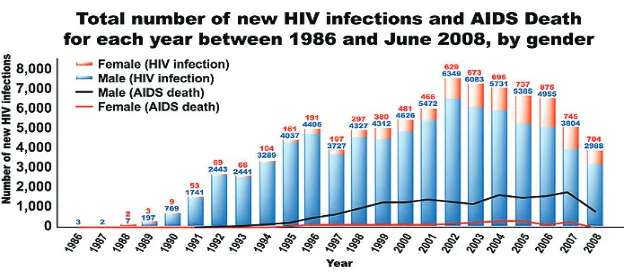
figure 1: number of new hiv/aidS and death (1986-2008)
To minimize the increasing trend of HIV infections diseases In June 2005, the Ministry of Health Malaysia approved the setting up of a pilot Needle and Syringe Exchange Programme (NSEP) for a period of 1 year. The availability and utilization of sterile injecting equipments by IDUs were found to reduce the rate of HIV infection. Drug users in Malaysia were receptive towards NSEP. They felt appreciated and the programme did not put any stigma against the IDU s ( Simmonds & Coombur, 2009). In the long run, NSEP helps to increase the IDUs self esteem and help them to abstain from using drugs ( Denga, Sringerryuange and Zhanga, 2007). The needles are provided free of charge and thus drug users do not have to spend money. Drug users do not have to steal money to purchase these needles and the criminal activities are controlled. Sinyang, A. (2004) reported that drug users in Malaysia are estimated to spend an average of between RM30 and RM50 per day or RM900 to RM1,500 per month for the drugs. When the drug users receive free needles, the risk of being detained by police is reduced since incidence of theft and pick pocket are reduced.
research objectives
SAHABAT. SAHABAT was recommended as the subject of the paper because Kelantan has the highest number of HIV cases in Malaysia. The following is extracted from the local gazette Utusan Malaysia dated 17 September 2011: “Menteri Besar Datuk Nik Abdul Aziz is disappointed with the increase in the number of HIV and AIDS patients in Kelantan, said to be the highest in the country, because it tarnishes the state’s image as the Corridor of Mecca.According to the Health Ministry, the ratio of people in Kelantan infected by HIV and AIDS was 28.8: 100,000.”
figure 2: the reduction in Percentage of hiv Cases among Male and increse Percentage among female
SAHABAT
The increasing number of HIV victims among females who are not sharing needles, is a major concern as they may transmit the virus to their fetus. The activities that SAHABAT organised include the dissemination of information about harm reduction, the distribution of needles and syringes as well as counseling. The staff that manages SAHABAT was given adequate training to perform services required by the IDUs.
Costing of nSeP intervention
Efforts had been made in the past to classify cost of harm reduction into direct costs and indirect costs ( Shiell and Law, 2001) , whereby direct costs include all expenditures incurred in detecting and treating the disease. Indirect costs, refers to the value of any production lost as a result of premature mortality, morbidity and the use of health care services. Alistar, Owens, and Brandeu (2011) classified costs of harm reduction into three main costs; annual cost of methadone substitution, additional counseling and program support costs and annual health costs. However, for HIV-infected individuals there will be an extra cost known as HIV-related health. Costs of such intervention can also be identified as (i) cost of the provider time for counseling and testing plus laboratory costs for blood testing and (ii) additional salary for AIDS coordinators associated with HIV counseling and testing plus administrative costs for travelling, materials and supplies, telephone charges associated with counseling and testing (Robin et al, 1995) In a 2006 study conducted in Ukraine, Peter Vickerman et al identified the cost of intervention as financial costs and economic costs. Financial costs represent actual expenditure on goods and services purchased and the data was gathered from the project documents, interviews and observations. Economic costs include the estimated value of goods and services for which there are no financial transactions or the price of good does not reflect the cost using it elsewhere (opportunity costs). The costs were obtained from the interviews with the coordinators of the program and from observation of the resources used.
has been emphasised by Krentz, Auld and Jill (2003).The productivity costs also consist of both financial and non-financial costs. The mortality from premature death of the victims are examples of economic productivity costs (Sendi, 2004). Some of the indirect costs that caused the economic productivity includes cost incurred relating to rehabilitation centers, jurisdiction process, potential corruption, retain and prison centers and increase in security costs.
The general perception is that management accounting is a discipline associated with profits and losses. It is high time for management accounting to be woven onto the fabrics of society even though profit maximisation is not the main issue (Wee,S.Sulaiman S F Abdul Hamid, N Omar,2011).
total Quality Management application in harm
reduction Costs-4Cs
the outlay on treatment, alternative drugs, rehabilitation, imprisonment, whereas the external consequences costs are the costs related to crimes and injuries to third parties and socieites.
h arm r eduction failure of h arm r eduction Costs
(incurred as a result of the affected disease)
tQM 4Cs a wareness Continuous a ssessment internal Consequences external Consequences Discriptions
Actual costs of creating awareness, advertising, education, etc Examining, locating and monitoring cost on patients over a period of time. The actual cost outlay on treatment, alternative drugs, rehabilitation, imprisonment, etc
The extra cost of ef
fected carers on others.
This includes influence on the family members, follow-up crimes, injuries to third parties and society
.
Examples
Posters Radio advertisement Pamphlets Screening Physical examination Training
•
Counsellin
g and testing services:
- Pretested counsellin
g session
- Session to draw blood -
A post-test counsellin
g session
- Laboratory testing • Recurrent costs on staffing • Recurrent costs on training • Financial personnel costs • Economic costs – volunteer staf
f
•
Medicare costs: - Inpatient care - Ambulatory and emergency room care - Freestanding clinic costs - Physician costs - Pharmacy costs -
Treatment costs
- Institutional long-term care - Home Health Care - Personal Care Other costs • Initial cost on buildings and equipment • Recurrent costs on staffing • Recurrent costs on building • Maintenance • Financial personnel costs • Economic costs – building/area used by the activities • Economic costs – volunteer staf
f
Economic costs – donated items (eg: condoms, syringes, etc) Loss of earnings(jobs loss) Indirect costs – value of any production lost as a result of premature mortality
, morbidity
and the use of health care services Loss of production arising from premature mortality
, sickness absenteeism, reduced
performance at work because of ill-health, changes to employment, such as a move to less demanding job to reduce stress and time taken of
f work by people with the virus or
their carers to attend hospital/other medical services Number of days of
f work due to infection
Quantifying production losses – number of days of production lost because of treatment Valuing lost production – production lost to related disorder the costs associated with lost or impaired ability to work or engage in leisure activities due to morbidity and lost economic productivity due to death
SAHABA
T
Posters Pamphlets Outreach Training Costs of methadone Cousellin
g session
Physical examination File updating Administration costs(rental, salary etc) Appointments Rehabilitation Medical cost for HIV positive Medical cost for treatment of other diseases
Loss of earnings (jobs loss)
Classification Cost of Harm Reduction Using the T
OT
AL
QUALITY
research Method
1. Data were gathered from a set of survey questions distributed to the clients of SAHABAT aided by the outreach workers. However, not all the clients registered with SAHABAT during the years responded to the survey. The survey included the background of the clients, social status, health status and drug history of the clients. The questions are kept to a minimum because the respondents are mostly incapable to focus on answering the questions.
2. Interviews were also conducted with the outreach workers and the supervisors to have a better insight of how NSEP at SAHABAT is run and to find out whether the harm reduction programme is successful from the workers perspectives. Their views are important because they work closely with the clients and trusted by them.
3. To determine the costs of running the program, financial statements for the years 2009 to 2012 were provided by SAHABAT. These are the actual funds received from the Malaysian Aids Council and the disbursements during the years. The costs were then translated into the 4Cs framework.
4. Initially the costs are separated into costs that relates directly to the activities of harm reduction ; awareness and continuous assessment, and the cost of failure of harm reduction; internal consequences and external consequences. Matching the descriptions and examples with the actual costs of SAHABAT, the researchers managed to cost the entire activities of harm reduction conducted in SAHABAT.
findings
Needle and Syringe Exchange Programme (NSEP) run by SAHABAT in Kota Bharu, Kelantan include outreach activities by its outreach workers. There are about eight (8) full time outreach workers and one program manager. These workers vary in age and experience and some of the outreach workers were also ex drug users. The programme run at SAHABAT was effective because it managed to influence some of the drug users to leave
There are 4 outreach points and 23 meeting points all over Kelantan that will be visited by the outreach workers. The outreach points are Kota Bharu, Pasir Mas, Machang and Bachok. Initially, there was only one outreach point, which is Kota Bharu. In 2011, Pasir Mas became another outreach point and eventually in 2012, two more outreach points were established. This is in line with the increasing need to lure the IDUs to take part in the NSEP activities. The success of the Kota Bharu team had convinced the Malaysian Aids Council to inject more funds to expand the NSEP all over Kelantan. Outreach is conducted 4 days a week and for every visit there will be two staffs involved. Every outreach day, two locations will be visited and for each visit the staff will spend a maximum of one hour with their clients . This is because they do not want to be caught distributing the syringes by the police, who will normally make their rounds near the IDUs’port. The fear to accidentally meet with the police is one of the contributing factors that deter the clients to meet the outreach workers, resulting in a small number of clients at the port to exchange their needles and syringes. However, on average the outreach workers will meet about 30 clients per visit day. SAHABAT does not have a vehicle for their outreach workers to use during their visits. As such the workers may need to arrange for their own transportation, thus allowing them to claim RM20 for mileage from SAHABAT.
During the outreach activities the workers will distribute the following items to the IDUs that they consider as clients;
1. The kit consisting of needles, syringes, condoms, cotton swaps, medicine and mineral water
2. Needles and syringes only
3. Condoms
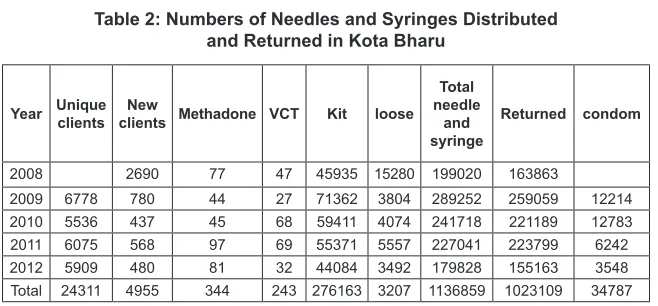
table 2: numbers of needles and Syringes distributed
and returned in Kota bharu
year unique clients clients Methadone vCtnew Kit loose total needle
and syringe
returned condom
2008 2690 77 47 45935 15280 199020 163863
2009 6778 780 44 27 71362 3804 289252 259059 12214 2010 5536 437 45 68 59411 4074 241718 221189 12783 2011 6075 568 97 69 55371 5557 227041 223799 6242 2012 5909 480 81 32 44084 3492 179828 155163 3548 Total 24311 4955 344 243 276163 3207 1136859 1023109 34787
Unique clients are clients that without fail will be present for the needle exchange, according to their schedule. There may not be many of them. New clients are new IDUs registered for the NSEP Programme or they can be the IDUs that were caught and send for imprisonment, and upon release re register for the programme.
Methadone here refers to the IDUs requesting to be placed on Methadone
Maintenance Therapy (MMT) treatment. There can be several reasons why they want to be placed under the treatment. First, they genuinely want to kick the habit of taking heroine. MMT has been successful in aiding IDUs to stop the craving for heroine and over time they may stop taking drugs. The other reason possibly is due to the difficulties of getting morphine. Thus, they may request to undergo MMT.
VCT is when the IDUs voluntarily request to be referred for treatment for HIV/AIDS. Most of the IDUs have been imprisonment for drug related crimes. In the prison, they will need to go through the screening process to find out whether they are infected with the HIV virus, other lung related diseases or worse case, AIDS. Thus, they may request to be given the necessary treatment.
Kit would consists of 4 sets of needle and syringes, cotton ball and medication.
Condoms were initially not distributed to the clients. However, in order to prevent the spreading of virus, condoms are distributed to encourage them to perform safe sex with their spouses or partners. It is another initiative to combat the HIV virus from infecting the IDUs spouses and partners. While on their rounds, the outreach workers may provide counseling to their clients. The IDUs are often reminded not to share needles and are taught the correct way to clean the needles before and after use. Pamphlets explaining the correct way of injecting needles as well information on the parts of human body that are considered as the safe areas to inject are often distributed to the IDUs. The awareness on the proper way of administering their habits may hinder the spreading of HIV virus. The needles will be collected by these outreach workers to be disposed upon returning to the office. On average, more than 90% of the needles and syringes distributed were returned.
To ensure that the activities are conducted smoothly, SAHABAT maintain good rapport with other organisations that include:
1. The Police Stations from various outreach points 2. The Anti-Narcotic Department (AADK)
3. The Ministry of Health (MOH)
4. The Prison
5. Malaysian Aids Council (MAC) 6. JAKIM
7. JAHEIK
8. Pharmaniaga
9. Hospital Univesiti Sains Malaysia (HUSM)
Home visit is the latest initiative that SAHABT has embarked on to reach the family of the IDUs. The effort is to educate the family members on the spreading of the HIV virus and to reduce stigmatisation and discrimination towards the IDUs. Apart from the counseling, the family members as well as the IDUs will interviewed by the representatives from the MOH and, or HUSM . Based on the information gathered, the IDUs and their family may be referred to the clinics or hospitals for further blood testing for Anti-retroviral treatment, Tuberculosis treatment, Hepatitis etc
Survey results
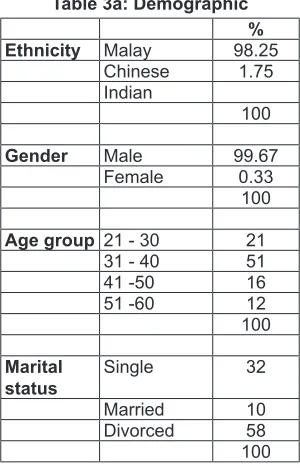
Table 3a shows that almost all of the SAHABAT clients are Malay divorced males that falls within the productive age of 21 to 40 years old
table 3a: demographic % ethnicity Malay 98.25
Chinese 1.75
Indian
100
gender Male 99.67
Female 0.33
100
age group 21 - 30 21
31 - 40 51
41 -50 16
51 -60 12
100
Marital
status Single 32
Married 10
Divorced 58
100
table 3c: history of drug used % More than one
type of drugs 82
types of drugs Sabutex 10
Domi 14
Heroine 16
Morphine 19
Shabu 5
Methamphetamine 16
Methadone 12
Suboxone 8
100
Consumption rate
per day One 15
Two 29
Three 42
Four 23
100
needle sharing Yes 45.3
No 55
100
Knowledge about
clean syringes Yes 38
No 21
Not specify 41
100
table 3d: Social Status
%
employment Yes 46
No 54
100
types of jobs Agriculture 30
Clerical 10
Service 20
Self employed 40
100
Partners Yes 38
No 62
100
Partners consume drugs Yes 3
No 81
Not Specify 16
100
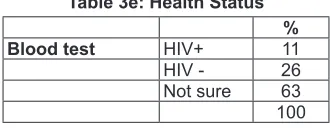
11% of the clients were confirmed to be HIV positive. The risk of spreading is higher since 63% of these clients were not sure of their health status. This may be a challenge to SAHABAT to convince them to undergo blood test.
table 3e: health Status % blood test HIV+ 11
HIV - 26
Not sure 63
100
Costing harm reduction at Sahabat
the costs according to the 4Cs. For the purpose of costing the needles and syringes some estimation were made based on the information provided by the manager of SAHABAT, Encik Maslimin bin Rakhman.
The 4Cs at SAHABAT
1. Preventive Cost
Awareness costs: The awareness activities at SAHABAT are more rigorous than the activities run in HUSM. SAHABAT has a group of outreach workers visits several ports in Kota Bharu and Pasir Mas. The outreach workers are paid salary and allowances and the outreach is conducted daily. The workers will distribute kits and needles to the IDUs. Each kit has three (3) pieces of needles, a syringe, cotton swaps and mineral water. They also distribute condoms to the IDUs. The outreach workers will use their own transports to reach their clients.
Training costs: Initial training is required for new workers
2. Continuous Assessment Costs
Salary and other related costs: There are 8 workers employed by SAHABAT Kota Bharu to perform various activities in the harm reduction programme which include outreach and counseling. Salaries and other related costs like SOCSO, insurance and medical costs for the workers are grouped as part of the overall costs.
Rental: SAHABAT is currently renting a shop house to run this noble activitiy even though most of their clients are at the points all over Kota Bharu and Pasir MAS. However, the IDUs may visit the clinic to seek medical care as well as to exchange the needle and syringes. The costs of rental from year 2009 to 2012 were RM2000 per month. Recently, SAHABAT moved to a new premise with a rental cost of
RM500 per month.
Documentation: This would include costs of clerical work performed by the staff in updating the clients’ files.
Utilities: The utilities include electricity and upkeep of the office.
need to attend workshops and seminars to enhance their knowledge on more effective ways of conducting harm reduction programmes. These seminars and workshops generally are organised wholly by the Malaysian Aids Council or in collaborations with the Police, AADK and other NGOs.
3. Internal Consequences Costs
These would be costs incurred as a result of the affected HIV positive.
HAART: This is a medication meant for clients infected with HIV/ AIDS. The average costs of HAART is between RM300 to RM500
per month per patient.
4. External Consequences Costs
Loss earnings (due to failure of the process where clients were unable to continue working): Based on the interview and survey conducted with the managers and the patients respectively in April 2011 and on
the 25 April 2013:
a) 46% of the clients were employed
b) 30% in agriculture (RM500 per month ), 10% in clerical/office work (RM700 per month), 20% in services (RM550 per month) and 40% were self-employed (RM750 per month)
c) To facilitate the earning loss, the numbers of HIV prevalence are applied. The statistics was provided by SAHABAT.
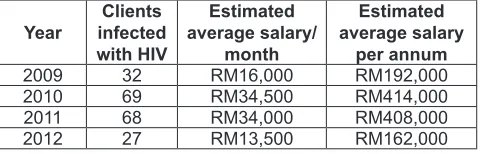
Estimated average salary per month for the clients at SAHABAT is given below:
table 4: estimated average Salary Per Month
agriculture clerical service employedSelf- average earning
30% x RM500 10% x RM500 20% x RM450 40% x RM350
RM150 RM50 RM90 RM200 RM500
The number of clients contribute to earning loss is:
table 5: estimated total salary for the years 2009-2012
year infected Clients with hiv
estimated average salary/
month
estimated average salary
per annum
2009 32 RM16,000 RM192,000
2010 69 RM34,500 RM414,000
2011 68 RM34,000 RM408,000
Costs of needles and Syringes exchange Programme at Sahabat-4cs
year 2012 2011 2010 2009
CLIENTS 6382 5902 5465 4685
rM rM rM rM
TYPES OF COST Preventative CoStS
Set-up costs 24,029
Communication 300 336 420 525.00 Initial Training @RM300 per person 2,400 1,800
Refreshment 505.50
Transportation for outreach 10,740.00 13,240.60 13,374.80 9,963.90 Kit (@3.00) 132,252.00 166,113.00 178,233.00 214,086.00
Needles 555.70
Syringes 2,662.80 2,851.80 3,889.90 2,443.70 Condoms (@ RM3.00) 36,642.00 38,349.00 18,726.00 10,644.00
182,596.80 223,795.90 214,643.70 250,443.90 ContinuouS aSSeSSMent
CoStS
Salary 105,737.30 170,534.32 176,686.56 119,164.63 EPF 24,064.00 38,640.00 39,744.00 23,904.00 SOCSO 2,198.70 3,664.50 3,769.20 5,706.90 Insurance 1,650.00 3,240.00 3,412.75 442.75 Medical for staff 2,246.35 2,381.80 4,126.50 4,854.50 Documentation 351.10 642.65 1,492.00 889.19 Communication 2,246.00 2,836.59 4,098.30 3,397.05 Electricity 1,605.30 3,004.28 1,695.79 2,312.90 Office rental 18,000.00 21,500.00 23,000.00 9,000
Transportation for work related 1,004.40 1,898.45 3,467.70 2,370.80
Upkeeping expenses 8 574.95 474.70
Wear and tear 505.80 465.90 1,746.05 1,592.15 Training costs@ RM750/worker 3,750 6,000 4,500 4,500
AUDIT FEE 500.00
VOLUNTEER ALLOWANCES 225
163,358.95 254,816.49 268,538.80 179,109.57
internal ConSeQuenCeS
HAART 36,000 75,600 72,000 28,800
external ConSeQuenCeS
loss earnings 162,000 408,000 414,000 192,000
discussions
Effectiveness of Harm Reduction
1. Awareness on the importance of not sharing needles
table 6: Percentage of needles returned by Clients for 2009-2012 year Methadone vCt returned %age
2008 77 47 163863 82
2009 44 27 259059 90
2010 45 68 221189 92
2011 97 69 223799 99
2012 81 32 155163 86
Total 344 243 1023109
Table 6 shows the percentage of syringes and needles returned are that the rate of return generally above 80%, indicating that most of the clients complied with the requirements. By returning the needles and syringes, they will be given a fresh set from the outreach workers and implying that they try not to use dirty needles when injecting heroine. However, the urgency to satisfy the craving for drugs often forced these addicts to still continue sharing needles.
2. Reduce stigmatisation and discrimination
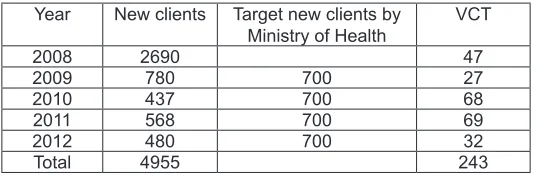
table 7: new Sahabat’s Clients
Year New clients Target new clients by
Ministry of Health VCT
2008 2690 47
2009 780 700 27
2010 437 700 68
2011 568 700 69
2012 480 700 32
Total 4955 243
The clients are very knowledgeable about the need to seek treatment if they are infected with HIV virus and will try not to hide the status of their health. The above table shows that about 5% of the IDUs have volunteered to be treated for HIV/AIDS.
SAHABAT had organised many events that include the participation of the drug addicts and their relatives. The public has become more receptive towards these addicts.
3. Quality of life has improved
The clients are able to earn income through the job placement programme conducted by SAHABAT and the other NGOs as well as Institute for Research in Molecular Medicine INFORMM. The main activities include agriculture projects..In addition, some of the clients managed to kick the habits of taking drugs and have now joined the outreach team and are paid monthly salary. They are now part of the team that sits in meetings with the police, hospitals, anti narcotic department etc.
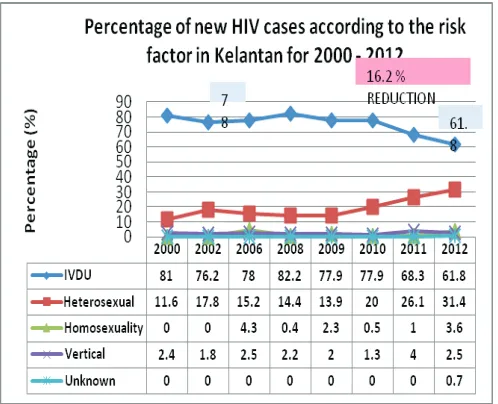
figure 3: new hiv Cases according to the risk factors for 2000-2012
Cost Effectiveness of Harm Reduction
The NSEP initiated at SAHABAT as part of the Malaysian government efforts to reduce the spreading of HIV virus is cost effective.
table 8: total Quality Management approach to Measure Cost-effectiveness of harm reduction
harm reduction failure of harm reduction Costs (incurred as a result of the affected
disease) tQM
4Cs awareness % assessmentContinuous %
% internal Consequences
%
external Consequences
%
%
2009 38.5 27.5 66 4 30 34
2010 23.6 29.4 53 1.3 45.7 47
2011 23.3 26.4 49.7 7.8 42.5 50.3
2012 33.6 30.4 64 6.6 2.4 36
reduction costs with the exception of 2011. Generally, organisations that consider quality as important will invest heavily in prevention and appraisal costs in order to prevent internal and external failure costs. Prevention seems to be the most cost-effective intervention for HIV spreading and a comprehensive effort can garner much hope and support for IDUs. Most of the prevention costs are the costs of distributing the needles and syringes. As mentioned earlier, the number of syringes and needles distributed has also decreased.
Conclusion
Dissemination on information about harm reduction must be extended to a larger group of people and not to be confined to the drug users and those related to them. The awareness of such programmes may lift the discrimination and stigmatisation among people. This effort will be able to encourage drug users to step forward and register voluntarily in harm reduction programmes all over the country. Awareness among school children should also be made so as to prevent them from trying ondrugs for the first time. This may lead to a second and third and finally they will become addicted and less productive. Money spent on rehabilitation of the drug users can be spent on the development of the country.
Many NGOs had played their parts in combating the drug abuse and thus spreading of HIV. However, other stakeholders must also lend their hands to fight this nation- wide problem so that the economy of the country can be lifted. Activities that can help the prevention of illicit drugs should be introduced and participated by many people. When many people understand the importance of preventing the spreading of HIV/AIDS, they will support the effort made by these NGOs and the government. Thus, they will not claim that money spent on such activities is wasteful. It is hoped the use of 4Cs can eventually help the government to embark and invest further in activities to prevent the initiation of illicit drug use.
references
Ahmad M. Bayoumi, Gregory S. Zaric, The cost-effectiveness of Vancouver’s supervised injection facility. CMAJ 2008, 179(11).
Alan Sheill, Mathew G Law, The cost of hepatitisC and the cost–effectiveness of its prevention. Health Policy Volume 58, Issue 2, November 2001, Pp 121–131.
Arnold D. Kaluzny, Curtis P McLaughlin, Kit Simpson 1992, Applying Total Quality Management Concepts to Public Health Organisations, Public Health report, Vol.107, No.3,1992.
Bluthenthal, R.N., Goginemi, A., Longshore, D., and Stein, M. (2001).
Denga, R., J. Lib, L. Sringerrnyuange and K. Zhanga, (2007). Drug Abuse, HIV/ AIDS and stigmatization in a Dai Community in Yunan, China. Social Science and Medicine, 64: 1560-1571.
Don C. Des Jarlais (1995). Harm Reduction - A Framework for Incorporating Science into Drug Policy, American Journal of Public Health, 85(1): 10-12.
Gibson, D.R. (2000). Two-To Sevenfold Decreased Risk Associated With Use Of Needle Exchange, 17th Annual AIDS Investigators’ Meetings,
California.
International Harm Reduction Association (IHRA). What is Harm
Reduction?
Krentz HB, Auld CM, Gill JM, for the HIV Economic Study Group. The changing direct costs of medical care for patients with HIV/AIDS, 1995-2001. CMAJ 2003; 169: 120-121.
Michael L Rekart (2005). Sex-work harm reduction. The Lancet, Volume 366, Issue 9503, Pages 2123-2134.
Pedram Sendi, Fabian Scellenberg, Gilbert R. Kaufman, Heiner C. Bucher, Rainer Weber, Manuel Battegay and the Swiss cohort study (2004), Productivity costs and determinants of productivity in HIV infected
Patients.
Robin D. Gorsky, Robin J. MacGowan, Nancy M. Swanson and Brenda P.Delgado, (1995) Prevention of HIV Infection in Drug Abusers: Cost
analysis
Sendi, P., Schellenberg, F., Ungsedhapand, C., Kaufman, G., Bucher, H., Weber, R., Battegay, M. and Swiss HIV Cohort Study (2004).
Productivity Costs and Determinants of Productivity in HIV-Infected Patients. Clinical Therapeutics, Vol. 26, No. 5, p. 791 – 800.
Simmonds, L. and R.Coomber (2009). Injecting Drug Users: A Stigmatized And Stimatising Populations. International Journal Drug Policy, (2002):121-130.
Sinyang, A. (2004). November 17. RM2b Setahun Beli Dadah. Utusan Malaysia, pp:11.
SS Alistar,DK Owens, ML Brandeau (2011). Effectiveness and Cost effectiveness of Expanding Harm Reduction and Antiretroviral Therapy in Mixed HIV Epidemic: A Modeling Analysis for Ukraine. PLOS Medicine, March 2011 issue.
Vickerman, P., Kumaranayake, L., Balakireva, O., Guinness, G., Artyukh, O., Semikop, T.
Yaremenko, O. & Watts, C. (2006). The Cost-Effectiveness of Expanding Ham Reduction Activities for Injecting Drug Users in Odessa, Ukraine.
Sexually Trasmitted Diseases. Vol. 33, No. 10, p.S89-102.
Wee Shu Hui, Suzana Sulaiman, Sharifah Fadzlon, Normah Omar (2011), The Relevance of Management Accounting in HIV Harm reduction Programme, MIA Articles of Merit on PAIB.
Wodak, A., Cooney, A. (2005). Effectiveness Of Sterile Needle And Syringe Programmes. The International Journal of Drug Policy 16S, S31-S44.