Journal for the History of
Analytical Philosophy
Volume 5, Number 10
Editor in Chief Kevin C. Klement, University of Massachusetts
Editorial Board Annalisa Coliva, University of Modena and UC Irvine Greg Frost-Arnold, Hobart and William Smith Colleges Henry Jackman, York University Sandra Lapointe, McMaster University Consuelo Preti, The College of New Jersey Marcus Rossberg, University of Connecticut Anthony Skelton, Western University Mark Textor, King’s College London Audrey Yap, University of Victoria Richard Zach, University of Calgary
Review Editors Sean Morris, Metropolitan State University of Denver Sanford Shieh, Wesleyan University
Design Daniel Harris, Hunter College
jhaponline.org
© 2017 Silver Bronzo
Frege on Multiple Analyses and the Essential Articulatedness of Thought
Silver Bronzo
Frege on Multiple Analyses and the
Essential Articulatedness of Thought
Silver Bronzo
1. The Problem
On the face of it, Frege is committed to two theses about thoughts and sentences. The first thesis, which I shall call theArticulation Thesis, states that thoughts are articulated into parts that corre-spond, by and large, to the grammatical parts of the sentences that express them. As Frege puts it,
We can regard a sentence as a mapping of a thought: correspond-ing to the whole-part relation of a thought and its parts we have, by and large, the same relation for the sentence and its parts. (Frege 1919, 275, translation 255; see also 1914a, 224, 243, 262, transla-tion 207–08, 225, 243; 1914b, 127–28, translation 320; 1918b, 148, translation 351;1923, 36, translation 390;2004, 87)
For Frege, a meaningful sentence is generally a logically complex sign: it is composed of parts (words or phrases) that have senses (and possibly references) of their own. The senses expressed by the parts of the sentence arepartsof the sense expressed by the whole sentence, which for Frege is a thought. In this way, the part/whole structure of a sentence mirrors in general the part/whole structure of the corresponding thought.
The second thesis, which I shall call the Multiple Analyses Thesis, states that the same thought can be ‘split up’ or ‘analyzed’ or ‘decomposed’ or ‘carved up’ in many ways, none of which has to be more fundamental than the others.1 In Frege’s words,
1The verbs that Frege uses in this connection are zerfallenand zerlegen, which are variously translated as ‘splitting up’, ‘analyzing’, or ‘decomposing’, andzerspalten, which is generally translated as ‘carving up’.
We must notice . . . that one and the same thought can be split up in different ways and so can be seen as put together out of parts in different ways. (Frege 1906, 218, translation 201–02; see also1892b, 199, translation 188)
The same thought can result from the combination of different thought-constituents, i.e., different sub-sentential senses. The analysis of a thought into its parts is not unique: the same thought can be analyzed into different sets of sub-sentential senses. We can also say: sentences with different semantic struc-tures can express the same thought, where two sentences have different semantic structures if they are not composed of ex-pressions with the same senses put together in the same way. The idea that no way of analyzing a thought needs to have a privileged status over the others is not explicitly stated in the quotation I gave or in other similar passages, but it can be seen to follow from some of Frege’s examples (which will be exam-ined in detail in thenext section).
These formulations of the two theses are framed in terms of Frege’s mature semantic view, which is informed by the sense/reference distinction. According to Frege’s earlier view, complete sentences express ‘judgeable contents’, and their fun-damental parts denote ‘objects’ and ‘concepts’. Within this ear-lier framework, the first thesis would be recast as the claim that a judgeable content is composed of parts (i.e., concepts and ob-jects) that correspond, by and large, to the parts of the sentence that expresses it, and the second thesis as the claim that the same judgeable content can be split up in many ways, none of which has to be more fundamental than the others. There are indeed passages in Frege’s early writings that appear to express quite explicitly this latter formulation of the Multiple Analyses Thesis. For example, he states:
ways can always claim objective preeminence. (Frege 1882, 164, translation 81)2
Early Frege does not state as explicitly that a judgeable content is composed of objects and concepts in a manner that mirrors the composition of the corresponding sentence, but such a view can be plausibly seen to follow from some of the ways in which he characterizes judgeable contents. In §2 of 1879, for exam-ple, Frege describes a judgeable content as a ‘complex of ideas’, where the term ‘idea’, in this very early work, denotes the con-tent of a sub-sencon-tential expression, i.e., an object or a concept. The natural implication is that judgeable contents have objects and concepts as their constituent parts. Moreover, in 1880–81
(17, translation 16), Frege argues that a content of possible judg-ment can be ‘split into a constant and a variable part’, i.e. (in the simplest case) into an object and a concept. This suggests that he treats concepts and objects aspartsof judgeable contents, and it is clear from his procedure that he takes the segmentation of a judgeable content to mirror the logical segmentation of the corresponding sentence.
Many of Frege’s most distinguished commentators have thought that the two theses, taken as they stand, are mutually incompatible. Accordingly, it has seemed that a sympathetic interpretation should show that Frege is notreallycommitted to both theses. The debate, then, has tended to polarize into two camps. Each camp argues that Frege subscribes only to one of the theses, and merelyappearsto subscribe to the other. The two camps differ because they implement this exegetical schema in opposite ways. I shall refer to one of these camps as the Dum-mettian Camp, because it has been most forcefully championed
2See alsoFrege(1879, §9, translation 66–69); (1884, §64, translation 75). Further evidence that early Frege does not think that there must be a unique ultimateanalysis of each judgeable content, having absolute priority over all the others, is provided by some of the examples that he discusses, which will be examined in thenext section.
by Michael Dummett; the opposite camp I shall simply call the Anti-Dummettian Camp, because it has tended to develop as a reaction against Dummett’s interpretation. The two camps may be characterized as follows:
The Dummettian Camp. Frege endorses the Articulation The-sis, but is not really committed to the Multiple Analyses Thesis. Thoughts are articulated into parts, in a way that mirrors the internal articulation of the sentences that ex-press them; but each thought is articulated in auniqueway. Sentences with different semantic structures cannot express the same thought.
The Anti-Dummettian Camp. Frege endorses the Multiple An-alyzes Thesis, but is not really committed to the Articulation Thesis. Thoughts can be analyzed in many ways, because they are in themselvesinarticulate. Thoughts, as unstruc-tured wholes, cannot mirror the semantic structure of the sentences that express them.
or referringto it). Commentators of the opposite camp, on the other hand, have pointed out that only philosophical prejudice can lead one to deny the Multiple Analyses Thesis, because the thesis amounts to the truism that we can, indeed,say the same thing in different ways. A reconciliation of the two theses, there-fore, would not only enable us to make best sense of Frege’s texts as they stand, but would also amount to a philosophical achievement in its own right.
The second aim of the following examination of the debate between Dummett and his opponents is to show that it has been informed by a crucial but unexamined assumption:
The Underlying Assumption. If internal articulation is essential to thoughts, then there must beonearticulation which is the single and unique articulation of each thought. Conversely, if each thought can be articulated in more than one way (none of which has to be more fundamental than the others), then it must be intrinsicallyinarticulate.
It is the allegiance to this assumption that forces each camp of the debate to believe that the two theses are mutually incompatible. But the assumption, I will argue, can be resisted. It is compul-sory if one conceives of thoughts as aggregates of atomistically independent components. But this is not the only option. One can also conceive of thoughts asorganic unitiesthat are indeed articulated into parts, but by parts that are individuated by the functionthat they perform within the whole. I will argue that when the relationship between a thought and its parts is con-strued on this model, the Underlying Assumption ceases to be compulsory and one becomes entitled to the simultaneous asser-tion of the two theses. I will also give independent reasons for thinking that Frege does in fact conceive of thoughts as organic unities. My suggestion, therefore, will be that by construing thoughts as organic unities, Frege can coherently accept both
theses and vindicate in this way the philosophical insights that animate the two opposite camps of the exegetical debate.3
2. Frege on Multiple Analyses: Five Kinds of Candidate Cases
Frege’s works contain discussions of several different kinds of examples that may be taken to illustrate his commitment to the Multiple Analyses Thesis. Before we turn to the two camps of the debate, it will help to have a systematic overview of these examples and to distinguish them from cases that are clearlynot exemplifications of the phenomenon of multiple analyses.
It is uncontroversial that, for Frege, ‘different sentences may express the same thought’ (1892b, 199, translation 188): he in-sists on this point all over the place (Frege 1879–91, 6, translation 6;1892b, 196, translation 184, note G;1897, 154, translation 143;
1924–25, 288, translation 269). But statements of this form, taken in isolation, do not suffice to show that Frege is committed to the possibility of multiple analyses. Within Frege’s framework, there is room for at least three kinds of cases in which the same thought is expressed by different sentences, but is not split up in different ways. First, there can be sentences that are composed of words with identical meanings and psychological associations, put together in exactly the same way (such as, possibly, ‘John is American’ and ‘John ist Amerikanisch’). Secondly, there can be sentences that have the same semantic structure, but differ in
psychological associations (such as, for Frege, ‘The dog is bark-ing’ and ‘The cur is barkbark-ing’; seeFrege 1897, 152, translation 140). And finally, there can be sentences that have different surface-syntactical forms, but the same underlying logical form (such as, for Frege, ‘Everybody loves somebody’ and ‘∀x∃y(xlovesy)’).
If one wants to argue that Frege is committed to the Multiple Analysis Thesis, one must look at his treatment of different sorts of cases. I will distinguish five kinds of relevant cases. As we shall see, there are various similarities and differences between the individual examples that Frege discusses. I do not claim, therefore, that what follows is the only sensible way of classify-ing them. The classification given below is meant to facilitate the discussion of the secondary literature in a way that I hope will become evident in the following sections.
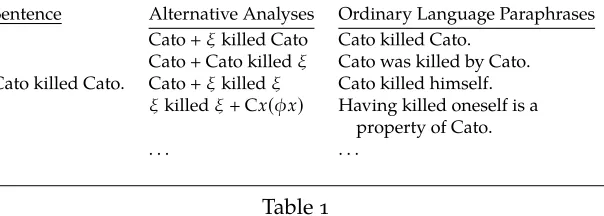
First kind of candidate case. Frege maintains that given a mean-ingful sentence, of either natural language or Begriffsschrift, there are many ways of segmenting it into a functional expres-sion and argument expresexpres-sions. Each of these segmentations is achieved by regarding one or more parts of the sentence as variable, and the remaining part of the sentence as constant. The constant part will be a functional expression; more specif-ically, a concept-expression. The variable parts will be proper names, if the constant part is a first-level concept-expression, or concept-expressions of first or higher level, if the constant part is a concept-expression of second or higher level. In §9 of Be-griffsschrift, for example, Frege indicates three different ways of ‘splitting up’ the sentence ‘Cato killed Cato’. We may regard the first occurrence of ‘Cato’ as variable and the rest as constant: in this case, we will regard the sentence as composed of the proper name ‘Cato’ and the concept-expressions ‘ξkilled Cato’ (where the Greek letter indicates the empty place that needs to be filled by a proper name). If we regard thesecondoccurrence of the word ‘Cato’ as variable and the rest as constant, then we will regard the sentence as composed of the proper name ‘Cato’
and the concept-expression ‘Cato killedξ’. Finally, if we regard both occurrences of the word ‘Cato’ as variable, but in such a way that they may only be replaced by two occurrences of the same proper name, then we will regard the sentence as com-posed of the proper name ‘Cato’ and the concept-expression ‘ξ killed ξ’. It seems to follow from Frege’s view that these are only three out of many possible ways of splitting up the sentence. For example, if we regard the concept-expression ‘ξ killed ξ’ as variable and the rest as constant, then we will seg-ment the sentence into a first-level concept-expression and a second-level concept-expression, the Cato-quantifier ‘Cx(φx)’ (where the Greek letter indicates the empty place that needs to be filled, in the early Frege, by a first-level one-place concept-expression, and in the mature Frege, by any first-level one-place function-expression). In fact, some commentators have argued that, by ascending the hierarchy of levels, we can split up any logically articulated sentence in infinitely many ways (seeHodes 1982, 167–68). In the following table, I provide a synopsis of the alternative ways of segmenting the sentence ‘Cato killed Cato’ that we have explicitly considered. Following Frege’s practice, I associate each alternative method of analysis with an ordinary language paraphrase of the original sentence; the dots on the bottom line indicate that the list is not meant to be exhaustive:
Sentence Alternative Analyses Ordinary Language Paraphrases Cato +ξkilled Cato Cato killed Cato.
Cato + Cato killedξ Cato was killed by Cato. Cato killed Cato. Cato +ξkilledξ Cato killed himself.
ξkilledξ+ Cx(φx) Having killed oneself is a
property of Cato.
. . . .
Table 1
Frege discusses many analogous examples in his writings (see
translation 81). These cases may be taken to be illustrations of the Multiple Analyses Thesis for the following reason. The alter-native segmentations of each sentence produce different sets of logicalorsemanticunits; they display, accordingly, different ways of splitting up thecontentexpressed by the sentence. But Frege insists that these different analyses need not affect the ‘concep-tual content’ expressed by the sentence, but only ‘our way of grasping it’ (1879, §9). Thus it seems that thesamepropositional content (‘judgeable content’ for early Frege, ‘thought’ for mature Frege) may be expressed by sentences with different semantic structures. On the other hand, as we shall see in the next sec-tion, one may argue that these cases do notactually illustrate the Multiple Analyses Thesis, because they are compatible with the idea that each sentence and thought has a unique funda-mentalstructure, which accounts for all the possible alternative analyses.
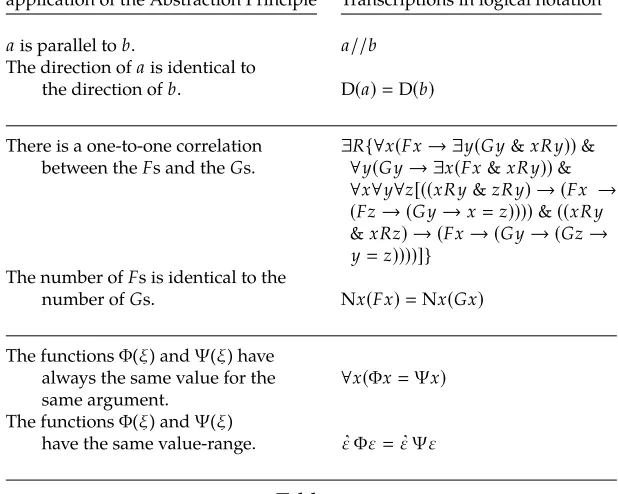
Second kind of candidate case. Frege holds that by applying what is now known as the Principle of Abstraction, we can ‘carve up’ the same propositional content in a different way. Three cases that he discusses explicitly are presented inTable 2.4 We have here three propositional contents, each of which is analyzed in
4In the table, the Latin capital letters ‘F’ and ‘G’ (or more accurately, those letters together with their argument places, i.e., ‘Fξ’ and ‘Gξ’) are used as schematic first-level one-place concept-expressions—what we would call schematic predicate letters. This accords with standard logical notation. By contrast, the Greek capital letters ‘Φ’ and ‘Ψ’ (or more accurately, ‘Φξ’ and ‘Ψξ’) are used more widely as schematic first-level one-place function-expressions, which may be conceptual (e.g., ‘ξ is wise’) or non-conceptual (e.g., ‘ξ2’). This follows Frege’s mature notational conventions (Frege 1893, §3, translation 7–8). One of the formulae to appear below, ‘∀x(ΦxΨx)’ is not
well-formed in standard logical notation if the capital Greek letters are inter-preted as concept-expressions (the correct formula would be ‘∀x(Fx↔Gx)’),
but it is well-formed in Frege’s mature system, where concepts are treated as special cases of functions. The capital Greek letters discussed here should not be confused with the lower-case Greek letters ‘φ’ and ‘ψ’, which I use elsewhere in this paper (followingFrege 1893, §21, translation 37) to indicate the argument places of second-level fuction-expressions.
Recarvings of the same content by
application of the Abstraction Principle Transcriptions in logical notation
ais parallel tob. a//b
The direction ofais identical to
the direction ofb. D(a)D(b)
There is a one-to-one correlation ∃R{∀x(Fx→∃y(G y&xR y))&
between theFs and theGs. ∀y(G y→∃x(Fx&xR y))& ∀x∀y∀z[((xR y&zR y) → (Fx → (Fz→ (G y→xz))))&((xR y
&xRz) → (Fx→ (G y→ (Gz→
yz))))]}
The number ofFs is identical to the
number ofGs. Nx(Fx)Nx(Gx)
The functionsΦ(ξ) andΨ(ξ) have
always the same value for the ∀x(ΦxΨx)
same argument. The functionsΦ(ξ) andΨ(ξ)
have the same value-range. ε–Φεε–Ψε
Table 2
the sense/reference distinction, this remark asserts that the two sentences agree not only in truth-value, but also in the thought they express.5 So in each of these three cases, sentences that by Frege’s own standards have different semantic structures are said to express the same thought or judgeable content.
There are some notable differences between these cases and the former ones. Cases of the first kind are characterized by the fact that the different analyses of the same thought are ob-tained from a single sentence, by regarding each time different parts of the sentence as variable and constant. Cases of the sec-ond kind, on the other hand, are characterized by the fact that we start from the very beginning with different sentences, which are thought to exhibit different semantic structures. Moreover, cases of the former kind display a method for generating an indefinite (or perhaps an infinite) number of different analyses of any thought that is initially expressed in an articulate way, whereas the ‘recarving process’ applies only to thoughts of a certain form (namely those involving an equivalence relation) and generates onlytwoalternative analyses.
Third kind of candidate case. Further evidence for Frege’s com-mitment to the possibility of multiple analyses is provided by his discussion of sentences involving truth-functional connectives. Here are some of the cases that Frege discusses:
5Frege regards the possibility of ‘transforming’ sentences of the form ‘∀x(Φx Ψx)’ into sentences of the form ‘ε–Φε ε–Ψε’ and vice versa as
a fundamental law of logic and includes it among the axioms of his formal system. This is the infamous Basic Law V (Frege 1893, §§3, 9, 20). In the passage from ‘Function and Concept’ that I have mentioned, Frege says ex-plicitly, of a particular pair of sentences of that form, that they express the same sense (i.e., the same thought), and even though the remark is made in connection with a particular example, it is clearly meant to have general significance. However, whether Frege held the same view inGrundgesetzeis a debated issue. Some commentators argue that Basic Law V incorporates identity of sense as well as identity of truth-value (see e.g., Michael Beaney’s editorial notes inFrege 1997, 136, note 4, 213, note 26); others argue that it expresses only identity of truth-value (see e.g.,Dummett 1981a, 336).
Alternative expressions of the same thought by means of sentences involving truth-functional connectives
p&q q&p
p&p p
p
¬¬p
p→q ¬q→ ¬p
Table 3
Concerning the first two pairs of sentences, Frege writes that these are cases ‘where two linguistically different expressions correspond to the same sense’, i.e., the same thought (1923, 9, translation 393). And yet, at least in the second case, it seems that the two sentences, by Frege’s standards, must exhibit different semantic structures. For Frege, the sign for conjunction is a concept-expression in its own right: it refers to a concept and expresses a certain sense, which will be part of the thought expressed by the sentence in which it occurs. Thus, the thought expressed by ‘p & p’ will contain a part that is not contained in the thought expressed by ‘p’. Similar considerations apply to the last two pairs of sentences. About double negation, Frege writes that ‘“not (notB)” has the same sense as “B”’ (1923, 44, translation 399);6and about contraposition, he asserts that ‘[t]he sense is scarcely affected by it’ (1897–98, 166, translation 154).
6See alsoFrege(1879, viii, translation 51), where Frege introduces an ax-iom stating that¬¬pandphave the same conceptual content (for a helpful
Fourth kind of candidate case. In ‘On Concept and Object’, Frege states that the two sentences, ‘There is at least one square root of four’ and ‘The conceptsquare root of fouris realized’, express the same thought (1892b, 199, translation 187–88). Frege argues that in the former sentence the expression ‘square root of four’ is a concept-expression, designating a first-level concept, whereas in the latter sentence, the expression ‘The conceptsquare root of four’ is a proper name, designating an object. For Frege, therefore, the two sentences have different logical structures: the former rep-resents a first-level concept falling within a second-level concept (namely the existential quantifier), whereas the latter represents an object falling under a first-level concept. And yet, they are said to express the same thought. Similar considerations apply to other examples discussed in the same essay, such as the pair of sentences ‘Jesus is a man’ and ‘Jesus falls under the concept man’, and the pair of sentences ‘2 is a prime number’ and ‘2 falls under the concept prime number’ (1892b, 197 and 205 re-spectively, translation 185 and 193; see alsoFrege 2004, 66). One may wonder what are, for Frege, the objects designated by ex-pressions of the form ‘The conceptF’. There is evidence that, at least in ‘On Concept and Object’, Frege takes these expressions to designate extensions of concepts. He writes that they stand for objects that ‘go proxy’ for concepts (1892b, 197, translation 185), and then maintains that any expression of the form ‘The extension of the conceptF’ may be replaced with an expression of the form ‘The concept F’ (1892b, 199, translation 187; for an extensive discussion of this issue, seeBurge 2005, chap. 7). We can therefore represent the different semantic structures of the
appear to be completely consistent in his writings about the fact that a sentence and its double negation express the same thought. At the end of1918b(157, translation 361), Frege writes that ‘of the two thoughts,Aand the negation of the negation ofA, either both are true or neither is’: here it would seem that there aretwodifferent thoughts which necessarily agree in truth-value.
sentences considered above by means of Frege’s notation for value-ranges, of which extensions of concepts are special cases:7
Alternative analyses of the
same thought, by means of sentences
involving extensions of concepts Transcriptions in logical notation
There is at least one square root of four. ∃x(x √
4)
The conceptsquare root of fouris realized. R(ε–(ε √
4))
Jesus is a man. M j
Jesus falls under the conceptman. U(j,ε–Mε); or: j∈ε–Mε
2 is a prime number. P(2)
2 falls under the conceptprime number. U(2,ε–Pε); or: 2∈ε–Pε
Table 4
Fifth kind of candidate case. There is some reason to believe that the use of the truth predicate generates for Frege another class of cases of multiple analyses. Consider pairs of sentences of the following form:
Different expressions of the same thought,
by means of sentences involving the truth predicate
p
It is true thatp.
Table 5
Frege consistently maintains that sentences of the form ‘p’ and ‘It is true that p’ express the same thought or judgeable con-tent.8 Moreover, at least on some occasions, he seems to regard the truth predicate as a genuine concept-expression. To the ex-tent that he does so, he is committed to the idea that the same thought may be expressed by sentences with different semantic structures.9
This concludes my overview of the kinds of cases discussed by Frege that may be taken to express his commitment to the
8SeeFrege (1897, 153, translation 141); (1915, 271, translation 251–52); (1918a, 61, translation 328); see also §3 ofBegriffsschrift, where Frege assumes that sentences of the form ‘p’ and ‘It is a fact thatp’ express the same judgeable content.
9The claim that Frege’s conception of truth shows that he is committed to the multiple analyzability of thoughts is made inBermúdez(2001) and, more incidentally, inBurge(2005, 292, note 16). However, Frege’s view of the nature of truth (and of the role of the truth predicate) is a very delicate issue. At some points, Frege argues that the predicate ‘is true’ should be regarded as a concept-expression, even though asui generisone: ‘All one can say is: the word “true” has a sense that contributes nothing to the sense of the whole sentence in which it occurs as a predicate’ (1915, 271, translation 251–52). But it is only with great reluctance that Frege talks of truth as a property. After an inquiry into the peculiar logical features of the truth predicate, Frege concludes: ‘The Bedeutungof the word “true” seems to be altogethersui generis. May we not be dealing here with something which cannot be called a property in the ordinary sense at all? In spite of this doubt I will begin by expressing myself in accordance with ordinary usage, as if truth were a property, until some more appropriate way of speaking is found’ (1918a, 61–62, translation 328– 29). This reluctance on Frege’s part, as well as other aspects of his conception of truth (such as the idea that ‘the meaning of the word “true” is spelled out in the laws of logic’ (1918a, 59, translation 326) and the claim that ‘the word “true” seems to make the impossible possible: it allows what corresponds to the assertoric force to assume the form of a contribution to the thought’ (1915, 272, translation 252)), can be taken to show that Frege is not really committed to regarding truth as a propertyat all(seeRicketts 1996). If that is the case, then there are grounds for attributing to Frege the view that pairs of sentences of the form ‘p’ and ‘It is true thatp’ express the same thought, but do not exhibit different semantic structures: the difference would merely lie in their surface-grammatical form. Consequently, Frege’s discussion of pairs of sentences of the form ‘p’ and ‘It is true thatp’ could not be taken to illustrate his commitment to the doctrine of multiple analyses.
Multiple Analysis Thesis. It is worth acknowledging that many of these cases pose special problems. Frege himself held dif-ferent views about some of these cases at difdif-ferent points of his career. Thus one might argue, as Frege did in his late writings, that given the inconsistency of Basic Law V, expressions of the form ‘the extension of the concept F’ or ‘ε–Fε’ should not be treated as genuine proper names (seeFrege 1924–25, 288, trans-lation 269).10 Consequently, some of the cases of the second type, and all of the cases of the fourth type, would not count as instances of multiple analyzability. Similarly, concerning cases of the fifth type, one might argue that the truth predicate should not be treated as a genuine concept-expression, and there is at least a strand in Frege’s writings that appears to pursue this line of reasoning.11 And again, concerning cases of the third kind, one could argue, following Wittgenstein’sTractatus, that logical connectives should not be treated as concept-expressions with a sense and reference of their own.12 But none of these con-siderations shows that there is something objectionable in the very idea that the same thought can be analyzed in many al-ternative ways, none of which can claim absolute priority over the others. Nor the fact that Frege, at some point of his ca-reer, subscribed to considerations of this sort shows that he was willing to question his commitment to the Multiple Analyses Thesis. The aforementioned considerations do not invoke any general reason for rejecting the possibility of multiple analyses.
10For an account of the evolution of Frege’s view about extensions of con-cepts, seeBurge(2005, chap. 7).
11See note9above.
12TheTractatussummarizes this view at 4.0312: ‘My fundamental thought is that the “logical constants” do not represent’. For theTractatus, ‘logical con-stants’ (i.e., logical connectives) do not characterize the sense of propositions, but expressoperationson the senses of propositions. In a perspicuous nota-tion, truth-functionally equivalent propositions are expressed by means of a singlesign: for instance, the propositions ‘p→q’, ‘¬q→ ¬p’, and ‘¬(p&¬q)’
The question, rather, is always whether theparticular case at hand should be taken as an instance of multiple analyzability, given the specific issues that it raises. In principle, one could raise spe-cific objections against each of the five kinds of cases mentioned above, and yet admit the possibility of multiple analyses, which may still be exemplified by other cases.
In the following sections, we will look at the two opposite sides of the debate that I described in Section1, beginning with Michael Dummett’s attempt to explain away Frege’s apparent recognition of the possibility of multiple analyses.
3. Dummett on the ‘Essential Structure’ of Thoughts
According to Dummett, Frege (or anyway Frege at his best) held the view that each thought has a uniqueidentifying structure, which corresponds to the unique semantic structure of the sen-tences that express it. For Dummett’s Frege, each unambiguous sentence is constructed in stages from a set of ultimate con-stituents. The senses of the constituents, together with their mode of combination, determine the sense of the whole sen-tence, i.e., the thought it expresses. More specifically, the senses of the parts of the sentence arepartsof the thought it expresses. The identity of each thought—and this is the crucial claim— is given by the parts of which it is composed and by the way they are put together. Consequently, sentences with different semantic structures cannot express the same thought.13
Dummett is of course well aware of the fact that he needs to ac-count for what Frege says about the different kinds of cases that we considered in the previous section, since Frege’s statements on the matter seem to show that he held precisely the opposite view. Dummett addresses different cases with different
strate-13The reconstruction of Dummett’s interpretation that I provide in this section is based especially onDummett(1981a, chaps. 15–17), (1981b, 27–33) and (1991, 192–95, 289–314).
gies. I will begin with his attempt to deal with the first kind of case by distinguishing between ‘analysis’ and ‘decomposition’.
ar-gument places of simple predicates by means of dots (as I did above with the putative simple predicate ‘. . . killed. . . ’). Thus, once we have the sentence ‘Cato killed Cato’, we can decompose it in various ways by omitting each time different significant parts of the sentence: we can decompose it into ‘Cato’ and ‘Cato killedξ’, or into ‘Cato’ and ‘ξkilledξ’, and so on. In each case, we obtain a different set of components. Decomposition does not give us the building blocks out of which the sentence has been constructed, but patterns that the sentence may share with other sentences. For each sentence (and for each corresponding thought), there is only one analysis, which reveals its essential structure, but many possible decompositions.
Dummett emphasizes that the distinction between analysis and decomposition should not be confused with the distinction between complete and partial analysis. The components ob-tained by decomposition do not have to figure atanystage of the process of analysis. For example, the concept-expression ‘Cato killedξ’ does not figure at any intermediate step of the analysis of ‘Cato killed Cato’: this is, by Dummett’s standards, an atomic sentence, and its analysis takes place in a single step. We do not reach the constituent ‘. . . killed. . . ’ byfirstdecomposing the sentence into ‘Cato’ and ‘Cato killed ξ’. Analysis and decom-position, as Dummett puts it, are two differentkindsof process (1991, 193, 301–02).
Dummett explains that these two processes fulfill different functions. The aim of analysis is ‘to reveal the manner in which the sense of a sentence depends upon the senses of its parts’ (1981a, 271). In this way, analysis shows how we understand a sentence given our understanding of its ultimate constituents and their manner of combination. Decomposition, on the other hand, serves at least two functions. In the first place, it gen-erates complex predicates that can appear as (non-ultimate) constituents of quantified sentences and definite descriptions (1981a, 276). From ‘Cato killed Cato’ we can extract by
decompo-sition the complex predicate ‘Cato killedξ’; we can then attach to this expression a quantifier and obtain, say, ‘∃x(Cato killedx)’. The complex predicate, which was only a component of the sen-tence from which it was extracted, is now a genuine constituent of the quantified sentence, since it figures at one stage of the analysis of the sentence. However, since the complex predicate does not figure at thelaststage of the analysis of the quantified sentence, it is not one of itsultimateconstituents.
A second function of decomposition, according to Dummett, is to ‘explain the validity of an inference in which the given sentence figures, or to exhibit such an inference as exemplifying some general pattern’ (1981a, 273). One way to explain the va-lidity of an inference is to show that it exemplifies some valid general pattern. In order to explain by this method different inferential relations of the same sentence, we may have to de-compose the sentence in different ways. Consider for instance these two inferences:
Cato killed Cato. Cato killed Cato.
∴Cato killed somebody. ∴Somebody killed Cato.
The two inferences exemplify the same general pattern, namely the introduction rule for the existential quantifier:
Fa
∴∃x(Fx)
If anybody killed Cato, he is an honorable man. Cato killed Cato.
∴Cato is an honorable man.
If we see in this inference the following pattern,
∀x(Fx →Gx) Fa
∴Ga
we need to regard the concept-expressions ‘ξ killed Cato’ and ‘ξ is an honorable man’ as components of the first premise— components that fill the empty places of the second-level, two-place concept-expression ‘∀x(φx → ψx)’. But we can also see the same inference as carried out in two steps, each of which exemplifies a different pattern: we first derive ‘Cato killed Cato’ from the first premise by Universal Instantiation, and then reach the conclusion bymodus ponens:
Pattern: If anybody killed Cato, he is an honorable man. ∀x(Fx)
∴If Cato killed Cato, Cato is an honorable man. ∴Fa
Pattern: If Cato killed Cato, Cato is an honorable man. p→q
Cato killed Cato. p
∴Cato is an honorable man. ∴q
If we choose to explain the validity of the inference in this way, we do not need to see the concept-expressions ‘ξ killed Cato’ and ‘ξis an honorable man’ as components of the quan-tified premise; we only need to decompose it into the second-level, one-place concept-expression ‘∀x(φx)’ and the first-level concept-expression ‘Ifξkilled Cato, thenξis an honorable man’. We do not need to enter any further into the details of Dummett’s distinction between ‘analysis’ and ‘decomposition’.14
14For a more comprehensive discussion, seeSullivan(2010).
(From this point, I will put these terms and cognate expressions in scare quotes whenever I use them in Dummett’s technical sense; all other occurrences of the expressions should not be taken to carry those connotations.) The presentation I offered should suffice to show how the distinction is supposed to ac-commodate what Frege has to say about the first kind of case in Dummett’s interpretation. To repeat, a thought admits of many alternative ‘decompositions’, but only one ‘analysis’, which re-veals its unique essential structure.
Even though this aspect of Dummett’s reading has not met the consensus of commentators, it has considerable advantages.15 In the first place, it does justice to the intuitive idea that the various ways of splitting up a sentence (and the corresponding thought) into its logical parts do not all stand on the same level. It seems obvious that the analysis of a sentence of the form ‘aRb’ into ‘a’ and ‘ξRb’ isless fundamental than the analysis of the sentence into ‘a’, ‘. . .R. . .’, and ‘b’. After all, the concept-expression ‘ξRb’containsthe simpler concept-expression ‘. . .R. . .’ and the proper name ‘b’! The former analysis strikes us as merely par-tial. Dummett’s distinction can explain the different status of these alternative analyses of the sentence, as well as another contrast that cannot be captured in terms of the distinction be-tween complete and partial analyses. It seems that the analysis of a sentence of the form ‘Fa’ into the ‘F. . .’ and ‘a’ ismore fun-damentalthan the analysis of the sentence into ‘F. . .’ and the second-level concept-expression ‘φa’, even though the latter is in no obvious sense ‘more partial’ than the former. Dummett gives us the resources for vindicating this intuition. According to his account, the higher-level analysis of the sentence is ob-tained by regarding one of its significant parts as variable and
the rest as constant; but in order to do so, we need to know whichsignificant expressions occur in the sentence, and this is revealed by the lower-level analysis. So the higher-level analysis is less fundamental than the other because itpresupposesit.
Dummett’s attribution to Frege of an implicit commitment to the distinction between ‘analysis’ and ‘decomposition’ is also supported by at least two pieces of textual evidence (both of which are extensively discussed by Dummett). First, in Begriffs-schrift, Frege claims that the different ways of splitting up a judgeable content into function and argument are all on the same level as long as function and argument are ‘fully determi-nate’, but if the argument ‘becomes indeterminate’ (i.e., if the argument becomes a variable governed by a quantifier), then ‘the whole splits up into function and argument according to its content and not merely according to our way of grasping it’ (Frege 1879, §9). This last remark fits well with Dummett’s claim that complex predicates can only becomponents of non-quantified sentences, but may be (non-ultimate)constituentsof quantified sentences.16 Secondly, in another early writing, after stressing that he arrives at a concept by splitting up a complete judgeable content, Frege remarks that ‘[o]f course, if the expres-sion of the content of possible judgment is to be analyzable in this way, it must already be itself articulated’. From this, Frege continues, ‘we may infer that . . . at least the properties and rela-tions that are not further analyzable must have their own sim-ple designations’ (Frege 1880–81, 18–19, translation 17). The idea that the various ways of splitting up a judgeable content (and the sentence that expresses it) presuppose a pre-existing articulation, as well as the explicit contrast between simple and complex concept-expressions, can be plausibly taken to support Dummett’s reading.
However successful is Dummett’s invocation of the ‘analy-sis’/‘decomposition’ distinction in connection with the first kind
16For a critique of Dummett’s appropriation of this passage and an alterna-tive (but not very convincing) interpretation, seeCurrie(1985, 288–90).
of case distinguished above, he is well aware that he cannot deal in the same manner with the second kind of case. The dif-ferent recarvings of the same content that Frege discusses in Grundlagenand elsewhere are not obtained through Dummet-tian ‘decomposition’. There is nosinglesentence from which we can obtain, by applying different methods of ‘decomposition’, both ‘a//b’ and ‘D(a) D(b)’. Dummettian ‘analysis’, when applied to the two sentences, yields different sets of ultimate constituents. The two sentences, therefore, have different se-mantic structures. And yet, Frege says that pairs of sentences of that form express the same content or sense. Dummett con-cedes that Frege’s remarks here are incompatible with the idea that each thought has a unique identifying structure, but holds that they should be dismissed as local aberrations (1981a, 332– 36;1991, 292–96). He claims that they are ‘too strong’ (1991, 293) and ‘embod[y] an exaggerated claim’ (1981a, 335), and suggests that Frege was misled by a ‘false analogy’ with cases in which a single sentence (and the thought it expresses) is ‘decomposed’ in different ways (1991, 295). By the time he wroteGrundgesetze, ac-cording to Dummett, Frege abandoned his early, incorrect view and got rid of any claim that is incompatible with the idea that each thought has a unique structure (1991, 293).17
Dummett addresses also some of the cases of the third kind. Here he adopts a new strategy. He introduces a distinction, not explicitly drawn by Frege, betweenessential structureandform of representation (1981a, 328–32). The essential structure of a sen-tence is what accounts for the way in which its sense depends upon the senses of its ultimate constituents. The form of rep-resentation is the particular grammatical construction that we adopt in order to represent a certain essential structure. The idea is that different sentences can have the same essential structure, even though they represent it in different ways. This is what
happens, according to Dummett, when we express a material conditional in Frege’s notation, in contemporary logical nota-tion, and in Polish notation (1981a, 328–29):
q p
p →q →pq
For Dummett, these formulas have the same essential structure and express the same thought; what changes is merely the form of representation. Dummett uses this model to account for the relationship between sentences of natural language and their translations in logical notation (1981a, 329–30), and then argues that we can explain in the same way Frege’s remarks about the first two cases listed inTable 3(1981a, 330–32). For Dummett, Frege says that ‘p & q’ and ‘q & p’ express the same thought because he holds that the two sentences represent in different ways the same essential structure. Frege holds the same view, according to Dummett, about ‘p’ and ‘p & p’. The fact that, in these cases, the same thought is expressed by different sentences of Frege’s notation is a sign of its imperfection. In anideallogical notation, each thought would be expressed by a single sentence. Dummett suggests that an adequate notation, with respect to the two cases under consideration, would be one in which ‘each conjoint is written on top of one another, as in a monogram, but each only half as bold as their unconjoined counterparts’ (1981a, 332).
Dummett’s ambition, here, is to show that Frege’s remarks about conjunction are fully compatible with the view that each thought has a single structure. In this respect, his treatment of these cases is similar to his discussion of the first kind of case, and unlike his dismissive response to the second kind of case. But Dummett’s attempted accommodation of cases involving conjunction is not as developed and compelling as his account of the first kind of case. Dummett does cite textual evidence in support of his reading. Concerning the pairs ‘p & q’ and ‘q & p’, and ‘p’ and ‘p & p’, Frege says that the ‘divergence of
expressive symbol and expressed thought is an inevitable con-sequence of the difference between spatio-temporal phenomena and the world of thoughts’ (Frege 1923, 39, translation 393). This suggests, as Dummett maintains, that in an ideal notation each pair of sentences would be replaced by a single formula. But it is not clear that this is consistent with Frege’s other commitments. Frege lumps together the two pairs of sentences, but even if his view worked for the former pair, it would not automatically carry over to the latter pair. As we saw in Section2, for Frege logical connectives are functional expressions with senses and references of their own, and their senses are part of the thoughts expressed by the sentences in which they occur. Given these assumptions, ‘p & p’ contains a semantic component not con-tained in ‘p,’ and the thought expressed by the former contains a sense not contained in the thought expressed by the latter. So, from the perspective of Frege’s official account of the logical con-nectives, a notation in which the two sentences were replaced by a single formula, far from being logically ideal, would obscure a genuine difference in semantic structure. The same considera-tions apply to double negation and contraposition (the last two cases inTable 3), which Dummett does not discuss.
previ-ous section. (Notice that whether or not it would actually be correct to regard those sentences as having the same semantic structure is beside the point: the question under discussion is whether Frege was committed to the possibility of multiple anal-yses, not whether he was right in claiming that those particular pairs of sentences illustrate of phenomenon.) I conclude that, when we look beyond the first kind of case, the claim that each thought has for Frege a unique structure appears as a require-ment that Dummettimposeson the texts—as a commitment that Fregemustaccept—rather than as a view that Dummettgathers from the texts as they stand.
The need for an interpretation that takes seriously Frege’s statements about the possibility of multiple analyses is one of the main motivations of the anti-Dummettian camp of the debate. Unfortunately, as we will begin to see in the next section, this camp assumes that in order to allow for multiple analyses of the same thought, Frege must regard thoughts as intrinsically unstructured wholes.
4. Sluga on the Priority of Complete Thoughts
The first representative of the anti-Dummettian camp that I shall consider is the interpretation developed by Hans Sluga in ex-plicit opposition to Dummett’s.18
Sluga argues that a central feature of Frege’s philosophy is his opposition to the traditional approach to logic, which starts with ‘concepts’ (here generically understood as sub-propositional contents), construes judgments as combinations of concepts, and finally gets to inferences as combinations of judgments. Accord-ing to this tradition, which supposedly spans from Aristotle to Boole, concepts are given prior to and independently of the com-plete thoughts in which they may occur. Similarly, at the
linguis-18The following account of Sluga’s interpretation is based onSluga(1975), (1977), (1980, especially 90–95, 134–36), and (1987).
tic level, sub-sentential expressions are taken to have meanings prior to and independently of their occurrences in meaningful sentences. As Sluga nicely puts it, the Aristotle-Boole tradition ‘treats concepts as if they where initially independent of judg-ments and entered them only incidentally’ (1980, 91). The fact that concepts appear in thoughts or contents of judgments, as well as the fact that words are used in sentences, is treated as a merely accidental feature of concepts and words respectively.
Frege, according to Sluga, replaces this traditional atomistic approach with a form of holism that inherits the Kantian doc-trine of the priority of judgments over concepts, of which Frege’s Context Principle (‘It is only in the context of a proposition that words have any meaning’, Frege 1884, §62) is a ‘logical con-sequence’ or ‘linguistic version’ (Sluga 1987, 86). Frege’s con-textualism, for Sluga, reversesthe direction of priority between the thought and its parts, as well as the correlative direction of priority between sentence-meaning and word-meaning. The traditional logician takes thoughts to arise from the combination of antecedently given thought-components; Frege, by contrast, takes thought-components to arise from the segmentation of antecedently given thoughts. As Sluga puts it, Frege ‘reversed [the] order [of traditional logic] and began his logic with the treatment of propositions . . . as unanalyzed wholes whose ini-tially significant feature is their truth or falsity’ (1975, 482). Frege begins with complete thoughts, which can be judged to be true or false; and a thought, according to Sluga’s interpretation, is an ‘unanalyzed whole’ or ‘unity’ (1975, 483)—where a ‘unity’ is something intrinsically ‘simple’ (1975, 484) and unstructured: a sense-monolith, we might say. Similarly, on the linguistic level, ‘sentence meanings precede word meanings’ (1987, 86).19 The meanings of sentences are first grasped as unarticulated wholes:
for Sluga, Frege considers ‘sentences as primarily simple’ (1975, 480). According to this account, it would seem, the manifest grammatical articulation of sentences plays no role in the initial apprehension of their sense.
According to Sluga’s interpretation, once the content ex-pressed by a sentence has been grasped, we may proceed to analyze it into components, which may (but need not) corre-spond to the grammatical parts of the sentence. The necessity of this process of analysis rests on our need of ‘making and explaining inference-relations’ (1975, 480):
In logic we must first speak of a judgment in which a whole thought is grasped. When we account for the logical relations that hold between judgments or the thoughts expressed by them, we may be forced to conceive of the judgment as falling apart into constituents. In a particular case, the logical constituents we have to distinguish in a judgment may closely correspond to the words out of which the grammarian sees the sentenced composed. (Sluga 1975, 483)
We can grasp the content of each sentence as an unarticulated whole. But in order to recognize and explain the inferential relations between these contents, we need to break them down into logical components, so as to present valid inferences as the exemplification of general patterns. Sluga does not explainwhy this is the case—why the validity of inference is accessible to us only through its formal character. But given Sluga’s com-mitments, it seems that this can only be a consequence of the limitations and parochialism of our cognitive capacities. Pre-sumably, the thoughts expressed by our sentences standalready in definite logical relations with one another before we articulate them into logical parts.
This leads, finally, to the introduction of the idea of multiple analyses. According to Sluga, Frege believes that in order to bring out different sets of inferential relations of a given thought, we may need to analyze it in different ways. As Sluga puts it, we might have to ‘assign’ a different ‘logical structure’ to the thought and to the sentence that expresses it:
. . . logical structure is not an absolute property of a sentence, but a relational one involving a sentence and a set of sentences relative to which structure is assigned. We need to assign to a sentence only enough structure to account for the logical relations between it and the other sentences in the set. (Sluga 1980, 135)20
The possibility of multiple analyses is grounded in the fact that the contents of sentences are in and of themselves unstructured. Internal articulation is something that is merely ‘assigned’ or imposedby us—something that reflects only ‘our subjective per-ception and our manner of speaking’ (1980, 157). Reversing the remark that Sluga uses to characterize the atomistic tradition that Frege opposes, we can say that thoughts areinitially inde-pendentof internal articulation and receive such an articulation only incidentally. Different analyses do not alter the identity of a thought, because thoughts are intrinsicallyinarticulate.
Sluga’s interpretation is informed by two implicit assump-tions, whose joint effect is to suggest that (a) the rejection of the atomistic approach to logic, (b) the view of thoughts as intrinsi-cally unstructured, and (c) the recognition of the possibility of multiple analyses come in a single package. The first assump-tion is that (a) entails (b). Sluga proceeds as if the only way to oppose a view that accords priority to the components of thoughts were to adopt the opposite view, i.e., a view that con-strues thoughts as intrinsically unstructured wholes that may become articulated only at a subsequent and optional stage. The second assumption is that (c) requires (b). This is the Underlying Assumption. Sluga never envisions the possibility of allowing for multiple analyses without maintaining that thoughts are in-trinsically unstructured.
The first assumption is not relevant for our immediate pur-poses, but will become relevant in Section 8, where I present my positive proposal. I will in fact agree with Sluga that in
order to understand Frege’s commitment to the Multiple Anal-yses Thesis, we need to appreciate his anti-atomistic conception of language and thought. But I will argue that we should reject both of Sluga’s assumptions.
Before we turn to Dummett’s arguments against Sluga, we will look at a different kind of ‘anti-Dummettian’ approach, namely the proposal advanced by David Bell. There are several substantial differences between Sluga’s and Bell’s respective ac-counts. But in spite of these differences, they share the idea that the possibility of multiple analyses rests on the intrinsically unstructured nature of thoughts. In this respect, I shall argue, they are equally liable to Dummett’s objections.21
5. Bell and the Function/Argument Model of Sentential Complexity
David Bell argues that the apparent tension between the Artic-ulation Thesis and the Multiple Analyses Thesis is generated by the fact that Frege is working with two quite different notions of ‘thought’, which he fails to distinguish.22 The tension is sup-posed to vanish as soon as we see that each thesis applies to a distinct notion of ‘thought’. As Bell puts it, ‘Frege is involved in no doctrinal inconsistency here: it is only his use of the term ‘thought’ that is inconsistent’ (1981, 223).23
21For an interpretation structurally similar to Sluga’s, seeGaravaso(1991, 2013). For Garavaso (as for Sluga) thoughts arein themselvesunstructured and are articulatedby us, for the purpose (not primarily of understanding inferential relations, as in Sluga, but rather) of grasping and communicating thoughts that have not been previously encountered.
22I shall focus mainly onBell(1981), (1987), and (1996).
23The general strategy of reconciling Frege’s two theses by arguing that they apply to two different sorts of item, which Frege supposedly conflated under the single rubric of ‘thought’, has enjoyed some popularity among commentators, especially in recent years; see for exampleKemmerling(1990), Penco (2003), Textor (2009), andKemmerling (2010). Commentators have proposed different ways of implementing that general strategy. In this paper, I
Bell maintains that we should distinguish between the ‘lin-guistic meaning’ or ‘sense’ expressed by a sentence, and the ‘conceptual content’ or ‘thought’ (properly so-called) it conveys (1981, 223;1987, 46;1996, 594). Thelinguistic meaningof a sen-tence is characterized by part/whole complexity: it is a whole that iscomposedof the senses of the parts of the sentence. Each sentential linguistic meaning has a unique intrinsic structure that is isomorphic to the structure of the sentences that express it. Structurally different sentences cannot express the same lin-guistic meaning. This is the notion of ‘thought’ to which the Articulation Thesis applies.
Theconceptual contentof a sentence, by contrast, is ‘the value that a certain conceptual function takes for a certain conceptual argument’ (Bell 1996, 595). At the level of conceptual content, sentences are characterized by function/argument complexity. Sentences with different function/argument structures can un-problematically convey the same judgeable conceptual content: the same judgeable conceptual content can be the value of differ-ent conceptual functions for appropriate conceptual argumdiffer-ents, just as a number can be the value of different arithmetical func-tions for appropriate numbers as arguments. Moreover, the judgeable conceptual content that is the value of a given con-ceptual function for a given concon-ceptual argument is not com-posed of the function and the argument, just as the number 16 is not composed of the function x2 and the number 4. Finally, the function/argument structure of a sentence that expresses a certain conceptual content does not reveal itsintrinsic struc-ture—just as the function/argument structure of an arithmetical expression that designates a certain number, say ‘42’, does not reveal the ‘inner structure’ of that number. Indeed, according to Bell, a Fregean judgeable conceptual content (or ‘thought’ in the
proper sense of the term) hasnointrinsic structure: it is a ‘struc-tureless whole’ (1981, 223; see also1996, 595). This is the notion of ‘thought’ to which the Multiple Analysis Thesis applies.
By means of this distinction, Bell can account for all the dif-ferent kinds of cases of multiple analyses reviewed in Section2. In particular, he can make room for the cases that Dummett is forced to dismiss, such as the different recarvings of the same conceptual content by means of the sentences ‘a//b’ and ‘D(a) D(b)’. The value of the conceptual function expressed by the relational sign ‘ξ//ζ’ for the conceptual arguments ex-pressed by the proper names ‘a’ and ‘b’ is the samejudgeable conceptual content that is the value of the conceptual function expressed by the relational sign ‘ξ ζ’ for the conceptual ar-guments expressed by the complex proper names ‘D(a)’ and ‘D(b)’. The two sentences have the same truth-value, the same conceptual content, but different linguistic meanings.
Bell maintains, therefore, that while Frege explicitly pro-posed (after the introduction of the sense/reference distinction) a three-stage analysis of language,24he was in fact committed (at least in so far as complete sentences are concerned) to afour-stage view. Frege’s official view is that sentences designate a truth-value, which is their reference, and express a ‘thought’, which is their sense. For Bell, Frege should have said that sentences des-ignate a truth-value, convey a ‘thought’ or judgeable conceptual content, and express a ‘sense’ or linguistic meaning.25
A noteworthy feature of this picture is that, at the level of conceptual content, things function in the same way as they do at the level of reference. Frege drew a contrast between sense and reference: the sense of a complex expression is composed of the senses of its parts, but the referent of a complex
expres-24I am borrowing this way of characterizing Frege’s official view from Hyl-ton(2005, chap. 7).
25It is unclear whether Bell wants to apply this four-stage theory across the board to both sententialandsub-sentential expressions (as Frege does with his official three-stage theory).
sion is not in general composed of the referents of its parts. ‘The capital of Sweden’, he remarked, is a complex proper name referring to Stockholm; but neither Sweden nor the function des-ignated by the expression ‘The capital of ξ’ arepartsof Stock-holm (Frege 1919, 275, translation 255).26 Similarly, the sentence ‘Stockholm is a capital’ is a complex proper name referring to the True; but neither Stockholm nor the concept designated by the concept-expression ‘ξ is a capital’ are parts of the True.27
At the level of reference, for Frege, linguistic expressions do not exhibit in general part/whole complexity, but only func-tion/argument complexity. On Bell’s account, the same holds for the conceptual content that sentences express. In fact, even though Bell normally speaks of judgeable conceptual contents as ‘expressed’ by sentences, it would be more appropriate to say that they aredesignatedorpicked outby sentences. Sentences designate (i.e., are names of) truth-values in virtue of the refer-ence of their parts; and similarly, they designate (i.e., are names of) judgeable conceptual contents or ‘thoughts’ in virtue of the conceptual content of their parts. We may speak, accordingly, of judgeable conceptual contents as theimmediate referentsof sen-tences, and of truth-values as theirultimate referents.28 On Bell’s proposed emendation of Frege’s view, the sort of contrast that Frege draws between sense and reference holds only between linguistic meaning on the one hand, and reference and concep-tual content on the other.
26See alsoFrege(2004, 87): ‘The meanings of the part of the sentence are not parts of the meaning of the sentence. However: The sense of a part of the sentence is part of the sense of the sentence.’
27At one point, Fregedidhold such a view about the reference of sentences, even though he qualified it by saying that when he speaks of the ‘parts of a truth-value’, he is using ‘the word “part” in a special sense’ (Frege 1892a, 35–36, translation 159). However, there is consistent evidence that Frege gave up this earlier view.
6. Dummett’s Critique of Sluga and Bell
We have seen that Sluga and Bell attempt to make room for the possibility of multiple analyses by regarding thoughts as intrinsically unstructured wholes, which in no way mirror the structure of the sentences that express them. For Sluga, thoughts can be analyzed in alternative ways because internal articulation is extrinsic to the nature of thoughts and is merely imposedby us. For Bell, thoughts are values of conceptual functions; and since the same thing can be the value of different functions for appropriate arguments, the same thought can be ‘expressed’ (or, as I suggested we should say,picked out) by sentences involving different combinations of conceptual arguments and conceptual functions. The strategies that these commentators adopt in or-der to accommodate Frege’s apparent commitment to the Artic-ulation Thesis differ accordingly. For Sluga, this thesis does not really concern thoughts in themselves, but only what happens to thoughts whenwearticulate them (after we have grasped them as inarticulate wholes) in order to make perspicuous some of their inferential relations. For Bell, the Articulation Thesis does not really apply to thoughts, but only to the ‘linguistic meanings’ of sentences.
Dummett has criticized these interpretations in detail.29 The aspect of his critique that I find most insightful—and that will be our concern in this section—has received little attention in the literature. It hinges on two mutually related distinctions: the distinction betweenlanguagesand (mere)codes, and the distinc-tion betweenexpressinga thought andreferringto it. Dummett argues that Sluga and Bell conflate these different notions, re-ducing the former member of each pair to the latter. As a result, they lose sight of the deepest philosophical rationale for the Ar-ticulation Thesis and saddle Frege with an untenable position.
29For Dummett’s criticism of Sluga, seeDummett(1981a, 292–322, 537–51); for his criticism of Bell, seeDummett(1991, 289–314).
This line of critique brings out whywe should accept the idea that thoughts are internally articulated, in a way that mirrors by and large the internal articulation of the sentences that we use to express them: we must hold on to that idea if we want to be talking aboutlanguageandthoughtin the full and proper sense of these terms.
Dummett writes:
Sentences do not encode thoughts, butexpressthem: it is only be-cause we can conceive of the thought as having parts correspond-ing to the parts of the sentence that we can distcorrespond-inguish expresscorrespond-ing the thought from a systematic way of identifying it. (Dummett 1991, 290)
to the internal structure of the point that they identify: it is hard to see how the sign ‘41°520
5500N, 87°3704000W’ could be said to reveal the ‘internal structure’ of the topographic center of Chicago. Similarly, Dummett suggests, we could perhaps devise a system that picks out any thought by specifying its relative position in the inferential space, without having to reveal its internal articulation.30 For Dummett, however, the possibility of codes of either kind isparasiticon our mastery of a language that complies with the requirements specified by the Articulation Thesis. It is crucial, in fact, that when it is time to specify whatis the thought that a certain sign encodes, we need to use asentence of our language which expresses the thought by displaying its internal structure.31
Dummett points out that the contrast between expressing a thought and merely encoding it is connected to the contrast between expressing a thought and referring to it. Our language gives us the tools for referring to thoughts without expressing them. We may refer, for example, to the thought expressed by the last sentence of Frege’sGrundlagen, in order to claim, say, that it is true, or insightful, or hasty. But it is significant that when we need to specify what this thoughtis, we need to use a sentence thatexpresses it. This shows that the possibility of referring to thoughts is parasitical on the possibility of expressing them. A thought is the sort of thing that is primarily expressed, and only derivatively designated. The phrases that we use to refer to thoughts may certainly exhibit internal semantic complexity; but that is merely the complexity of a complex referring expression, which differs essentially from the complexity of sentences. We may understand what someone says when she speaks of ‘The capital of Sweden’ without knowing that the capital of Sweden
30See the discussion of the ‘map-reference view of language’ inDummett (1981a, 41–45, 296–304).
31See the discussion of the phrase-book knowledge of a foreign language in Dummett(1981a, 308–11). I discuss this issue in more detail inBronzo(2011).
is Stockholm; similarly, we may understand what someone says when she speaks of ‘The thought expressed by the last sentence of Grundlagen’ without knowing which thought that is; but if we understand a sentence that somebody is uttering, wethereby know which thought the sentence expresses. Understanding a sentence and knowing which thought it expresses are one and the same thing. The kinds of codes that we considered above— codes that can be contrasted with languages—exhibit, at most, the kind of complexity of referring expressions. Their signs, which may be simple or complex, serve to pick out thoughts, just as Fregean proper names, be they simple or complex, serves to pick out objects.
We are now in a position to see how these Dummettian ideas afford the materials for a critique of Sluga and Bell. For Sluga, thoughts are devoid of any internal structure, and the same holds for the sentences that convey them. Internal articulation is something that we impose on both thoughts and sentences only at a subsequent and optional stage, after we have grasped the thought that each sentence conveys. Thus, according to Sluga’s picture, ‘language’ is like one of our simple, completely non-compositional codes (which associate English sentences with semantically simple signs), with the crucial difference that this so-called ‘language’ is supposed to beall there is: it is not taken to be parasitic on any other system of communication, qualitatively different from it. The Dummettian criticism, then, is that Sluga is not really entitled to claim that he is speaking aboutlanguage andthoughts.32
The same criticism applies, with some modifications, to Bell’s proposed emendation of Frege’s view. For Bell, sentences are logically articulated, but merely as a complex referring expres-sion is logically articulated. According to Bell’s picture, sen-tences are like the complex phrases that we use ordinarily to refer to thoughts without expressing them, with the crucial dif-ference that this is supposed to be theonly way in which lan-guage is related to thoughts: there isno such thingas expressing a thought in the way specified by the Articulation Thesis. Dum-mett’s conclusion is, once again, that Bell is not really entitled to claim that he is offering an account oflanguageandthoughts.
Bell might reply that the view he ascribes to Frege does in fact account for all the notions that Dummett cares so much about. The way in which a sentence is related to its ‘linguistic meaning’, in fact, satisfies the requirements of the Articulation Thesis. Thus, even though sentences merelypick out‘thoughts’ or ‘conceptual contents’ (in the same way in which they pick out truth-values), they can still be said toexpresstheir linguistic meanings.
But this response does not give Bell what he needs. Recall that what we are trying to understand is how structurally different sentences can express the same thought, where a ‘thought’ is what a sentence says or expresses. Bell purports to explain this phenomenon by pointing out that sentences with different func-tion/argument structures may pick out the same item, which bears no isomorphic relation with the sentences that pick it out—and is, indeed, intrinsicallyunstructured. However, Dum-mett’s considerations show that whatever this ‘item’ might be, it cannot bewhat the sentences says or expresses. Thus, whatever Bell manages to show by appealing to the function/argument model, he does not show how structurally different sentences may say or express the same thing. Here we must not let our-selves be deceived by the fact that Bell calls the items he invokes ‘thoughts’ or ‘conceptual contents’. In order to really address the question of the multiple analyzability of what Frege calls
‘thoughts’ (i.e.,what sentences say or express), Bell should explain how the same item may be expressed by structurally different sentences, where the item in question is both internally structured and by and large isomorphic to the sentences that express it. But the function/argument model, in the form that Bell considers, is not equipped for that task.
In the next section, we will examine the appeal to a special version of the function/argument model, which may initially appear to be a better candidate for making sense of the Multi-ple Analyses Thesis, because it is not liable to the fundamental criticism that Dummett mounts against Sluga and Bell.
7. Geach and theSpecialFunction/Argument Model of Sentential Complexity