161
The Development Concept On Student’s
Responsibility Environment Behavior
Eva Marthinu, Yahya Hairun, Hernita PasongliAbstract: The objectives of this research is to know the effect of problem based learning model and knowledge about sustainable development concept on student’s responsibility environment behavior. An experimental method with 2x2 factorial design was employed in this quantitative study which was conducted at SMA Negeri 5 Ternate. Samples of the study were 32 students of grade XI of Social Sciences selected by means of random sampling. Data analysis shows that: 1. In general, the students that was touched problem based learning model with outdoor approach, have higher average score on responsibility environment behavior than those with indoor approach, 2.There is significant interaction effects between problem based model and knowledge of sustainable development concept toward student’s responsibility environment behavior. 3. Students having high knowledge level in sustainable development concept and using outdoor approach have higher average score on responsibility environment behavior than those with indoor approach, 4.Students who have low knowledge level in sustainable development concept and using indoor approach have higher average score on responsibility environment behavior than those with outdoor approach.
Index Terms: PBL Model, sustainable development, Responsibility environment behavior.
————————————————————
1
INTRODUCTION
Environmental carrying capacity sustainability that can sustain life for all beings including humans at present and in the future is set forth in RI Law No.32 of 2009 concerning Environmental Protection and Management article 1 paragraph 7 that the carrying capacity of the environment is the ability of the environment to support human life, other living creatures, and the balance between the two, is contrary to the actual facts about the behavior of some people in all circles, including high school students. Behavior damaging plants in the school yard, spitting carelessly, not closing the tap water after use, storing trash in a desk drawer, etc., is a reflection of behavior that is less rational, positive and not responsible for the environment, as opposed to the goal of integrating environmental education in all subjects in educational institutions at all levels since 1993. There are problems that need to be addressed about this, especially in the strategy of training and fostering the attitudes and behavior of students by teachers in schools that must be dealt with according to differences in characteristics including the level of knowledge about sustainable development. Based on the above problem, [1] said that responsible behavior towards environment is determined to act supported by personality factors (attitude, locus of control, personal responsibility), knowledge issue and knowledge strategy of acting (this is meant by the teacher's ability to choose a learning model that is appropriate and relevant in training students to have responsible behavior towards the environment), skills to act, also influenced by situational factors such as social status and social income. According to [2] said that, Problem Based Learning is to trains, develop, and internalize students’ problem solving competencies which to increase their awareness and thinking are needed to solve a problems.
That problem-based learning is a learner-centered approach. In problem based learning, planning and instructions are very different with a teacher-centered approach. Planning and instruction from teachers often use the method of explanation and presentation from the teacher; while problem-based learning focuses on students solve problems through a small group [3]. To form the students’ responsible behavior towards the environment, it should be needed other learning approaches that can be provided the real experiences from students by not ignoring the consideration of different characteristics [4]. Therefore the approach to learning outside the classroom or known as outdoor and inside the classroom (Indoor) is a learning approach that is considered appropriate for the purpose. According to [5] says that the benefits of outdoor learning can include learning about: nature, society, the interaction of nature and society and oneself. Loeffler’s results show that participation in a lifetime of outdoor adventure experiences bestowed many personal, physical, social and spiritual benefits [6]. According to [7] the concept of sustainable development was firstly coined by the World Commission Environment and Development (WCED), who is raising the issue of sustainable development which is defined as development aimed at meeting the needs of the present generation without compromising the ability of future generations to meet their own needs. Under-developed social and emotional learning (SEL) skills limit educational progress and make it difficult for children and young people with social, emotional and behavioural difficulties (SEBD) to form effective relationships with peers and Adults [8]. Therefore this phenomenon became interesting to study by using the problem based learning model to knowledge about sustainable development concept toward responsibility environment behavior. This study aims to find out: 1) differences behavior responsible for the environment between students who joined learning by using problem-based learning model with outdoor approach and indoor approach; 2) interaction effect of between problem-based learning model and knowledge about
sustainable development concept on responsibility
environment behavior; 3) differences in responsibility environment behavior which those students have a high level of knowledge about the concept of sustainable development, who they joined learning by using problem-based learning model with an outdoor approach and an indoor approach; and 4) The difference in responsibility environment behavior
_______________________________
• Eva Marthinu is currently Lecturer at the Geography education study program in University of Khairun, Indonesia, E-mail: [email protected]
• Yahya Hairun is currently Lecturer at the Math education study program in University of Khairun, Indonesia, E-mail: [email protected]
162
between students who have a low level of knowledge about sustainable development concept, who follows the problem-based learning model with an outdoor approach and an indoor approach.
2
METHOD
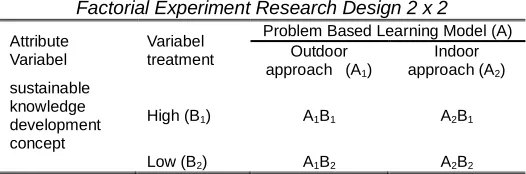
The research method used is an experimental method with a 2x2 factorial design table 1 as follows.
TABLE 1
Factorial Experiment Research Design 2 x 2
Attribute Variabel
Variabel treatment
Problem Based Learning Model (A) Outdoor
approach (A1)
Indoor approach (A2) sustainable
knowledge development concept
High (B1) A1B1 A2B1
Low (B2) A1B2 A2B2
Remarks:
A1 = Group of students who obtained a problem based learning model with an outdoor approach
A2 = Group of students who obtained a problem based learning model with indoor approach
B1 = Group of students who have high knowledge about sustainable development concept
B2 = A group of students who have low knowledge about sustainable development concept
A1B1 = Group of students who treated by using problem based learning model with outdoor approach and high knowledge about sustainable development concept
A1B2 = Group of students who treated by using problem based learning model with outdoor approach and low knowledge about sustainable development concept
A2B1 = Group of students who treated by using problem based learning model with the Indoor approach and having high knowledge about sustainable development concept A2B2 = Group of students who treated by using problem based learning model with the Indoor approach and having low knowledge about sustainable development concept.
The sample collection technique used in this research is cluster purposive random sampling, namely; 1) All of those senior high schools in Ternate were chosen them in random cluster, SMAN 5 was selected as a sample; 2) Purposively selected grade XI of IPS, consist of 3 classes (IPS-1, IPS-2, IPS-3), 3). Randomly selected 2 classes to set the experimental class by using problem based learning model with an outdoor approach (A1) and the other class as a control class with a problem based learning model with an indoor approach (A2); 4) The experimental class consisted of 24 students and the control class consisted of 24 students, who were subsequently given tests on knowledge about sustainable development concept; 5) The sample number in each class was taken from 33% students. Data showed that 16 students obtained highest score of knowledge about sustainable development concept, and 16 students obtained lowest score of knowledge about sustainable development concepts in the experimental class and the control class. The instrument used in this research is tests. It used to know about data knowledge about sustainable development concept and a questionnaire for data on responsibility environment behavior. The results of the data analysis of responsibility environment
behavior variable for 30 respondents in the validity test with alpha (α) = 0.05, obtained Rtabel of 0.361. As for the reliability
test, the criteria used is to compare the results of Ralpha with
Rtables, if the results are positive and greater than Rtables, the
variables used are reliable with the Cronbach Alpha value obtained is 0.846. Test the validity of the knowledge of the
concept of development of 30 respondents with alpha (α)
=0.05, then obtained a Rtable was 0.361. The Cronbach Alpha
value obtained for the reliability test was 0.841 [9].
3 RESULT
AND
DISCUSSION
Based on the analysis of the variance of the two paths at a significant level α =0.05, obtained Fcount =5.16 and Ftable =4.20.
Thus Fcount > Ftable, so that H0 is rejected. With other words that
the problem based learning model with the outdoor approach (=106.00) is higher than the indoor approach (=99.88). This means that the research hypothesis which states that the overall problem-based learning model with an outdoor approach is better than the indoor approach is accepted.
3.1 Overall, there are differences in responsiblility environment behavior between obtaining a problem-based learning model with an outdoor and indoor approach
Based on the analysis of the variance of the two paths at a significant level α = 0.05, obtained F-count = 5.16 and F-table =
4.20. Thus F-count> F-table, so that H0 is rejected. With other
words that the problem based learning model with the outdoor approach (=106.00) is higher than the indoor approach (=99.88). This means that the research hypothesis which states that the overall problem-based learning model with an outdoor approach is better than the indoor approach is accepted.
3.2 Interaction between problem-based learning model and knowledge about Sustainable Development concept toward Differences in Responsibility environment Behavior
Based on the analysis of the variance of the two factors in the ANAVA calculation table above shows that the calculated price F-count interaction =51.01 and F-table =4.20. Obtained F-count > F
-table, so H0 is rejected. The conclusion is that there is an
interaction between problem based learning model and
knowledge about sustainable development toward
163
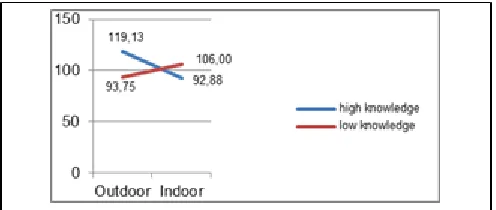
approach is higher than with an indoor approach. Conversely students who have responsibility environment behavior are low and obtain problem-based learning model with an indoor approach higher than with an outdoor approach. The interaction graph between the problem-based learning model and the knowledge about sustainable development is shown in Figure 1:
3.3 Differences of Problem-Based Learning Model effect with Outdoor and Indoor Approaches on Responsibility Environment Behavior for Groups Who Have Knowledge of High Sustainable Development Concepts
Students who have knowledge about sustainable development concept have a high influence on responsibility environment behavior when taught with a problem-based learning model through an outdoor approach. This is proven based on the results of further tests using the Tukey test whose results can be seen in table 2.
TABLE 2
COMPARISON OF A1B1 AND A2B1 GROUPS
No Comparison Groups Qcount Qtable α= 0.05
1. A1B1 with A2B1 9.40 ** 4.53
3.4 Differences of Problem-Based Learning Model effect with Outdoor and Indoor Approaches on Responsibility Environment Behavior for Groups Who Have Knowledge of High Sustainable Development Concepts
Students who have knowledge about sustainable development have low influence on responsibility environment behavior, when taught with a problem-based learning model with an indoor approach. This is proven based on the results of further tests using the Tukey test which can be seen in table 3.
TABLE 3
COMPARISON OF A1B2 AND A2B2 GROUPS
No Comparison Groups Qcount Qtable α= 0.05
1. A1B2 with A2B2 4.86** 4.53
4
DISCUSSION
The first hypothesis. Overall, there are differences in responsiblility environment behavior between obtaining a problem-based learning model with an outdoor and indoor approach. Based on the results of the analysis of variance (ANAVA) of the two roads in hypothesis 1 testing it was found that F-count is greater than F-table (F-count = 5.16> F-table (0.05) (1;
48) = 4.20). This shows that there are significant differences in responsibility environment behavior group of students being taught with problem based learning model through outdoor and indoor approaches. This difference is also shown by the average value of responsibility environment behavior of the two approaches (outdoor and indoor) on the problem-based learning model with an average difference of 106.00 - 99, 88 = 6.12. Conclusion, Outdoor and Indoor approaches to problem-based learning model both contribute to the improvement of responsible environment behavior, but the outdoor approach is superior compared to indoor. This is in accordance with the opinion of [10] stated that outdoor learning can provide sustainable development education through initiatives such as working to increase biodiversity in the school environment, exploring and engaging with local communities. On the other hand, the learning process in the classroom raises the problem of the lack of sense of involvement in understanding phenomena that exist in the natural environment [11]. The results of the analysis of the two path variance in hypothesis 2 found that the F-count interaction of 51.01 was greater than the
F-table (0.05; 1: 28) = 4.20. This means that there is a significant
interaction effect between the problem-based learning model and knowledge about sustainable development concept towards responsibility environment behavior. It is clear that before a person is able to act in solving environmental problems, the main requirement is to have knowledge of the environmental problems themselves that are included in sustainable development materials in order to be able to evaluate the various behavioral consequences that they do in utilizing natural resources. Nevertheless, the knowledge possessed cannot be realized in the form of responsibility environment behavior for students, if it is not transduced by the application of appropriate and relevant learning models. Furthermore, with a significant interaction effect, it was followed by a Tukey test for the two experimental design cells. The results of the Tukey test on scores of responsibility environment behavior of students who have a high knowledge about sustainable development concept obtained the value of Q-count =9.40 greater than Q-table (0.05;4:8) =4.53. Thus it can
164
in the field that are able to stimulate the ability to inspire the discovery of different problem solutions if limited by walls class, his curiosity did not develop. Outdoor learning provides information that is firmly attached to a student's memory. They can explain environmental concepts well with concrete examples [8]. The results of the Tukey test on the score of responsibility environment behavior of students who have low
knowledge about sustainable development obtained Q-count
=4.86 greater than Q-table (0.05;4:8) =4.53. This means that
there are differences in scores of responsibility environment behavior of students who obtain problem-based learning model with outdoor approach and indoor approach for groups of students who have low knowledge about sustainable development concepts. Thus it can be concluded that the average score of responsibility environment behavior of students who have low knowledge about sustainable development concept, the group of students who are taught with a problem-based learning model through an outdoor approach is 92.88 lower than the indoor approach of 106,00. This is in line with the opinion expressed by [12] stated that knowledge can be used by humans in appropriate actions when facing threats. At the time that allows knowledge can also be a motivator for actions, actions that have to do with personal and public interests. Based on this opinion, students with limited knowledge about sustainable development concept, independence in taking a decision of action is very low and very dependent on the teacher as a source of information, therefore the learning approach in the classroom (indoor) will be very relevant to be applied to students with knowledge about sustainable development concept is low compared to learning outside the classroom (outdoor). The results of relevant research conducted by [11] on science learning, that through Contextual Based Outdoor Science Learning, learning become meaningful because of student actively finds the concept of science that learnt in the context every day. contextual based outdoor learning could improve curiosity. A concept that is still abstract requires tangible efforts from the teacher to improve learning outcomes and the formation of the character of love for the surrounding environment. The teacher always strives to develop learning tools to improve student learning outcomes. This is evident from the results of [13] that the students chemistry learning outcomes with Innovative LKS on the material of reduction and oxidation reactions is better. Moreover, The results showed that mathematical problem solving abilities of students after being given ethnomathematics with outdoor learning models were higher than before being given the learning models [14]. The outdoor learning can be an effective approach for educators wishing to augment the social and emotional learning skills of young people with social, emotional and behavioural difficulties [8]. Learning with an outdoor approach can provide stimuli to students cognitively, attitudes and behaviors. They are more sensitive to the environment and learning is more fun. Types of outdoor learning that can provide students with experience and self-actualization is recreational activities. Recreation may play a critical role in the process of selective acculturation. This is because, as a form of behavior, it has potential to be both individually and culturally "expressive". Research suggests that one reason for this is that leisure experiences are perceived by participants as being relatively free from social role constraints [15]. However, the teacher needs to know more about students' psychology and recreation destination locations before carrying out
recreational activities [16].
5
CONCLUSION
The conclusion from the results of this research is to establish responsibility environment behavior for students who have high knowledge about sustainable development concept can be done by applying a problem-based learning model with an outdoor approach better than the indoor approach. Conversely, to form responsibility environment behavior for those who have knowledge about sustainable development concept low can be done by applying a problem based learning model with an indoor approach better than the outdoor approach.
6
ACKNOWLEDGMENT
This paper is a research output sourced from the Khairun University DIPA funding. Thank you to the Head of the LPPM of the Khairun University for agreeing to the allocation of research funds, the Head of SMAN 10 Kota Ternate and the council of teachers, also appreciate to the data collection team.
REFERENCES
[1]. H. R. Hungerford and T. L. Volk, ―Changing learner behavior through environmental education,‖ J. Environ. Educ., vol. 21, no. 3, pp. 8–21, 1990.
[2]. T. O. Seng, ―Problem based learning innovation: using
problem to power learning in 21th century,‖ Singapore Thomson Learn., 2003.
[3]. C. Beard and J. P. Wilson, The Power of Experiential
Learning: A Handbook for Trainers and Educators. ERIC, 2002.
[4]. L. W. Anderson and D. R. Krathwohl, ―Platform
Framework for Teaching and Assessment, Revised Taxonomy of Bloom Education,‖ Yogyakarta: Pustaka Belajar, 2014.
[5]. N. F. for Educational Research in England, Wales, and J. Dillon, ―Engaging and learning with the outdoors: The final report of the outdoor classroom in a rural context action research project,‖ 2005.
[6]. T. A. Loeffler, ―Looking back, paddling forward:
Perspectives on outdoor expedition participation over the lifespan,‖ J. Adventure Educ. Outdoor Learn., vol. 19, no. 2, pp. 111–123, 2019.
[7]. E. D. Enger, B. F. Smith, and A. T. Bockarie,
Environmental science: A study of interrelationships. McGraw-Hill Boston, MA, 2000.
[8]. A. Price, ―Using outdoor learning to augment social and emotional learning (SEL) skills in young people with social, emotional and behavioural difficulties (SEBD),‖ J. Adventure Educ. Outdoor Learn., vol. 19, no. 4, pp. 315–328, 2019.
[9]. D. Wolsk, ―Methodologies of environmental
education,‖ Trends Environ. Educ., 1977.
[10].B. Keith, ―Curriculum excellence Through Outdoor
Learning.‖ Scotland: Improving Scottish Education, 2010.
[11].R. P. Sekarini and I. S. Arty, ―Contextual-based Science Outdoor Learning to Improve Student Curiosity,‖ in Journal of Physics: Conference Series, 2019, vol. 1233, no. 1, p. 12103.
165
lingkungannya. Erlangga, Jakarta, 1990.
[13]. I. Lukman, M. Damanik, S. Silaban, and A. Kembaren,
―Development of problem based learning innovative student worksheets in learning the concept of chemistry for senior high school students,‖ J. Transform. Educ. Educ. Leadersh., vol. 1, no. 1, pp. 23–28, 2019.
[14]. W. Widada, D. Herawaty, A. F. D. Anggoro, A. Yudha,
and M. K. Hayati, ―Ethnomathematics and outdoor learning to improve problem solving ability,‖ in International Conference on Educational Sciences and Teacher Profession (ICETeP 2018), 2019.
[15]. J. H. Gramann, M. F. Floyd, and R. Saenz, ―Outdoor
recreation and Mexican American ethnicity: A benefits perspective,‖ in Culture, conflict, and communication in the wildland-urban interface, Routledge, 2019, pp. 69–84.