By
I?
D.
Gurney
Johnson Matthey Technology Centre
At the heart of personal computers in current use is the hard magnetic disk drive, which pro- vides the sofrware programmes and data with long term storage. The increasing use of Windows, the graphically based computer inter- face which enables users to run several pro- grammes simultaneously, has meant that an ever- increasing amount of data storage space is required. With Windows itself requiring some 15 megabytes (Mb) of storage space and indi- vidual Windows programmes typically taking up 10 to 15 Mb each; the average Windows per- sonal computer (PC) now needs at least 100 Mb of storage space to contain a useful number of programmes and data. The trend for more long term storage will inevitably accelerate with the
growth in multimedia applications, which com- bine photographs, video clips and sound into PC applications. With a single high quality photo- graph requiring up to 30 Mb of storage space, future PCs are expected to need hundreds , and possibly thousands of megabytes of storage space on the desktop.
At present the mainstream of magnetic hard disk drives can provide up to about 1000 Mb locally. Optical data storage, on the other hand, provides an accessible route to larger data stor- age densities since the use of a non-contacting laser to access the data allows for data bit sizes of around 1 micron from the focused beam and enables disks to be easily removed so that sever- al disks can be used with a single drive. Three
external blaS field
-
dlsk spin PerpendicLlarmdgntic domains
-disk spin
bl
external blas foeld
low power p o l a r K e r r l a s e r beam eft ect
(.) Magneto-opttc f i l m
-disk spin
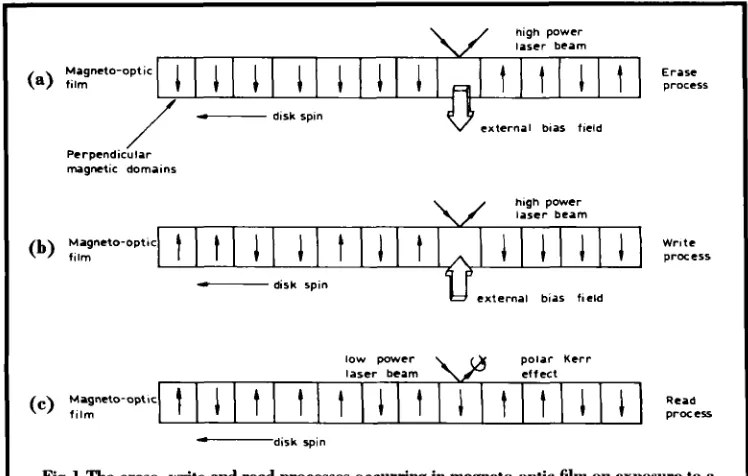
Fig. 1 The erase, write and read processes occurring in magnetooptic f i n on exposure to a laser beam and a magnetic field. The read process employs a lower powered laser beam than the erase and write processes
PlatinudCobalt Multilayers
TNE
NEXT GENERATION MAGNETO-OPTIC DATA STORAGE MEDIUM
By
I?
D.
Gurney
F i g 2 Research and development into disks and drives of the next generation is well advanced, as evidenced by this Johnson Matthey platinudcobalt magneto-optic
disk
types of optical data storage media are in com- mon use, CD-ROMs (Compact Disk Read Only Memory) being the most widespread at present. These disks are prepared using the same tech- nology as audio compact discs and enable data to be read from but not written to the disk. CD- ROM disks can hold 650 Mb on a single 5.25
inch diameter disk. Their main uses are in data- base or software distribution. WORM (Write Once Read Many times) technology has become established as a niche market for archival data storage. The advantage of WORM disks is that once thay have been written to, they cannot be changed and so provide a permanent record.
Several optical data storage methods have been developed where the data can be written and subsequently erased. These include Phase Change Erasable and dye polymer systems, but the one which has become the most widely estab lished to date is magneto-optic data storage. Magnetooptic disks of diameter 5.25 inches cur-
rently available provide a removable, overwritable medium with 650 Mb of storage. During 1993, new agreed standards are likely to result in the commercial availability of 1200 Mb 5.25 inch disks and 256 Mb 3.5 inch disks. The technol- ogy for these disks still uses a magnetic thin film
on which to store the data, but instead of a mag- netic readwrite head, a finely focused laser beam is used to write, read and erase the magnetic domains, as is shown in Figure 1.
The three main elements of the magneto-optic storage system are: the magnetic film,which has a high perpendicular magnetic anisotropy, that is the domains are oriented perpendicularly to the plane of the film; the laser beam, which can be used at high or low power; and the bias coil which can provide an external biasing magnetic field in either the “up” or “down” directions. Figure l a shows the erase process. Here the external magnetic field is pointing downwards and the laser beam, at high power, heats up each domain in turn to above its Curie temperature, while the magneto-optic disk spins round its vertical axis. The Curie temperature of a magnetic material is the temperature above which it loses its coer- cive magnetic field and is typically around 200°C
in these rare earth films. As the domains cool, they take on the orientation of the external bias field, and all the domains point downwards. This
selective domains to above their Curie tempera-
ture, which as they cool take on a reversed mag- netic orientation, thus setting these information bits to “one”. At room temperature the magne- to-optic films have high coercivities, typically of several thousand oersteds, which make the domains very stable and much less susceptible to magnetic change than conventional magnet- ic storage media. The high laser power reduces
this coercivity to a figure approaching zero near its Curie temperature, thus allowing the domain to be reversed by the relatively low strength exter-
nal magnetic field. Finally, Figure l c shows the read process. Here a low power laser beam is used so that the magnetic properties of the film
remain unchanged. The Merent magnetic ori- entations are read by means of the polar Kerr effect, in which the plane of polarisation of the reflected laser beam is rotated to the left or to the right, depending on the magnetic pole from which it is reflected. A detector system is used to record the polarisation shift and thus the mag- netic orientation of the domain.
h4agneto-optic disks and drives have only been available in quantity in the marketplace since 1991, but already research and development into disks and drives of the next generation is well advanced, see Figure 2. The technology of the current generation reads, writes and erases using infrared semiconductor lasers which form domains of about 1 .O micron in diameter. The use of shorter wavelength blue lasers will enable much smaller bits to be written and permit a fourfold increase in data storage density to be achieved. The development of blue lasers small enough to be incorporated into disk drives is like
ly to be achieved within the next few years by doubling the frequency of current generation semiconductor lasers, although a significant worldwide research effort on new materials sys- tems for blue semiconductor lasers is also under- way.
The magnetic films used in present day mag- neto-optic disks are based around amorphous rare earth-transition metal alloys, typically TbFeCo or GdTbCo, which have a good per- pendicular magnetic anisotropy, high coercivi- ties and relatively large polar Kerr rotations, 8,.
n G.
2 300 4 0 0 500 600 7 0 0 800 900 WAVELENGTH. n m
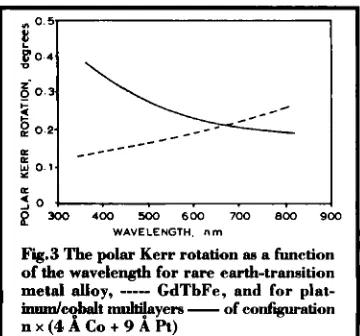
Fig.3 The polar Kerr rotation as a function
of the wavelength for rare earth-transition metal alloy,
---
GdTbFe, and for plat- imnnle~balt +yers-
of configuration n x ( 4 A Co+
9 A Pt)However, as can be seen from Figure 3, the key magneto-optic property, the polar Kerr rotation,
diminishes rapidly for such materials as the wave- length of the light is reduced from infrared to blue (1). Of the new materials systems that have been considered as future replacements for the rare earth-transition metals, the most promising is that of platindcobalt multilayer thin films. Figure 3 shows that this material possesses an increasing polar Kerr rotation as the wavelength of the incident laser beam is reduced and should
give a superior performance to rare earth films at short wavelengths. These multilayers are pre- pared by alternately sputtering ultra-thin films of platinum and cobalt to give a structure of the type shown in Figure 4, where each metal layer is just a few Angstroms thick.
The use of platinudcobalt multilayers can provide other benefits as well. Although extreme- ly thin, they are remarkably stable on exposure to air, unlike the equivalent rare earth-transition metal films and should provide for an inherent- ly stable disk structure. This may enable simpler disk structures to be used.
Developments
in
PlatindCobalt
Technology
magnetic anisotropy (2). In 1989 research groups from both Sony and Du Pont reported the devel- opment of platindcobalt multilayer films with good perpendicular magnetic anisotropy and polar Kerr rotation, even though the film coer- civity was still low at around 500 Oe (3,4).
Further work from Du Pont and Philips Research resulted in the preparation of high coer- civity multilayers of over 3kOe, prepared by sput- tering using krypton or xenon, rather than the usual argon, and by using a zinc oxide under- layer ( 5 ) .
At Johnson Matthey, research into platinum- containing magneto-optic media has been under- way since 1988. This research programme has included collaborative work with Coventry University on both multilayer modelling ( 6 ) and on platinum manganese antimonide magneto- optic films (7).0ur in-house programme has focused on investigating the production of high quality magneto-optic platindcobalt multilay- ers using argon sputtering, which should pro- vide a simpler route to commercial production than krypton or xenon sputtering. We have found that close control over the argon sputtering process has enabled us to control the film coer- civity over a wide range of values (8).
Typical polar Kerr hysteresis loops for identi-
PI a t inu rn
Cobalt
I
Platinum
Cobalt
I
PIaimrn
Cobalt
I
Plat inu rnI
I Cobalt I
I
Rat i n u rn1
Cobalt
Platinum
Cobalt
Fi.4 I)pical construction of Idatirmm/eobalt multilayer film
'k 3 degree!
1-0.4
0 . 4
Y
I
0.2
0.1
?-y
H, kOe. 0 . 2
)
-0.3
- 0 4
Fi. 5 Hysteresjs loop &owing the response of the magnetooptic pol? Kerr rotation of identical 8A platind3A cobalt mdtilay- ers to changes in applied magnetic field.
Tbe x-axis c-ver indicates the film coelc
civity, H,
cal platindcobalt multilayers prepared here at the Technology Centre are shown in Figures 5.
x-axis, is seen to be controllable from levels of
1 kOe or below, up to over 6 kOe. While the ideal coercivity for a magneto-optic disk will also depend on the optimisation of other disk prop- erties, this degree of control provides the means to make large changes in these other properties without restricting the film coercivity to unac- ceptably low levels.
The other basic multilayer property that needs to be controlled is that of the Curie temperature. Typical platindcobalt multilayers tend to have Curie temperatures at least one hundred degrees higher than rare earth films, and a higher laser power is therefore required to write to or erase the film. These Curie temperatures may need to be reduced in future platindcobalt magneto-optic systems as blue lasers may not have the relative- ly high powers of present day infrared lasers.
Several workers have now shown that increas- ing the platinum layer thickness in the multilay- er can reduce the Curie temperature. For instance, at Johnson Matthey we have produced multilayers with differences of over 120°C in their Curie temperatures, by increasing the plat- inum thickness fkom 8
A
to 15A,
as shown in the Table below.Films with very high platinumkobalt ratios tend to have reduced polar Kerr rotations, and therefore such an approach, on its own, is not ideal. We have also shown that the Curie temperature varies with the number of platinumkobalt periods (9). Figure 6 shows the effect of the number of platindcobalt periods on the Curie temperature for otherwise identi- cal multilayers of configuration platinum 8 &cobalt 3
A.
Several research groups have investigated the effect on Curie temperature of additives to the
Cobalt thickness, Platinum thickness,
A
A
3 8
3 15
: I
1
u' 250
2 4 s a 10 12 14 1s ia 20 22
Fig.6 The variation of the Curie temperature with the punbereof platinumlcohalt p e r i o d s
for Pt 8 NCo 3 A multilayers which are 0th- e h s e identical
NUMBER OF PERIODS
Number of Curie temperature, Pt/Co periods "C
9 365
9
1
240platindcobalt multilayer. Philips Research have recently reported that the addition of a few per cent of elements, such as rhenium, osmium, rhodium, iridium and ruthenium, to the cobalt layer can be useful in lowering the Curie tem- perature, with rhenium and osmium in particu- lar maintaining anisompy and the hysteresis loop shape (1 0). Sony Research have used nickel as an additive to the cobalt layer which has pro- duced similar results (1 1).
PlatindCobalt Disk Production
Magneto-optic disks containing platinum/ cobalt are currently being prepared and tested in many laboratories worldwide, including those of Johnson Matthey, and their superior perfor- mance at short wavelengths, compared to that of rare earth-based disks, is now well established. There are, however, several key technical issues that need to be addressed in order to commer- cialise this new technology. These include long term stability of the multilayer structureand also the noise levels that can be achieved. The stability of the interfaces of a platindcobalt multilayer to repeated laser puls- es is an issue that has been investigated by Sony Research, where the noise level of a series of plat- inudcobalt disks has been measured as a func- tion of both disk structure and Curie temperature (12).
It was found that those disks with a structure or a low Curie temperature that enabled a lower peak temperature for writing to be used were the ones which maintained good noise figures over long write/erase cycles. Platinudcobalt disks which were exposed to consistently higher writ- ing temperatures experienced a long-term degra- dation in noise levels which was ascribed to atom- ic mixing at the platindcobalt interface.
Noise levels in platindcobalt disks have been shown by Sony Research to be related to the smoothness of the silicon nitride underlayer and the degree of the (1 11) crystal orientation in the platindcobalt multilayer (1 1). The higher polar Kerr rotation of platindcobalt at shorter wave- lengths should lead to improved noise figures compared to rare earth disks as the wavelength is reduced, and several groups have now reported this.
Sony have prepared, by using xenon sputter- ing, platindcobalt disks with higher carrier to noise levels of 6 to 8 decibels (dB) than rare earth
disks, at 488 nm readwrite wavelengths (1 1). Philips Research investigated magneto-optical performance over a range of wavelengths and found that their platinudcobalt disks gave a higher (2-3 dE3) noise level than a rare earth disk at wavelengths of 820 and 647 nm (13). However, at 458 nm the result was reversed with the platindcobalt disk performing 3 dB bet- ter than the rare earth disk.
Conclusions
Platindcobalt multilayers are fundamental- ly an attractive option as magneto-optic data stor- age media for the next generation because of their inherent nobility and their excellent mag- netic and optical properties at short wavelengths. Significant advances have been made in opti- mising the magnetic properties of these multi- layers by using standard argon sputtering process- es, which makes the commercial production of disks based on this technology feasible. Noise levels for p l a t i n d c o b a l t magneto-optic disks have the potential to equal those of rare earth- transition metal disks at currently used laser wave- lengths and to become superior as the readwrite wavelength shortens.
While much detailed work is still required to turn this technology into a commercial product, the future of platindcobalt magneto-optic disks shows great promise.
References
1 P. F. Carcia, W. B. Zeper, H. W. van Kesteren, B. A. J. Jacobs and J. H. M. Spruit, Proc. Magneto- Optical Recording Int. Symp. (MORIS 91), April 1991,J M a p . Soc. Jp., Suppl. S1,1991,151 2 P. F. Carcia, A. D. Meinhaldt and A. Suna, AppZ.
Phys. Lett., 1986,47, (2), 178
3 Y. Ochiai, S. Hashimoto and K. Aso, Jpn. J Appl.
Phys., 1989, 28, (4), L659
4 W. B. Zeper, F. J. A. M. Greidanus, P. F. Carcia and C. R. Fincher, J AppZ. Phys., 1989,65, (12), 497 1
5 P. F. Carcia, M. Redly, W. B. &per and H. W. van Kesteren, Appl. Phys. Lett., 1991, 58, (2), 191 6 R Carey, D. M. Newman, P. A. G. Sandoval, B. W.
J. Thomas, P. J. Grundy and E. T. M. Lacey, op
cit., (Ref. l), 25
7 R Carey, H. Jenniches, D. M. Newman and B. W. J. Thomas, MORE 92, Dec. 1992,J Magn. SOC.
Tpn., Suppl. S1, 1993,290
8 P. G. Pitcher, J. Miller, D. P. A. Pearson and P. D. Gurney, Proc. Magneto-Optical Recording Int. Symp. (MORIS 92), Dec. 1992,J. Magn. Soc. Jpn, Suppl. S1, 1993, 91
9 P. G. Pitcher, J. Miller, D. P. A. Pearson and P. D. Gurney, Proc. Magneto-Optical Recording Int. Symp. (MORIS 92), Dec. 1992,J. Magn. Soc. Jp., Suppl. S1, 1993, 95
10 H. W. van Kesteren and W. B. Zeper, J Magn. 6 Magn. Mater., 1993,120,271
11 S. Hashimoto, A. Maesaka, K. Fujimoto and K. Bessho,J Magn. 6 M a g n . Mum.., 1993,121,471
12 K. Fujimoto and S. Hashimoto, 1st Int. Symp. on Metal Multilayers, (MML'93) Kyoto, 1-5 March
1993, Paper 2P-76
13 W. B. Zeper, A. J. P. Jongelis, B. A. J. Jacobs, H. W. van Kesteren and P. F. Carcia, IEEE Trans.