32
A Comparison Study Between Xquery And LOQL
In Querying LO
Huda Basloom
Abstract: E-learning turns out to be an important aspect for the educational area. An important problem in the e-Learning area is the creation of digital learning materials because it becomes expensive. Learning Object (LO) has been proposed to reuse materials which will reduce the cost. Each LO has metadata. Metadata is used to make LO reusable, sharable, storable and manageable in a repository such as an archive or museum. The most popular metadata standards that provide cataloguing, searching and reuse of resources are the Dublin Core Metadata Element Set (DCMES) and the IEEE Learning Object Metadata (LOM).An interesting form to retrieve and manipulate collections of LOs is declaratively via a query language. However, current languages used to achieve this are either aimed to a particular implementation of LOs (e.g. XML for instance) or lack the required features to manage and query collections of LOs adequately. Currently possible to use a general purpose XML query language, such as XPath or XQuery. These languages have widely acceptance and great expression power. LOQL (Learning Object Query Language) is a new language which allows a user/application to create, assemble, update and query LOs, independently of any particular implementation. A prototype system has been implemented to test these ideas. The paper presents SCORM concepts. Also, it discusses adaptation possibilities of the SCORM. In addition, it presents different ways to query LO and a comparison study between XQuery and LOQL.
Index Terms: Adaptation, adaptivity, adaptability, personalized learning, SCORM, Learning Objects, manage Learning Object, XQuery, XPath, Query XML.
————————————————————
1.
I
NTRODUCTIONE-learning is a process of learning that takes place through a network, usually over the Internet or an intranet of an educational institute or a company. With e-Learning system Companies have improved training efficiency and reduce costs as well. E-education enables E-Learners to learn without the restrictions of both time and space. However, learning is a highly personalized activity, which varies based on the background knowledge of the subject, previous experiences (general and specific), motivation, preferences, context and other activities in which the user is engaged. Personalization is a process, which would affect the learning of an individual at different levels. It should identify specific skills and knowledge gaps and direct learners to the appropriate lessons or modules. [15] Learning Object (LO) has been proposed to reuse materials which will reduce the cost. Each LO has metadata. Metadata is used to make LO reusable, sharable, storable and manageable in a repository such as an archive or museum. The most popular metadata standards that provide cataloguing, searching and reuse of resources are the Dublin Core Metadata Element Set (DCMES) and the IEEE Learning Object Metadata (LOM). An interesting form to retrieve and manipulate collections of LOs is declaratively via a query language. However, current languages used to achieve this are either aimed to a particular implementation of LOs (e.g. XML for instance) or lack the required features to manage and query collections of LOs adequately [2]. Querying XML data is a well explored topic in both Database (DB) and Information Retrieval (IR) fields, which focuses on the study of XML element retrieval methodology. The most popular way to querying XML documents use path-based query language, such as XPath or XQuery. There are other ways to query XML will discussed in section14. There is a new language proposed in 2008 particularly to query LO. This language is LOQL. LOQL considers not only aspects for querying LO repositories, but also takes into account the creation of simple and complex LOs as well as their grouping in LO-sets that can be manipulated. The paper aims to do comparison study between the XQuery language and the LOQL in querying LO. Due to the rapid progress of e-learning, numerous standardization efforts have been emerged to allow reusability of educational contents and interoperability between developed systems.
33 course following different activities that are appropriate for him
according to his profile 0. This paper will discuss the SCORM adaptations abilities and will present survey about the previous work in combining adaptation with SCORM. [9] Learning style represents an important concept in educational psychology, having a significant effect on the learning process. However, most of today’s adaptive educational systems don’t take into account this dimension of the student profile [5]. Those that do, only rely on a single learning style model and usually adopt a static and explicit approach to student modeling: the learner has to fill in a specific psychological questionnaire and the resulted categorization is stored once and for all in the system [5]. This paper present FSMLSM and cognitive traits and how to adapt course content to user needs through them. This paper structured as follows, first, the paper gives brief introduction to e-learning (Section 2). Then LO and its repository presented (Section3). Next, the paper describes the concepts and main features of the SCORM standard (Section 4). The most important part querying LO discussed in (Section 5). Finally, a comparison study is discussed in (Section 6) followed by future work.
2.
E-
LEARNING‖E-learning is the delivery of a learning, training or education program by electronic means. E-learning involves the use of a computer or electronic device, e.g. a mobile phone, in some way to provide training, educational or learning material.‖0 The term includes: 0
Online learning. Web-based learning. Computer-based training.
The most common terms used to describe learning:
Learning standards, when applied to learning infrastructure, are intended to assure that learning content will be run on similar ―standards compliant‖ infrastructure components and might be interoperable. LMS is an application that handles learning - related administrative tasks such as creating course catalogs, registering users, providing access to online courses or course components, tracking users within courses, recording data about learners (such as test scores and pages visited), and providing reports about usage and outcomes to stakeholders. A LCMS (Learning Content Management System) is an application that manages aggregation (putting together) of learning content, typically called learning objects, allows administrators or designers to search for desired content, convert content format, and sequence learning objects into courses. Some LCMSs integrate authoring capabilities. LO are digital media elements (such as text, graphics, audio, video, and animations) that can be aggregated to form lessons, modules, or courses and are intended to be granular enough to be usable in a variety of courses.
LO (Learning Object)
It was defined by the LTSC of IEEE as‖any entity, digital or non digital, that may be used for learning, education or training‖ [6]. Wiley (2000) narrowed the definition as ―any digital resource that can be reused to support learning.‖ In its most basic form, a learning object can be any content in digital form that facilitates some valued learning in some computer - based media context. This would mean that a LO could be anything from a selection of text or video to an entire instructional unit
[3]. Learning Objects are a new way of thinking about learning content design, development and delivery. Instead of providing all of the material for an entire course or lecture, a Learning Object only seeks to provide material for a single lesson or lesson-topic within a larger course. It was noted that LOs are extensively used by well known corporations such as Cisco, Microsoft. AT&T Business Learning Services also adopt this technology for internal and customer training [3, 6]. There are many architectures and platforms which have been adopted as test beds and prototypes. One of these is a LMS based on the Life Cycle Management Model (LCMM) of e-learning courseware [6].This model concentrates on analysis, design, development, delivery and measurement of courseware content – activities known collectively as SCORM - within the e- learning environment. This architecture does not include collaboration with other LMSs on other sites. Another e-learning architecture was proposed based on workflow using fuzzy Petri nets [6]. This architecture takes account of the processes of academic study activities which means that it navigates the learning resources (i.e. LO), adapting to each learners pace by formal description of their learning path and the application of workflow technology in building and implementing workflow course in the service environment[3]. In general, LOs have the following characteristics:
Can be consumed independently.
Single LO may potentially be used in multiple contexts for multiple purposes on multiple campuses.
Can be grouped into larger collections, allowing for their inclusion within a traditional course structure.
Every LO has descriptive information allowing it to be easily found by a search -- which facilitates the object being used by others.
If the needed is only part of a course, you can use only the LOs you need.
LOs are searchable, it can be found.
LOs allow for easy customization of courses for a whole organization or even for each individual.
The term LO is meaningful only if it achieves the instructional author's learning intent and is reusable.
Accessibility: the LO should be tagged with metadata so that it can be stored and referenced in a database Reusability: once created, the LO should function in
different instructional contexts:
o Original learning intent and strategy effectively embodied by the author
o Capable of re-purposing for new learning intent & strategy
o Adaptive use by new authors, instructors, and learners
Interoperability: the LO should be independent of both the delivery media and learning management systems.
LO can be defined as "Encapsulation of Content within a Learning Strategy." In this illustration, a Course is composed of modules of both online LO, as well as Lectures, Classroom exercises, Textbook assignments, Video assignments and Discussions that provide a course presentation [3]. A RLO (Reusable Learning Object) is typically conceived as having a fundamental structure that includes these minimum components:
34 tagging language across various platforms.
Content: allows digital assets to be presented in a form that is interactive
Practice: allows digital assets to be presented in a form that is interactive, and requires active responding by the learner
Assessment: allows digital assets to be presented in a form that is interactive, requiring pre and post assessment events
Digital assets: include a combination of text, graphics, animation, audio, video, and interactive user interface components.
A repository of LOs is a system that applies standards for representing LOs metadata. It also takes into consideration how to store and index its LOs effectively, enabling search and browse facilities. Using these services, an instructional designer can query-like using XPath or XQuery- the repository to select related LOs to some certain topics, and then can perform the suitable packaging to produce new learning curricula [3]. The best way to manage these services is to associate the repository with an efficient IR (Information Retrieval) engine. This engine, which can be based on a solid IR model, could provide the basic operations, such as indexing, querying, matching, and evaluating that are needed in content development [3].
3.
SCORM
SCORM (Sharable Content Object Reference Model) is a standard for developing e-learning content, which is proposed by ADL (Advanced Distributed Learning) [1]. Reference models are descriptions of how existing technical specifications may be used together to achieve some aim. In the case of the SCORM, the aim is to describe how learning content and the systems that manage that content can interoperate in a standard way [1]. ADL was launched to provide access to the high-quality education and training that can be tailored to individual learner needs and delivered cost effectively, whenever and wherever they are required [15]. SCORM emphasizes on Web-based Training (WBT) [15]. It use existing specifications as AICC (Aviation Industry CBT Committee) [24], IMS Global Learning Consortium [11], IEEE (Institute of Electrical and Electronics Engineers) LTSC (Technology Standards Committee) [13], and combines those via XML -instead of creating a new specification again- to standardize the interface between web based content and web based learning technology systems such as learning management systems (LMSs), also known as virtual learning environments (VLEs). The SCORM is not in itself a specification or standard. It is for standardizing the way web based content works with the systems that use the content, the VLEs. [1, 15, 12] SCORM states these main criteria: reusable, accessible, durable, interoperable, adaptable, and affordable. In the following little describe of them: [1]
Accessibility: The ability to locate and access instructional components from one remote location and deliver them to many other locations.
Adaptability: The ability to tailor instruction to individual and organizational needs.
Affordability: The ability to increase efficiency and productivity by reducing the time and costs involved in delivering instruction.
Durability: The ability to withstand technology evolution
and changes without costly redesign, reconfiguration or recoding.
Interoperability: The ability to take instructional components developed in one location with one set of tools or platform and use them in another location with a different set of tools or platform.
Reusability: The flexibility to incorporate instructional components in multiple applications and contexts.
SCORM versions
The SCORM has progressed through a number of releases since version 1.0 in January 2000, with each release adding further maturity and functionality [19, 12]. Originally it released as the Sharable Courseware Object Reference Model in Version 1.0. It renamed to the Shareable Content Object Reference Model in Version 1.2. This was done to better show that the SCORM applies to various levels of content. Aligning with this shift, the Course Structure Format which is one of the fundamental aspects of SCORM was also changed to the Content Structure Format (CSF) [19]. The CSF defines all of the content elements, the content structure, and all external references necessary to represent content and its intended behavior. This CSF is intended to promote reuse of entire courses and course components by exposing all the details of each course element. The CSF is intended to reduce (or eliminate) dependency of content on a particular LMS implementation. With the release of SCORM Version 1.2 the addition of content packaging application profiles became available. Derived from the IMS Content Packaging specification, these profiles map the Content Structure Format (CSF) from the SCORM Version 1.1 into the general IMS specifications. This version of the SCORM also updated the metadata used to describe learning content. SCORM 2004 introduced Sequencing and Navigation as an aspect of the SCORM suite of specifications. This new version updated the other specifications to track evolution of standards and harmonized them with Sequencing and Navigation. With this version, the SCORM document is considered stable. [19]
The organization of SCORM
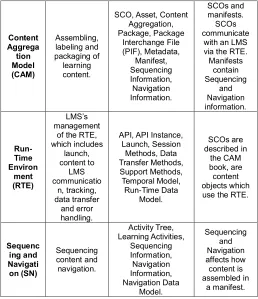
SCORM is a collection of specifications and standards that can be viewed as separate "books" gathered together into a growing library. Nearly all of the specifications and guidelines are taken from other organisations (such as, AICC, IEEE and IMS). These technical "books" are presently grouped under three main topics: Content Aggregation Model (CAM), Run-Time Environment (RTE) and Sequencing and Navigation (SN) [1]. While the various SCORM books can stand-alone, there are areas of overlap. For instance, while the RTE book focuses primarily on communication between content and LMSs, it frequently refers to the different types of content objects conducting that communication: Sharable Content Objects (SCOs). More details about SCOs are found in the CAM book. Table summarizes the books.
SCORM Book
Concepts Covered
Key SCORM Technologies
Covered
Areas of Overlap
Overvie w
High-level conceptual information.
Introduction to numerous high-level elements of SCORM
terminology.
35 Content
Aggrega tion Model (CAM)
Assembling, labeling and packaging of learning content.
SCO, Asset, Content Aggregation, Package, Package
Interchange File (PIF), Metadata,
Manifest, Sequencing Information, Navigation Information.
SCOs and manifests. SCOs communicate
with an LMS via the RTE. Manifests
contain Sequencing
and Navigation information.
Run-Time Environ
ment (RTE)
LMS’s management
of the RTE, which includes
launch, content to
LMS communicatio
n, tracking, data transfer
and error handling.
API, API Instance, Launch, Session
Methods, Data Transfer Methods, Support Methods, Temporal Model,
Run-Time Data Model.
SCOs are described in
the CAM book, are content objects which use the RTE.
Sequenc ing and Navigati on (SN)
Sequencing content and navigation.
Activity Tree, Learning Activities,
Sequencing Information, Navigation Information, Navigation Data
Model.
Sequencing and Navigation affects how content is assembled in
a manifest.
Table 1: SCORM Book Coverage
4.
Q
UERYINGL
EARNINGO
BJECTLO has some metadata associated with it to facilitate its search, retrieval and processing, which includes assemble it with other LOs to form a more complex one. Sets of LOs are usually stored in repositories. Metadata are usually described in terms of the IEEE LOM standard, although other standards (like Dublin core metadata, IMS metadata) have been also used to represent LOs. In any case, metadata are usually represented in XML. The next section will present an over view to Query. After that we will present the XML and how to Query XML."Databases provide a means of retrieving records or parts of records and performing various calculations before displaying the results. The interface by which such manipulations are specified is called the query language". [16] The most popular way of querying structured data is the SQL Query language. Most critical data is stored in a relational database, and most users and applications employ SQL to find, retrieve, and manipulate the data. So SQL defines the benchmark (or gold standard) for querying data. The relational database (SQL database) stores data in tables and allows search across those tables with SQL. At least 90% of the data in the world is unstructured data [37, 39], and a great deal of valuable information is locked up in word files, PowerPoint presentations, PDF documents, and so on. The unstructured data is the data that cannot be represented naturally as numbers and dates and strings, such as a documents, pictures, and movies clips and it's not always binary. There are three approaches to query learning objects- metadata, objects, and markup. The metadata approach store the unstructured data as an opaque chunk of data and add metadata and querying it directly using object technology [16]. The object approach requires the definition of an object type, with methods, for each kind of data to be queried, plus an
application to query that data. In markup we deal at the end with XML document that can be described and queried with standard tools. The markup can be used to represent metadata. There is another approach to query unstructured data directly in a way that is appropriate to that kind of data. For example query text data using full-text queries. There are analogous query mechanisms for other kinds of unstructured data. For example, to query across images, you can extract some metadata (like size, date, exposure, etc); represent that metadata in database column or an object attribute or as markup; and query that metadata. Or directly query images according to their similarity to some given image (query by example) or by given verbal description of the image you are looking for. Images could be compared along several dimensions like texture, colors, shapes, etc.
XML
XML (Extensible Markup Language) is a Meta language for marking up semi-structured documents. It can be extended to include domain specific tags; information can be encoded with meaningful structure and semantics that allow rapid information sharing among devices and organizations [36]. XML has become the standard for information representing, exchanging, and publishing. Querying XML data is a well explored topic in both Database (DB) and Information Retrieval (IR) fields, which focuses on the study of XML element retrieval methodology [38].
Querying XML
36 APIs rather than query languages. They are popular ways to
walk the XML tree and return results [16]. XQuery is a language defined by W3C specifically for querying XML data. It is strongly typed, expression-based, highly expressive language. XQuery 1.0 also includes the XPath 2.0 expressions. XQuery 1.0 and XPath 2.0 will become the standard way to query XML [37, 39]. Many people believe that SQL/XML (the extensions to SQL) competes with XQuery as an XML query language, but that is not true. SQL/XML provides an API for querying XML data in SQL environment, using XPath and XQuery to query the XML structure and values.
XPath
The XML Path language was first published as a recommendation by the W3Cin 1999. It was created to provide a common syntax for functionality shared between XSLT (XSL Transformations) and XPointer, and its purpose is to address parts of an XML document [16, 40]. XPath can quit reasonably be viewed as a language for querying XML documents. If we replace address by locate or identify the meaning would be the same. Because querying facilitates in general function to locate or identify certain information, it's easy to see that XPath is a sort of query language. XPath is used to query only one document at a time, which it is not suitable for finding documents of interest but to find desired information within a known document [16]. Ther are two versions available, XPath 1.0 and XPath 2.0. In 1999, the W3C established the XML Query Working Group, with the charter to develop a language designed specifically for querying XML documents. The XML Query language is known as XQuery. XPath 2.0 requirements are subset of those for XQuery. In addition they share a number of other specifications, including the data model, formal semantics, and functions and operators-all discussed in the XQuery section-.
XQuery
XQuery, which is proposed by W3C, is a language that can query structured or semi-structured XML data. With the XML data type support provided in the Database Engine, documents can be stored in a database and then queried by using XQuery. XQuery is based on the existing XPath query language, with support added for better iteration, better sorting results, and the ability to construct the necessary XML. XQuery is widely accepted by many applications. The structural aspects of the unified XML view are rigid enough to support DR (Data Retrieval) queries as known from database systems. XQuery standard, have exploited this fact to provide expressive DR query capabilities for XML. A standard query language is very helpful for interoperability among digital library systems over the Internet. XQuery, which has been influenced from most of the previous XML query languages, is a forthcoming standard for querying XML data. XQuery could be used in digital library systems that support XML documents [47]. Figure 1 show generic digital library system architecture. With this system, users may be able to request content-based and/or structured-based search, and to get full and/or partial XML documents as answers. The generic digital library system consists of four modules: a User Interface, an XQuery Engine, an Information Retrieval Engine, and an XML Repository [47]. The user interface module gives a user an interface to search XML documents and transforms a given user query to its equivalent query in XQuery. The XQuery Engine module takes
a query in XQuery from the User Interface and gives a POT to the Information Retrieval Engine as output. The Information Retrieval Engine executes the POT by communicating with the XML Repository, which stores XML documents [47].
5.
LOQL
(L
EARNINGO
BJECTQ
UERYL
ANGUAGE)
LOQL is a language that offers expressions to manage and query individual LOs or sets of them (LO- sets). It allows a user/application to create, assemble, update and query LOs, independently of any particular implementation. LOQL considers not only aspects for querying LO repositories, but also takes into account the creation of simple and complex LOs as well as their grouping in LO-sets that can be manipulated. Also it defined algebra for manipulating LOs. They implement LOTool prototype system, which maps LOQL expressions to their XQuery counterparts for execution [2].
6.
C
OMPARISON STUDY37 need to deal with the specifities of the representation used for
metadata. LOQL deals with the specifities of the representation used for metadata. XQuery defines two phases of processing an expression called the static analysis phase and the dynamic evaluation phase. The purpose of the Static Typing Feature is to provide early detection of type errors and to infer type information that may be useful in optimizing the evaluation of an expression. The dynamic evaluation phase is the phase during which the value of an expression is computed. It occurs after completion of the static analysis phase. It can occur only if no errors were detected during the static analysis phase. LOQL define three phases of processing an expression E: syntactic and semantic analysis of E, transformation of E into an algebraic expression A, and execution of A. The execution of an algebraic expression consists in the sequence of executions of the individual functions/ operators. The execution of each one of these elements depends on its particular implementation. Consider for instance that the LO repository is implemented using an XML database. In that case, a set of rules need to be applied to generate the corresponding XQuery expression that will be finally executed. The following table summarizes the comparison between LOQL and XQuery.
LOQL XQuery
Developed in 2008 1999
Created for
It is implemented specifically for LO. LOQL considers not only aspects for querying LO repositories, but also takes into account the creation of simple and complex LOs as well as their grouping in LO-sets that can be manipulated.
Querying any XML file. And it is used to query metadata (which is XML file) of LO.
These languages are totally bound to a XML implementation, and they do not have the appropriate mechanisms to compose basic LOs into larger ones.
Based on
Based on OQL and the semi-structured query language Lorel.
borrows features from several other languages, including XPath , XQL , XML-QL , SQL, and OQL
Acceptance New language does not have widely used.
Widely used to query XML file and LO metadata. It is forthcoming standard for querying XML data.
Familiarity to SQL
Like height level language, it is English structured which is easy to understood.
Familiar to those of SQL to prepare queries and retrieve query results. It hiding the XML details. Offers an OQL-like select-from-where expression to query LO-sets.
It combines XML with query so it is not very familiar, because the user needs to know background about XML programming language.
Execution time for the same query
Set of rules need to be applied to generate the corresponding XQuery expression that will be finally executed. At the final it will be converted to XQuery (using LOTool) and execute as XQuery query. So it will take a long time than the same query written by
It will execute immediately as XQuery query. So it will execute faster than LOQL.
XQuery directly.
Representation used for metadata
It deals with the specifities of the representation used for metadata.
Dose not deals with the specifities of the representation used for metadata.
Query LO
Query learning objects independently from its implementation.
the query of LO is dependent on its implementation which is XML.
processing an expression
Three phases:
Syntactic and semantic analysis of E, transformation of E into an algebraic expression A, and execution of A.
two phases:
Static analysis phase and the dynamic evaluation phase. The static analysis phase depends on the expression itself and on the static context. The dynamic evaluation phase occurs after completion of the static analysis phase. It can occur only if no errors were detected during the static analysis phase.
7.
C
ONCLUSIONS ANDF
UTURE WORK38 languages so far. DR provides means to formulate queries
based on exact matches of data. IR is based on the notion of (relative) relevance of documents within a document collection. The future work is to integrate IR capabilities into XQuery and through this, provide more expressive queries than DR or IR alone can answer.
LIST OF REFERENCES
[1] ―SCORM 2004 3rd edition Overview‖, Advanced Distributed Learning, 2006, http://www.adlnet.org.
[2] Edgard Bentez-Guerrero, Carmen Mezura-Godoy .(2008). "A Declarative Approach for Managing and Querying e-Learning Objects", Mexican International
[3] Saul Carliner, And Patti Shank, E-learning handbook, 1st ed. Pfeiffer. , 2008, pp.13-77
[4] Hartley, Darin, and Elizabeth Rossen. Info-line: Basics of E-Learning (Infoline). Alexandria: 1st ed, 2001, pp.23- 50
[5] Elvira Popescu, Philippe Trigano and Costin Badica, "Adaptive Educational Hypermedia Systems: A Focus on Learning Styles ", the International Conference on ―Computer as a Tool‖, IEEE, 2007, Vol.6, No., pp 2473- 2478.
[6] Song Wang, Elke A. Rundensteiner and Murali Mani,"Optimization of Nested XQuery Expressions with Orderby Clauses", 2005, IEEE, Vol., No., pp:1-10
[7] Fawaz Ghali1, Alexandra I. Cristea1, and Craig Stewart2 ."My Online Teacher 2.0" , 2008, Vol., No., pp.1-6
[8] F. Mödritscher, V. García Barros,"Enhancement of SCORM to support adaptive E-Learning within the Scope of the Research Project AdeLE". Proceedings of the ELEARN, 2004, Vol, No., PP.1-7
[9] M. Rey-López, et al.," An extension to the ADL SCORM standard to support adaptivity: The t-learning case-study," Computer Standards & Interfaces, Vol. 10, No. , 2008, PP.1-10.
[10] V. García Barrios, Gütl.C, "AdeLE: A Framework for Adaptive E-Learning through Eye Tracking", Vol.8, No., 2004, PP.1-8.
[11] IMS Global Learning Consortium, Inc.." Welcome to IMS Global Learning Consortium, Inc.. 27 Jan. 2009 <http://www.imsglobal.org>.
[12] W.Kraan, "What is ADL SCORM?", Centre For Educational Technology Interoperability Standards(CETIS),2005, Vol.4, No., pp.1-4
[13] "AICC - Aviation Industry CBT Committee." AICC - Aviation Industry CBT Committee. 27 Jan. 2009 <http://www.aicc.org/>.
[14] C. Limongelli, A. Sterbini and M. Temperini. ―Automated course configuration based on automated planning: framework and first experiments‖. In Methods and
Technologies for Learning ICMTL- International Conference on Methods and Technologies for Learning, G. Chiazzese et. al. Eds. WIT Press, Vol.7, No., 2005, PP.1-7.
[15] Limongelli, C.; Sampietro, G.; Temperini, M. EUROCON,"Configuration of Personalized e-LearningCourses in Moodle", 2007. The International Conference on "Computer as a Tool" , Issue , 9-12 Sept. 2007 Vol, No. ,pp:2680 – 2686
[16] Peng, Yan ," SCORM-based Courseware Design for the Personalization of E-Learning System", IITA , Vol. 4, No. , 2007, pp. 260-263.
[17] "Querying XML: XQuery, XPath, and SQL/XML in Context", Jim Melton, Stephen Buxton, Morgan Kaufmann, 2006, pp:3- 403