ISSN (Online): 1694-0784 ISSN (Print): 1694-0814
A New Computational Schema for Euphonic Conjunctions in
Sanskrit Processing
Rama N.1 and Meenakshi LAKSHMANAN2
1 Department of Computer Science, Presidency College Chennai 600 005, India
2
Department of Computer Science, Meenakshi College for Women Chennai 600 024, India
and
Research Scholar, Mother Teresa Women’s University Kodaikanal 624 101, India
Abstract
Automated language processing is central to the drive to enable facilitated referencing of increasingly available Sanskrit E-texts. The first step towards processing Sanskrit text involves the handling of Sanskrit compound words that are an integral part of Sanskrit texts. This firstly necessitates the processing of euphonic conjunctions or sandhi-s, which are points in words or between words, at which adjacent letters coalesce and transform.
The ancient Sanskrit grammarian Pāṇini’s codification of the Sanskrit grammar is the accepted authority in the subject. His famed sūtra-s or aphorisms, numbering approximately four thousand, tersely, precisely and comprehensively codify the rules of the grammar, including all the rules pertaining to sandhi-s. This work presents a fresh new approach to processing sandhi-s in terms of a computational schema. This new computational model is based on Pāṇini’s complex codification of the rules of grammar. The model has simple beginnings and is yet powerful, comprehensive and computationally lean.
Keywords: Sanskrit, euphonic conjunction, sandhi, linguistics, Panini, aphorism, sutra.
1. Introduction
The recognition of Sanskrit as a highly phonetic language as also one with an extensively codified grammar [1], is widespread. The very name Saṁskṛt (Sanskrit) means "language brought to formal perfection". That the Backus-Naur Form used in the specification of formal languages, has now come to be popularly known as the Pāṇini-Backus Form [8, 9], bears ample testimony to this fact.
Sanskrit E-texts are being increasingly made available for reference in repositories such as the Göttingen Register of Electronic Texts in Indian Languages (GRETIL) [11]. Now the essential first step towards language processing of such Sanskrit E-texts is to develop efficient algorithms and tools to handle segmentation in Sanskrit compound words that are an integral part of Sanskrit texts. This firstly
necessitates the processing of sandhi-s or euphonic conjunctions.
1.1 Unicode Representation
The Unicode (UTF-8) standard is what has been adopted universally for the purpose of encoding Indian language texts into digital format. The Unicode Consortium has assigned the Unicode hexadecimal range 0900 - 097F for Sanskrit characters.
All characters including the diacritical characters used to represent Sanskrit letters in E-texts are found dispersed across the Basic Latin (0000-007F), Latin-1 Supplement (0080-00FF), Latin Extended-A (0100-017F) and Latin Extended Additional (1E00 – 1EFF) Unicode ranges. The Latin character set has been employed in this work to represent Sanskrit letters as E-text. Moreover in this paper, any Sanskrit text except the names of people is given in italics. As such, variables such as x, y and z are not italicized as per the norm.
1.2 The Basis of the Work
Pāṇini, the sage and scholar dated by historians in the fourth century BC or earlier, codified the rules of the Sanskrit language based on both the extant vast literature as well as the language in prevalent use at the time. His magnum opus, the Aṣṭādhyāyī, which literally means ‘work in eight chapters’, is regarded by all scholars as the ultimate authority on Sanskrit grammar. In four parts each, these eight chapters comprise nearly four thousand sūtra-s or aphorisms, terse statements in Sanskrit. This grammar-codification of Pāṇini is perhaps unparalleled, for it is terse and yet comprehensive, complex yet precise. Intensive study, taking recourse to authoritative commentaries authored by adroit grammarians, is required to get a grasp of the work.
and comprehensive. One such authoritative commentary with a neat, topic-wise classification of Pāṇini’s aphorisms, is the Siddhānta-kaumudī [2] written in the seventeenth century by the Sanskrit grammarian, Bhaṭṭoji Dīkṣita. The most important of these aphorisms were later extracted and compiled into the Laghu-siddhānta-kaumudī [10] by the scholar Varadarāja.
It is accepted among Sanskrit scholars that any exploratory work on Sanskrit grammar must necessarily have the aphorisms of Pāṇini as its basis, optionally taking recourse to any of the authoritative commentaries. This work on euphonic conjunctions is also based directly on Pāṇini’s aphorisms, and not on secondary or tertiary sources of information. The Siddhānta-kaumudī of Bhaṭṭoji Dīkṣita, famed and accepted amongst scholars as an unabridged, comprehensive compendium of the entire Aṣṭādhyāyī, has been studied in the original Sanskrit, and the euphonic conjunctions dealt with in it form the basis of this work. The Laghu-siddhānta-kaumudī was also initially consulted for insights.
1.3 The Māheśvara aphorisms - the backbone of Pāṇini’s code
The Māheśvara aphorisms, said to have come from the
beats of a special drum called ‘ḍamaru’ (hourglass drum) held in the hand of Lord Maheśvara (a form of God in the Hindu pantheon), are a set of aphorisms containing the letters of the Sanskrit alphabet in a certain sequence. These aphorisms form the basis of Pāṇini’s composition of his grammar aphorisms. The Māheśvara aphorisms are fourteen in number and are listed below:
1. a-i-u-ṇ
2. ṛ-ḷ-k 3. e-o-ṅ
4. ai-au-c
5. ha-ya-va-ra-ṭ
6. la-ṇ
7. ña-ma-ṅa-ṇa-na-m
8. jha-bha-ñ
9. gha-ḍha-dha-ṣ
10. ja-ba-ga-ḍa-da-ś
11. kha-pha-cha-ṭha-tha-ca-ṭa-ta-v
12. ka-pa-y
13. śa-ṣa-sa-r 14. ha-l
The last letter in each of the above aphorisms is only a place-holder and is not counted as an actual letter of the aphorism. The first four aphorisms list the short forms of all the vowels, while the rest list the consonants. It must be noted that the letter ‘a’ added to each of the consonants is only to facilitate pronunciation and is not part of the consonant proper.
2. The Problem
Sandhi-s in Sanskrit are points in words or between words, at which adjacent letters coalesce and transform. This is a common feature of Indian languages and is particularly elaborately dealt with and used in Sanskrit. The
transformations that apply are commonly categorized into four:
1. āgama – addition of an extra letter or set of letters 2. ādeśa – substitution of one or more of the letters 3. lopa – dropping of a letter
4. prakṛtibhāva – no change
(The last is considered a transformation in the language and has therefore been listed above. However, it may be ignored for practical purposes and is hence not covered in this work.)
There are close to seventy aphorisms of Pāṇini that deal with sandhi-s. These aphorisms lay out the rules for the above transformations, giving the conditions under which certain letters combine with certain others to give particular results.
The challenge is to develop a computational algorithm to handle the entire range of sandhi-s. Such a computational algorithm would be useful to generate various word forms of a given Sanskrit word through the application of sandhi rules. Though this task is not difficult for a scholar of Sanskrit with a thorough knowledge of the Pāṇinian system, it is certainly a computationally non-trivial task, given the complexity and number of rules.
Existing methods of sandhi processing, be they methods to form compound words or even to try to split them, seem to be based on a derived understanding of the functioning of euphonic conjunctions, and usually go the finite automata-HMM-artificial intelligence way [3-7, 12]. However, the present work directly codifies Pāṇini’s rules as is, recognizing that Pāṇini’s codification of the grammar is based on the Māheśvara aphorisms that in turn lay out the letters of the alphabet in a non-trivial order. This work presents one novel method of directly representing Pāṇini’s sandhi rules. It presents, on this basis, a mathematical formulation of a new approach to solving the non-trivial problem of handling euphonic conjunctions.
3. The Approach
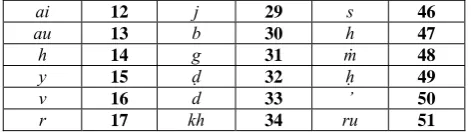
To take advantage of the ordering of letters of the alphabet given in 2.3 above, we assign values to each letter in the Sanskrit alphabet, sticking to the order in the Māheśvara aphorisms rather than to the commonly adopted ordering of the letters. Thus, we have the assignment of values for the letters of the alphabet shown in Table 1.
Table 1 : Values for the letters of the Sanskrit alphabet
Letter Value Letter Value Letter Value
a 1 l 18 ph 35
ā 2 ñ 19 ch 36
i 3 m 20 ṭh 37
ī 4 ṅ 21 th 38
u 5 ṇ 22 c 39
ū 6 n 23 ṭ 40
ṛ 7 jh 24 t 41
ṝ 8 bh 25 k 42
ḷ 9 gh 26 p 43
e 10 ḍh 27 ś 44
ai 12 j 29 s 46
au 13 b 30 h 47
h 14 g 31 ṁ 48
y 15 ḍ 32 ḥ 49
v 16 d 33 ’ 50
r 17 kh 34 ru 51
Further, the letters are clubbed into various types as given below:
1. vowels: 1 – 13 2. consonants: 14 – 47 3. semi-vowels: 15 – 18 4. mutes: 19 – 47 5. nasals: 19 – 23
6. non-nasal mutes: 24 - 47 7. soft consonants: 24 – 33 8. hard consonants: 34 - 46 9. column 1: 39 – 43 10. column 2: 34 – 38 11. column 3: 29 – 33 12. column 4: 24 – 28 13. sibilants: 44 – 46 14. aspirate: 14 and 47 15. anusvāra: 48 16. visarga: 49
17. avagraha: 50 (replacement for the first vowel) 18. ru: 51 (denotes the letter r but is handled differently) 19. gutturals: 42, 34, 31, 26, 21
20. palatals: 39, 36, 29, 24, 19 21. cerebrals: 40, 37, 32, 27, 22 22. dentals: 41, 38, 33, 28, 23 23. labials: 43, 35, 30, 25, 20
A rule is the name we use for letter-level conjunctions such as the following of the savarṇadīrgha type: a+ā = ā where the symbol ‘+’ denotes adjacency and the term on the right of the ‘=’ symbol is the resultant term that has to be either substituted for or added to ones on the left. (In the case of this particular sandhi, the term on the right is the single substitute for both terms on the left.) Substituting values of letters from Table 1, this would translate into 1+2 = 2. Each sandhi may have more than one governing aphorism that specifies its functioning. Each such aphorism for every
sandhi type in turn expands into a series of ‘rules’ as
defined above. In this work, each and every rule for each aphorism under each of the major twenty three sandhi types were listed. Further, an aphorism would specify if an addition, deletion or substitution would have to be made. In accordance with this, a further cataloguing of aphorisms into five categories was done.
If we denote a sandhi rule as x + y = z where variables x and y denote the values of single letters joining together to yield a resultant z, then we have the following categorizations depending on both the characteristics of z and on what we actually do with it:
C1: replace x and y with single-letter or multi-letter z C2: replace x with single-letter or multi-letter z C3: replace y with single-letter z
C4: add single-letter z C5: drop x
Table 2 gives the summary of the numbers involved in this scenario. It must be noted that in practice, some aphorisms have to be combined or handled in two different ways to yield sets of rules, and hence what may seem to be a discrepancy in the number of aphorisms shown in the table and the number of rows shown for the rules of that aphorism, is no real discrepancy at all.
As can be seen, there are close to 2500 individual rules involved, even with considering only the major sandhi-s. Tabulation of these rules in terms of x, y and z for the categories and then tabulation of the corresponding values as per Table 1 were done.
Table 2: Summary of the number of Sanskrit sandhi aphorisms and rules
Careful observations based on a thorough understanding of the domain and classification of the input conditions, yielded the equations presented in this work.
# Sandhi Type sNo. of ūtra-s
Categories No. of
Rules C1 C2 C3 C4 C5
1 yaṇādeśa 1 74 74
2 ayāyāvāvādeśa 4 50 50
2 2
3 3
3 guṇa 2 18 8 18 8 4 vṛddhi 3 8 8
18 18
10 10
5 pararūpa 1 10 10
6 savarṇadīrgha 1 15 15
7 pūrvarūpa 1 2 2
8 avaṅādeśa 1 13 13
9 tugāgama 4 13 13
1 1
10 jaśtva 2 23 23
240 240
11 satva 2 5 5
230 230
138 138
12 anusvāra 5 34 34
24 24
1 1
3 3
13 dhuḍāgama 2 2 2
14 ṅamudāgama 1 195 195
15 ścutva 2 36 31 36 31 16 ṣṭutva 3 31 31
6 6
17 anunāsikā 1 160 160
18 cartva 1 312 312
19 parasavarṇa 3 29 29
5 5
20 pūrvasavarṇa 1 20 20
21 chatva 1 340 340 22 visarga 2 13 13 13 13
23 svādi 5
66 66
13 13
132 132
33 33
33 33
We define the general binary operators
⊕1, ⊕2, ⊕3, ⊕4and ⊕5 for the categories C1, C2, C3, C4 and
C5 respectively, as follows:
C1: ⊕1(x, y) = z = z1
C2: ⊕2(x, y) = z = z2y
C3: ⊕3(x, y) = z = xz3
C4: ⊕4(x, y) = z = xz4y
C5: ⊕5(x, y) = z = y
where each of z1, z2, z3, z4 is to be calculated. Now we
introduce the second and third subscripts for the above general operators as follows: the general operator ⊕i,j (x, y)
is derived from ⊕i and signifies the operator applying to
aphorism number j of Category Ci; the specialized operator
⊕i,j,k (x, y) is derived from the operator ⊕i,j and appertains
to the kth equation for the jth aphorism of Category C i,.
These two extra subscripts are necessitated by the facts that a category encompasses many aphorisms and one aphorism may itself be governed by more than one equation.
4. Results and Discussion
The main sandhi aphorisms, their brief description (Rule), the corresponding general operator and the final, specialized equations along with the domain of operation are given below in a category-wise listing. Special notations followed are:
• The equations and conditions given as operators with three subscripts are the ones that are implementable. The ‘general operator’ specified for each aphorism typifies the aphorism’s meaning and all the conditions it becomes operative under, and provides a generalization from which the final equations are specialized. A specialized operator would thus override the ‘general operator’ with its own specialized conditions.
• The variable X denotes the sequence of letters culminating in x; the variable Y denotes the sequence of letters starting with y. These are used to depict special conditions that pertain to the entire word involved in the sandhi.
• Variables u and w represent the value of the letter occurring just before x and just after y respectively.
• [ ] are used to club domain conditions simply in order to depict the ‘or’ condition more clearly.
4.1 C1Sandhi-s guṇa sandhi
1. ādguṇaḥ || 6.1.87 ||
Rule: a or ā followed by i, u (short and long) -> guṇa letter (e, o) corresponding to second letter replaces both.
General operator: ⊕1,1 (x, y) = z = z1 when x {1,
2}, y {3, 4, 5, 6}
⊕1,1,1 (x, y) : z1 = 10 when y {3, 4}
⊕1,1,2 (x, y) : z1 = 11 when y {5, 6}
2. uraṇraparaḥ || 1.1.51 ||
Rule: a or ā followed by ṛ (short and long), ḷ -> guṇa letter (ar, al) corresponding to the second letter replaces both.
General operator: ⊕1,2 (x, y) = z = z1 = z11z12 when x
{1, 2}, y א {7, 8, 9}
⊕1,2,1 (x, y) : z11 = 1, z12 = 17 when y א {7, 8}
⊕1,2,2 (x, y) : z11 = 1, z12 = 18 when y א {9}
vṛddhi sandhi
3. vṛddhireci || 6.1.88 ||
Rule: a or ā followed by e, o, ai, au -> vṛddhi letter (ai, au) corresponding to second letter replaces both. General operator: ⊕1,3 (x, y) = z = z1 when x א {1, 2},
y א {10, 11, 12, 13}
⊕1,3,1 (x, y) : z1 = y + 2 when y א {10, 11}
⊕1,3,1 (x, y) : z1 = y when y א {12, 13}
4. etyedhatyūṭhsu || 6.1.89 ||
Rule: In all the following rules, vṛddhi letter (ai, au, ār,
āl) corresponding to the beginning of second word,
replaces both.
a. a or ā followed by the prepositions eti, edhati -> ai replaces both
b. preposition pra followed by eṣaḥ, eṣya -> ai replaces both
c. word sva followed by īr -> ai replaces both
d. a or ā followed by the preposition ūh -> au
replaces both
e. word akṣa followed by word ūhini -> au replaces both
f. preposition pra followed by ūh, ūḍh -> au replaces both
General operator: ⊕1,4 (x, y) = z = z1 when x א {1, 2}
⊕1,4,1 (x, y) : z1 = 12 when [y = 10, Y א {10+41+3,
10+28+1+41+3}] or [x = 1, y = 10, X א {43+17+1}] or [x = 1, y = 4, X א {46+16+1}, Y א {4+17}]
⊕1,4,2 (x, y) : z1 = 13 when [y = 6, Y א {6+14}] or [x
= 1, y = 6, X א {1+42+45+1}, Y א {6+14+3+23+3}] or [x = 1, y = 6, X א {43+17+1}, Y א {4+17, 4+27}] 5. etyedhatyūṭhsu || 6.1.89 ||
Rule: In all the following rules, vṛddhi letter (ai, au, ār,
āl) corresponding to the beginning of second word,
replaces both.
a. a followed by word ṛta -> ār replaces both b. preposition/words pra, vatsara, kambala, vasana,
daśa, ṛṇa followed by the word ṛṇa -> ār replaces both
General operator: ⊕1,5 (x, y) = z = z1 = z11z12 when x =
1
⊕1,5,1 (x, y) : z11 = 2, z12 = y + 10 when [y = 7, Y א
{7+41+1}] or [X א {43+17+1, 16+1+41+46+ 1+17+1, 42+1+20+30+1+18+1, 16+1+46+1+23+ 1, 33+1+44+1, 7+22+1}, Y א {7+22+1}]
6. upasargādṛti dhātau || 6.1.91 ||
General operator: ⊕1,6 (x, y) = z = z1 = z11z12 when x א
{1, 2}, y = 7
⊕1,6,1 (x, y) : z11 = 2, z12 = y + 10 when X א
{43+17+1, 43+1+17+2, 1+43+1,1+16+1, 5+43+1}
pararūpa sandhi
7. eṅi pararūpaṁ || 6.1.94 ||
Rule: a or ā at the end of a preposition followed by e or o (of a verbal root) -> second letter (e or o) replaces both.
General operator: ⊕1,7 (x, y) = z = z1 = y when x א {1,
2}, y א {10,11}
⊕1,7,1 (x, y) : z1 = y when x א {1, 2}, y א
{10,11}, X א {43+17+1, 43+1+17+2, 1+43+1, 1+16+1, 5+43+1}
savarṇadīrgha sandhi
8. akaḥ savarṇe dīrghaḥ || 6.1.101 ||
Rule: a, i, u, ṛ, ḷ (short or long) followed by similar a, i, u, ṛ, ḷ (short or long) -> corresponding long letter replaces both.
General operator: ⊕1,8 (x, y) = z = z1 = y when 1 <= x
<= 9, 1<= y <= 9
All operators ⊕1,8,i are commutative.
⊕1,8,1 (x, y) : z1 = y when [x א {1, 3, 5}, y = x+1] or [x
א {2, 4, 6}, y = x]
⊕1,8,2 (x, y) : z1 = y + 1 when x א {1, 3, 5}, y = x
⊕1,8,3 (x, y) : z1 = 8 when x, y א {7, 8, 9}
pūrvarūpa sandhi
9. eṅaḥ padāntādati || 6.1.109 ||
Rule: e or o followed by a -> first letter replaces both. General operator: ⊕1,9 (x, y) = z = z1 = x when x א {10,
11}, y = 1
⊕1,9,1 (x, y) : z1 = x when x א {10, 11}, y = 1
4.2 C2Sandhi-s yaṇādeśa sandhi
1. iko yaṇaci || 6.1.77 ||
Rule: i, u, ṛ, ḷ (short and long) followed by dissimilar vowel -> y, v, r, l respectively replace first letter. General operator: ⊕2,1 (x, y) = z = z2y when 3 <= x <=
9, y <= 13
⊕2,1,1(x, y) : z2 = 15 when x א {3, 4}, y {3, 4}
⊕2,1,2(x, y) : z2 = 16 when x א {5, 6}, y {5, 6}
⊕2,1,3(x, y) : z2 = 17 when x א {7, 8}, y {7, 8, 9}
⊕2,1,4(x, y) : z2 = 18 when x א {9}, y {7, 8, 9}
ayāya-avāva-ādeśa sandhi
2. ecoyavāyāvaḥ || 6.1.78 ||
Rule: e, o followed by āc -> ay, av replace the first respectively;
ai, au followed by ac -> āy, āv replace the first respectively.
General operator: ⊕2,2 (x, y) = z = z2y = z21z22y when
10 <= x <= 13, y <= 13
⊕2,2,1(x, y) : z21 = 1, z22 = x + 5 when x א {10, 11}, y
!= 1
⊕2,2,2(x, y) : z21 = 2, z22 = x + 3 when x א {12, 13}
3. vānto yi pratyaye || 6.1.79 ||
Rule: o, au followed by y -> av, āv replace the first respectively.
General operator: ⊕2,3 (x, y) = z = z2y = z21z22y when x
א {11, 13}, y = 15
⊕2,3,1(x, y) : z21 = 1, z22 = x + 5 when x = 11
⊕2,3,1(x, y) : z21 = 2, z22 = x + 3 when x = 13
4. kṣayyajayyau śakyārthe || 6.1.81 || krayyastadarthe || 6.1.82 ||
Rule: e which is the end of words kṣe, je, kre followed by y -> ay replaces the first.
General operator: ⊕2,4 (x, y) = z = z2y = z21z22y when x
= 10, y = 15, X א {42+45+10, 29+10}
⊕2,4,1(x, y) : z21 = 1, z22 = x + 5
avaṅādeśa sandhi
5. avaṅ sphotāyanasya || 6.1.123 ||
Rule: o which is the end of word go followed by a vowel -> ‘ava’ replaces the first.
General operator: ⊕2,5 (x, y) = z = z2y = z21z22z23y
when x = 11, y <= 13, X = 31+11
⊕2,5,1 (x, y) : z21 = 1, z22 = 16, z23 = 1
jaśtva sandhi
6. jhalām jaśo’nte || 8.2.39 ||
Rule: non-nasal mutes, sibilants, aspirate at the end of a word -> first letter replaced by corresponding column 3 letter.
General operator: ⊕2,6 (x, y) = z = z2y when 24 <= x
<= 47, y = 0
⊕2,6,1 (x, y) : z2 = x + 5 when x א {24, 25, 26, 27, 28}
⊕2,6,2 (x, y) : z2 = x when x א {29, 30, 31, 32, 33, 44,
45, 47}
⊕2,6,3 (x, y) : z2 = x – 3 when x = 34
⊕2,6,4 (x, y) : z2 = x – 5 when x א {35, 37, 38}
⊕2,6,5 (x, y) : z2 = x – 7 when x = 36
⊕2,6,6 (x, y) : z2 = x – 8 when x א {40, 41}
⊕2,6,7 (x, y) : z2 = x – 11 when x = 42
⊕2,6,8 (x, y) : z2 = x – 13 when x = 43
⊕2,6,9 (x, y) : z2 = x – 10 when x = 39
satva sandhi
7. samaḥ suṭi || 8.3.5 ||
Rule 1: word sam followed by affixes kṛ, kṝ, kar, kār, kur -> m of sam replaced with the combination ṁs. General operator: ⊕2,7 (x, y) = z = z2y = z21z22y when x
= 20, y = 42, X א {46+1+20}, Y א {42+7, 42+8, 42+1+17, 42+2+17, 42+5+17}
⊕2,7,1 (x, y) : z21 = 48, z22 = 46
8. pumaḥ khayyampare || 8.3.6 ||
General operator: ⊕2,8 (x, y) = z = z2y = z21z22y when x
= 20, 34<=y<=43, 1<=w<=23
⊕2,8,1 (x, y) : z21 = 48, z22 = 46
9. naśchavyapraśān || 8.3.7 ||
Rule: final n of a word except for the word praśān, followed by ch, ṭh, th, c, ṭ, t which is in turn followed by a vowel, aspirate, semi-vowel or nasal -> ending n replaced with the combination ṁs.
General operator: ⊕2,9 (x, y) = z = z2y = z21z22y when x
= 23, 36<=y<=41, 1<=w<=23, X {43+17+1+44+2+23}
⊕2,9,1 (x, y) : z21 = 48, z22 = 46
visarga sandhi
10. kharavasānayorvisarjanīyaḥ || 8.3.15 ||
Rule: r followed by hard consonant -> r replaced with visarga.
General operator: ⊕2,10 (x, y) = z = z2y when x = 17, 34
<= y <= 46
⊕2,10,1 (x, y) : z2 = 49
anusvāra sandhi
11. mo’nusvāraḥ || 8.3.23 || mo rāji samaḥ kvau || 8.3.25 ||
Rule: m followed by any consonant -> m letter replaced by ṁ (anusvāra) (except in the case of the word sam being followed by the word rāṭ)
General operator: ⊕2,11 (x, y) = z = z2y when x = 20,
14 <= y <= 47, X {46+1+20}, Y {17+2+40}
⊕2,11,1 (x, y) : z2 = 48
12. naścāpadāntasya jhali || 8.3.24 ||
Rule: n followed by a non-nasal mute, sibilant or aspirate (not at the end of a pada) -> n replaced by ṁ
(anusvāra).
General operator: ⊕2,12 (x, y) = z = z2y when x = 23,
24 <= y <= 47
⊕2,12,1 (x, y) : z2 = 48
13. he mapare vā || 8.3.26 ||
Rule: m followed by h which is in turn followed by y, l, or v -> the first m replaced by nasal y, l, v (i.e. ṁy, ṁl,
ṁv) respectively.
General operator: ⊕2,13 (x, y) = z = z2y = z21z22y when
x = 20, y = 14, w א {15, 16, 18}
⊕2,13,1 (x, y) : z21 = 48, z22 = w
14. napare naḥ || 8.3.27 ||
Rule: m followed by h at the end of a pada which is in turn followed by n -> m replaced by n.
General operator: ⊕2,14 (x, y) = z = z2y when x = 20, y
= 14, w = 23
⊕2,14,1 (x, y) : z2 = w
visarga sandhi
15. visarjanīyasya saḥ || 8.3.34 ||
Rule: visarga followed by hard consonant –> visarga replaced with s.
General operator: ⊕2,15 (x, y) = z = z2y when x = 49,
34 <= y <= 46, w {44, 45, 46}
⊕2,15,1 (x, y) : z2 = 46
ścutva sandhi
16. stoḥścunāḥścuḥ || 8.4.40 ||
Rule: dentals, s followed by palatals, ś -> first replaced by its corresponding palatal, ś respectively.
General operator: ⊕2,16 (x, y) = z = z2y when x א {41,
38, 33, 28, 23, 46}, y א {39, 36, 29, 24, 19, 44}
⊕2,16,1 (x, y) : z2 = x – 2 when x ϵ {41, 38, 46}
⊕2,16,2 (x, y) : z2 = x – 4 when x ϵ {33, 28, 23}
ṣṭutva sandhi
17. ṣṭunāḥṣṭuḥ || 8.4.41 || toḥṣi || 8.4.43 ||
Rule: [dentals, s followed by cerebrals] or [s followed by ṣ] -> dentals or s replaced by cerebrals or ṣ
respectively.
General operator: ⊕2,17 (x, y) = z = z2y when x א {41,
38, 33, 28, 23, 46}, y א {40, 37, 32, 27, 22, 45}
⊕2,17,1 (x, y) : z2 = x – 1 when [x = 46] or [y != 45]
anunāsikā sandhi
18. yaro'nunāsike’nunāsiko vā || 8.4.45 ||
Rule: semi-vowels y, v and l followed by nasal -> first replaced by its corresponding nasal, ṁy, ṁv, ṁl respectively.
General operator: ⊕2,18 (x, y) = z = z2y = z21z22y when
x א {15, 16, 18}, 19 <= y <= 23
⊕2,18,1 (x, y) : z21 = 48, z22 = x
19. yaro'nunāsike’nunāsiko vā || 8.4.45 ||
Rule: semi-vowel r, mutes, sibilants followed by nasal -> first replaced by its corresponding nasal.
General operator: ⊕2,19 (x, y) = z = z2y when 17 <= x
<= 46, x != 18, 19 <= y <= 23
⊕2,19,1 (x, y) : z2 = x when x א {17, 19, 20, 21, 22, 23,
44, 45, 46}
⊕2,19,2 (x, y) : z2 = x – 5 when x א {24, 25, 26, 27, 28}
⊕2,19,3 (x, y) : z2 = x – 10 when x א {29, 30, 31, 32, 33}
⊕2,19,4 (x, y) : z2 = x – 13 when x = 34
⊕2,19,5 (x, y) : z2 = x – 15 when x א {35, 37, 38}
⊕2,19,6 (x, y) : z2 = x – 17 when x = 36
⊕2,19,7 (x, y) : z2 = x – 18 when x א {40, 41}
⊕2,19,8 (x, y) : z2 = x – 20 when x = 39
⊕2,19,9 (x, y) : z2 = x – 21 when x = 42
⊕2,19,10 (x, y) : z2 = x – 23 when x = 43
jaśtva sandhi
20. jhalām jaś jhaśi || 8.4.53 ||
Rule: non-nasal mutes, sibilants, aspirate followed by soft consonants (column 3, column 4) -> first replaced by corresponding column 3 letter.
General operator: ⊕2,20 (x, y) = z = z2y when 24 <= x
<= 47, 24 <= y <= 33
⊕2,20,2 (x, y) : z2 = x when x א {29, 30, 31, 32, 33, 44,
45, 46, 47}
⊕2,20,3 (x, y) : z2 = x – 3 when x = 34
⊕2,20,4 (x, y) : z2 = x – 5 when x א {35, 37, 38}
⊕2,20,5 (x, y) : z2 = x – 7 when x = 36
⊕2,20,6 (x, y) : z2 = x – 8 when x א {40, 41}
⊕2,20,7 (x, y) : z2 = x – 10 when x = 39
⊕2,20,8 (x, y) : z2 = x – 11 when x = 42
⊕2,20,9 (x, y) : z2 = x – 13 when x = 43
cartva sandhi
21. khari ca || 8.4.55 ||
Rule: non-nasal mutes, sibilants, aspirate followed by hard consonants (column 3, column 4, sibilants) -> first replaced by its corresponding column 1 or sibilants. General operator: ⊕2,21 (x, y) = z = z2y when 24 <= x
<= 47, 34 <= y <= 46
⊕2,21,1 (x, y) : z2 = x + 18 when x = 25
⊕2,21,2 (x, y) : z2 = x + 16 when x = 26
⊕2,21,3 (x, y) : z2 = x + 15 when x = 24
⊕2,21,4 (x, y) : z2 = x + 13 when x א {27, 28, 30}
⊕2,21,5 (x, y) : z2 = x + 11 when x = 31
⊕2,21,6 (x, y) : z2 = x + 10 when x = 29
⊕2,21,7 (x, y) : z2 = x + 8 when x א {32, 33, 34, 35}
⊕2,21,8 (x, y) : z2 = x + 3 when x א {36, 37, 38}
⊕2,21,9 (x, y) : z2 = x when 39 <= x <= 47
parasavarṇa sandhi
22. anusvārasya yayi parasavarṇaḥ || 8.4.58 ||
Rule: anusvāra followed by semi-vowels, mutes ->
anusvāra replaced by the nasal equivalent of the
second.
General operator: ⊕2,22 (x, y) = z = z2y when x = 48,
15 <= y <= 43
⊕2,22,1 (x, y) : z2 = 20 when x א {16, 17}
⊕2,22,2 (x, y) : z2 = y when x א {15, 18, 19, 20, 21, 22,
23}
⊕2,22,3 (x, y) : z2 = y – 5 when 24 <= x <= 28
⊕2,22,4 (x, y) : z2 = y – 10 when 29 <= x <= 33
⊕2,22,5 (x, y) : z2 = y – 13 when x = 34
⊕2,22,6 (x, y) : z2 = y – 15 when x א {35, 37, 38}
⊕2,22,7 (x, y) : z2 = y – 17 when x = 36
⊕2,22,8 (x, y) : z2 = y – 18 when x א {40, 41}
⊕2,22,9 (x, y) : z2 = y – 20 when x = 39
⊕2,22,10 (x, y) : z2 = y – 21 when x = 42
⊕2,22,11 (x, y) : z2 = y – 23 when x = 43
23. torli || 8.4.60 ||
Rule 1: dentals except n followed by l -> dentals replaced by l.
General operator: ⊕2,23 (x, y) = z = z2y when x א {41,
38, 33, 28}, y = 18
⊕2,23,1 (x, y) : z2 = y
24. torli || 8.4.60 ||
Rule 2: n followed by l -> n replaced by nasal l (i.e.
ṁl).
General operator: ⊕2,24 (x, y) = z = z2y = z21z22y when
x = 23, y = 18
⊕2,24,1 (x, y) : z21 = 48, z22 = y
4.3 C3Sandhi-s
ścutva sandhi
1. stoḥścunāḥścuḥ || 8.4.40 ||
śāt || 8.4.44 ||
Rule: [palatals followed by dentals, s] or [ś followed by s] -> second replaced by palatals or ś respectively. General operator: ⊕3,1 (x, y) = z = xz3 when x א {39,
36, 29, 24, 19, 44}, y א {41, 38, 33, 28, 23, 46}
⊕3,1,1 (x, y) : z3 = y – 2 when [y = 46] or [x != 44, y א
{41, 38}]
⊕3,1,2 (x, y) : z3 = y – 4 when x != 44, y א {33, 28, 23}
ṣṭutva sandhi
2. ṣṭunāḥṣṭuḥ || 8.4.41 ||
na padāntāṭṭoranām || 8.4.42 ||
Rule: ṣ followed by dentals, s -> dentals, s replaced by cerebrals, ṣ respectively.
General operator: ⊕3,2 (x, y) = z = xz3 when x = 45, y
א {41, 38, 33, 28, 23, 46}
⊕3,2,1 (x, y) : z3 = y – 1
pūrvasavarṇa sandhi
3. jhayo ho’nyatarasyām || 8.4.62 ||
Rule: non-nasal mutes followed by h -> h replaced by the aspirate letter (column 4) corresponding to the first non-nasal mute.
General operator: ⊕3,3 (x, y) = z = xz3 when 24 <= x
<= 43, y = 47
⊕3,3,1 (x, y) : z3 = x when 24 <= x <= 28
⊕3,3,2 (x, y) : z3 = x - 5 when 29 <= x <= 33
⊕3,3,3 (x, y) : z3 = x - 8 when x = 34
⊕3,3,4 (x, y) : z3 = x – 10 when x א {35, 37, 38}
⊕3,3,5 (x, y) : z3 = x – 12 when x = 36
⊕3,3,6 (x, y) : z3 = x – 13 when x א {40, 41}
⊕3,3,7 (x, y) : z3 = x – 15 when x = 39
⊕3,3,8 (x, y) : z3 = x – 16 when x = 42
⊕3,3,9 (x, y) : z3 = x – 18 when x = 43
chatva sandhi
4. śaścho’ṭi || 8.4.63 ||
Rule: non-nasal mutes followed by ś which is in turn followed by a vowel, aspirate or y, v, r -> ś replaced by ch.
General operator: ⊕3,4 (x, y) = z = xz3 when 24 <= x
<= 43, y = 44, 1 <= w <= 17
⊕3,4,1 (x, y) : z3 = 36
4.4 C4Sandhi-s tugāgama sandhi
1. che ca || 6.1.73 ||
āṅmāṅośca || 6.1.74 || dīrghāt || 6.1.75 || padāntādvā || 6.1.76 ||
Rule: vowel followed by ch -> t added.
General operator: ⊕4,1 (x, y) = z = xz4y when x <= 13,
y = 36
dhuḍāgama sandhi
2. ḍaḥ si dhuṭ || 8.3.29 || naśca || 8.3.30 ||
Rule: ḍ or n followed by s -> dh added.
General operator: ⊕4,2 (x, y) = z = xz4y when x א {23,
32}, y = 46
⊕4,2,1 (x, y) : z4 = 28
tugāgama sandhi
3. śi tuk || 8.3.31 ||
Rule: n followed by ś -> t added.
General operator: ⊕4,3 (x, y) = z = xz4y when x = 23, y
= 44
⊕4,3,1 (x, y) : z4 = 41
ṅamuḍāgama sandhi
4. ṅamo hrasvādaci ṅamuṇnityam || 8.3.32 ||
Rule: Short vowel precedes ṅ, ṇ, n which is followed by vowel -> ṅ, ṇ, n get duplicated.
General operator: ⊕4,4 (x, y) = z = xz4y when x א {21,
22, 23}, 1<=y<=13, u א {1, 3, 5, 7, 9}
⊕4,4,1 (x, y) : z4 = x
4.5 C5Sandhi-s svādi sandhi
1. etattadoḥ sulopo’koranañsamāse hali || 6.1.132 || Rule: word eṣaḥ or saḥ followed by a consonant -> visarga (end ḥ) of first word dropped.
General operator: ⊕5,1 (x, y) = z = y when x = 49, 14
<= y <= 47, X א {10+45+1+49, 46+1+49}
⊕5,1,1 (x, y) = z= y
2. so’ci lope cetpādapūraṇam || 6.1.134 ||
Rule: word saḥ followed by a vowel -> the final visarga of first word optionally dropped.
General operator: ⊕5,2 (x, y) = z = y when x = 49, 1 <=
y <=13, X = 46+1+49
⊕5,2,1 (x, y) = z= y
3. lopaḥśākalyasya || 8.3.19 ||
Rule: final v or y preceded by a or ā and followed by a vowel, semi-vowel, nasal, column 3 or column 4 -> the v or y is dropped.
General operator: ⊕5,3 (x, y) = z = y when x א {15,
16}, 1 <= y <= 33, u א {1, 2}
⊕5,3,1 (x, y) = z= y
4. oto gārgyasya || 8.3.20 ||
Rule: y preceded by o and followed by a vowel, semi-vowel, nasal, column 3 or column 4 -> the y is dropped.
General operator: ⊕5,4 (x, y) = z = y when x = 15, 1 <=
y <= 33, u = 11
⊕5,4,1 (x, y) = z= y
5. hali sarveṣām || 8.3.22 ||
Rule: y followed by consonant -> y dropped.
General operator: ⊕5,5 (x, y) = z = y when x = 15, 14
<= y <= 46
⊕5,5,1 (x, y) = z= y
The aphorisms presented above encompass four out of the five major sandhi divisions that exist in Sanskrit as per Pāṇini – vowel, consonant, prakṛtibhāva (no change and hence not dealt with here), visarga and svādi. The vowel sandhi-s have been extensively dealt with above, with all exceptions to main rules incorporated. In the other divisions, only the main sandhi-s have been covered. Furthermore, listing of the same aphorism twice was necessitated by the need for different general operators for different rules within the same aphorism.
It is noteworthy that the sandhi-s have not been presented under these five divisions, but in the order of the categories introduced in this paper. Furthermore, since the order of aphorisms is crucial to determining the sequence of firing of the rules, Pāṇini’s numbering (given as aphorism number for each aphorism) has been maintained, albeit only within each category.
5. Conclusions
In spite of there being almost 2500 individual letter-level rules (Table 2), this new schema that directly maps the patterning in the Pāṇinian aphorisms in a simple and effective way, ensures that we arrive at a total of just 110 equations. Clearly, this is a computationally lean way of calculating the result of sandhi operations. The results represent a computational model to process a majority of the euphonic conjunctions in Sanskrit. The work also demonstrates the simplicity with which euphonic conjunctions can be handled by adopting Pāṇini’s precise scheme for rule representation.
A main strength of this modeling approach is that it is deterministic, as against the probabilistic methods adopted till now for sandhi operations. Determinism is inherent in Pāṇini’s sandhi rules, which indeed specify how sandhi-s are formed and not how they are broken up, and this determinism has been uniquely tapped and modeled in this work. Traditional AI methods such as hidden Markov models, which have hitherto been applied for Sanskrit processing [3-7], assume relevance in the sandhi-splitting approach in which there are inherent ambiguities, rather than in the sandhi-building approach which is modeled here.
The five main operators and all the 110 derived equations designed and presented in this work, form the immediate basis for directly realizing crucial applications of sandhi-processing such as subtext searching.
References
[1] Briggs Rick, “Knowledge Representation in Sanskrit and Artificial Intelligence”, RIACS, NASA Ames Research Center, AI Magazine, 1985.
[2] Dīkṣita Bhaṭṭoji, Siddhānta-kaumudī, Translated by Śrīśa Candra Vasu, Volume 1, Motilal Banarsidas Publishers, Delhi, 1962.
Sicily, July 2003, in Verification: Theory and Practice: Essays Dedicated to Zohar Manna on the Occasion of His 64th Birthday, Ed. Nachum Dershowitz, Springer-Verlag LNCS vol. 2772, 2004, pp. 359-372.
[4] Huet Gérard, “Lexicon-directed Segmentation and Tagging of Sanskrit”, in XIIth World Sanskrit Conference, Helsinki, Finland, Aug. 2003. Final version in Themes and Tasks in Old and Middle Indo-Aryan Linguistics, Eds. Bertil Tikkanen & Heinrich Hettrich. Motilal Banarsidass, Delhi, 2006, pp. 307-325.
[5] Huet Gérard, “Shallow Syntax Analysis in Sanskrit Guided by Semantic Nets Constraints”, Proceedings of International Workshop on Research Issues in Digital Libraries, Kolkata, Dec. 2006. Editors Prasenjit Majumder, Mandar Mitra and Swapan K. Parui, ACM Digital Library.
[6] Hellwig Oliver, “SanskritTagger, a Stochastic Lexical and POS Tagger for Sanskrit”, Peer-reviewed Proceedings of the First International Sanskrit Computational Linguistics Symposium, France, 2007.
[7] Hyman Malcolm D., “From Pāninian Sandhi to Finite State Calculus”, Sanskrit Computational Linguistics: First and Second International Symposia, Revised Selected and Invited Papers, ISBN:978-3-642-00154-3, Springer-Verlag, 2009. [8] Rao T. R. N., Kak Subhash, Computing Science in
Ancient India, Center for Advanced Computer Studies, University of Southwestern Louisiana, 1998. [9] Rao T. R. N., Kak Subhash, The Panini-Backus Form
in Syntax of Formal Languages, Center for Advanced Computer Studies, University of Southwestern Louisiana, 1998.
[10]Varadarāja, Laghu-siddhānta-kaumudī, Translated with commentary by Panḍit Viśvanātha Śāstri Prabhākara, Motilal Banarsidas Publishers, Delhi, 1989.
Websites
[11]Göttingen Register of Electronic Texts in Indian Languages (GRETIL), www.sub.uni-goettingen.de/ ebene_1 /fiindolo/gretil.htm.
[12]Sanskrit Heritage site, Program and documentation,Gérard Huet, pauillac.inria.fr/~huet/ SKT/.
Rama N. B.Sc. (Mathematics),Master of Computer Applications, Ph.D. (Computer Science). Employment: Anna Adarsh College, Chennai; Bharathi Women’s College, Chennai; Presidency College, Chennai, India. Has 20 years of teaching experience including 10 years for PG, has guided 15 M.Phil. students; Chairperson of the Board of Studies in Computer Science for UG, and Member, Board of Studies in Computer Science for PG and Research at the University of Madras. Current research interest: Program Security. Member of Editorial cum Advisory Board of Oriental Journal of Computer Science and Technology.
Meenakshi Lakshmanan. B.Sc. (Mathematics), Master of
Computer Applications, M.Phil. (Computer Science), currently pursuing Ph.D. (Computer Science) at Mother Teresa Women’s University, Kodaikanal, India and pursuing Level 4 Sanskrit (Samartha) of the Samskṛta Bhāṣā Pracāriṇī Sabhā, Chittoor, India. Employment: SRA Systems Pvt. Ltd., currently Head of the