2417
Dietary Application For Diabetic Patients Using
Gamification Method
Dewi Lie, Julio Christian Young, Seng HansunAbstract: The prevalence of Diabetes Mellitus (DM) in Indonesia shows a very high number. This high number causes the need for appropriate prevention for diabetics. One appropriate prevention method is to obey Amount, Type, Schedule. To support these prevention efforts, motivation can be one of the factors that give effect. Gamification can be one way to increase that motivation. This study aims to design and build a diet control application that refers to the amount and schedule for diabetics with an Android based gamification method. This application is being developed with Android Studio and RESTful API as a data exchange medium into the database and applies game elements in accordance with the Werbach and Hunter gamification framework. Hedonic Motivation System Adoption Model is used as a method to calculate user acceptance for the application and the result for aspect joy is 72.2%, aspect control 64.8%, aspect focused immersion 59.8%, aspect temporal dissociation 54.4%, aspect curiosity 65.1%, aspect perceived of use 66.7%, aspect perceived usefulness 65.5%, and aspect behavioral intention to use 73%.
Index Terms: Android, Diabetes Mellitus, Diet Control, Gamification, HMSAM, Indonesia, RESTful API. ————————————————————
1
INTRODUCTION
Health is one of the main needs for every human being. Personal health can be obtained by maintaining a regular diet and exercise. However, because of the lack of public knowledge about balanced food intake and calorie needs, it is difficult to regulate the portion of food consumed daily to meet the nutrients needed by their bodies. Global status report on Non-Communicable Disease (NCD) of the World Health Organization (WHO) in 2010 reported that 60% of the causes of death of all ages in the world are due to Non-Communicable Diseases. Diabetes mellitus (DM) is one of the Non-Communicable Diseases that is ranked 6th as a cause of death. About 1.3 million people die from diabetes and 4% die before 70 years old. In 2030, DM estimated ranks 7th cause of world death. While Indonesia is estimated that in 2030 it will have 21.3 million people with DM. This condition will make Indonesia reach ranked fourth after the United States, China, and India among the countries that have the most diabetes, with the largest population in the world [1]. Adherence to eating patterns is one of the factors that stabilize blood sugar levels to normal and prevent complications. The factors that influence a person who is not compliant with the Diabetes Mellitus diet are the lack of knowledge of Diabetes Mellitus. There are 75% DM not compliant with the recommended dietary arrangements. This non-compliance is one of the obstacles to achieving treatment goals. One component that is important enough to reduce the risk of complications and recurrence in Diabetes Mellitus is to take proper prevention and management. The survival of diabetics is longer and can be controlled longer. This goal can be achieved by carrying out the 4 pillars of education, physical training, pharmacological intervention, and medical nutrition therapy [2]. The need for Information and Communication Technology (ICT) is the main media to bridge health-related problems. One technology that a human needed is a smartphone.
At this time, the smartphone has various abilities such as internet access and also has an operating system like a computer. Some people use smartphones all the time for purposes such as browsing, social media, games, etc. Based on available data, around 83% of people use smartphones to play games. This proves that everyone is familiar with games. In general, games are only considered for children's and teenage games, but age is not a barrier to playing games [3]. Over time, gamification began to be used frequently in 2010, but there has not much discussion about it because matters relating to games and video games have not been given much attention. The concept of gamification can be implemented in many sectors such as Marketing, Training, and Education. Gamification itself is the process of applying game designs and concepts to the learning or training process with the aim of making it more interesting and entertaining [3]. Based on these problems, an application will be made to manage the diabetes mellitus prevention diet using gamification methods. Previously, "Application for Decision Making and Diet Control for Android-Based Diabetes Mellitus Patients" has been developed [4]. This application was built to make a diagnosis in the form of questions using the Naive Bayes method with a diagnostic accuracy of 83.30%. The application also handles the recording and calculation of daily calories and provides facilities for reminder media in the form of alarms. As for other studies in the form of "Decision System Support Calorie Counter for Diabetics" [5]. This system is a decision support system for calculating calorie diets for diabetic patients that can help health practitioners to determine calorie intake for diabetics according to age, weight, height, and gender with near-accurate results. This application can also explain the calorie intake per consumption which is divided into breakfast, snack, lunch, snack, and dinner with the distribution of carbohydrates, protein, and fat at each meal time. The purpose of developing this application is as an alternative so that users are more motivated and will diligently run their dietary control program.
2
THEORETICAL
BASES
2.1 Diet
Diet is a particular way of regulating the amount and type of food intake with a view to maintaining health, nutritional status, ________________________________
• Dewi Lie has finished her undergraduate degree program in Informatics department in Universitas Multimedia Nusantara, Indonesia. E-mail: [email protected]
• Julio C. Young is currently a lecturer in Informatics department in Universitas Multimedia Nusantara, Indonesia. E-mail: [email protected]
and preventing or helping the healing process [1]. A good diet should be understood by people with DM in their diet control. Based on the results of statistical tests, it can be concluded that there is a relationship between diet and blood sugar levels that exist in people with DM. Diet plays an important role for someone with DM who cannot manage the diet with Schedule, Types, and Amounts then this will cause patients to experience increased blood sugar levels. Blood sugar levels will increase dramatically after consuming foods that contain lots of carbohydrates or sugar. Therefore, DM sufferers need to maintain dietary control and limit calorie intake in food in order to control blood sugar levels so that their blood sugar levels remain controlled. Calculation of calorie intake based on BMI (Body Mass Index) needed by the body is shown in equation 1.
𝐵𝑀𝐼 =
(1)
After calculating BMI, then calculate IBW (Ideal Body Weight). According to Broca's formula:
𝐼𝐵𝑊 = 𝐻𝑒𝑖𝑔ℎ𝑡 − 100 − 10% or
𝐼𝐵𝑊 = 90% ∗ 𝐻𝑒𝑖𝑔ℎ𝑡 − 100 ∗ 1 𝑘𝑔 (2)
For men who are <160 cm in height and women under <150 cm used the formula:
𝐼𝐵𝑊 = 𝐻𝑒𝑖𝑔ℎ𝑡 − 100 ∗ 1 𝑘𝑔 (3)
TABLE1
IDEAL BODY WEIGHT CATEGORY Nutrition Category Ideal Body Weight
Thin Weight < 90% IBW
Normal Weight 90-110% IBW
Fat Weight 110-120% IBW
Obesity Weight >120% IBW
1. Basal Calorie Calculation
According to the calculation of the PERKENI formula or the Indonesian Endocrinology Association [6], the formula for calculating basal calories according to gender is:
TABLE2
BASAL CALORIE CALCULATION
Man 30 calories
Woman 20 calories
𝐵𝑎𝑠𝑎𝑙 𝐶𝑎𝑙𝑜𝑟𝑖𝑒𝑠 𝐶𝑎𝑙𝑐𝑢𝑙𝑎𝑡𝑖𝑜𝑛 = 𝐼𝐵𝑊 ∗ 𝐵𝑎𝑠𝑎𝑙 𝐶𝑎𝑙𝑜𝑟𝑖𝑒𝑠 (4)
2. Age
The age calculation is according to the PERKENI formula calculation or the Indonesian Endocrinology Association [6].
TABLE3
AGE CALCULATION
40 – 59 years old -5% * Basal Calorie Needs 60 – 69 years old -10% * Basal Calorie Needs >70 years old -20% * Basal Calorie Needs
3. Weight Criteria
TABLE4
WEIGHT CRITERIA
Thin +20% * Basal Calorie Needs
Fat -20% * Basal Calorie Needs
Obesity -30% * Basal Calorie Needs
4. Activity
Activities are calculated according to the work and activities carried out. Calculations according to the formula PERKENI or Indonesian Society of Endocrinology [6].
TABLE5
ACTIVITY CATEGORY
Rest Rest
Light Employee, teacher, housewife Average College student, Industry employee Heavy Farmer, Laborers, Sailor, Athlete Very Heavy Diggers, Blacksmith
TABLE6
ACTIVITY CALCULATION Rest +10% * Basal Calorie Needs Light +20% * Basal Calorie Needs Average +30% * Basal Calorie Needs Heavy +40% * Basal Calorie Needs Very Heavy +50% * Basal Calorie Needs
Total Calories needed per day according to the calculation of the PERKENI formula or the Indonesian Society of Endocrinology [6]
𝑇𝑜𝑡𝑎𝑙 𝐶𝑎𝑙𝑜𝑟𝑖𝑒 𝑁𝑒𝑒𝑑𝑠 = 𝐵𝑎𝑠𝑎𝑙 𝐶𝑎𝑙𝑜𝑟𝑖𝑒 𝑁𝑒𝑒𝑑𝑠 + 𝐴𝑔𝑒 + 𝐺𝑒𝑛𝑑𝑒𝑟 +
𝑊𝑒𝑖𝑔ℎ𝑡 𝐶𝑟𝑖𝑡𝑒𝑟𝑖𝑎 + 𝐴𝑐𝑡𝑖𝑣𝑖𝑡𝑦 (5)
2.2 Diabetes Mellitus
Diabetes mellitus (DM) is a metabolic disorder due to the pancreas not producing enough insulin or the body cannot use insulin that is produced effectively. Insulin is a hormone that regulates blood sugar balance. The result is an increase in glucose concentration in the blood (hyperglycemia) [7]. Hyperglycemia that lasts for a long time will cause serious damage and complications to the patient's body. Conversely, when sufferers try to control food diets that are too strict and unbalanced, the sufferer can experience hypoglycemia [8]. Dietary control for people with diabetes mellitus is important to help sufferers in controlling blood sugar levels. From several studies, Diabetes Mellitus is one disease that cannot be completely cured. Controlling normal blood sugar levels requires the management of proper and proper DM dietary management. Motivation and support from nutrition counselors are also needed. This can be done by means of nutrition education through good dietary planning [9].
2.3 Gamification
2419
Define Business Objectives
The determination of the purpose of the gamification system is important so that the next step in making the system more effective. The intended purpose is checked and the benefits are explained. This is done to consider which goals will still be used.
Delineate Target Behaviors
At this stage, it must focus on what behaviors you want to manifest on the gamification player or user and how to measure them. The target of the actors to be achieved must be specific and concrete in order to support the achievement of the objectives of the gamification system that have been predetermined.
Describe Your Player
In general, gamification users do not come from one user group. Therefore, an explanation of the user is needed to segment so that the system is suitable for all groups of users. Game designers have several types of players that they use as a starting point for segmentation. The best known was rediscovered in the late 1980s by game researcher Richard Bartle. Bartle distinguishes four types of players, namely achiever, explorer, socializer, and killer.
Devise Activity Cycles
Planning the gamification stage is the most useful way to model the action in the gamification system. There are two types of activity cycles used to build a gamification system: engagement loops and progression stairs. Engagement loops explain at the micro level, what players do, why they do it, and what the system responds. Stairs explained at the macro level of the player's journey in the gamification system.
Don’t Forget the Fun
The last thing to do before starting to implement a gamification system is to take a step back and check whether the "fun" aspect is sufficient. The complexity of the players, goals, rules, motivation, and every element of the game created must still present a pleasant aspect.
Deploy the Appropriate Tools
The last stage in creating a gamification system is to apply the stages that were made previously into a tool or tool that will help the formation of a gamification system.
2.4 HMSAM
Hedonic-motivation System Adoption Model (HMSAM) is a testing model regarding the level of user acceptance in the Hedonic-motivation system (HMS) system and focuses on the intrinsic motivation of users based on the nature of hedonism [14].
3 MATERIALS
AND
METHODS
The explanation in this chapter begins with the design of the application diagram and continues with the applied research methodology.
3.1 Use Case Diagram
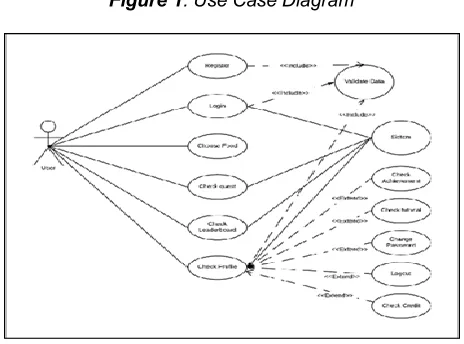
Figure 1. Use Case Diagram
The Use Case Diagram application has two actors namely user and system. Users connect with six use cases such as register, log in, choose food, check quest, check the leaderboard, and check profiles. While the system is connected to four use cases, use case logins, check quest, check the leaderboard, and check profiles. Use case validates data that is connected including the use case register, login, and check profile. The relationships included in the use case validate the data that shows the use case validates the data representing an inseparable part of the other use cases. Use Case Diagram can be seen in Figure 1.
3.2 Methodology
a. Feasibility Studies
The feasibility study is used to measure the effectiveness of factors that influence diet. This measurement is carried out using digital questionnaires distributed online or through social media. The target respondents of this feasibility study questionnaire were people with diabetes
b. Literature Studies
In the study of literature, learning of various theories related to the design and builder of android applications using gamification methods. One theory taken is the Framework of Werbach and Hunter.
c. System Design
This stage begins with the architectural design of an android application as the basis of making the system. The system is built in the form of an android-based mobile application and uses the gamification method. After the system architecture design is made, this stage continues with the design and programming of the android application system. Making the system also includes designing the user interface system and determining the additional features needed on the system.
d. System Testing
usefulness, and behavioral intention to use
e. Evaluation
System evaluation is done by analyzing the questionnaire generated from the system testing field study. The evaluation results will be concluded through the use of a Likert Scale so that it can measure the usefulness of the application of the system.
4 RESULTS
AND
DISCUSSION
4.1 Results
As can be seen in Figure 2, when the user first opens the application the user is directed to the login page. On this page, the user uses an email and password for the user authentication. An additional button is the register button that will direct users to the register page. In register page, user need to fill identity such as full name, email, password, birthdate, gender, weight, height, and activity level.
Figure 2. Login
Figure 3. Home Page
As shown in Figure 3, When all stages of the register are successful, the user will be directed directly to the login page. On the login page, the user must enter an email and password that has been successfully registered. After the user logs in, the user will enter the main page where there is a user name, a minimum daily calorie number, and a list of foods based on the selected category. The minimum daily calorie count is based on gender, age, height, weight, and type of activity. The categories of food types are divided into five parts namely breakfast, breakfast snacks, lunch, lunch snacks, and dinner. At the bottom, there is navigation to switch pages consisting of the main page, the quest page, the leaderboard page, and the profile page.
Figure 4. Choose Food
When the user presses the Add Food button, the user will be directed to the food list page. The food list page has a (+) button and when the button is pressed, an edit text will appear to enter the number of grams of the selected food. When the number of grams has been entered, the user can press the confirm button when they are sure to choose food. Users can also search for food with the search feature on the page. Figure 4 is a food list page display.
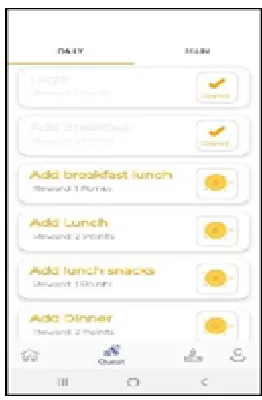
2421 The quest page is divided into two parts, namely daily quest
and main quest. Daily quest is a quest that will reset automatically every day. While the main quest is a quest that can be completed by the user with an unspecified time. If the user has completed the quest, the completed quest will change color and symbol, as shown in Figure 5.
Figure 6. Leaderboard Page
A leaderboard page is a page that lists the ranking of users who have the most points than other users. User ratings that appear on the leaderboard page are three users with the most points. Figure 6 shows the leaderboard page.
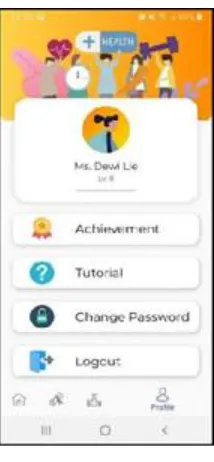
Figure 7. Profile Page
The profile page consists of the user's name, user-level, and several other additional menus such as achievement, tutorial, change password, logout, and credit. Figure 7 is the profile page display.
4.2 Test Results
The number of users who registered on the modified diet control application reached 44 users and the number of users who filled out the questionnaire was 35 users. The questionnaire distributed consisted of eight parts, namely joy, control, focused immersion, temporal dissociation, curiosity, perceived ease of use, perceived usefulness, and behavioral intention to use. Each question is provided on a Likert scale consisting of seven categories starting from strongly disagree, disagree, quite disagree, neutral, quite agree, agree, and strongly agree. The percentage calculation of categories can be seen in Table 7.
TABLE7
PERCENTAGE OF LIKERT SCALE CATEGORY
Category Percentage Score
Strongly Disagree 0% - 14% 1
Disagree 14.1% - 28% 2
Quite Disagree 28.1% - 42% 3
Neutral 42.1% - 56% 4
Quite Agree 56.1% - 70% 5
Agree 70.1% - 84% 6
Strongly Agree 84.1 – 100% 7
Each section of the questionnaire has several questions, there are some questions that are reversal scaled in which the category strongly disagrees with getting seven points while the category of strongly agree only gets one point. Questions with scaled reversal will be marked with the asterisk symbol (*).
1. Joy
The joy section gets a total score of 1064 with details, 1 answer is worth 2, 13 answers are worth 13, 52 answers are worth 4, 76 answers are worth 5, 41 answers are worth 6, and 27 answers are worth 7. The assessment table for the joy section is shown in Table 8.
TABLE8
JOY ASSESSMENT
Num/Score 1 2 3 4 5 6 7
1 0 0 4 11 11 6 3
2 0 0 2 14 12 3 4
3* 0 0 2 9 8 10 6
4* 0 0 1 4 11 9 10
5 0 0 2 8 20 3 2
6* 0 1 2 6 14 10 2
Total 0 1 13 52 76 41 27
Joy level part satisfaction calculation:
2. Control
The control section gets a total score of 954 with details, 1 answer worth 1, 4 answers worth 2, 31 answers worth 3, 63 answers worth 4, 72 answers worth 5, 33 answers worth 6, and 6 answers worth 7, shown in Table 9.
TABLE9
CONTROL SECTION ASSESSMENT
1 1 1 6 11 12 3 1
2 0 0 5 11 11 7 1
3* 0 0 9 7 12 6 1
4 0 0 4 10 16 4 1
5* 0 2 6 9 9 8 1
6 0 1 1 15 12 5 1
Total 1 4 31 63 72 33 6
3. Focused Immersion
The focused immersion section gets a total score of 744 with details, 1 answer worth 1, 4 answers worth 2, 26 answers worth 3, 95 answers worth 4, 35 answers worth 5, 10 answers worth 6, and 6 answers worth 7. the focused immersion section is shown in Table 10.
TABLE10
FOCUSED IMMERSION SECTION
Num/Score 1 2 3 4 5 6 7
1 0 0 9 15 9 1 1
2 0 1 3 16 9 4 2
3 1 1 5 20 6 2 1
4* 0 2 4 22 6 1 1
5 0 0 5 22 5 2 1
Total 1 4 26 95 35 10 6
Calculation of satisfaction level of the focused immersion section:
4. Temporal Dissociation
The temporal dissociation section gets a total score of 395 with the breakdown, 2 scores are 1, 1 answer is 2, 35 answers are 3, 40 answers are 4, 24 answers are 5, and 1 answer is 6. The table of the results of the assessment of the temporal dissociation section is shown in Table 11.
TABLE11
TEMPORAL DISSOCIATION SECTION
Num/Score 1 2 3 4 5 6 7
1 0 0 7 13 14 1 0
2 1 0 12 15 7 0 0
3 1 1 16 12 5 0 0
Total 2 1 35 40 24 1 0
Calculation of Assessment of Temporal Dissociation:
5. Curiosity
The curiosity section gets a total score of 487 with details, 15 answers are worth 3, 38 answers are worth 4, 36 answers are worth 5, 16 answers are worth 6, and 2 answers are worth 7. The results of the curiosity section are shown in Table 11.
TABLE11
CURIOSITY SECTION
Num/Score 1 2 3 4 5 6 7
1 0 0 4 11 14 5 1
2 0 0 2 13 13 7 0
3 0 0 7 14 9 4 1
Total 0 0 15 38 36 16 2
Calculation of satisfaction level of curiosity section:
6. Perceived Ease of Use
The perceived ease of use section gets a total score of 1143 with the breakdown, 4 answers worth 2, 27 answers worth 3, 87 answers worth 4, 72 answers worth 5, 32 answers worth 6, and 22 answers worth 7. of use is shown in Table 12.
TABLE12
PERCEIVED EASE OF USE
Num/Score 1 2 3 4 5 6 7
1 0 0 3 11 12 6 3
2 0 1 3 11 14 3 3
3 0 3 8 11 8 2 3
4 0 0 2 16 8 6 3
5 0 0 4 13 10 5 3
6 0 0 2 15 9 6 3
7 0 0 5 10 11 5 4
Total 0 4 27 87 72 32 22
Calculation of the level of satisfaction of parts perceived ease of use:
7. Perceived Usefulness
The perceived usefulness section gets a total score of 794 with details, 18 answers are worth 3, 80 answers are worth 4, 44 answers are worth 5, 17 answers are worth 6, and 14 answers are worth 7. The results of the assessment of the perceived usefulness section are shown in Table 13.
TABLE13
PERCEIVED USEFULNESS
Num/Score 1 2 3 4 5 6 7
1 0 0 2 14 11 3 5
2 0 0 3 16 10 4 2
3 0 0 4 17 6 5 3
4 0 0 4 17 9 2 1
5 0 0 5 16 8 3 3
Total 0 0 18 80 44 17 14
Assessment Results Perceived Usefulness Section:
8. Behavioral Intention to Use
2423 537 with details, 3 answers are worth 3, 23 answers are worth
4, 47 answers are worth 5, 23 answers are worth 6, and 9 answers are worth 7. The results of the assessment table of the Behavioral Intention to Use section are shown in Table 14.
TABLE14
INTENTION TO USE
Num/Score 1 2 3 4 5 6 7
1 0 0 1 6 16 7 5
2 0 0 1 6 17 9 2
3 0 0 1 11 14 7 2
Total 0 0 3 23 47 23 9
Calculation of satisfaction level of behavioral intention to use:
4 CONCLUSION
The design and construction of a diet control application using the gamification method has been completed. The application uses the Werbach and Hunter gamification framework as Six Steps to Gamification uses the RESTful API as a bridge for data entry into the database, and the use of English as the main language in using a diet control application for DM sufferers.Based on the calculation of questionnaire data compiled based on HMSAM, the level of user acceptance of diet control applications using the gamification method can be known. The percentage of user acceptance on the joy aspect is 72.2%, the control aspect is 64.8%, the focused immersion aspect is 59.8%. the temporal dissociation aspect is 4.4%, the curiosity aspect is 65.1%, the perceived ease of use aspect is 66.7%, the perceived usefulness aspect is 65.5%, and the behavioral intention aspect is 73%.
5
REFERENCES
[1]. Depkes RI. Tahun 2030 Prevalensi Diabetes Melitus Di Indonesia Mencapai 21,3 Juta Orang. Kementrian Kesehatan Republik Indonesia, 1-2, 2009.
[2].S. Ndraha, ―Diabetes Melitus Tipe 2 dan Tatalaksana Terkini,‖ MEDICINUS, vol.27, no.2, pp.9-16, 2014. [3].Pratomo, ―Pengaruh Konsep Gamifikasi Terhadap
Tingkat Engagement,‖ The Journal: Tourism and Hospitality Essentials Journal, vol.8, no.2, pp.63–74, 2018.
[4]. K.C. Widiastuti, D. Ananda, and M.H. Syahbani, ―Aplikasi Pengambilan Keputusan dan Pengatur Pola Makan Bagi Penderita Diabetes Melitus,‖ e-Prooceding of Applied Science, 1736, 2015.
[5]. F. Aldyningtyas, T. Pinandita, and Harjono, ―Sistem Pendukung Keputusan Penghitung Kalori Diet bagi Diabetesi (Decision Support System to Count Calorie Diet for Diabetics),‖ JUITA, vol.II, no.2, pp.145–157, 2012.
[6]. Maryamah, R.R.M. Putri, and S.A. Wicaksono, ―Optimasi Komposisi Makanan Pada Penderita Diabetes Melitus dan Komplikasinya Menggunakan Algoritma Genetika,‖ Jurnal Pengembangan Teknologi Informasi Dan Ilmu Komputer (J-PTIIK) Universitas Brawijaya, vol.1, no.4, pp.270–281, 2017.
[7]. Depkes RI. Tahun 2030 Prevalensi Diabetes Melitus Di
Indonesia Mencapai 21,3 Juta Orang. Kementrian Kesehatan Republik Indonesia, 1-2, 2009.
[8]. M. Iqbal, ―Sistem Pendukung Keputusan Pola Makan Untuk Penderita Diabetes Tipe-2 Berdasarkan Preferensi dengan Menggunakan Logika Fuzzy,‖ pp.1– 9,
http://informatika.stei.itb.ac.id/~rinaldi.munir/TA/Makala h_TA_Muhammad_Iqbal.pdf.
[9]. S. Susanti and D.N. Bistara, ―Hubungan Pola Makan Dengan Kadar Gula Darah Pada Penderita Diabetes Mellitus,‖ Jurnal Kesehatan Vokasional, vol.3, no.1, pp.29, 2018. https://doi.org/10.22146/jkesvo.34080 [10].K.M. Kapp, The Gamification of learning and
Instruction: Game-based Methods and Strategies for Training and Education, John Wiley and Son, 2012. [11].K. Werbach and D. Hunter, 'The Gamification Toolkit
Game Elements', in For the Win: How Game Thinking can Revolutionize Your Business, 2012. doi:10.1017/CBO9781107415324.004.
[12].H. Setiana and S. Hansun, ―Gamified Android Based Academic Information System,‖ International Journal of Evaluation and Research in Education, vol.6, no.2, pp.164-173, 2017.
[13].S. Hansun, ―Gamified e-Commerce: A New Paradigm on e-Media Business,‖ ULTIMATICS, vol.4, no.2, pp.28-31, 2012.