2516
Modeling Of The Process Of Functioning Of The
Mechanism Of Economic Security Of Foreign
Economic Activity Of Enterprise Taking Into
Account Weak Signals And Identification Of
Risks And Threats
Nataliia Havlovska, Valentyna Pokotylova, Olena Korpan, Yevhenii Rudnichenko, Iryna Sokyrnyk
Abstract: The feasibility of using a behavioristic model of the mechanism of economic security of foreign economic activity of enterprise is substantiated in order to determine and detail the features of the qualitative functioning of the mechanism of economic security of enterprises foreign economic activity as a part of the enterprise management system. The use of behaviorism to describe the functioning of the mechanism of economic security of foreign economic activity of enterprise has its own causal basis and its advantages. Firstly, the mechanism of economic security of foreign economic activity of enterprise is not an inherently valuable element of the enterprise management system. In simple words, the composition of the mechanism is not that valuable as its necessary reactions under various stimuli. Secondly, using just behaviorism and content analysis allows us to combine the triad ―stimulus-content-response‖. Thirdly, the use of behaviorism allows relatively simple, without involving deterministic analytical models, to carry out a scenario analysis of the functioning of the mechanism of economic security of foreign economic activity of enterprise and, if necessary, debug such a mechanism and ensure its adequate content with increasing complexity, variability and intensity of stimuli. This allows to use the model of the functioning of the mechanism of economic security of foreign economic activity of enterprise depending on the needs of the user and the task in prescriptive, descriptive and constructive-reflective modes. Based on the developed model of the functioning of the mechanism of economic security of foreign economic activity of enterprise and the detailed disclosure of each of the elements of such a model, an algorithm for constructing this mechanism is developed. On the basis of the model under consideration, certain elements of such a model and their content, the structure of scenarios of functioning of mechanism, the generated algorithm allows to build an mechanism of economic security of the foreign economic activity of enterprise for a particular enterprise taking into account the specific operating conditions of such an enterprise, the expected incentives from the external and internal environment of the enterprise as for mechanism functioning, its predetermined reactions and its necessary structure, which allows to provide such reactions in existing conditions. Index Terms: mechanism, economic security, foreign economic activity, quality functioning, threat, risk, behavioral model
—————————— ——————————
1
I
NTRODUCTIONhe effect of ―erasing borders‖ and the integration of business structures in the markets of different countries generates a significant number of threats and risks. This situation requires an appropriate response from enterprise management due to increased competition and increased requirements for micro-level economic security systems. Foreign economic activity (FEA) is an integral component of globalization processes in the economy, and it is the main source of funds for most enterprises. However, today there are practically no scientific and methodological approaches to the formation of effective mechanisms for ensuring the economic security of foreign economic activity.
Accordingly, to ensure economic security, specific actions on the part of the enterprise governing bodies are in demand, that is, an effective element in the enterprise management system should be clearly defined, which, according to the results of the economic security assessment of foreign economic activity of enterprise (FEA), should take measures to improve it. Such an effective element is proposed to determine the of mechanism of economic security of foreign economic activity of enterprise (MESEFEA). It should be emphasized that the MESEFEA is not identical to a certain structural unit, which will be responsible for ensuring the economic security of the FEA of the enterprise, but will be instrumental and applied in the overall system of enterprise management. A considerable number of scientists was engaged in the study of economic mechanisms, unlikely to the mechanisms of economic security of enterprise. Among the publications of Ukrainian authors covering this topic, we can distinguish researches by Havlovska N. [4], [5], Zlotenko O. [17], Kozachenko H.V., Pogorelov, Yu. S. [8], Rudnichenko Ye.M. [9], [10], et al. Foreign approaches to the formation of economic mechanisms and mechanisms of economic security were investigated in the works [1], [6], [2], [7]. However, in most studies, the authors do not pay attention to the research methodology from the perspective of modern behavioral economics [3], [13], [14], where threats, risks and managerial decisions are examined in relation to the reactions of relevant subjects. In our view, one of the fundamental approaches of scientific research from the point of view of the above aspects is the theory of behaviorism. Behaviorism as a scientific trend dates back to 1913, when John Watson made a program report "Psychology as the Behaviorist Views it" at the annual meeting of the American Psychological Association [15]. The key idea of T
————————————————
• Nataliia Havlovska. Professor, Khmelnitsky National University, Department of Management, Administration and Hotel & Catering Industry, Khmelnitsky, Ukraine.
• Valentina Pokotilova. Professor, Kherson economic and law institute, Department of Management, Kherson, Ukraine.
• Olena Korpan. Associate Professor, Vinnytsia Trade and Economic Institute of Kyiv National University of Trade and Economics Vinnytsia, Ukraine.
• Yevhenii Rudnichenko. Professor, Khmelnitsky National University, Department of Management, Administration and Hotel & Catering Industry, Khmelnitsky, Ukraine. Corresponding author: E-mail: [email protected].
2517 behaviorism (J. Watson) is the relation between the stimulus
and the response for the object under study, which has the ability to certain reactions: a certain stimulus or their combination causes a certain reaction. Based on the study of such a ratio, it is possible to either fix certain reactions or predict them, or the ability to elicit the necessary reactions based on the use of known stimuli [16]. In this case, the internal processes that occur "inside" the object under study are often given much less attention, either because of the principle of non-determination in determining their content or due to the dominance of the reaction over the process of its formation, that is, the situation when the reaction of the object under study is of much greater value than the process by which it is formed. That is, from the point of view of economic security of foreign economic activity of enterprise, an interesting and useful scientific result will be the consideration of all possible reactions in the processes of formation and functioning of mechanisms of economic security.
2 Methodology
To describe the functioning of the economic security
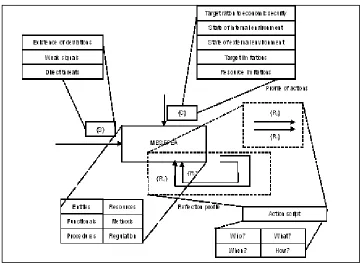
mechanism of foreign economic activity of enterprise based on the consideration of weak signals, we have developed a behaviorist model of the functioning of the economic security mechanism of foreign economic activity of enterprise (Fig. 1). The description of the behavior of MESEFEA on the basis of behaviorism with the allocation of sets {R} to available stimuli {S} under conditions of operation {C} allowed to clarify the composition of each of the elements in such a scheme and the content of the mechanism itself as a response agent. The reactions of the mechanism are considered by groups {R1} - {R4}, specifying the nature of the activity of each of these groups and distinguishing two reaction loops - the action loop and the reflection loop.
Fig. 1. Model of mechanism of economic security functioning concerning the foreign economic activity of enterprise.
3 R
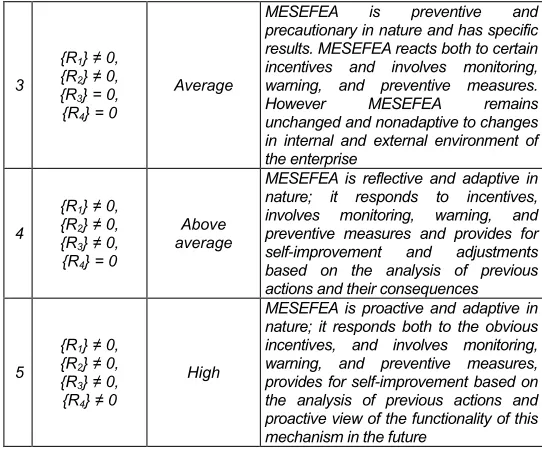
ESULTSThe availability of response multitudes {R} for MESEFEA of a particular enterprise it is possible to soundly ascertain the level of such mechanism. This assertion in its simplest version is presented in tabular format in table 1.
TABLE 1
Characteristics of MESEFEA depending on the availability of multitudes of its responses to present incentives (simplified
version)
№
Characteristi cs of multitudes
{R}
Characteristi cs of MESEFEA
level
Characteristics of MESEFEA
1
{R1} = 0,
{R2} = 0,
{R3} = 0,
{R4} = 0
Zero
MESEFEA is declarative in nature, since there are no responses to present incentives within the mechanism functioning. Even if MESEFEA formally exists within the enterprise system and the functioning of this mechanism is formally declared, in fact, the result of its functioning is not available
2
{R1} ≠ 0,
{R2} = 0,
{R3} = 0,
{R4} = 0
Low
2518
3
{R1} ≠ 0,
{R2} ≠ 0,
{R3} = 0,
{R4} = 0
Average
MESEFEA is preventive and
precautionary in nature and has specific results. MESEFEA reacts both to certain incentives and involves monitoring, warning, and preventive measures.
However MESEFEA remains
unchanged and nonadaptive to changes in internal and external environment of the enterprise
4
{R1} ≠ 0,
{R2} ≠ 0,
{R3} ≠ 0,
{R4} = 0
Above average
MESEFEA is reflective and adaptive in nature; it responds to incentives, involves monitoring, warning, and preventive measures and provides for self-improvement and adjustments based on the analysis of previous actions and their consequences
5
{R1} ≠ 0,
{R2} ≠ 0,
{R3} ≠ 0,
{R4} ≠ 0
High
MESEFEA is proactive and adaptive in nature; it responds both to the obvious incentives, and involves monitoring, warning, and preventive measures, provides for self-improvement based on the analysis of previous actions and proactive view of the functionality of this mechanism in the future
If we consider a larger variation of the sets {R1} - {R4} for a particular MESEFEA of a particular enterprise, then we can propose and consider a larger number of combinations of MESEFEA reactions to the set {S} (table 2). Describing options 1-16 in table 2, it should be noted that options 1-8 cover situations where the MESEFEA level can be described as low or initial. The initial level describes the situation when MESEFEA is only created (in whole or in part) and begins its activity. Of course, in such a situation, one cannot expect a full and adequate response of the mechanism to the existing stimuli. Therefore, in such a situation, {R1} may be equal to zero, and other sets {R} are empty or non-empty (in such a situation, we can talk about establishing routine maintenance, improving MESEFEA, etc.). If MESEFEA is already functioning, but {R} is an empty set, then the level of MESEFEA can be estimated as low or below average, since MESEFEA does not give a reaction to the set {S}.
TABLE 2
MESEFEA evaluation based on the presence of sets of its reactions to the available stimuli
№ {R1} {R2} {R3} {R4} MESEFEA level characteristics MESEFEA characteristics
1 =0 =0 =0 =0 Zero effective mechanism Absence of an
2 =0 =0 =0 ≠0 Low/initial Declarative character 3 =0 =0 ≠0 =0 Low/initial Declarative character 4 =0 =0 ≠0 ≠0 Low/initial Declarative character 5 =0 ≠0 =0 =0 Low/initial Declarative character 6 =0 ≠0 =0 ≠0 average/initial Below Declarative-reflexive character
7 =0 ≠0 ≠0 =0 average/initial Below Declarative-reflexive character
8 =0 ≠0 ≠0 ≠0 Medium/initial Declarative-reflexive character
9 ≠0 =0 =0 =0 Low Reactive character
10 ≠0 =0 =0 ≠0 Average Fragmentary-reactive character
11 ≠0 =0 ≠0 =0 Average Fragmentary-reactive character
12 ≠0 =0 ≠0 ≠0 Above average Preventive-preventive character
13 ≠0 ≠0 =0 =0 Average Preventive-preventive character 14 ≠0 ≠0 =0 ≠0 Above average Preventive-preventive
character
15 ≠0 ≠0 ≠0 =0 High adaptive character Reflexive and
16 ≠0 ≠0 ≠0 ≠0 High Active-adaptive character
2519 and by individual elements, but they allow us to more fully
reflect the content of {S} as an element of the model of functioning of the mechanism of economic security of foreign economic activity of enterprise. The set {C} is of no less value for the description and establishment of MESEFEA is such an element of the proposed model of the functioning of the mechanism of economic security of foreign economic activity of enterprise, that is, the conditions for the functioning of the enterprise as a whole, and MESEFEA, in particular. The target attitude to economic security determines the fundamental importance of this category for the management system, the orientation of the enterprise as a whole, the management system and MESEFEA to ensure economic security.
TABLE 3
An example of MESEFEA activity signals
Groups of
signals Example signal
The presence of
deviations
Significant deviation of gross income from foreign economic activity from the planned value according to the results of the period
Extension of customs clearance of goods Increase in transaction costs
Weak signals
High turnover of staff in the FEA department
The onset of the "recession" stage for the life cycle of the exported product
Changing market development trends, introducing and implementing new technologies in target markets
Direct threats
Competitive expansion in the market
Direct regulatory restrictions or prohibitions on foreign economic activity
Resources loss due to natural or artificial events
Leakage of information on enterprise counterparties in the FEA
Conflicts with institutional agents
The state of internal and external environments are in priori conditions of the enterprise. The more threats the external environment contains, the more risks the internal environment carries, the more effective MESEFEA must be in order to ensure the necessary state of economic security of the foreign economic activity of the enterprise. Target limits and resource constraints are an important element of the set {C}. There are restrictions on the resource, target, regulatory plan at any enterprise, and such restrictions have an objective impact on the functioning of MESEFEA. Therefore, their clear definition will simplify the management decision made to ensure the economic security of foreign economic activity. The analysis of the content of MESEFEA itself and its specific elements (subjects, functionalities, regulations, procedures, resources and methods) have already been carried out in the MESEFEA frame model, therefore, no additional comments are needed. Such elements of the MESEFEA mechanism provide its functionality, that is, the formation of the set {S} as a response to the set {R}.The scripting method is one of the classic ones in management [12]. Its essence lies in the fact that there is a formation of scenarios of alternative options and a managerial decision is made based on the results obtained and the optimal (according to various criteria) scenario is selected. Using the scenario method, it is proposed to present the functioning of MESEFEA in tuple form. To represent such functioning, it is necessary to describe its two key elements: a trigger and a script. Such elements have their own definition, are used in science, but for a more complete picture of the functioning of this mechanism, it will require concretization of
its content. A trigger is an electronic logic circuit that has two stable states in which it can remain until the control signals change accordingly. In psychology, the term ―trigger‖ refers to a stimulus that starts feelings or problematic behavior. In fact, a trigger is a collection or combination of conditions that trigger certain events. Script – in concept [11] – one of the types of consciousness structures, the type of frame, which performs some special task in natural language processing: familiar situations are described by scripts as stereotypical changes in events. Formalizing the relationship between triggers and scripts to describe the MESEFEA functioning is described as follows:
Scl = if Tri than Scrj,
i = 1...k, j = 1...m, l = 1…t,
Tr{Tr}, Scr{Scr}, (1)
in which i, j, l – counters for scenarios, triggers and scripts; Sc – MESEFEA functioning scenario;
Tr – trigger, which starts certain MESEFEA functioning scenario;
Scr – script, which occurs as a result of a specific trigger.
That is, the script describes a situation of MESEFEA activity in which if a certain trigger occures, it leads to updating of a certain script. Trigger and script in each scenario belong (individually) to a set of predefined triggers and scripts. One trigger starts one script, while one script can be the result of multiple triggers. In an analytical form, the ratios for trigger combinations and scripts in the MESEFEA scenario are proposed to be represented as follows:
Sc=<Tr, Scr>, {Tr} ={S}{С},
Scr=<Sub, Func, Res, Meth, Proc, Regl R>, R{R1, R2, R3, R4},
(2)
in which Sub – specific subjects from the composition of MESEFEA subjects that will form a MESEFEA response to the prevailing trigger;
Func – formed functional of subjects within MESEFEA; Res – resources used to form a MESEFEA response to a generated trigger;
Meth – methods used to form a MESEFEA response to a formed trigger;
Proc – procedures within the selected scenario, which are part of the MESEFEA response to a formed trigger;
Regl – regulations within the selected scenario, which are part of the MESEFEA reaction to a formed trigger;
R{R1, R2, R3, R4} – formed MESEFEA reaction to an
updated trigger.
2520 the enterprise operating. The proposed algorithm for
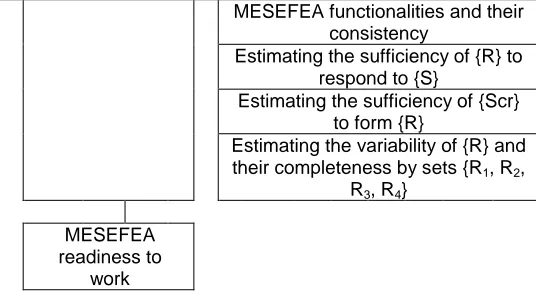
constructing MESEFEA is presented in Fig. 2.
Goal setting for MESEFEA
functioning
Formalization of purpose of MESEFEA existence and
functioning
Determining MESEFEA's place in the enterprise management
system
The definition of the set {C} – the MESEFEA
operating conditions
Identifying groups of elements of MESEFEA operating conditions Identifying elements for each group
of MESEFEA operating conditions Selecting indicators that characterize MESEFEA operating
conditions
Estimating actual values and forecasting intervals of MESEFEA
operating conditions
The definition of the set {S} –
signals for MESEFEA
Defining groups of signal elements to MESEFEA
Defining the content of each group of signals to MESEFEA in the form
of specific possible signals Defining signal parameters for
each of the elements of each group
Empirical defining signal parameter values for each of the elements of
each group
Definition of MESEFEA internal content
Identifying MESEFEA subjects Identifying required and available
resources Building functionalities for
MESEFEA subjects Defining MESEFEA activity elements (procedures, regulations
and methods)
The formation of triggers variety, which will update
the MESEFEA scenarios
Combining elements of sets {S} with {C} to determine the content of
the set {Tr} for MESEFEA Constructing polycriteria patterns of MESEFEA scenario triggers and
their combinations
Formation of a set {R} of MESEFEA managerial responses to {S}
Determining the principal content of each scenario R{R1, R2, R3,
R4}
Linking scenarios {R} as MESEFEA external reactions with
set {Tr}
Constructing {Scr} to form {R}
Checking the effectiveness of
generated MESEFEA
Estimating the adequacy of resources for the adequate formation of {R} in the presence of
certain {S} Estimating the balance of
MESEFEA functionalities and their consistency
Estimating the sufficiency of {R} to respond to {S}
Estimating the sufficiency of {Scr} to form {R}
Estimating the variability of {R} and their completeness by sets {R1, R2,
R3, R4}
MESEFEA readiness to
work
Fig. 2. The algorithm of constructing MESEFEA.
2521 evaluated. Moreover, such consistency should be considered
inside of MESEFEA between individual entities and other units in the activity of the enterprise. In the future, as part of the validation of the generated MESEFEA, it is necessary to expertly check the sufficiency of the generated {R} to respond to the expected or empirically determined {S}. For a deeper test, it is advisable not to take retrospective information, but to combine the {S} scenario and test MESEFEA's readiness to formulate the necessary {R}. To ensure MESEFEA's internal readiness to formulate adequate management responses, the sufficiency of multiple scripts should be evaluated. Since the external reaction from the composition {R} is a consequence of the joint functioning of the MESEFEA elements, the set {Scr} is subject for verification, which ensures the formation of external reactions. The insufficiency of the set {Scr} will automatically make {R} impossible, and it is better to detect this at the testing and verification stage of MESEFEA, rather than at the stage of its functioning, since such insufficiency will lead to an inability to respond to {S} in a timely manner. Finally, at the step of MESEFEA test, it is advisable to check the degree of variability {R}. Such variability should be adequate {S}, since the measure of variability of the control system should be higher than the variability of the controlled system. Otherwise, MESEFEA simply will not happen. In terms of management, otherwise, MESEFEA simply will not cope with its tasks – low variability {R} will actually mean the ergodic equifinal deterministic nature of the functioning of MESEFEA. However, speaking about the set {S} as a generalizing characteristic of the influence of the external and internal environment on the functioning of MESEFEA, it will actually mean that MESEFEA is not a governing body to ensure the economic security of the foreign economic activity of the enterprise, but rather acts as a management object. Such a situation is not useful, but even harmful in the context of ensuring the economic security of the enterprise, since then the response of the governing body is less dependable on many possible stimuli, and such a reaction is narrowed regarding the entire spectrum {S}. Of course, it is difficult to talk about the effectiveness of MESEFEA in this situation, therefore, to ensure the normal efficient functioning of MESEFEA in the case of a wide range of {S}, the variability {R} should be adequately high. But this fact must be checked before, at the step of MESEFEA construction. Another aspect of checking the set {R} is to establish the completeness of the reaction for all the sets {R1}, {R2}, {R3} and {R4}. That is, in general, for the set {R} the number of reactions may be sufficient, but for individual sets of {R1}, {R2}, {R3} and {R4} the number of reactions may be insufficient. In such a situation, when checking the effectiveness of the developed algorithm for constructing MESEFEA, it is advisable to check for sufficiency of each of the sets under consideration and, if necessary, supplement it with the necessary reactions. If the verification of the effectiveness of the generated MESEFEA in all areas recognized the adequacy of MESEFEA, its adequacy, the ability to perform the main task is to ensure adequate {R} in the case of empirically and scenario-confirmed {S}, then the action of the algorithm should be considered as completed, and the generated MESEFEA is ready for work. If an imbalance is identified in one or more of the proposed areas of verification, or iterative simulation has revealed insufficient functionality of the mechanism, then the proposed algorithm provides a return to the stage of determining the internal content of MESEFEA, its refinement in order to provide an
adequate managerial response. Of course, this feature of the algorithm (iterative improvements with checking the effectiveness before the algorithm starts functioning) has its drawbacks, in particular, the formation of the algorithm can take a sufficient amount of time. However, it is better to spend efforts at the stage of MESEFEA formation to ensure the functionality of such a mechanism than to obtain insufficiently functioning MESEFEA with inadequate {R} or to refine MESEFEA in the process of its functioning due to the many reactions {R3}, which still need to be formed.
4 C
ITATIONSThe study proposed a behavioral model of MESEFEA functioning, which allows to describe the action of such a mechanism for a particular enterprise, taking into account the conditions of its functioning and the expected incentives from the external and internal environment, by isolating and describing the set of reaction paths of such a mechanism. The practical value of the presented scientific results lies in the fact that they allow the developed mechanism to be implemented in the enterprise management system basing on a detailed description of the incentive content, the operating conditions of the mechanism and its content, reaction paths and corresponding scenarios. Based on the developed model of MESEFEA functioning and the detailed disclosure of each of the elements of such a model, an algorithm for constructing this mechanism has been developed. On the basis of the model under consideration and its certain elements, as well as the structure of the scenarios of MESEFEA functioning, it allows to build MESEFEA for a particular enterprise, taking into account the actual operating conditions of such an enterprise, the expected incentives and reactions. In view of the foregoing, the prospects for further research will be to detail the actions of the direct executors involved in the functioning of MESEFEA and the scientific, methodological and instrumental support for their effective work.
R
EFERENCES[1] Bates, R. (2017). The Development Dilemma: Security, Prosperity, and a Return to History. Princeton University Press, 200.
[2] Davidavičienė, V., Raudeliūnienė, J., Tvaronavičienė, M., Kaušinis, J. (2019). The importance of security aspects in consumer preferences in electronic environment. Journal of Security and Sustainability. Issues, 8(3), 399-411.
[3] Hart, O. and B Holmström (2010). A Theory of Firm Scope. Quarterly Journal of Economics, 125(2), 483-513.
[4] Havlovska, N., Rudnichenko, Y., Lisovskyi, I. (2019). Transformation processes in the system of providing economic security of investment activities of industrial enterprises. Baltic Journal of Economic Studies, 5(2), 18-23.
[5] Havlovska, N., Savina, H., Davydova, O., Savin, S., Rudnichenko, Y., Lisovskyi, I. (2019). Qualitative substantiation of strategic decisions in the field of cost management using the methods of economic mathematical modeling. TEM JOURNAL – Technology, Education, Management, Informatics, 8(3), 959-971.
2522 Economic Security Index.
[7] Korauš, A., Dobrovič, J., Polák, J., Kelemen, P. (2019). Security position and detection of unusual business operations from science and research perspective. Entrepreneurship and Sustainability. Issues, 6(3), 1270-1279.
[8] Kozachenko, G. V., Pogorelov, Yu. S., Bilousova, A. Yu. (2019). Development of threats to enterprise activity. Security of the XXI century: national and geopolitical aspects : collective monograph. Prague Czech Repulic, 134-140.
[9] Rudnichenko, Ye., Havlovska, N., Matiukh, S., Lopatovskyi, V., Yadukha, S. (2019). Optimization of the interaction of industrial enterprises and foreign counterparties using pure player strategies in a non-cooperative game. TEM JOURNAL – Technology, Education, Management, Informatics, 8(1), 182-188. [10] Rudnichenko, Ye. M., Havlovska, N. I., Yadukha, S. Y.
(2018). Implementation of managerial innovations in the system of providing economic security for subjects of foreign economic activity. Scientific bulletin of Polissia, 1(13), Р.1, 88-94.
[11] Schank, R. C., Abelson R. P. (1977). Scripts, plans, goals, and understanding: An inquiry into human knowledge structures. Hillsdale : Erlbaum, 248. [12] Sparrow, O. (2010). Making use of scenarios – from
the vague to the concrete. Scenario & Strategy Planning. London : Ark Publishing, 2(5), 18–21. [13] Thaler, R. H. (2016). Behavioral economics: Past,
present, and future. American Economic Review. 106, 1577–1600.
[14] Thaler, R.H. (2015). Misbehaving: The Making of Behavioral Economics. New York: W. W. Norton & Company.
[15] Watson, J. B. (1913). Psychology as the Behaviorist Views it. Psychological Review, 20(2), 158-177.
[16] Watson, J. B. (1930). Behaviorism (Revised edition). Chicago: University of Chicago Press.