Article
1
Energy Efficient Clustering Protocol to Enhance
2
Performance of Heterogeneous Wireless Sensor
3
Network: EECPEP-HWSN
4
Santosh Purkar 1,*, Dr. R. S. Deshpande 2
5
1 Department of Electronics and Telecommunication Engineering, Matoshri College of Engineering and
6
Research Center, Nashik Eklahare odha (M.S), India ; E-mail: [email protected]
7
2 Principal, S.C.S.M.CO.E, Ahmednagar Nepti (M.S), India, E-mail: [email protected]
8
* Correspondence: [email protected]; Tel.: +91-985-012-0485
9
Abstract: As Heterogeneous Wireless Sensor Network (HWSN) fulfill the requirements of
10
researchers in the design of real life application to resolve the issues of unattended problem. But,
11
the main constraint face by researchers is energy source available with sensor nodes. To prolong
12
the life of sensor nodes and hence HWSN, it is necessary to design energy efficient operational
13
schemes. One of the most suitable routing scheme is clustering approach, which improves stability
14
and hence enhances performance parameters of HWSN. A novel solution proposed in this article is
15
to design energy efficient clustering protocol for HWSN, to enhance performance parameters by
16
EECPEP-HWSN. Propose protocol is designed with three level nodes namely normal, advance and
17
super node respectively. In clustering process, for selection of cluster head we consider three
18
parameters available with sensor node at run time, i.e., initial energy, hop count and residual
19
energy. This protocol enhance the energy efficiency of HWSN, it improves performance parameters
20
in the form of enhance energy remain in the network, force to enhance stability period, prolong
21
lifetime and hence higher throughput. It is been found that proposed protocol outperforms than
22
LEACH, DEEC and SEP with about 188, 150 and 141 percent respectively.
23
Keywords: cluster head; dead node; random; vicinity; modulation; index; survival; overhead
24
25
1. Introduction
26
As remote event sensing is possible by wireless sensor network, which is composed with
27
certain number of small size sensor nodes with capabilities such as advanced processing, support for
28
communication protocol, transceivers and sensor with better sensitivity. As wireless sensor nodes or
29
network is easy to deploy and manage, deployment may be uniform, linear or random based on
30
objectives. To record a real time picture large number of sensor nodes needs to be arrange
31
systematically, such that information collection is possible for low intense and large threshold event
32
for longer span of time. This indicates that wireless sensor network (WSN) is cost effective in
33
information sensing for completing different tasks such as collection, aggregation and
34
communication over the air in the coverage radius or in sensing region, but the main problem faced
35
by WSN or wireless sensor node is in limitations of resources facilitated in development of tiny or
36
small size node. Normally resource facilities available are low storage, less processing power
37
compared to complex instruction set computer, antenna system with limited gain, low energy
38
backup or battery and low bandwidth for communication. Depend on the application area, WSN for
39
particular application has their own respective constraints than the low battery energy. Some of the
40
popular applications design and developed by researchers are in surveillance, forestry, weather
41
forecasting, in habitat monitoring, volcano, military, in machine health updating and for inventory
42
system update, in biomedical applications such as for human health record and to convey doctor in
43
certain premises areas [1-3]. Very differently classified applications of WSN are in geoinformatics
44
and Intelligent Transport System (ITS) [3]. Finally in research for hypothesis model verification for
45
different scenario. With this list of applications, applications can be categorized as social, industrial,
46
medical, GIS and in research field. As WSN not only composed of wireless sensor nodes, but one
47
most important element used by WSN is base station (BS) or sink node. After collecting information
48
or sense data, data need send it to the BS through wireless channel. But, the main difficulty faced by
49
researchers in using WSN is energy supply available, which shrinks the life and all performance
50
parameters. Systematic energy utilization and enhancing performance parameters is the main goal
51
of the researchers. Design and implementation of energy efficient scheme is commonly suggested
52
solution by researchers in the form of local energy saving and global energy saving like sleep and
53
wake-up strategy, data aggregation, overload reduction, single hop communication, multi-hop
54
communication and transmission power control inside network operation. Different working
55
approaches proposed by authors for data updating at BS like query, threshold and time based
56
approach [1-4]. Clustering based routing is most suitable scheme to support for load balancing, fault
57
tolerance and reliable communication and hence to prolong performance parameters of WSN.
58
Clustering scheme have three elements as cluster head (CH) node or head of clustered node
59
department works as an intermediate node to transfer concise report of activity inside the network
60
in the form of aggregated data to head of system or controller i.e. BS, sensor nodes or cluster member
61
(CM) the followers to collect and report the event information to head regularly or based on certain
62
rule. Indirectly CH manages all CM locally and utilizes the available resources systematically. CH
63
also contribute for different responsibility towards cluster as allocation of channel, intimation of
64
power control, as well as reformed the cluster, control the activity of routing based on distance from
65
BS or CM. Finally clustering scheme is the well-organized routing framework in sensory system for
66
the sake of energy conservation by distributing responsibility to each and every member of WSN.
67
There are the different approaches suggested by researchers to work with clustering scheme as
68
mentioned in [1-2]. All those approaches have their respective merits and demerits. However
69
clustering scheme provides better energy conservation with Wireless Sensor Network (WSN). But, at
70
run time there is variation in energy level at sensor nodes of WSN, hence network with different
71
energy level node is formed. This type of network behavior is referred as Heterogeneous WSN and
72
longer support to traditional designed clustering protocol, which is based on assumption of sensor
73
nodes available in the network have equal energy capability node (Homogeneous WSN). Hence
74
researchers turn their focus on the design and development of clustering HWSN. Main components
75
of HWSN are same as WSN like sensor nodes and BS, but in this sensor node have different
76
capability as varied battery level, varied antenna system, high processing and link capability. On the
77
outset high energy capability nodes is the best choice of all the varied features, as battery energy
78
level controls all the varied features of sensor node. Ideal consideration is to have high energy node
79
in WSN is good practice to prolong the lifetime. Adding heterogeneity in WSN (HWSN) termed as
80
HWSN, which have better performance parameters than homogeneous WSN. HWSN with
81
clustering approach additionally improve performance parameter of the network [1-2]. WSN may be
82
homogeneous or heterogeneous, node whose energy level reach zero during operation termed as
83
dead node. In real time application node whose battery energy level lower than energy require for
84
sensing accurately or processing is termed as dead. Thus energy optimization scheme is demanded
85
that minimize the death of nodes from WSN. Meta-heuristic approach is the preferable optimization
86
scheme to enhance performance parameter. As heuristics approach support full benefit to specific
87
issue, and are in greedy in nature in the solution that trapped in local saving and fails for global
88
optimum [5]. However, meta-heuristics approach is full proof solution for energy efficiency and
89
finding the best for global. Author follow the approach of Meta-heuristics for selecting cluster head
90
for HWSN with three different energy level nodes as normal, advance and super node with
91
reference to [6-7]. In this work, we present a distributed clustering approach that considers a hybrid
92
of energy and communication cost. A novel protocol named EECPEP-HWSN (Energy Efficient
93
Clustering Protocol to Enhance Performance of HWSN) is proposed here with different objectives
94
such as: (i) Select best possible node to be CH by considering the real time information, (ii) Enhance
95
stability period and lifetime by reducing energy consumption in the form of reducing internal
96
overhead and cost of processing energy. In the proposed clustering protocol there is an assumption
of random deployment or distribution of nodes, with the considerations that nodes in remote
98
applications are randomly deployed. All nodes have their location awareness in advance or at the
99
time of deployment. The issue we highlighted here is for the sake of load balancing and minimizing
100
energy consumption of the network by dividing the network initially in four subsections called as
101
zones based on population [8]. All the nodes have to work for the role inside the network may be as
102
CH or CM, but only one at particular cluster round. A certain amount of clusters and hence CH
103
generated inside the network at a time and there location is also known to the other member of
104
network. In the proposed network model everybody gets an opportunity to work as CH or
105
intermediate CH other than role of cluster member. Sensor node or member node can transfer their
106
collected information to CH, which is in coverage range. It is well assured that selected temporary
107
CH and final CH is less likely in the or on the vicinity of network. Proposed work is presented here
108
in the following subsections as, second section presents literature survey, third section offers
109
network details acquired for the proposed work, proposed work in the form of explanation of
110
mathematical base is presented in the form of proposed protocol in fourth section, proposed
111
protocol implementation and its validations with existing protocol is presented in fifth section of this
112
article and efforts in the form of outcome is presented in final section of this article.
113
2. Literature Survey
114
Though the design and implementation of energy efficient clustering protocol is demanded,
115
there are number of issues raised during real time working. Design energy efficient routing that
116
support heterogeneity, scalability and hierarchical topology is the main goal of researchers in the
117
area of wireless sensor network for longer span of time [1-2]. There is high need to design energy
118
efficient clustering protocol such that it balance the load among the available nodes and must keep
119
routing table minimum. Any node death must be recorded and overhead need to be reduced. To
120
prolong lifetime of WSN or Heterogeneous WSN researchers efforts a lot to design clustering
121
scheme based on hierarchical clustering protocol as proposed in [2]. Single hop scheme of cluster
122
routing for homogeneous WSN with the goal of load balancing such that every node get chance to
123
become CH once during lifetime of network as proposed by author in [8]. Node which is elected as
124
CH for particular round never be CH again in next 1/p round with probability of cluster head is p.
125
The base of CH election is random number generated by node within range 0 to 1. The node whose
126
values is less than the threshold T (n) is been elected as cluster head for particular round. Once node
127
is elected as CH, then it publishes its identity and parameter associated in the form of advertise ADV
128
message towards other member in the coverage zone. CM replied on the receipt of ADV with
129
associated parameters like time slot acquired, energy level available, hop count etc. CH prepares
130
TDMA from the reply of all the nodes in its coverage and publishes it by air. With this everybody
131
comes to know the time slot on which to participate for communication. Other than this slot period
132
particular node can be in sleep state, to save energy available. Merits suggested by LEACH protocols
133
are CH role is rotated such that load balancing is achieved. With single hop approach considerable
134
energy is saved. But, there are higher number of demerits to compensate for merits as no basis of
135
residual energy is considered, as role of CH is rotation impose possibility that node elected as CH is
136
on the vicinity of network or in the vicinity. This mechanism increases control overhead and its
137
processing energy, which is not suitable for scalable network. Like this other protocols suggested as
138
[7, 10] etc. are also focused on energy efficient clustering. But all those are somehow are less faithful
139
to really enhance energy efficiency of WSN without their considering criteria of CH selection and
140
network model support. Stable Elections Protocol (SEP) is introduce, to enhance stability and
141
lifetime of heterogeneous WSN by author of [11]. Two level energy nodes are introduced in this
142
protocol namely normal and advance nodes. Basically in HWSN, nodes those are heterogenite in
143
resources are less in percentage fraction. In this advanced node have higher battery energy level
144
than its follower normal node. Probability of node to be CH is different for both type of node, but
145
mostly advanced node have more chance to get select as CH than normal node. In this by increasing
146
percentage factor of advance nodes and hence probability of CH selection improves performance in
147
the form of stability and lifetime, which also improves throughput of the network. Demerits
identified in this is advanced node get punished badly as they have more chance to get selected as
149
CH. Reduce the survival time of network with added parameter of probability function for CH
150
selection. DEEC (Distributed Energy Efficient Clustering) is another HWSN clustering protocol
151
having different approach of selecting CH as proposed in [12]. In DEEC, CH selection is based on
152
ratio of residual energy to average energy of the network. By varying epoch period we can have CH
153
selection for different types of node. The node whose energy level, initial or residual energy is higher
154
gets more chance to become CH than the node with low energy level. But, DEEC have the
155
constraints as network lifetime is recorded while protocol in action for cluster round activity. DEEC
156
have the same problem as SEP protocol as to punish advanced node badly and global knowledge of
157
network. Hence to design and implement energy efficient clustering with heterogeneous WSN a
158
novel approach to select CH such that energy utilization of the network get enhanced.
159
2.1. Motivation
160
All aforementioned protocol HWSN clustering such as [9, 11, 12]. There is the CH selection
161
criteria indirectly linked with probabilistic approach or connected to threshold T(n) with
162
probabilistic approach. By varying the CH selection criteria to select most promising node, increases
163
internal overhead. Some of the time node selected as CH is at the vicinity or off the vicinity. If node is
164
at or on the vicinity, it increases the energy consumption in the network and hence reduces the
165
stability and lifetime of the network. So node with this position is not suitable for the role of CH.
166
Hence node must have better internal parameter and better connectivity with nodes and mainly
167
situated in the premises of network. Hence best suitable node is selected for the role of CH, improves
168
energy remain in the network, stability, lifetime and throughput of the network for respective
169
cluster round.
170
2.2. Energy Consumption Model
171
In communicating data between sensor nodes wirelessly some energy is dissipated due to
172
internal electronics circuits operation. Other source of energy dissipation is sometimes node may
173
have GPS system installed to update the location information. But, energy dissipation is mainly
174
depending on the distance between sender and target receiver. It means some of the energy
175
consumed at the time of process in sender and at transmission, at the same time energy is consumed
176
in reception successfully and again to process for record. This energy consumption scene is
177
presented mathematically as given below with reference to [13]. Where the parameter involved have
178
their respective significance as Eelec presents energy consumed by transmitting and receiving
179
electronics circuitry to process single bit information. Etx and Erx is the energy required by
180
transmitting and receiving section to process complete data packet of length L, This is directly
181
depend digital coding or spreading of the bit and indirectly to digital modulation scheme used. Efs
182
and Emp are the amount of transmitter amplifier expenses in the form of energy for free space loss
183
and multipath fading loss, d0 is the safe distance or threshold distance or crossover distance between
184
sender and receiver. Main classified information about amplifier (power amplifier) is to control the
185
setting of power such that if communication distance d between sender and receiver is less than d0
186
then free space power loss model is to consider in the form of:
187
188
Etx (L, d) =LEelec+ LEfsd2 d << d0 (1)
189
190
If the distance is greater than threshold d0 then multipath fading power loss model as:
191
192
Etx (L, d) =LEelec+ LEmpd4 d >> d0 (2)
193
194
Where L is length of data packet in number of bit for communication. Calculation of d0 is:
(3)
196
2.3. Network Model
197
In the proposed network model, there are n numbers of randomly deployed sensor nodes with
198
the network layout of M X M. After deployment all nodes are assumed to be fix or immobile.
199
Network layout is divided in four zone based on population and BS is at the center of network field.
200
Every node has the capability to aggregate the data. Each and every node has the location
201
information in advanced. All nodes have symmetric communication channel. It is prime
202
considerations that node always have data to send. Networks have combination of different energy
203
level nodes in certain percentage. Nodes are namely normal, advance and super nodes in increasing
204
order of energy level as presented in [6-7]. For our simulation we are using increasing energy factor
205
as 2. In the proposed work we are using three level energy heterogeneity as E0, EAdv and ESuper. Nodes
206
with percentage population factor a with n nodes for advanced node, which is equipped with energy
207
factor greater than m times than normal node. Super nodes are equipped with increase energy factor
208
as m0, with percentage population factor a0 with respect to n nodes. Now we are presenting
209
individual details in the form of equation as: Initial energy E0 is the energy available for normal
210
nodes whose density found as n (1-a-a0), Hence advance and super node populations are, na and na0
211
respectively. Energy presented by each individual node type is as follows:
212
213
Energy due to normal node is;
214
Enormal = nE0 (1-a- a0) (4)
215
216
EAdv = nE0 (1+m) a (5)
217
218
ESuper= nE0 (1+m0) a0 (6)
219
220
Equation 4, 5 and 6 presents available energy with all three types of nodes. Total initial energy
221
proposed in the network model is calculated as ETot;
222
223
ETot = Enormal+ EAdv+ ESuper (7)
224
225
ETot = nE0 - naE0- na0E0+ naE0 + nE0 ma+ na0E0 + na0m0E0 (8)
226
227
In equation (8) it is found that the second and fourth term is of equal magnitude and is out of
228
phase, and terms third and sixth is of the same magnitude and is out of phase. Hence equation (8)
229
is rewritten as;
230
ETot = nE0 + nE0 ma+ na0m0E0 = n E0 (1+ma+m0a0) (9)
231
232
Hence from equation (9) we are hereby conclude that if we add heterogeneity level up to level 2
233
available energy increased by factor (1+ma) and if it increased by level 3, then energy present at
234
beginning is increased by factor (1+ma+m0a0). If we would like to improve heterogeneity level
235
greater than 2 then equation is modified as given below:
236
ETot = nE0( 1+ma + ); i=0...N (10)
237
Where, N can be any integer number.
238
239
3. Proposed Protocol
240
We are presenting here a novel energy efficient clustering protocol to enhance performance
241
metrics of HWSN in all the way better than the formerly available protocol. Initially all the nodes are
deployed randomly in the network, network is divided in four equal zone based on location
243
information such as zone A, Zone B, zone C and zone D as per [7].
244
245
Total network area is= Area (A+B+C+D) (11)
246
247
Which reduce the internal overhead inside the network during network management, this
248
improves the energy remain in the network at run time. In most of the existing clustering protocol,
249
cluster size is arbitrary some of the time cluster head or CH is located on the border or towards the
250
border of the network, due this energy depletes at faster rate and degrades the network
251
performance. In the proposed work, we are having a very different approach of selecting cluster
252
head based on real time parameter available with the sensor node in the form of Node Quality Index
253
(Qni). Node Quality Index is the devised parameter based on initial energy, residual energy and the
254
hop count required by the particular node with respect to base station. As initial energy required
255
being higher in normal selection of cluster head, residual energy need to be higher at run time for the
256
assurance of longer life of node and finally node must be moderately or nearly situated from the
257
base station. Hence finally arranging all these in the form of linear equation gives us a better value of
258
Qni for the role of cluster head. There is the index modeling used from data modeling approach for
259
Qni calculation.
260
3.1. Protocol Explanation
261
In this propose work, we are presenting a new approach of CH selection by introducing a very
262
new factor named as Node Quality Index (Qni). Node Quality Index is the fusion of initial energy of
263
the node, current available energy at run time and hop count with respect to base station. Once
264
selection of CH is started with available parameter from each zone. Node who have better value of
265
index and satisfying the boundary condition criteria, as given below in CH solution. Node with
266
better value of node index from each zone is selected as temporary CH for that zone. Every zone has
267
the information of selected temporary CH and it is conveyed to all nodes available from the zone.
268
Each and every zone submit the information of temporary CH, finally averaging of all the temporary
269
CH Node Index is performed and the CH whose value greater than average value of CH is selected
270
as final CH from the network for data transaction. All temporary CH have the updation of final CH
271
and transfer aggregated data depends on requirement. But, at the time of data transmission
272
temporary CH have to check relative distance between final CH and with BS. If distance between BS
273
and the CH is lower than the final CH, transfer collected data to BS directly. Initially it is found that
274
most of the nodes have equal value of node index, so it is very necessary to have appropriate
275
approach of data collection such that load balancing is achieved. For this short span of time we are
276
using LEACH scheme for CH selection. The proposed protocol is most suitable in surveillances,
277
weather forecasting, home automation, traffic management, habitat monitoring, in machine health
278
analysis and inventory management.
279
The fundamental CH solution for apply in proposed work is:
280
281
CHi = (12)
282
283
Where,
284
285
Boundary = Boundary of network layout ± 10%
286
287
CHi = (13)
4. Simulation and Results
289
This section highlights the achievements of proposed work in the form of enhanced
290
performance parameters than the existing well known clustering protocols such as HWSN, like
291
LEACH, SEP and DEEC. Some of the performance parameters are explained in short as follows:
292
293
• Stability Period: The time period before the death of very first node from available sensor
294
nodes from deployed HWSN.
295
• Number of alive node per cluster round: Number of node alive available inside the
296
network for every cluster round, which indirectly presents the available energy remain in
297
the network.
298
• Number of dead nodes per cluster round: Number of nodes dead per cluster round during
299
the survival against changing energy level inside the network. This factor indirectly presents
300
death rate of nodes over cluster cycle. Which indicate network survival time before complete
301
death.
302
• Throughput: Number of data packets sent from the sensor nodes towards base station over
303
the cluster round present’s amount of throughput. Amounts of throughput signify efficiency
304
of network. Throughput presents quality of the network.
305
5. Result discussion
306
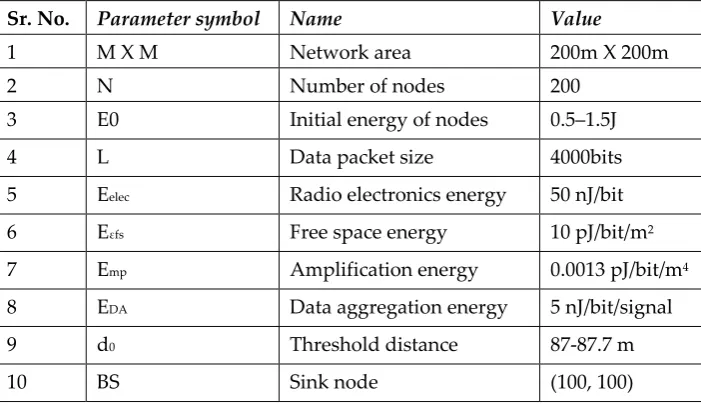
With reference to table 1 given below in the form of parameter set, we randomly deploy the
307
network in 200 m X 200 m form. Divide the network in four equal zones based on population, place
308
the BS at the center of the network with position (100 X 100). Total node population is 200, with
309
percentage fraction factor as a=0.2 and a0=0.1. With advance node energy value about to double the
310
normal node energy. Super node energy value is about twice the advanced node.
311
Table 1. Simulation Parameter.
312
Sr. No. Parameter symbol Name Value
1 M X M Network area 200m X 200m
2 N Number of nodes 200
3 E0 Initial energy of nodes 0.5–1.5J
4 L Data packet size 4000bits
5 Eelec Radio electronics energy 50 nJ/bit
6 Eεfs Free space energy 10 pJ/bit/m2
7 Emp Amplification energy 0.0013 pJ/bit/m4
8 EDA Data aggregation energy 5 nJ/bit/signal
9 d0 Threshold distance 87-87.7 m
10 BS Sink node (100, 100)
5.1. Validation with LEACH protocol
313
As we know LEACH strategy is best suitable for improving lifetime of WSN by offering an
314
equal opportunity everybody to become a CH and balance the energy consumption as proposed in
315
[8]. But it’s a random selection of CH, no reference of residual energy available and about hop count.
316
Hence our protocol outperforms than the LEACH with this aspect in the form of stability period and
317
lifetime presented in figure 1(a) and 1(b). Colour used for presentation is blue for proposed protocol
318
and red colour is used for former protocol. As per LEACH, there is less guarantee that selected node
319
is inside the network premises and not on the verge of vicinity or in the vicinity. This improves
320
energy consumption inside the network. Propose protocol solve this issue with reduction in internal
overhead packets, hence energy remain in the network is better than LEACH protocol as shown in
322
figure 1(c). Finally available energy is utilized efficiently and systematically for longer span of time
323
improves throughput from the network shown in figure 1(d).
324
325
Figure 1. (a) No. of Alive nodes versus no. of cluster rounds
326
327
Figure 1 (b) No. of Dead nodes versus no. of cluster rounds
328
329
Figure 1 (c) Energy remain in the network versus no. of cluster rounds
330
331
Figure 1 (d) No. of Data packets sent to BS versus no. of cluster rounds
332
333
334
5.2. Validation with SEP protocol
335
Basically SEP is proposed to introduce energy heterogeneity in WSN i.e. in the form of
336
advanced nodes other than normal node as per [11]. But, in SEP protocol there is two level of
337
probability function to differentiate between advanced and normal node for the role of CH. Which
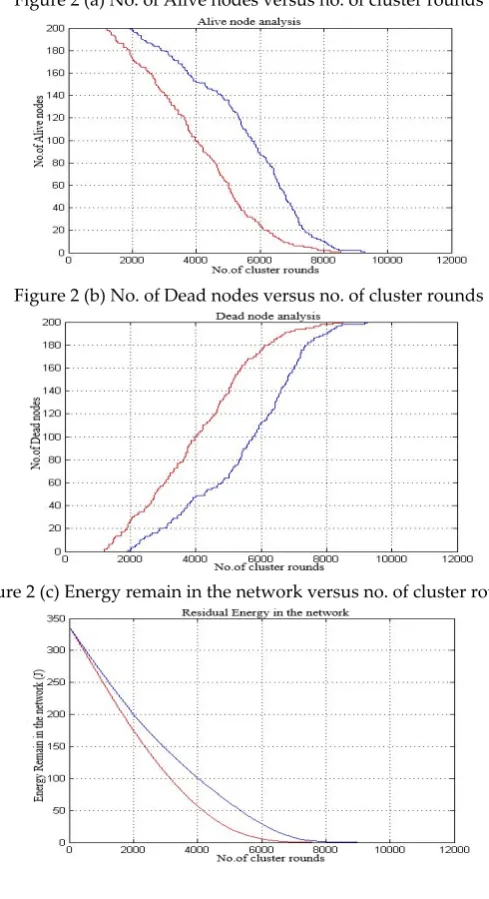
vary the energy level excursion and deplete the energy. It normally punishes the high energy node
339
and results in early death, which reduce the stability period and lifetime. As shown in figure 2(a),
340
lifetime 2(b) and energy remain in the network 2(c) compared with proposed protocol. Graph
341
presented with two colour as red for former protocol and blue colour is used for proposed protocol.
342
As proposed protocol is free from the varying probability function and changing energy level
343
utilization. Finally with improved energy remain or residual energy in the network enhance the
344
lifetime and hence number of data packets sent towards base station in the form of figure 2(d) as
345
throughput over lifetime.
346
347
Figure 2 (a) No. of Alive nodes versus no. of cluster rounds
348
349
Figure 2 (b) No. of Dead nodes versus no. of cluster rounds
350
351
Figure 2 (c) Energy remain in the network versus no. of cluster rounds
352
353
354
355
356
357
358
359
360
361
Figure 2 (d) No. of Data packets sent to BS versus no. of cluster rounds
363
5.3. Validation with DEEC protocol
364
DEEC protocol proposed by author with the approach of average energy in the network and
365
initial lifetime calculations in the form of number of round as given in [12]. In this protocol global
366
knowledge of network needs to be updated regularly at end of each round and probability threshold
367
function also playing an important role for CH selection based on varying probability function.
368
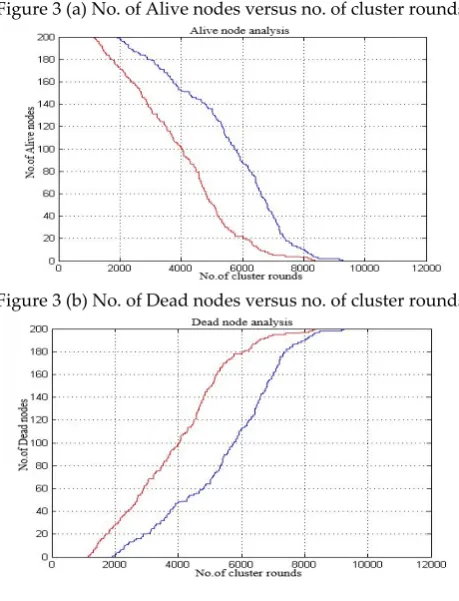
Which affect the energy balancing inside the cluster and hence in network. Which reduce the lifetime
369
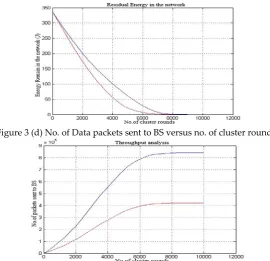
of sensor network as depicted in figure 3(a) and 3(b) in the form of blue and red colour. Energy
370
unbalancing of DEEC depicted in the form of energy remain in the network as in figure 3(c).
371
Throughput of the former protocol is also getting reduced, presented in figure 3(d). Because
372
proposed protocol does not have any varying probability function and criteria for CH selection is
373
deterministic. Hence proposed protocol outperforms than the former.
374
375
Figure 3 (a) No. of Alive nodes versus no. of cluster rounds
376
377
Figure 3 (b) No. of Dead nodes versus no. of cluster rounds
378
379
380
381
382
383
384
385
386
387
Figure 3 (c) No. of Alive nodes versus no. of cluster rounds
389
Figure 3 (d) No. of Data packets sent to BS versus no. of cluster rounds
390
391
Finally proposed simulation works shows better performance parameters than the existing
392
protocols. Hence our proposed clustering protocol is well balanced energy efficient clustering
393
protocol than the former. Performance validation is given below in table 2.
394
Table 2. Performance validation table
395
Sr. No.
Name of the protocol to be simulated % Enhancement on
Performance parameter LEACH SEP DEEC Proposed LEACH SEP DEEC 1 First node death (Stability) 874 1206 1136 1931 221 160 170
2 Tenth node death 1345 1903 1710 2896 215 152 170
3 All node death (Lifetime) 7254 8199 8375 9284 128 113 110
Overall performance parameter improvement with proposed protocol is: 188 141 150
6. Conclusion
396
In the proposed clustering protocol of HWSN, selection of CH is depend on current available
397
energy, initial energy, hop count from the base station. Node selected for the role of temporary CH
398
of each region is situated off the vicinity. Node which has better value of Node Index than
399
temporary selected CH and off the vicinity can be final CH, which enhances energy efficiency of the
400
network. Other achievement with proposed approach is internal overheads getting reduced to
401
greater extent with the initial division of network than the arbitrary clustering network. This
402
improves energy efficiency, force to enhance stability period, lifetime, improves residual energy of
403
the network and hence throughput is also enhanced than existing protocol.
404
References
405
1. A. A. Abbasi; M. Younis. A survey on clustering algorithms for wireless sensor networks. Science
406
Direct Computer Communications 2007, Volume 30, pp. 2826–2841, Doi:10.1016/j.comcom.2007.05.024.
407
2. S.V.Purkar; Dr. R.S.Deshpande. A review on energy efficient clustering protocols of heterogeneous
408
wireless sensor network. International Journal of Engineering and Technology 2017, Volume 9, pp.
409
2514–2527, Doi: 10.21817/ijet/2017/v9i3/170903342.
410
3. S.A. Nikolidakis; D. Kandris; D.D.Vergados; C.Douligeris. Energy efficient routing in Wireless Sensor
411
Networks through balanced clustering. Algorithms 2013, Volume6, pp. 29-42, Doi: 10.3390/a6010029.
4. G. Abdul-Salaam.; A. H. Abdullah; M. H. Anisi; A. Gani; A. Alelaiwi. A comparative analysis of
413
energy conservation approaches in hybrid wireless sensor networks data collection protocols.
414
Telecommunication Syst. 2016, Volume 16, pp. 159-179, Doi: 10.1007/S 11235-015-0092-8.
415
5. S. Singh; A.Malik; R. Kumar. Energy efficient heterogeneous DEEC protocol for enhancing lifetime in
416
WSNs. Engineering Science and Technology an International Journal 2017, Volume 20, pp. 345-353,
417
Doi:10.1016/j.jestch.2016.08.009.
418
6. A. Kashaf; N. Javaid; Z. A. Khan; I. A. Khan. TSEP: Threshold-sensitive Stable Election Protocol for
419
WSNs. 10th International Conference on Frontiers of Information Technology at Islamabad 2012, pp. 164-168,
420
Doi: 10.1109/FIT.2012.37.
421
7. D. Kumar; T. C. Aseri; R.B. Patel. EEHC: Energy efficient heterogeneous cluster scheme for wireless
422
sensor networks. Elsevier computer communication 2009, Volume 32, pp. 662-667,
423
Doi:10.1016/j.comcom.2008.11.025.
424
8. B.Manzoor; N.Javaid; O.Rehman; M.Akbar; Q.Nadeem; A.Iqbal; M.Ishafaq. Q-LEACH: A New
425
Routing Protocol for WSNs. International Workshop on Body Area Sensor Networks (BASNet-2013),
426
SciVerse ScieceDirect 2013, Volume 19, pp. 926-931, Doi: 10.1016/j.procs.2013.06.127.
427
9. W. R. Heinzelman; A. Chandrakasan; H. Balakrishnan. Energy-Efficient communication protocol for
428
wireless microsensor networks. In Proceedings of the Hawaii International Conference on System Sciences,
429
Maui, Hawaii 2000 , pp. 1-10, Doi: 10.1109/HICSS.2000.926982.
430
10. O. Younis; S. Fahmy. HEED: A hybrid, energy-efficient, distributed clustering approach for ad-hoc
431
sensor networks. IEEE Trans. Mobile Comput. 2004, Volume 3, pp. 366–379, DOI: 10.1109/TMC.2004.41.
432
11. G. Smaragdakis; I. Matta; A. Bestavros. SEP: A Stable Election Protocol for clustered heterogeneous
433
wireless sensor network. Second International Workshop on Sensor and Actuator Network Protocols and
434
Applications 2004, pp. 1–6.
435
12. L. Qing; Q. Zhu; M. Wang. Design of a distributed energy-efficient clustering algorithm for
436
heterogeneous wireless sensor network. ELSEVIER, Computer Communications 2006, Volume 29,
437
pp.2230-2237, Doi:10.1016/j.comcom.2006.02.017.
438
13. N. Javaid; M. B. Rasheed; M. Imran; M.Guizani, Z. A. Khan; T.A. Alghamadi; M. Llahi. An
439
energy-efficient distributed clustering algorithm for heterogeneous WSNs. EURASIP Journal on
440
Wireless Communications and Networking, Springer 2015, pp. 3-11, Doi: 10.1186/s13638-015-0376-4.