an action research model
of curriculum review
David Waalen,
BA, DC*
Terry Watkins,
DC**
Ron Saranchuk,
PhD†
* Director, Chiropractic Clinical Sciences Division, CMCC. ** Chair, Chiropractic Principles and Practice Department, CMCC.
† Curriculum and Evaluation Coordinator, CMCC.
Canadian Memorial Chiropractic College, 1900 Bayview Avenue, Toronto, Ontario M4G 3E6. Tel: (416) 482-2340. Fax: (416) 482-9745. © JCCA 1999.
The philosophy of chiropractic has always been
regarded as an integral and indispensable component of the curriculum at chiropractic colleges. This study describes a review process in which instruments were designed to survey students and faculty to obtain
information concerning curricular aspects of philosophy at the Canadian Memorial Chiropractic College. Approximately one half of the student body (N = 292) and sixty percent of the full-time and part-time faculty members (N = 66) responded to the surveys. The students who were surveyed indicated that philosophy was a very important part of their chiropractic education and they felt that their needs in this regard were not being met by the present program. Further, they perceived most faculty as being unappreciative of philosophy. The results from the faculty survey were at odds with the students’ perceptions and indicated that the faculty members were favourably disposed towards philosophy and felt that it should be an integral part of the students’ educational experience. The information gained from these surveys was subsequently used as a catalyst to stimulate discussion in a series of student/ faculty focus groups on philosophy. These discussions helped to clarify some curricular philosophical issues and resulted in specific modifications to the philosophy program in the areas of content, format, faculty, and evaluation methods.
(JCCA 1999; 43(3):149–160)
K E Y W O R D S: chiropractic, philosophy, curriculum.
La philosophie de la chiropratique a toujours été considérée comme un élément indispensable du programme des collèges de chiropratique. La présente étude décrit un processus de révision dans lequel les étudiants et les étudiantes ainsi que les membres du corps professoral étaient invités à faire connaître leur opinion sur différents aspects du programme, concernant la philosophie au Canadian Memorial Chiropractic College. Environ la moitié des étudiants (n = 292) et soixante p. cent des professeurs à temps plein ou à temps partiel (n = 66) ont répondu au questionnaire. Les étudiants ont indiqué que la philosophie était un élément très important de leur formation en chiropratique et qu’ils avaient l’impression que le programme actuel ne répondait pas à leurs besoins à cet égard. Qui plus est, à leur avis, la plupart des membres du corps professoral ne considéraient pas la philosophie à sa juste valeur. De leur côté, les professeurs voyaient la philosophie d’un bon oeil et considéraient qu’elle devait faire partie intégrante de la formation des étudiants, ce qui contrastait nettement avec les perceptions de ces derniers. L’information ainsi recueillie a servi de catalyseur et a donné lieu à une série de groupes de consultation sur la philosophie, constitués d’étudiants et de professeurs. Les discussions qui en ont découlé ont permis de clarifier certains points du programme de philosophie et ont entraîné des changements, notamment en ce qui concerne le contenu, le format et les méthodes d’évaluation, ainsi qu’au sein du corps professoral. (JACC 1999; 43(3):149–160)
Introduction
The philosophy of chiropractic has always been regarded as an integral and indispensable component of the curricu-lum at chiropractic colleges. When D.D. Palmer accepted his first students in 1897 the course of study included phi-losophy in addition to such subjects as anatomy, physiol-ogy, pathology and adjusting technique.1 Since that time, prominent chiropractic educators have maintained that chiropractic principles underpin the knowledge, skills and values of the profession, and that the philosophy of chiro-practic can contribute an enduring sense of equilibrium to an otherwise complicated curriculum.2,3 However, the positive contribution of philosophy to the chiropractic cur-riculum has, to some extent, been compromised by the fact that philosophy has long been a source of considerable discord among members of the chiropractic profession.4,5 Despite some signs of a growing consensus with respect to this controversial subject, such as the outcome of the phi-losophy versus science debate at the 1997 California Chiropractors’ Association Convention,6 Morgan’s recent article on innate intelligence7 and the reaction it provoked in several letters to the editor of this journal, suggests that philosophy continues to be a contentious issue among chiropractors. Confirmation of this conjecture can be found in the Biggs et al. study of chiropractors’ attitudes towards philosophy8 where significant minority groups were at opposite ends of the conservative/liberal philoso-phy continuum. In this context it is interesting to note that, although philosophy has not previously been an intrinsic part of their curriculum, other health care professions such as osteopathy9 and medicine are now beginning to ac-knowledge that philosophy should be included in their syl-labi, and that “to teach any given therapy detached from its fundamental body of knowledge risks losing both what it has to offer and a complete understanding of it.”10
Despite its position of professional prominence and rec-ognized significance to chiropractic education, philosophy runs the risk of being treated complacently in any course or curriculum review process. The teaching of its time-hon-oured tenets and venerable concepts has become so famil-iar to some chiropractic educators that any in-depth inspection of their philosophy program appears to them to be superfluous. This uncritical acceptance of the status quo, however, fails to adequately consider the relative naiveté of the contemporary chiropractic student popula-tion in this respect, and the necessity for students to be able
to appropriately integrate the philosophy of chiropractic into their demanding course of study. The recent prolifera-tion of student philosophy clubs and the increasing popu-larity of extracurricular philosophy seminars presented by self-styled experts in this domain suggests that the stu-dents’ needs in this area have not been fully addressed by the traditional approach to teaching the philosophy of chiropractic. A few chiropractic educators have intro-duced more innovative approaches to the instruction of philosophy utilizing computer-assisted modules and pa-tient centred problem solving to more fully engage stu-dents in the learning process and better integrate philosophy content into the curriculum.11,12 Faculty mem-bers at some chiropractic colleges have also conducted surveys in an attempt to identify important curricular is-sues and fundamental problems with philosophy programs from the students’ perspective.13,14 The necessity for this type of research-oriented approach to curriculum review has been established by well-respected authorities in chi-ropractic education.15 The authors of this paper have uti-lized just such an investigative approach to survey students and faculty on fundamental philosophical issues and to subsequently conduct student/faculty focus groups which recommended significant modifications to the Chiroprac-tic Principles Program, at the Canadian Memorial Chiro-practic College.
Methods and materials
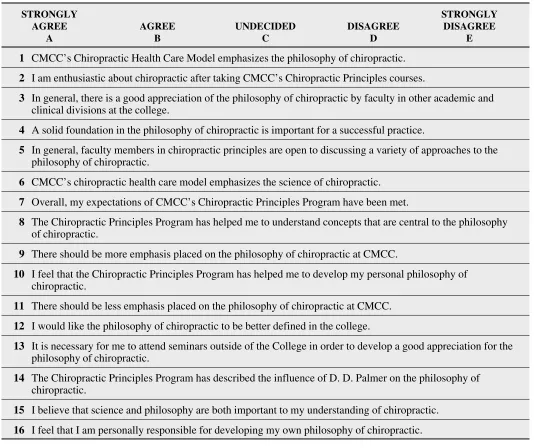
Figure 1
Student Assessment of Chiropractic Principles Program
This questionnaire is part of a review of the Chiropractic Principles and Practice Program. We request that you answer ALL questions on the scanner sheets provided using the rating scale outlined below. Confidentiality will
be maintained, and your answers will in no way affect your academic standing.
STRONGLY STRONGLY
AGREE AGREE UNDECIDED DISAGREE DISAGREE
A B C D E
1 CMCC’s Chiropractic Health Care Model emphasizes the philosophy of chiropractic.
2 I am enthusiastic about chiropractic after taking CMCC’s Chiropractic Principles courses.
3 In general, there is a good appreciation of the philosophy of chiropractic by faculty in other academic and clinical divisions at the college.
4 A solid foundation in the philosophy of chiropractic is important for a successful practice.
5 In general, faculty members in chiropractic principles are open to discussing a variety of approaches to the philosophy of chiropractic.
6 CMCC’s chiropractic health care model emphasizes the science of chiropractic.
7 Overall, my expectations of CMCC’s Chiropractic Principles Program have been met.
8 The Chiropractic Principles Program has helped me to understand concepts that are central to the philosophy of chiropractic.
9 There should be more emphasis placed on the philosophy of chiropractic at CMCC.
10 I feel that the Chiropractic Principles Program has helped me to develop my personal philosophy of chiropractic.
11 There should be less emphasis placed on the philosophy of chiropractic at CMCC.
12 I would like the philosophy of chiropractic to be better defined in the college.
13 It is necessary for me to attend seminars outside of the College in order to develop a good appreciation for the philosophy of chiropractic.
14 The Chiropractic Principles Program has described the influence of D. D. Palmer on the philosophy of chiropractic.
15 I believe that science and philosophy are both important to my understanding of chiropractic.
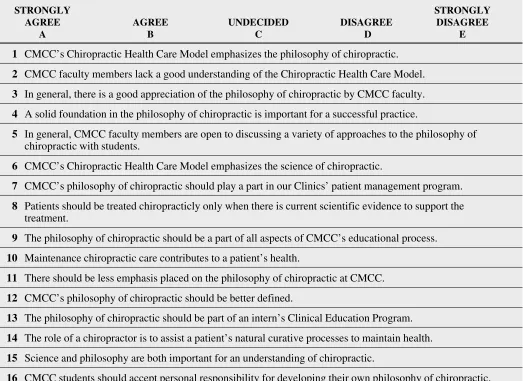
The results of the student survey suggested that a more extensive review of the Chiropractic Principles Program should be undertaken. Therefore, a sixteen (16) item Likert scale questionnaire (see Figure 2) was developed and administered to faculty members to gain information about their perceptions of several aspects of the Chiroprac-tic Principles Program and the philosophy of chiropracChiroprac-tic. Sixty-six individuals (representing approximately 60% of full-time and part-time faculty) responded to the survey, with nine respondents from Biological Sciences, twenty from Chiropractic Sciences, thirteen from Clinical Sci-ences, twelve from Clinical Education, nine from Post-graduate Education, and three from Library Services.
The student and faculty survey results indicated that there was a need to further explore specific curricular is-sues related to the philosophy of chiropractic. Therefore, a student/faculty focus group was convened to review the Chiropractic Principles Program and make suggestions for appropriate modifications. The six separate meetings of the focus group were attended by a total of nine first, sec-ond, and third year students, as well as six faculty mem-bers from various academic divisions. Although no fourth year students were available to participate in the group, a recently graduated resident member was often able to bring a senior student perspective to the forum.
Results
Student survey
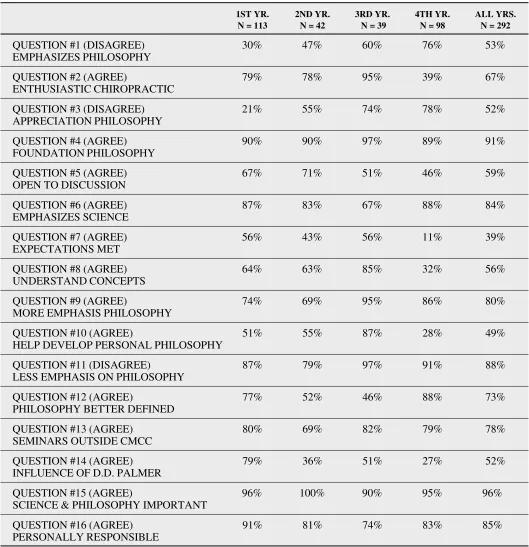
The results of the student survey, which were collapsed from the five point Likert scale to a three point scale (agree, undecided, disagree), are summarized in Table 1. Overall, the majority of students surveyed (53%) did not agree that the college’s health care model emphasized the philosophy of chiropractic (Question 1). However, when broken down by year of study, 30% of the first year class, 47% of the second year class, 60% of the third year class, and 76% of the fourth year class disagreed with the survey statement. This is an interesting response pattern in view of students’ presumed increasing familiarity with the col-lege’s health care model as they advance through the pro-gram. In contrast, a substantial majority of all years (84%), felt that the college’s health care model emphasized the science of chiropractic (Question 6). Eighty percent of all students surveyed were in favour of more emphasis on the philosophy of chiropractic (Question 9) and, as might
rea-sonably be expected, students responded to the antithetical question (11) in a like manner. Eighty-eight percent dis-agreed with this statement which suggested that less em-phasis be placed on philosophy.
Although the majority of students (67%) gained enthu-siasm about chiropractic from their principles courses (Question 2), the majority of students (78%) agreed that it was necessary to attend outside seminars to appreciate the philosophy of chiropractic (Question 13). Only thirty-nine percent of students surveyed felt that their expectations of the Chiropractic Principles Program had been met (Ques-tion 7), and seventy-three percent wanted the philosophy of chiropractic better defined in the college’s program (Question 12). Approximately one half of students agreed that the Chiropractic Principles Program helped them: un-derstand concepts central to the philosophy of chiropractic (Question 8); develop a personal philosophy of chiroprac-tic (Question 10); and appreciate the influence of D.D. Palmer on the philosophy of chiropractic (Question 14).
While the majority of students surveyed (59%) agreed that the Chiropractic Principles faculty were open to dis-cussing a variety of approaches to the philosophy of chiro-practic (Question 5), the level of agreement tended to decline by year as students advanced through the program (67% of first year students agreed versus only 46% of fourth year students). The majority of all students (52%) disagreed that there was a good appreciation of the phi-losophy of chiropractic by faculty in other academic and clinical divisions (Question 3). Responses to this item re-vealed a pronounced trend toward disagreement with in-creasing time in the program. While only 21% of first year students disagreed with the statement, 55% of second year students, 74% of third year students, and 78% of fourth year students disagreed. It is interesting to note that this pattern emerges as the students move from a basic science milieu toward a more clinically oriented learning environ-ment. These results mirror, to a large extent, the pattern found in Question 1, where more senior students felt that the college’s health care model did not emphasize the phi-losophy of chiropractic.
Figure 2
Faculty Assessment of Chiropractic Principles Program
This survey is part of a review of the Chiropractic Principles and Practice Program. Its purpose is to gain an understanding of the perceptions that faculty have about the program and the philosophy of chiropractic at CMCC.
We will keep your individual responses confidential and they will in no way affect your relationship with CMCC.
STRONGLY STRONGLY
AGREE AGREE UNDECIDED DISAGREE DISAGREE
A B C D E
1 CMCC’s Chiropractic Health Care Model emphasizes the philosophy of chiropractic.
2 CMCC faculty members lack a good understanding of the Chiropractic Health Care Model.
3 In general, there is a good appreciation of the philosophy of chiropractic by CMCC faculty.
4 A solid foundation in the philosophy of chiropractic is important for a successful practice.
5 In general, CMCC faculty members are open to discussing a variety of approaches to the philosophy of chiropractic with students.
6 CMCC’s Chiropractic Health Care Model emphasizes the science of chiropractic.
7 CMCC’s philosophy of chiropractic should play a part in our Clinics’ patient management program.
8 Patients should be treated chiropracticly only when there is current scientific evidence to support the treatment.
9 The philosophy of chiropractic should be a part of all aspects of CMCC’s educational process.
10 Maintenance chiropractic care contributes to a patient’s health.
11 There should be less emphasis placed on the philosophy of chiropractic at CMCC.
12 CMCC’s philosophy of chiropractic should be better defined.
13 The philosophy of chiropractic should be part of an intern’s Clinical Education Program.
14 The role of a chiropractor is to assist a patient’s natural curative processes to maintain health.
15 Science and philosophy are both important for an understanding of chiropractic.
Table 1
Summary of Student Assessment of Chiropractic Principles Program
1ST YR. 2ND YR. 3RD YR. 4TH YR. ALL YRS. N = 113 N = 42 N = 39 N = 98 N = 292
QUESTION #1 (DISAGREE) 30% 47% 60% 76% 53%
EMPHASIZES PHILOSOPHY
QUESTION #2 (AGREE) 79% 78% 95% 39% 67%
ENTHUSIASTIC CHIROPRACTIC
QUESTION #3 (DISAGREE) 21% 55% 74% 78% 52%
APPRECIATION PHILOSOPHY
QUESTION #4 (AGREE) 90% 90% 97% 89% 91%
FOUNDATION PHILOSOPHY
QUESTION #5 (AGREE) 67% 71% 51% 46% 59%
OPEN TO DISCUSSION
QUESTION #6 (AGREE) 87% 83% 67% 88% 84%
EMPHASIZES SCIENCE
QUESTION #7 (AGREE) 56% 43% 56% 11% 39%
EXPECTATIONS MET
QUESTION #8 (AGREE) 64% 63% 85% 32% 56%
UNDERSTAND CONCEPTS
QUESTION #9 (AGREE) 74% 69% 95% 86% 80%
MORE EMPHASIS PHILOSOPHY
QUESTION #10 (AGREE) 51% 55% 87% 28% 49%
HELP DEVELOP PERSONAL PHILOSOPHY
QUESTION #11 (DISAGREE) 87% 79% 97% 91% 88%
LESS EMPHASIS ON PHILOSOPHY
QUESTION #12 (AGREE) 77% 52% 46% 88% 73%
PHILOSOPHY BETTER DEFINED
QUESTION #13 (AGREE) 80% 69% 82% 79% 78%
SEMINARS OUTSIDE CMCC
QUESTION #14 (AGREE) 79% 36% 51% 27% 52%
INFLUENCE OF D.D. PALMER
QUESTION #15 (AGREE) 96% 100% 90% 95% 96%
SCIENCE & PHILOSOPHY IMPORTANT
QUESTION #16 (AGREE) 91% 81% 74% 83% 85%
that it was their responsibility to develop their own phi-losophy of chiropractic (Question 16). Responses to these three items were fairly uniform over all four years of the program and were the most unequivocal of the survey.
Faculty survey
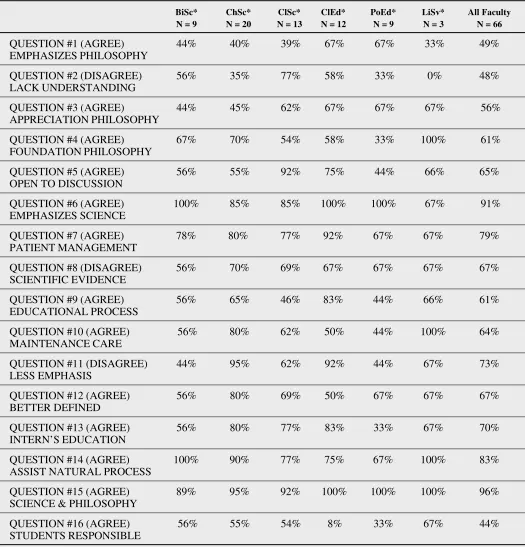
The results of the faculty survey, which were collapsed from the five point Likert scale to a three point scale (agree, undecided, disagree), are summarized in Table 2. Almost half of the faculty surveyed (49%) agreed that the college’s health care model emphasized the philosophy of chiropractic (Question 1). Twenty seven percent of all fac-ulty, and 45% of Chiropractic Sciences faculty disagreed with the statement. Twenty four percent of all faculty and 41% of non-chiropractic faculty were undecided. These results are in contrast to the figures from the student survey where the majority (53% of all students) disagreed with the statement, and there was an increasing level of disagree-ment in more senior years (76% in fourth year). A substan-tial majority of faculty (91%) felt that the college’s health care model emphasized the science of chiropractic (Ques-tion 6). These figures compare well with those from the student survey where 84% of respondents agreed with the statement. Seventy three percent of all faculty surveyed (95% of Chiropractic Sciences and 92% of Clinical Educa-tion faculty) disagreed with the statement which suggested that there should be less emphasis placed on the philoso-phy of chiropractic at the college (Question 11). Twenty one percent of all faculty and 41% of non-chiropractic faculty were undecided on the issue. Again, these figures compare reasonably well with those from the student survey where 88% of respondents disagreed with the statement.
The majority of faculty members surveyed (67%) thought that the college’s philosophy of chiropractic should be better defined (Question 12). These results com-pare very well with those from the student survey which showed that 73% of students wanted the philosophy of chiropractic better defined. Sixty one percent of all faculty and 83% of Clinical Education faculty felt that the philoso-phy of chiropractic should be a part of all aspects of the college’s educational process (Question 9). Seventy per-cent of all faculty and 83% of Clinical Education faculty agreed that the philosophy of chiropractic should be part of an intern’s Clinical Education Program (Question 13). Eighteen percent of all faculty and 35% of
non-chiroprac-tic faculty were undecided on the issue.
The majority of the college’s faculty members surveyed (79%) agreed that philosophy should play a part in the Clinics’ patient management program (Question 7). Twelve percent of all faculty and 29% of non-chiropractic faculty were undecided on this issue. Two-thirds of all faculty (67%) disagreed with treating a patient chiropracticly only when there is current scientific evi-dence to support the treatment (Question 8). However, only 53% of the non-chiropractic faculty disagreed, while 47% agreed with the statement. The majority of faculty members (64%) agreed that maintenance chiropractic care contributes to a patient’s health (Question 10). However, only 7% of all faculty disagreed with the statement, while 29% were undecided. Eighty three percent of all the fac-ulty surveyed and 100% of the Biological Sciences facfac-ulty agreed that the role of a chiropractor is to assist a patient’s natural curative processes (Question 14).
The majority of faculty members surveyed (56%) agreed that there was a good appreciation of the philoso-phy of chiropractic by the college’s faculty (Question 3). Twenty four percent of all faculty and 35% of Chiropractic Sciences faculty disagreed with the statement. Twenty percent of all faculty and 35% of non-chiropractic faculty were undecided on the issue. These results are in contrast to those from the student survey where 52% of all students disagreed with the statement and there was an increasing level of disagreement in more senior years (78% in fourth year). Sixty five percent of all faculty agreed that faculty members were open to discussing a variety of approaches to philosophy (Question 5). The level of agreement ranged from 44% for Postgraduate Education to 92% for Clinical Sciences. Twenty four percent of all faculty and 35% of non-chiropractic faculty were undecided on the issue. These figures compare well to those from the student sur-vey where 59% of students agreed that Chiropractic Prin-ciples faculty were open to discussing a variety of approaches to philosophy. Forty eight percent of all fac-ulty disagreed that facfac-ulty members lack a good under-standing of the chiropractic health care model (Question 2), while only 24% of the respondents agreed with the statement and 28% of all faculty and 41% of non-chiro-practic faculty were undecided on the issue.
Table 2
Summary of Faculty Assessment of Chiropractic Principles Program
BiSc* ChSc* ClSc* ClEd* PoEd* LiSv* All Faculty N = 9 N = 20 N = 13 N = 12 N = 9 N = 3 N = 66
QUESTION #1 (AGREE) 44% 40% 39% 67% 67% 33% 49%
EMPHASIZES PHILOSOPHY
QUESTION #2 (DISAGREE) 56% 35% 77% 58% 33% 0% 48%
LACK UNDERSTANDING
QUESTION #3 (AGREE) 44% 45% 62% 67% 67% 67% 56%
APPRECIATION PHILOSOPHY
QUESTION #4 (AGREE) 67% 70% 54% 58% 33% 100% 61%
FOUNDATION PHILOSOPHY
QUESTION #5 (AGREE) 56% 55% 92% 75% 44% 66% 65%
OPEN TO DISCUSSION
QUESTION #6 (AGREE) 100% 85% 85% 100% 100% 67% 91%
EMPHASIZES SCIENCE
QUESTION #7 (AGREE) 78% 80% 77% 92% 67% 67% 79%
PATIENT MANAGEMENT
QUESTION #8 (DISAGREE) 56% 70% 69% 67% 67% 67% 67%
SCIENTIFIC EVIDENCE
QUESTION #9 (AGREE) 56% 65% 46% 83% 44% 66% 61%
EDUCATIONAL PROCESS
QUESTION #10 (AGREE) 56% 80% 62% 50% 44% 100% 64%
MAINTENANCE CARE
QUESTION #11 (DISAGREE) 44% 95% 62% 92% 44% 67% 73%
LESS EMPHASIS
QUESTION #12 (AGREE) 56% 80% 69% 50% 67% 67% 67%
BETTER DEFINED
QUESTION #13 (AGREE) 56% 80% 77% 83% 33% 67% 70%
INTERN’S EDUCATION
QUESTION #14 (AGREE) 100% 90% 77% 75% 67% 100% 83%
ASSIST NATURAL PROCESS
QUESTION #15 (AGREE) 89% 95% 92% 100% 100% 100% 96%
SCIENCE & PHILOSOPHY
QUESTION #16 (AGREE) 56% 55% 54% 8% 33% 67% 44%
STUDENTS RESPONSIBLE
the Postgraduate faculty, 46% of the Clinical Sciences fac-ulty, 33% of the Clinical Education facfac-ulty, and 30% of the Chiropractic Sciences faculty disagreed with the state-ment. In comparison, 91% of the students surveyed agreed with the statement. Ninety six percent of the faculty mem-bers agreed that both science and philosophy are important for an understanding of chiropractic (Question 15). This finding is identical to the student response to the same question. Forty four percent of faculty members surveyed agreed that students should accept responsibility for their own philosophy (Question 16), while 42% of faculty dis-agreed with the statement and 14% were undecided. These results are in contrast to those from the student survey where 85% of the respondents agreed with the statement.
Focus group
The faculty survey provided significant new information with respect to faculty members’ perceptions of issues re-lated to the philosophy of chiropractic. The results from this survey together with those from the student survey served as a catalyst to provoke discussion and facilitate understanding in the student/faculty focus groups on phi-losophy. The six separate meetings of the Focus Group were attended by nine students and six faculty members. Discussion concentrated on the content, format, faculty, and evaluation methods of the Chiropractic Principles courses, as well as several other topics which were felt to be related either directly or indirectly to philosophy of chiropractic issues at CMCC. The most salient suggestions for change which emerged from this discussion are con-tained in the following paragraphs.
Content
The members of the Focus Group were of the opinion that there was too little information with respect to the history, development, and basic principles of chiropractic pre-sented in the existing curriculum. Further, it was felt that this information should be taught as early as possible in the program so as to provide a meaningful context for subse-quent elements of the Chiropractic Principles curriculum. The group expressed the view that a broad range of philosophical perspectives should be presented in the pro-gram. However, student members emphasized that it was their responsibility, not the college’s, to develop their own individual philosophy of chiropractic, and for this reason and because of the “high energy” and the opportunity to
“bond with chiropractors” they would continue to attend outside philosophy seminars irrespective of any positive modifications to the Chiropractic Principles Program.
The Focus Group felt that there was some overlap of content with respect to the practice of chiropractic in some senior courses, and suggested that, in order to eliminate redundancies, this material should be presented in the con-text of a new, concise but comprehensive and “seamless” course on the essentials of chiropractic practice manage-ment. It also recommended that an elective practice man-agement course be made compulsory, and be scheduled earlier in the program before competing clinical responsi-bilities rendered student attendance impracticable.
Format
Members of the Focus Group agreed that the newly modi-fied, problem-based portion of the first year principles course was a very good learning experience and should be extended to the second year course if possible. The focus group felt that the student presentations that had been a part of the second year course were not a good learning experience, which probably accounted for the generally poor attendance at these sessions. It was suggested that the presentations be replaced by problem-based or other ac-tive learning strategies that could be dovetailed, where possible, into the lecture component of the course.
Faculty
The members of the focus group were generally very fa-vourably disposed towards the Chiropractic Principles fac-ulty. Individual faculty members were praised for their passion, commitment, innovative learning strategies, and ability to motivate students by demonstrating the applica-bility of philosophy to chiropractic practice. However, it was felt that some consideration should be given to engag-ing additional faculty members with diverse academic cre-dentials and philosophical perspectives in order to provide students with a better appreciation of the role philosophy can play in the practice of their chosen profession.
Evaluation
Stu-dent members commented that marks for the second year course oral presentation were often allocated unfairly since some students made no contribution to the group project, but nonetheless received the same grade as those students who had actually fulfilled their responsibilities. It was therefore suggested that the marking scheme be re-vised to ensure that marks would be apportioned in a more equitable manner. Members of the group agreed that there were no other significant concerns with respect to the evaluation methods of any other Chiropractic Principles course.
Philosophy related issues
The focus group discussed several issues that were actu-ally outside of the defined boundaries of the Chiropractic Principles Program. However, it was felt that these issues were sufficiently related to the philosophy of chiropractic at the college to justify some exploration “beyond the pale”. Perhaps the most compelling of these issues was the students’ perception that faculty members did not appreci-ate the philosophy of chiropractic. When it was pointed out that results from the faculty survey indicated that most faculty felt that philosophy was important (79% of all fac-ulty and 92% of Clinical Education facfac-ulty felt that phi-losophy should play a part in our clinics’ patient management program), student members responded by saying that faculty had a “different definition of philoso-phy”. They went on to comment on the apparent inconsist-encies in philosophical perspectives among clinicians and the need for interns to search out particular clinicians who would permit them to treat their patients in a holistic man-ner. It was suggested that faculty development programs would be a useful tool, particularly for clinicians, to foster the development of a more common philosophical view with respect to what constitutes acceptable treatment protocols for patients at CMCC’s Clinics.
Student members of the group also felt that there was a lack of appreciation of the philosophy of chiropractic in some areas of the academic program – especially in Bio-logical Sciences, where many of the faculty are non-chiropractors. It was suggested that the Human Resources Division of the college should provide an orientation pro-gram for new faculty that would include information about the philosophy of chiropractic. It was also suggested that faculty development opportunities be made available to non-chiropractic faculty which would enable them to
bet-ter understand and elucidate the chiropractic relevance of the course material which they present.
Some members of the focus group considered the qual-ity and quantqual-ity of books, journals, and other reference material on the philosophy of chiropractic in CMCC’s li-brary to be inadequate or inaccessible. It was suggested that a review of this area of the library be undertaken and that appropriate recommendations be made with respect to the acquisition of additional publications related to the phi-losophy of chiropractic.
Members of the focus group agreed that the statement on philosophy (see Figure 3), which had been abstracted from CMCC’s Mission Statement and disseminated throughout the College in response to the perceived need by both students and faculty for a better defined philoso-phy, was a positive step in this direction. However, it was felt that more work should be done to emphasize the phi-losophy of chiropractic, particularly in the areas of patient education and public awareness. It was suggested that phi-losophy should be an integral part of patient resumes (a concept supported by the findings of the faculty survey), and also part of college outreach programs, advertising campaigns, and open houses.
The focus group was of the opinion that opportunities for philosophy-related research should be pursued in CMCC Clinics with respect to such under-investigated areas as the efficacy of chiropractic treatment for condi-tions such as dysmenorrhea. It was suggested that senior student, single subject research design projects, supervised by clinicians, could contribute useful information that might provide the basis for more extensive clinical investi-gations.
Discussion
dichotomy on the philosophy of chiropractic to be openly discussed and constructively appraised. The success of this process suggests that additional student/faculty dis-cussions of this kind might be useful in future attempts to more fully articulate the nature of philosophy and deter-mine the role it should play in our curriculum.
The focus group was able to identify problematic as-pects with respect to the content, format, faculty, and evaluation methods of several Chiropractic Principles courses and recommend specific solutions in these areas. Curricular modifications that were introduced as a result of these recommendations included: increasing the content of basic principles and history of chiropractic early in the program; integrating problem-based components to complement the existing lecture format in some courses; introducing new faculty with diverse philosophical perspectives; and revising the evaluation methods of
some courses to allow a more equitable apportionment of marks. Preliminary proposals have been made to improve integration and eliminate redundancies in the practice management components of the Chiropractic Principles curriculum. Initiatives were also undertaken to support a more visible presence of CMCC’s philosophy statement throughout the College and confirm the importance of phi-losophy in other areas of the curriculum such as: Biologi-cal Sciences, CliniBiologi-cal Education, and the Library.
gested, the pervasive presence of philosophy should act as a powerful unifying force to “bring the various compo-nents ... of the curriculum into a coherent, consistent, com-pelling and integrated paradigm”.16 Although much work remains to be done, and the outcome of the curriculum modifications already undertaken must be thoroughly evaluated, the results of the curriculum review procedures outlined in this study have laid a firm foundation for phi-losophy to perform just such an integrative function.
Conclusion
The Chiropractic Principles program is an essential ele-ment of the chiropractic curriculum which must be re-viewed as thoroughly and thoughtfully as any other component of the curriculum. The action research process of curriculum review described in this article which in-volved systematic data collection and open dialogue among students, faculty, and academic administrators, proved to be an effective means of modifying the Chiro-practic Principles curriculum. It also emphasized that meaningful curriculum review must not be regarded sim-ply as a single, time-limited event, but rather as an ongoing iterative process of evaluation, modification, and re-evalu-ation which can foster the evolution and development of innovative curricular concepts. Philosophy must be recog-nized as more than the mere dispensation of venerable doctrines, but rather as a vital activity that has the capacity to provide a powerful integrative force to the curriculum of a chiropractic college. The defining characteristic of phi-losophy is, after all, the methodical pursuit of knowledge, not the perpetuation of a belief system.17 The philosophy of chiropractic can achieve its full potential only by ad-vancing beyond the historical boundaries of doctrine and applying its systematic methods of inquiry to the many important issues currently facing the profession.18 For the good of our students and our profession, chiropractic edu-cators must acknowledge their obligation to weave a con-tinuous strengthening strand of philosophy throughout the tapestry of our curriculum.
Acknowlegements
The authors would like to express their appreciation to Judith Waalen, Ph.D. for her contribution to this article, and also to the many students and faculty members of the Canadian Memorial Chiropractic College, without whose participation this study would not have been possible.
References
1 Wiese G. A review and comparison of medical and chiropractic education. J Chiropractic Education 1993; 6(4):127–139.
2 Kleynhans A. The teaching of chiropractic principles – Basic assumptions. J Chiropractic Education 1991; 5(2):42–46.
3 Kleynhans A. An institutional perspective on the
philosophy of in the chiropractic curriculum. Chiropractic J Australia 1991; 21(4):144–148.
4 Donahue J. Philosophy of chiropractic: Lessons from the past – guidance for the future. J Can Chiropr Assoc 1990; 34(4):194–205.
5 Coulter I. Sociology and philosophy of chiropractic. Chiropractic J Australia 1991; 22(4):149–152.
6 Chapman-Smith D. (ed.) Lessons from the marketplace. Chiropractic Report 1997; 11(4):1–6.
7 Morgan L. Innate intelligence: Its origins and problems. J Can Chiropr Assoc 1998; 42(1):35–41.
8 Biggs L, Hay D, Mierau D. Canadian chiropractors’ attitudes toward chiropractic philosophy and scope of practice: Implications for the implementation of clinical practice guidelines. J Can Chiropr Assoc 1997;
41(3):145–154.
9 Crow W, Christy J, Vick D, Peckham J. A comparative curricular review project. J American Osteopathic Assoc 1989; 89(5):665–669.
10 Harris G. Complementary therapies: Their role and place within undergraduate medical education. Complementary Therapies in Medicine 1995; 3:167–170.
11 Keating J. Introduction to chiropractic history: Design of a course. J Chiropractic Education 1991; 5(1):131–137. 12 Gatterman M. Teaching chiropractic principles through
patient centered problems. J Can Chiropr Assoc 1997; 41(1):27–35.
13 McNamee K, Magarian K, Phillips R. Chiropractic education: A student survey. J Manipulative Physiol Ther 1990; 13(9):521–531.
14 DuMonthier W, Coyle B. Contemporary student attitudes on chiropractic philosophy. Chiropractic History 1990; 10(1):19–21.
15 Adams A, Gatterman M. The state of the art of research on chiropractic education. J Manipulative Physiol Ther 1997; 20(3):179–184.
16 Coulter I. An institutional philosophy of chiropractic. Chiropractic J Australia 1991; 21(4):136–141.
17 Kleynhans A. A chiropractic conceptual framework. Part 1: Foundations. Chiropractic J Australia 1998;
28(3):91–109.