Dyke, Amy and Hutchison, Sonia (2017) Our understanding of mutuality when reflecting on our values and experience of caring. Educational Journal of Living Theories, 10 (2). pp. 82-104.
Downloaded from: http://insight.cumbria.ac.uk/id/eprint/3536/
Usage of any items from the University of Cumbria’s institutional repository ‘Insight’ must conform to the following fair usage guidelines.
Any item and its associated metadata held in the University of Cumbria’s institutional repository Insight (unless stated otherwise on the metadata record) may becopied, displayed or performed, and stored in line with the JISC fair dealing guidelines (available here) for educational and not-for-profit activities
provided that
• the authors, title and full bibliographic details of the item are cited clearly when any part of the work is referred to verbally or in the written form
• a hyperlink/URL to the original Insight record of that item is included in any citations of the work
• the content is not changed in any way
• all files required for usage of the item are kept together with the main item file.
You may not
• sell any part of an item
• refer to any part of an item without citation
• amend any item or contextualise it in a way that will impugn the creator’s reputation
• remove or alter the copyright statement on an item.
The full policy can be found here.
Volume 10(2): 82-104
www.ejolts.net
ISSN 2009-1788
Educational Journal of Living Theories
Our Understanding of Mutuality when
Reflecting on our Values and Experience
of Caring.
Amy Dyke and Sonia Hutchison
Amy Dyke University of
Gloucestershire, UK.
Sonia Hutchison University of Cumbria, UK.
Copyright: © 2017 Dyke & Hutchison.
This is an open access article distributed under the terms of the Creative Commons Attribution Non-Commercial License, which permits unrestricted non-commercial use, distribution, and reproduction in any medium, provided the original author and source are credited.
Abstract
In this paper we respond to the question: How can we gain a better understanding of our own values and where they come from, and how this has influenced our work together and in our interests in improving outcomes for carers? We evidence our claims to knowledge in responding to this question in the areas of:
• shared values and how we came to them;
• our learning through writing this paper;
• our ability to give to hope to others.
In analysing our claims, we find areas of mutuality that we had not predicted. We subsequently analyse further to understand our relational dynamics and we introduce our readers to our living-theory of mutuality that emerges.
This account provides guidance for a way of writing a collaborative paper that enables both authors’ voices to be of equal value, recognising both the unique and the shared perspectives as a result of our shared methodological approach. Through the process of writing a dual-authored paper we show how our mutuality develops as an explanatory principle and a living standard of judgement (Laidlaw, 1996).
Amy Dyke and Sonia Hutchison
Educational Journal of Living Theories 10(2): 82-104, http://ejolts.net/drupal/node/311
83
Introduction
Throughout this paper, we interchange the use of ‘we’ to signify where we wrote the paper together, but using Amy and Sonia to signify when each author is writing from their unique point of view. When writing together as ‘we', we used Google Docs which allowed us to see a real-time version of what we were writing and allowed us to edit at the same time. We used a process through Skype, where one of us would speak and the other would type and vice-versa; each of us would then edit the paper using Google Docs. As we developed the paper we discussed with a Skype research group consisting of Arianna Briganti, Marie Huxtable, Jack Whitehead, Per Jensen and Robyn Pound. The group helped us to validate our findings and clarify our understandings.
When Sonia suggested to Amy to write a paper together, the relationship was one of mentor/mentee. Amy had been a beneficiary of the Young Carers Development Trust, the charity Sonia worked for. Sonia had been in the role of Amy’s Development Manager where Sonia provided Amy with mentoring and support to help her achieve her ambitions. Amy agreed to write a paper with the view to learning from Sonia and, as the process developed, Amy began to see that she had an equal ability to develop Sonia’s learning. Through writing the paper together our understanding of our living-theory of mutuality emerged. Our definition of mutuality in this paper allows for each person’s unique insights and input. However, through the process of working together both people are enriched in their learning and development. There is a value of equality and respect that enables each person to critique and strengthen each other’s work. By this we are meaning that:
• Through the process of writing together we found we chose similar quotations when reflecting on the data; we feel this shows our mutuality in the research process. • Our mentor/mentee relationship developed into shared learning from each other; we
feel this shows the mutuality in our learning.
• Through the communications over Skype and the Skype Research group Amy was treated as an equal1. Amy had expected to be treated as though her knowledge had less value as she was an undergraduate. However, Amy was treated with a level of respect in being capable of understanding and not to be patronised or seen as lesser and unable to understand. This led to mutuality in our relational dynamic and the relational dynamic in the group.
• Through the research process of writing emails to each other we discovered many shared understandings of our values of love, hope, participation and justice. All of these come from a shared understanding of an empathetic love, which emerged despite our different lived experiences.
1
Our Understanding of Mutuality
Educational Journal of Living Theories 10(2): 82-104, http://ejolts.net/drupal/node/311
84
The original purpose of this paper was to respond to the question: How can we gain a better understanding of our own values and where they come from and how this has influenced our work together and in our interests in improving outcomes for carers? We created the question from reflecting on email and Facebook correspondence where we described what was of interest to us. In order to face our question, we embarked upon six months of correspondence via email. We collated all of our correspondence to create our data set. There is a link to the full data in the conclusion. We highlighted our claims in our writing when reflecting on the data and put them into a list. We have included the claims to show our process as well as our mutuality. For the purposes of this paper we are using the definition from the publication Carers at the Heart of 21st-century Families and Communities (2008), which defines a carer as someone who, ‘... spends a significant proportion of their life providing unpaid support to family or potentially friends. This could be caring for a relative, partner or friend who is ill, frail, disabled or has mental health or substance misuse problems’ (p.19).
Who we are and our relationship/history together
Amy:
I was one of the recipients of a charity supporting young carers when I first met Sonia. She was introduced to me through Victoria who had been a part of setting up a new charity called the Young Carers Development Trust. Victoria told me about this charity and how it aimed to get young carers like me through to university, and had told me at this point that she had already sent through a proposal on my behalf to plead for me to be the first recipient of this Trust. For a while Victoria was my mentor through this process, offering me books and tuition. However, there came a time where she had to move on and I was introduced to Sonia, who would be taking over. Sonia came over to my house for a cup of tea to meet me and find out what support I would be needing for the next few years.
It was at this time I was having a change of mind and wanted to study Psychology rather than Medicine. Finding out that Sonia had studied Psychology was brilliant news for me as I could ask her all the questions I could think of about the course, and I had someone to enthuse to. It was around this time that Sonia offered to take me to university open-days, as she offered the ability to ask the questions I would need answers to. She had the university experience I was aiming for.
Amy Dyke and Sonia Hutchison
Educational Journal of Living Theories 10(2): 82-104, http://ejolts.net/drupal/node/311
85
Sonia:
I grew up in foster care; I have cared for my mum from a distance due to her acute mental health problems and drug-addiction issues, and I have worked with carers for over a decade. These experiences have motivated me to support others in complex situations. I worked closely with a woman called Victoria Clare, when we were both Young Carers’ Managers. Victoria had helped to set up a small charity to help young carers who showed ambition, tenacity of spirit and high achievement in their areas of interest. She asked me to help with the charity by becoming a Development Manager, where I would help the young carers supported by the charity as a mentor. My role was to help the beneficiaries manage their development in their areas of interest. This is how I met Amy. She had been previously supported by Victoria through the Trust and now was needing a new person to support her to realise her ambitions. It was a good match as Amy became interested in pursuing Psychology when she realised she would not get the subjects she needs to pursue medicine.
I had studied Psychology at university and was able to support her in considering going to university, as, like me, she had no direct family experience of going to university. I provided her with official support until the end of her first year at university. However, Amy has stayed in touch with the Trust as an ambassador, and she has inspired me and others with her achievements.
It was at a summer get-together of the Trust, we discussed writing a paper together with the aim of sharing our stories to bring hope to others with challenges in their early lives. Since writing the paper, our relationship has matured from a mentor/mentee relationship, to one where we are both on a shared educational journey together.
Mutuality
Amy:
Throughout the processes of writing this paper, I feel I have taken a large educational leap in my understanding of academic writing and my understanding of my own self. I started this process unsure of what I could contribute to the project, and have come away with confidence in my writing ability and my own understanding.
I feel the process of working with the Skype research-group enabled my confidence in my ability to grow, as I was treated as a peer rather than an undergraduate. I was encouraged to participate in group-discussions, and felt valued for my knowledge-base. At no point did I ever feel inferior or belittled, which enabled me to feel of equal value to the research group and validate my own knowledge. I feel the respect has been mutual within the relationship, which has really given me confidence in my ability and the worth of my knowledge. As well as this, I was able to see how open and comfortable the group were about their own short-comings and mistakes and how the group responded to aiding a person with these things. I feel this made me feel comfortable enough to know that I am still learning and open to making mistakes, as well as knowing I was in a safe place to make mistakes and learn from them.
Our Understanding of Mutuality
Educational Journal of Living Theories 10(2): 82-104, http://ejolts.net/drupal/node/311
86
had had similar experiences and outcomes when reflecting on our values. I feel this has enabled me to appreciate my experience and consider the ways in which caring has enhanced my life.
I feel an understanding of our experiences and an ability to formally communicate them has given us the ability to derive hope from our stories, much as Sonia once gave to me when she first aided my journey into further education. For me it was affirming to find we both had similar responses to the data. This was shown when we both wrote our key findings, only to read them through a few days later, to see we had used the same quotations several times. This gave me the confidence to know my contribution was equal; it showed that we could collaborate really well as we thought similar things.
Writing this paper has also made me aware of what values I do hold dearly and how these may influence my actions and experiences. I feel it has been a really positive experience for me and I do hope we have the opportunity in the future to write again together.
Sonia:
The process of writing this paper emerged as we wrote, with each stage of the data collection and writing. We continually checked with each other what we should do and provided a creative space with mutual respect and value for each other. I was amazed that as we wrote our findings we used so many of the same quotations without checking on the other’s writing. This was a moment in the writing where I realised we shared many of the same insights, even though they were from our unique perspectives. Our findings are structured to highlight these similarities and differences.
For me, writing this paper with Amy has opened up new insights about my ways of knowing and the relational dynamics that are present when I am able to consistently live my values. I have been able to see there has been true mutuality in the writing that has not been present in previous collaborative papers I have been involved in. By writing with Amy and being committed to us having an equal voice in the paper, I have seen how we have been able to develop a process that has enabled us to have our own unique ‘I’ voice, whilst also having a process that enables a truly mutual ‘we’ voice to be heard. This has helped me to understand that, not only is reclaiming the idea of caring (Hutchison, 2013) important to me, but it has enabled me to see my living standards of judgement and explanatory principles are my living-theory of caring as mutuality. This learning has come through the whole process and our claims to knowledge that we have been able to share around our values, learning and desire to bring hope to others. It has been a process filled with pleasure and life-giving energy with one another, as we have both learned together and are now enabled to share our learning with others.
Amy Dyke and Sonia Hutchison
Educational Journal of Living Theories 10(2): 82-104, http://ejolts.net/drupal/node/311
87
Claims
Originally, we were going to write our claims separately. However, in the process of writing this paper we realised the claims we were making were shared. As a result, we have collated a list of the shared claims that emerged as our mutuality-in-practice developed.
• We both explored our meaning of love as a value, and found we both have a good and shared understanding and acceptance of love that has led us to being giving, caring individuals.
• We hold hope open for a good life that brings, ‘hope for the flourishing of humanity’ (Whitehead, 2008).
• Because of our hope we are resilient.
• We have both used our life experience to build our values, which have encouraged us both to work hard and achieve, and we have many similar experiences of developing our values. • We both strive to achieve, with the hope that we can provide a good life for ourselves and
inspire others to aim high.
• We both had a shared goal of advancing our own knowledge and the knowledge of others through our own experiences.
• We share a belief that, given the right assistance, a person can be empowered to achieve their goals.
• We respect each other’s educational influences and the impact that has had on our outlook during writing this paper. We share a belief that both of our contributions are equally valued, as well as uniquely insightful to this theoretical understanding.
• We have mutually respected each other’s opinions and valued each other’s input. • We have realised our influence and impact on each other.
• We have learnt from each other.
• We have evidence of the energy and pleasure that has been created from working together, enabling our relationship to evolve, from a mentor/mentee relationship to colleagues of equal value.
• We have been able to show how we have found meaning in our lives, through sharing our stories and our findings from our research, which is enabling us to spread our influence. • We acknowledge that this paper can influence the reader to develop their understandings
of mutuality.
Structure of the paper
This paper will provide evidence for our claims and take the reader through our:
Our Understanding of Mutuality
Educational Journal of Living Theories 10(2): 82-104, http://ejolts.net/drupal/node/311
88
• Findings:
o How have we gained a better understanding of our own values and where they
come from?
o How has writing this paper influenced our work together?
o How has writing this paper helped our interests in improving outcomes for carers? • Conclusion
Educational context
Amy:
I am a third-year student, studying Psychology at an undergraduate level, at the University of Gloucestershire. I have selected modules within the area of counselling and mental health and am currently undertaking a dissertation based around the psychological wellbeing of carers.
I feel, upon reflection, that the educational journeys Sonia and I have been on are vastly different from each other. At my current state, I am very much encouraged to make my studies as scientific as possible, and ecologically viable. By this, I mean that I think my research should be of value to society and be made freely available. I have applied this to my research and my studies and I feel this is the foundation to my knowledge. I am also aware that, at this early stage of my education, I am more susceptible to the ideologies of others. I feel therefore, that I am more aware of my critical reflection upon the knowledge I find and what I am told by lecturers. As a part of my studies, I am taught critical reflection and I feel this aids my awareness of good practices in Psychology and what to look out for in good research.
At this current stage of my education, I am used to a certain writing style and structure. Writing this paper has been a journey for me; I feel it has been a really positive experience for my educational journey, as I have learned to think more critically about my own writing. This process has enabled me to consider different forms of research and different ways of reflection.
This started with my introduction with EJOLTs, and seeing a different form of article that I had not encountered before. It also aided my introduction to living-theory and how I would be writing. This process, for me, was starting from scratch from my knowledge, and it gave me the chance to learn something new. I will always value the opportunity to learn, so when offered the opportunity to dive into something and learn from a different perspective, I was more than up for the challenge.
Sonia:
Amy Dyke and Sonia Hutchison
Educational Journal of Living Theories 10(2): 82-104, http://ejolts.net/drupal/node/311
89
of a small national U.K. charity, supporting young carers with ambition and tenacity to succeed, which is how I came to work with Amy. I am also enquiring into how I have come to be a success in my career, after starting off life in foster care, where statistical predictions for life chances have remained stubbornly low.
I am using a Living Theory methodology (Whitehead, 2010) and creating my own unique living-theory through my research. Living Theory research asks questions of the kind, How can I improve my practice? However, it is not merely a continuing professional- development process, but rather has a methodological clarity that enables practitioners to make their ways of knowing public. Living Theory recognises practice as not only work but also brings together the personal, identifying that an individual’s standards of judgements and explanatory principles are made up through their own unique constellation of values. By researching practice through this lens, practitioners are able to make public their own living-theory, not as an impositional or generalisable living-theory, but rather as an epistemology that can influence others’ practice, as they seek to make explicit their own living-theory.
Self-study has been criticised for being self-indulgent and narcissistic (Coffey, 1999). However, Living Theory aims at, ‘communicating and expressing … values that brings hope for the flourishing of humanity’ (Whitehead & Huxtable, 2016 p. 12), rather than for personal indulgence. Rather, I would argue Living Theory has more personal risk than third-person research, as it is the researcher themselves who is opening their life-experiences to the criticism of others. Unlike third-person research, which validates the research through generalisability, Living Theory uses Habermas’s (1976) criteria to validate the research to check it is comprehensible, truthful, right and authentic through validation groups. Amy joined Sonia’s Skype Research Support Group, which acted as a validation group for us both.
Data collection
We collected data over eight months through Facebook, emails and Skype conver-sations, which can be accessed by a link in the conclusion. We copied and pasted text from the emails to keep a record in chronological order to make sense of the data
We identified and reflected on common themes when analysing the data to provide evidence for the claims we have made for the paper. This enabled us to reflect on our learning, our relationship and our values. The findings will be discussed throughout the paper.
Methodology
Sonia:
Our Understanding of Mutuality
Educational Journal of Living Theories 10(2): 82-104, http://ejolts.net/drupal/node/311
90
understanding and move from an abstract concept, to developing her own living-theory, as a living process. I was also interested in what I could learn from writing a joint paper with a young carer whom I have worked with, as I had an intuition that the process would move my thinking forward and bring insights into my own enquiry, where I am seeking to understand my own living-theory of caring (Hutchison, 2013).
As part of our process of writing, we have been part of a Skype research group that has helped us to develop our ideas. Robyn, one of the group members, describes the value of Living Theory. In the image (Figure 1.), you can see the pleasure of all of us as we are able to share in the joy of Robyn’s insight and of the mutuality shared between each of us. We are able to both give and receive in the pleasure, learning and understanding Robyn is sharing, that Living Theory is an approach that values everyone’s knowledge:
Figure 1. Robyn describing the value of Living Theory
https://www.youtube.com/watch?v=8ccmGJiLMrQ&feature=youtu.be
Amy Dyke and Sonia Hutchison
Educational Journal of Living Theories 10(2): 82-104, http://ejolts.net/drupal/node/311
91
Where I find myself as a living contradiction, I am provided with points of insight to change and improve my practice. As I come to live my values more fully and understand when my values are negated, my values become my explanatory principles (Laidlaw, 1996). I am able to make these public through my research, not only to help in my learning, but in the learning of others and in the learning of social formations (Whitehead, 2007).
Living Theory cannot be validated like abstract theories, through making them generalisable. My living-theory is by its very nature unique to me and my lived experience. No other person could repeat my life to validate my living-theory. However, Living Theory has a validation process that is developed from Habermas’s ideas on validation. I use questions developed from Habermas (1976) to pose to validation groups to validate my research. Habermas describes validity as: the researcher being ‘comprehensible’, to ‘have the intention of communicating a true proposition’, to ‘express his intentions truthfully [or in my words authentically] and ‘choose an utterance that is right’ (pp. 2–3). These questions developed by Whitehead (2015) are:
• How could I improve the comprehensibility of my explanations of influence? • How could I strengthen the evidence I use to justify the claims I make?
• How could I deepen and extend my sociohistorical and sociocultural understandings of their influence in my practice and understandings?
• How could I enhance the authenticity of my explanation to show that I am living my espoused values as fully as possible?
Living Theory, whilst not being generalisable, still has significance and provides new ways of knowing that are not always valued or understood:
Questions may be asked about the social significance of making public the[se] narratives of the lives and influences of individuals. Our response is that it is through the lives of individuals who are committed to holding themselves to account for living [certain] values as fully as possible that creates a social movement that can contribute to transforming the world. (Whitehead & Huxtable, 2016, p. 15)
I want my research to make a positive difference and it is the reason I have chosen Living Theory as a methodology. I was keen to introduce Amy to this form of research, as I believe she has knowledge that could increase her learning, my learning as well as others’ learning, and learning of social formations that have an impact on young carers. I also realised that our enquiry was a collaborative enquiry and that the learning we gained through our research together and the process of writing a joint paper could also help others develop mutuality in writing joint papers, as we have done.
Amy:
Our Understanding of Mutuality
Educational Journal of Living Theories 10(2): 82-104, http://ejolts.net/drupal/node/311
92
for my dissertation, so when considering this I had to think how I would be reflexive in this piece of work, and how I would relate Sonia's knowledge to my own.
I mostly found the context of Sonia’s emails enabled me to respond, as she would often give me good areas to build on from what she had previously said to me. I found when reading her emails, I often had similar stories or situations which, upon reflection, I could relate to her point and add my own point of view to it.
I found the process of our Skype conversations the most beneficial for me, as I had the opportunity to gain a first-hand understanding of what Sonia’s knowledge was and what influenced her understanding. The exchange of contextual information was also very helpful as it gave me the opportunity to see what Sonia’s educational style was like and how it differed from mine. I felt this enabled me to develop a mutuality as we were writing.
When collaborating on work I often found it helpful to Skype while writing on Google Docs, as it gave us both the opportunity to talk as we wrote our sections. I feel this was essential to our collaborative work. This gave us both the opportunity to write together and discuss what format we would like for our work, whilse ensuring we were both ‘on the same page’.
Amy Dyke and Sonia Hutchison
Educational Journal of Living Theories 10(2): 82-104, http://ejolts.net/drupal/node/311
93
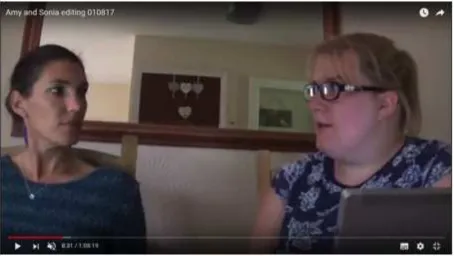
Figure 2. Amy and I Editing Our Paper August 1st, 2017 7:14-9:41 https://www.youtube.com/watch?v=K7zc3GJ7WAw&feature=youtu.be
I feel the video shows how our mutuality in the way we constantly chip in to help refine our thoughts and what we are writing as well as our relational dynamic of laughter, equal respect and honesty.
Findings
Mutuality
For us both the experience of collating our findings was a key area where mutuality in our research emerged. When we submitted our paper for review, we left our findings as they were when we originally wrote them. However, our reviewers suggested the repetition in use of quotations was less engaging for the reader (Qutoshi, 2017). We have, therefore, separated out the quotations where we both chose the same one, to highlight the mutuality and yet keep the context within which each of us chose the quotation.
Our Understanding of Mutuality
Educational Journal of Living Theories 10(2): 82-104, http://ejolts.net/drupal/node/311
94
Amy: Sonia:
I often felt that as Sonia initiated the emails, I had the opportunity to reflect on my own life and see where we had similar experiences to each other. From the very start of our communication, I found we both had similar values instilled in us from our experiences. (below)
I have found writing with Amy has shown that we have many similar experiences of developing our values. In my first email to Amy I wrote:
I have found that in order to understand my values I’ve needed to look back at my childhood and identify the things that motivated me then and still motivate me now. As I reflect I have been able to identify four key values that when I don’t live by them or I am prevented from living them I feel uncomfortable. (S. Hutchison, personal communication, October 16, 2016)
I reflected to Amy where my core values of love, hope, justice and participation came from. Although Amy has had a very different life from my own, I was struck that she also shared these values. I wrote – below
Quotations we both chose without consulting each other
Love took me a long time to come to terms with because as a child brought up in foster care I had a lot of love but there was a lot of pain mixed up with that love due to not being brought up with my biological parents and due to their mental health and addiction issues it was not straightforward to love or be loved. (S. Hutchison, personal communication, October 16th, 2016)
Amy: Sonia
Similarly I had written (below) Whilst Amy’s experience of love is a very different experience from mine Amy wrote in her response to my email (below)
Quotations we both chose without consulting each other
Amy Dyke and Sonia Hutchison
Educational Journal of Living Theories 10(2): 82-104, http://ejolts.net/drupal/node/311
95
others and what a giving relationship is all about. (A. Dyke, personal communication, October 24, 2016)
Amy:
Both of these experiences are drastically different. However, I feel Sonia and I have reached similar points in our lives, where we both have a good acceptance and understanding of what love means to us.
I feel with other values such as hope, we both share very similar viewpoints, as Sonia had written:
In order to cope I developed the ability to keep both possibilities open but not allow myself to be crushed if the worst possibility happened. I have developed this ability through life and can hold open both – hoping for the best but being open that the worst could happen but that I can overcome and reopen the possibility for the best to happen again. (S. Hutchison, personal communication, October 16, 2016)
Again, much the same I had written:
When looking at my beliefs of what hope means to me I am similar to Sonia, I do not see hope as something that is in the hands of fate. I personally have no affiliation with spirituality so Karma, Fate and hope all fall short with me. However, I do believe we can control our own fate, we can create our own hope. I have personally felt that I influence my own hope as once I get an idea in my head I strive to do all I can to achieve it. (A. Dyke, personal communication, October 24, 2016)
Re-reading Sonia’s views on hope I have a stronger affiliation with them now, as I also feel I hold hope open, so not to be disappointed. I feel this is a trait, that although our childhood experiences were drastically different I feel we both have similar, if not the same understanding of what hope is and how we cope with it. In much the same way, I feel that Sonia like me, does not rely on hope for achievements, as to get as far as she has with her life I very much admire her determination, which, in a way, is derived from hope.
Amy: Sonia:
I feel in a way we have both used our life experience to build our values and encourage us both to work hard and achieve (below)
Our Understanding of Mutuality
Educational Journal of Living Theories 10(2): 82-104, http://ejolts.net/drupal/node/311
96
Quotations we both chose without consulting each other
My values were born from what many would see as a hard life, but I am really grateful for the life I have had that has made me who I am. I instead feel lucky to have had my life because it has made me stronger and more resilient and able to help others. It motivates me to work to help others who have what are perceived as hard lives be able to be made stronger from their experiences rather than crushed by them. (S. Hutchison, personal communication, October 16, 2016)
Amy: Sonia:
In a way we both strive to achieve with the hope that we can provide a good life for ourselves. This for me was reaffirmed by reading Sonia’s emails, to find that it was like reading my own work, in my own words, we had very similar points of view (below)
I feel this is a key finding in our work together, that despite those who might assume that either of us would want to change our lives, because of the hardships, it is actually from those experiences that we have been able to live our lives and values as fully as possible.
Amy’s expresses our similarities at the end of her email response to my email on values (below).
Quotations we both chose without consulting each other
Your last paragraph I feel wholeheartily could have literally be written in my own words, I can’t add anything to it as I feel that it fits my feelings perfectly. People have sometimes felt sorry for me due to my life however I can’t truly understand it as I am grateful for how it has taught me a great lesson. From my struggles in A level year I understand also all too well how important it is to monitor my own wellbeing and when to step back and ensure I have some mindfulness time, as I have also learned the hard way how dangerous it can be to burn out! (A. Dyke, personal communication, October 24, 2016)
Amy:
I feel this last paragraph of mine is a perfect example of how much I agree with what Sonia has said and how it fits with my values.
How has writing this paper influenced our work together?
Amy: Sonia:
One of the most influential moments while writing this paper was reading Sonia’s email regarding the tuition that she had arranged for me. I found it hard to read such wonderful things, as I had
Amy Dyke and Sonia Hutchison
Educational Journal of Living Theories 10(2): 82-104, http://ejolts.net/drupal/node/311
97
Amy: Sonia:
never considered before how much of an impact the tutors had made on my life. When corresponding with each other, I found that we both had similar stories when reflecting on our childhood (below).
together has shown me that I am still able to help Amy develop and grow as a person, as I aimed to do as her Development Manager. However, I feel that there is a mutuality to the relationship with Amy, that we have been able to learn from each other and have had an honesty and openness that has made researching together a real pleasure and equal experience. I wrote about what working with Amy meant to me in an email to her (below).
Quotations we both chose without consulting each other
It is particularly special for me to work with Amy because I empathise with how hard it is to stay focused when everything is so hard at home. I recognise all the emotions Amy has been through on her journey and how difficult it is to focus on school work when there are literally life and death concerns at home. However, Amy has remained not only resilient to bounce back from not getting the hoped-for grades after first year at AS levels, but also cheerful, giving, and ambitious. (S. Hutchison, personal communication, November 27th, 2016)
Amy:
This quotation (above) from Sonia particularly resonates with me, as I feel the same could be said about Sonia. Although I have not known her from the opposite side of this mentor/mentee relationship I feel that people who do know her would say the same for her. I feel this resilience is shared between us and to be as far as she is in her educational journey, we must have these shared qualities.
I feel that Sonia and I both share an interest in others, as well as a goal for advancing our knowledge. I have found through this process, although my educational journey is at its start, Sonia has always respected my opinions and valued my input and when I reflect on her emails this is very much shown:
I realise I can’t experience everyone’s difficulties and so I value participation where people can speak for themselves and have their voices listened to. I was a child in care rep for my local social services board when I was a child and I realised that I had a power then that was different to the power I would have as an adult. (S. Hutchison, personal communication, October 16th, 2016)
Our Understanding of Mutuality
Educational Journal of Living Theories 10(2): 82-104, http://ejolts.net/drupal/node/311
98
I am grateful for this as I feel that it is a lesson I will carry with me my whole life. I feel when I look back listening carefully is something I learned to do to my mother, when she was ill or feeling blue I learned to pick up the subtle clues as to when she would need me to cheer her up or just be near her. (A. Dyke, personal communication, October 24th, 2016)
Sonia:
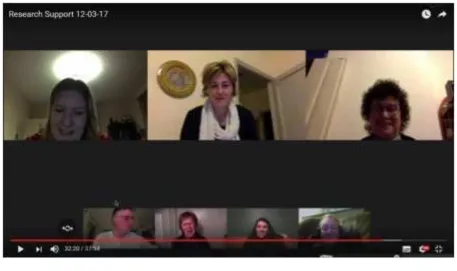
The Skype conversations in the research have shown the energy and pleasure that has been created from working together. I feel there has been a mutuality, equality and respect that has been provided in the research Skypes. Amy’s knowledge has not been seen as lesser because she is an undergraduate, but rather as holding new knowledge that the rest of the group has been keen to hear. I think the photo below (Figure 3) shows the life affirming energy that has been resonating in the Skypes, enabling our influence on each other’s learning to develop and grow.
I feel the Skypes have helped us to develop our influence on each other and to help us develop how to write the paper together.
Amy Dyke and Sonia Hutchison
Educational Journal of Living Theories 10(2): 82-104, http://ejolts.net/drupal/node/311
99
Amy: Sonia:
To conclude, Sonia being my mentor in itself inspired me, when considering the quotation below.
It has been helpful for me to understand my influence on Amy. She wrote about several ways that I had helped her through bringing my own lived experience as an example that could give Amy hope, that she could also achieve her own dreams. Some of these were an influence on her before I even became her Development Manager, as Amy describes in her email what Victoria said (below).
Quotations we both chose without consulting each other
When talking to her (Victoria) she said to me she knew only one young carer who in my region had gone to university, this was Sonia. This for me was a beacon of light to me, someone has done it! This to me meant I could do it too. (A. Dyke, personal communication, November 14, 2016)
Amy: Sonia:
Reflecting on this (above), I was able to fully appreciate how much of an impact Sonia has had on me and how much she does still positively influence my life. While writing this paper together, we have had the opportunity to learn from each other. However, I feel that throughout the duration of this paper we have evolved from a mentor mentee relationship to colleagues of equal value to this research.
Amy’s quotation (above) is great evidence for my hope that by sharing my stories, I can bring hope to young people, growing up in similar situations to me. To hear that I gave Amy the confidence, that if I had done it so could she, is a validation for creating my living-theory of caring (Hutchison, 2013) and making my experiences and Amy’s experiences public. Our research together, provides a possibility for others to be given a similar ‘beacon of light’.
How has writing this paper helped our interests in improving
outcomes for carers?
Amy:
Our Understanding of Mutuality
Educational Journal of Living Theories 10(2): 82-104, http://ejolts.net/drupal/node/311
100
I have been pleased to be able to have this experience as I now have two previous young carers working in the Young Carers Team at the Carers’ Centre. I have known both of them for over a decade and they both identify that I have had a positive influence on their lives. It is hugely rewarding to be able to see the progress of young carers I have worked with over many years and to see them succeeding. The ability to help others along their journey and to have the privilege of seeing that help turn into amazing successes is definitely a powerful ‘will to meaning’ (Frankl, 1984) for me. (S. Hutchison, personal communication, November 27th, 2016)
This paragraph above, is Sonia discussing how working with young carers and the Young Carers Development Trust has been rewarding for her. In the same way as I find volunteering and being able to give back, gives meaning to me. For me, at this point Sonia was experiencing similar joy to me, as the work she got meaning from altered my life and gave me hope that I could achieve something amazing, with her believing in me:
Victoria had introduced me to Sonia at this point telling me about how a trust had been formed to help young carers even further. My first thought was amazement how could they possibly top what they’ve already done, however it seems they very much could. This is another point in which Victoria had put my name down unbeknown to me for something that again would change my life. (A. Dyke, personal communication, December 5th, 2016)
I feel, that if others in a similar situation as me, were given the ideology that they could achieve, they could be empowered in the same way I was to achieve my goals. When looking at the following quotation, it can be seen how Sonia enabled me to do this.
I was over the moon when Amy was able to go to visit all her future university days with her parents. For me this was validation of being successful in empowering Amy and her parents that they could visit universities without me. (S. Hutchison, personal communication, November 27th, 2016)
Sonia:
Writing this paper has helped to make our stories public, which has provided a platform to improve outcomes for carers. Amy has shown how helpful it was for her to hear about my story of how I managed to go to university and succeed. Amy and I have worked to inspire young carers through the development of a video for the Young Carers Development Trust (Figure 4), which I spoke about in our emails to each other:
Amy Dyke and Sonia Hutchison
Educational Journal of Living Theories 10(2): 82-104, http://ejolts.net/drupal/node/311
101
Figure 4. Young Carers Development Video https://vimeo.com/146374421
The Young Carers Development Trust seeks to work with young carers with:
• tenacity of spirit
• academic and/or practical ability • exceptional ambition
• a strong work ethic • a sense of humour.
Amy has shown all of these qualities over the years I have worked with her. Amy says it best herself in a video that we made with the Young Carers Development Trust last year. Each of the young carers were supported to tell their own stories (Figure 5). (S. Hutchison, personal communication, November 27th, 2016)
Our Understanding of Mutuality
Educational Journal of Living Theories 10(2): 82-104, http://ejolts.net/drupal/node/311
102
https://vimeo.com/149780688
Amy: Sonia:
I have found this whole experience a massive learning curve, there have been many conversations where I have walked away with more knowledge and this paper was my introduction to Living Theory (below).
This paper has allowed us to show, that by knowing that someone else has done what we aspire to do with determination and ability to share their experiences, carers can be helped to improve the outcomes for their lives. Amy says in her final email (below)
Quotations we both chose without consulting each other
Without Sonia’s support and guidance, I don’t think I would be where I am today, a third-year psychology student focusing my own research on helping carers and understanding the impact of the caring role has on a person’s psychological well-being. Hopefully one day I can look back on my own life much like Sonia is reflecting now and see how I have in turn, helped someone along their journey. (A. Dyke, personal communication, December 5th, 2016)
Sonia:
I find this (above) a really powerful paragraph to understand, that it is both important to seek help and that I have been successful in the help and support I have provided Amy, but also that Amy has been able to take what has been given to her and use it to benefit other carers and that she is still keen to strive for more.
I wrote to Amy that Frankl’s writing had been influential in my understanding of why the difficulties in my life had enabled me to strive to xhelp others. This is something which Amy recognised in her own life. Our willingness to share our own stories can help what Frankl (1984) describes as:
There is nothing in the world, I venture to say, that would so effectively help one to survive even the worst conditions as the knowledge that there is a meaning in one's life. There is much wisdom in the words of Nietzsche: ‘He who has a why to live for can bear almost any how.’ (p.126)
Our research together has shown us that we have found meaning in our lives as carers and in our mentee/mentor relationship, that, whilst we cannot replicate that for every young carer, we can spread our influence through sharing our stories and our findings from our research.
Conclusion
Amy Dyke and Sonia Hutchison
Educational Journal of Living Theories 10(2): 82-104, http://ejolts.net/drupal/node/311
103
own experiences. The benefits as a whole influenced our values and we both recognised commonalities in how caring enhanced our learning and development. We recognised within these gains there was also mutuality that we acknowledge could influence carers to help them have a new perspective on their own caring roles, as having the potential to have mutual gain for them.
Writing this paper has helped us to make our knowledge public on the areas of our:
• shared values and how we came to these; • learning through writing the paper; • ability to give to hope to others.
In our abstract we introduced the four key aspects that emerged from our research.
The first consisted of areas of mutuality that we had not predicted. During the process of writing the paper, we came across a number of unexpected findings. These emerged during the analysis of our original data, where we realised there were a vast number of similarities between both of our choices in use of the data to explain our findings. When we reflected on these similarities we began to understand and explore the relationship of these choices and identified that our mutual decisions were significant. An unexpected outcome of writing the paper has been the influence on Sonia’s Ph.D. studies and the emergence of her living-theory of caring as mutuality that emerged during the process of writing the paper with Amy.
The second aspect that emerged from our research was a deeper understanding of our relational dynamic. The process of engaging in each other’s educational backgrounds led us to reflect on the changing nature of our relationship and the changing nature of the paper. During the writing of the paper we both became learner and educator of each other. This led to the third aspect that emerged from our research. Through our educational journey our living-theory of mutuality became apparent. This has been experienced by us in the practice of writing this paper.
Finally, through our positive experience of writing a paper together, we decided to provide guidance on writing a dual-authored paper, which might enable others to be influenced by our living-theory of mutuality in their process of writing. These are provided not as an imposition but as an influence for others’ learning. We have provided evidence of our abilities to rise above difficult circumstances and expectations, and to achieve both personally and academically. We have provided encouragement for others through our stories in which Sonia provided encouragement for Amy to achieve through sharing Sonia’s story of her own achievements before her.
Our view as authors is that the full conversations we had via email and Facebook help to fully understand the paper. Therefore, we have made the full transcripts available online. They include:
• 1 Email Data.
• 2 Data Facebook conversations.
Our Understanding of Mutuality
Educational Journal of Living Theories 10(2): 82-104, http://ejolts.net/drupal/node/311
104
They can be accessed at:
https://www.academia.edu/32889562/Our_Understanding_of_Mutuality_When_Ref lecting_on_our_Values_and_Experience_of_Caring
The most challenging part of the paper has been editing without being a living contradiction by sacrificing mutuality in order to ‘get the paper done’. We have overcome this by editing over Skype and in person. We are interested in writing in the future to explore whether our values of mutuality continue to emerge in future papers.
References
Bettinger, D. & Swerdloff, N. (2016). Coming Home; Uncovering the Foundations of Psychological Wellbeing. London: Cataloguing Publishing.
Bruce, P. (2017) Our Understanding of Mutuality When Reflecting on our Values and Experience of Caring. Message posted to
http://ejolts.org/mod/forum/discuss.php?d=193
Carers Trust (2015). Carers trust. Retrieved from https://carers.org/key-facts-about-carers-and-people-they-care
Coffey, P. (1999). The ethnographic self. London: Sage.
Dadds, M. & Hart, S. (2001). Doing Practitioner Research Differently. London: Routledge Falmer.
Frankl, V. E. (1984). Man's search for meaning: An introduction to logotherapy. New York: Simon & Schuster.
Habermas, J. (1976). Communication and the Evolution of Society. London: Heinemann. H.M. Government, Department of Health, (2008). Carers at the heart of 21st century families
and communities: a caring system on your side, a life of your own. Accessed November 29, 2017, from
https://www.gov.uk/government/uploads/system/uploads/attachment_data/file/13 6492/carers_at_the_heart_of_21_century_families.pdf
Hutchison, S. (2013). A living theory of care-giving. Educational Journal of Living Theories, 6(1) 40-56. Retrieved 8 February 2016 from http://ejolts.net/node/203
Layous, K., Chancellor, J., & Lyubomirsky, S. (2014). Positive activities as protective factors against mental health conditions. Journal of Abnormal Psychology, 123(1), 3-12. Laidlaw, M. (1996). How can I create my own living educational theory as I account for my
own educational development? (Doctoral dissertation, University of Bath, 1996). Retrieved from http://www.actionresearch.net/moira.shtml
Amy Dyke and Sonia Hutchison
Educational Journal of Living Theories 10(2): 82-104, http://ejolts.net/drupal/node/311
105
Qutoshi, S. (2017, April 21). Our Understanding of Mutuality When Reflecting on our Values and Experience of Caring. Message posted to
http://ejolts.org/mod/forum/discuss.php?d=193
Segon, M., & Booth, C. (2015). Virtue: The Missing Ethics Element in Emotional Intelligence. Journal of Business Ethics, 128(4), 789-802.
Smith, L., Mao, S., Perkins, S., & Ampuero, M. (2011). The Relationship of Clients' Social Class to Early Therapeutic Impressions. Counselling Psychology Quarterly, 24(1), 15-27. Whitehead, J. (2017, May 25). Our Understanding of Mutuality When Reflecting on our
Values and Experience of Caring. Message posted to http://ejolts.org/mod/forum/discuss.php?d=193
Whitehead, J. & Huxtable, M. (2016). Creating a Profession of Educators with the living-theories of Master and Doctor Educators. Gifted Education International, 32(1), 6 - 25 Whitehead, J. (2015). How Could Living Theory Research Contribute to the Action Research Network of the Americas? Paper presented to the Action Research Network of the Americas Conference, (8th May, 2015, Toronto).
Whitehead, J. (2010). Creating an Educational Epistemology in the Multi-Media Narratives of Living Educational Theories and Living Theory Methodologies. Action Researcher in Education 1(1), 89-109.
Whitehead, J. (2008). Using a living theory methodology in improving practice and generating educational knowledge in living theories. Educational Journal of Living Theories, 1(1), 103-126.
Whitehead, J. (2007). Generating Educational Theories That Can Explain Educational Influences in Learning: living logics, units of appraisal, standards of judgment. A presentation in the Symposium on Generating Educational Theories That Can Explain Educational Influences in Learning, at the British Educational Research Association Annual Conference, Institute of Education, University of London, 5-8 September, 2007.
Whitehead, J. (1989). Creating a living educational theory from questions of the kind, ‘How do I improve my practice?' Cambridge Journal of Education, 19(1), 41-52.
Williamson, B. (2017, May 24). Our Understanding of Mutuality When Reflecting on our Values and Experience of Caring. Message posted to