RVC OPEN ACCESS REPOSITORY – COPYRIGHT NOTICE
This is an Accepted Manuscript of an article published by Taylor & Francis in Avian Pathology on 13 March 2018, available online:
https://doi.org/10.1080/03079457.2018.1451621.
The full details of the published version of the article are as follows:
TITLE: Eimeria spp. in captive-reared corncrakes (Crex crex): results of GeneScan assay consistent with high prevalence of infection and extra-intestinal life stages
AUTHORS: Serna, H., Pocknell, A., Sainsbury, A. W., Peniche, G., Blake, D. P. and Beckmann, K. M.
JOURNAL TITLE: Avian Pathology
PUBLISHER: Taylor & Francis
PUBLICATION DATE: 13 March 2018 (online)
TITLE 1
Eimeria spp. in captive-reared corncrakes (Crex crex): GeneScan assay results
2
consistent with high prevalence of infection and extra-intestinal life stages 3
4
AUTHORS 5
Hannah Serna1, 2, Ann Pocknell3, Anthony W. Sainsbury2, Gabriela Peniche2, Damer P.
6
Blake4 and Katie M. Beckmann2*
7
8
AFFILIATIONS 9
1The Royal Veterinary College, 4 Royal College St, London, NW1 0TU; 2Institute of Zoology, 10
Zoological Society of London, Regent’s Park, London, NW1 4RY; 3Finn Pathologists, The Old 11
Schoolhouse, Hoxne Road, Weybread, Suffolk, IP21 5TT; 4Department of Pathobiology and 12
Population Sciences, The Royal Veterinary College, Hawkshead Lane, North Mymms, 13
Hatfield, Herts, UK, AL9 7TA 14
15
*CORRESPONDING AUTHOR 16
ABSTRACT 18
Eimeria crecis and Eimeria nenei have been detected in association with enteric disease 19
(‘coccidiosis’) in the corncrake (Crex crex: Family Rallidae, Order Gruiformes). Both parasite 20
species are common in apparently healthy free-living corncrakes, but captive-bred juvenile 21
birds reared for reintroduction appeared particularly susceptible to clinical coccidiosis. We 22
investigated the occurrence and relative pathogenicity of these Eimeria species in this 23
juvenile corncrake population and developed a diagnostic species-specific polymerase chain 24
reaction (PCR) for their identification. PCR amplification and sequencing of 18S rDNA was 25
performed on genomic DNA extracted from samples of corncrake intestine, liver and spleen. 26
Sequences generated were used to design a GeneScan diagnostic PCR assay targeting a 27
species-specific TTA indel located within the 18S rDNA – the results suggested this assay 28
was more sensitive than the 18S rDNA/amplicon sequencing approach. Eimeria sp. DNA 29
(consistent with Eimeria sp. infection) was detected at a high prevalence and E. crecis was 30
the predominant species. Each Eimeria species was detected in cases with and without 31
histological evidence of coccidiosis: parasite detection was not statistically associated with 32
disease. In addition to intestinal tissue, liver and spleen samples were positive for Eimeria 33
sp. DNA. Its detection in tissues other than intestine is unusual and a novel finding in 34
corncrakes, although extra-intestinal infection occurs with closely-related Eimeria species in 35
cranes (Family Gruidae, Order Gruiformes). Eimeria sp. infection of corncrakes appears 36
typically to be chronic, and to exhibit extra-intestinal spread: as for cranes, these 37
characteristics may be adaptations to the host’s migratory nature. 38
39
Research highlights 40
High prevalence of Eimeria sp. (E. crecis significantly more common than E. nenei) 41
Detection of E. crecis and E. nenei DNA in corncrake spleen and liver tissue 42
Improved Eimeria spp. detection through development/application of a GeneScan 43
Introduction 45
The corncrake (Crex crex) (Family Rallidae, Order Gruiformes) is a migratory rail that inhabits 46
tall vegetation in meadows and grasslands. The species breeds across Europe and Central 47
Asia, spending winter months in sub-Saharan Africa (Schaffer & Green, 2001). Though global 48
populations are classified as being of Least Concern (IUCN, 2012), breeding populations in 49
Western Europe have declined significantly in both number and range over the past century 50
(Koffijberg & Schaffer, 2006). The decline in Western Europe has largely been attributed to 51
changes in farming practices including the introduction of mechanised agriculture and a 52
movement from hay to silage harvests, both of which typify more intensive grassland 53
management systems (Green et al., 1997). Following conservation efforts initiated in 1992, 54
corncrake populations in the Scottish Hebridean islands and Ireland continue to breed 55
successfully, however with a very limited range the species remains vulnerable to extinction 56
in the UK (O’Brien et al., 2006). 57
A corncrake reintroduction project (CRP) was initiated in 2001, with the aim of restoring 58
corncrakes to the wild in eastern England through establishment of a viable breeding 59
population (Carter & Newbery, 2004). Partners in the initiative (which has been scaled back 60
since 2017) have included the Zoological Society of London (ZSL), the Royal Society for the 61
Protection of Birds (RSPB), Natural England (NE) and Pensthorpe Conservation Trust (PCT). 62
Corncrake chicks were captive-bred, reared to 10-14 days of age in quarantine facilities at 63
ZSL Whipsnade Zoo (WZ) and PCT, and then transferred to pre-release pens close to the 64
release site, in which they underwent a three-week acclimatisation period prior to release 65
(Carter & Newbery, 2004). All birds underwent a clinical examination (health check) before 66
transfer to the pre-release pens and also before final release. Only birds considered as healthy 67
were transferred and released. 68
The Eimeria species (phylum: Apicomplexa) are highly host-specific protozoan parasites 69
which are closely related to Toxoplasma gondii. Eimeria species have traditionally been 70
parasite’s lifecycle is multi-stage and complex, relying on a faecal-oral transmission route. 72
Unsporulated, non-infective oocysts are excreted in the faeces and mature to sporulated, 73
infective oocysts in the environment. Eimeria are among the most speciose eukaryotic 74
organisms and are known to infect a wide range of vertebrate species (Ogedengbe et al., 75
2018). Pathogenic species of Eimeria have the potential to cause fatal coccidiosis within the 76
host (Johnson & Reid, 1970). 77
Two species of Eimeria, Eimeria crecis and Eimeria nenei, have been found to parasitise the 78
corncrake (Jeanes et al., 2013). Coccidia-associated enteritis of the small intestine (which we 79
term enteric ‘coccidiosis’) was diagnosed as a cause of morbidity and mortality in corncrakes 80
reared for reintroduction from 2007 onwards (Jeanes et al., 2013), although the pathogenicity 81
of E. crecis and E. nenei – and their relative roles in the disease process – are yet to be 82
determined (Jeanes et al., 2013). Disease risk management for the reintroduction project 83
included measures to reduce, but not preclude, coccidia infection in corncrakes being reared 84
for release: control measures were designed to conserve the parasites within the corncrake 85
population, to allow for maintenance of low – subclinical – levels of infection (Sainsbury, 2015). 86
Coccidiosis control measures (in addition to the health checks and quarantine conditions at 87
WZ and PCT), included treatment with the anticoccidial toltrazuril (Baycox 2.5% Oral 88
Solution™, which, by 2014, was administered to chicks according to the following protocol: 89
first, immediately prior to transport to the pre-release pens, either in drinking water at 25mg (1 90
ml)/ L for two consecutive days, or as one dose directly per os at 7 mg/kg (0.01 ml); and then, 91
in the pre-release pens, at 25mg/ L for two consecutive days each week) and pen 92
management (including resting of pens, and, latterly, construction of new release pens on 93
‘clean’ land). High stocking densities and stress are likely to predispose to coccidiosis 94
outbreaks (McGill et al., 2010), so these factors were minimised as far as possible during the 95
reintroduction process. 96
Control of Eimeria-associated coccidiosis is essential in modern livestock production, 97
Effective integrated control includes a requirement for sensitive and specific diagnostics, but 99
for Eimeria, species identification based upon oocyst morphology alone can be challenging 100
(Kumar et al., 2014). In response, polymerase chain reaction (PCR) techniques have been 101
developed for genus- and species-level identification that target a range of sequences within 102
the ribosomal DNA/internal transcribed spacer repeat unit and the mitochondrial cytochrome 103
oxidase subunit 1 (mtCOI) gene (e.g. (Schwarz et al., 2009; Ogedengbe et al., 2011). 104
Equivalent tools will be of benefit to diagnosis and control of coccidiosis in captive-reared 105
corncrakes. 106
Eimeria species of poultry are typically pathogenic, and their infections are short-lived in the 107
absence of re-exposure (Blake et al., 2015; Shirley et al., 2007). By contrast, Eimeria spp. 108
infections in cranes (Family Gruidae – also Order Gruiformes) result in additional sub-clinical, 109
chronic extra-intestinal infections within individual hosts (Novilla et al., 1989). Jeanes et al. 110
(2013) detected E. crecis and E. nenei at a low level in a high proportion of wild-caught 111
corncrakes, largely irrespective of the birds’ ages, suggesting the absence of a robust 112
protective immune response (Jeanes et al., 2013). In the CRP, juvenile corncrakes in the pre-113
release pens were likely to be particularly susceptible to disease, since Eimeria sp. was known 114
to be present in the pen environments and in the reintroduced population on the adjacent 115
reserve, and having been raised in quarantine conditions the chicks were likely to be 116
immunologically naive to the parasites. Also, the unavoidable stressors of transport and 117
handling increased the likelihood of stress-induced immunosuppression and associated 118
disease emergence at this stage of the reintroduction project (Dickens et al., 2009). 119
Typically, and in poultry, Eimeria spp. infections are localised to the intestine (Johnson & Reid, 120
1970). However in cranes, Eimeria have been found to occupy a wide range of extra-intestinal 121
tissues (Novilla et al., 1989), where they can be associated with granulomatous lesions and 122
cause disseminated visceral coccidiosis. Novilla et al. (1989) proposed that the extra-123
intestinal lifecycle and apparent limited immunogenicity exhibited by Eimeria species of cranes 124
within populations as they range across large areas. Eimeria species which infect corncrakes 126
are genetically most closely related to those which infect crane species (Jeanes et al., 2013), 127
but it is not known whether E. crecis and E. nenei occupy sites external to the intestine within 128
the corncrake host. 129
The aims of this study were to further understand the nature of E. crecis and E. nenei infections 130
in captive corncrakes, including their relative pathogenicity, and to develop a novel diagnostic 131
test for their detection. Through this study we aimed to increase understanding of the parasite 132
genus, Eimeria, and for the results to inform coccidiosis management strategies for the CRP. 133
134
Materials and methods 135
Ethical review The population of corncrakes investigated during this study was considered 136
endangered and formed part of a reintroduction program, as such ethical review was 137
conducted and approved by ZSL prior to this study. Ethical implications were minimal, though, 138
since samples were taken from tissue archives that had been collected during routine post 139
mortem examinations (PMEs) conducted for the CRP. 140
141
Pathological investigation and tissue sampling
142
Post mortem procedure and histological examination Tissue samples were subsampled 143
from archived material that had been collected during routine PMEs of juvenile captive-bred 144
corncrakes conducted from 2007-2014. These birds had either been euthanised at their pre-145
release health check due to ill-health, or found dead in their pre-release pen. PMEs had 146
followed standard procedure (Latimer & Rakich, 1994): during each PME, a range of tissues 147
had been sampled aseptically and tissue samples from each organ had been placed 148
separately in individual sterile 7ml bijous (SigmaAldrich, Gillingham, UK) and then stored at -149
In a subset of cases, and depending on the state of carcass preservation, tissue samples had 151
also been placed in 10% formalin and submitted for histological examination: any lesions, and 152
also sections of organs such as (proximal and/or mid) small intestine, liver and spleen (where 153
available) had been sampled. Routine histological methods had been employed (Bancroft, 154
2008), and 5-µm-thick sections had been examined using stains such as H&E, Ziehl-Neelsen, 155
Giemsa, Periodic Acid-Schiff and Gram-Twort. 156
157
Case selection and sub-sampling of tissues Frozen, archived intestinal tissue (duodenum 158
or jejunum) was selected from a range of individual cases, including: cases in which 159
histological evidence of intestinal coccidiosis had been observed; cases in which coccidia 160
infection had been diagnosed histologically but associated disease had not been observed; 161
cases in which coccidia infection had not been detected on histological examination; and 162
cases in which histology had not been performed on intestinal tissue. A histological diagnosis 163
of coccidiosis had been ascribed where leukocytes – mononuclear cells and/or granulocytes 164
– had been visualised in the lamina propria of the intestine, concurrent with coccidia parasites 165
(oocysts and/or microgametes and/or macrogametes) in enterocytes. In some cases where 166
histology had been performed, tissue autolysis had limited interpretation. In cases where 167
intestinal coccidiosis had been confirmed through histological examination, liver and spleen 168
were also sampled, where available. 169
The archived tissues were minimally defrosted and each tissue was sub-sampled in a sterile 170
petri dish using sterile scalpel blades. For small-intestinal tissue, the area of the intestine that 171
grossly appeared most inflamed was selected, to increase the likelihood of detecting Eimeria 172
sp.. Each sub-sample of tissue was placed in a sterile 7ml bijou (Sigma-Aldrich, Gillingham, 173
UK) and stored at -80°C prior to molecular testing. 174
175
Molecular diagnostic investigation
Genomic DNA isolation from tissue samples Total genomic DNA (gDNA) was extracted 177
from each frozen tissue using a DNeasy Blood & Tissue Kit (Qiagen, Crawley, UK) and quality 178
controlled using a Nanodrop ND-1000 Spectrophotometer (DNA concentration >50ng/µl, 179
260:280 ratio close to 2.0; Thermo Scientific, Basingstoke, UK) according to the respective 180
manufacturer’s guidelines. 181
182
Eimeria genus-specific PCR amplification Polymerase chain reaction was carried out 183
targeting the 18S rDNA using the primers ERIB1 and ERIB10 as described elsewhere 184
(Schwarz et al., 2009). Briefly, all PCRs were carried out using the following reagents to make 185
a 25µl reaction: 12.5 µl 2x MyTaq mix (Bioline, London, UK); 1µl sample DNA; 0.4µM forward 186
and reverse primers and molecular grade water (Sigma-Aldrich, Gillingham, UK). Positive 187
controls consisted of purified Eimeria tenella genomic DNA, negative controls consisted of 188
molecular grade water (Sigma-Aldrich, Gillingham, UK). PCR products were resolved by 189
electrophoresis using 1% (w/v) ultrapure agarose in 1% (v/v) Tris Borate EDTA buffer with 190
0.01% (v/v) SafeView DNA stain (Invitrogen, Paisley, UK and NBS Biologicals, Huntingdon, 191
UK). Gels were run at 50 volts and visualised under ultra violet light using a Syngene U:Genius 192
gel imaging system (Syngene, Cambridge, UK). Amplicons from successful reactions were 193
purified using a QIAquick PCR Purification Kit (Qiagen, Crawley, UK) and Sanger sequenced 194
(GATC Biotech, Constanz, Germany) using the same primers employed in their original 195
amplification. Amplicon identity was confirmed by similarity to published sequences for E. 196
crecis (GenBank accession numbers: HE653904 and HE653905) and E. nenei (HE653906) 197
using BLASTn (NCBI, Bethesda, USA) through CLC Main Workbench version 5.7.1 (CLC Bio, 198
Prismet, Denmark). 199
200
GeneScan primer design The 18S rDNA sequence for E. crecis was compared to the chicken 201
(Gallus gallus) genome (Ensembl, release 80) using BLASTn (NCBI, Bethesda, USA) which 202
value 4.9e-91), indicating a possible risk of cross reaction to host DNA. Subsequent alignment 204
of reference and 18S rDNA sequences generated in this study representing Eimeria which 205
infect corncrake revealed the presence of a TTA three base pair indel (insertion or deletion) 206
with potential for GeneScan marker development. For E. crecis TTAn n = 2 (alignment 169-207
172bp). For E. nenei TTAn n = 1 (alignment 169-171). The forward primer ERIBnf (5’-208
TGTCTCAAAGATTAAGCCATGC-3’) and reverse primer ERIBnr (5’-209
CGAAGTGGGTTGGTTTTGTATC’-3) were designed using the Sigma Aldrich Oligos & 210
Peptides Design website (Sigma-Aldrich, Gillingham, UK), incorporating a 6-211
carboxyfluorescein (6-FAM) modification. PCR conditions were 1 cycle 94°C for 60s, 35 cycles 212
94°C for 30s, 57°C for 30s and 72°C for 60s, followed by 1 cycle 72°C for 10 mins. 213
214
GeneScan PCR resolution PCR products obtained using the ERIBnf/ERIBnr primer pair 215
were resolved using an ABI3100 series system (Applied Biosystems/Life Technologies, UK) 216
with the GeneScanTM-ROX 500 size standard as recommended by the manufacturer. Raw 217
data (.fsa files) were visualised using Peak Scanner 2 (Applied Biosystems). GeneScan 218
output results were manually scored for E. crecis and/or E. nenei presence by product size 219
(180 bp corresponded to E. crecis, 177 bp for E. nenei). 220
221
Statistical analyses
222
Statistical analyses were carried out using R (version 3.2.1) statistical software. The Chi-223
squared test was used to compare the proportion of birds in which each Eimeria species was 224
detected. Fisher’s exact test was used to compare the proportion of cases in which coccidia 225
infection (including putative coccidia-associated enteritis) had been diagnosed through (i) 226
histological examination, relative to (ii) molecular analysis. Similarly, the relative occurrence 227
of single versus multi-species detection was compared (through Fishers exact test) between 228
had been examined histologically but no coccidia-related disease had been detected. P values 230
≤ 0.05 were considered statistically significant. 231
232
Results 233
Pathological investigation and tissue sampling
234
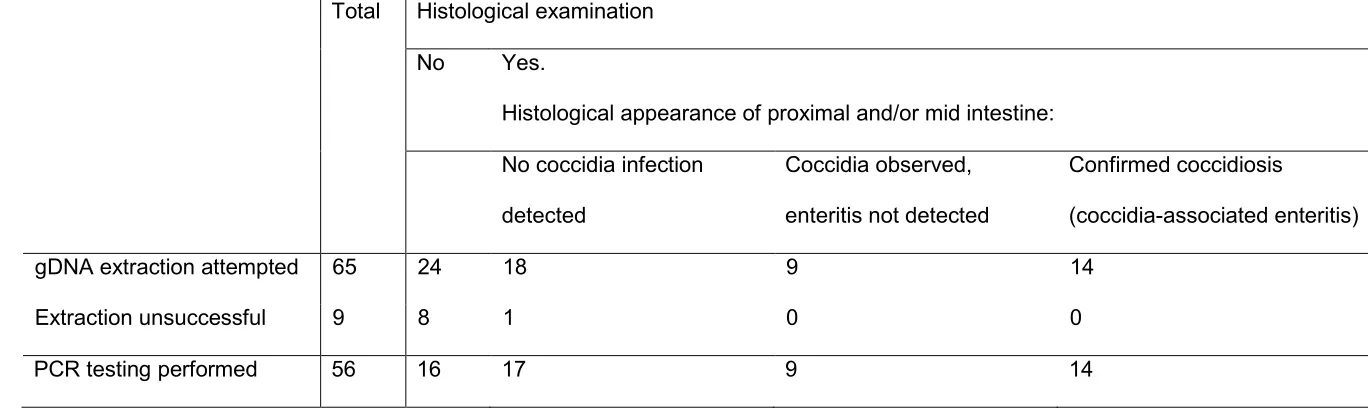
Archives presented a total of 65 birds from which tissues were available for DNA extraction 235
(Table 1). 236
237
Molecular diagnostic investigation
238
Genomic DNA isolation from tissue samples DNA was successfully extracted from tissues 239
from 56 of the 65 cases (Table 1). 240
Of these 56 cases, previous histological examination had been performed in 40 cases: 241
coccidia infection had been detected in 23 cases, and histological lesions consistent with 242
intestinal coccidiosis had been observed in 14 of these cases (Table 1). 243
244
Eimeria genus-specific PCR amplification PCR amplification targeting the Eimeria genus 245
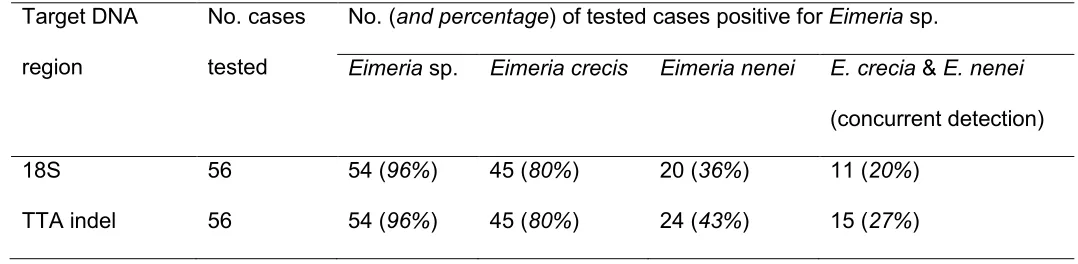
18S rDNA locus was successful in all 56 cases (Table 2). Eimeria sp. DNA was detected by 246
direct amplicon sequencing followed by BLASTn in samples from 54 (96%) of these 56 cases. 247
No sequences different to the published references (accession numbers HE653904-6) were 248
detected, with new flanking sequences confirmed for E. crecis and E. nenei respectively 249
(accession numbers LT970833-4). Manual sequence curation was required to identify both 250
E. crecis and E. nenei sequences: 45 (80% of all tested) cases were positive for E. crecis, and 251
20 (36%) were positive for E. nenei. E. crecis and E. nenei were detected concurrently in 11 252
(Figure 1): E. crecis was called as the dominant species in 8 cases. Minority sub-populations 254
are unlikely to have been detected in the absence of a cloning/multiple clone sequencing 255
protocol. 256
257
GeneScan PCR resolution Application of the new GeneScan assay successfully identified 258
the presence of Eimeria sp. gDNA in 54 of 56 cases and allowed species-specific detection 259
of E. crecis and E. nenei (Figure 2). E. crecis was detected in 45 (80%), and E. nenei in 24 260
(43%), of all tested cases. E. crecis was significantly the most common species detected 261
(χ2
=16.65; p<0.01). These results were equivalent to the standard 18S rDNA PCR plus
262amplicon sequencing (Table 2), with the exception that the GeneScan assay identified four 263
additional cases of E. nenei occurrence. 264
265
Molecular detection of Eimeria sp. relative to pathological findings
266
Our GeneScan assay targeting the TTA indel detected Eimeria sp. in tissues from 39 of the 267
40 birds in which histology had been performed – a significantly greater proportion than the 268
23 cases in which coccidia infection had been detected histologically (P=0.0076); only one of 269
the cases remained negative, as it had been on histology. 270
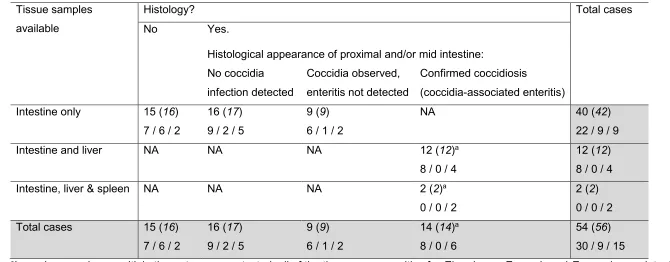
Of the 14 cases in which intestinal coccidiosis had been diagnosed through histological 271
examination – in which E. crecis was detected in the intestine of all cases, and E. nenei in the 272
intestine of six cases using the GeneScan assay – liver tissue was available for all and splenic 273
tissue was available for two cases (Table 3). Eimeria sp. DNA was detected using the 274
GeneScan PCR in all of these extra-intestinal tissue samples. In each case, the Eimeria 275
species detected in the liver +/- spleen was/were also detected in the intestine. E. crecis DNA 276
was detected in the liver of 13 cases (i.e. there was one case in which it was detected in the 277
intestine but not the liver), and in the spleen of both cases in which it was available. By 278
nenei DNA was only detected in the liver tissue in two cases, and not in either splenic sample 280
(both Eimeria species were detected in the intestine of each of these the cases). In 6 of the 281
14 coccidiosis cases, both E. crecis and E. nenei were detected concurrently in the intestine, 282
however there was only one case in which they were detected concurrently in liver. 283
There was found to be no significant difference in the species of Eimeria present between 284
birds that had been diagnosed with coccidia infection on histology, but in which coccidiosis 285
had not been observed (n=9), versus those diagnosed with coccidiosis (n=14) (P value=0.78). 286
Similarly, the proportion of cases in which there was co-detection of both Eimeria species did 287
not differ significantly (P value=0.18) between these two groups. 288
Of the 13 coccidiosis cases where Eimeria sp. DNA was detected in liver tissue, PME results 289
reported a grossly enlarged appearance for the liver +/- ‘congested’ in 11 cases, and in one 290
of these cases there had also been multiple small firm white foci over the liver surface, 291
however, these findings were considered a potential artefact of barbiturate euthanasia +/- 292
another concurrent disease. The liver had been examined histologically in 12 of these cases, 293
and observations had included changes consistent with: haematopoiesis (6 cases), 294
intracellular lipid +/- glycogen deposition (4 cases), autolysis (2 cases), haemosiderosis (2 295
cases), euthanasia artefact (1 case), and, in one case (in which no gross abnormalities of the 296
liver had been noted), mild, necrotising, multi-focal inflammation. Of the 2 coccidiosis cases 297
in which spleen tested Eimeria sp.-positive, at PME the spleen had grossly appeared enlarged 298
or ‘congested’, which (again) was a potential artefact of barbiturate euthanasia +/- another 299
concurrent disease. The spleen had been examined histologically in both cases and no 300
abnormalities had been observed. 301
302
Discussion 303
Eimeria-derived coccidiosis in the corncrake was highlighted as a concern for the CRP 304
(Sainsbury, 2015). The approaches adopted to rear and release corncrake bear some 306
similarities to gamebirds such as pheasants, partridge and bobwhite quail, where coccidiosis 307
has become a notable health issue (i.e. Gerhold et al., 2016; Liou et al., 2001; Ruff et al., 308
1987); although corncrake are more closely related to other gruiformes, such as the cranes. 309
This study identified E. crecis and E. nenei in juvenile (approximately 2-5 week old) corncrakes 310
which had died in the pre-release phase of a reintroduction project. Eimeria sp. DNA was 311
detected in tissues from 54 of 56 birds tested. While not absolute, we considered positive 312
DNA detection to be indicative of current or recent infection with viable parasites, and therefore 313
considered the results to be consistent with a very high infection prevalence in this population 314
of birds submitted for PME. All PCR reactions were accompanied by negative controls, 315
indicating the absence of laboratory contamination. The level of occurrence was consistent 316
with previous studies based on faecal oocyst excretion from wild corncrake (Jeanes et al., 317
2013). Microscopic detection of coccidial organisms during histology remains the Gold 318
Standard measure of parasite occurrence, but it should be noted that such evidence was only 319
available here for the samples from the intestine. It is possible that parasite numbers in the 320
liver and spleen would have been lower than the intestine for these naturally infected birds, 321
undermining attempts at microscopic detection. High-level experimental parasite challenge 322
could resolve the question, although such an approach was not possible with these captive 323
birds. E. crecis appeared to be the more common Eimeria species in this corncrake 324
population. The high level of occurrence precluded detection of an association between 325
infection status and the presence of coccidia-associated disease, and indicated that whilst 326
both corncrake Eimeria species may have the potential to be pathogenic, their infections 327
probably follow a chronic course, and that the onset of coccidiosis is likely to be triggered by 328
extraneous factors such as stress or high-level oocyst challenge (environmental 329
contamination). Quantitative PCR could be used in future to investigate whether these Eimeria 330
A high prevalence of Eimeria sp. infection was not surprising to the authors, because we 332
considered that most, if not all, juvenile birds were likely to have been exposed to coccidia 333
oocysts in their pre-release pens, and because (as per above) a previous study found an 334
infection prevalence of up to 86% in wild corncrakes (Jeanes et al., 2013). Samples in this 335
current study therefore showed an even higher prevalence than for wild corncrakes, possibly 336
because of a higher rate of environmental challenge, but also because post mortem intestinal 337
samples are likely to be a more sensitive diagnostic tool than single faecal samples (used by 338
Jeanes et al., 2013), since oocyst shedding in faeces can vary temporally (Villanúa et al., 339
2006). Also, tissue samples for this study were taken from birds which had died pre-release 340
– the prevalence of infection in birds that appeared healthy and were released might well have 341
been lower than in those birds submitted for PME. 342
The presence of E. crecis and E. nenei DNA in the liver and spleen of corncrakes is a novel 343
finding, however closely-related Eimeria species of cranes typically infect extra-intestinal 344
tissues – including the liver and/or spleen – where they can elicit granulomatous lesions and 345
cause disseminated visceral coccidiosis; this disease is most common in young cranes 346
(Carpenter et al., 1992; Novilla & Carpenter, 2004). Natural extra-intestinal coccidia infections 347
have also been observed in some other avian and mammalian species such as E. truncata 348
and E. stiedae, in the goose and rabbit respectively (Long, 1970; Novilla & Carpenter, 2004; 349
Ball et al., 2014). Of our corncrake cases in which Eimeria DNA was detected in liver +/- 350
spleen, Eimeria parasites had not been visible histologically in those tissues, neither had there 351
been gross or histological evidence of hepatic or splenic inflammation, with the exception of 352
one case, which had had very mild, multi-focal hepatic necrosis. Therefore, we were unable 353
to determine the pathogenicity of extra-intestinal Eimeria sp. infection in corncrakes. 354
Our findings support growing evidence that extra-intestinal infection forms a mechanism to 355
overcome the migratory lifecycle of these gruiform hosts (Jeanes et al., 2013). In order to 356
investigate this aspect further, liver and spleen samples could also be analysed from birds 357
would add further support for an altered, non-limited parasite lifecycle similar to that of crane-359
adapted Eimeria species. Analysis of other tissue samples, for example lung and kidney, 360
could further identify the extent of the infection and serve as another comparison to Eimeria 361
sp. infections of cranes (Novilla & Carpenter, 2004). 362
Eimeria species are characteristically highly host and site-specific (Shirley et al., 2007), 363
however as of yet nothing is known about site specificity in E. crecis and E. nenei within the 364
corncrake intestine, or whether one species is more adept at extra-intestinal migration. The 365
higher parasite prevalence demonstrated through PCR as opposed to histology demonstrated 366
that infection in some birds was probably missed on histological examination of intestinal 367
tissue, due to e.g. low-level infection, tissue autolysis, and possibly because, generally, only 368
one or two finite sections of small intestine had been sampled for histological examination at 369
PME. Changes to PME protocol have since been instigated, to ensure that multiple sections 370
of the intestinal tract are sampled in a standardised manner, which will, for example, allow 371
future work to investigate whether E. crecis and E. nenei have a predilection to particular areas 372
of the intestinal tract, as in poultry (Johnson & Reid, 1970). In cases of intestinal coccidiosis, 373
when E. crecis was found in the intestine, its DNA was also detected in extra-intestinal tissue 374
(with one exception), whereas E. nenei was rarely detected outside the intestine, indicating 375
potentially more limited systemic spread than for E. crecis: we hypothesise that E. crecis may 376
be more adept at extra-intestinal migration. Alternatively, however, this could have been an 377
artefact of our relatively small sample size – given that we were working with a species of high 378
conservation concern. Further investigation of both of these points would greatly benefit 379
understanding of these parasite species. 380
A species-specific set of primers were designed for a GeneScan-style analysis, and provided 381
slightly increased sensitivity as a diagnostic tool to identify the two species of Eimeria when 382
compared to primers previously available for standard PCR and amplicon sequencing, or 383
through detection by histopathology. A possible explanation for the increased sensitivity of 384
upon sufficient DNA from both species being present to be detected on overlying traces. By 386
contrast, using the GeneScan primers to detect the TTA indel may be more sensitive at 387
detecting low levels of infection, benefitting from a smaller amplicon and possible greater PCR 388
efficiency. 389
Future uses of the GeneScan PCR primers as a diagnostic tool could include analysis of faecal 390
samples; PCR methods for detection of Eimeria sp. in faecal samples have recently been 391
developed for health monitoring of endangered whooping cranes (Grus Americana) (Bertram 392
et al., 2015). In the context of the CRP, this could, first, confirm the point at which chicks are 393
exposed to the parasite during rearing; and, second, enable the prevalence of infection in 394
juvenile birds that are ultimately released to be compared to the prevalence in individuals 395
submitted for PME. Future diagnostics for Eimeria which infect corncrakes would benefit from 396
access to additional sequence markers. While the GeneScan assay presented here worked 397
well in samples collected in Southeast England, proving consistent with results from the 398
Hebrides (Jeanes et al., 2013), it is noted that an indel marker may be influenced by 399
expansion/contraction which could result in unreliable results. Further sequencing from a more 400
diverse panel of isolates will be required to assess stability, while the development of markers 401
such as mtCOI would be appropriate (Ogedengbe et al., 2011). 402
Disease management practices, including toltrazuril treatment, broadly appear to have 403
successfully suppressed the occurrence of coccidiosis in corncrakes reared for the CRP and 404
to have maintained infection at a predominantly sub-clinical level. A prophylactic, in-feed 405
treatment regime with an ionophore (coccidiostat) might promote better development of 406
natural immunity to coccidia infection and could be considered preferable to our current 407
toltrazuril-based strategy (Carpenter et al., 1992; Blake et al., 2017); however, for a number 408
of reasons, toltrazuril treatment is more practicable in the case of the CRP. An alternative 409
control strategy that could be investigated, for which this current study formed a useful piece 410
of background research, would be vaccination of chicks with a controlled level of Eimeria sp. 411
encounter Eimeria sp. during the early-rearing stage may encourage early development of 413
immunity and better enable them to acclimatise to oocyst burdens encountered in the pre-414
release and release environments. Vaccination would initially need to be highly controlled, 415
however, to identify any pathogenic effects and to determine the suitable timing and dosage 416
of oocysts. Nonetheless, such a strategy has been proposed for use with captive reared 417
pheasants (Liou et al., 2001). 418
In conclusion, our results provide evidence for a high prevalence of E. crecis and E. nenei 419
infection in juvenile captive-reared corncrakes presented for PME. We present a GeneScan 420
assay that detects E. crecis and E. nenei with greater sensitivity than those primers previously 421
available for standard PCR. The presence of both species of Eimeria in intestinal samples 422
showed no significant relation to disease status, suggesting that neither species should be 423
considered highly pathogenic. The novel finding of E. crecis and E. nenei DNA in liver and 424
spleen provides support for an extra-intestinal life cycle, similar to that seen in Eimeria species 425
infecting cranes (Novilla & Carpenter, 2004). This finding further supports a migratory 426
hypothesis for Eimeria sp. evolution in Gruiformes, i.e. that the parasite’s life cycle has evolved 427
as an adaptation to the host species’ migratory behaviour (Novilla & Carpenter, 2004). 428
429
Acknowledgments 430
The disease risk management work for the CRP was undertaken by the Disease Risk Analysis 431
and Health Surveillance (DRAHS) team, which is part of a Natural England/ZSL partnership 432
and part-funded by RSPB and the People’s Trust for Endangered Species. Project funding 433
was provided by ZSL and the Royal Veterinary College as part of the Masters in Wild Animal 434
Biology course. We are grateful to DRAHS colleagues (past and present), including Fieke 435
Molenaar, Rebecca Vaughan-Higgins, Timothy Hopkins and Jenny Jaffe, as well as ZSL’s 436
Veterinary Services department, ZSL Whipsnade Zoo, PCT, and the RSPB, for their 437
439
Disclosure statement 440
The authors of this paper disclose that no financial interest or benefit will arise from the direct 441
applications of their research. 442
443
References chk all present in text 444
Ball, S.J., Pittilo, M.R. & Snow, K.R. (2014). Observations on oocyst development of Eimeria 445
stiedai in rabbits. Acta Parasitol, 59, 544-547. 446
Bancroft, J.D. (2008). Theory and Practice of Histological Techniques. Oxford: Elsevier Health 447
Sciences. 448
Bertram, M.R., Hamer, G.L., Snowden, K.F., Hartup, B.K. & Hamer, S. A. (2015). Coccidian 449
parasites and conservation implications for the endangered whooping crane (Grus 450
americana). Plos One, 10(6): e0127679. 451
Blake, D.P., Clark, E.L., Macdonald, S.E., Thenmozhi, V., Kundu, K., Garg, R., Jatau, I.D., 452
Ayoade, S., Kawahara, F., Moftah, A., Reid, A.J., Adebambo, A.O., Álvarez-Zapata, R., 453
Srinivasa Rao, A.S.R., Thangaraj, K., Banerjee, P.S., Raj, G.D., Raman, M. & Tomley, 454
F.M. (2015). Population, genetic and antigenic diversity of the apicomplexan Eimeria 455
tenella and their relevance to vaccine development. Proceedings of the National 456
Academy of Sciences of the United States of America, 112, 5343–5350. 457
Blake, D.P., Pastor-Fernandez, I., Nolan, M.J. & Tomley, F.M. (2017). Recombinant 458
anticoccidial vaccines - a cup half full? Infect Genet Evol, 55, 358-365. 459
Carpenter, J.W., Novilla, M.N., Hatfield, J.S. (1992). The safety and physiologic effects of the 460
anticoccidial drugs monensin and clazuril in sandhill cranes (Grus canadensis). Journal 461
Carter, I. & Newbery, P. (2004). Reintroduction as a tool for population recovery of farmland 463
birds. Ibis, 146, 221–229. 464
Conway, D. P., Sasai, K., Gaafar, S. M. & Smothers, C. D. (1993). Effects of different levels 465
of oocyst inocula of Eimeria acervulina, E. tenella, and E. maxima on plasma constituents, 466
packed cell volume, lesion scores, and performance in chickens. Avian Diseases, 37, 467
118-123. 468
Dickens, M. J., Earle, K. A. & Romero, M. (2009). Initial transference of wild birds to captivity 469
alters stress physiology. General and Comparative Endocrinology, 160, 76-83. 470
Gerhold, R.W., Fuller, A.L. & McDougald, L.R. (2016). Coccidiosis in the Chukar Partridge 471
(Alectoris chukar): A Survey of Coccidiosis Outbreaks and a Test of Anticoccidial Drugs 472
Against Eimeria kofoidi. Avian Diseases, 60, 752-757. 473
Green, R. E., Rocamora, G. & Schaffer, N. (1997). Populations, ecology and threats to the 474
Corncrake Crex crex in Europe. Vogelwelt-Berlin, 118, 117-134. 475
IUCN. (2012). IUCN red list of threatened species. Version 2012.2. www.iucnredlist.org. 476
Accessed April 19, 2015. 477
Jeanes, C., Vaughan-Higgins, R., Green, R.E., Sainsbury, A. W., Marshall, R.N. & Blake, D.P. 478
(2013). Two new Eimeria species parasitic in corncrakes (Crex crex) (Gruiformes: 479
Rallidae) in the United Kingdom. Journal of Parasitology., 99, 634–8. 480
Johnson, J. & Reid, W.M. (1970). Anticoccidial drugs: lesion scoring techniques in battery and 481
floor-pen experiments with chickens. Exp Parasitol, 28, 30-36. 482
Koffijberg, K. & Schaffer, N. (2006). International single species action plan for the 483
conservation of the corncrake Crex crex. CMS Technical Series No. 14 & AEWA 484
Kumar, S., Garg, R., Moftah, A., Clark, E.L., Macdonald, S.E., Chaudhry, A.S., Sparagano, 486
O., Banerjee, P.S., Kundu, K., Tomley, F.M., & Blake, D.P. (2014). An optimised protocol 487
for molecular identification of Eimeria from chickens. Veterinary Parasitology, 199, 24-31. 488
Latimer, K.S. & Rakich, P.M. (1994). Necropsy examination. In B.W. Ritchie, G.H. Harrison, & 489
L.R. Harrison (Eds.). Avian Medicine: Principles and Application. (pp. 355-376). Florida: 490
Wingers Publishing. 491
Liou, C.T., Wang, J.S. & Ooi, H.K. (2001). Immunization against coccidiosis in pheasants with 492
low-dose live sporulated oocysts of Eimeria colchici. Avian Pathology, 30, 283-295. 493
Long, P.L. (1970). Development (schizogony) of Eimeria tenella in the liver of chickens treated 494
with corticosteroid. Nature, 225, 290-291. 495
Long, P., Joyner, L., Millard, B. & Norton, C. (1976). A guide to laboratory techniques used in 496
the study and diagnosis of avian coccidiosis. Folia Veterinaria Latina, 6, 201-217. 497
McDonald, V. & Shirley, M.W. (2009). Past and future: vaccination against Eimeria. 498
Parasitology, 136, 1477–1489. 499
McGill, I., Feltrer, Y., Jeffs, C., Sayers, G., Marshall, R.N., Peirce, M.A., Stidworthy, M.F., 500
Pocknell, A. & Sainsbury, A.W. (2010). Isosporoid coccidiosis in translocated cirl buntings 501
(Emberiza cirlus). Veterinary Record, 167, 656–60. 502
Novilla, M.N. & Carpenter, J.W. (2004). Pathology and pathogenesis of disseminated visceral 503
coccidiosis in cranes. Avian Pathology, 33, 275–80. 504
Novilla, M.N., Carpenter, J.W., Jeffers, T.K. & White, S.L. (1989). Pulmonary lesions in 505
disseminated visceral coccidiosis of sandhill and whooping cranes. Journal of Wildlife 506
Diseases, 25, 527–533. 507
O'Brien, M., Green, R.E. & Wilson, J. (2006). Partial recovery of the population of corncrakes 508
Ogedengbe, J.D., Hanner, R.H. & Barta, J.R. (2011). DNA barcoding identifies Eimeria 510
species and contributes to the phylogenetics of coccidian parasites (Eimeriorina, 511
Apicomplexa, Alveolata). International Journal for Parasitology, 41, 843–850. 512
Ogedengbe, M.E., El-Sherry, S., Ogedengbe, J.D., Chapman, H.D. & Barta, J.R. (2018). 513
Phylogenies based on combined mitochondrial and nuclear sequences conflict with 514
morphologically defined genera in the eimeriid coccidia (Apicomplexa). Int J Parasitol, 48, 515
59-69. 516
Ruff, M.D., Wilkins, G.C. & Chute, M.B. (1987). Prevention of coccidiosis in bobwhites by 517
medication. Poultry Science, 66, 1437-1445. 518
Sainsbury, A.W. (2015). Mitigating the risk from disease while conserving parasites in future 519
ecosystems: case studies from cirl buntings and corncrakes. In Health and Disease in 520
Translocated Wild Animals: Abstracts & Posters. Proceedings of a Zoological Society of 521
London Symposium, 14th & 15th May 2015 (p. 11). Available from:
522
https://www.zsl.org/sites/default/files/media/2015-523
05/14%2615%20May%20ZSL%20Symposium_Full%20programme%20and%20abstrac 524
ts.pdf. 525
Schaffer, N. & Green, R.E. (2001). The global status of the corncrake. RSPB Conservation 526
Review, 13, 18–24. Royal Society for the Protection of Birds. 527
Schwarz, R.S., Jenkins, M.C., Klopp, S. & Miska, K.B. (2009). Genomic analysis of Eimeria 528
spp. populations in relation to performance levels of broiler chicken farms in Arkansas 529
and North Carolina. Journal of Parasitology, 95, 871–880. 530
Sharman, P.A., Smith, N.C., Wallach, M.G. & Katrib, M. (2010). Chasing the golden egg: 531
vaccination against poultry coccidiosis. Parasite Immunology, 32, 590–8. 532
Shirley, M.W., Smith, A.L. & Blake, D.P. (2007). Challenges in the successful control of the 533
Villanúa, D., Pérez-Rodríguez, L., Gortázar, C., Höfle, U. & Viñuela, J. (2006). Avoiding bias 535
in parasite excretion estimates: the effect of sampling time and type of faeces. 536
check table formatting inc superscript and use of vertical lines for all… (Table 3) 538
539
Table 1. Number of cases from which tissue samples were available and in which DNA extraction was successful, and histological findings 540
Total Histological examination
No Yes.
Histological appearance of proximal and/or mid intestine:
No coccidia infection
detected
Coccidia observed,
enteritis not detected
Confirmed coccidiosis
(coccidia-associated enteritis)
gDNA extraction attempted 65 24 18 9 14
Extraction unsuccessful 9 8 1 0 0
PCR testing performed 56 16 17 9 14
541
Table 2. Number of birds positive for Eimeria spp. using: 18S rRNA gene primers (ERIB1 and ERIB10) coupled with direct amplicon sequencing; 543
and TTA indel primers (ERIBnf and ERIBnr) coupled with GeneScan resolution 544
Target DNA
region
No. cases
tested
No. (and percentage) of tested cases positive for Eimeria sp.
Eimeria sp. Eimeria crecis Eimeria nenei E. crecia & E. nenei
(concurrent detection)
18S 56 54 (96%) 45 (80%) 20 (36%) 11 (20%)
TTA indel 56 54 (96%) 45 (80%) 24 (43%) 15 (27%)
545
Table 3. Number of cases positive for Eimeria sp. DNA (and total number of cases tested) using the GeneScan assay, and associated 547
histological findings. The number of cases from which each particular Eimeria species was detected is indicated on the second line of each row 548
as follows: E. crecis only / E. nenei only / concurrent detection of both Eimeria species 549
Tissue samples available
Histology? Total cases
No Yes.
Histological appearance of proximal and/or mid intestine: No coccidia
infection detected
Coccidia observed, enteritis not detected
Confirmed coccidiosis
(coccidia-associated enteritis) Intestine only 15 (16)
7 / 6 / 2
16 (17) 9 / 2 / 5
9 (9) 6 / 1 / 2
NA 40 (42)
22 / 9 / 9
Intestine and liver NA NA NA 12 (12)a
8 / 0 / 4
12 (12) 8 / 0 / 4
Intestine, liver & spleen NA NA NA 2 (2)a
0 / 0 / 2
2 (2) 0 / 0 / 2 Total cases 15 (16)
7 / 6 / 2
16 (17) 9 / 2 / 5
9 (9) 6 / 1 / 2
14 (14)a 8 / 0 / 6
54 (56) 30 / 9 / 15
aIn each case where multiple tissue types were tested, all of the tissues were positive for Eimeria sp.. E. crecis and E. nenei were detected 550
concurrently in the intestine in six cases, and concurrently in the liver in one of these cases. 551
Figure legends 553
Figure 1. Sequence traces viewed using CLC Main Workbench version 5.7.1 (CLC Bio, 554
Prismet, Denmark). The TTA indel is highlighted by a bold line above and below the trace. (a) 555
The E. crecis trace includes the TTA repeat. (b) The E. nenei trace has no TTA repeat. (c) 556
Both E. crecis & E. nenei sequences are present, with E. crecis identified semi-quantitatively 557
as the majority species on the trace as shown by the TTA repeat, however the E. nenei 558
sequence was also visible at lower level. 559
560
Figure 2. Excised sections of GeneScan outputs from Peak Scanner 2. (a) Results obtained 561
from samples previously shown to have no eimerian DNA present. (b) Samples containing E. 562
crecis, as shown by a blue arrow at 180 bp peak. (c) Samples containing E. nenei, as shown 563
by a green arrow at 177 bp peak. (d) Samples containing both species as shown by blue and 564
green arrows. Non-target peaks (red) represent marker samples of known molecular length 565