Community- and hospital based nurses’ implementation of evidence-based practice: are there any differences?
Jaimee Mallion, Undergraduate Student, University of Kent
Joanne Brooke, Associate Professor in Dementia Care, University of West London PUBLISHED IN:
British Journal of Community Nursing 2016, 21(3): 148-154.
Abstract
The aim of this paper is to discuss the impact of nurses’ beliefs, knowledge and skills on the implementation of evidence-based practice (EBP) in hospital and community settings. EBP refers to the implementation of the most up-to-date robust research into clinical practice. Barriers have been well-documented and traditionally include negative beliefs of nurses as well as a lack of time, knowledge and skills. However, with degree entry nursing and a focus on community health care provision, what has changed? A comprehensive search of
contemporary literature (2010-2015) was completed. The findings of this review show that the traditionally acknowledged barriers of a lack of time, knowledge and skills remained, however, nurses’ beliefs towards EBP however were more positive, but positive beliefs did not affect the intentions to implement EBP or knowledge and skills of EBP. Nurses in hospital and community settings reported similar barriers and facilitators.
KEYWORDS: evidence-based practice, barriers, facilitators, community nurse, literature review
INTRODUCTION
1996, p. 71). The integration of the latest research evidence into practice is associated with patients receiving improved care and obtaining better outcomes (Melnyk et al, 2012). Robust systematic research is only one form of evidence nurses may access to influence their
practice. Other forms of evidence include: clinical guidelines from recognised bodies such as the National Institute for Health and Care Excellence (NICE), objective case note reviews and even subjective experiences of patients can inform EBP (Hewitt-Taylor 2011).
Professional nursing organisations including the Nursing Midwifery Council (NMC) and the International Council of Nurses (ICN) include the expectation of nurses to deliver EBP in all settings. The NMC (2015) The Code: Professional standards of practice and behaviour for nurses and midwives, states that it is the responsibility of each nurse and midwife to maintain their knowledge and skills and to practice within the best available evidence.
The focus of health care provision in the community, has developed community nurses who are tasked with undertaking multi-dimensional complex health, social and psychological assessments and provide appropriate care and treatment in patient’s homes (Burke 2014). In response to this demand institutions/providers of community healthcare have focused on supporting their nurses to provide EBP, this is evident from policies such as the Community Nursing Research Strategy implemented by NHS Wales (Welsh Assembly Government 2009), which supports an infrastructure for community nurses to work together and be involved in the creation of evidence for their own practice (Kendre et al. 2013).
A major limitation of the traditional research exploring nurses’ beliefs, knowledge and skills of EBP was the focus on nurses who work in acute hospital settings. The aim of this review is to understand current EBP beliefs, knowledge and skills of nurses who work in either an acute hospital or a community setting, and to identify if differences exist.
METHODS
A literature review of empirical research published between 1 January 2010 and 31 December 2015 was completed. Databases searched included CINAHL and MEDLINE. Inclusion criteria were: empirical research study; community or hospital setting; exploration of nurse beliefs, knowledge and skills of EBP and/or barriers and facilitators of implementing EBP. Exclusion criteria were: the inclusion of other healthcare professionals without a
separate reporting of nurses’ beliefs, knowledge and skills of EBP or barriers and facilitators of implementing EBP. The last exclusion were studies which focused on senior nurse
Keywords included: evidence-based practice, evidence-based nursing, beliefs, attitudes, knowledge, nurses, primary care, and community nursing.
RESULTS
The search resulted in 1438 hits of which 22 relevant papers were identified. The focus of the studies ranged from hospital nurses (n=14), community nurses (n=5), nursing home nurses (n=1), hospital and community nurses (n=2). The subject matter is of global importance as papers were from Austria (n=1), Canada (n=1), Iceland (n=2), Iran (n=1), Israel (n=1), Netherlands (n=1), Norway (n=2), Singapore (n=3), Spain (n=2), Sweden (n=1), Taiwan (n=1), Turkey (n=1), United Kingdom (n=1) and United States of America (n=4).
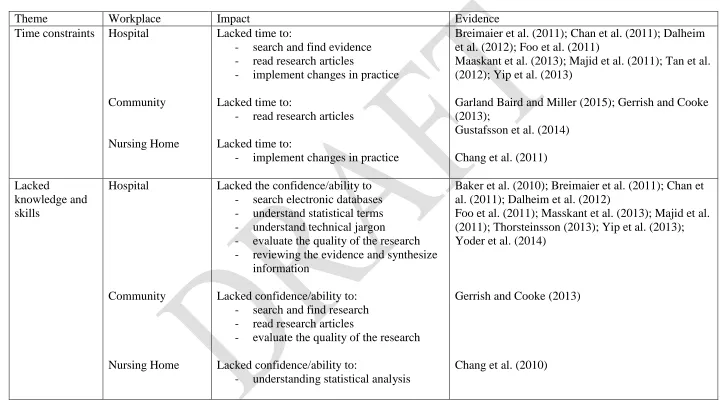
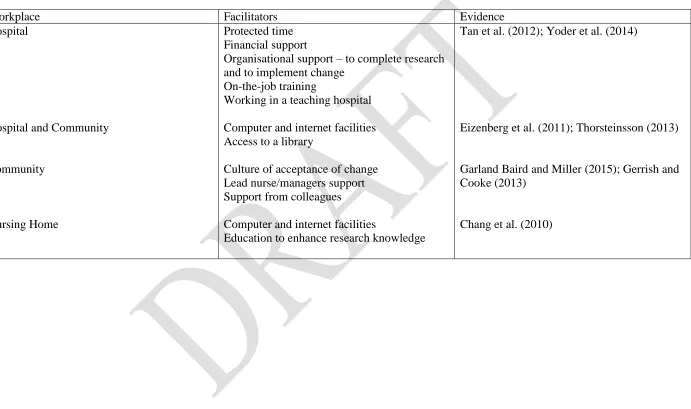
The most frequently reported barriers of EBP by nurses included time constraints, lack of knowledge and skills (refer to Table 1). These barriers are consistent with previous research. Other barriers included: lack of resources (Baker et al. 2010; Yoder et al. 2014), lack of organisational support (Gonzalez-Torrente et al. 2012; Chan et al. 2011; Pericas-Beltran et al. 2014) and lack of authority to change clinical practice (Chan et al. 2011; Tan et al. 2012; Garland Baird and Miller 2015). Positive beliefs concerning EBP were reported by eight studies of hospital nurses and two studies of community nurses. Positive beliefs were not associated with EBP knowledge or skills, or to the implementation of EBP. One study directly compared hospital and community nurses EBP knowledge and skills, no differences between these two groups were found (Eizenberg 2011). Only seven papers reported on facilitators of implementing EBP (refer to Table 2), although all papers provided
Table 1: Overview of time constraints, beliefs, knowledge and skills of EBP reported by nurses
Theme Workplace Impact Evidence
Time constraints Hospital
Community
Nursing Home
Lacked time to:
- search and find evidence - read research articles
- implement changes in practice Lacked time to:
- read research articles Lacked time to:
- implement changes in practice
Breimaier et al. (2011); Chan et al. (2011); Dalheim et al. (2012); Foo et al. (2011)
Maaskant et al. (2013); Majid et al. (2011); Tan et al. (2012); Yip et al. (2013)
Garland Baird and Miller (2015); Gerrish and Cooke (2013);
Gustafsson et al. (2014) Chang et al. (2011) Lacked knowledge and skills Hospital Community Nursing Home
Lacked the confidence/ability to - search electronic databases - understand statistical terms - understand technical jargon
- evaluate the quality of the research - reviewing the evidence and synthesize
information
Lacked confidence/ability to: - search and find research - read research articles
- evaluate the quality of the research Lacked confidence/ability to:
- understanding statistical analysis
Baker et al. (2010); Breimaier et al. (2011); Chan et al. (2011); Dalheim et al. (2012)
Foo et al. (2011); Masskant et al. (2013); Majid et al. (2011); Thorsteinsson (2013); Yip et al. (2013); Yoder et al. (2014)
Gerrish and Cooke (2013)
Table 2: Overview facilitators of implement EBP reported by nurses
Workplace Facilitators Evidence
Hospital Protected time
Financial support
Organisational support – to complete research and to implement change
On-the-job training
Working in a teaching hospital
Tan et al. (2012); Yoder et al. (2014)
Hospital and Community Computer and internet facilities Access to a library
Eizenberg et al. (2011); Thorsteinsson (2013)
Community Culture of acceptance of change
Lead nurse/managers support Support from colleagues
Garland Baird and Miller (2015); Gerrish and Cooke (2013)
Nursing Home Computer and internet facilities
Education to enhance research knowledge
TIME
Lack of time to engage in EBP activities such as searching for evidence, reading research articles and implementing change in practice was reported by nurses working in hospital and community settings. Community nurses reported not having the time to read articles, but time to read guidelines, standards and policies as these were viewed as part of their role and supported their EBP (Garland Baird and Miller 2015). Hospital nurses reported a heavy workload impacted on their ability to engage in EBP activities (Majid et al. 2011), whilst community nurses reported sacrificing some of their private life and family obligations to engage in EBP activities (Gustafsson et al. 2014).
KNOWLEDGE AND SKILLS
Complexity of research was the most significant issue reported by both hospital and community nurses and included: research methodology (Maaskant et al. 2013), statistical analysis (Chang et al. 2010), and research jargon (Majid et al. 2011). An area of concern for both hospital and community nurses was how to evaluate the quality of the research (Foo et al. 2011), and this impacted on the nurses ability to critically review and synthesise evidence with relevance to practice (Garland Baird and Miller 2015). Although not as widely reported, some nurses did report difficulties in searching electronic databases (Thorsteinsson 2013) and identifying relevant research articles and journals (Gerrish and Cooke 2013).
BARRIERS
standards, even with the presentation of scientific evidence lead to former clinical practice prevailing (Pericas-Beltran et al. 2014).
Lack of authority to change clinical practice was highlighted by hospital nurses (Chan et al. 2011; Tan et al. 2012) and community nurses (Garland Baird and Miller 2015).
However, community nurses reported confidence in updating their practice and their workplace was receptive to change, but felt they did not have the authority to implement change to institutional guidelines and policies (Garland Baird and Miller 2015).
BELIEFS
Hospital and community nurses’ beliefs and attitudes of EBP were positive, although this did not lead to the implementation of EBP (Thorsteinsson and Sveindsdottier 2014) or was related to EBP knowledge or skills (White-Williams et al. 2013).
FACILITATORS
Facilitators for hospital, community and nursing home staff were access to libraries and opportunities to work on computers with internet access (Eizenberg et al. 2011;
Thorsteinsson 2013; Chang et al. 2010). Only nursing home staff reported education as facilitating enhanced research knowledge (Chang et al. 2010).
Facilitators for hospital staff included protect time, financial and organisational support, training and working within a teaching hospital (Tan et al. 2012; Yoder et al. 2014). Facilitators for community nurses included a culture of acceptance and change, support from managers and colleagues (Garland Baird and Miller 2015; Gerrish and Cooke 2013).
Changes to nurses’ beliefs and skills towards EBP have occurred, nurses’ beliefs are more positive and knowledge and skills have developed. However, the main barriers reported by nurses to implement EBP were unchanged and included an envisaged lack of time,
knowledge and skills. Other barriers reported by nurses included a lack of resources, organisation support and authority to change clinical practice. Hospital and community nurses face many of the same barriers and facilitators, and their nurses had comparable EBP skills and knowledge.
Nurses reporting a lack of time to engage in EBP has been well documented and the current review confirms this has not changed. The nurses’ impressions of research and EBP appear to be overwhelmingly perceived as an additional pursuit which is undertaken beyond their normal workload (Gray et al. 2012). Protected time was acknowledged as a facilitator by many nurses, and a recommendation from numerous studies. However, building protected time into existing roles in the current healthcare climate appears overtly simplistic and logistically unlikely. The development of new roles and support of clinical nurses through active dissemination of research maybe more practical and achievable.
Lack of knowledge and skills of EBP remained a concern for many nurses, who expressed a need to understand the complexities of research in more depth. A few nurses still reported difficultly in searching electronic databases and identifying relevant research articles and journals (Gerrish and Cooke 2013). Hospital and community initiatives are being
Facilitators reported by community nurses suggest a culture of acceptance and change, and support from manager and colleagues, although this is not enough to change practice as nurses felt they did not have the authority to implement change (Garland Baird and Miller 2015; Gerrish and Cooke 2013). Lack of authority of nurses can be addressed through the development of shared governance systems where nurses and administrations work together and have an equal voice in decision making and policy changes that affect patient care and work environments (Dunbar et al. 2007). Shared governance systems can support the drive of research and EBP to improve clinical practices and patient outcomes (Harris et al. 2007).
Degree entry into nursing has only recurrently occurred in the UK, in countries where degree entry into nursing has been established for a number of years the impact on nurses intentions to become involved in research and EBP has been modest, particularly at the beginning of their careers (Forsman et al. 2010; 2012). Suggesting, the change in nursing education alone is not sufficient to impact on the implementation of EBP by nurses. However, a possible confounding variable in the current research is the inclusion of all practicing nurses, the nursing workforce is an aging workforce which suggests that a large proportion did not complete research of EBP studies as part of their nursing education (Melynk 2012).
responding to the changing needs of the public and fellow healthcare professions, which encompasses evidence-based practice.
Nurses’ positive beliefs and understanding of the need to implement EBP was apparent in all of the studies included in this review. However, nurses reported the
implementation of clinical guidelines rather than being involved in research was important to inform their practice. Nurses’ reported not feeling empowered to make changes in practice from evidence of research findings, but supported changes in practice based on clinical guidelines. These guidelines were viewed as the amalgamation of national guidelines and research by more senior and specialist nurses in their institutions, which supported and maintained their practice as current and based on contemporary evidence.
There are a number of limitations regarding the studies included in this review; firstly although the results of these studies were published between 2010 and 2015, some of the data collection occurred as early as 2006. Secondly, the contribution is from a wide range of countries with differing healthcare structures and systems, although this does suggest commonality of the issues discussed. The approach of supporting nurses to implement EBP appears unanimous across countries, including resources such as mentoring, journal clubs, policies, procedures and national guidelines. Lastly, there remains a predominance of this work to concentrate on acute hospital based nursing.
CONCLUSION
practice appear remarkably similar. Innovative approaches are required to engage nurses in EBP that supports their practice and are not viewed as an extra workload or burden. Guidance from such approaches can be taken from around the world and adapted to local healthcare structures. Lastly, it has been recognised that it can take up to 17 years, before research findings are assimilated into healthcare practice (Morris et al. 2011), but it appears it may take just as long for the impact of education changes and focus on community care to be reflected in research.
References
Baker KA, Ellett ML, Dudley-Brown S (2010) Evidence-based practice of gastroenterology nurses. Gastroenterolo Nurs 33(4): 263-266.
Bonner A, Sando J (2008) Examining the knowledge, attitude and use of research by nurses. J Nurs Manage 16(3): 334-343.
Breimaier HE, Halfens RJG, Lohrmann C (2011) Nurses’ wishes, knowledge, attitudes ad perceived barriers on implementing research findings into practice among graduate nurses in Austria. JCN 20: 1744-1756.
Brown CE, Wickline MA, Ecoff L, and Glaser D, (2009) Nursing practice, knowledge, attitudes and perceived barriers to evidence‐based practice at an academic medical center. JAN 65(2): 371-381.
Burke M (2014) Modelling district nurse expertise. British Journal of Community Nursing 19(12): 608-11.
Chan GK, Barnason S, Dakin CL, Gillespie G, Kamienski MC, Stapleton S, Williams J, Juarez A, Li S (2011) Barriers and perceived needs for understanding and using research among emergency nurses. J Emerg Nurs 37(1): 24-31.
Chang HC, Russell C, Jones MK (2010) Implementing evidence-based practice in Taiwanese Nursing Homes: Attitudes and perceived barriers and facilitators. Journal of
Dalheim A, Harthug S, Nilsen RM, Nortvedt W (2012) Factors influencing the development of evidence-based practice among nurses: a self-report survey. BMC Health Services Research 12: 367.
Dunbar B, Park B. Berger-Wesley M, Cameron T, Lorenz B, Mayes D et al (2007) Shared governance: making the transition in practice and perception. J Nurs Admin 37(4): 177-183.
Eizenberg MM (2011) Implementation of evidence-based nursing practice: nurses' personal and professional factors? JAN 67(1): 33-42.
Forsman H, Rudman A, Gustavsson P, Ehrenberg A, Wallin L (2010) Use of research by nurses during their first two years after graduating. JAN 66(4): 878-890.
Forsman H, Rudman A, Gustavsson P, Ehrenberg A, Wallin L (2010) Nurses’ research utilization two years after graduation—a national survey of associated individual, organizational, and educational factors. Implement Sci 7: 46.
Foo S, Majid S, Mokhtar IA, Zhang X, Luyt B, Chang Y-K, Theng Y-L (2011) Nurses’ perception of evidence-based practice at the National University Hospital of Singapore. J Contin Educ Nurs 42(11): 522-528.
Garland Baird LM, Miller T (2015) Factors influencing evidence-based practice for community nurses. British Journal of Community Nursing 29(5): 233-242.
Gerrish K, Cooke J (2013) Factors influencing evidence-based practice among community nurses. JCN 27(4): 98-101.
professional environment of Primary Health Care nurses in the Spanish context: across-sectional study. BMC Health Services Research 12:227.
Gray M, Joy E, Plath D, Webb SA (2012) Implementing Evidence-Based Practice: A Review of the Empirical Research Literature. Res Social Work Prac 23(2): 157–166.
Gustafsson LK, Mattsson K, Dubbleman K, Snoljung A (2014) Aspects of nursing with evidence-based when nursing frail older adults: a phenomenological analysis of interviews with nurses in municipal care. Scand J Caring Sci 28: 793-801.
Harris K, Spinweber C, Doherty M, Milligan I, Addy I, Hydro B (2007) The integration of a nurse model to increase clinical excellence. J Nurses Staff Dev 23(3): 12-9.
Hewitt-Taylor J (2011) Using Research in Practice. Palgrave Macmillan: Hampshire.
Heydari A, Mazlom SR, Ranjbar H, Scurlock-Evans L (2014) A study of Iranian nurses’ and midwives’ knowledge, attitudes and implementation of evidence-based practice: The time for change has arrived. Worldvi Evid-Based Nu 11(5): 325-331.
Johnson N, List-Ivankovic J, Eboh W et al (2010) Research and evidence based practice: Using a blended approach to teaching and learning in undergraduate nurse
education. Nurse Education in Practice 10(1): 43-47.
Kenkre J, Wallace C, Davies R, Bale S, Thomas S (2013) Developing and implementing the community nursing research strategy for Wales. British Journal of Community Nursing 18(11): 561-566.
Maatta S, Wallmyr G (2011) Clinical librarians as facilitators of nurses’ evidence-based practice. JCN 19: 3427-3434.
Majid S, Foo S, Luyt B, Zhang X, Theng YL, Chang YK Mokhtar IA (2011) Adopting evidence-based practice in clinical decision making: nurses’ perceptions, knowledge, and barriers. J Med Libr Assoc 99(3): 229-236.
Melnyk BM, Fineout-Overholt E, Feinstein NF, Li H, Small L, Wilcox L, Kraus R (2004) Nurses’ perceived knowledge, beliefs, skills and needs regarding evidence-based practice: Implications for accelerating the paradigm shift. Worldvi Evid-Based Nu 1(3): 185-193.
Melnyk BM, Fineout-Overholt E, Gallagher-Ford L, Kaplan L (2012) The state of evidence-based practice in US nurses: critical implications for nurse leaders and educators. J Nurs Admin 42(9): 410-417.
Morris ZS, Wooding S, Grant J (2011) The answer is 17 years, what is the question:
Understanding time lags in translational research. J Roy Soc Med 104(12): 510-520.
Nursing and Midwifery Council (2015) The Code: Professional standards of practice and behaviour for nurses and midwives. London: Nursing and Midwifery Council.
Nursing and Midwifery Council (2015) Revalidation. London: Nursing and Midwifery Council.
Sackett DL, Rosenberg WM, Gray JA, Haynes RB, Richardson WS (1996) Evidence based medicine: What it is and what it isn't. BMJ 312(7023): 71-72.
Sortedahl C (2012) Effect of online journal club on evidence-based practice knowledge, intent and utilization in school nurses. Worldvi Evid-Based Nu 9(2): 117-125.
Tan M, Sahin ZA, Ozdemir FK (2012) Barriers of research utilization from the perspective of
nurses in Eastern Turkey. Nurs Outlook 60(1): 44-50.
Thorsteinsson HS (2013) Icelandic nurses’ beliefs, skills and resources associated with
evidence-based practice and related factors: A national survey. Worldvi Evid-Based
Nu 10(2): 116-126.
Thorsteinsson HS, Sveinsdottir H (2014) Readiness for and predictors of evidence-based practice of acute-care nurses: a cross-sectional postal survey. Scand J Caring Sci 28: 572-581.
Underhill M, Roper K, Siefert ML, Boucher J, Berry D (2015) Evidence-based practice beliefs and implementation before and after an initiative to promote evidence-based nursing in an ambulatory oncology setting. Worldvi Evid-Based Nu 12(2): 70.
Welsh Assembly Government (2009) A Community Nursing Strategy for Wales.
http://gov.wales/topics/health/cmo/professionals/officechiefnursing/cno-publictions/community/?lang=en
Yip WK, Mordiffi SZ, Liang S, Ang ENK, Xue Z, Majid S (2013) Nurses’ perception towards evidence-based practice: A descriptive study. Singapore Nursing Journal 40(1): 34-41.
Yoder LH, Kirkley D, McFall DC, Kirksey KM, StalBaum AL, Sellers D (2014) Staff