Fog over Virtualized IoT: New Opportunity for
Context-Aware Networked Applications and
a Case Study
Paola G. Vinueza Naranjo1, Zahra Pooranian2 ID, Shahaboddin Shamshirband3,4,*ID and Jemal Abawajy5 ID
1 Department of Information Engineering, Electronics, and Telecommunication, Sapienza University of Rome,
via Eudossiana 18, 00184 Rome, Italy; [email protected]
2 Department of Mathematics, University of Padova, Italy; [email protected]
3 Department of Management of Science and Technology Development, Ton Duc Thang University, Ho Chi
Minh City, Vietnam
4 Department of Management of Science and Technology Development, Ton Duc Thang University, Ho Chi
Minh City, Vietnam; [email protected]
5 Faculty of Science, Engineering and Built Environment, Deakin University, Australia;
* Correspondence: [email protected]; [email protected]; Tel.: +39-327-114-4158
Abstract: In this paper, we discuss the most significant application opportunities and outline the 1
challenges in performing a real-time and energy-efficient management of the distributed resources 2
available at mobile devices and Internet-to-Data Center. We also present an energy-efficient adaptive 3
scheduler for Vehicular Fog Computing (VFC) that operates at the edge of a vehicular network, 4
connected to the served Vehicular Clients (VCs) through an Infrastructure-to-Vehicular (I2V) over 5
multiple Foglets (Fls). The scheduler optimizes the energy by leveraging the heterogeneity of Fls, 6
where the Fl provider shapes the system workload by maximizing the task admission rate over 7
data transfer and computation. The presented scheduling algorithm demonstrates that the resulting 8
adaptive scheduler allows scalable and distributed implementation. 9
Keywords:big data streaming; energy-efficiency; resource management; Infrastructure-to-Vehicular 10
(I2V); Vehicular Fog Computing (VFC) 11
1. Introduction and Related Work 12
Vehicular Fog Computing (VFC) is a promising paradigm (still unexplored), where the aim is 13
supporting services in order to include the come up Internet infotainment applications. The Cloud 14
Computing (CC) has attract the big companies (such as VTube, Netflix, Cameleon, etc) [1,2] that exploit 15
the Fog Nodes (FNs) of the Infrastructure-to-Vehicle (I2V) with a single-hop IEEE 802.11 likes wireless 16
links for data dissemination, proving low energy consumption [2]. Furthermore, Fog Computing (FC) 17
is used to design an efficient solution within supporting low-latency [3] and energy-efficient as well 18
as self-adaption. It plays as spectrum efficient by means of a strict collaboration among end-devices 19
in the same integrate platform. FC aims at distributing self-powered data center (e.g., FNs) between 20
resource remote clouds and resource-limited smartphone equipped in the vehicles, in order to perform 21
context-aware energy-efficient data mining and dissemination for the adoption of smartphone device 22
and clients’ heavy dependence mobile applications [3,4]. Moreover, being deployed in proximity of the 23
Vehicular Clients (VCs), the FNs efficiently exploit the awareness of the connection states supporting 24
latency and delay-jitter. In Vehicular scenarios that is presented in [5,6], FNs are virtualized and 25
connected to networked data center (VNetFCs), which are hosted by Road Side Unit (RSU) at the edge 26
of Vehicular Network and the task offloading can be achieved without introducing intolerable delay. In 27
the IoTs era, Foglets (Fls) are defined as large implemented serving demands for the future 5G [7]. In 28
this paper, a basic system model for VFC with multiple Fls is illustrated in Fig.1. The current practice 29
allocates mobile tasks to the closest Fl. The model provides and operates multiples Fls. Moreover, 30
we consider a case study and go in depth in the Fog Data Center (FDC) as a vital component in VFC, 31
present general resource allocation model and propose an adaptive scheduler which covers the hard 32
limited QoSs. 33
The rest of the paper is organized as follow. The description of the FDC architecture is reported in 34
the next section. A simple case study of the Fog data center data stream managements and its correlated 35
problem/solution are reported in Sec.3. The performance evaluation of the optimal formulations is 36
reported in Sec.4. Finally, Sec.5concludes our work. 37
2. Fog Computing Paradigm 38
Fog Computing (FC) is a platform that uses a collaborative multitude of near-users edge devices 39
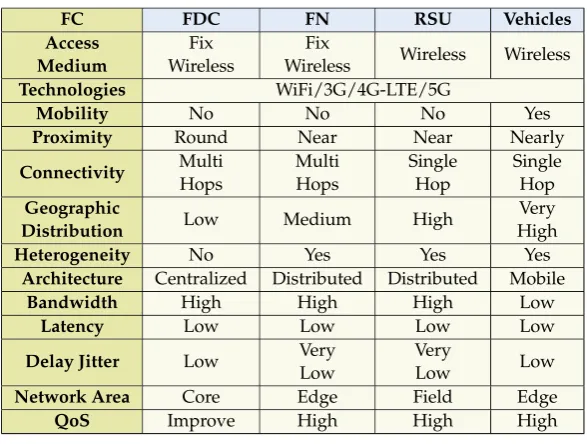
[3] with some important characteristics shown in Table1. It provides data, computing, storage and 40
application services [3,8] to end users [9]. FC affords proximity to the end users, a dense geographical 41
distribution and supports the mobility [3], it means, it provides services in local area instead of global 42
and near to the users [3,8,10]. An example scenario is shown in Fig.1. Specifically, in the Fig.1, we 43
adopt a simple three main areas: Vehicles area, RSU area, FDC area [3,8,10].
Figure 1.The overall VFC architecture. CDC:= Cloud-Data-Center with the main areas: FN:=Fog-Node, RSU:=Road-Side-Unit, Fl:=Foglet FDC:= Fog-Data-Center.
44
In this architecture, the VFC provides a solid platform for applications used to provide services 45
to users. VFC services are mainly implemented in the Fog: these use a distributed architecture over 46
moderate-bandwidth to provide high availability operations. As we see, vehicles are attached to one 47
of the RSU in the FN [11], with heterogeneous type of devices considered as a physical infrastructure. 48
Indeed, each FN consists of a single server or a set of servers that builds heterogeneous requests. On 49
connected to the RSU. The vehicles in mobility are arbitrarily entering in the field of RSU and may 51
leave the coverage area of it. FNs could be interconnected and each of them is linked to the FDC. 52
Vehicles could request a service to RSU (i.e, then transfer this request to FN and finally FDC for 53
managing the request) while they are freely moving across the FDC and RSU areas and FDC can 54
provide required services to them in order to facilitate the connectivity between service providers and 55
users. They provide application services for near-users that are located in this area (FDC area) and 56
directly access to the context parameters with the main characteristics of VFC showing in the Table 57
1. The management architecture of FNs should include challenge strategies for resource allocation, 58
edge devices management jointly with computing and storage resources. Also, it is important to 59
remind that, it should be managed by Software Defined Networks (SDNs) [3] and Network Functions 60
Virtualization (NFV) [9]. The correlated explanations are beyond of the topic of this paper. Motivated 61
by these considerations, we aim to focus on the Fog computing environment and FDC component 62
which are detailed in the next section.
Table 1.Main characteristics of Vehicular Fog Computing (VFC).
FC FDC FN RSU Vehicles
Access Medium
Fix Wireless
Fix
Wireless Wireless Wireless
Technologies WiFi/3G/4G-LTE/5G
Mobility No No No Yes
Proximity Round Near Near Nearly
Connectivity Multi
Hops
Multi Hops
Single Hop
Single Hop
Geographic
Distribution Low Medium High
Very High
Heterogeneity No Yes Yes Yes
Architecture Centralized Distributed Distributed Mobile
Bandwidth High High High Low
Latency Low Low Low Low
Delay Jitter Low Very
Low
Very
Low Low
Network Area Core Edge Field Edge
QoS Improve High High High
63
3. A Case Study: StreamVehicularFog 64
We then move our attention to a more formal modeling of the presented case study and their 65
correlated models. Motivated by the aforementioned consideration and based on the self-configuring 66
framework as a prototype which is recently presented in [12], we define a cases study, named 67
"StreamVehicularFog" (SVF), as a paradigm which is covered in an Internet assisted peer-to-peer 68
(P2P) service architecture. The SVF aim is to minimize the total energy cost in mobile devices and 69
data centers with an adaptive synchronization of the resource management operations that guarantee 70
stream of data passed/process over the underutilized networking/computing servers in FDC. In 71
this scenario, FC equipped with RSUs to broadcast locally processed data to smartphones in the 72
vehicles through point-to-point TCP/IP based I2V connections with only one hop wireless link. In 73
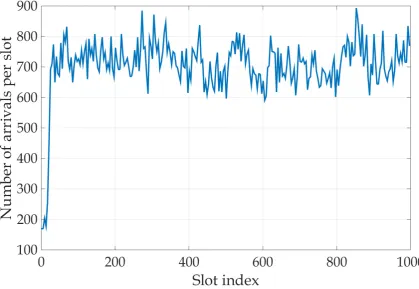
order to evaluate the performance of our model, we consider a real-time streams workload as is 74
presented in Fig. 2being the arrival rate for the challenge task that sent to the FNs and should be 75
processed through FDC to the available servers. Moreover, FDC adopts some resource allocation adn 76
shedyler techniques to analyze the data and setup frequently ON/OFF transitions of the underutilized 77
computing/communication servers with the aim of energy provisioning. Indeed, in turn, Fig. 2 78
Fig.1. Remind that, in this case study we assume the processing data are gathered from the vehicular 80
application service requested.
Figure 2.Trace sample of I/O arrival from enterprise cluster in WorldCup98 Workload [1:1000] [13]. The corresponding average arrival rate and PMR (Peak Mean Rate) are 1.56 and 19.65.
81
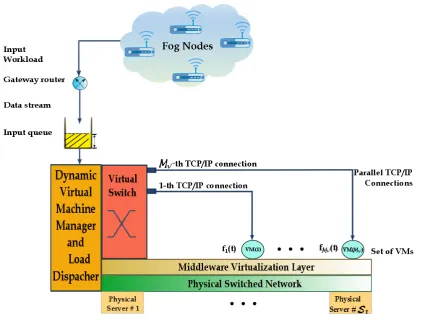
In order to understand the FDC structure over SVF scenario, we modeled it in Fig. 3. We 82
understand that, each FN sends the coming traffic through the router gateway to the load dispatcher 83
and transfer the traffic to the available virtual machines (VMs) running on the servers for the processing. 84
We need to minimize the computation cost in each server as well as decreasing the inter-communication 85
TCP/IP connection cost between VMs. IN this model, virtual machine manager is responsible for 86
the resource allocation and VM management. Therefore, we need to propose an efficient scheduling 87
method for this resource management problem. To cope with this problem, firstly, we formulate a 88
stochastic programming problem with the considerations of uncertainties in FNs. We propose a general 89
algorithm to solve the simple problem engaged in FDC and give some results. Due to the possible 90
high number of involved VCs, RSU, and hosted VMs, we require that the resulting adaptive scheduler 91
allows scalable and distributed implementation in the emerging paradigm of the cognitive computing. 92
3.1. StreamVehicularFog virtualized TCP/IP communication model 93
Reporting Fig.3, the master functional block of our considered FDC is the intra-communication 94
part. FDC operates at Middleware layer and is composed by: i) an Admission Control Server (ACS) 95
that is considered also as gateway Internet router, ii) an input buffer of the admitted workload (where 96
our corresponding resource scheduler adaptively performs the control and allocation admission of the 97
available virtual resources) shared by the VMs, iii) the Load Dispacher that reconfigure and consolidate 98
the available computing/networking physical resources, dispatching the workload buffered by the 99
input/queue to the turned ON VMs that processes the currently assigned task by self-managing 100
guarantee the demand of the local virtualized computation and communication virtual resources, 101
Figure 3.FDC Structure over StreamVehicularFog scenario.
avoidance state) protocol as an effective means to manage the end-to-end transport connections, 103
allowing the internal VM communication. 104
3.2. StreamVehicularFog computing model 105
We consider the most general case composed by multiple reconfigurable VMs per physical server 106
interconnected by a switched rate-adaptive virtual LAN (VLAN), managed by the controller, named 107
StreamVehicularFog Manager (SVFM), with the following parameters: 108
• ST
4
=total number of physical server withST≥1;
109
• V Mmax(s)
4
=maximum number of VMs (possibly, heterogeneous) hosted by thes−th physical 110
server with 111
V Mmax(s)≥1, s=1, . . . ,ST;
112
• V M(s;v)=4v−th VM hosted by thes−th server, 1≤v≤ V Mmax(s), 1≤s≤ ST;
113
• Msv
4
= total number of VMs in the data center that is calculated as: ST
∑ s=1
V Mmax(s) ≡
114
ST× V Mmax. Formally,Msvis the set of the available VMs which may be hosted by the FDC.
115
116
Moreover, the engaged internal parameters for the server of FDC is presented as follows: 117
• M(t)=4set of the VMs which are turned-ON at(t)time slot 118
(t)⊆ {(s;v); 1≤s≤ ST; 1≤v≤ V Mmax(s)}
119
• M(t)=4set of the VMs which are turned-OFF at(t)⊆ {(s;v); 1≤s≤ ST; 1≤v≤ V Mmax(s)}
120
• M(t)≡ {(s;v); 1≤s≤ ST; 1≤v≤ V Mmax(s)}/M(t);
122
• fs,v(t)
4
=processing rate of VM(s;v) att∈[0, fsmax,v ](IU/s), 1≤s≤ ST, 1≤v≤ V Mmax(s);
123
• Ls,v(t)
4
=workload processed by VM(s;v) att∈[0, Lmax
s,v ](IU), 1≤s≤ ST, 1≤v≤ V Mmax(s);
124
• fs,v
4
=maximum processing rate of VM(s;v),(IU/s), 1≤s≤ ST, 1≤v≤ V Mmax(s);
125
• Lmax s,v
4
= tslotfsmax,v
4
= maximum workload processed by VM(s;v) during each time slot (t); in 126
(IU), 1≤s≤ ST, 1≤v≤ V Mmax(s);
127
Lmax
s,v ≤tslotfsmax,v .
128
Lett∈ T be a consolidation instant. Each slottcan be considered as the following states: 129
1. turn-ON some physical servers which were turned-OFF at slott; 130
2. turn-OFF some physical servers which were turned-ON at slott; 131
3. turn-ON or turned-OFF some VMs hosted by servers which were turned-ON at slot(t−1)and 132
are still turned-ON at slott; 133
4. scaling up/down the processing rates and workloads of some VMs which are turned-ON at slot 134
t. 135
According the aforementioned engaged parameters, the following actions should be made to 136
manage the problem applicable in the real environment: Let: fON(IU/s)be the minimum practical
137
processing rate allowed a turned-ON VMs andM(t)≡ {(s;v): fs,v(t)> fON; 1≤s≤ ST; 1≤v≤
138
V Mmax(s)}andM(t)≡ {(s;v): fs,v(t)≤ fON; 1≤s≤ ST; 1≤v≤ V Mmax(s)}.
139
3.3. Energy models 140
LetEidle
c (s)[J], andEcmax(s)[J]1 ≤s ≤ ST, be the energies wasted by thes−th physical server
141
in the idle (inactive) state and we haveEidle
c (s) ≤ Ecmax(s)and the TCP/IP intra-connection inside
142
the FDC can be considered under Fast/Giga Ethernet with the practical ranges of values forΩcs,vas
143
bandwidth power coefficient in[Joule/(IU)γ], andR
max as end-to-end band-witch rate in([IU/sec])
144
as follows: 145
• Fast Ethernet: 1.1×10⁻³≤Ωc
s,v≤1.8×10⁻³,Rmax=100
146
• Giga Ethernet: 1.8×10⁻³≤Ωc
s,v≤2.5×10⁻²,Rmax=1000.
147
The corresponding communication energy ELAN
s,v [J] wasted by the s-th virtual link is: EsLAN,v ≡
148
ELAN
s,v (Ls,v) =Ωcs,v(Ls,v)γ[J], 1≤v≤ V Mmax(s); s=1, . . . ,ST.
149
When the VMs hosted per physical server are perfectly isolated, the resulting model for the overall wasted computing energy simplifies to the following formula:
ET(t) =EC(t) +ES(t) +EN(t) [J]: where,EC(t)is the SVF computing energy;ES(t)is the SVF energy
switching; and,EN(t)is the SVF TCP/IP communication energy. Therefore, theETfor slottis defined
as
ET(t) =
ST
∑
s=1 E idle c (s)
V Mmax(s)
∑
v=1
fs,v(t)
+
Emax
c,v (s)− Ecidle,v (s) V Mmax(s)
!
V Mmax(s)
∑
v=1
fs,v(t)
fmax s,v
!w
+ ke
V Mmax(s)
∑
v=1
(fs,v(t)−fs,v(t−1))2
+
V Mmax(s)
∑
v=1
Ωc
s,v(Ls,v)γ(t)
wheret∈ T,t≥1;γis the powered model for the per-transport layer connections energy holds for
energy instantt;Ω−is the common energy consumptions of all LAN (TCP/IP) connection measured [Joule/(IU)γ]andw≥2 does strictly convex in f
s,v(t). Therefore, the general optimization problem
can be simplified as
min{ET(t)}, (2.1)
subjected to:
LT(t)−
ST
∑
s=1
V Mmax(s)
∑
v=1
Ls,v(t)
=0, (2.2)
Ls,v(t)−tslotfsmax,v ≤0, ∀s,v∈ V M(s;v), (2.3) fs,v(t)−fsmax,v ≤0, ∀s,v∈ V M(s;v). (2.4)
wheretslotis the hard deadline considered to process each slot, in fact, it can be considered as the
150
service lever agreement for the mobile application requested from VFC. The workload processed 151
should not be more than input workload in each time slot(t)(see eq.(2.2)), and the frequency of each 152
VMs should not be more than the maximum frequency (see eqs.(2.3) and (2.4)). 153
Algorithm 1Pseudo-code heuristic solution for eq.2.
INPUT: ST, ˆS,Msv,LT,fsmax,v ,Ecidle,v ,Emax,T
OUTPUT: ET, ˆS(t),M(t)
1: fort≥1do t∈T 2: Check feasibility ofinput 3: forit=1 :Msvdo
4: ifL(t)≤ fsmax,v tslotthen
5: fs,v(t) =L(t)/tslot;
6: .Update set of servers ˆS(t)with 0 penalty;
7: Find the minimumEidle
c,v (t)in ˆS(t);
8: if(f lag(t) ==1)then
9: .decrease the penalty (-1) in all the servers withpenalty≥1;
10: end if
11: .add new VM into the ˆS(t);
12: end if
13: end for
Update ˆS(t)andM(t)throughV M(s;v); CalculateE(t)as in (1);
14: end for
15: returnET, ˆS(t),M(t)
In order to resolve the problem, we can consider the problem as abin packing penalty-aware 154
problem. Algorithm 1presents the pseudocode of the proposed solution. Indeed, in turn, for each 155
incoming workloadLT(t)we calculate how many VMs can be allocated fort-th slot. After that, we
156
consider servers as bins and VMs as packs that must be served distributively based on their time 157
limitations and frequency limitations. For each iterationit, we give a penalty to each server based on 158
their energy characteristics (idle energy, maximum energy, maximum frequency) and look for the best 159
servers to be allocated. The penalty is considered in order to decrease the fatality cases (increasing 160
the energy consumptions exponentially). It means, the server will be punished and banned to be 161
used again in nextit. When the freezing iterationsn-th for the server passed, the server will back to 162
the list of available servers for the nextit. Note that, serverScan serve VMs when it does not pass 163
the maximum number of VMsV Mmax(s). Otherwise, serverSputs out from the list of processing
164
servers. The maximum interactions is definedMs,v. The process is done for each time slottuntil all
the incoming workloads will be served. At last, we calculate the energy consumption components of 166
the optimization problem for each slott. 167
4. Performance Evaluation 168
In this section, we aim to test the proposed method on FDC. 169
4.1. Test Scenario 170
In order to guarantee the accuracy and timeliness of information transmission of the VCs. It is 171
necessary to analyze and act on the data in less than a second. Data are sent to the Cloud for historical 172
analysis, BD analytics, and long-term storage with less latency. For example, each of thousands or 173
hundreds of thousands of FNs might send periodic summaries of data grid to the Cloud for historical 174
analysis and storage. 175
In order to confirm the correctness of the proposed infrastructure in Fig.1, we require an evaluation 176
for exploring several resource management and scheduling techniques such as operator, application 177
and task placement and consolidation. We make some evaluations of resource management policies 178
applicable to Fog environment with respect to their impact on latency, network usage, and energy 179
consumption. In this framework, the VCs publish data to SVF, applications run on Fog devices (FN) 180
to process data coming from VCs. Indeed, it is important to test the solution with real-world input 181
workload and compare it with the corresponding ones of the recent FDC-based techniques. So in the 182
next subsection, we will move to this issue and we will specify it with several simulated testbed cases. 183
4.2. Test Result 184
In this subsection, we aim to test our scheduler on 100 incoming data stream (T=100) for Fast 185
Ethernet communication channel and calculate the on-line instantaneous overall energy consumption 186
and energy savings that is shown in Fig.4. From this figure, we conclude that the total energy cost in 187
changing by the time and even it has effect on its correlated saving energy per time. 188
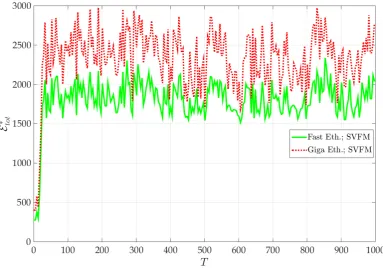
On the other hand, in order to evaluate the instantaneous energy consumption for 1000 slots 189
using two different scheme of the communication network (Fast and Giga) we evaluate the energy 190
consumptions of Fast/Giga Ethernet of SVF scenario. The results of these comparisons are presented 191
in Figs.5. We understand that when theΩcs,vincreases the correlated energy consumption rises with
192
the same scale due to rising the communication constant and this changing continues due to time. 193
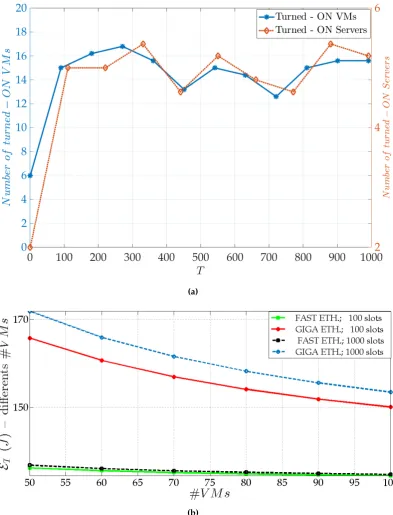
Finally, in the last test scenario, the plots of Fig.6areport the time-behaviours of the numbers 194
of VMs and physical servers that are dynamically turned ON by our algorithm scheduler under the 195
real-world workload of Fig.2. A comparison of the plots of Fig. 6awith the arrival trace of Fig. 2 196
supports the conclusion that the consolidation action performed by the proposed algorithm is capable 197
to track the abrupt (and unpredicted) changes of the input workload with a delay of 1 slot period. 198
5. Conclusion and Future Developments 199
The ability of Fog Computing is never-ending. It has the potential to solve many problems in 200
different fields that are still unexplored such as context-aware data produce/transfer in vehicular 201
networks. Fog computing over the vehicular networks is a platform that offers real-time services 202
to the clients. In this paper, we study one of the most significant issues of FC which aims to focus 203
on the Fog data center data streams which are requested from the vehicular clients. We proposed 204
a holistic VFC architecture, focus on the FDC data streams and formulate the problem analytically 205
and resolve the presented resource allocation and scheduling algorithm over a simplified cases study 206
called StreamVehicularFog (SVF). In this regard, the SVF simulations in both small and large scales 207
confirmed the considerable reduction on the average energy cost that can be achieved by scheduling 208
in mobile edge fog of SVF. We test the presented case study with various test scenarios and confirm 209
the energy efficiencies. The energy-efficient adaptive management of the delay-vs.-throughput trade 210
Figure 4.Energy saving of SVF (dashed plot) and energy consumption of the SVF (continuous plot) for the Fast Ethernet LAN forT=100.
(a)
(b)
Figure 6.Fig.6a: Behaviour time of number of turned-ON VMs and physical servers, and Fig. 6b: Average total energy inT=1000, respectively.
6. Acknowledgement 212
This work has been partially supported by the PRIN2015 project with grant number 213
2015YPXH4W_004: ”A green adaptive FC and networking architecture (GAUChO)”, funded by 214
the Italian MIUR and by the project ”Vehicular Fog energy efficient QoS mining and dissemination of 215
References 217
1. Karagiannis, G.; Altintas, O.; Ekici, E.; Heijenk, G.; Jarupan, B.; Lin, K.; Weil, T. Vehicular networking: 218
A survey and tutorial on requirements, architectures, challenges, standards and solutions. IEEE
219
Communications Surveys & Tutorials2011,13, 584–616. 220
2. Naranjo, P.G.V.; Pooranian, Z.; Shojafar, M.; Conti, M.; Buyya, R. FOCAN: A Fog-supported Smart City 221
Network Architecture for Management of Applications in the Internet of Everything Environments. arXiv
222
preprint arXiv:1710.018012017. 223
3. Bonomi, F.; Milito, R.; Zhu, J.; Addepalli, S. Fog computing and its role in the internet of things. Proceedings 224
of the first edition of the MCC workshop on Mobile cloud computing. ACM, 2012, pp. 13–16. 225
4. Büsching, F.; Schildt, S.; Wolf, L. DroidCluster: Towards Smartphone Cluster Computing–The Streets are 226
Paved with Potential Computer Clusters. 2012 32nd International Conference on Distributed Computing 227
Systems Workshops. IEEE, 2012, pp. 114–117. 228
5. Bitam, S.; Mellouk, A.; Zeadally, S. VANET-cloud: a generic cloud computing model for vehicular Ad Hoc 229
networks. IEEE Wireless Communications2015,22, 96–102. 230
6. Mtibaa, A.; Fahim, A.; Harras, K.A.; Ammar, M.H. Towards resource sharing in mobile device clouds: 231
Power balancing across mobile devices. ACM SIGCOMM Computer Communication Review. ACM, 2013, 232
Vol. 43, pp. 51–56. 233
7. Chen, M.; Zhang, Y.; Li, Y.; Mao, S.; Leung, V.C. EMC: emotion-aware mobile cloud computing in 5G.IEEE
234
Network2015,29, 32–38. 235
8. Skala, K.; Davidovic, D.; Afgan, E.; Sovic, I.; Sojat, Z. Scalable distributed computing hierarchy: Cloud, fog 236
and dew computing.Open Journal of Cloud Computing (OJCC)2015,2, 16–24. 237
9. Vaquero, L.M.; Rodero-Merino, L. Finding your way in the fog: Towards a comprehensive definition of fog 238
computing. ACM SIGCOMM Computer Communication Review2014,44, 27–32. 239
10. Tang, B.; Chen, Z.; Hefferman, G.; Wei, T.; He, H.; Yang, Q. A hierarchical distributed fog computing 240
architecture for big data analysis in smart cities. Proceedings of the ASE BigData & SocialInformatics 2015. 241
ACM, 2015, p. 28. 242
11. Aazam, M.; Huh, E.N. Fog computing and smart gateway based communication for cloud of things. 243
Future Internet of Things and Cloud (FiCloud), 2014 International Conference on. IEEE, 2014, pp. 464–470. 244
12. Barbera, M.V.; Kosta, S.; Mei, A.; Perta, V.C.; Stefa, J. Mobile offloading in the wild: Findings and lessons 245
learned through a real-life experiment with a new cloud-aware system. IEEE INFOCOM 2014-IEEE 246
Conference on Computer Communications. IEEE, 2014, pp. 2355–2363. 247
13. Urgaonkar, B.; Pacifici, G.; Shenoy, P.; Spreitzer, M.; Tantawi, A. Analytic modeling of multitier internet 248