Weak Deflection angle of some classes of non-linear electrodynamics black holes via
Gauss-Bonnet Theorem
H. El Moumni,1,∗ K. Masmar,2,† and Ali ¨Ovg ¨un3,‡
1EPTHE, Physics Department, Faculty of Science, Ibn Zohr University, Agadir, Morocco.
2Laboratory of High Energy Physics and Condensed Matter Hassan II University, Faculty of Science Ain Chock, Casablanca, Morocco. 3Physics Department, Faculty of Arts and Sciences, Eastern Mediterranean University, Famagusta, North Cyprus, via Mersin 10, Turkey
(Dated: August 15, 2020)
In this paper, we study the gravitational lensing by some black hole classes within the non-linear electrodynamics in weak field limits. First, we calculate an optical geometry of the non-linear elec-trodynamics black hole then we use the Gauss-Bonnet theorem for finding deflection angle in weak field limits. The effect of non-linear electrodynamics on the deflection angle in leading order terms is studied. Furthermore, we discuss the effects of the plasma medium on the weak deflection angle.
PACS numbers: 04.70.Dy, 95.30.Sf, 97.60.Lf
Keywords: Weak Deflection Angle; Gauss-Bonnet theorem; Nonlinear electrodynamics; Gravitational lensing.
I. INTRODUCTION
Einstein’s general theory of relativity [1] is considered as the most beautiful and elegant theory of the last century. This theory has passed several tests with spectacular successes showing this compatibility with experimental obser-vations since 1920 [2], when Dyson, Eddington and Davidson have measured the gravitational bending of light by the Sun. A quote of years ago, other huge experiments also unveil the predictions of such a theory one can cite the detection of the gravitational waves [3] and the realization of the first black hole image in M87 galaxy announced by Event Horizon Telescope (EHT) [4,5]. One of the key phenomena predicted by the gravitation theory is the ”gravita-tional lensing” which can be interpreted by the ability of gravity to bend light. Such phenomena have been observed many times and it has been established as one of the powerful tools in astronomy and cosmology especially for investigation of the dark sector of our universe [6]- [31].
As of late, Gibbons and Werner [32] changed the standard perspective identified with the manner in which we ordinarily evaluate the deflection angle. They demonstrated that one can compute the deflection angle in a very elegant manner; Specifically, they have utilized the Gauss-Bonnet theorem (GBT) with regards to optical geometry. It is important to note that in this method, the deflection of photon can be seen as a global effect. One can focus only on a nonsingular area outside of the photon ray. This method is applied on various black holes [33]-[73] and wormholes [74–83] to find the weak deflection angle.
In the framework of Gravitation theory, one can discover peculiarity of singularity–free solutions of the Einstein field equations coupled to suitable nonlinear electrodynamics (NLED), which in the weak field limit reduces to the ordinary linear Maxwell theory. In in this context NLED charged black hole solutions were derived and discussed in a number of works [84]-[118]. Initially, the NLED was elaborated by Born and Infeld’s to expel the central singularity of a point charge and the related energy divergence by generalizing Maxwell’s theory [93]. Then, the enthusiasm for NLED in current studies is to an enormous degree roused by the discovery that some kinds of NLED appear as limiting cases of certain models of string theory [87,88].
Here, the main aim of the paper is to contribute to such interest area of gravitational physics by recalling the Gauss-Bonnet theorem to evaluate the the deflection angle of two class of black hole solutions of gravity coupled to nonlinear electrodynamics. These calculations are elaborated in the vacuum and by considering a plasma medium.
This paper is organized as follows, after a concise introduction of the black hole solutions we compute their optical metrics and the Gaussian optical curvatures. After what and by the help of the GBT, the deflection angle of light for such black holes configuration is computed. In section Sec.3, we observe the graphically the variation bahaviour of the deflection angle in non-plasma and plasma medium and make a comparison between both mediums, then we briefly summarize our results.
∗
Electronic address:[email protected] †Electronic address:[email protected]
‡Electronic address:[email protected];https://www.aovgun.com
II. COMPUTATION OF WEAK LENSING BY NON LINEAR ELECTRODYNAMICS BLACK HOLE WITHIN THE GAUSS-BONNET THEOREM
Our starting point is the following action in which gravity is coupled to nonlinear electrodynamics fields [117,118] S= 1
16π
Z
d4x√−g[R−4πL(F)], (1) whereRdenotes the scalar curvature andL(F)is a function of the invariantF := 1
4FµνF
µν andF˜ := 1 4Fµν? F
µν
built form Faraday tensorF=12Fµνdxµ∧dxνand its Hodge dual?F. In this paper, we will deal with the non-linear
electrodynamics termsL(F)are explicitly given by [117,118]
L(F) =
8M3F(6M(−2F)14+√Q−2M Q(−2F)34
√
Q(2M+Q32(−2F)41+2M Q(−2F)12)3 NLED1
3M
|Q|3
(2Q2F)3/2
[1+(2Q2F)3/4]2 NLED2,
(2)
in whichM andQare the mass and charge of black holes respectively. Herein, we would like to deal with static and spherical symmetric black hole given by the following ansatz
dt2=−f(r)dt2+ dr
2
f(r)+r
2(dθ2+ sinθdφ2),
(3) where the metric functions written as [117,118]
f(r) =
(1
− 2M r r2+Q2
2Mr+Q2
NLED1
1− 2M r2
r3+Q3 NLED2.
(4)
In order to consider the Gauss-Bonnet theorem [32], we introduce the optical space simply written in equatorial plane(θ=π2)to get null geodesics (ds2= 0) as
dt2=gijoptdxidxj= dr
2
f(r)2+
r2dφ
f(r). (5)
The Gaussian optical curvatureKwhich is an intrinsic property of spacetime and which corresponds to the optical metric is related to its Ricci scalarRvia the following formula
K= R
2, where R=
−f0(r)2
2 +f
00(r)f(r).
(6) Recalling the both expressions off(r), the Gaussian optical curvature is given explicitly by
K ≈
3Qr42 +
−2r−3+ 6Q2 r5
M NLED1
−2r−3+ 20Q3 r6
M NLED2. (7)
Now, by utilizing Gauss-Bonnet Theorem (GBT), we evaluate the deflection angle of photon by such black holes. Using GBT in the regionGR, given as
Z
GR
KdS+
I
∂GR
kdt+X t
ˆ
α= 2πX(GR) (8)
in which,krepresent the geodesic curvature,Kis for the Gaussian optical curvature as well as the geodesic curvature kis written ask= ¯g(∇αˆα,ˆ αˇ)so that¯g( ˆα,αˆ) = 1, in whichαˆis the unit acceleration vector andαtis for the exterior
angle attthvertex respectively. ForR → ∞,the jump angles equal toπ/2, so thatα
O+αS →π. Here,X(GR) = 1
stands for a Euler characteristic number andGRis the nonsingular domain. Then we find that
Z Z
GR
KdS+
I
∂GR
where, the total jump angle isαˆ=π, WhenR → ∞, then the remaining part iskDR =|∇D˙R ˙
DR|radial component
for geodesic curvature:
(∇D˙R
˙
DR)r= ˙DφR∂φD˙rR+ Γ r φφ( ˙D
φ R)
2
(10) At very highR,DR :=r(φ) =R=const. Hence, we write that the leading term of equation Eq.(10) vanishes and
( ˙DRφ)2= 1
f(r?). RecallingΓ r φφ=
2f(r)−rf0(r)
2rf(r) , we get(∇D˙R ˙
DR)r= R1 and which proves that the geodesic curvature is
not effected to the topological defects. We can writedt=Rdφ. Thus;k(DR)dt=dφ. From the previous results, we get
Z Z
GR
KdS+
I
∂GR
kdtR→∞=
Z Z
S∞ KdS+
Z π+α
0
dφ. (11)
At0thorder, weak field deflection limit of the light is defined asr(t) =b/sinφ. Consequently , the deflection angle
can now expressed as as:
α=− Z π
0
Z ∞
b/sinφ
Kpdet ¯gdudφ. (12)
here we put the leading term of Eq.(7) into above Eq.(12), so the obtained deflection angle up to leading order term is computed as:
α≈ (
4M
b −3/4 Q2π
b2 −8/3
Q2M
b3 NLED1
4Mb −15M π Q8b4 3 NLED2
(13)
While we can immediately see that the charge term decreases the deflection angle in the both classes.
Lensing in a vacuum does not involve dispersive proprieties of a photon. Furthermore, lenses are usually besieged [31] by plasma, which discloses a nontrivial component for the deflection angle. Gravitational deflection in a plasma medium encourages refraction including more deflection such that the information is encoded in the refraction index [23].
In order to encompass the effects of plasma, we suppose that the photon travels from vacuum to a hot, ionized gas medium, where thev is the speed of light through the plasma. Then we can write the refractive index,n(r)as follows:
n(r)≡ v c =
1
dr/dt, {∵c= 1}. (14) The refractive indexn(r)for such black hole is obtained as [33]
n(r) =
s
1− ω
2
e
ω2 ∞
f(r), (15)
whereωeis the electron plasma frequency, andω∞is the photon frequency measured by an observer at infinity. The
line element figured in equation Eq.(3) take a new form given by dt2=goptij dxidxj =n2(r)
dr2
f(r)2 +
r2dφ f(r)
. (16)
Taking account into the plasma medium the Gaussian optical curvatures Eq.(7) become Kp≈
(
5Q2ωe2 r4ω∞2 + 3
Q2 r4 −5
M Q2ωe2 ω∞2r5 + 6
Q2M r5 −3
M ωe2
ω∞2r3 −2Mr3 NLED1 36M Q3ωe2
r6ω∞2 + 20 M Q3
r6 −3 M ωe2 r3ω∞2 −2
M r3 −156
M2Q3ωe2 r7ω∞2 −36
M2Q3 r7 + 12
M2ω
e2 r4ω∞2 + 3
M2
r4 NLED2
(17)
By the help of the Gauss-Bonnet-theorem, one can express the deflection angle of such black hole classes within the plasma medium as
αplasma≈
(
4Mb −8/3Qb23M −3/4
Q2π
b2 −5/4
Q2ω
e2π b2ω∞2 +
20M Q2ω
e2
9b3ω∞2 + 6
M ωe2 bω∞2 NLED1
4M
b −
15M Q3π
8b4 +
27M Q3ωe2π
8b4ω∞2 + 6
M ωe2
bω∞2 NLED2
III. CONCLUSION
Having obtained the expressions of the deflection angle for each black hole classes in the vacuum and plasma medium and to illustrate graphically the the effect on nonlinear electrodynamics on such quantity, we depict in the figure Fig.1the variation of the deflection angleαversus the impact parameterb
0 5 10 15 20
0 5 10 15 20
Impact parameter b
Deflection
angle
α
NLED1
Q
0 1 2 3 4 5 6
0 5 10 15 20
0 5 10 15 20
Impact parameter b
Deflection
angle
α
NLED2
Q
0 1 2 3 4 5 6
FIG. 1:The relation between the deflection angleαand the parameter impactbfor each black hole class, within different values of the chargeQ. The green line is associated with the vanishing chargeQ= 0. In both panels, we have setM= 10.
From Fig.1, one can easily see that, for both varieties of the nonlinear electrodynamics black hole solution, the deflection angleαpresents a maximum at
bmax,1=
3πQ2+p
512M2Q2+ 9π2Q4
16M and bmax,2=
1 2
3 √
15πQ (19)
respectively, then decrease gradually and go to positive infinity. Comparing the deflection anglesα, one can notice that theαassociated withN LED1class is more important than theN LED2one. Another important remark is that the maximumbmax,2depends only on the charge whilebmax,1is controlled by the massM and the chargeQ. In the
vanishing limit of chargeQ= 0(green line) we recover the Schwarzschild [] behaviour, where the deflection angle is initially exponentially decreasing and then goes to positive infinity.
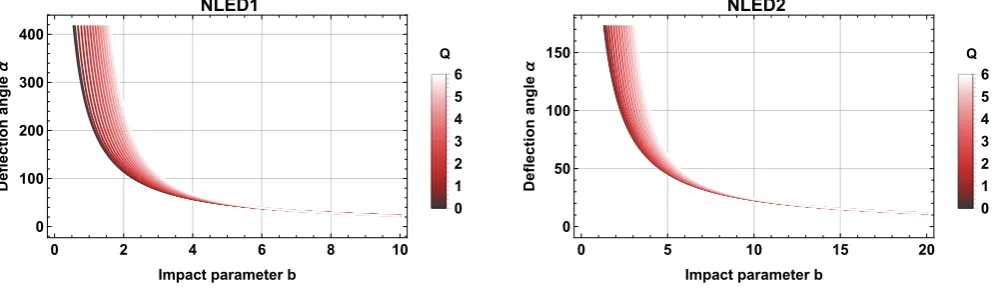
To unveil the effect of the plasma medium on the deflection angles of such black hole solutions, we depict in the figure Fig.2the variation ofαin terms of the parameter impactb.
0 2 4 6 8 10
0 100 200 300 400
Impact parameter b
Deflection
angle
α
NLED1
Q
0 1 2 3 4 5 6
0 5 10 15 20
0 50 100 150
Impact parameter b
Deflection
angle
α
NLED2
Q
0 1 2 3 4 5 6
One can notice from this figure that the situation is quite different from the vacuum medium. Herein in the plasma medium, the maximum point disappears and the decreasing behaviour takes place: the deflection angle is initially exponentially decreasing and then goes to positive infinity. However, by the help of deflection angle expression Eq.(18), one can see that the value deflection angle increases within the introduction of the plasma medium.
In this work, we have investigated the weak gravitational lensing in the framework of nonlinear electrodynamics black hole solutions. For this end, we have considered the photon rays into the equatorial plane. Then we have calculated the associating optical metric and the Gaussian optical curvature. By these quantities and the Gauss-Bonnet theorem we derive the expression of the deflection angle for each black hole background in vacuum and in plasma medium. We have also probed graphically the variation of the black hole deflection angle in terms of the impact parameterband within the charge and the plasma medium. We plan in the near future to extend our study using the Gauss-Bonnet theorem to other black hole and dark object configurations.
[1] A. Einstein, “The Foundation of the General Theory of Relativity,” Annalen Phys.49, no.7, 769-822 (1916).
[2] F. W. Dyson, A. S. Eddington and C. Davidson, “A Determination of the Deflection of Light by the Sun’s Gravitational Field, from Observations Made at the Total Eclipse of May 29, 1919,” Phil. Trans. Roy. Soc. Lond. A220, 291-333 (1920).
[3] B. P. Abbottet al.[LIGO Scientific and Virgo], “GW150914: The Advanced LIGO Detectors in the Era of First Discoveries,” Phys. Rev. Lett.116, no.13, 131103 (2016).
[4] B. P. Abbottet al.[LIGO Scientific and Virgo], “Observation of Gravitational Waves from a Binary Black Hole Merger,” Phys. Rev. Lett.116, no.6, 061102 (2016).
[5] K. Akiyamaet al.[Event Horizon Telescope], “First M87 Event Horizon Telescope Results. I. The Shadow of the Supermas-sive Black Hole,” Astrophys. J.875, no.1, L1 (2019).
[6] M. Bartelmann and P. Schneider, “Weak gravitational lensing,” Phys. Rept.340, 291 (2001).
[7] K.S. Virbhadra and G. F. R. Ellis, “Schwarzschild black hole lensing,” Phys. Rev. D62, 084003 (2000). [8] K.S. Virbhadra, “Relativistic images of Schwarzschild black hole lensing,” Phys. Rev. D79, 083004 (2009). [9] M. Bartelmann, “Gravitational Lensing,” Class. Quant. Grav.27, 233001 (2010).
[10] C. R. Keeton, C. S. Kochanek and E. E. Falco, “The Optical properties of gravitational lens galaxies as a probe of galaxy structure and evolution,” Astrophys. J.509, 561-578 (1998).
[11] V. Bozza, “Gravitational lensing in the strong field limit,” Phys. Rev. D66, 103001 (2002). [12] V. Bozza, “Gravitational Lensing by Black Holes,” Gen. Rel. Grav.42, 2269-2300 (2010).
[13] K. Takizawa, T. Ono and H. Asada, “Gravitational lens without asymptotic flatness,” [arXiv:2006.00682 [gr-qc]].
[14] S. b. Chen and J. l. Jing, “Strong field gravitational lensing in the deformed Horava-Lifshitz black hole,” Phys. Rev. D80, 024036 (2009).
[15] E. F. Eiroa, G. E. Romero and D. F. Torres, “Reissner-Nordstrom black hole lensing,” Phys. Rev. D66, 024010 (2002). [16] A. Bhadra, “Gravitational lensing by a charged black hole of string theory,” Phys. Rev. D67, 103009 (2003). [17] R. Whisker, “Strong gravitational lensing by braneworld black holes,” Phys. Rev. D71, 064004 (2005).
[18] M. Sharif and S. Iftikhar, “Strong gravitational lensing in non-commutative wormholes,” Astrophys. Space Sci.357, no.1, 85 (2015).
[19] A. Edery and M. B. Paranjape, “Classical tests for Weyl gravity: Deflection of light and radar echo delay,” Phys. Rev. D58, 024011 (1998).
[20] K. Nakajima and H. Asada, “Deflection angle of light in an Ellis wormhole geometry,” Phys. Rev. D85, 107501 (2012). [21] W. G. Cao and Y. Xie, “Weak deflection gravitational lensing for photons coupled to Weyl tensor in a Schwarzschild black
hole,” Eur. Phys. J. C78, no.3, 191 (2018).
[22] C. Y. Wang, Y. F. Shen and Y. Xie, “Weak and strong deflection gravitational lensings by a charged Horndeski black hole,” JCAP04, 022 (2019).
[23] G. S. Bisnovatyi-Kogan and O. Y. Tsupko, “Gravitational Lensing in Presence of Plasma: Strong Lens Systems, Black Hole Lensing and Shadow,” Universe3, no.3, 57 (2017).
[24] G. S. Bisnovatyi-Kogan and O. Y. Tsupko, “Gravitational lensing in a non-uniform plasma,” Mon. Not. Roy. Astron. Soc. 404, 1790-1800 (2010).
[25] O. Y. Tsupko and G. S. Bisnovatyi-Kogan, “Gravitational lensing in plasma: Relativistic images at homogeneous plasma,” Phys. Rev. D87, no.12, 124009 (2013).
[26] G. S. Bisnovatyi-Kogan and O. Y. Tsupko, “Gravitational Lensing in Plasmic Medium,” Plasma Phys. Rep.41, 562 (2015). [27] C. Bambi, K. Freese, S. Vagnozzi and L. Visinelli, “Testing the rotational nature of the supermassive object M87* from the
circularity and size of its first image,” Phys. Rev. D100, no.4, 044057 (2019).
[28] P. V. P. Cunha and C. A. R. Herdeiro, “Shadows and strong gravitational lensing: a brief review,” Gen. Rel. Grav.50, no.4, 42 (2018).
[29] P. V. P. Cunha, C. A. R. Herdeiro and E. Radu, “EHT constraint on the ultralight scalar hair of the M87 supermassive black hole,” Universe5, no.12, 220 (2019).
[31] X. Er and S. Mao, “Effects of plasma on gravitational lensing,” Mon. Not. Roy. Astron. Soc.437, no.3, 2180-2186 (2014). [32] G. W. Gibbons and M. C. Werner, “Applications of the Gauss-Bonnet theorem to gravitational lensing,” Class. Quant. Grav.
25, 235009 (2008).
[33] G. Crisnejo and E. Gallo, “Weak lensing in a plasma medium and gravitational deflection of massive particles using the Gauss-Bonnet theorem. A unified treatment,” Phys. Rev. D97, no.12, 124016 (2018).
[34] K. Jusufi, I. Sakalli, and A. ¨Ovg ¨un, “Effect of Lorentz Symmetry Breaking on the Deflection of Light in a Cosmic String Spacetime,” Phys. Rev. D96, no.2, 024040 (2017).
[35] A. ¨Ovg ¨un, K. Jusufi, and I. Sakalli, “Gravitational lensing under the effect of Weyl and bumblebee gravities: Applications of Gauss–Bonnet theorem,” Annals Phys.399, 193-203 (2018)
[36] K. Jusufi and A. ¨Ovg ¨un, “Effect of the cosmological constant on the deflection angle by a rotating cosmic string,” Phys. Rev. D97, no.6, 064030 (2018).
[37] K. Jusufi, M. C. Werner, A. Banerjee, and A. ¨Ovg ¨un, “Light Deflection by a Rotating Global Monopole Spacetime,” Phys. Rev. D95, no.10, 104012 (2017).
[38] A. ¨Ovg ¨un,“Weak field deflection angle by regular black holes with cosmic strings using the Gauss-Bonnet theorem,” Phys. Rev. D99, no.10, 104075 (2019).
[39] W. Javed, R. Babar, and A. ¨Ovg ¨un, “Effect of the dilaton field and plasma medium on deflection angle by black holes in Einstein-Maxwell-dilaton-axion theory,” Phys. Rev. D100, no.10, 104032 (2019)
[40] W. Javed, J. Abbas, A. ¨Ovg ¨un, “Deflection angle of photon from magnetized black hole and effect of nonlinear electrody-namics,” Eur. Phys. J. C79, no.8, 694 (2019).
[41] I. Sakalli and A. ¨Ovg ¨un, “Hawking Radiation and Deflection of Light from Rindler Modified Schwarzschild Black Hole,” EPL118, no.6, 60006 (2017)
[42] K. de Leon and I. Vega, “Weak gravitational deflection by two-power-law densities using the Gauss-Bonnet theorem,” Phys. Rev. D99, no.12, 124007 (2019)
[43] Z. Li and T. Zhou, “Equivalence of Gibbons-Werner method to geodesics method in the study of gravitational lensing,” Phys. Rev. D101, no.4, 044043 (2020)
[44] A. ¨Ovg ¨un, I. Sakalli, and J. Saavedra, “Weak gravitational lensing by Kerr-MOG black hole and Gauss–Bonnet theorem,” Annals Phys.411, 167978 (2019)
[45] A. ¨Ovg ¨un, I. Sakalli, and J. Saavedra, “Shadow cast and Deflection angle of Kerr-Newman-Kasuya spacetime,” JCAP10, 041 (2018)
[46] K. Jusufi and A. ¨Ovg ¨un, “Light Deflection by a Quantum Improved Kerr Black Hole Pierced by a Cosmic String,” Int. J. Geom. Meth. Mod. Phys. 16, no. 08, 1950116 (2019).
[47] R. Kumar, S. U. Islam and S. G. Ghosh, “Gravitational lensing by Charged black hole in regularized4D Einstein-Gauss-Bonnet gravity,” [arXiv:2004.12970 [gr-qc]].
[48] Y. Kumaran and A. ¨Ovg ¨un, “Weak Deflection Angle of Extended Uncertainty Principle Black Holes,” Chin. Phys. C44, no.2, 025101 (2020)
[49] R. Kumar, S. G. Ghosh and A. Wang, “Gravitational deflection of light and shadow cast by rotating Kalb-Ramond black holes,” Phys. Rev. D101, no.10, 104001 (2020)
[50] W. Javed, J. Abbas and A. ¨Ovg ¨un, “Effect of the Hair on Deflection Angle by Asymptotically Flat Black Holes in Einstein-Maxwell-Dilaton Theory,” Phys. Rev. D100, no.4, 044052 (2019)
[51] W. Javed, A. Hazma and A. ¨Ovg ¨un, “Effect of Non-Linear Electrodynamics on Weak Field Deflection Angle by Black Hole,” Phys. Rev. D101, no.10, 103521 (2020).
[52] R. Kumar, S. G. Ghosh and A. Wang, “Shadow cast and deflection of light by charged rotating regular black holes,” Phys. Rev. D100, no.12, 124024 (2019)
[53] A. Ishihara, Y. Suzuki, T. Ono and H. Asada, “Finite-distance corrections to the gravitational bending angle of light in the strong deflection limit,” Phys. Rev. D95, no.4, 044017 (2017)
[54] T. Ono, A. Ishihara and H. Asada, “Gravitomagnetic bending angle of light with finite-distance corrections in stationary axisymmetric spacetimes,” Phys. Rev. D96, no.10, 104037 (2017)
[55] T. Ono, A. Ishihara and H. Asada, “Deflection angle of light for an observer and source at finite distance from a rotating global monopole,” Phys. Rev. D99, no.12, 124030 (2019)
[56] T. Ono and H. Asada, “The Effects of Finite Distance on the Gravitational Deflection Angle of Light,” Universe5, no.11, 218 (2019).
[57] H. Arakida, “Light deflection and Gauss–Bonnet theorem: definition of total deflection angle and its applications,” Gen. Rel. Grav.50, no.5, 48 (2018)
[58] Z. Li and A. ¨Ovg ¨un, “Finite-distance gravitational deflection of massive particles by a Kerr-like black hole in the bumblebee gravity model,” Phys. Rev. D101, no.2, 024040 (2020)
[59] Z. Li, G. Zhang and A. ¨Ovg ¨un, “Circular Orbit of a Particle and Weak Gravitational Lensing,” Phys. Rev. D101, no.12, 124058 (2020)
[60] W. Javed, M. B. Khadim, A. ¨Ovg ¨un and J. Abbas, “Weak gravitational lensing by stringy black holes,” Eur. Phys. J. Plus135, no.3, 314 (2020)
[61] W. Javed, M. B. Khadim and A. ¨Ovg ¨un, “Weak gravitational lensing by Bocharova–Bronnikov–Melnikov–Bekenstein black holes using Gauss–Bonnet theorem,” Eur. Phys. J. Plus135, 595 (2020)
[62] Z. Li and J. Jia, “The finite-distance gravitational deflection of massive particles in stationary spacetime: a Jacobi metric approach,” Eur. Phys. J. C80, no.2, 157 (2020)
Gravity,” [arXiv:2001.01642 [gr-qc]].
[64] K. Takizawa, T. Ono and H. Asada, “Gravitational deflection angle of light: Definition by an observer and its application to an asymptotically nonflat spacetime,” Phys. Rev. D101, no.10, 104032 (2020)
[65] G. W. Gibbons, “The Jacobi-metric for timelike geodesics in static spacetimes,” Class. Quant. Grav.33, no.2, 025004 (2016) [66] S. U. Islam, R. Kumar and S. G. Ghosh, “Gravitational lensing by black holes in 4D Einstein-Gauss-Bonnet gravity,”
arXiv:2004.01038 [gr-qc].
[67] R. C. Pantig and E. T. Rodulfo, “Weak lensing of a dirty black hole,” arXiv:2003.00764 [gr-qc].
[68] N. Tsukamoto, “Non-logarithmic divergence of a deflection angle by a marginally unstable photon sphere of the Damour-Solodukhin wormhole in a strong deflection limit,” Phys. Rev. D101, no.10, 104021 (2020).
[69] G. Crisnejo, E. Gallo and J. R. Villanueva, “Gravitational lensing in dispersive media and deflection angle of charged mas-sive particles in terms of curvature scalars and energy-momentum tensor,” Phys. Rev. D100no.4, 044006, (2019).
[70] Kimet Jusufi, Al¨ı Ovg ¨un, and Ayan Banerjee, “Light deflection by charged wormholes in Einstein-Maxwell-dilaton theory,” Phys. Rev. D96, no.8, 084036 (2017)
[71] M. C. Werner, “Gravitational lensing in the Kerr-Randers optical geometry,” Gen. Rel. Grav.44, 3047-3057 (2012).
[72] A. Belhaj, M. Benali, A. E. Balali, H. El Moumni and S. E. Ennadifi, “Deflection Angle and Shadow Behaviors of Quintessen-tial Black Holes in arbitrary Dimensions,” [arXiv:2006.01078 [gr-qc]].
[73] K. Jusufi, A. ¨Ovg ¨un, J. Saavedra, Y. Vasquez, and P. A. Gonzalez, “Deflection of light by rotating regular black holes using the Gauss-Bonnet theorem,” Phys. Rev. D97, no.12, 124024 (2018).
[74] A. ¨Ovg ¨un, K. Jusufi, and I. Sakalli, “Exact traversable wormhole solution in bumblebee gravity,” Phys. Rev. D99, no.2, 024042 (2019).
[75] W. Javed, R. Babar, and A. ¨Ovg ¨un, “The effect of the Brane-Dicke coupling parameter on weak gravitational lensing by wormholes and naked singularities,” Phys. Rev. D99, no.8, 084012 (2019).
[76] K. Jusufi and A. ¨Ovg ¨un, “Gravitational Lensing by Rotating Wormholes,” Phys. Rev. D97, no.2, 024042 (2018).
[77] K. Jusufi, A. ¨Ovg ¨un, A. Banerjee and I. Sakalli, “Gravitational lensing by wormholes supported by electromagnetic, scalar, and quantum effects,” Eur. Phys. J. Plus134, no.9, 428 (2019).
[78] A. ¨Ovg ¨un, G. Gyulchev, and K. Jusufi, “Weak Gravitational lensing by phantom black holes and phantom wormholes using the Gauss-Bonnet theorem,” Annals Phys.406, 152-172 (2019).
[79] A. ¨Ovg ¨un, “Deflection Angle of Photons through Dark Matter by Black Holes and Wormholes Using Gauss–Bonnet Theo-rem, ” Universe 5, 115 (2019).
[80] A. ¨Ovg ¨un, “Light deflection by Damour-Solodukhin wormholes and Gauss-Bonnet theorem,” Phys. Rev. D98, no.4, 044033 (2018)
[81] Z. Li, G. He and T. Zhou, “Gravitational deflection of relativistic massive particles by wormholes,” Phys. Rev. D101, no.4, 044001 (2020)
[82] P. Goulart, “Phantom wormholes in Einstein–Maxwell-dilaton theory,” Class. Quant. Grav.35, no.2, 025012 (2018)
[83] T. Ono, A. Ishihara and H. Asada, “Deflection angle of light for an observer and source at finite distance from a rotating wormhole,” Phys. Rev. D98, no.4, 044047 (2018)
[84] A. Allahyari, M. Khodadi, S. Vagnozzi and D. F. Mota, “Magnetically charged black holes from non-linear electrodynamics and the Event Horizon Telescope,” JCAP02, 003 (2020).
[85] E. Ayon-Beato and A. Garcia, “Regular black hole in general relativity coupled to nonlinear electrodynamics,” Phys. Rev. Lett.80, 5056-5059 (1998).
[86] A. Belhaj, M. Chabab, H. El Moumni, K. Masmar, M. B. Sedra and A. Segui, “On Heat Properties of AdS Black Holes in Higher Dimensions,” JHEP05, 149 (2015).
[87] A. A. Tseytlin, “Born-Infeld action, supersymmetry and string theory,” doi:10.1142/9789812793850 0025 [arXiv:hep-th/9908105 [hep-th]]..
[88] N. Seiberg and E. Witten, “String theory and noncommutative geometry,” JHEP09, 032 (1999). [89] L. Susskind, “The World as a hologram,” J. Math. Phys.36, 6377-6396 (1995).
[90] J. M. Maldacena, “The Large N limit of superconformal field theories and supergravity,” Int. J. Theor. Phys.38, 1113-1133 (1999).
[91] A. Belhaj, M. Chabab, H. El Moumni and M. B. Sedra, “On Thermodynamics of AdS Black Holes in Arbitrary Dimensions,” Chin. Phys. Lett.29, 100401 (2012).
[92] A. Belhaj, L. Chakhchi, H. El Moumni, J. Khalloufi and K. Masmar, “Thermal Image and Phase Transitions of Charged AdS Black Holes using Shadow Analysis,” [arXiv:2005.05893 [gr-qc]].
[93] M. Born and L. Infeld, “Foundations of the new field theory,” Proc. Roy. Soc. Lond. AA144, no.852, 425-451 (1934). [94] K. A. Bronnikov, “Dyonic configurations in nonlinear electrodynamics coupled to general relativity,” Grav. Cosmol.23,
no.4, 343-348 (2017).
[95] J. D. Brown, J. Creighton and R. B. Mann, “Temperature, energy and heat capacity of asymptotically anti-de Sitter black holes,” Phys. Rev. D50, 6394-6403 (1994).
[96] R. G. Cai, “Gauss-Bonnet black holes in AdS spaces,” Phys. Rev. D65, 084014 (2002).
[97] R. G. Cai, L. M. Cao, L. Li and R. Q. Yang, “P-V criticality in the extended phase space of Gauss-Bonnet black holes in AdS space,” JHEP09, 005 (2013).
[98] R. G. Cai, L. M. Cao and N. Ohta, “Topological Black Holes in Horava-Lifshitz Gravity,” Phys. Rev. D80, 024003 (2009). [99] M. M. Caldarelli, G. Cognola and D. Klemm, “Thermodynamics of Kerr-Newman-AdS black holes and conformal field
theories,” Class. Quant. Grav.17, 399-420 (2000).
hole phase transition,” Eur. Phys. J. C76, no.12, 676 (2016).
[101] M. Chabab, H. El Moumni, S. Iraoui and K. Masmar, “Probing correlation between photon orbits and phase structure of charged AdS black hole in massive gravity background,” Int. J. Mod. Phys. A34, no.35, 1950231 (2020).
[102] M. Chabab, H. El Moumni, S. Iraoui, K. Masmar and S. Zhizeh, “Chaos in charged AdS black hole extended phase space,” Phys. Lett. B781, 316-321 (2018).
[103] M. Chabab, H. El Moumni and K. Masmar, “On thermodynamics of charged AdS black holes in extended phases space via M2-branes background,” Eur. Phys. J. C76, no.6, 304 (2016).
[104] A. Chamblin, R. Emparan, C. V. Johnson and R. C. Myers, “Charged AdS black holes and catastrophic holography,” Phys. Rev. D60, 064018 (1999).
[105] A. ¨Ovg ¨un, “P−vcriticality of a specific black hole inf(R)gravity coupled with Yang-Mills field,” Adv. High Energy Phys. 2018, 8153721 (2018).
[106] A. Anabalon, M. Appels, R. Gregory, D. Kubiznak, R. B. Mann and A. ¨Ovg ¨un, “Holographic Thermodynamics of Acceler-ating Black Holes,” Phys. Rev. D98, no.10, 104038 (2018).
[107] A. Chamblin, R. Emparan, C. V. Johnson and R. C. Myers, “Holography, thermodynamics and fluctuations of charged AdS black holes,” Phys. Rev. D60, 104026 (1999).
[108] H. H. Soleng, “Charged black points in general relativity coupled to the logarithmic U(1) gauge theory,” Phys. Rev. D52, 6178-6181 (1995).
[109] Z. Y. Fan, “Critical phenomena of regular black holes in anti-de Sitter space-time,” Eur. Phys. J. C77, no.4, 266 (2017). [110] H. Maeda, M. Hassaine and C. Martinez, “Lovelock black holes with a nonlinear Maxwell field,” Phys. Rev. D79, 044012
(2009).
[111] M. Cvetic, S. Nojiri and S. D. Odintsov, “Black hole thermodynamics and negative entropy in de Sitter and anti-de Sitter Einstein-Gauss-Bonnet gravity,” Nucl. Phys. B628, 295-330 (2002).
[112] H. El Moumni, “Revisiting the phase transition of AdS-Maxwell–power-Yang–Mills black holes via AdS/CFT tools,” Phys. Lett. B776, 124-132 (2018).
[113] Z. Y. Fan and X. Wang, “Construction of Regular Black Holes in General Relativity,” Phys. Rev. D94, no.12, 124027 (2016). [114] G. W. Gibbons, M. J. Perry and C. N. Pope, “The First law of thermodynamics for Kerr-anti-de Sitter black holes,” Class.
Quant. Grav.22, 1503-1526 (2005).
[115] R. A. Konoplya, T. Pappas and A. Zhidenko, “Einstein-scalar–Gauss-Bonnet black holes: Analytical approximation for the metric and applications to calculations of shadows,” Phys. Rev. D101, no.4, 044054 (2020).
[116] X. M. Kuang, B. Liu and A. ¨Ovg ¨un, “Nonlinear electrodynamics AdS black hole and related phenomena in the extended thermodynamics,” Eur. Phys. J. C78, no.10, 840 (2018).
[117] S. N. Sajadi, N. Riazi and S. H. Hendi, “Dynamical and thermal stabilities of nonlinearly charged AdS black holes,” Eur. Phys. J. C79, no.9, 775 (2019).