R E V I E W
Open Access
Implementation of linked data in the life sciences
at BioHackathon 2011
Kiyoko F Aoki-Kinoshita
1, Akira R Kinjo
2, Mizuki Morita
3, Yoshinobu Igarashi
4, Yi-an Chen
4, Yasumasa Shigemoto
5,
Takatomo Fujisawa
5, Yukie Akune
1, Takeo Katoda
1, Anna Kokubu
1, Takaaki Mori
1, Mitsuteru Nakao
6,
Shuichi Kawashima
7, Shinobu Okamoto
7, Toshiaki Katayama
7and Soichi Ogishima
8*Abstract
Background:Linked Data has gained some attention recently in the life sciences as an effective way to provide and share data. As a part of the Semantic Web, data are linked so that a person or machine can explore the web of data. Resource Description Framework (RDF) is the standard means of implementing Linked Data. In the process of generating RDF data, not only are data simply linked to one another, the links themselves are characterized by ontologies, thereby allowing the types of links to be distinguished. Although there is a high labor cost to define an ontology for data providers, the merit lies in the higher level of interoperability with data analysis and visualization software. This increase in interoperability facilitates the multi-faceted retrieval of data, and the appropriate data can be quickly extracted and visualized. Such retrieval is usually performed using the SPARQL (SPARQL Protocol and RDF Query Language) query language, which is used to query RDF data stores. For the database provider, such interoperability will surely lead to an increase in the number of users.
Results:This manuscript describes the experiences and discussions shared among participants of the week-long BioHackathon 2011 who went through the development of RDF representations of their own data and developed specific RDF and SPARQL use cases. Advice regarding considerations to take when developing RDF representations of their data are provided for bioinformaticians considering making data available and interoperable.
Conclusions:Participants of the BioHackathon 2011 were able to produce RDF representations of their data and gain a better understanding of the requirements for producing such data in a period of just five days. We summarize the work accomplished with the hope that it will be useful for researchers involved in developing laboratory databases or data analysis, and those who are considering such technologies as RDF and Linked Data.
Keywords:Semantic Web, Data integration, PDBj, DDBJ, Glycobiology, Alzheimer’s disease, Faceted search interface
Introduction
As technologies in the life sciences advance among vari-ous -omics fields in the post-genomic age, increasing amounts of a wide variety of data are being generated, making it difficult to query and find relationships between the data. Currently, many of the databases that allow data to be downloaded often provide them in their own propri-etary format or as tab- or comma-delimited text files. In-corporating such data requires much data manipulation and integration, which is usually difficult for most
researchers. In order to process such data, most biologists would use Excel and would probably need to write scripts to find matching data across different data files, if not done manually. Moreover, data matching may be difficult because of different levels of detail of the data provided, requiring disambiguation/clarifiation of data types, which is a difficult process. Even for bioinformaticians, there is a great amount of ad hoc data processing which becomes quite a burden. Moreover, high-activity databases often update their data on a regular basis, often increasing the burden to continuously import the necessary information. Another burden lies in the need to develop individual query tools for each database, which may be limited in functionality and focus solely on the database at hand, still * Correspondence:[email protected]
8Department of Bioclinical informatics, Tohoku Medical Megabank
Organization, Tohoku University, Seiryo-cho 4-1, Aoba-ku, Sendai-shi Miyagi 980-8575, Japan
Full list of author information is available at the end of the article
requiring researchers to integrate data from multiple sources manually.
In the midst of such activity, Linked Data has gained some attention recently in the life sciences as an effective way to provide and share data. As a part of the Semantic Web, data are linked so that a person or machine can ex-plore the web of data. With Linked Data, when a user has some data, he/she can find other, related, data [1] rather easily. Resource Description Framework (RDF) is the standard means of implementing Linked Data. By using RDF, database providers can publish data contents that are accessible via URIs. In addition, each data contains links to other related data that are (preferably) provided in RDF. Thus, by crawling through the URIs that are linked to one another, a wide range of inter-related data can be retrieved using Semantic Web technologies. As an example, the Sin-dice portal provides a search engine to query RDF data across all domains. Using existing web standards, Sindice collects Semantic Web data, updated every five minutes, and allows users to search and query across this data [2].
In the process of generating RDF data, not only are data simply linked to one another, the links themselves are characterized by ontologies, thereby allowing the types of links to be distinguished. Although it may re-quire a lot of effort for data providers to define an ontol-ogy, the merit lies in the higher level of interoperability with data analysis and visualization software. That is, re-lated data are linked to one another via ontologies con-taining URIs, thus facilitating the multi-faceted retrieval of data, where the appropriate data can be quickly ex-tracted and visualized. Such retrieval is usually per-formed using the SPARQL (SPARQL Protocol and RDF Query Language) query language, which is used against RDF data stores, or triplestores [3]. For the database provider, such interoperability will surely lead to an in-crease in the number of users.
This manuscript will describe the experiences and dis-cussions shared among participants of BioHackathon 2011 who went through the development of RDF repre-sentations of their own data and developed specific RDF and SPARQL use cases within a period of five days. For bioinformaticians considering making data available and interoperable, this manuscript will provide advice re-garding considerations to take when developing RDF representations of their data.
Review
Current landscape of Semantic Web in the life sciences Linking Open Data (LOD) is a recent movement encour-aging data providers to develop and to publish their data in a semantically connected manner. It is recommended that datasets are exposed and shared as Linked Data in RDF format, where URIs interlink resources on the Se-mantic Web. As shown in the LOD cloud diagram [4],
life science data occupies one of the major domains of LOD. This situation is primarily brought by the Bio2RDF project [5] which translated major public bioinformatics databases into RDF and provided them as SPARQL end-points. This pioneering work showed that distributed datasets in the life sciences can be effectively integrated through Semantic Web technology.
The semantics of RDF data is described by an ontology, which describes basic concepts in a domain and defines relations among them. It provides the basic building blocks comprising its structure: classes or concepts, prop-erties, and restrictions on properties. As a result, an ontol-ogy provides a common vocabulary for researchers who need data integration, data sharing, semantic annotation, and extraction of information in the specific domain. To take advantage of Linked Data, one will eventually need to make use of ontologies. Several ontologies have already been carefully designed by experts in particular fields.
BioPortal is a useful web resource for developers to find a particular ontology in the life sciences. It provides an open repository and search engines for biological ontol-ogies [6]. Moreover, the BioPortal Ontology Recom-mender system uses a set of keywords describing a domain of interest and suggests appropriate ontologies for representing the query [7]. The Open Biological and Bio-medical Ontologies (OBO) Foundry provides bioBio-medical ontologies, such as the well-known Gene Ontology (GO), with the goal of creating a suite of orthogonal interoper-able reference ontologies in the biomedical domain [8].
The BioGateway project [9] attempts to query complex biological questions for obtaining scientific knowledge from RDF datasets in the semantic systems biology do-main. They integrated SwissProt [10] protein annotations and taxonomic information with gene ontology annota-tions (GOA), ontologies provided by the open biological and biomedical ontologies (OBO) foundry and in-house developed ontologies such as cell cycle ontology (CCO). This system presented an example of how SPARQL quer-ies can retrieve meaningful biological knowledge when the Semantic Web database contains rich information sup-ported by fine-grained ontological annotations.
0.8 release, enabling users to query the metadata of any BioMart system from Semantic web applications [13].
* LinkDB
LinkDB is a database that compiles relationships be-tween database entries that have been serviced as the backbone of GenomeNet for nearly 20 years. As of August, 2011, a total of over 780,000,000 relationships between entries from over 160 life science databases have been registered. The data structure of LinkDB is triples, consisting of pairs of database entries and their relationships. Thus, it is very suitable for converting to RDF. The following three entry relationships are defined in LinkDB: equivalent (the same molecule but from dif-ferent databases), original (hyperlinks to target database entry provided in the subject database entry), and re-verse (opposite of original; subject database entry is ref-erenced by target). These relationships could be used as predicates when generating RDF. During this BioHacka-thon, all of the LinkDB entries were converted to RDF. A manual describing how to use this data is available at http://www.genome.jp/linkdb/linkdb_rdf.html.
* PDBj
The Protein Data Bank Japan (PDBj), a member of the worldwide Protein Data Bank (wwPDB), is a database of atomic structures of proteins and other biological mac-romolecules. PDBj has recently started providing the contents of its entries in terms of RDF (http://rdf. wwpdb.org/). The RDF-formatted PDB entries are re-ferred to as PDB/RDF in the following. The original PDB entries are provided in a format called macromol-ecular crystallographic information format (mmCIF), which is in turn defined by the PDB exchange (PDBx) dictionary [14,15]. The PDBx dictionary defines categor-ies and items for describing various aspects of macro-molecular structures. The OWL ontology of the PDB/ RDF is essentially a direct translation of the PDBx dic-tionary augumented with additional classes and proper-ties to handle links between different data sources.
In the PDB/RDF service, each PDB entry can be accessed via a specific URL such as http://rdf.wwpdb. org/pdb/1GOF for the PDB entry 1GOF. This page con-tains mostly a list of links to the categories contained in the entry. By following these links, for example, http:// rdf.wwpdb.org/pdb/1GOF/entityCategory, one finds a list of links to“entity” category elements. Each category element can be also accessed by a URL such as http:// rdf.wwpdb.org/pdb/1GOF/entity/1 which contains the data describing the molecular entity whose the primary key is 1 (in this particular example, the entity is galact-ose oxidase. The PDBx dictionary also defines relations between related categories, and this is reflected in PDB/ RDF as URL links between elements of different categories.
In each PDB entry, there are also references to other re-sources such as UniProt, Enzyme Commission numbers, PubMed, DOI (document object identifier), etc. URL links to these resources are also included in PDB/RDF. Thus, the user agent can find information of various aspects of PDB entries by following the link structure of PDB/RDF.
* DDBJ
DNA Data Bank of Japan (DDBJ) is one of the members of International Nucleotide Sequence Database collabor-ation (INSDC). DDBJ has produced the database for two decades collaborating with GenBank/NCBI in the USA and EMBL-EBI in the UK. DDBJ has been opened to the public in a flat file format. However, the format is changeable and complex. For example, biological anno-tations are expressed in 957 pairs of feature and qualifier such as CDS feature and gene qualifier. The feature and qualifier names are revised by the meeting in INSDC every year.
Therefore DDBJ developed the initial version of RDF representation of DDBJ sequence records during Bio-Hackahton 2011 which eliminates laborious parsing from users to extract biological annotations. Since then, it has been revised to incorporate an newly developed INSDC ontology which captures metadata of sequence entries and semantics among features and qualifiers. We also started to align the RDF data model with EBI so that the resulting data can be searched by the same SPARQL queries.
Use cases
This section will describe two use cases involving the de-velopment of RDF data. Use case 1 describes the develop-ment of Linked Data pertaining to Alzheimer’s disease. Use case 2 describes the RDFization of glycobiology data.
Use-case1: Alzheimer’s disease
Data to microarray analysis in Alzheimer’s disease (AD) study as one of typical clinical microarray studies.
Source data
Source data is (1) gene variation data (AlzGene), (2) gene expression data, (3) gene annotation data, (4) PubMed co-occurrence data. As for gene expression data, hippocam-pal gene expression of nine control and 22 Alzheimer’s disease subjects of varying severity (control, incipient, moderate, Severe) was used (NCBI GEO GSE1297). An-notation data provided by Affymetrix was used (HG-U133A.na31.annot.csv). As for PubMed co-occurrence data, a gene list co-occurred with“Alzheimer’s disease”in PubMed abstract was used.
Data designing and transformation
(1) URI Scheme
HTTP URIs were adopted to identify biological entities. If original data providers provide their own URIs for their data, we used their original URIs. Otherwise, we used the Bio2RDF URIs because Bio2RDF is a pioneer in Linked Data in life science. As for URIs for Affymetrix probe sets, we chose Bio2RDF becase Affymetrix did not provide any URI for their probe sets and Bio2RDF pro-vided URIs for Affymetrix probe sets.
(2) Unifying terms (predicates)
To realize federated searches, we used unified terms (predicates). If defined in Bio2RDF, we used Bio2RDF terms (predicates). If not, we defined our own terms (predicates). An example of one of our defined terms is
“http://open-biomed.org/BH11Ujicha/ExprsFc_Severe_ Control” which describes the fold change in expression values between severe and control samples. In RDF, it may not be appropriate to define such a context-specific predicate; it is better to use unifying terms (predicates) instead of our defined terms (predicates). See the section on Utilization of Ontologies in the Discussion for appro-priate adoption of predicates.
(3) Ontology design
In this use case, we did not use any technical terms in neuroscience to represent data in RDF, however, if needed, we can utilize such ontologies. For example, the Neurosci-ence Information Framework (NIF) has developed a
comprehensive ontology for describing neuroscience re-sources [16], and if needed, we can use NIF ontologies.
As for gene expression data, W3C Health Care and Life Sciences Interest Group (HCLSIG) examined the feder-ation of microarray data and related data using the Linked Data technology. They examined and provided RDF repre-sentations of microarray data, and examined their use cases [17]. Also, EBI has started providing RDF representa-tions of gene expression data in the Gene Expression Atlas on the RDF platform (http://www.ebi.ac.uk/rdf/services/ atlas/) [18] since July 19, 2013. RDF representations of the NCBI GEO GSE1297 dataset are now provided in Gene Expression Atlas as the E-GEOD-1297 dataset. However, at the original time of this writing in 2011, the EBI RDF platform was not yet available so it could not be utilized.
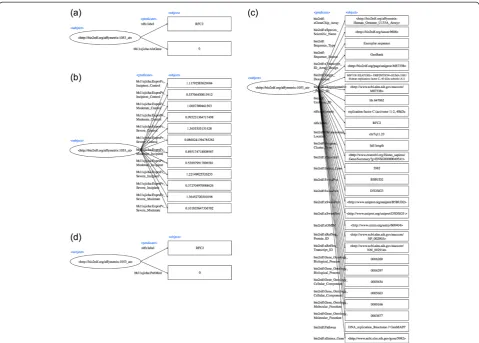
According to the data design described above, source data was transformed to RDF in turtle format. A property and its corresponding value were transformed to a URI or literal as a subject and an object, respectively. We used Google Refine with RDF Extension for transformation. Details regarding the generated data is listed in Table 1. See RDF diagram of gene variation data (AlzGene), RDF diagram of gene expression data (fold changes and P values), RDF diagram of gene annotation data, RDF dia-gram of PubMed co-occurrence data for Figure 1(a), (b), (c), and (d), respectively.
SPARQL query, facet view and crawling linked data Suppose, for instance, an AD researcher can obtain his/ her genes of interest, (1) showing differential expression between AD severe subjects and normal subjects, (2) functioning in the blood clotting cascade, (3) having the corresponding entry in OMIM [19], and (4) having the corresponding three-dimensional structure of coding proteins. After transforming source data to Linked Data in RDF, an AD researcher can obtain his/her genes of interest by both executing SPARQL query to SPARQL end point and crawling Linked Data.
(1) SPARQL query and facet view
The following SPARQL query enables an AD researcher to obtain differentially expressed genes between AD severe subjects and normal subjects (Significance Analysis of Microarrays (SAM) P < 0.05; Fold Change > 1.5 or <0.67).
Table 1 Generated RDF of Alzheimer’s disease data
Data type URL of RDF (in turtle format) file Number of triples
Gene variation data (AlzGene) http://open-biomed.org/bh/11/ujicha/AlzGene.ttl 66856
Gene expression data (fold changes and P values) http://open-biomed.org/bh/11/ujicha/GSE1297.ExprsFc.ttl 289686
Gene annotation data http://open-biomed.org/bh/11/ujicha/HG-U133A.na31.annot.ttl 965966
PubMed co-occurrence data http://open-biomed.org/bh/11/ujicha/Alzheimer_PubMed.ttl 66856
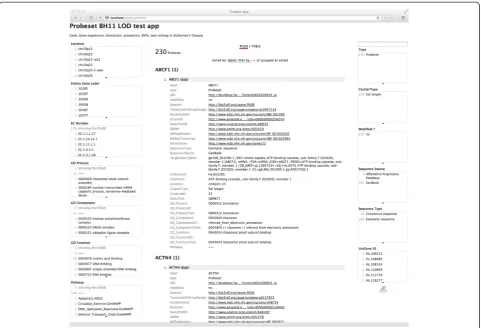
The Virtuoso SPARQL endpoint returns 1824 differ-entially expressed genes (probe sets) and their relevant data (properties) in JSON format. As for these differen-tially expressed genes, we examined their properties using our facet viewer implemented by Exhibit library (Figure 2).
After examining candidate genes using the facet viewer, we decided to focus on differentially expressed genes on the blood clotting cascade. By executing the follow-ing SPARQL query, we obtained all the differentially expressed genes on the blood clotting cascade in the GenMAPP pathway database.
The Virtuoso SPARQL end point returns 4 differen-tially expressed genes (probe sets) and their relevant data (properties) as shown below in Table 2.
(2) Traversing linked data
Among the genes that were narrowed down in Table 2, F9 (coagulation factor IX) showed the lowest P value, in-dicating that it is a plausible candidate responsible for pathogenesis. Next, we obtain data that can be possibly linked regarding Coagulation factor IX (http://www.uni-prot.org/uniprot/P00740), which was obtained from the genes obtained in (1). For example, disease information regarding F9 (coagulation factor IX) is obtained from OMIM (http://omim.org/entry/300746). From this link traversal, it is possible to obtain the physiological and phenotypical information supporting the reason for
Moreover, we can select plausible drug targets from the potential genes of (1). As a simple example, we ex-tract those proteins whose structures have been solved together with a small molecule (based on a naive story whereby the inhibitor for this small molecule can be synthesized as a candidate drug). This can be done by the following steps. 1) we confirm whether the PDB ID exists in the RDF of the UniProt entry obtained by the previous SPARQL query. If this can be obtained, then 2) we confirm whether a small molecule is bound to this protein, from PDBj (whose RDF-ization is complete). Summary of traversing results from the four genes ob-tained in (1) are shown in Table 3.
Use-case 2: RINGS
(1) Background of glycobiology data
The RINGS web site [20] is a resource of data mining and analytical tools for understanding glycan function. Behind this resource is a database of glycan structures and related data such as lectins, glycolipids, glyco-genes, proteins (enzymes) and reactions. The data for this data-base were all manually integrated from various publicly
available databases, such as KEGG GLYCAN [21], NCBI Gene [22], GlycomeDB [23], CAZy [24], Lectines [25], Animal Lectins DB [26], LipidBank [27], LIPID MAPS [28], and some from the literature. Then these data were organized into a MySQL database.
(2) Approaching the Semantic Web
In considering the transition to the Semantic Web, we considered the most efficient manner of making these data available and linkable, especially since many of the original databases are still detached from the Semantic Web. The main questions that arose were the following:
1. Should a triplestore be created, when we have spent so many resources to develop an RDB?
2. Do we need to develop an ontology first? What predicates should be used?
3. What URIs should be used?
http://ontop.inf.unibz.it/, R2RML at http://www.w3.org/ TR/r2rml/), these were still in the developmental stage. It was suggested that RDF-formatted data be generated dir-ectly from the RDB. Thus, It was determined that as a first step, the data from the RDB would first be made available as REST web services in RDF format.
The second question of whether an ontology was neces-sary then went under consideration. For glycomics data, the GlycO ontology has been published online for some time [29]. To quote the description as stated in this OWL file:
The Glycomics Ontology GlycO focuses on the glycoproteomics domain to model the structure and functions of glycans and glycoconjugates, the enzymes involved in their biosynthesis and modification, and the metabolic pathways in which they participate. GlycO is
intended to provide both a schema and a sufficiently large knowledge base, which will allow classification of concepts commonly encountered in the field of glycobiology in order to facilitate automated reasoning and information analysis in this domain.
This is a file with over 10000 lines and covers glyco-conjugate structures at a very detailed level. However, the scope of the ontology was quite different from the RINGS data. For example, the glycan entries focused on describing the glycan structure in different formats and linking with the existing links found in KEGG GLYCAN, such as with KEGG REACTION, are not available in GlycO. The Lectin and Lipid data are also quite general-ized, and it would require a glycochemist expert to prop-erly annotate each of the entries with this ontology. Figure 2Snapshot of the facet viewer app for the gene data of Alzheimer’s disease.
Table 2 SPARQL results of differentially expressed genes in Alzheimer’s Disease data
Probe set ID Ratio P value Gene symbol SwissProt URI
Thus, we decided to put this ontology on hold and in-stead directly use the labels that were already being dis-played via the existing web services as predicates.
Regarding question (3), for the object URIs, we learned about identifiers.org, which is a system providing resolv-able persistent URIs used to identify data for the scientific community, with a focus on the Life Sciences domain, thus facilitating trustable URIs to be used for the Semantic Web and Linked Data. This site uses the resources as defined in MIRIAM [30]. Thus, as much as possible, we looked up the identifiers.org URI for each of our foreign links.
(3) RDFization of glycobiology data
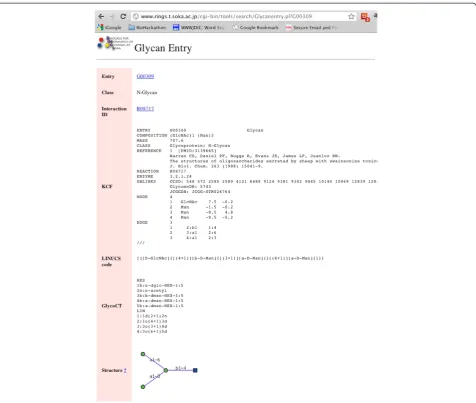
The RINGS data is searchable from the main web page for a particular glycan, lectin or lipid entry, which is gen-erated in a somewhat REST-like manner. For example, for glycan ID G00309, the following page (Figure 3) would be displayed as HTML in a web browser with the given URL containing the glycan ID.
So our first goal was to develop web services to return the same data in RDF format for particular glycan IDs, lectin IDs and lipid IDs. This was thus just a matter of rewriting our current code to generate RDF triples in-stead of HTML. An example of the resulting glycan entry G00309 in ntriples format is as follows:
Once this RDF data could be generated, then tools such as rapper [31] (http://librdf.org/raptor/rapper.html) can be used to generate RDF-XML from the triples, which could then be formatted appropriately for web browsers using xsl stylesheets. Although the triples themselves could be displayed in turtle format in the browser, for the glycobiol-ogist, HTML was preferred.
For our next step, we will return to the GlycO ontol-ogy and make additions to this existing ontolontol-ogy with our RINGS data such that other database providers can use a consistent vocabulary in generating Linked Data in the future.
(4) Benefits of RDFization
From this use-case, we learned that it is possible to easily transform tables from RDB to RDF if we narrow the focus of the namespace. As described later, it will be important to incorporate an appropriate ontology in order to truly appreciate the utility of RDF data. The current RINGS namespace is limited to the local server, and the relation-ship of the data to other RDF data is unavailable. More-over, the ontology is very simple. Extension of the ontology to describe substructures or patterns of glycan structures (known as“motifs”in the glycosciences) would make it more useful for performing structure searches of
Table 3 PDB traversing results from the four genes obtained in (1)
UniProt ID Gene (protein) name PDB entries with small compounds*
B4DU26 cDNA FLJ50218, highly similar to Coagulation factor V
-P00740 Coagulation factor IX (EC 3.4.21.22) 1RFN (PBZ), 3LC3 (IYX), 3LC5 (IZX)
A6PVI2 Plasminogen
-A8K7V7 cDNA FLJ75522, highly similar to Homo sapiens von Willebrand factor (VWF), mRNA -*
the database, for example. Once such RDF data is gener-ated, the next step is to provide triplestores to house the data and allow federated queries to be made across various RDF databases. In other words, URIs referring to the same data entry (glycans in this case) can be easily linked to one another using RDF and queried together at once. This is in contrast to the current state of glycomics, where data-bases provide links to one another for each equivalent gly-can, but the databases cannot be queried together. To make such queries available even for a single database, each database developer needed to write code to perform such queries on their databases. The reciprocal links also needed to be computed based on complicated tree-matching algorithms for glycans (in contrast to string comparisons often used for nucleotide or amino acid se-quences). Thus by providing a centralized URI for glycan
structures, duplicated efforts across different databases can be avoided. Moreover, by providing RDF data in tri-plestores, inference engines can be run on the data to glean new information from the linked data which could not be easily retrieved by browsing alone. The use of iden-tifiers.org actually adds an extra step between the current data and the foreign link, which may cause some compli-cations in federated queries. This is currently under dis-cussion, but either an URI mapping or additional triples to the original URI may need to be incorporated in the RDF data.
Discussion
must first be checked before they can be used, with Linked Open Data, the most prominent strength is that users can simply access URIs and filter the retrieved data to obtain the relevant triples of interest. RDF data elimi-nates bothersome needs for struggling to develop spe-cialized parsers and to find the correspondence between different databases because the links are already pro-vided in the data themselves. In addition, individual data providers can define their ontologies for describing types and properties of data and publish their RDF independ-ently of one another. This enables a truly distributed, global database or the Web of Data.
However, there are still several issues that should be ad-dressed for the Semantic Web to be fully functional. In both use cases described in this work, RDF representa-tions were newly created for each domain in order to ac-complish their goals during the five-day BioHackathon. However, by putting more efforts into developing an ontology to cover the data at hand, mapping issues could be avoided later. Mapping fills in gaps between links that should refer to the same data, as described next.
Missing links in linked data
A possible complication is that we need to know which triples are relevant to our purpose beforehand, that is, it
is necessary to explicitly specify specific predicates and/ or specific classes. Although it is assumed in the Seman-tic Web that the “meaning” of data is provided in the form of RDFS/OWL ontologies, those ontologies provide only formal structures and relationships between classes and properties and it is left for us to figure out, for ex-ample, which class actually corresponds to UniProt en-tries or Glycan enen-tries. Currently, the greatest drawback is that there are still relatively few data providers that provide RDF data via dereferenceable URIs.
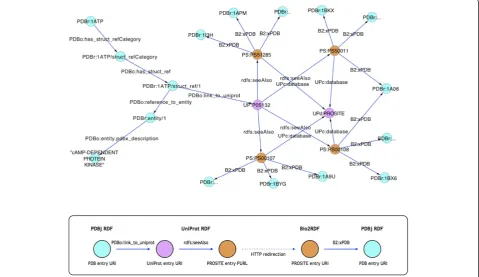
For example, to find PDB entries which share the same PROSITE [32] sequence motifs in their protein sequences with a given PDB entry, we would find links from a PDBj [33] entry to UniProt [10] entries, then extract links to PROSITE entries, and finally follow the links back to other PDB entries. All these steps can be achieved simply by re-trieving a series of URIs and filtering relevant triples, and iteration thereof. As shown in Figure 4, we started from a PDB entry of cAMP-dependent protein kinase <http://rdf. wwpdb.org/pdb/1ATP> (or PDBr:1ATP in short), which, after following some links, eventually reaches UniProt entry <http://purl.uniprot.org/uniprot/P05132> (or UP: P05132 in short). Next, by accessing UP:P05132, we find links to four PROSITE entries, PS00107, PS00108, PS50011, PS51285. Then, retrieving the PROSITE entries
at the Bio2RDF service yields the final result, that is, the annotations of the PROSITE motifs and a list of PDB en-tries sharing those PROSITE motifs. However, there were several issues: (1) The PROSITE database does not pro-vide RDF data at the time of this writing. (2) As a work-around, UniProt provides PURLs for PROSITE entries and redirects the PURLs to the corresponding entries in Bio2RDF (e.g., <http://purl.uniprot.org/prosite/PS00107> is redirected to <http://bio2rdf.org/prosite:PS00107>). Re-directions from UniProt PURLs to Bio2RDF URIs are not provided as RDF data, so a SPARQL query will not resolve these links. The only option for a user is to access the PURLs and find the redirected URIs by following HTTP status codes such as 303 See Other and/or 302 Moved Temporarily. (3) Although Bio2RDF provides essential subsets of many databases, it is not targeted at providing full sets of all the databases. Nevertheless, as more data providers provide dereferenceable RDF data, the utility of Linked Data will increase tremendously.
Utilization of ontologies
An ontology describes basic concepts in a domain and de-fines relations among them. It provides the basic blocks comprising its structure: classes or concepts, properties, and restrictions on properties. As a result, an ontology provides a common vocabulary for researchers who need data integration, data sharing, semantic annotation, and extraction of information in the specific domain. To take advantage of Linked Data, one will eventually need to make use of ontologies. Several ontologies have already been carefully designed by experts in particular fields, so whenever possible, researchers should try to use existing ontologies. Moreover, a variety of methodologies for build-ing ontologies have been proposed [34,35]. For those look-ing to use ontologies, the followlook-ing three steps may be considered.
1. Ontology searching: As mentioned in the Review section, several ontology resources are currently available providing a number of ways to search for ontologies of interest, such as BioPortal and Sindice. Another tool called OntoFinder [36] displays a table with all matching ontologies in the columns and matching terms in the rows when searched. The base database is BioPortal, so it may take a while for results to display, but once the table is shown, users can freely filter down to their ontology of choice to find the most appropriate terms that match with the target terms.
2. Ontology merging: when existing ontologies are insufficient in terms of vocabulary and expressions, it is recommended to merge multiple related ontologies and/or remove unnecessary parts, creating a new ontology. Many editors have been developed for
editing ontologies [37]. Protege is a major ontology editor, and WebProtege can support editing and full-fledged collaboration for domain experts [38,39]. 3. Ontology mapping: an ontology mapping is a
correspondence between two ontologies, and mapping between different ontologies can enhance data linking on the Web. In Linked Data, use of owl: sameAs is ubiquitous in“inter-linking”data sets. However, the issue of how to represent relationships of identity on Linked Data is more complex than just applying owl:sameAs [40]. For terms that refer to types, it would be better to formalize them as classes, and make them equivalent using owl: equivalentClass. Ontologies such as SKOS (http:// www.w3.org/TR/skos-reference/) also allow users to describe the relationships between ontologies and terms. For example, concepts such as“narrower”or “broader”can be used to describe the relationship between such terms.
Once an ontology has been developed, it should be published as an OWL file. Most ontology editors should support this format. Users may also consider submitting their ontology to BioPortal to allow it to be searched. This will allow other users to re-use the ontology to avoid recreating the same terms in a new ontology.
Conclusions
With the rapid speed of growth of databases in number and volumes, there is a greater demand to integrate this data in order to interpret in-house data; that is, more agile data integration is sought. Thus, it would benefit users to provide a painless and flexible framework to fa-cilitate the cycle of hypothesis construction and experi-mental validation. Linked Data is a step towards such a framework.
Linked Data with appropriate use of ontologies can link and integrate more datasets, thus increasing accessi-bility. The ultimate goal of being able to freely query Life Science data would then become a possibility. There are still many challenges such as to be able to make queries using a natural language (i.e. not only English, but also French, Italian, Japanese, etc.), and ensuring the accuracy of the data. The annual BioHackathons have allowed each project described in this review to get closer to this goal while keeping these challenges in mind. It is thus expected that in the near future, life science researchers will be able to retrieve their target information in an in-telligent manner and with confidence.
Competing interests
The authors declare that they have no competing interests.
Authors’contributions
KFK, YA, TK, AK, TM discussed and implemented the glycan-related RDF data. ARK implemented the PDBj crawler. SO generated the RDF data of Alzeheimer’s disease. MN implemented the Facet viewer for the Alzheimer’s disease data. All authors wrote, read, revised and approved the final manuscript.
Acknowledgements
This work has been supported by National Bioscience Database Center (NBDC) of Japan Science and Technology Agency (JST) and the Database Center for Life Science (DBCLS) in Japan. RINGS was developed under the support of Grant-In-Aid for Young Scientists (A), KAKENHI (20016025), the Japan Society for the Promotion of Science (JSPS) and the Ministry of Education, Culture, Sports, Science and Technology (MEXT).
Author details
1Department of Bioinformatics, Faculty of Engineering, Soka University, 1-236
Tangi-machi, Hachioji, Tokyo 192-8577, Japan.2Laboratory of Protein Informatics, Laboratory of Protein Databases, and Protein Data Bank Japan, Research Center for Structural and Functional Proteomics, Institute for Protein Research, Osaka University, 3-2 Yamadaoka, Suita, Osaka 565-0871, Japan.3Center for Knowledge Structuring, The University of Tokyo, 7-3-1 Hongo, Bunkyo-ku, Tokyo, Japan.4National Institute of Biomedical
Innovation, 7-6-8 Asagi Saito, Ibaraki-City, Osaka 567-0085, Japan.5DNA Data Bank of Japan, National Institute of Genetics, Yata 1111, Mishima, Shizuoka 411-8540, Japan.6Next Generation Systems Core Function Unit, Eisai Product Creation Systems, Eisai Co., Ltd, Tsukuba, Ibaraki, Japan.7Database Center for
Life Science, Research Organization of Information and Systems, 178-4-4 Wakashiba, Kashiwa-shi, Chiba 277-0871, Japan.8Department of Bioclinical
informatics, Tohoku Medical Megabank Organization, Tohoku University, Seiryo-cho 4-1, Aoba-ku, Sendai-shi Miyagi 980-8575, Japan.
Received: 19 October 2013 Accepted: 27 November 2014 Published: 7 January 2015
References
1. Linked Data.http://www.w3.org/DesignIssues/LinkedData.html. 2. Oren E, Delbru R, Catasta M, Cyganiak R, Stenzhorn H, Tummarello G:
Sindice.com: a document-oriented lookup index for open linked data. Int J Metadata Semant Ontol2008,3(1):37–52.
3. Segaran T, Evans C, Taylor J:Programming the Semantic Web.Sebastopol, CA, USA: O’Reilly Media; 2009.
4. LOD Cloud Diagram as of September 2011.http://en.wikipedia.org/wiki/ File:LOD_Cloud_Diagram_as_of_September_2011.png.
5. Belleau F, Nolin MA, Tourigny N, Rigault P, Morissette J:Bio2RDF: towards a mashup to build bioinformatics knowledge systems.J Biomed Inform 2008,41:706–716.
6. Noy NF, Shah NH, Whetzel PL, Dai B, Dorf M, Griffith N, Jonquet C, Rubin DL, Storey MA, Chute CG, Musen MA:BioPortal: ontologies and integrated data resources at the click of a mouse.Nucleic Acids Res2009,
37:W170–W173.
7. Jonquet C, Musen MA, Shah NH:Building a biomedical ontology recommender web service.J Biomed Semantics2010,1(Suppl 1):S1. 8. Smith B, Ashburner M, Rosse C, Bard J, Bug W, Ceusters W, Goldberg LJ,
Eilbeck K, Ireland A, Mungall CJ, The OBI Consortium, Leontis N, Rocca-Serra P, Ruttenberg A, Sansone SA, Scheuermann RH, Shah N, Whetzel PL, Lewis S:The OBO Foundry: coordinated evolution of ontologies to support biomedical data integration.Nat Biotechnol2007,25:1251–1255. 9. Antezana E, Blondé W, Egaña M, Rutherford A, Stevens R, De Baets B,
Mironov V, Kuiper M:BioGateway: a semantic systems biology tool for the life sciences.BMC Bioinformatics2009,10(Suppl 10):S11.
10. Bairoch A, Apweiler R, Wu CH, Barker WC, Boeckmann B, Ferro S, Gasteiger E, Huang H, Lopez R, Magrane M, Martin MJ, Natale DA, O'Donovan C, Redaschi N, Yeh LS:The Universal Protein Resource (UniProt).Nucleic Acids Res2005,33:D154–D159.
11. Kasprzyk A:BioMart: driving a paradigm change in biological data management.Database (Oxford)2011,2011:bar049.
12. Guberman JM, Ai J, Arnaiz O, Baran J, Blake A, Baldock R, Chelala C, Croft D, Cros A, Cutts RJ, Di Génova A, Forbes S, Fujisawa T, Gadaleta E, Goodstein
DM, Gundem G, Haggarty B, Haider S, Hall M, Harris T, Haw R, Hu S, Hubbard S, Hsu J, Iyer V, Jones P, Katayama T, Kinsella R, Kong L, Lawson D, et al:BioMart Central Portal: an open database network for the biological community.Database (Oxford)2011,2011:bar041.
13. Zhang J, Haider S, Baran J, Cros A, Guberman JM, Hsu J, Liang Y, Yao L, Kasprzyk A:BioMart: a data federation framework for large collaborative projects.Database2011,2011:bar038.
14. Westbrook JD, Bourne PE:STAR/mmCIF: an ontology for macromolecular structure.Bioinformatics2000,16:159–168.
15. Westbrook J, Ito N, Nakamura H, Henrick K, Berman HM:PDBML: the representation of archival macromolecular structure data in XML. Bioinformatics2005,21:988–992.
16. Akil H, Martone ME, Van Essen DC:Challenges and opportunities in mining neuroscience data.Science2011,331:708–712.
17. Cheung K, Marshall MS:HCLSIG BioRDF Subgroup. Query Federation. Use case 2 - microarray.http://www.w3.org/wiki/HCLSIG_BioRDF_Subgroup/ QueryFederation2.
18. Jupp S, Malone J, Bolleman J, Brandizi M, Davies M, Garcia L, Gaulton A, Gehant S, Laibe C, Redaschi N, Wimalaratne SM, Martin M, Le Novère N, Parkinson H, Birney E, Jenkinson AM:The EBI RDF platform: linked open data for the life sciences.Bioinformatics2014,30:1338–1339. 19. Amberger J, Bocchini CA, Scott AF, Hamosh A:McKusick’s Online
Mendelian Inheritance in Man (OMIM).Nucleic Acids Res2009, 37:D793–D796.
20. Akune Y, Hosoda M, Kaiya S, Shinmachi D, Aoki-Kinoshita KF:The RINGS resource for glycome informatics analysis and data mining on the Web. OMICS2010,14:475–486.
21. Hashimoto K, Goto S, Kawano S, Aoki-Kinoshita K, Ueda N, Hamajima M, Kawasaki T, Kanehisa M:KEGG as a glycome informatics resource. Glycobiology2006,16:63R–70R.
22. NCBI Gene.http://www.ncbi.nlm.nih.gov/gene/.
23. Ranzinger R, Herget S, von der Lieth CW, Frank M:GlycomeDB–a unified database for carbohydrate structures.Nucleic Acids Res2011, 39:D373–D376.
24. Cantarel BL, Coutinho PM, Rancurel C, Bernard T, Lombard V, Henrissat B: The Carbohydrate-Active EnZymes database (CAZy): an expert resource for Glycogenomics.Nucleic Acids Res2009,37:D233–D238.
25. Breton C, Snajdrová L, Jeanneau C, Koca J, Imberty A:Structures and mechanisms of glycosyltransferases.Glycobiology2006,16:29R–37R. 26. Animal Lectins Database.http://www.imperial.ac.uk/animallectins/default.html. 27. Yasugi E, Seyama Y:Lipid database“LipidBank”and international
collaboration.Tanpakushitsu Kakusan Koso2007,52:1357–1362. 28. Sud M, Fahy E, Cotter D, Brown A, Dennis EA, Glass CK, Merrill AH, Murphy
RC, Raetz CR, Russell DW, Subramaniam S:LMSD: LIPID MAPS structure database.Nucleic Acids Res2007,35:D527–D532.
29. GlycO Ontology.http://bioportal.bioontology.org/ontologies/GLYCO. 30. Laibe C, Le Novère N:MIRIAM Resources: tools to generate and resolve robust cross-references in Systems Biology.BMC Syst Biol 2007,1:58.
31. Beckett D:The design and implementation of the redland RDF application framework.InProceedings of the 10th international conference on World Wide Web.Hong Kong, Hong Kong: ACM; 2001:449–456. 32. Sigrist CJ, Cerutti L, de Castro E, Langendijk-Genevaux PS, Bulliard V,
Bairoch A, Hulo N:PROSITE, a protein domain database for functional characterization and annotation.Nucleic Acids Res2010, 38:D161–D166.
33. Kinjo AR, Suzuki H, Yamashita R, Ikegawa Y, Kudou T, Igarashi R, Kengaku Y, Cho H, Standley DM, Nakagawa A, Nakamura H:Protein Data Bank Japan (PDBj): maintaining a structural data archive and resource description framework format.Nucleic Acids Res2011.
34. Uschold M, Gruninger M:Ontologies: Principles, methods and applications.InKnowledge engineering review. Volume 11. Issue 02. Cambridge, UK: Cambridge University Press; 1996:93–136.
35. A Guide to Creating Your First Ontology.http://www-ksl.stanford.edu/ people/dlm/papers/ontology-tutorial-noy-mcguinness-abstract.html. 36. Ontofinder.http://ontofinder.dbcls.jp/.
37. Ontology editor.[http://en.wikipedia.org/wiki/Ontology_editor] 38. Protege.http://protege.stanford.edu/.
40. Halpin H, Herman I, Hayes PJ:When owl: sameAs isn’t the same: an analysis of identity links on the semantic web.InLinked Data on the Web (LDOW); 2010.
41. Marshall MS, Boyce R, Deus HF, Zhao J, Willighagen EL, Samwald M, Pichler E, Hajagos J, Prud’hommeaux E, Stephens S:Emerging practices for mapping and linking life sciences data using RDF—A case series. Web Semant Sci Serv Agents World Wide Web2012,14:2–13.
doi:10.1186/2041-1480-6-3
Cite this article as:Aoki-Kinoshitaet al.:Implementation of linked data in the life sciences at BioHackathon 2011.Journal of Biomedical Semantics
20146:3.
Submit your next manuscript to BioMed Central and take full advantage of:
• Convenient online submission
• Thorough peer review
• No space constraints or color figure charges
• Immediate publication on acceptance
• Inclusion in PubMed, CAS, Scopus and Google Scholar
• Research which is freely available for redistribution