ScholarlyCommons
Publicly Accessible Penn Dissertations
2017
Regular Programming Over Data Streams
Mukund Raghothaman
University of Pennsylvania, [email protected]
Follow this and additional works at:
https://repository.upenn.edu/edissertations
Part of the
Computer Sciences Commons
This paper is posted at ScholarlyCommons.https://repository.upenn.edu/edissertations/2540 For more information, please [email protected].
Recommended Citation
Raghothaman, Mukund, "Regular Programming Over Data Streams" (2017).Publicly Accessible Penn Dissertations. 2540.
Abstract
Data streams arise in a variety of applications, such as feeds from financial markets, event streams from sensors and medical devices, logs produced by long-running programs, click-streams from websites, and packet sequences passing through internet routers. In this thesis, we are concerned with computing quantitative statistics over these streams, and with expressing transformations in the related domain of strings. Many string transformations are instances of simple patterns, such as inserting, deleting and replacing substrings, or applying a function to each element in the stream. Over data streams, the task is usually to compute some simple quantitative statistic, such as counting the number of occurrences of a pattern or the mean time between occurrences of an event.
There has traditionally been limited programming language support for stream processing, and programmers are forced to write low-level code, by manually maintaining state and updating it on seeing each new input element. This sacrifices both ease of expression and amenability to static analysis. We propose a simple, expressive programming model for stream transformations, with strong theoretical foundations and fast evaluation algorithms.
We present two concrete systems: DReX, to express string-to-string transformations, and quantitative regular expressions (QREs) for numerical queries. Both formalisms start with a set of basic functions and a small collection of hierarchically composable combinators, analogous to the operations of regular expressions. The operators are simple to describe, and can be used to combine small, easy-to-understand expressions into more complicated expressions.
The functions expressible using DReX and QREs coincide with the class of regular string transformations, which is a robust class with multiple characterizations and appealing closure properties (under composition, input reversal, and regular look-ahead). We present a single-pass linear-time evaluation algorithm for function expressions, and study efficient approximate representations of numerical terms, so that some numerical QREs can also be evaluated with sub-linear memory requirements.
Degree Type
Dissertation
Degree Name
Doctor of Philosophy (PhD)
Graduate Group
Computer and Information Science
First Advisor
Rajeev Alur
Keywords
Data streams, Programming languages, Quantitative analysis, Regular expressions
Computer Sciences
Mukund Raghothaman
A DISSERTATION in
Computer and Information Science
Presented to the Faculties of the University of Pennsylvania in
Partial Fulfillment of the Requirements for the Degree of Doctor of Philosophy
2017
Supervisor of Dissertation Graduate Group Chairperson
Rajeev Alur Lyle Ungar Zisman Family Professor of
Computer and Information Science
Professor of Computer and Information Science
Dissertation Committee
Susan Davidson, Weiss Professor of Computer and Information Science
Acknowledgements
First and foremost, I would like to thank my advisor, Rajeev Alur. This thesis would not have been possible without his support and guidance.
My thesis committee consisted of Susan Davidson, Sanjeev Khanna, Benjamin Pierce, and Moshe Vardi: I thank them for the careful reading of this document and suggestions for improvement. I would also like to thank Youssef Hamadi and Yi Wei for hosting me at Microsoft Research Cambridge for two exciting and productive summers.
One of the best parts about working with Rajeev is the wonderful group of postdocs and research scientists he assembles. Dana Fisman, Kostas Mamouras, and Arjun Radhakrishna deserve special mention: their keen eye for detail has contributed immeasurably towards making this a more rigorous and better presented thesis. Christos Stergiou, Ashutosh Trivedi, and Jyotirmoy Deshmukh provided great guidance at various stages of this Ph.D. journey. Jyotirmoy was the one who pushed me to follow up what would become my first research paper, and continues to be a rich source of technical problems and an excellent sounding board for ideas.
Over six years and innumerable cups of coffee, Abhishek Udupa and I have become close friends and professional collaborators. The cohort of Rajeev’s Ph.D. students—Abhishek, Loris D’Antoni, Salar Moarref, Yifei Yuan, and Nimit Singhania—formed an amazing and lively peer group with which to discuss research problems.
My office-mates in GRW 571—Salar, Nan Zheng, Kai Hong, and Shaheen Jabbari—have each contributed in their little way to the successful completion of this thesis. Arjun Ravi Narayan taught me a lot: from writing code to economics trivia and general wisdom about life. Mike Felker greatly simplified and helped me navigate the bureaucracy associated with being an international Ph.D. student.
Outside the department, Varun Aggarwala, Carin Molenaar, the ECE Lobby from college, and Abhishek Anand were all always there. Finally, I thank my parents, my grandmother, and my brother, without whom I would not even have begun work on this thesis. For them, no words of gratitude will ever be enough.
Mukund Raghothaman March 8, 2017
REGULAR PROGRAMMING OVER DATA STREAMS
Mukund Raghothaman
Rajeev Alur
Data streams arise in a variety of applications, such as feeds from financial markets,
event streams from sensors and medical devices, logs produced by long-running programs,
click-streams from websites, and packet sequences passing through internet routers. In this
thesis, we are concerned with computing quantitative statistics over these streams, and with
expressing transformations in the related domain of strings. Many string transformations are
instances of simple patterns, such as inserting, deleting and replacing substrings, or applying
a function to each element in the stream. Over data streams, the task is usually to compute
some simple quantitative statistic, such as counting the number of occurrences of a pattern
or the mean time between occurrences of an event.
There has traditionally been limited programming language support for stream processing,
and programmers are forced to write low-level code, by manually maintaining state and
updating it on seeing each new input element. This sacrifices both ease of expression and
amenability to static analysis. We propose a simple, expressive programming model for
stream transformations, with strong theoretical foundations and fast evaluation algorithms.
We present two concrete systems: DReX, to express string-to-string transformations, and
quantitative regular expressions (QREs) for numerical queries. Both formalisms start with
a set of basic functions and a small collection of hierarchically composable combinators,
analogous to the operations of regular expressions. The operators are simple to describe,
and can be used to combine small, easy-to-understand expressions into more complicated
expressions.
The functions expressible using DReX and QREs coincide with the class ofregular string
transformations, which is a robust class with multiple characterizations and appealing closure
properties (under composition, input reversal, and regular look-ahead). We present a
single-pass linear-time evaluation algorithm for function expressions, and study efficient approximate
representations of numerical terms, so that some numerical QREs can also be evaluated with
1. Rajeev Alur, Adam Freilich, and Mukund Raghothaman. Regular combinators for string transformations. InProceedings of the Joint Meeting of the 23rd EACSL Annual Conference on Computer Science Logic and the 29th Annual ACM/IEEE Symposium on Logic in Computer Science, CSL-LICS 2014, pages 9:1–9:10. ACM, 2014.
2. Rajeev Alur, Loris D’Antoni, and Mukund Raghothaman. DReX: A declarative language for efficiently evaluating regular string transformations. InProceedings of the 42nd ACM SIGPLAN-SIGACT Symposium on Principles of Programming Languages, POPL 2015, pages 125–137. ACM, 2015.
3. Rajeev Alur, Dana Fisman, and Mukund Raghothaman. Regular programming for quantitative properties of data streams. In Peter Thiemann, editor, Programming Languages and Systems: Proceedings of the 25th European Symposium on Programming, ESOP 2016, pages 15–40. Springer, 2016.
4. Rajeev Alur, Sanjeev Khanna, Zachary Ives, Konstantinos Mamouras, and Mukund Raghothaman. StreamQRE: Modular specification and efficient evaluation of quantita-tive queries over streaming data. In submission, 2016.
Contents
1 Introduction 1
1.1 QREs, More Generally . . . 4
1.2 Contributions . . . 10
1.3 Thesis Outline . . . 16
2 Syntax and Semantics 18 2.1 DReX . . . 18
2.2 Towards More General Cost Domains . . . 27
2.3 Preliminaries . . . 28
2.4 Quantitative Regular Expressions . . . 30
2.5 Examples . . . 39
2.6 Streaming Composition . . . 41
I Expressiveness 44 3 Regular Cost Functions 45 3.1 Streaming String Transducers . . . 45
3.2 Streaming String-to-Term Transducers . . . 49
4 Converting Function Expressions into Transducers 56 4.1 From DReX to SSTs . . . 56
4.2 From QREs to SSTTs . . . 61
5 Converting Transducers into Function Expressions 66 5.1 Motivation . . . 67
5.2 A Theory of Shapes . . . 70
5.3 Operations on Expression Vectors . . . 72
5.4 The Base Case: RpS0qpq,q1q . . . 75
5.5 Motivating the Inductive Step: RpSi`1qpq,q1 q . . . 75
5.6 Ordering the Registers . . . 75
5.7 A Preorder over Shapes . . . 77
5.8 Decomposing Loops: TheS-Decomposition . . . 79
5.9 ConstructingB`S . . . 82
5.10 Completing the Proof: ConstructingRpSi`1qpq,q1q . . . 86
5.11 The Case of SSTTs . . . 86
5.12 Notes . . . 89
II Evaluation Algorithms 91 6 A Fast Evaluation Algorithm for Consistent Expressions 92 6.1 Formal Statement of Result . . . 92
6.2 Motivation . . . 94
6.3 The Formal Specification of a Function Evaluator . . . 100
6.4 Inductive Evaluator Construction . . . 102
6.5 On Streaming Composition . . . 110
7 Quantitative Approximate Terms 111 7.1 Motivation . . . 111
7.2 Fixing the Space of Operations . . . 113
7.3 Analysis . . . 114
7.4 Notes . . . 117
8 Experiments and Case Studies 120 8.1 Implementation Details . . . 120
8.2 String Processing with DReX . . . 121
8.3 QREs and Query Approximation . . . 124
8.4 Anecdotal Account of User Experience . . . 127
9 Related Work 129 9.1 Parsing Technologies . . . 129
9.2 Transducer Models . . . 131
9.3 Streaming Databases . . . 134
9.4 Streaming Algorithms . . . 136
10 Conclusion 138 10.1 Summary . . . 138
List of Tables
2.1 Consistency rules for QREs. . . 36
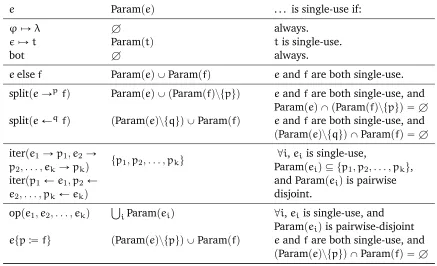
2.2 Defining Parampeqand single-use expressions. . . 38
8.1 Evaluated DReX expressions and consistency-checking time. . . 121
8.2 QRE evaluation performance. . . 124 8.3 Comparing QRE evaluation performance with a handcrafted implementation. 127
List of Figures
1.1 Hypothetical EEG event stream from a patient. . . 2
1.2 The semantics of iterpe,opq. . . 5
1.3 The semantics of foldpc,e,opq. . . 6
1.4 The semantics of foldpc,e,opq. . . 7
1.6 The operation ofe0son progressively longer prefixes ofw. . . 9
2.1 The semantics of chainpe,rq. . . 20
2.2 The syntax of DReX. . . 22
2.3 Defining shufflepwq. . . 23
2.4 Expressing shuffle using function combinators. . . 23
2.5 Unambiguous concatenability. . . 25
2.6 Defining oppe1,e2, . . . ,ekq. . . 32
2.7 Defining splitpeÑpfqand splitpeÐqfq. . . 33
2.8 Semantics of the iter combinator. . . 33
2.9 The syntax of QREs. . . 34
2.10 The semantics of QREs. . . 35
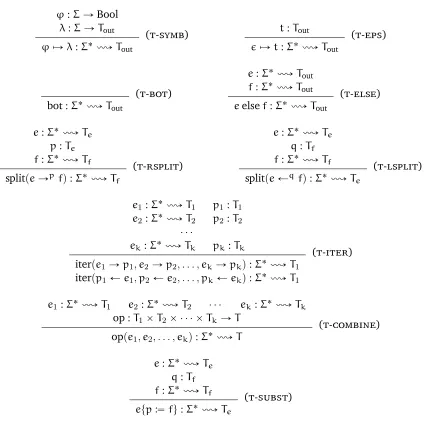
2.11 Typing rules for QREs. . . 37
2.12 Visualizing the streaming composition operation,e"f. . . . 42
3.1 Example SST,M1. . . 46
3.2 Another example SST,M2. . . 47
3.3 Example transition in an SSTT. . . 50
3.4 Example SSTTsM3,M4, andM5. . . 54
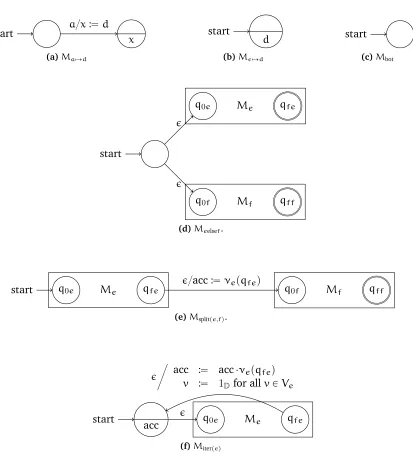
4.1 Constructing unambiguous SSTs from DReX expressions. . . 59
4.3 Unambiguous SSTT fore“iterpe1 Ñp1,e2 Ñp2q. . . 65
5.2 Example runs of the SSTM2. . . 69
5.3 Visualizing shapes as bipartite graphs. . . 71
5.4 Modifying an SST to mandate a register order. . . 76
5.5 Decomposing paths inrpiqpqi`1,qi`1q`whose shape isS. . . 80
5.6 Analyzing data flows while iteratingk-segments. . . 82
5.7 Summarizing the extremal patches. . . 84
5.8 Summarizing paths through SSTTs. . . 87
6.1 Ar1¨r2. . . 94
6.2 Visualizing incomplete parse trees. . . 96
6.3 Constructing parse trees withAr1¨r2. . . 96
6.4 Example run of the evaluator for splitpeÑpfqover a streamw. . . 97
6.5 Dropping co-located tokens while pattern matching. . . 99
6.6 Collision-free evaluator inputs. . . 101
7.1 The index problem from communication complexity. . . 118
7.2 Reducing the index problem to QRE evaluation. . . 118
8.1 Performance of the streaming DReX evaluation algorithm. . . 122
8.2 Performance of the baseline DReX evaluation algorithm. . . 123
List of Algorithms
6.1 MsplitpeÑpfq. . . 98
6.2 Moppe,fq. . . 99
6.3 MϕÞÑλ. . . 102
6.4 MÞÑt. . . 103
6.5 Mbot. . . 103
6.6 Meelsef. . . 104
6.7 Miterpe1Ñp1,e2Ñp2q. . . 106
6.8 Mchainpe,rq. . . 108
7.1 simplptrq: Arithmetic term simplification. . . 115
7.2 simplptsq: Multiset compression. . . 116
Introduction
Programmers routinely encounter sequential data, traditionally as strings, and more recently as streams, arising in applications such as financial markets, click-streams from websites, event logs produced by programs, and measurements made by sensors and medical devices. When dealing with strings, the programmer typically wishes to perform some simple operation, such as extract, reorder, or delete substrings according to some regular pattern. Over data streams, the task is usually to compute some simple quantitative statistic, such as counting the number of occurrences of a pattern or the mean time between occurrences of an event. In this thesis, we will introduce high-level abstractions to program queries over data streams. There has been limited language support for these functions: traditional regular expressions do not produce non-boolean outputs, database query languages such as SQL focus on the relational abstraction rather than on the sequential nature of the data, and contemporary stream processing systems consider the orthogonal problem of connecting a topology of individual stream processors, where each stream processor is itself written in low-level code and contains explicit instructions on how to update its state on seeing each new element, i.e. the problem of composing individual stream transformations, each written a low-level language of the programmer’s choice.
Writing low-level stateful code is a cumbersome task, and it is difficult to provide program-mer assistance for debugging, static analysis, or automatic parallelization. The benefits of high-level abstractions are well-established, for e.g., by successful domain-specific languages such as SQL and regular expressions. In our system, the programmer writes a succinct de-scription of the stream transformation or quantitative query in which they are interested, and we automatically generate efficient query evaluators. The formalism based on the concept of function combinators—constructs which combine functions into larger and more complicated functions. There is a small collection of these core combinators, and each combinator has a simple, intuitive description. Queries written in this style have the advantage of being modular and easy-to-understand, and emphasizewhatneeds to be computed over operational details describinghowthe function needs to be computed.
In this thesis, we will address both the logical foundations—what class of queries can we express in our system—and the algorithmic foundations—by showing that queries can be evaluated with low time- and space-complexity.
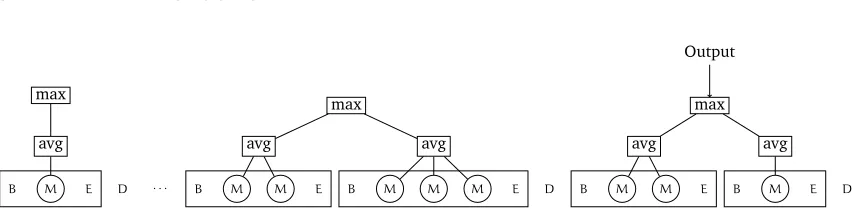
B M E D ¨ ¨ ¨ B M M E B M M M E D B M M E B M E D
avg max
avg avg
max
avg avg
max Output
Figure 1.1: Hypothetical EEG event stream from a patient. There are four types of events: (a)Bindicates the beginning of an episode, (b)Mpt,vqindicates the measurement of the valuevat timet, (c)Eindicates the end of the episode, and (d)Dindicates the end of a calendar day. We indicate each episode by drawing a box around its events. The doctor wishes to compute the maximum of the per-episode average measurements for the last day.
Example 1.1. Consider the example of a patient being monitored in a hospital for a condition such as epilepsy. The hypothetical data stream consists of four types of events: (a)B, indicating the beginning of an episode, (b) EEG sensor readingsMpt,vq, indicating the timestamptand valuevobserved, (c)E, indicating the end of an episode, and (d)D, indicating the end of a calendar day. The doctor wishes to know if the patient had a severe episode on the last day: because individual measurements during an episode may widely vary, they measure severity by the average measurement during an episode. The query is to find the maximum over all episodes of the last day, of the average measurement during the episode. See figure 1.1.
For simplicity, let us say that the event stream has the formppB¨M`
¨Eq`¨Dq`. Given a sequence of measurementswPM`
, the expression:
e1 “iter`pMpt,vq ÞÑv,avgq
extracts the value from each measurement event, and computes the average of these values over the entire sequence. The measurements of a single episode are flanked on the left and on the right by begin- and end-markers,BandErespectively. The expression:
e2 “splitpB,e1,E,π2q
maps event streams of the form B¨M` ¨E
to the output of e1 on the sub-sequence of measurements. The input stream wis broken into three parts, w “ w1w2w3, wherew1
is of the form B, w2 is fed as input to e1, and w3 is of the formE. The results from the sub-expressions are combined using the usual second projection operator,π2pa,b,cq “b.
The third expression:
e3 “splitpiter`pe2,maxq,D,π1q
maps the events of a single day,wPJpB¨M
`¨Eq`¨D
Kto the severity of the most intense
episode. Recall that the doctor was interested in this measurement for the last day:
The expressions we have written are inspired by the common notation of regular expres-sions. Just as with regular expressions, the operations, splitpe,f,opq, iterpe,opq, etc. do not specify themechanicsof parsing the input stream, but rather only specifyhow to recognize a viable decomposition: “Split the input streamwinto two partsw“w1w2such that both
v1 “JeKpw1qandv2“JfKpw2qare defined. Output oppv1,v2q.”
We will consider three concrete questions in this thesis: (a) How do we define program-ming abstractions so that we can write expressions similar to those we have just written? (b) What class of queries can we express using this notation? And (c) what is the time and space complexity of evaluating queries expressed in this notation? By using high-level combinators such as split, iteration (iter), or global choice (eelsef), our hope is that we free the programmer from the burden of explicitly reasoning about state and case analyses based on potentially unseen events. Notably, the only structure we assume inherent in the input data is that it is sequential. The evaluation tree, such as that shown in figure 1.1, is an artifact of the query rather than of the data: different queries can potentially impose different structure on the same input stream.
Example 1.2. Let us consider an example from text processing. Given an email address such as “user@domain”, we wish to extract the domain name, “domain”. We can write function expressions in a similar manner as we did for the EEG data stream:
e1 “iterpx‰@ÞÑq
uniformly maps input streams of the form p @q˚ to the empty output string . We are expressing functionsJeK:Σ
˚ ÑΓ˚
: the only way to combine the outputs in this case is by string concatenation, and the concatenation operator, “¨”, is implicit: iterpeqis shorthand for iterpe,¨q.
The second expression,
e2 “iterpx‰@ÞÑxq,
is also only defined for strings of the formp @q˚, but simply echoes such strings unchanged. We wished to extract the domain name from the email address: this is accomplished by the expression,
e3 “splitpe1,@ÞÑ,e2q. 4
Function combinators. We will present two formalisms: DReX, to express string-to-string
transformations, and quantitative regular expressions (QREs), for numerical functions over data streams. In both formalisms, we start with a small collection of basic functions of the form
ϕÞÑλ, whereϕ:ΣÑBool is a single-element predicate, andλ:ΣÑDis a single-element transformation: if the input streamwconsists of a single element, andϕpwq “true, then outputλpwq.
the analogue of concatenation, and iterpe,opqis the analogue of Kleene-*. We also include the operation combine:
Jcombinepe,fqKpwq “JeKpwq ¨JfKpwq,
or in the world of numerical quantities, oppe,fq, for some numerical operator op:RˆRÑR:
Joppe,fqKpwq “oppJeKpwq,JfKpwqq.
This combinator is the counterpart of the intersection operator in regular expressions. Our ultimate motivation is to obtain a formalism which is easy to understand, efficiently parseable and expressively powerful.
Example 1.3. There are several situations where combine and op are useful constructs. Consider the function copy:Σ˚ ÑΣ˚
, defined as copypwq “ww. The identity function can be expressed as id“iterptrueÞÑxq, and so we write
copy“combinepid,idq.
In the case of the patient data stream, we might be interested in mapping episodeswPM` to their inter-quartile range. We would then be interested in the QRE:
iqr“s0.75´s0.25, where
s0.75“iter`pMpt,vq ÞÑv,select0.75q, and
s0.25“iter`pMpt,vq ÞÑv,select0.25q.
Here, the function selectk :MSetpRq ÑRmaps a multisetAto thek|A|-th smallest element of A. Observe that in the expression iqr, both operands of the “´”, s0.75 and s0.25, are themselves QREs rather than concrete real numbers.JiqrKpwq “Js0.75Kpwq ´Js0.25Kpwq. 4
1.1
QREs, More Generally
Historically, we developed QREs after introducing DReX and proving most of the results of this thesis for the case of string-to-string transformations. Our motivation in developing QREs was to obtain similar a similar abstraction for numerical functions as DReX is for string-valued functions. Output domains such as the set of real numbers provide the most important applications, justifying the qualifier “quantitative” in the phrase “quantitative regular expressions”. Primarily, however, QREs are a significant generalization of DReX, where both the output domain and associated cost operations, such as the choice of “op”, are arbitrary and chosen by the programmer when constructing the expression. (We will formally state this connection between QREs and DReX in theorem 2.24.)
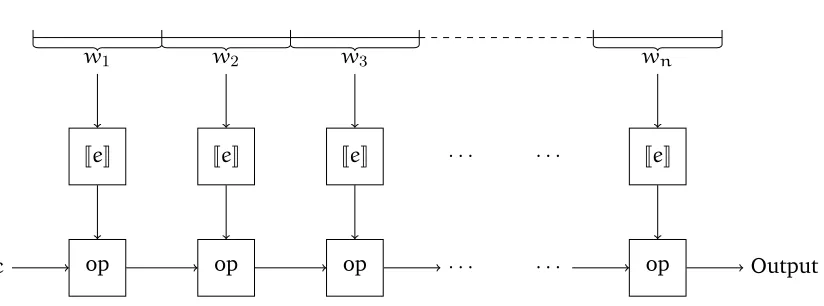
w1 w2 w3 wn
JeK JeK JeK ¨ ¨ ¨ ¨ ¨ ¨ JeK
op
v1
v2 v3
vn
Figure 1.2: The semantics of iterpe,opq. The input stream is divided into pieces, w “ w1w2¨ ¨ ¨wn, such thatvi “ JeKpwiq is defined for each i. Given an associative operator
op:T ˆT ÑT with an identity elementc,Jiterpe,opqKpwq “oppv1,v2, . . . ,vnq.
commutativity. This reluctance to assume additional properties is also practically motivated: operators such as median:MSetpRq ÑRtake a single argument as input, operators such as subtraction,´:RˆRÑRare not associative, and even the implicit concatenation operator of DReX,¨:Σ˚
ˆΣ˚
ÑΣ˚
is non-commutative.
We therefore have to review some implicit assumptions in combinators such as split and iter. Consider the definition ofJiterpeqKpwq. The input stringwis divided into patches
w “ w1w2¨ ¨ ¨wn, such that vi “ JeKpwiq is defined for each i. These values are then
combined to produce the result,JiterpeqKpwq “v1¨v2¨ ¨ ¨vn. See figure 1.2.
foldpc,e,opq. In particular, when writing iterpe,opq, we assume that op is associative and admits an identity element, so that binary concatenation¨:Γ˚
ˆΓ˚
Ñ Γ˚
can be freely extended to arbitrary arities, ¨ : Γ˚
ˆΓ˚
ˆ ¨ ¨ ¨ ˆΓ˚
Ñ Γ˚
. A combinator inspired by the “fold” operation from functional programming is somewhat more general than iterpeq: Let
e:Σ˚
ùTe be a QRE which maps streamswPΣ˚
to valuesJeKpwq:Te,c:T be an initial
value, and op:TˆTeÑT be an operation over the cost domains. Then foldpc,e,opqis a QRE whose semantics are defined as follows. Given an input streamw, it is divided into chunks,
w“w1w2¨ ¨ ¨wn, such thatvi“JeKpwiqis defined for eachi. Then, eachiP t0, 1, 2, . . . ,nu,
defineaias follows:
a0 “c,
a1 “oppa0,v1q,
a2 “oppa1,v2q,
¨ ¨ ¨
an“oppan´1,vnq.
w1 w2 w3 wn
JeK JeK JeK ¨ ¨ ¨ ¨ ¨ ¨ JeK
op op op ¨ ¨ ¨ ¨ ¨ ¨ op
c Output
Figure 1.3: The semantics of foldpc,e,opq. The input stream is divided into pieces,w “ w1w2¨ ¨ ¨wn, such thatvi“JeKpwiqis defined for eachi. Starting with the initial valuec,
the results of subsequent applications ofeare “threaded through” using the operator op.
Values vs. terms. A large variety of functions can be expressed using the fold combinator, and it relaxes the assumption that op be associative, but still assumes that op is binary, and requires a “neutral” elementc. To work around this, the key idea behind QREs is to make expressions outputterms, rather than concrete values. Consider, for example, the expressions
e1 “anÞÑn, and e2 “anÞÑminpp,nq.
Pick the input streamw “ a534. The first expression e1 simply returns the length of the
stream,Je1Kpwq “534. On the other hand, the second expressione2 returns thesyntactic
object“minpp, 534q”, wherepis an integer-valued parameter. Parameters can be thought of as holes in the evaluation tree, to be filled in later either by the programmer, or some other QRE. For example, if we define
e3 “anÞÑ5, and e4 “e2tp:“e3u,
then the expressione4evaluates bothe2ande3on the entire input streamw, and substitutes the value ofe3 into the parameterpin the value returned bye2. On our input stream of
choice,w“a534, we have:
Je3Kpwq “5, so that
Je4Kpwq “Je2Kpwqrp:“Je3Kpwqs
“ pminpp, 534qqrp:“5s “minp5, 534q
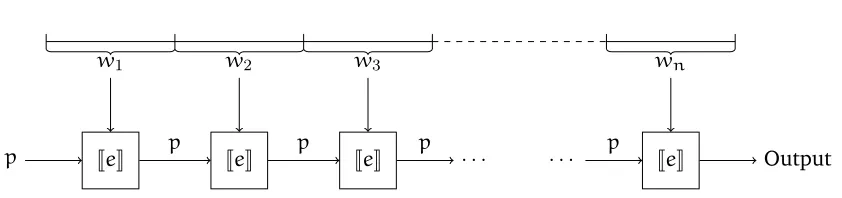
w1 w2 w3 wn
JeK JeK JeK ¨ ¨ ¨ ¨ ¨ ¨ JeK
p p p p p Output
Figure 1.4: The semantics of foldpc,e,opq. The input stream is divided into pieces,w “ w1w2¨ ¨ ¨wn, such thatvi“JeKpwiqis defined for eachi. Starting with the initial valuec,
the results of subsequent applications ofeare “threaded through” using the operator op.
iterpe Ñ pq and splitpe Ñp fq. Once we accept that QREs return representations of syntactic objects called terms, it is relatively straightforward to to devise domain- and operator-agnostic versions of the split and iter combinators. Let e : Σ˚ ù T be a QRE1 which maps input streamswPΣ˚
to output terms,JeKpwq, of typeT. Then, the expression
iterpeÑpqalso transforms input streamswPΣ˚
into output termsJiterpeÑpqKpwqof type
T.
The semantics of iterpeÑpqare somewhat similar to fold. The main idea is that inter-mediate results are accumulated using term substitution rather than by applying any specific operator op. Concretely, the input streamwis first divided into patchesw“w1w2¨ ¨ ¨wn, such thatti“JeKpwiqis defined for eachi. We then iteratively define the following sequence
of terms:
ta,0“p,
ta,1“t1rp:“ta,0s, ta,2“t2rp:“ta,1s,
¨ ¨ ¨
ta,n“tnrp:“ta,n´1s.
Finally, we defineJiterpe Ñ pqKpwq “ ta,n. See figure 1.4. Both simpler versions of iter,
iterpe,opq, and foldpc,e,opqcan be desugared into this more general combinator (we will show the explicit desugaring in chapter 2 in examples 2.19 and 2.20).
Similarly, the more general version of the concatenation operator is of the form splitpeÑp fq. Heree:Σ˚ ùT
e, andf:Σ˚ ùTf produce terms of typeTe andTfrespectively. The parameterpis of typeTe, and the intention is to substitute the resultteproduced byTeinto the parameterpof the termtf produced byTf. Concretely, letwbe the input stream, which
can be divided into two pieces,w“wewfsuch thatte “JeKpweqandtf “JfKpwfqare both
1We intentionally choose a notatione : Σ˚ ù T
for QREs similar to that used to describe functions, f:TÑT1
. However, we pick a different arrow,ù, because (a) the object actually doing the transformation is
JeK, (b) for QREs, the objects produced are actually of type TermspTq, and (c) (at least early on,) in chapter 2,
JeK:Σ
˚ˆ
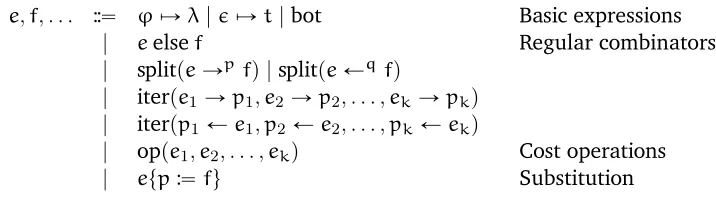
e,f, . . . ::“ ϕÞÑλ|ÞÑt|bot Basic expressions
| eelsef Regular combinators | splitpeÑpfq |splitpeÐqfq
| iterpe1Ñp1,e2 Ñp2, . . . ,ek Ñpkq | iterpp1 Ðe1,p2Ðe2, . . . ,pkÐekq
| oppe1,e2, . . . ,ekq Cost operations
| etp:“fu Substitution
Figure 2.9: The syntax of QREs. (Repeated from page 34.)
defined. Then
JsplitpeÑ
pf
qKpwq “tfrp:“tes.
As before, the simpler instances of the split combinator, splitpe,f,opq can be desugared to use this more general combinator, as we will see in example 2.18.
See figure 2.9 for the final definition of QREs. As a result of generalizing QREs to output terms rather than concrete values, the combinators split into two separate classes: the parsing combinators such as split, iter and else, and the cost combinators such as oppe,fqanderp:“fs. The remaining operators such as splitpe,f,opq, iterpe,opq, and foldpe,a0,opqare just special instances of our more general split- and iteration-combinators, as we will show in chapter 2. We therefore have a framework which is completely agnostic of instance-specific details such as the cost domain, and the number and arity of individual cost operations.
Streaming composition. Say that the medical sensor occasionally produces out-of-scale readings due to physical limitations, and the manufacturer recommends that all measurements which are numerically greater than100be discarded. Rather than rewrite all our previous queries, it is simpler to construct a “predicate QRE”e0:
e0“ϕpxq ÞÑx, where
ϕpxq “ px“Bq _ px“Eq _ px“Mpt,vq ^vď100q.
Next, the expression
e0s “splitpΣ˚,e0,π2q
maps a non-empty streamw“w1a
of stream elements to its final valueaiffasatisfies the property being tested, and is otherwise undefined.
ϕpw1q ϕpw2q ϕpw3q ϕpw4q ϕpw5q
w2 w3 w5
Je0sKpq
J e 0 s K p w 1 q J e 0 s K p w 1w 2 q J e 0 s K p w 1w 2w 3 q J e 0 s K p w 1 ¨ ¨ ¨ w 4 q J e 0 s K p w 1 ¨ ¨ ¨ w 5 q
Figure 1.6: The operation ofe0son progressively longer prefixes ofw. The expressione0s
emits the last element ofw “ w1a
iff a satisfies ϕ. The sequence of outputs, Je0sKpq ¨ Je0sKpw1q ¨Je0sKpw1w2q ¨ ¨ ¨Je0sKpw1w2¨ ¨ ¨wnq, with replacing every occurrence of the
undefined elementK, consists of only those elements ofwwhich satisfyϕ.
w: Me Mf i Motion of tape head
vi“JeKpw1w2¨ ¨ ¨wiq
Figure 2.12:Visualizing the streaming composition operation,e"f. (Repeated from page
The streaming composition combinator, “"”, allows us to access this sequence of outputs. Given expressionseandf, wherefaccepts a stream of elements each of which is of the return type ofe,e"fconceptually makes one left-to-right pass over the input streamw, examining
each prefix ofwin increasing order of length. Whenevereis defined, the result is fed to the second sub-expressionf. See figure 2.12.
Recall that our goal was to ignore out-of-scale readings emitted by the medical sensor, and we wrote the QREe0s to do the filtering. Ifeis the actual query of interest, then this is achieved the expressione1 “e0s"e.
While it is not part of the basic QRE calculus of figure 2.9, we have found streaming composition to be an extremely useful operation in some of our later work [20]. Unlike the remaining operators, there is more wide-spread support for this construct outside the text-parsing ecosystem. Long processing pipelines are a natural programming abstraction, it is the primary building block in stream-processing systems such as Apache Storm [1], and also finds application in synchronous programming languages.
1.2
Contributions
In this thesis, we propose DReX expressions and QREs as a practical and theoretically well-understood framework to express functions over data streams. We are easily able to express several non-trivial queries, there is a fast one-pass evaluation algorithm for consistent function expressions, and for many numerical queries, we can maintain inter-mediate results as approximate terms to control memory requirements. QREs and DReX expressions are expressively equivalent toregular cost functionsandregular string
trans-formations respectively. Both classes have several equivalent representations, appealing closure properties, and traditional static analysis problems such as precondition computation and equivalence-checking are decidable for regular string transformations. We are not aware of a prior characterization of these classes of functions by a set of combinators analogous to the characterization of regular languages by regular expressions.
Both DReX and QREs are built around a small core: queries are modular, and the com-binators are simple to explain. This makes programming in these formalisms simple, and raises the possibility of new and improved forms of programmer support. This includes better static analysis and debugging tools, and potential for automatic parallelization and query optimization. In comparison, most previous string-manipulating programs do not have a small core calculus, making this kind of programmer assistance difficult or even impossible to provide.
We can broadly divide our technical contributions into two parts, those related to expres-siveness, and those related to evaluation algorithms. We will now motivate and describe our results in each of these directions.
1.2.1 Expressiveness
at similar results from regular language theory. The study of regular languages has been one of the most prominent successes in computer science: Traditional regular expressions are easy-to-understand, can be efficiently parsed, and are powerful enough for a variety of simple text-processing tasks. Regular languages have robust closure properties, and most analysis questions such as equivalence and language inclusion are decidable. They have multiple equivalent representations, including: (a) operational models such as finite automata, (b) descriptive characterizations such as regular expressions, and (c) as formulas in monadic second-order (MSO) logic.
Therefore, a natural starting point for our expressiveness results is the class of “finite automata extended with outputs”, i.e. the class of finite-state transducers. It can be readily seen that unlike in the simpler setting of acceptors, two-way finite-state transducers are strictly more powerful than their one-way counterparts (the functionw ÞÑ reversepwq is a simple function in this gap). While the post-image of a regular language under such a transformation need not be regular [6], they are closed under composition [37] and the equivalence ofdeterministictwo-way finite state transducers is decidable [64].
Courcelle extended the idea of MSO-definable acceptors to transformationsdefined by logical formulas in MSO [38]. Engelfriet and Hoogeboom later showed that the class of transformations expressible as deterministic two-way finite state transducers coincides with functions definable in MSO [51], and labelled this the class ofregular string transformations.
Streaming string transducers (SSTs). So far, we have described two equivalent
char-acterizations of regular string transformations, first as the operational model of two-way deterministic finite-state transducers, and second, as transformations defined by logical formu-las in MSO. In a sequence of papers [9, 10], Alur and Černý introduced the equivalent one-way operational model of streaming string transducers (SSTs), and this is the characterization which we will use in this thesis.
An SST is a finite-state machine which reads the input stringwin one left-to-right pass, but maintains multiple registers to store partially computed chunks of the output which are updated and combined to produce the final result. See figure 3.2.
The expressive power of DReX. Having defined regular string transformations as those which can be implemented by SSTs, our goal in part I of this thesis is the following pair of theorems, which establish that SSTs and DReX expressions are expressively equivalent:
Theorem 4.1(Closure). IfΣis a finite input alphabet, then:
1. Ifeis a consistent DReX expression, then we can construct an SSTMwhich computesJeK.
2. Ifeis a consistent QRE, then we can construct an SSTTMwhich computesJeK.
Theorem 5.1(Completeness). 1. For every SSTM, we can construct an equivalent consis-tent DReX expressione.
q1
start q2
q3
x aL z:“z¨b
b
O x:“x¨y
y:“z z:“
a
N
x:“x¨a z:“z¨b
b
O x:“x¨y
y:“z z:“
a
N
x:“x¨a z:“z¨b
b
O x:“x¨y
y:“z z:“
Figure 3.2: An example of a streaming string transducer (SST). We name this machine M2. The details of the function being computed are presently unimportant. Observe that the machine has a finite set of control states,Q“ tq1,q2,q3u, and a finite set of registers
V “ tx,y,zu. Each register holds an intermediate result, and registers are combined and updated during transitions. The stateq3 is the only accepting state, and when the machine finishes execution in this state, the value of registerxis emitted as output. We will formally define SSTs in chapter 3. (Repeated from page 47.)
am2
shufflepwq: bm1 am3 bm2 am1
w: b am2 b am3 b ¨ ¨ ¨ amk´1 b amk b
¨ ¨ ¨ amk bmk´1
Figure 2.3: Defining shufflepwq. (Repeated from page 23.)
The closure theorem, which converts DReX expressions into equivalent SSTs is relatively straightforward, and mostly follows the traditional regular-expression-to-NFA translation algorithm. The completeness theorem is the more challenging claim to prove.
So far, we have described four operators in the DReX calculus: else, split, iter, and combine. We conjecture that the function “shuffle” defined as follows:
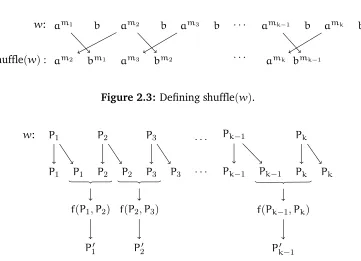
shufflepam1bam2b¨ ¨ ¨amkbq “am2bm1am3bm2¨ ¨ ¨amkbmk´1
is inexpressible using only these four combinators. See figure 2.3. The rough intuition is that each of these operators first divides the input into disjoint patches, and then maps each of these patches into disjoint substrings of the output, in the same order as in the input. The function shuffle does not have this property, and is therefore unlikely to be expressible using these operators alone.
this thesis is in the identification of an additional operator “chain” which allows the proof of theorem 5.1 to go through.
chainpe,rq. We will now briefly describe the chained sum combinator, chain. Letebe a DReX expression, andrbe a regular expression. Then chainpe,rqis a DReX expression, and it operates as follows. Given an input stringw, the chained sum expression first divides it into patches,w“w1w2¨ ¨ ¨wn, where each patchwiPΣ˚
matches the regular expressionr. The expression chainpe,rqthen applies the sub-expressioneto each pair of adjacent patches
wiwi`1 and glues the results together to obtain the result:
Jchainpe,rqK“JeKpw1w2qJeKpw2w3q ¨ ¨ ¨JeKpwn´1wnq
In the case of shuffle,r“a˚b
, andemaps strings of the formam1bam2b
toam2bm1
. See figure 2.3. We will formally define chain in chapter 2. The motivation behind the combinator is two-fold: first, we believe that shuffle is inexpressible using the remaining combinators, and second, the operation emerges naturally as an idiom during the proof of theorem 5.1. The final construction of a DReX expression from an SST in chapter 5 will involve a detailed analysis of the pattern of data flows between the registers of the given SST.
A theory of regularity for numerical functions. To prove properties about the expressive power of QREs, we would like a model of functions from streams to numerical quantities which naturally generalizes the previous notion of regular string transformations. Weighted automata [49] are the best known of the various automaton models which map streams to numerical values.
Unfortunately, weighted automata are limited to two operations which form a semiring. This is insufficient for our purposes, because we would like to express a richer class of functions, simultaneously involving multiple arithmetic operations such as`, min and max, and multiset operations such as avg and median.
We therefore use the more recent concept of regular cost functions[13]. This model is parameterized by the set of operations Ops: there can be any number of operations, and each operation opPOps can be of arbitrary arity. Regular cost functions coincide with MSO-definablestring-to-termtransformations, and are also captured by the one-pass operational model of streaming string-to-term transducers (SSTTs). SSTTs are very similar to SSTs: they have a finite set of control statesQ, and a finite set of registersVto hold intermediate results of computation, except that the registers now hold terms rather than concrete values. We will define SSTTs in chapter 3, and just as the case of SSTs for regular string transformations, SSTTs will be our characterization of choice for regular cost functions. Paralleling the claim that DReX and SSTs are equi-expressive, in chapter 5, we will show that QREs and SSTTs can express the same class of functions.
1.2.2 The Expression Evaluation Problem
A straightforward approach is to “operationalize” the semantics, by using dynamic pro-gramming and evaluating each sub-expression ofeon each sub-stream ofw. Unfortunately, this algorithm requires Op|w|3qtime, and does not scale to streams longer than a few thousand elements. Ideally, we would like an evaluation algorithm which makes a single left-to-right pass over the input stream, and processes each symbol ofwin polyp|e|qtime.
Because of the analogy between DReX expressions (split, else, iter, etc.) and regular expressions (concatenation, union, Kleene-*, etc.), another approach is to construct an transducer for evaluation similar to the automaton built to match strings against regular expressions. Unfortunately, in this approach, the expression combinepe,fqinvolves the product construction, and repeated invocations of the product construction results in a transducer whose size is exponential in the expression size|e|.
Bounding the memory usage. Consider a pair of states,qe PQe and qf PQf, of each of the component machines when constructing the product. While the product machine has significantly more states in total than each of the component machines,|Q| “ |Qe||Qf|, each product state can itself be represented in a much smaller amount of space,|pqe,qfq| «
|qe| ` |qf|, where the notation|q|indicates the amount of space required to encode the
representation of a state. Therefore, instead of explicitly constructing this transducer with an exponentially large state space, we build function “evaluators”, which are stateful machines which lazily (and implicitly) traverse the states of the underlying transducer.
However, the underlying automaton is still a non-deterministic machine. To match a string against an NFA in one-pass, we have to simultaneously maintain all eventualities, i.e. the set
Qw“ tqPQ|q0Ñwqu
of all statesqwhich are reachable from the initial stateq0 along some path labelledw. Each elementqPQwcorresponds to a differentpotentialparse tree of the entire stringww1, where
w1
is the (still unseen) suffix. Memory usage, and hence processing time, is determined by the size ofQw, where|Qw| ď |Q|. Therefore, even if we do not explicitly construct the product machine for combinepe,fq, executing an implicit non-deterministic product machine would require memory exponential in the expression size,|combinepe,fq|.
Expression consistency. Therefore, the main challenge is to find a subset of DReX and QREs which does not sacrifice expressiveness, but still permits fast and memory efficient evaluation algorithms, in particular by restricting the ability to express complicated anti-patterns, such as with combine, which has the flavour of language intersection:
Jcombinepe,fqKpwq “JeKpwq ¨JfKpwq
wPJr1Xr2K ðñ wPJr1K^wPJr2K
We call this restricted set theconsistentfragment, obtained by imposing additional constraints on the domains of the sub-expressions of each combinator. For example, for combinepe,fq
Dompcombinepe,fqqis then equal to the domain of each sub-expression and the operator cannot express language intersection. For splitpe,fq, we require that Dompeqand Dompfq
are unambiguously concatenable. In the case of the choice combinator,eelsef, we require Dompeqand Dompfqto be disjoint. Consistency is closely linked to the notion of unambiguous regular expressions, and also ensures that QREs and DReX expressions produce at most a single output string for each input, i.e. that the expression encodes apartial functionrather than an unrestricted relation.
Consistency can be checked in polyp|e||Σ|qtime if the input stream is drawn from a finite alphabetΣ. The consistency rules are simple to state and do not sacrifice expressive power. Most natural QREs and DReX expressions are already consistent, indicating that all streams must be unambiguously parsed, and do not pose a significant burden on the programmer. Notably, the few times we wrote non-consistent expressions, the problem turned out to be a mistake in the expression, rather than a limitation of the expressions we could write.
For the consistent fragment, we are able to provide a fast, memory-efficient one-pass evaluation algorithm: given an expressione and an input streamw “ w1w2¨ ¨ ¨wn, each
symbolwiof the stream is processed in Op|e|2qtime, and during this processing, the algorithm produces the value ofJeKpw1w2¨ ¨ ¨wiq.
Informally, each expression evaluator keeps track of potential parse trees ofwas multiple threads, and updates the threads on reading each input symbol. The key technical challenge is to limit the number of threads to some function of the expression size, butindependentof the length of the input stream|w|. We exploit the consistency requirements to achieve this by establishing a correspondence between the active threads of each evaluator and the states of the underlying NFA.
Size of the output. The output of a DReX expression,JeKpwqmay be comparable in size
to the input: consider for example the identity function, id“iterptrueÞÑxq, or the string reversal function, rev“left-iterptrue ÞÑxq. At the very least, the evaluator needs to keep this output in memory, and its memory usage therefore depends on the size of the output. In particular, we define the value
slpe,wq “maxt|Je
1
Kpw
1
q| |e1 sub-expression ofe, andw1substring ofwu, (1.2.1)
as a bound on the size of the largest intermediate result produced during evaluation. We will similarly define a quantitystpe,wqfor QRE evaluation. The main technical contributions of chapter 6 are QRE / DReX evaluation algorithms which satisfy the following properties.
Theorem 6.1. 1. Let e be a consistent DReX expression, and w “ w1w2¨ ¨ ¨wn be a se-quence of symbols. There is an algorithm which makes one pass overw, and processes each symbolwi in Op|e|2qtime. During this processing, it will also output the value of
JeKpw1w2¨ ¨ ¨wiq, if it is defined. While reading the first i symbols, the algorithm will
consume less than Op|e|slpe,w1w2¨ ¨ ¨wiqqmemory.
each symbolwi in Op|e|2qtime. During this processing, it will also output the value of
JeKpw1w2¨ ¨ ¨wiq, if it is defined. While reading the first i symbols, the algorithm will
consume less than Op|e|stpe,w1w2¨ ¨ ¨wiqqmemory.
Term compression and approximation algorithms. Observe that the QRE evaluation
algorithm in theorem 6.1 requires Op|e|stpe,wqqmemory, wherestpe,wq “Op|e||w|qis the size of the largest intermediate term produced while evaluatingeon w. For some output domains, such as strings, it is impossible to do significantly better than this bound.
However, when the expression only involves arithmetic operations,`, min, max, and avg, we are able to “compress” intermediate terms so thatstpe,wq ďpolyp|e|q, independent of the length of the streamw.
Another class of queries for whichstpe,wqcannot be improved is when the expression involves quantile queries, such as median, or selectk. Here, selectkpAq, for0ďkď1, is the
k|A|-th smallest element ofA. It is a well-known lower bound that computing medianpAqor selectkpAqin one pass over the elements ofArequires|A|space, and similar lower bounds on exact computation have motivated the study of approximation algorithms for data streams. In the case of QREs, when the expression involves a bounded number of quantile queries, and the programmer provides an error toleranceą 0, we are able to reducestpe,wqto polyp´1
|e|logp|w|qq. In this case, we guarantee that the result we produce,v, and the true resultˆvare related asp1´qvˆďvď p1`qˆv. This result is particularly interesting because
it suggests that we can incorporate continuing developments from the streaming algorithms literature, which is focused on finding time- and memory-efficient algorithms for specific problems, into our framework, which addresses the orthogonal problem of conveniently expressing a large class of simple queries.
Experimental performance. We implemented our evaluation and consistency-checking
algorithms and evaluated them on several text transformations: deletion of comments from a program, insertion of quotes around words, tag extraction from XML documents, reversing dictionaries, and the reordering and aligning of misplaced fields in BibTeX files. The evaluation algorithm for consistent DReX scales to large inputs (less than for 8 seconds for 100,000 characters), while the dynamic programming algorithm, due to the cubic complexity in the size of the input, does not scale in practice (more than 60 seconds for 5,000 characters) and therefore has limited applicability. Finally, the consistency-checking algorithm is very fast in practice (less than0.6seconds for programs of size«3,600 sub-expressions), and it is also very helpful in identifying sources of ambiguity in the implemented programs.
1.3
Thesis Outline
We begin by defining DReX and QREs in chapter 2. While this chapter is necessarily formal, we will also include some pedagogical examples to improve readability.
implemented by an SST, and regular cost functions are those that can be implemented using an SSTT. In chapter 4, we describe the translation from consistent function expressions to transducer models, and in chapter 5, we describe the translation from transducer models to function expressions.
Part II presents the fast evaluation algorithm for consistent QREs. The algorithm itself is described in chapter 6. We consider issues related to term compression and approximate query evaluation in chapter 7, and present an experimental evaluation of the framework in chapter 8.
Syntax and Semantics
In this chapter, we will define the basic expressions and combinators that make up the QRE / DReX framework. We will begin by defining DReX expressions in section 2.1, including the important idea of expression consistency. In section 2.2, we will motivate the definition of QREs by writing some representative expressions, and outline our primitive notions—types, operations, and terms—in section 2.3. In section 2.4, we will define QREs: the development of ideas will closely follow the pattern used for DReX, but will involve some additional considerations beyond expression consistency, particularly well-typedness and single-usage. In section 2.5, we will construct a few example QREs, and finally introduce the streaming composition combinator in section 2.6.
2.1
DReX
DReX is a formalism to express mappings between input stringswPΣ˚
, and an output monoid
pD,¨, 1Dq[19]. The most important instantiation is whereD“Γ˚
, the set of strings over an output alphabetΓ. In this case, DReX can be used to express string transformations [14], similar to tools such as sed, AWK and Perl. Some simple numerical queries can also be expressed using the monoidpR,`, 0q. In this section, we will formally define the syntax and semantics of DReX expressions. Each expressioneencodes a relation,JeKĎΣ
˚
ˆD, and we will write “e:Σ˚ùD” to succinctly indicate the input and output domains.
Basic expressions. Pick a characteraPΣ, and designate an outputdPD. There are three basic expression constructors: (a) a ÞÑ d, which maps the input stringa to the constant
outputd, (b)ÞÑd, which maps the empty stringto the outputd, and (c) bot, which is undefined everywhere.
JaÞÑdK“ tpa,dqu, (2.1.1) JÞÑdK“ tp,dqu, and (2.1.2)
JbotK“ H. (2.1.3)
Choice. For each pair of expressionse,f, the expressioneelsefnon-deterministically applies eithereorf. This is the straightforward analogue of the union operator in regular expressions.
JeelsefK“ tpw,dq | pw,dq PJeKorpw,dq PJfKu
“JeKYJfK. (2.1.4)
Concatenation. The expression splitpe,fq splits the input streamw into two parts,w “ wewf, and applieseto the first part, andfto the second.
Jsplitpe,fqK“ tpwewf,de¨dfq | pwe,deq PJeK,pwf,dfq PJfKu. (2.1.5)
The sister-expression left-splitpe,fqis similar, except for the order in whichde and df are
combined:
Jleft-splitpe,fqK“ tpwewf,df¨deq | pwe,deq PJeK,pwf,dfq PJfKu. (2.1.6)
Clearly, split and left-split overlap for the special case of commutative monoids. In more general cases, such as the the cost domain of strings under concatenation, the two expressions are different.
Iteration. Given an input streamw, iterpeqbreaks it up into piecesw“w1w2¨ ¨ ¨wnsuch thateis defined for eachwi. The resultsd1,d2, . . . ,dnare then glued back together to form the output,d1¨d2¨ ¨ ¨dn. Formally,JiterpeqKis the smallest set defined by the following rules:
1. p, 1Dq PJiterpeqK, where1Dis the identity element of the monoidD.
2. Wheneverpw,dq PJiterpeqK, andpwe,deq PJeK,pwwe,d¨deq PJiterpeqK.
Similar to left-split, left-iterpeq differs only in the direction in which concatenation is performed. Formally,Jleft-iterpeqKis the smallest set defined by the following rules:
1. p, 1Dq PJleft-iterpeqK.
2. Wheneverpw,dq PJleft-iterpeqK, andpwe,deq PJeK,pwwe,de¨dq PJleft-iterpeqK.
Example 2.1. If the expression echoΣ maps each individual character to itself, then the expression id“iterpechoΣqencodes the identity function over all strings. The expression rev“left-iterpechoΣqrepresents the symmetric string reversal function. 4
Function combination. The expression combinepe,fqconcatenates the results ofeandf, each applied to the entire stringw.
Jcombinepe,fqK“ tpw,de¨dfq | pw,deq PJeKandpw,dfq PJfKu. (2.1.7)
w: w1 w2 w3 wn´1 wn
d:
d1 d2 dn´1
JeK
JeK J
eK
Figure 2.1: The semantics of chainpe,rq. The input string w is broken into pieces w “ w1w2¨ ¨ ¨wn, where each substringwiPJrK. The sub-expressioneis applied to each pair of
subsequent chunkswiwi`1, and the results are concatenated to produce the final output.
Chained sum. The final operator is the chained sum, which allows us to “mix” outputs produced by different parts of the input string. Givene, and a regular expressionr, chainpe,rq breaks the input stringwinto pieces,w“w1w2¨ ¨ ¨wn, such that: (a)ně2, (b) for each
i,wi P JrK, and (c) for eachi, there exists di P Dsuch thatpwiwi`1,diq P JeK. Then, w
is mapped to the outputd1¨d2¨ ¨ ¨dn´1. See figure 2.1. This is a new operator, without a traditional regular expression counterpart. The motivation is two-fold: first, we believe that shuffle (which we will see in example 2.6) is inexpressible using the remaining operators, and second, the operation naturally emerges as an idiom during the proof of theorem 5.1.
Formally,Jchainpe,rqKis the closure of the following rules:
1. For each pair of strings,w1 P JrKandw2 P JrK, and eachd P D, if pw1w2,dq P JeK,
then:
pw1w2,dq PJchainpe,rqK.
2. For all strings w1, w2, w3, and for each pair of values d,de P D, if pw1w2,dq P
Jchainpe,rqK,pw2w3,deq PJeK,w1 PJr
˚
K,w2 PJrK, andw3PJrK, then:
pw1w2w3,d¨deq PJchainpe,rqK.
The symmetric expression left-chainpe,rqis defined by the following rules:
1. For each pair of strings,w1 P JrKandw2 P JrK, and eachd P D, if pw1w2,dq P JeK,
then:
pw1w2,dq PJleft-chainpe,rqK.
2. For all strings w1, w2, w3, and for each pair of values d,de P D, if pw1w2,dq P
Jleft-chainpe,rqK,pw2w3,deq PJeK,w1 PJr
˚
K,w2 PJrK, andw3 PJrK, then:
Symbolic predicates and character transforms. Consider echoΣ, the single-character echo. Over a finite alphabet,Σ“ ta1,a2, . . . ,aku, echoΣ can be expressed as:
echoΣ “a1 ÞÑa1elsea2 ÞÑa2else¨ ¨ ¨elseak ÞÑak.
We will regularly consider large alphabets, such as Unicode (« 128,000 characters and growing), and even potentially infinite alphabets, such as the set of all measurements produced by a sensor. In these settings, this approach of explicitly handling each character does not scale. We therefore extend the basic expressions to allow properties over values to be described symbolically using predicates. Our formalization here is derived from the recently proposed model of symbolic transducers [94].
Over each alphabet Σ, pick a non-empty (and potentially even infinite) collection of predicatesΦΣ. Each predicate is a computable functionϕ : ΣÑ Bool. We also choose a
collection of basic character transformations,Λ. Each character transform is a computable function,λ :ΣÑ Γ. For each predicateϕ and character transformλ,ϕ ÞÑ λappliesλto
those charactersaPΣsuch thatϕpaq “true:
JϕÞÑλK“ tpa,λpaqq |aPΣ, andϕpaq “trueu. (2.1.8)
We require:
1. that the satisfiability of predicates be decidable, and
2. thatΦΣ be effectively closed under boolean operations:ϕ1^ϕ2,ϕ1_ϕ2, ϕ1 PΦΣ,
for eachϕ1,ϕ2 PΦΣ.
We will assume that predicate evaluation, boolean combination, and satisfiability checking can all be performed in Op1q time. The chosen predicates ΦΣ divideΣ into equivalence classes called minterms: two valuesa,bPΣare equivalent ifϕpaq “ϕpbq, for allϕPΦΣ. We refer to the set of minterms ofΦΣ as MintermspΦΣq.
We summarize the syntax of DReX combinators in figure 2.2. The interpretation of regular expressions is standard: each regular expressionris associated with a languageJrKĎΣ
˚ , defined inductively as follows: (a)JϕK“ taPΣ|ϕpaq “trueu, (b)JK“ tu, (c)JKK“ H,
(d)Jr1`r2K“Jr1KYJr2K, (e)Jr1¨r2K“Jr1K¨Jr2K, and (f)Jr
˚
K“JrK
˚ .
Example 2.2. Common examples of character predicates and transformations include the clas-sification of letters into upper- and lower-case variants, isUpperCasepxqand isLowerCasepxq, and the conversion functions toUpperCasepxqand toLowerCasepxq.
We previously expressed the identity function as id “iterpechoΣq, where echoΣ is the
single-character echo. Over an arbitrary alphabet, this function can be expressed as echoΣ“
e,f, . . . ::“ ϕÞÑλ|ÞÑd|bot Transformations
| eelsef
| splitpe,fq |left-splitpe,fq | iterpeq |left-iterpeq
| chainpe,rq |left-chainpe,rq | combinepe,fq
r ::“ ϕ|| K Regular expressions
| r1`r2 |r1¨r2|r˚
Figure 2.2: The syntax of DReX.
operator: Define:
swCase“swCase1else swCase2, where
swCase1 “isUpperCasepxq ÞÑtoLowerCasepxq, and swCase2 “isLowerCasepxq ÞÑtoUpperCasepxq.
The expression swCase flips the case of a single input character, and so iterpswCaseqswitches the case of each character in the input string. 4
Example 2.3(Minterms). Consider the set of integersZ, and the basic predicates:
p0pxq ““x”0 pmod 3q”,
p1pxq ““x”1 pmod 3q”, and
p2pxq ““x”2 pmod 3q”.
The boolean closure of these3basic predicates,ΦZ“ tfalse,p0,p1,p2,p0_p1,p1_p2,p2_
p0,trueucontains8elements, while there are just3minterms, corresponding to the predicates
p0,p1andp2. The number of minterms,|MintermspΦΣq|, is therefore often much smaller than the number of predicates,|ΦΣ|, and is useful in measuring the computational complexity
of our algorithms. 4
Example 2.4. Mangling filenames is a common operation performed on the command line. Consider the function strip, which maps full filenames, such as “/home/user/file.txt”, to just the location, “/home/user”. We wish to drop all characters starting from the last occurrence of “/”. The following expression performs this operation:
strip“splitpid,"/"ÞÑ,drop "/"q, where drop "/"“iterpx‰"/"ÞÑq
am2
shufflepwq: bm1 am3 bm2 am1
w: b am2 b am3 b ¨ ¨ ¨ amk´1 b amk b
¨ ¨ ¨ amk bmk´1
Figure 2.3:Defining shufflepwq.
w: P1
P1 P1 P2 P2
P2 P3 P3
P3 ¨ ¨ ¨ ¨ ¨ ¨
Pk´1
Pk´1
Pk´1 Pk
Pk
Pk
fpP1,P2q fpP2,P3q fpPk´1,Pkq
P1
1 P21 Pk1´1
Figure 2.4: Expressing shuffle using function combinators. Each patchPiis a a string of the forma˚b.
Example 2.5. Given a string of the form “First-Name Last-Name”, the expressions
echoFirst“splitpid isSpace,isSpacepxq ÞÑ,iterptrueÞÑqq, and echoLast“splitpiterptrueÞÑq,isSpacepxq ÞÑ,id isSpaceq
output “First-Name” and “Last-Name” respectively. The two expressions can be combined into combinepechoLast,echoFirstq, which outputs “Last-NameFirst-Name”. Note that the space in between is omitted—the expression
swap“combinepsplitpechoLast,ÞÑ" "q,echoFirstq
preserves this space. 4
Example 2.6(shuffle). Consider the function shuffle:Σ˚ÑΣ˚
from figure 2.3. IfΣ“ ta,bu andw“am1bam2b¨ ¨ ¨amkb
, withkě2, then shufflepwq “am2bm1am3bm2¨ ¨ ¨amkbmk´1
. We will now express shuffle using the chained sum combinator: we illustrate the main idea in figure 2.4. We first divide the inputwinto patchesPi, each of the forma˚b, and the output into patchesPi1, each of the forma˚b˚. Each input patchPishould be scanned twice,
first to produce thea-s inPi1´1, and then again to produce theb-s inPi1. The pattern of the
input patches is given byr“a˚b
. Consider the expression:
Given two consecutive input patchesPiPi`1,fproduces the output patchPi1. It follows that
shuffle“chainpf,rq. 4
Example 2.7. DReX can also be used to write simple queries in output domains other than the set of strings. Consider the situation of a customer who frequents a coffee shop. Each cup of coffee he purchases costs $2, but if he fills out a survey, then all cups of coffee purchased that month cost only $1 (including cups already purchased). HereΣ“ tC,S,Mudenoting respectively the purchase of a cup of coffee, completion of the survey, and the passage of a calendar month. The expression:
m“m SelsemS, where m S“iterpCÞÑ2q, and
mS“splitpiterpCÞÑ1q,SÞÑ0,iterpCÞÑ1elseSÞÑ0qq
maps the events of a single month to the customer’s debt. The expression:
coffee“splitpiterpsplitpm,MÞÑ0qq,mq
maps the entire purchase history of the customer to the amount he needs to pay the store. 4
2.1.1 Expression consistency
We have defined DReX expressions as denoting relations, rather than (partial) functions. A single input string w could thus be mapped to multiple (possibly even infinitely many) outputs. This is troublesome for the following reasons: (a) All our examples naturally denote functions, such as id, swap, and shuffle. An expression with multiple outputs is a code smell. (b) We would ideally like to solve the “function evaluation” problem: findthevalue ofJeKpwq,
given an expression e and an input string w. Therefore, we will now define the class of “consistent” DReX expressions: the central objects of our study. The main idea is to make the
definitions of the choice, split sum and iteration combinators unambiguous.
Unambiguity. Two languagesL1,L2 are unambiguously concatenable if for all strings
u,u1
P L1, v,v1
P L2, if uv “ u1v1
, thenu “ u1
and v “ v1
(see figure 2.5). A language
L is unambiguously iterable if for all strings u1,u2, . . . ,um P L, v1,v2, . . . ,vn P L, if
u1u2¨ ¨ ¨um “ v1v2¨ ¨ ¨vn, then m “ n, and ui “ vi for all i. Unambiguous regular
expressions are inductively defined as follows:
1. ϕ,, andKare all unambiguous,
2. r1`r2 is unambiguous if:
(a) r1 andr2 are both unambiguous, and
(b) Jr1KXJr2K“ H,