University of Pennsylvania
ScholarlyCommons
Publicly Accessible Penn Dissertations
1-1-2013
Nonlinear Structural Functional Models
Michael Ryan Wierzbicki
University of Pennsylvania, [email protected]
Follow this and additional works at:http://repository.upenn.edu/edissertations Part of theBiostatistics Commons
This paper is posted at ScholarlyCommons.http://repository.upenn.edu/edissertations/944
For more information, please [email protected]. Recommended Citation
Nonlinear Structural Functional Models
Abstract
A common objective in functional data analyses is the registration of data curves and estimation of the locations of their salient structures, such as spikes or local extrema. Existing methods separate curve modeling and structure estimation into disjoint steps, optimize different criteria for estimation, or recast the problem into the testing framework. Moreover, curve registration is often implemented in a pre-processing step. The aim of this dissertation is to ameliorate the shortcomings of existing methods through the development of unified nonlinear modeling procedures for the analysis of structural functional data. A general model-based framework is proposed to unify registration and estimation of curves and their structures. In particular, this work focuses on three specific research problems. First, a Sparse Semiparametric Nonlinear Model (SSNM) is proposed to jointly register curves, perform model selection, and estimate the features of sparsely-structured functional data. The SSNM is fitted to chromatographic data from a study of the composition of Chinese rhubarb. Next, the SSNM is extended to the nonlinear mixed effects setting to enable the comparison of sparse structures across group-averaged curves. The model is utilized to compare compositions of medicinal herbs collected from two groups of production sites. Finally, a Piecewise Monotonic B-spline Model (PMBM) is proposed to estimate the locations of local extrema in a curve. The PMBM is applied to MRI data from a study of gray matter growth in the brain.
Degree Type
Dissertation
Degree Name
Doctor of Philosophy (PhD)
Graduate Group
Epidemiology & Biostatistics
First Advisor
Wensheng Guo
Keywords
Chromatography, Functional Data, Model Selection, Nonlinear Models, Sparsity
Subject Categories
NONLINEAR STRUCTURAL FUNCTIONAL MODELS
Michael R. Wierzbicki
A DISSERTATION
in
Epidemiology and Biostatistics
Presented to the Faculties of the University of Pennsylvania
in
Partial Fulfillment of the Requirements for the
Degree of Doctor of Philosophy
2013
Supervisor of Dissertation
Signature
Wensheng Guo, Professor of Biostatistics
Graduate Group Chairperson
Signature
Daniel F. Heitjan, Professor of Biostatistics
Dissertation Committee
Warren B. Bilker, Professor of Biostatistics
Sarah J. Ratcliffe, Associate Professor of Biostatistics
NONLINEAR STRUCTURAL FUNCTIONAL MODELS
c
COPYRIGHT
2013
Michael R. Wierzbicki
This work is licensed under the
Creative Commons Attribution
NonCommercial-ShareAlike 3.0
License
To view a copy of this license, visit
ACKNOWLEDGMENT
I would like to thank my advisor, Wensheng Guo, for his guidance, advice, and
patience the past three years. Your mentorship and teaching have made me a much
better statistician and scientist. I also thank my committee members: Warren Bilker,
I thank you for advising me and for bring me onto the Mental Health Training Grant
[No. 5T32MH065218] which has provided invaluable experience (and also financial
support). Sarah Ratcliffe, I thank you for introducing me to the world of functional
data, your advice, and time you spent advising and teaching me. Bruce Turetsky, I
thank you for providing the outside perspective that I would not have without you.
Thank you to the Biostatistics faculty and staff. In particular, I thank Kevin Lynch
for his guidance and advice during my last two years at Penn; Phyllis Gimotty for her
guidance during my first year; Clay Wells for all your help and computing wizardry;
Ann Facciolo, Cathy Vallejo, and Marissa Fox for all that you do for the department.
Also thanks to Jonas Ellenberg, Susan Ellenberg, Benjamin French, Dick Landis,
Nandita Mitra, Rene´e Moore, and Thomas Ten Have.
A very special thanks to: Drs. Bill Baker, Bob Fray, David Moffett, David Penniston,
and Wesley Wong.
I also thank the students of the various schools and departments I have crossed paths
with during my many years of schooling.
I thank my family and friends, past and present, for their love and support throughout
the years. Last, but certainly not least, I thank my significantly better half: my wife,
ABSTRACT
NONLINEAR STRUCTURAL FUNCTIONAL MODELS
Michael R. Wierzbicki
Wensheng Guo
A common objective in functional data analyses is the registration of data curves
and estimation of the locations of their salient structures, such as spikes or local
extrema. Existing methods separate curve modeling and structure estimation into
disjoint steps, optimize different criteria for estimation, or recast the problem into
the testing framework. Moreover, curve registration is often implemented in a
pre-processing step. The aim of this dissertation is to ameliorate the shortcomings of
existing methods through the development of unified nonlinear modeling procedures
for the analysis of structural functional data. A general model-based framework
is proposed to unify registration and estimation of curves and their structures. In
particular, this work focuses on three specific research problems. First, a Sparse
Semi-parametric Nonlinear Model (SSNM) is proposed to jointly register curves, perform
model selection, and estimate the features of sparsely-structured functional data. The
SSNM is fitted to chromatographic data from a study of the composition of Chinese
rhubarb. Next, the SSNM is extended to the nonlinear mixed effects setting to
en-able the comparison of sparse structures across group-averaged curves. The model
is utilized to compare compositions of medicinal herbs collected from two groups of
production sites. Finally, a Piecewise Monotonic B-spline Model (PMBM) is
pro-posed to estimate the locations of local extrema in a curve. The PMBM is applied
TABLE OF CONTENTS
ACKNOWLEDGMENT . . . iii
ABSTRACT . . . iv
LIST OF TABLES . . . vii
LIST OF ILLUSTRATIONS . . . ix
CHAPTER 1 : Introduction . . . 1
CHAPTER 2 : Sparse Semiparametric Nonlinear Model with Ap-plication to Chromatographic Fingerprints . . . 6
2.1 Introduction . . . 6
2.2 Data . . . 11
2.3 Model . . . 14
2.4 Estimation . . . 18
2.5 Application to Data Example . . . 22
2.6 Simulation . . . 25
2.7 Discussion . . . 29
CHAPTER 3 : Semiparametric Nonlinear Mixed Effects Models for Sparsely-Structured Functional Data . . . 32
3.1 Introduction . . . 32
3.2 Model . . . 39
3.3 Estimation . . . 41
3.5 Simulation . . . 53
3.6 Discussion . . . 58
CHAPTER 4 : Piecewise Monotonic B-spline Model for estimat-ing local extrema . . . 60
4.1 Introduction . . . 60
4.2 Piecewise Monotonic B-Spline Model . . . 64
4.3 Estimation and Inference . . . 66
4.4 Simulation . . . 69
4.5 Application to MRI Data Set . . . 74
4.6 Conclusion . . . 75
CHAPTER 5 : Discussion . . . 77
CHAPTER A : Proof of Theorem 2 . . . 80
A.1 Consistency . . . 80
A.2 Variable selection consistency . . . 82
A.3 Asymptotic Normality . . . 83
APPENDIX . . . 80
LIST OF TABLES
LIST OF ILLUSTRATIONS
FIGURE 2.1 : Chromatograms of the 24 samples of rhubarb. . . 15
FIGURE 2.2 : Estimated population averaged fingerprint with 95%
confi-dence bands. . . 23
FIGURE 2.3 : Estimated warping functions. . . 26
FIGURE 2.4 : Simulated curves with 12 peaks and additive t-distributed
noise. . . 28
FIGURE 2.5 : Boxplots of the mean square error of the estimated
finger-prints for the proposed procedure using 3-, 4-, and 5-knots
and the two-step procedure using dynamic time warping and
wavelet thresholding. . . 29
FIGURE 2.6 : True (solid) and mean of 100 estimated warping functions
(dashed) using 4 uniform knots. . . 30
FIGURE 3.1 : Chromatograms of the GAP-compliant production sites and
the market sites. . . 34
FIGURE 3.2 : Group averaged estimates of the chromatographic fingerprint
and confidence intervals for the GAP sites and market sites
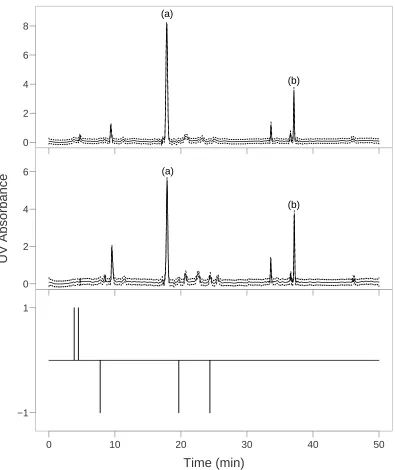
along with the difference between the two fingerprints. . . . 50
FIGURE 3.3 : Observed data curves and subject specific estimates of
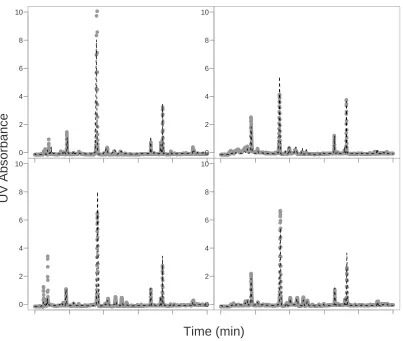
chro-matograms from the GAP and market sites. . . 51
FIGURE 3.4 : Estimated deviation from the unwarped time scale for each
production site. . . 52
FIGURE 3.5 : True simulated functions along with their estimates for each
FIGURE 3.6 : Observed simulated data along with estimates of the
subject-specific curves. . . 56
FIGURE 3.7 : Boxplots of the mean square error of the estimated
group-averaged difference for the proposed procedure and the
two-step procedure using dynamic time warping and WFMM. . 57
FIGURE 4.1 : Observed gray matters volumes calculated from MRIs of 107
healthy individuals along with estimates of the growth curve
shape and point and interval estimates of the time of peak
volume from the proposed procedure. . . 62
FIGURE 4.2 : True piecewise sinusoidal function with observed data points,
estimate using PMBM, and estimated using SSM. . . 72
FIGURE 4.3 : Boxplots of the bias and confidence interval widths of the
extrema location estimates from the 500 runs of the proposed
CHAPTER 1
Introduction
The prevalence of functional data has increased greatly in the last few decades.
Func-tional data are commonplace in a variety of research areas including pharmacological,
biomedical, and environmental fields, and have motivated a plethora of statistical
research in their display, exploration, and analysis. The starting point of most
func-tional data analyses is the assumption that the data vector is comprised of discrete
observations arising from some underlying continuous curve, and the curve itself is
treated as the basic unit of data analysis. In such analyses, a common objective is
to register curves and locate and draw inferences on their salient structures, such
as spikes or local extrema. Numerous methodologies for the analysis of functional
data and the estimation of their structures exist which accommodate complex designs
and various correlation structures (e.g. Ke and Wang, 2001; Guo, 2002; Ramsay and
Silverman, 2005; Morris and Carroll, 2006). However, in drawing inferences on
struc-tures, existing methods model a curve and estimate its structures in disjoint steps,
optimize different criteria for curve and structure estimation, or recast the problem
into the testing framework. Moreover, curve registration is treated as a pre-processing
step and implemented separately from the modeling procedure. The unified,
nonlin-ear, model-based estimation procedures developed in this dissertation address the
shortcomings of existing approaches in the analysis of structured functional data.
This dissertation is motivated by three data applications. The first two applications
concern chromatographic data of medicinal herbs. Medicinal herbs have been used in
Eastern nations for the treatment of a variety of ailments and diseases for thousands
com-prising of numerous compounds, and it is widely accepted that the therapeutic effects
of herbs are due to multiple compounds in conjunction with each other. Determining
the composition of medicinal herbs is the first step towards elucidating their active
composition and their development into standardized pharmaceuticals. The need
for composition identification in medicinal herb research has prompted the rise in
popularity of a tool used in analytical chemistry, namely High Performance Liquid
Chromatography.
High Performance Liquid Chromatography (HPLC) is a tool for the separation and
detection of compounds in biological mixtures, such as herbs (Snyder and Kirkland,
1979). Chromatographic experiments analyze an herb sample and output a curve,
termed chromatogram, characterized by spikes over experiment time corresponding
to detected compounds. The HPLC process is described in more detail in Chapter 2.
As the particular set of compounds is unique to an herb and spike locations can
be used to identify compounds, chromatograms provide a visual representation, or
fingerprint, of the herb. Therefore, obtaining the fingerprint of an herb is vital for
active composition exploration.
Certain characteristics of medicinal herbs and chromatography preclude the direct
identification of herb compositions via HPLC. First, the exact chemical composition
of an herb differs based on its particular species and origin; properties of the seed
and field used to grow the herbs; and the particular processes used in the
grow-ing, harvestgrow-ing, and storage of the herbs (Leung and Cheng, 2008). This lack of
proper quality control results in the existence of many variations of a single herb.
Second, constructing statistical models for the estimation and comparison of
chro-matographic fingerprints is difficult due to the sparse, spiky nature of the curves.
shifted, preventing the establishment of a standardized fingerprint. The inability to
establish a standardized fingerprint from multiple experiments has a financial
impli-cation in regards to compound identifiimpli-cation, as well. Unknown compounds can be
identified by analyzing samples of known compounds under identical conditions and
comparing the reference spike timings to those in the study chromatogram. The
mis-alignment prevents the comparison of reference spike timings across conditions and
requires the purchase of many reference compounds to be analyzed under every
ex-perimental condition. As known compounds samples are expensive, the use of HPLC
in large-scale medicinal herb studies is not practical. The first two studies
consid-ered in this dissertation address the complications presented by medicinal herbs and
chromatography.
The first study aims to establish a fingerprint of the herb, Rheum palmatum, or
Chinese rhubarb. Samples of Chinese rhubarb of identical composition are analyzed
via HPLC under a set of different experimental conditions. The varying conditions
induce transformations of the underlying fingerprint shape and, as a result, curve
spikes are unaligned across experiments.
Chapter 2 develops a Sparse Semiparametric Nonlinear Model (SSNM) for the
regis-tration of sparsely-structured functional data, such as chromatographic data.
Data-driven basis expansion is used to model the common shape of curves while a
para-metric time warping function registers individual curves. Penalized weighted least
squares with the Adaptive Lasso penalty provides a unified criterion for registration,
model selection, and estimation. The unified criterion results in a unique solution and
allows the study of sampling properties, as opposed to existing methods which can
guarantee neither. A back-fitting algorithm is proposed for estimation and sampling
through a simulation study and the SSNM is fitted to the rhubarb chromatographic
data and a standardized fingerprint is established. Furthermore, through the use of
the SSNM, known compounds need only be analyzed under a single condition, greatly
reducing the cost of compound identification.
The aim of the second study is to compare the compositions of samples of the herb,
Andrographis paniculata, collected from two groups of production sites: sites that
adhere to Good Agricultural Practices (GAP) and pharmacies, or market sites, whose
compliance with GAP is unknown. Chapter 3 discusses GAP in further detail.
Iden-tifying discordant compounds between the two groups of sites can aid in the quality
control of herbs produced by the market sites. The site-level warpings of the
finger-print shapes prevent the establishment of and comparison between GAP-compliant
and market fingerprints.
Chapter 3 extends the SSNM to accommodate nested designs, such as
longitudi-nal data settings, by developing a Sparse Semiparametric Nonlinear Mixed Effects
Model (SSNMM) for the registration and comparison of grouped functional data
with sparse structures. Similar to the the SSNM, group-averaged curve shapes are
modeled using data-driven basis expansion. To correctly account for the sources of
variability, subject-specific deviations in the group-averaged curves are modeled using
parametrically-specified random effects. Penalized likelihood with the Adaptive Lasso
provides a unified criterion for joint registration, model selection, and estimation. A
back-fitting algorithm using the Laplace Approximation is proposed for estimation
and the sampling properties of model estimators, whose variation account for the joint
estimation of the shape functions, fixed and random effects, and variance components,
are proved. The performance of the SSNMM is assessed through a simulation study
identifies compounds which are not common between the GAP-compliant and market
sites.
The third and final motivating example is a cross-sectional study of the growth of
gray matter, an important neurological tissue, in the prefrontal cortex of the brain.
Previous research has shown that gray matter volume increases until some point
in adolescence and then decreases into adulthood. Identifying the unknown age at
which gray matter volume stops increasing has implications in predictions of
neuro-logical development in children and the classification and diagnosing of neuroneuro-logical
conditions. In this study, Magnetic Resonance Images (MRIs) were obtained on 107
subjects aged one month to 25 years and volumetric measurements of gray matter
were collected in multiple regions of the brain.
Chapter 4 develops a Piecewise Monotonic B-spline regression Model (PMBM) for
the estimation of local extrema locations in a multi-modal curve. The model-based
approach enables joint estimation of the curve shape and extrema timings via
op-timization of a unified nonlinear least squares criterion. As a result, the procedure
developed in this chapter allows flexible modeling of a data curve and enables
sta-tistical inference to be drawn on the locations of its extrema. The performance of
the PMBM is assessed by comparing its performance to an alternative method using
smoothing splines in a simulation study. The PMBM is fitted to the volumetric MRI
data set and point and interval estimates of peak gray matter volume are obtained
CHAPTER 2
Sparse Semiparametric Nonlinear Model with Application
to Chromatographic Fingerprints
2.1. Introduction
Traditional Chinese Herbal Medicines (TCHMs) have been used for thousands of
years for the treatment and prevention of a wide range of medical ailments and
diseases (Duke, 2002). TCHMs are comprised of substances extracted from the roots,
stems, or leaves of plants and herbs by boiling (Liang et al., 2004). The structure
of TCHMs is complex and their therapeutic effects are due to a combination of
multiple compounds. Furthermore, the preparation process is difficult to replicate
exactly, inhibiting proper quality control. Thus efficacy research, classification, and
the development of standardized medications is problematic and has been the focus
of much research in recent years.
The first step in TCHM research is identifying compounds in an herbal medicine.
Chromatography is a standard technique used in the exploration of biological
sam-ple composition and has become a key tool in herbal medication research. A
chro-matographic experiment outputs a curve displaying an intensity measurement over
experiment time characterized by a number of sharp, narrow spikes, where each spike
corresponds to a compound in the sample. The location in time of a spike, called
retention time, can be used to identify the compound. For instance, a sample of a
known compound can be analyzed under the identical experimental condition and if
its retention time is the same as one of the spikes in the study chromatogram, this is
Therefore the chromatographic curve, termed chromatogram, provides a visual
rep-resentation of the composition of a study sample. As the combination of compounds
is unique to a TCHM, its chromatogram serves as a fingerprint of the medicine. The
main difficulty in fingerprinting is that, due to variations in experimental conditions,
spikes are often shifted in time across experiments. The incomparability of spikes
across experiments prevents the establishment of an overall standardized fingerprint.
In addition, due to the shifting of retention times, any known samples used to identify
compounds must be analyzed under every experimental condition, which can become
cost-prohibitive. Hence retention time warping poses a large obstacle in the practical
application of chromatographic experiments in TCHM research.
Recent statistical methods proposed to address the time warping seek to align spikes
across experiments. Alignment is performed through parametric models of the
warp-ing function or dynamic time warpwarp-ing of the chromatograms (Kassidas et al., 1998;
van Nederkassel et al., 2006). Generally, alignment is performed as a pre-processing
step and the mean curve is obtained separately on the aligned curves. The
disadvan-tages of such two-step approaches have been noted previously (Morris et al., 2008).
Two-step methods do not take the variability in the alignment step into account which
leads to downward attenuation of subsequent parameter estimates and optimizing
dif-ferent objective functions for each step does not guarantee overall convergence. In
addition, these methods usually focus on a few large spikes and the smaller spikes are
ignored. Curve registration offers a framework to model chromatograms and
warp-ing functions jointly (Ramsay and Li, 1998). By assumwarp-ing time has been warped
by some unknown monotonic function and estimating the warping function jointly
with the standardized fingerprint, estimation and alignment of chromatograms are
In regards to modeling the fingerprint shape, wavelets are a particular family of
functions that have become popular due to their ability to estimate curves with
lo-cal features, such as sharp spikes. This ability has prompted their use in modeling
mass spectrometry (MS) data which is similar in nature to chromatographic data
(Randolph and Yasui, 2006; Morris et al., 2008). In particular, Morris et al. (2008)
considered proteomic MS data and applied the discrete wavelet transform (DWT) to
the curves and fit a linear functional mixed effects model to the transformed data.
Their methodology can accommodate functional effects and can be used in nested
designs. However, their methods are restrictive in that the DWT is a linear
trans-formation and their model is linear in the mixed effects. In our setting, the warping
function parameters enter into the model nonlinearly, thus we cannot employ the
DWT. Instead wavelet basis expansion can be utilized to supply a finite-dimensional
representation of the curves that can accommodate nonlinear parameters.
A salient feature of chromatograms is that only a small fraction of each curve is
true signal. While the curves are comprised of thousands of data points, there are
relatively few narrow spikes along with long, flat regions. This sparse structure
sug-gests that their basis representation is also sparse, in that most of the basis functions
correspond to the flat regions of the curves and the true values of their coefficients
are zero. It is imperative, then, to identify the subset of nonzero coefficients and
include only their corresponding basis functions in the model. In other words, model
selection should be performed on the basis functions. Imposing an`1 penalty on the
basis functions shrinks irrelevant coefficients to 0, in essense dropping them from the
model while retaining and estimating the important variables. Thus model
selec-tion is performed on the basis funcselec-tions as well as nonparametric estimaselec-tion, as the
The semiparametric nonlinear regression models of Wang and Ke (2009) is a large
class of flexible models that can accommodate nonlinear parameters, such as
warp-ing function parameters. However, Wang and Ke (2009) use smoothwarp-ing splines to
estimate the mean function. They induce smoothness in the functional estimate via
an `2 penalty, which does not perform model selection as all variables are included
in the model. Furthermore, the estimation algorithms used for`2-penalized methods
differ from those for `1-penalized methods.
In this chapter we propose a sparse semiparametric nonlinear model for the
reg-istration of chromatograms and establishment of a standardized chromatographic
fingerprint. We assume the chromatograms arise from a common spiky function and
employ basis expansion by the Battle-Lemari´e spline wavelets to model this function.
We assume each curve has been distorted by a smooth, monotonic, nonlinear warping
function, and model the warping functions by monotonic parametric smooth
func-tions. We impose the Adaptive Least Absolute Shrinkage and Selection Operator
(Adaptive Lasso) penalty on the coefficients of the wavelet basis functions. Penalized
weighted least squares provides a unified criterion to simultaneously select wavelet
basis parameters and estimate the standardized fingerprint and warping functions,
guaranteeing a unique solution and enabling us to study sampling properties of the
estimates (Fan and Li, 2001; Zou, 2006). We propose a computationally efficient
back-fitting algorithm for the estimation of model parameters which is equivalent to
a blockwise coordinate descent algorithm and utilizes existing algorithms.
Estimating the warping functions enables recovery of information across experiments
in establishing a standardized fingerprint. By averaging across samples, the consistent
spikes will be preserved even if their amplitudes are small, and the inconsistent spikes
spikes do not necessarily represent the active set of compounds. As the number of
curves grows larger, a consistent estimate of the standardized fingerprint is obtained.
The search for active compounds can then be focused on the common compounds
reflected in the standardized fingerprint. Furthermore, if the time scale of a particular
experiment is used as the reference scale to which all experiments are warped, any
known compounds used to identify compounds in the study chromatograms need be
analyzed under only the reference condition as opposed to every condition. Thus
comparisons of retention times of a large number of known compounds to those in
the study chromatograms is much more financially possible than the current practice.
The use of the adaptive lasso results in root-n consistency, asymptotic normality and
variable selection consistency of the model estimates, known as the oracle property
(Donoho and Johnstone, 1994). Statistical inference can be made on the curves and
warping functions and the variance estimates reflect the variability in their joint
estimation.
We construct chromatographic experiments to demonstrate the application of our
procedure. We obtain chromatograms of samples of the herbal medicine, rhubarb,
through High Performance Liquid Chromatography (HPLC) under a set of uniquely
calibrated experimental settings, chosen to induce time retention warping across
set-tings. More details about rhubarb, HPLC, and the design of our experiments are
given in Section 2.2. We further assess our procedure via simulation.
The remainder of the chapter is organized as follows: We discuss rhubarb, HPLC,
and the design of our experiments in Section 2.2. In Section 2.3 we present the sparse
semiparametric nonlinear model. In Section 2.4 we discuss estimation and
proper-ties of the estimates. Application of the model to fingerprint data and simulations
Section 2.7.
2.2. Data
Rhubarb is a medicinal plant that has been used since at least 250 A.D. for the
treat-ment and prevention of number of medical conditions including cancer, constipation,
fever, and inflammations (Peigen et al., 1984; Duke, 2002). The rhizomes and roots of
the plant are typically used for its medical applications. The structure of rhubarb is
quite complex, with more than one hundred compounds identified across six species
of the plant, and its medicinal properties are still not fully understood (Ye et al.,
2007). As rhubarb is one of the more popular and widely-used TCHMs, there is
much interest in the exploration of the medicine. Before identification and
quantifi-cation of the active compounds in rhubarb is possible, its chemical composition must
be determined.
High Performance Liquid Chromatography (HPLC) is a particular technique for
sep-arating compounds of a biological sample. HPLC dissolves a sample into a liquid
solution of two solvents, called the mobile phase. The relative composition of the
two solvents is varied at a controlled rate over time, where the levels and timings
to-gether are termed the gradient program. The sample and mobile phase are pumped
through a column containing sorbent materials, called the stationary phase. As the
sample passes through the column, the compounds separate from each other. Due
to the unique properties of the individual compounds and the mobile and stationary
phases, the compounds travel through the column at different rates and leave the
column at different times (Snyder and Kirkland, 1979). A detector, such as an
Ul-traviolet (UV) detector, records two measurements: the time a compound leaves the
UV detectors measure UV absorbance, which is a function of concentration and
mo-lar absorptivity of each compound. The amplitude of the resulting spike in the
chro-matogram increases with compound concentration and molar absorptivity (Meyer,
2010). Thus spike amplitude is not indicative of the importance of the corresponding
compound in the medicine’s therapeutic effects, but instead provides information
re-garding a combination of the amount of the compound in the sample and its structural
properties.
The retention time of a compound is a function of various conditions such as column
length, temperature, and stationary and mobile phase volumes. As a compound’s
particular behavior in the column is due to its unique structure, and under identical
conditions remains unchanged, its retention time provides an indicator to its identity
(Meyer, 2010). If after a large number of known compounds are analyzed and a
retention time match has not been found for every compound in the study sample,
then mass spectrometry (MS) can be used to elucidate the ionic structure of any
remaining unknown compounds. MS ionizes a compound through some mechanism,
such as electrospray ionization, and then measures ion abundance and the mass to
charge ratio of the ions. Plotting ion abundance over mass to charge ratio provides
an ion chromatogram of the compound and can be used to identify it.
Between HPLC experiments, a number of experimental factors can vary, altering
retention times of compounds. For example, unique calibrations of different HPLC
equipment can result in slight differences in column temperature, gradient program,
and the rate of flow of the mobile phase. These differences lead to variation in the
separation and velocity of compounds which alters retention time and thus, spike
timings, across experiments. In this chapter we wish to emulate this phenomenon.
compo-sitions. The samples are analyzed using HPLC under eight experimental conditions
set to induce changes in retention times of sample compounds. Under the same
experimental conditions, the resulting chromatograms are identical apart from
mea-surement error. Across experiments, the differing conditions induce nonlinear shifting
of spikes.
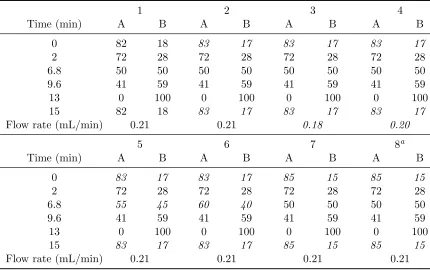
Table 2.1: Gradient program and flow rate for the eight experiments. Shown are the
proportion of 0.1% phosphoric acid aqueous solution (A) and acetonitrile (B) in the
mobile phase and the timings of the changing of relative proportions along with the flow rate of the mobile phase. The italicized values indicate the altered parameters in comparison to those in condition 1.
1 2 3 4
Time (min) A B A B A B A B
0 82 18 83 17 83 17 83 17
2 72 28 72 28 72 28 72 28
6.8 50 50 50 50 50 50 50 50
9.6 41 59 41 59 41 59 41 59
13 0 100 0 100 0 100 0 100
15 82 18 83 17 83 17 83 17
Flow rate (mL/min) 0.21 0.21 0.18 0.20
5 6 7 8a
Time (min) A B A B A B A B
0 83 17 83 17 85 15 85 15
2 72 28 72 28 72 28 72 28
6.8 55 45 60 40 50 50 50 50
9.6 41 59 41 59 41 59 41 59
13 0 100 0 100 0 100 0 100
15 83 17 83 17 85 15 85 15
Flow rate (mL/min) 0.21 0.21 0.21 0.21
aTime at which last two concentration changes occur at 12 and 14 minutes, respectively
For each of the eight experimental conditions, we analyze three samples of rhubarb via
HPLC. The conditions are constructed by varying the gradient program and flow rate
as described in Table 2.1. Each sample is run using the ACQUITY BEH C18column
held at 30 degrees Celsius. The wavelength of the UV detector is set at 260 nm. The
The observed total retention times ranged from 14.0021 to 16.0025 minutes. The
observed vectors for conditions 1–8 were of respective lengths {19200, 18000, 18000,
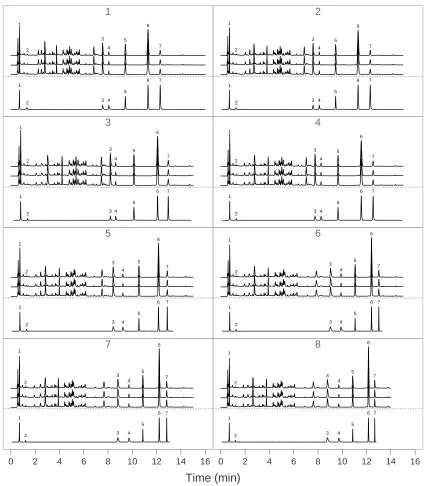
18000, 18000, 18000, 18000, 16800}. Figure 2.1 displays the chromatograms for the
24 samples. To illustrate the ability to identify compounds across different conditions
using the fingerprint of a set of known compounds under one single condition, we also
analyzed a mixture of seven compounds known to be in rhubarb under condition 1
(Ye et al., 2007) and the resulting chromatogram is displayed in Figure 2.1. The 7
known compounds are (1) gallic acid, (2) catechin, (3) aloe-emodin, (4) rhein, (5)
emodin, (6) chrysophanol, and (7) physcion.
2.3. Model
Let yijk be observation k from chromatogram j in experimental condition i at time
pointtijk, where we assume without loss of generality thattijk ∈[0,1],i= 1,2, . . . , n,
j = 1,2, . . . , m, k = 1,2, . . . , Li. Our model is
yijk =f(τijk) +eijk, τijk =g(tijk,bi) (2.1)
wheref is an unknown spiky function,τijk is the warped time relating totijkvia some
smooth monotonic function g, indexed by unknown condition-level parameter vector
bi, andeij = (eij1, . . . , eijLi)
T is the vector of measurment errors for chromatogramj
with mean 0 and covariance matrix σ2V
i(θ), where θ is a vector of unknown
param-eters and σ2 is an unknown scale parameter. V
i depends on ithrough its dimension.
In this chapter we assume equal number of experiments per condition and each
ex-periment within a condition are observed on the same time vector, however these
assumptions can be relaxed.
1 2 3 4 5 6 7 1 1
2 3 4
5 6 7 1 2 3 4 5 6 7 2 1
2 3 4
5 6 7 1 2 3 4 5 6 7 3 1
2 3 4
5 6 7 1 2 3 4 5 6 7 4 1
2 3 4
5 6 7 1 2 3 4 5 6 7 5 1
2 3 4
5 6 7 1 2 3 4 5 6 7 6 1
2 3 4
5 6 7 1 2 3 4 5 6 7 7
0 2 4 6 8 10 12 14 16
1
2 3 4
5 6 7 1 2 3 4 5 6 7 8
0 2 4 6 8 10 12 14 16
1
2 3 4
5 6 7
Time (min)
basis, that is f(τijk) =Pps=1xs(τijk)βs, where xs(τijk) is the sth spline wavelet basis
function evaluated atτijk andβsis the corresponding unknown basis function
param-eter. In wavelet bases, thexsestimate oscillations in the observed signal at particular
dyadic scales and integer translates for different s. Battle-Lemari´e spline wavelets
possess a number of attractive properties such as orthogonality, regularity, vanishing
moments, symmetry, and a closed-form expression (Daubechies, 1992; Unser, 1997).
Some common examples of parametric models for the warping functions include:
a linear combination of polynomial functions g(tijk,bi) = PQq=0bqtqijk. By setting
bq = 0 for q > 1 we get the location and scale functions as in shape-invariant and
self-modeling regression models (Lawton et al., 1972). A more flexible example is a
linear combination of B-splines: g(tijk,bi) = Bq,r(tijk)bi,whereBq,r(tijk) is the 1×Q
design matrix of B-spline basis functions of orderq and knot sequencer evaluated at
tijk (Brumback and Lindstrom, 2004). We focus on estimation using B-splines with
a uniform knot sequence in the current chapter.
The time warping functions are constrained to be monotonic so that no time point
in the original scale is mapped to more than one time point in the warped scale.
B-splines are a convenient choice of basis as imposing monotonicity in the warping
functions can be accomplished by imposing monotonicity in the B-spline coefficients
(Schumaker, 2007, chap. 4.9). Numerically, we can either invoke inequality
con-straints for eachior reparametrize the sequential increments of the coefficients by an
exponential transformation resulting in a sequence of increasing B-spline coefficients.
That is, for condition i, letting bil be the lth parameter for condition i, we set
where δij ∈ (−∞,∞), j = 2, . . . , Q. As with most wavelet bases, a boundary
con-straint must also be placed on the wavelet basis, such as periodicity or symmetry.
As such, a further constraint must be placed on the B-spline coefficients to maintain
identifiability of the warped time vector. For example, assuming periodic wavelets,
we can constrain bi1 to be in [−0.5,0.5] to ensure identifiability. This can be
accom-plished by letting bi1 = exp(δi1)/(1 + exp(δi1))−0.5 where δi1 ∈ (−∞,∞). While
there is a monotonic constraint among the B-spline coefficients, we do not need to
consider explicit constraints in estimating δi1,· · · , δiQ.
To set a particular experimental condition as the reference time scale, we set the
warping function parameters of one condition to correspond to the 45 degree line,
which denotes no warping. For example, for cubic B-splines with k uniform knots,
the coefficients for the reference condition are equal to {0,1/(3k−3), . . . ,3z/(3k−
3), . . . ,(3k−4)/(3k−3),1}, for z = 1, . . . k−2. Without loss of generality, we select
condition 1 as the reference condition.
Thus (2.1) can be expressed as:
yijk = p
X
s=1
xs{τijk}βs+eijk, τijk =Bq,r(tijk)bi (2.2)
As we wish to restrict the number of parameters to be less than the number of data
points per curve, p should be less than min(Li)−Q(n−1). Thus the total number
2.4. Estimation
Let yij = (yij1, . . . , yijni)
T, t
ij = (tij1, . . . , tijni)
T, and b
i = (bTi1, . . . ,bim)T. The
penalized weighted least squares criterion is:
1 2σ2
n X i=1 m X j=1
yij − p
X
s=1
xs{g(tij,bi)}βs
!T
Vi−1(θ) yij − p
X
s=1
xs{g(tij,bi)}βq
! +λ p X j=1 ˆ
wj(|βj|)
(2.3)
where ˆwj are data-driven weights, andλis a tuning parameter for the Adaptive Lasso
penalty which controls the amount of shrinkage. We use ˆwj = |βˆjNLS|−1 where ˆβjNLS
is the unpenalized, nonlinear weighted least squares estimator of βj as it is a root-n
consistent estimator of ˆβj (Jennrich, 1969).
Letting b = (bT
2, . . . ,bTn)T, computation can be greatly simplified by setting λ
∗ =
σ2λ, and noting that for fixed b = ˆb and θ = ˆθ, solving (2.3) for β simplifies to a
penalized least squares problem with the Adaptive Lasso penalty:
ˆ
β= arg min
β
yij∗ −
p
X
s=1
x∗s{g(tij,bˆi)}βs
2 2 +λ∗ p X j=1 ˆ
wj(|βj|)
(2.4)
where y∗ij = Vi−1/2( ˆθ)yij and xs(·)∗ = V
−1/2
i ( ˆθ)sxs(·) where V
−1/2
i (θ)s is the sth
row of Vi−1/2(θ). Minimizing (2.4) can be accomplished using standard algorithms
for `1-penalized regression (Zou, 2006). For fixed β = ˆβ and θ = ˆθ, using the
reparameterization of bi described in the previous section, solving (2.3) for b is
δ = (δ21, . . . , δ2Q, . . . , δn1, . . . , δnQ)T:
ˆ
δ = arg min
δ n X i=1 m X j=1
y∗ij −
p
X
s=1
x∗s(g{tij,δi)}βˆs
2 2 (2.5)
Similarly, for fixed β = ˆβ and b = ˆb, solving (2.3) for θ is also an unpenalized
nonlinear least squares problem:
ˆ
θ = arg min
θ n X i=1 m X j=1
Vi−1/2(θ) yij − p
X
s=1
xs(g{tij,bˆi)}βˆs
! 2 2 (2.6)
Hence we propose the following iterative back-fitting algorithm to estimateβ,b, and
θ:
At iteration k:
1. Fix the b and θ at their estimates from iteration (k−1), denoted b(k−1) and
θ(k−1). Solve (2.4) for β, obtaining ˆβ(k−1).
2. Fixβ at ˆβ(k−1) from step 1 and θ atθ(k−1). Solve (2.5) for δ, obtaining ˆδ(k−1)
and ˆb(k−1).
3. Fixβ at ˆβ(k−1) and bat ˆb(k−1) from steps 1 and 2, respectively. Solve (2.6) for
θ, obtaining ˆθ(k−1).
Iterate steps 1–3 until convergence. At convergence, estimate σ2 via
ˆ
σ2 = 1
mPn
i=1Li n X i=1 m X j=1
Vi−1/2( ˆθ) yij − p
X
s=1
xs{g(tij,bˆi)}βˆs
! 2 2 (2.7)
The algorithm as a whole minimizes the unified criterion, (2.3), and by using line
algorithm (Tseng, 2001).
Convergence of the back-fitting algorithm depends on good initial estimates.
Specif-ically, the algorithm requires good initial estimates of the warping function
parame-ters. One method for obtaining initial estimates is to set λ = 0 and solve (2.3). In
this situation, (2.3) is an unpenalized nonlinear least squares problem. As standard
nonlinear least squares procedures are iterative, initial estimates of the warping
func-tion parameters are necessary for this step, as well. These can be obtained by first
estimating the warping functions via dynamic time warping (Kassidas et al., 1998;
Giorgino, 2009) and then modeling the estimated warping functions using monotonic
B-splines.
It is important to note that since the bi are updated at each iteration, the wavelet
basis design matrix also changes at each iteration. The adaptive weights, |βˆNLS|−1,
are calculated at the initial estimation step using the unpenalized estimates and are
kept constant throughout the estimation procedure.
The estimates obtained from (2.3) depend on the particular value of the tuning
parameter, λ, as the proposed back-fitting algorithm is for a fixed λ. Numerous
techniques to choose the optimal value of λ exist with varying degrees of properties.
In penalized least squares problems with the smoothly clipped absolute deviation
(Fan and Li, 2001) chosen as the penalty, it has been shown that BIC consistently
chooses the correct model (Wang et al., 2007). This results follows when using the
Adaptive Lasso. We use the BIC to choose the optimal value of λ.
Our proposed method does not require normality. In practice, when applying our
procedure to chromatographic data, we have found that the tails of the distribution of
the Lasso to fat-tailed errors has been studied previously. Finite sample performance
is affected by fat tails, however Fan et al. (2013) showed that Lasso estimates retain
sign consistency if the signal is large enough. Bunea and Gupta (2010) and Sang
and Sun (2012) consider Lasso and SCAD estimates under correlated data, including
auto-regressive errors, and show that their asymptotic properties are still valid. As
chromatograms exhibit a large signal-to-noise ratio and contain thousands of data
points, heavy-tailed errors should not pose a problem in practice.
The model estimates possess attractive sampling properties. As in Zou (2006), we
assume, without loss of generality, that there is ap0 < p such that|βk|>0 fork ≤p0
and βk = 0 for p0 < k ≤ p. Thus the true active set of β, A, is {1,2, . . . p0}. Let
ˆ
An = {j : ˆβj = 06 } be the estimated active set of β, where ˆβj is the estimate of βj
from the adaptive lasso criterion.
Theorem 1. Let ψ = (θT,bT,βT)T and ψA = (θT,bT,βTA)T. Under the regularity
conditions described in Fan and Li (2001); Zhang and Lu (2007); Bunea and Gupta
(2010), the estimates obtained by minimizing (2.3) satisfy the following:
1. limn→∞P( ˆAn =A) = 1.
2. √n( ˆψA−ψA)→ N(0, σ2C−1).
where n1 P
if(ψA)V
−1(θ)f(ψ
A)T →C.
The proof of Theorem 1 follows very closely to the corresponding proofs in Fan and
Li (2001); Zhang and Lu (2007); Bunea and Gupta (2010), so it is omitted. Theorem
1 shows that the adaptive lasso estimators obtained from (2.3) are variable selection
consistent, root-n consistent, and asymptotically normal. Thus, the estimators
pos-sess the oracle property (Donoho and Johnstone, 1994). The root-n consistency is
parameter coefficients. The asymptotic normality of the estimates enables the
con-struction of asymptotic confidence intervals for the estimated fingerprint and warping
functions which reflect the combined variability in estimatingβ,b, and θjointly. For
example, by taking a Taylor expansion off about the true value ofψ, we estimate the
approximate asymptotic variance for the estimated fingerprint as ˆσ2s( ˆψ)C−1s( ˆψ)T,
where s( ˆψ) = ∂f( ˆψ)/∂ψ.
2.5. Application to Data Example
We applied (2.2) to the rhubarb chromatographic dataset described in Section 2.2.
For computational efficiency, we subsampled the data such that the data vectors
for the eight conditions were of respective lengths {2743, 2572, 2572, 2572, 2572,
2572, 2572, 2400}. The observed time vectors were mapped to [0,1] by setting the
maximum observed time, 16.0025 min., to 1.
Spline wavelets can be evaluated at any arbitrary time point, however the
compu-tation involves nested summations of many terms, so for compucompu-tational speed, we
computed the design matrix at arbitrary time points using the following procedure:
a reference design matrix is evaluated on a grid of 217 time points in [0,1]. Design
points are computed via a table-look-up and for time values not in the reference design
matrix, interpolation between adjacent points is used. We chose the finest wavelet
scale to be 10, resulting in 2048 basis functions where the 2i,2i+ 1, . . . ,(2i+1−1)th
functions correspond to the wavelet basis functions at scalei. The finest level wavelet
scale is chosen based on the data so that the resolution is fine enough to capture the
narrowest spikes. We assume periodic boundary conditions for convenience.
To model the warping functions, we used monotonic cubic B-splines with 14
appears to work well for a moderate amount of warping. We assume a first-order
auto-regressive correlation structure, thusθ is a scalar, denotedθ, and represents the
correlation between points one unit of time apart.
The algorithm was written in MATLAB and run on an Intel Xeon CPU E7-4860.
For each value of λ, the algorithm converged in less than five outer iterations, and
finished, on average, in 10 minutes. The adaptive lasso parameterλ, found using BIC
and a golden search algorithm, was 0.489. The estimated variance of the measurement
error was 1.24×10⁻³ and the estimate for θ was 0.698.
0 2 4 6 8 10 12 14 16
0.0
0.2
0.4
0.6
0.8
1
2
3
4 5
6
7
Time (min)
Intensity (A
U)
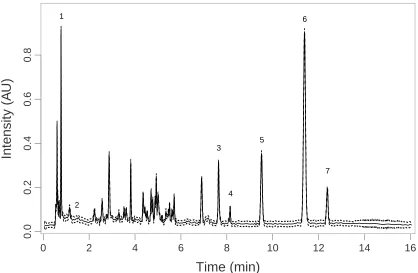
Figure 2.2: Population averaged fingerprint (solid) from the estimates along with 95% confidence bands (dashed). Identified compounds are denoted: (1) gallic acid, (2) catechin, (3) aloe-emodin, (4) rhein, (5) emodin, (6) chrysophanol, and (7) physcion.
The population averaged estimate of the standardized chromatographic fingerprint
scale corresponds to the real time scale under condition 1. The population-averaged
curve captures the shape of the individual chromatograms quite well, resulted from
a good alignment across conditions. As the known compounds were analyzed under
condition 1, spike locations between the reference chromatogram and the estimated
fingerprint can be compared. The seven spikes that correspond to the known
com-pounds are labeled in Figure 2.2.
To identify the seven known compounds in other conditions, we use the inverse
es-timated warping functions to warp the reference chromatogram in condition 1 to
the time scale of each other condition. The estimated reference chromatograms are
displayed in Figure 2.1 along with the raw data. By comparing with the estimated
ref-erence chromatograms, the seven known compounds are identified in each condition.
These also show that we are able to estimate each warping function accurately.
The final estimate of the fingerprint shape contained 427 nonzero wavelet coefficients,
while the remaining 1621 were shrunk to 0. This highlights the sparse nature of the
fingerprint shape as a little more than 79% of the wavelet basis functions are
irrele-vant. The confidence intervals for the fingerprint can be used to determine whether
a spike is artificial or real based on whether the corresponding confidence interval
contains 0 or not. For example, the amplitude of the spike corresponding to catechin
is small however the confidence interval at the peak of the spike is [0.014,0.044],
suggesting it is present in rhubarb, which coincides with previous research (Ye et al.,
2007).
The groups of tightly-packed spikes located between 4 and 6 minutes in the fingerprint
can either correspond to single compounds or multiple compounds which were not
well separated in the HPLC column. If we wished to identify the compounds in this
that these particular compounds are better separated and travel through the column
at more distinct velocities. This would result in more spacing among spikes in this
region of the chromatograms.
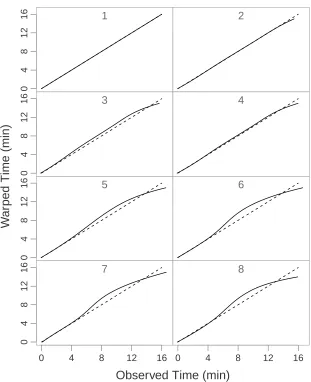
Figure 2.3 displays the estimated warping function for each of the eight conditions.
Confidence intervals were computed for the warping functions however due to the
low variance of the B-spline coefficients (Var(bi) ∼ O(10−4)), the bands are visually
indistinguishable from the estimated warping functions. The low order of variance is
due to the large effective sample size.
The estimated warping functions represent the distortion in retention time of
condi-tions 2–8 in comparison to condition 1. The relative proporcondi-tions of phosphoric acid
and acetonitrile differs by only 1% at time 0 between conditions 1 and 2, and this
difference caused little to no warping, as evidenced by the estimated warping
func-tion of condifunc-tion 2. Conversely, a 3% change, as in condifunc-tion 7, results in substantial
warping after minute 4. The estimated warping functions for conditions 3 and 4 in
comparison to those for conditions 5–8 suggest that flow rate does not have quite as
large of an impact on retention time as the composition of the mobile phase.
2.6. Simulation
A vast number of mathematical functions have been proposed to simulate
chromato-graphic data (Di Marco and Bombi, 2001). One such example is the Laplace
distribu-tion funcdistribu-tion. We simulated the true fingerprint shape by overlaying a fixed number
of spikes, where each spike was generated via f(t) =aexp(−|t−c|/b)/(2b) where a
controls the amplitude of the spike,cthe location of the maximum of the spike, andb
is a scale parameter, affecting the width and tails of the spike. We used twelve spikes
1
0
4
8
12
16 2
3
0
4
8
12
16 4
5
0
4
8
12
16 6
7
0 4 8 12 16
0
4
8
12
16 8
0 4 8 12 16
Observed Time (min)
W
ar
ped Time (min)
Figure 2.3: The estimated warping functions (solid) along with the 45 degree line denoting no warping for each condition (dashed).
were generated from a N(20,25) distribution and the scale parameters were sampled
with replacement from the set {0.45,0.50, . . . ,0.75}.
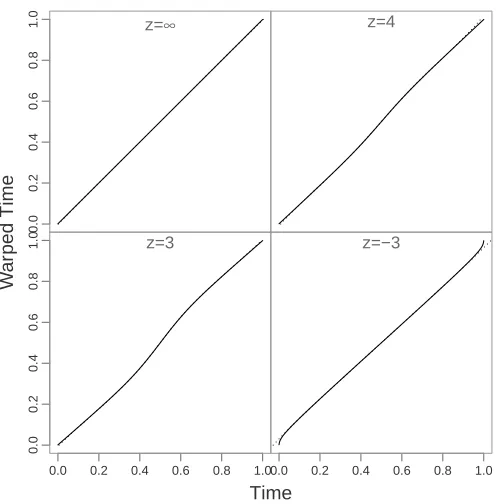
To simulate time warping similar to those seen in the rhubarb data, the time warping
functions were generated by the following logistic function, g(t) = [1 + exp(−14t+
7))]−1. The point-wise mean betweeng(t) and the 45 degree line, denoting no warping,
can be iteratively calculated to generate warping functions with similar shape, but
the function and the 45 degree line, then the warping function deviates less from the
45 degree line as z increases and converges to the 45 degree line as z → ∞. The
inverse logistic function was used to generate one warping function with a mirrored
shape to the rest. For notational brevity, a negative value ofzcorresponds to iterated
averaging the 45 degree line with the inverse logistic function z times.
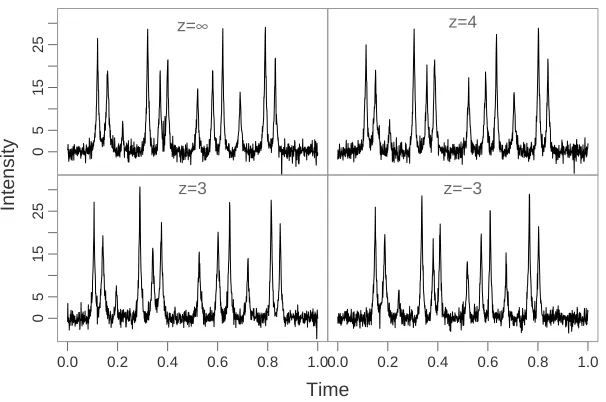
A set of four warping functions were generated using z ={∞,4,3,−3}, representing
four different experimental conditions, and the warping functions were estimated
us-ing three, four, and five uniform knots. For each condition we generated 4 fus-ingerprints
sampled on 1000 equispaced time points in [0,1]. We added t-distributed noise, with
9 degrees of freedom, to each curve. The t-distribution was used as it has longer tails
than the normal distribution. Figure 2.4 displays an example of a noisy fingerprint
from each condition.
For comparison, we also fit a two-step model where the first step used dynamic time
warping to align the curves and the second applied a wavelet thresholding to the
aligned curves and averaged across the curves to obtain the population averaged
fingerprint. The dynamic time warping step was accomplished using the ‘dtw’
pack-age in R (Giorgino, 2009) and the wavelet thresholding was performed using the
‘wavethresh’ package in R (Nason, 2008). We simulated 100 datasets and performed
the four methods on each set.
The proposed model was fit using 29 = 512 cubic Battle-Lemari´e spline wavelet basis
functions to model the shape and cubic B-splines to model the warping function.
For each value of λ, our algorithm converged in less than five outer iterations and
finished, on average, in 40 seconds. We also used 512 cubic Battle-Lemari´e spline
wavelets for the two-step method and the Bayesian approach of Abramovich et al.
z=∞
0
5
15
25
z=4
z=3
0.0 0.2 0.4 0.6 0.8 1.0
0
5
15
25
z=−3
0.0 0.2 0.4 0.6 0.8 1.0
Time
Intensity
Figure 2.4: Simulated warped curves with 12 peaks and additive t-distributed noise. The curve was generated using the Laplace distribution function and the warping functions were generated by logistic and inverse-logistic functions.
To assess the fits, boxplots of the mean squared error (MSE) between the true and
estimated fingerprints were used, which are displayed in Figure 2.5. First, the
pro-posed 4- and 5-knot models performed the best. The 3-knot model performed the
worst of the four methods. This is due to the fact that three knots does not provide
enough flexibility in capturing the shape of the warping functions. The boxplots
suggest that by estimating the warping function using B-splines with at least four
uniform knots, the degree of the warping does not appear to affect the MSE in any
substantial way. The two-step approach does not perform as well as the proposed
4-and 5-knot models, though it outperforms the 3-knot model.
Figure 2.6 displays the mean of the estimated warping functions across all 100
sim-ulations for the proposed 4-knot model overlaid on the true warping functions. The
proposed model with four knots estimates the true warping functions well except at
the ends of the tails, where there is slight deviation. Though we only consider
function, our simulation shows that a large amount of flexibility is not required for
quality performance of the modeling procedure.
SSNM3 SSNM4 SSNM5 2−step
0.2 0.4 0.6 0.8
Method
Mean Squared Error
Figure 2.5: Boxplots of the mean square error of the estimated fingerprints for the proposed procedure using 3-, 4-, and 5-knots and the two-step procedure using dy-namic time warping and wavelet thresholding.
2.7. Discussion
We have proposed a sparse semiparametric nonlinear model for the registration of
chromatographic data and establishment of a standardized fingerprint. The common
shape of the chromatograms is modeled via data-driven basis expansion. Curve
reg-istration is accomplished by parametric modeling of the time warping functions. As
chromatograms are sparsely-structured curves, we impose the adaptive lasso penalty
on the common shape basis function parameters to induce sparsity in the estimated
fingerprint. A unified penalized weighted least squares criterion is minimized to
z=∞
0.0
0.2
0.4
0.6
0.8
1.0 z=4
z=3
0.0 0.2 0.4 0.6 0.8 1.0
0.0
0.2
0.4
0.6
0.8
1.0 z=−3
0.0 0.2 0.4 0.6 0.8 1.0
Time
W
ar
ped Time
Figure 2.6: True (solid) and mean of 100 estimated warping functions (dashed) using 4 uniform knots.
shape, and estimate the model parameters. From the penalized criterion naturally
arises a back-fitting algorithm which is equivalent to a blockwise coordinate descent
algorithm. The unified criterion results in a unique solution and allows the study of
asymptotic properties, as opposed to two-step methods which can guarantee neither.
Our resulting estimators possess the oracle property.
We applied our model to a chromatographic dataset of the TCHM, rhubarb. Our
model was effective in establishing a standardized fingerprint of rhubarb based on
chromatograms arising from different experimental conditions. A sample of known
compounds was analyzed under a single condition to identify compounds in the
fin-gerprint. We demonstrated that known compounds need only be analyzed under
a single condition, substantially decreasing both time and cost of chromatographic
We use BIC to select the tuning parameterλhowever other tuning parameter selection
techniques such as AIC, GCV, and Stein’s unbiased risk exist, and in our simulations,
performed similarly. We have focused the discussion on modeling the common shape
using a linear combination of wavelet basis function and the warping functions using
monotonic B-splines, however the proposed model can be easily extended to include
multiple population average curves or in the situation that the observations relate to
CHAPTER 3
Semiparametric Nonlinear Mixed Effects Models for
Sparsely-Structured Functional Data
3.1. Introduction
Functional data arise in numerous applications in pharmacological, environmental,
and biomedical research including chromatographic, weather pattern, biomarker, and
growth hormone studies. The cornerstone of functional data analyses is viewing the
observed data as samples of unknown functions and modeling the data as curves. A
common objective in functional data analyses is aligning data curves and estimating
and comparing their structures, such as spikes.
Our research is motivated by a study of the chemical composition of the medicinal
herb, Andrographis paniculata. Medicinal herbs have been used for the treatment
of a number of medical ailments for thousands of years (Duke, 2002; Chao and Lin,
2010). As the exact chemical composition of an herb differs based on its particular
species and origin, properties of the seed and field used to grow the herbs, and the
particular processes used in the growing, harvesting, and storage of the herbs (Leung
and Cheng, 2008), tools and methodologies for composition determination and the
identification of compounds not shared between, say, production sites are vital for
the quality control of herbal medications.
High Performance Liquid Chromatography (HPLC), which is a set of techniques to
separate compounds of biological mixtures, has played a large role in medicinal herb
characterized by a number of spikes, where each spike corresponds to a particular
compound in the herb. Since the location of spikes in the curve can be used to identify
the compounds and the chemical composition is unique to an herb, chromatograms
provide a fingerprint of an herb. Consider Figure 3.1 which displays chromatograms
of samples of Andrographis paniculata collected from two types of production sites:
five sites which comply with Good Agricultural Practices (GAP) and five pharmacies
whose GAP compliance unknown and analyzed using HPLC. The objective of the
study is to compare the compositions of samples between the two groups, GAP
and pharmacy, or market sites, and identify compounds present in one group of
herbs but not the other. The presence of any discordant compounds will suggest
deficiencies in the production processes of the market sites. Further details regarding
GAP are described in Section 3.4. Through HPLC, comparing compositions between
GAP and market herbs amounts to comparing their group-averaged chromatographic
fingerprints.
However, a number of characteristics of chromatograms evident in Figure 3.1
im-pede the direct establishment of chromatographic fingerprints and their comparison.
First, spiky curves, such as chromatograms, are not well estimated by parametric
functions. This common issue in functional data analyses can be addressed by
ex-panding the curve into some basis system such as splines or wavelets (Ramsay and
Silverman, 2005). Second, due to differing experimental and environmental
condi-tions, the timings of spikes in chromatograms often vary across experiments. The
site-level transformations of the curves induce misalignment of spikes and prevent
the establishment and comparison of group-averaged curves. Curve registration is a
set of methodologies in which features of interest are aligned by warping the
0 10 20 30 40 50 0 10 20 30 40 50
Time (min)
is accomplished by modeling the unknown, monotonic time warping function within
the basis expansion of the fingerprint shapes, as in shape-invariant and self-modeling
regression models (SEMOR) models (e.g. Lawton et al., 1972; Ke and Wang, 2001;
Brumback and Lindstrom, 2004). Since there are a large number of production sites
under study and the number of parameters in SEMOR models increases with the
number of sites. Thus, along with the fact that we wish to compare group-averaged
curves while taking into account the correct sources of variability, warping function
parameters should be modeled as random (Ke and Wang, 2001; Guo, 2002). Thus,
curve registration offers a flexible, nonlinear framework to align and estimate spikes.
Finally, thousands of data points are collected per chromatogram but the curves
exhibit only a small number of sharp, narrow spikes. The large sections of the curves
between spikes are flat and do not contain meaningful signal. Due to their sparse
nature, estimating curves via basis expansion results in the irrelevancy of a large
number of basis functions as they correspond to the flat section and are merely
estimating noise. As their true coefficient value is 0, these superfluous variables
need to be excluded to avoid overfitting. As such, identifying, or selecting, important
functions while leaving out irrelevant functions is a necessary component to modeling
sparsely-structured functional data. As we wish to select the functions whose true
coefficient values are not equal to zero, this falls within the model selection framework.
There exist numerous methods for the analysis of chromatographic data. For
exam-ple, Morris et al. (2008) model mass spectrometry data, which is similar in nature to
chromatographic data, using a wavelet-based functional mixed effects model
(Mor-ris and Carroll, 2006). The model is an extension of the functional mixed effects
models of Guo (2002) to the sparsely-structured setting and can accommodate a
levels of nested structures. However the models of Guo (2002); Morris and
Car-roll (2006); Morris et al. (2008) are linear in the mixed effects and so data which
exhibit subject-specific transformations of the common shape functions cannot be
adequately modeled within these frameworks. Much like most current methods for
chromatographic data, Morris et al. (2008) circumvents this issue by aligning curves
in a pre-processing step. By aligning individual curves and estimating mean curves
in separate steps, the variability in the alignment step is ignored in the second step.
Thus variance estimates, which do not account for both phase and measurement error
variability, will be incorrect and valid statistical inference cannot be drawn. A model
which allows for the mixed effects to enter into the model nonlinearly is needed.
Ke and Wang (2001) proposed a general class of semiparameteric nonlinear mixed
effects models (SNMM), which includes extensions of nonlinear mixed effects and
SEMOR models. SNMMs can handle numerous curve shapes encountered in practice
and allow for nonlinearity in the mixed effects specification. Ke and Wang (2001)
pro-pose estimating the mean functions nonparametrically with parametrically-specified
covariates using a double-penalized likelihood criterion. They propose an iterative
back-fitting estimation algorithm where the first step estimates the shape function
via smoothing splines and the second estimates fixed and random effects and variance
components via a nonlinear mixed effects model through linearization of the
likeli-hood about the random effects. However, the second step of the estimation algorithm
in Ke and Wang (2001) ignores the fact that the random effects are allowed to enter
into the shape functions (Lin and Zhang, 2001; Elmi et al., 2011). As shown in Lin
and Zhang (2001), their estimation procedure is equivalent to a two-step procedure
in which each step fits a separate mixed effects model. As the two mixed effects