Preterm Cognitive Function Into
Adulthood
Linda D. Breeman, PhDa, Julia Jaekel, PhDa,b, Nicole Baumann, BSca, Peter Bartmann, MD, Dr rer natc, Dieter Wolke, PhD, Dr rer nat hca,d
abstract
BACKGROUND:Very preterm (VP; gestational age,32 weeks) and very low birth weight (VLBW;,1500 g) births are related to impaired cognitive function across the life span. It is not known how stable cognitive functions are from childhood to adulthood for VP/VLBW compared with term-born individuals and how early adult cognitive function can be predicted.
METHODS:The Bavarian Longitudinal Study is a prospective geographically defined cohort study that followed 260 VP/VLBW and 229 term-born individuals from birth to adulthood. Data on cognitive function were assessed with developmental and IQ tests at 5 and 20 months and at 4, 6, 8, and 26 years of age.
RESULTS:Across all assessments, VP/VLBW individuals had significantly lower IQ scores than term-born controls, even when individuals with severe cognitive impairment (n= 69) were excluded. IQ scores were found to be more stable over time for VP/VLBW than term-born individuals, yet differences in stability disappeared when individuals with cognitive impairment were excluded. Adult IQ could be predicted with fair certainty (r.0.50) from age 20 months onward for the whole VP/VLBW sample (n= 260) and from 6 years onward for term-born individuals (n= 229).
CONCLUSIONS:VP/VLBW individuals more often suffer from cognitive problems across childhood into
adulthood and these problems are relatively stable from early childhood onward. VP/VLBW children’s risk for cognitive problems can be reliably diagnosed at the age of 20 months. These findings provide strong support for the timing of cognitive follow-up at age 2 years to plan special support services for children with cognitive problems.
WHAT’S KNOWN ON THIS SUBJECT:Children born very preterm (VP) or with very low birth weight (VLBW) are at risk for cognitive deficits and low IQ in childhood. Recent evidence indicates that IQ discrepancies between VP/VLBW and term-born individuals are still found in adulthood.
WHAT THIS STUDY ADDS:Development of cognitive function is more stable for VP/VLBW than term-born individuals from infancy into adulthood and can be predicted fairly well from age 20 months onward. However, when adults with cognitive impairment are excluded, group differences in stability disappear.
aDepartment of Psychology, anddDivision of Mental Health and Wellbeing, Warwick Medical School, University of
Warwick, Coventry, United Kingdom;bDepartment of Developmental Psychology, Ruhr-University Bochum, Bochum,
Germany; andcDepartment of Neonatology, University Hospital Bonn, Bonn, Germany
Dr Breeman conceptualized and designed the study, drafted the initial manuscript, and analyzed and interpreted the data; Drs Jaekel and Bartmann and Ms Baumann conceptualized and designed the study, and reviewed and revised the manuscript; Dr Wolke conceptualized and designed the study, coordinated and supervised data collection and analysis, interpreted the data, and reviewed and revised the manuscript; and all authors approved of thefinal manuscript as submitted. www.pediatrics.org/cgi/doi/10.1542/peds.2015-0608
DOI:10.1542/peds.2015-0608 Accepted for publication Jun 11, 2015
Address correspondence to Dieter Wolke, PhD, Department of Psychology, University of Warwick, Coventry CV4 7AL, United Kingdom. E-mail: [email protected]
PEDIATRICS (ISSN Numbers: Print, 0031-4005; Online, 1098-4275). Copyright © 2015 by the American Academy of Pediatrics
FINANCIAL DISCLOSURE:The authors have indicated they have nofinancial relationships relevant to this article to disclose.
FUNDING:Supported by grants PKE24, JUG14, 01EP9504, and 01ER0801 from the German Federal Ministry of Education and Science (BMBF).
Impaired cognitive function is the most common neurologic impairment in infants born very preterm (VP; gestational age [GA],32 weeks) or with very low birth weight (VLBW;
,1500 g). VP/VLBW children and
adolescents have an increased prevalence of cognitive deficits1–3 and recent evidence indicates that young VP/VLBW adults still have lower average IQ scores compared with those born at term.1,2,4–6It is, however, not known whether the same children who had cognitive deficits in childhood continue to have deficits in adulthood, as developmental tests in early childhood rely strongly on sensorimotor skills and may not accurately measure core cognitive ability.7Children’s test scores could thus improve or deteriorate over time, because later tests may assess different aspects of cognitive
function. Furthermore, early cognitive function may just set the stage for the next developmental phase rather than predicting cognitive function at later ages, whereas environmental influences, such as parenting or schooling, may lead to changes in cognitive function over time.7
VP/VLBW birth is associated with an increased risk of brain injury due to an amalgam of destructive and developmental mechanisms of the brain, including inflammation and ischemia that cause reduced white matter volume and ventricular dilation to name but a few.8–10These brain injuries can lead to altered brain development with persistent changes in intrinsic networks11,12 that may limit the neural plasticity of the brain13and overall cognitive function.14Adaptation to age-appropriate challenges may be a characteristic of developmental plasticity and has, so far, rarely been studied. Yet it has been found that diagnosis of developmental disability has poor stability for VP/VLBW infants across childhood.15Finally, prospective studies of cognitive function in VP/VLBW individuals are
necessary to determine how early it is possible to predict adult cognitive function with reasonable certainty. This is important for establishing optimal timing of early follow-up and planning of supportive measures and interventions.
We assessed VP/VLBW and healthy term-born comparisons from 5 months until 26 years of age and tested 3 research questions: Do VP/VLBW individuals outgrow their cognitive deficits into adulthood, indicated by mean differences in cognitive scores, compared with term-born individuals? Is cognitive function more stable and thus more early predictable from childhood to adulthood in VP/VLBW than term-born individuals? How early can we predict cognitive impairment in VP/VLBW adults?
METHODS
Design
The Bavarian Longitudinal Study is a prospective whole population study of VP/VLBW children born in a geographically defined area of Southern Bavaria (Germany) between January 1985 and March 1986 who required admission to 1 of 16 children’s hospitals within thefirst 10 days after birth. Healthy term-born comparisons were recruited in obstetric units in the same catchment area during the same period.16,17The current study uses data collected at 5 and 20 months, and at 4, 6, 8, and 26 years of age. The assessments at 5 and 20 months were at corrected age for prematurity for VP/VLBW participants. Original ethical approval was obtained from the University of Munich Children’s Hospital and the Landesärztekammer Bayern. Ethical approval for follow-up in adulthood was granted by the Ethical Board of the University Hospital Bonn (reference 159/09). Informed written consent was provided by parents within 48 hours of their child’s birth and all participants gave fully
informed written consent for the assessments in adulthood. In case of severe impairment of the adult participant, consent was provided by an assigned guardian (usually the parents).
Participants
This study assessed a whole population sample of 682 VP/VLBW individuals. Of this cohort, 411 VP/VLBW were presumed alive, living in Germany, and eligible for inclusion at 26 years of age, and 260 (63.3%) participated in the current study (seeflowchart in Fig 1). Of the eligible healthy term-born children (ie, born at 37–42 weeks of gestation, cared for on normal postnatal wards, and not transferred to a pediatric hospitals in thefirst 10 days after birth), 350 were randomly selected within 2 stratification variables (gender and family socioeconomic status [SES]) to be comparable with the VP/VLBW group. In adulthood, 308 term-born individuals were eligible for inclusion and 229 (74.4%) participated at 26 years (see Fig 1).
Cognitive Assessments
Cognitive functioning was assessed with standardized developmental test (DQ) and intelligence tests carried out by pediatricians (infancy) or psychologists (childhood, adulthood).
DQ at 5 and 20 months was assessed with the Griffiths Mental
Development Scale (GMDS),18,19 which assesses 5 dimensions of mental development: locomotor, personal-social development, hearing and speech, hand and eye
coordination, and performance. A total developmental quotient across the 5 domains was computed according to German norms.18 Satisfactory reliability and good construct validity of the GMDS have been demonstrated across different studies and cultures.20,21
(AWST), and the Beery-Buktenica Developmental Test of Visual-Motor Integration. The CMMS assesses reasoning ability of children between age 3 and 10 years22,23by testing whether the child is able to select the 1 drawing that is out of place from a series of drawings. The reliability for the CMMS is high17and has been shown a valid assessment of
nonverbal intelligence.23,24The AWST was developed for German-speaking countries and evaluated the expressive vocabulary of preschool children,25similar to the widely used and valid Peabody Picture Vocabulary Test26,27in which children are required to name the drawings depicted on item cards. The AWST has high reliability and good concurrent and prognostic validity.28 The Beery-Buktenica Developmental Test of Visual-Motor Integration assesses the integration of visual and motor abilities by asking children to copy drawings of geometric forms arranged in order of increasing difficulty29and has good reliability and validity.30,31To develop 1 general
IQ score, the raw scores of all 3 measures were first standardized on a normative sample with a mean of 100 and an SD of 15 (Cronbach’safor the 3 measures = 0.78) before they were averaged to 1 general IQ score at 4 years of age.
IQ at 6 and 8 years was assessed with the German version of the Kaufmann Assessment Battery for Children (K-ABC).32,33 A total IQ score was calculated from the sequential (3 subtests) and simultaneous (5 subtests) processing scales. Reliability (ie, range: 0.83–0.98, split-half method) and construct validity of the K-ABC are high (eg, correlation of 0.70 with the Wechsler Intelligence Scale for Children-Revised total score).33
IQ at 26 years was assessed with a short German version of the Wechsler Adult Intelligence Scale (WAIS III).34,35The 6 subtests were vocabulary, similarities, letter-number-sequence, block design, matrix reasoning, and digit symbol coding. Cognitive functioning scores
of the subtests were converted into age-normed Full-Scale IQ scores.36 The WAIS III is broadly used and a well-established measure of general cognitive abilities.35
Assessment of Demographic Characteristics
The assessment of demographic factors is described elsewhere in detail.17In short, family SES at birth was computed as a weighted composite score of parents’education and occupation and grouped as low, middle, or high.37Severe neurologic or neurosensory disability was determined in childhood according to the following criteria: suffering from grade 3 or 4 cerebral palsy,38 blindness, or deafness (not corrected or insufficiently corrected). GA (weeks); birth weight (kilograms); small for gestational age (SGA; ie, children with birth weight less than the gender-specific 10th percentile for gestational age); gender; multiple births (twins or other multiples); maternal age (years); and
prepregnancy, pregnancy, birth, and neonatal complications were coded from Bavarian perinatal survey forms at birth.39
Data Analysis
Descriptive statistics and analyses were performed in Mplus 7.3 (Muthén & Muthén, Los Angeles, CA). This program allows for the analysis of missing data by using full information maximum likelihood. All analyses were corrected for family SES, as this may affect cognitive abilities in both VP/VLBW and term-born individuals from the general population.36,40Statistical
significance was set atP,.05 and all tests were 2-tailed.
Differences between VP/VLBW and term-born individuals in mean IQ scores were assessed with analyses of covariance, and effect sizes are reported as Cohen’sdof the adjusted estimated means (ie, 0.20 small, 0.50 medium, and 0.80 large effects).41 Stability of continuous IQ scores was
FIGURE 1
assessed with Pearson correlations. To compare VP/VLBW and term-born comparisons, correlations were converted to Fisherz-scores with 95% confidence intervals. Effect sizes for the difference in magnitude between population correlations were calculated and interpreted according to Cohen’s guidelines as small (0.10), medium (0.30), and large effects (0.50). To assess how early one can reliably predict cognitive function in adulthood, correlations between childhood and adulthood IQ measures were examined and deemed clinically meaningful if correlations (r) were at least 0.50 (ie, a large correlation and explained variance [r2] of 25% in adulthood IQ). Analyses were repeated excluding individuals with severe cognitive impairment in adulthood (ie,–2 SD of term-born adults’mean IQ). For those
individuals with missing IQ scores at 26 years (15.5%), their latest available childhood IQ score with its associated,–2 SD cutoff criterion was used as a proxy for grouping these individuals.36Finally, to estimate how early cognitive impairment can be predicted in
VP/VLBW adults, point biserial correlations of developing a cognitive impairment in adulthood were calculated for each childhood IQ score, by using only participants with complete data available.
RESULTS
Sample Characteristics and Dropout
Compared with term-born individuals, VP/VLBW individuals were by definition born at earlier gestational age and weighed less. In addition, VP/VLBW individuals were more often SGA, more often multiple births, and more complications were recorded for mother and child before pregnancy, during pregnancy, during birth, and the neonatal period. VP/VLBW adults more often had been born to
socioeconomically disadvantaged families than their term-born
counterparts. The VP/VLBW and term-born individuals did not differ in terms of gender and maternal age (Table 1).
The VP/VLBW adult participants did not differ from VP/VLBW dropouts (n= 151) in terms of GA, birth weight, SGA, gender, multiple births, and complications before pregnancy, during birth, and the neonatal period.
However, VP/VLBW dropouts had younger mothers, were more often socially disadvantaged, and their mothers had more complications during pregnancy. The participating term-born individuals did not differ from term-born dropouts (n= 79) in terms of GA, birth weight, SGA, gender, multiple births, and mothers’ complications before pregnancy, during birth, and the neonatal period. However, the term-born dropouts had younger mothers, their mothers had more complications during
pregnancy, and they were more often socially disadvantaged.
Stability of Cognitive Functioning Into Adulthood
Raw means and 95% confidence
intervals of IQ scores over time are presented in Table 2. Across all time points, VP/VLBW individuals had lower IQ scores than term-born individuals. With the exception of the Griffiths assessment at 5 months, all corresponding ESs regarding corrected group differences in mean IQ scores were large.
Correlations between IQ scores in childhood and adulthood are shown in Fig 2 and exact estimates and test
TABLE 1 Demographics of Participating and Dropout VP/VLBW and Term-Born Individuals
Participants Dropouts
VP/VLBWn= 260 Term-Born,n= 229 Pa VP/VLBW,n= 151 Pb Term-Born,n= 79 Pc
M/ % 95% CI M/ % 95% CI M/ % 95% CI M/ % 95% CI
GA, wk, mean 30.6 30.3–30.9 39.7 39.5–39.8 ,.001 30.4 30.0–30.8 .50 39.6 39.4–39.9 .91 Birth weight, kg, mean 1.32 1.29–1.36 3.36 3.31–3.42 ,.001 1.27 1.22–1.31 .06 3.44 3.34–3.54 .19 SGA, % 41.5 35.5–47.5 10.0 6.2–13.9 ,.001 45.0 37.1–53.0 .49 10.1 3.5–16.8 .98 Females, % 46.9 40.9–53.0 53.3 46.8–59.7 .16 51.0 43.0–59.0 .43 40.5 29.7–51.3 .05 Maternal age, y, mean 28.9 28.3–29.4 29.1 28.5–29.7 .61 27.8 26.9–28.7 .05 27.5 26.3–28.7 .02 Multiple births, % 26.5 21.2–31.9 3.1 0.8–5.3 ,.001 22.5 15.9–29.2 .37 6.3 1.0–11.7 .21 Complications, mean
Prepregnancy 1.38 1.28–1.48 1.14 1.03–1.24 .001 1.27 1.13–1.40 .18 1.05 0.88–1.22 .40 Pregnancy 2.26 2.12–2.41 0.72 0.61–0.83 ,.001 2.61 2.41–2.81 .006 1.06 0.84–1.29 .007 Birth 4.65 4.48–4.82 2.11 1.92–2.31 ,.001 4.45 4.22–4.67 .16 2.16 1.82–2.51 .80 Neonatal 9.30 8.97–9.62 0.38 0.30–0.47 ,.001 9.53 9.09–9.96 .43 0.39 0.25–0.54 .93 SES, %
High 20.5 15.6–25.4 33.6 27.5–39.7 .001 18.5 12.3–24.7 .64 19.0 10.3–27.6 .02 Middle 47.1 41.0–53.2 42.8 36.4–49.2 .34 33.8 26.2–41.3 .009 30.4 20.2–40.5 .05 Low 32.4 26.7–38.1 23.6 18.1–29.1 .03 47.7 39.7–55.6 .002 50.6 39.6–61.7 ,.001
CI, 95% confidence interval.
results are shown in Table 3. Correlations were higher for
VP/VLBW than term-born individuals across all time points with
corresponding large ESs. Stability for different subdomains of intelligence can be found in the online
Supplemental Information 1. Cognitive function could be reliably estimated (r$0.50) in adulthood from age 6 years in term-born children and from age 20 months in VP/VLBW children.
Severe Cognitive Impairment
More than a quarter of VP/VLBW (n= 69, 26.5%) and 3.9% (n= 9) of term-born adults were diagnosed with severe cognitive impairment, based on mean and variance of term-born adult IQ scores. The right side of Table 2 shows the raw mean IQ
scores of VP/VLBW individuals with and without severe cognitive impairment. Once individuals with cognitive impairment were excluded,
VP/VLBW individuals’mean IQ
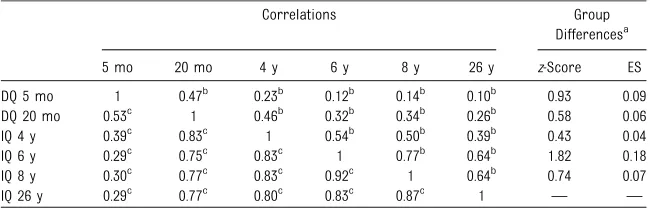
scores remained significantly lower than term-born individuals’mean IQ scores across all time points, yet ESs decreased to a medium to large range. Correlations between IQ scores in childhood and adulthood of VP/VLBW individuals with and without cognitive impairment and test results comparing VP/VLBW and term-born individuals without impairment are shown in Table 4. When individuals with impairment were excluded, differences between VP/VLBW and term-born individuals in stability of IQ scores disappeared. Finally, for VP/VLBW individuals, point biserial correlations between childhood IQ scores and having a cognitive impairment in adulthood were all in the medium to large range (5 months:r=–0.48; 20 months:
r=–0.64; 4 years:r=–0.63; 6 years:
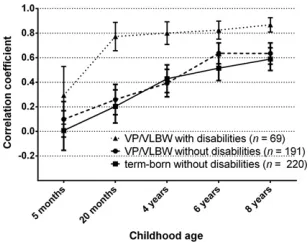
r=–0.67; 8 years:r=–0.71). In the online Supplemental Information 2, we also report on the performance of different subtests in discriminating adults who do and do not develop cognitive impairment. When VP/VLBW individuals were divided into those with and without severe cognitive impairment, those with cognitive impairment showed the highest stability in IQ scores (Fig 3). Of those 69 VP/VLBW adults with cognitive impairment, 53.6% (n= 37)
also had a diagnosis of a neurologic or neurosensory impairment in
childhood, yet additional analyses showed that this impairment by itself could not account for differences in IQ stability.
DISCUSSION
VP/VLBW individuals had significantly lower IQ scores than term-born individuals across all time points into adulthood. Approximately 1 in 4 VP/VLBW adults had a severe cognitive impairment and mean differences between VP/VLBW and term-born individuals in IQ scores were partly explained by those with cognitive impairment. IQ scores were consistently found to be more stable from childhood to adulthood in VP/VLBW than term-born individuals, yet this difference in stability
TABLE 2 Raw Means With Their 95% CI and Tests of Group Differences in Mean IQ Scores
VP/VLBW Whole Sample, n= 260
Term-Born Whole Sample, n= 229
ESa VP/VLBW With Impairment,n= 69
VP/VLBW Without Impairment,n= 191
ESb ESc
n Mean 95% CI n Mean 95% CI n Mean 95% CI n Mean 95% CI
DQ 5 mo 248 96.3 93.7–98.8 229 107.1 105.7–108.5 0.59 62 78.9 73.9–84.0 186 102.0 99.6–104.5 1.07 0.35 DQ 20 mo 244 93.7 91.4–96.0 229 106.9 106.0–107.7 0.86 59 73.6 67.5–79.7 185 100.1 98.7–101.5 1.45 0.81 IQ 4 y 230 87.2 84.8–89.6 228 101.8 100.5–103.2 0.85 53 66.0 61.4–70.7 177 93.5 91.6–95.5 1.39 0.68 IQ 6 y 218 87.2 85.1–89.3 229 102.0 100.5–103.4 0.92 52 68.4 64.2–72.6 166 93.1 91.4–94.8 1.52 0.81 IQ 8 y 233 90.3 88.2–92.5 227 102.0 100.7–103.3 0.76 55 69.1 64.6–73.6 178 96.9 95.4–98.4 1.60 0.56 IQ 26 y 216 86.2 83.6–88.9 197 102.6 100.9–104.4 0.77 58 59.4 55.9–62.9 158 96.1 94.4–97.8 1.79 0.55
Tests and ESs are corrected for socioeconomic status; all tests are significant withP,.001. CI, 95% confidence interval; ES, effect size. aComparison between whole VP/VLBW and term-born sample.
bComparison between VP/VLBW individuals with and without cognitive impairment. cComparison between VP/VLBW and term-born individuals without cognitive impairment.
FIGURE 2
Stability of IQ scores. Correlations between IQ scores in childhood and IQ score as measured in adulthood (26 years of age) with 95%
con-fidence intervals. Differences are all significant (P,.001).
FIGURE 3
disappeared when individuals with severe cognitive impairment in adulthood were excluded. Cognitive function in adulthood could be fairly well estimated from age 6 years in term-born children and already from age 20 months in VP/VLBW children. IQ scores were highly stable in VP/VLBW individuals who had cognitive impairment in adulthood.
VP/VLBW children are known to be at risk for neurodevelopmental problems, including cognitive impairment and higher risk of lower educational qualifications in young adulthood compared with term-born children.1–4,6,42In the general population, low childhood IQ has been found to predict low adult SES,43,44as well as reduced survival and health into old age.45,46IQ is thus
an important marker of brain health.47Yet, as far as we are aware, this is thefirst prospective study report on the change and stability of cognitive function into adulthood (26 years of age) on a whole population sample of VP/VLBW individuals. Compared with term-born individuals, VP/VLBW
individuals had lower IQ scores, not only as previously found in childhood, but also in adulthood at the age of 26 years consistent with other recent studies.6As a consequence, lower cognitive function may contribute to more problems in academic
achievement of VP/VLBW individuals and thus ultimately in earning a lower salary and less wealth in adulthood.48
Consistent with results from previous longitudinal studies,49,50cognitive
function was relatively stable from middle childhood onward in term-born children. Specifically, adulthood cognitive function could be fairly well predicted from age 6 years onward, a result comparable to age 7 to 11 onward, as reported previously.45,49 Yet, as expected, IQ scores were significantly and consistently more stable from childhood to adulthood in VP/VLBW than term-born individuals, even when results were adjusted for family SES.
We found that IQ scores were most stable for VP/VLBW individuals who had severe cognitive impairment in adulthood. Thus, those who turned out to be cognitively impaired in adulthood most often already had a cognitive impairment in early and middle childhood or had lower scores on IQ tests. Furthermore, 53.6% of the VP/VLBW adults with severe cognitive impairment also had severe neurologic or neurosensory
impairment diagnosed in childhood. The high stability of cognitive function into adulthood for VP/VLBW individuals with severe cognitive impairment suggests that alterations in brain development associated with being born preterm place limits on neurodevelopmental plasticity, especially in individuals with relatively high levels of initial brain trauma. Thus, next to visual
dishabituation tests,51developmental tests, such as the GMDS, are well suited to detect preterm children who, toward the end of the second year of life, have enduring cognitive impairment. The GMDS did not reliably predict cognitive
development at 5 months. This is likely due to faster statefluctuation of cognitive function in younger compared with older infants. That cognitive development can be predicted from age 2 years is important information for health practitioners and validates existing efforts to monitor these children around this time to plan and provide appropriate support.52Yet, it is important to realize that these
TABLE 3 Correlations Between IQ Measures at the Different Time Points for VP/VLBW Individuals and Term-Born Comparisons and Test of Group Differences in IQ Stability From Childhood to Adulthood
Correlations Group
Differencesa
5 mo 20 mo 4 y 6 y 8 y 26 y z-Score ES DQ 5 mo 1 0.62b 0.50b 0.43b 0.46b 0.46b 5.13* 0.47 DQ 20 mo 0.17c 1 0.78b 0.73b 0.77b 0.74b 7.54* 0.69 IQ 4 y 0.09c 0.32c 1 0.80b 0.79b 0.75b 5.06* 0.46 IQ 6 y 0.03c 0.29c 0.51c 1 0.91b 0.85b 6.44* 0.59 IQ 8 y 20.02c 0.31c 0.47c 0.68c 1 0.87b 6.56* 0.60 IQ 26 y 0.03c 0.25c 0.47c 0.57c 0.62c 1 — — Correlations and tests are corrected for socioeconomic status. *P,.001.
aTests of group differences in correlations between the specific childhood IQ score and adulthood IQ (26 y). bVP/VLBW individuals.
cTerm-born comparisons.
TABLE 4 Correlations Between IQ Measures at the Different Time Points for VP/VLBW Individuals Without Cognitive Impairment and VP/VLBW Individuals With Cognitive Impairment and Test of Group Differences in IQ Stability From Childhood to Adulthood Between VP/VLBW and Term-Born Individuals With Cognitive Impairment Excluded
Correlations Group
Differencesa
5 mo 20 mo 4 y 6 y 8 y 26 y z-Score ES DQ 5 mo 1 0.47b 0.23b 0.12b 0.14b 0.10b 0.93 0.09 DQ 20 mo 0.53c 1 0.46b 0.32b 0.34b 0.26b 0.58 0.06 IQ 4 y 0.39c 0.83c 1 0.54b 0.50b 0.39b 0.43 0.04 IQ 6 y 0.29c 0.75c 0.83c 1 0.77b 0.64b 1.82 0.18 IQ 8 y 0.30c 0.77c 0.83c 0.92c 1 0.64b 0.74 0.07 IQ 26 y 0.29c 0.77c 0.80c 0.83c 0.87c 1 — — All correlations and tests are corrected for socioeconomic status.
aTests of group differences, term-born (values in Table 3) versus VP/VLBW with impairment excluded, in correlations between the specific childhood IQ score and adulthood IQ.
stability values based on the whole VP/VLBW group may not be as predictive of cognitive development of a single individual.
This study has a range of strengths, the most important being the long-term follow-up of a large whole population sample of VP/VLBW and term-born individuals recruited in the same obstetric hospitals and the use of reliable and valid tests to assess IQ. There are also limitations. First, although 68% of the eligible VP/ VLBW and term-born individuals assessed in childhood could be reached at 26 years, the dropout was not random. VP/VLBW and term-born individuals at social
disadvantage were less likely to continue participation, as reported in many longitudinal studies.53
Additional analyses showed that VP/VLBW and term-born individuals with lower cognitive abilities were also less likely to continue
participation. However, simulations have shown that even when dropout is selective or correlated with the outcome of interest, predictions only marginally change.54In addition, to control for possible bias, we adjusted IQ scores for family socioeconomic status at birth in all analyses.
CONCLUSIONS
Although some VP/VLBW children scoring low on cognitive tests beat the odds and improve into adulthood, many with persistent problems can be detected in the second year of life. Standardized developmental tests are suited for screening VP/VLBW children for enduring cognitive impairment. Where not all VP/VLBW children can be followed up, parent reports may be a valid alternative as first-stage screening.55,56Cognitive problems in early childhood are associated with increased
vulnerability for learning problems and academic achievement with long-lasting consequences into adulthood.1–4,6Early identification of cognitive problems in VP/VLBW
children may help to plan specialized therapeutic and educational
interventions for these children and their families.52,57
ACKNOWLEDGMENTS
We thank all current and former Bavarian Longitudinal Study group members, pediatricians,
psychologists, and research nurses. Moreover, we thank those who contributed to study organization, recruitment, data collection, and management at the 26-year
assessment: Barbara Busch, Stephan Czeschka, Claudia Grünzinger, Christian Koch, Diana Kurze, Sonja Perk, Andrea Schreier, Antje Strasser, Julia Trummer, and Eva van Rossum. Special thanks are due to the study participants and their families.
ABBREVIATIONS
AUC: area under the curve AWST: Active Vocabulary Test CMMS: Columbia Mental Maturity
Scale
DQ: developmental quotient GA: gestational age
GMDS: Griffiths Mental Development Scale K-ABC: Kaufmann Assessment
Battery for Children SES: socioeconomic status SGA: small for gestational age VLBW: very low birth weight VP: very premature
WAIS III: Wechsler Adult Intelligence Scale ZPF: Fisherr-to-Z transformedrs
REFERENCES
1. Hack M, Flannery DJ, Schluchter M, Cartar L, Borawski E, Klein N. Outcomes in young adulthood for very-low-birth-weight infants.N Engl J Med. 2002; 346(3):149–157
2. Hack M. Adult outcomes of preterm children.J Dev Behav Pediatr. 2009;30(5): 460–470
3. Jaekel J, Baumann N, Wolke D. Effects of gestational age at birth on cognitive
performance: a function of cognitive workload demands.PLoS ONE. 2013;8(5): e65219
4. Løhaugen GCC, Gramstad A, Evensen KA, et al. Cognitive profile in young adults born preterm at very low birthweight. Dev Med Child Neurol. 2010;52(12): 1133–1138
5. Strang-Karlsson S, Andersson S, Paile-Hyvärinen M, et al. Slower reaction times and impaired learning in young adults with birth weight,1500 g.Pediatrics. 2010;125(1). Available at: www.pediatrics. org/cgi/content/full/125/1/e74
6. Pyhälä R, Lahti J, Heinonen K, et al. Neurocognitive abilities in young adults with very low birth weight.Neurology. 2011;77(23):2052–2060
7. Bornstein MH, Hahn C-S, Wolke D. Systems and cascades in cognitive development and academic achievement. Child Dev. 2013;84(1):154–162
8. Volpe JJ. Brain injury in premature infants: a complex amalgam of destructive and developmental disturbances.Lancet Neurol. 2009;8(1): 110–124
9. Skranes J, Vangberg TR, Kulseng S, et al. Clinicalfindings and white matter abnormalities seen on diffusion tensor imaging in adolescents with very low birth weight.Brain. 2007;130(pt 3): 654–666
10. Woodward LJ, Clark CAC, Bora S, Inder TE. Neonatal white matter abnormalities an important predictor of neurocognitive outcome for very preterm children.PLoS ONE. 2012;7(12):e51879
11. Bäuml JG, Daamen M, Meng C, et al. Correspondence between aberrant intrinsic network connectivity and gray-matter volume in the ventral brain of preterm born adults [published online ahead of print June 16, 2014].Cereb Cortex.
12. Eikenes L, Løhaugen GC, Brubakk A-M, Skranes J, Håberg AK. Young adults born preterm with very low birth weight demonstrate widespread white matter alterations on brain DTI.Neuroimage. 2011;54(3):1774–1785
14. Li Y, Liu Y, Li J, et al. Brain anatomical network and intelligence.PLOS Comput Biol. 2009;5(5):e1000395
15. Roberts G, Anderson PJ, Doyle LW; Victorian Infant Collaborative Study Group. The stability of the diagnosis of developmental disability between ages 2 and 8 in a geographic cohort of very preterm children born in 1997.Arch Dis Child. 2010;95(10):786–790
16. Wolke D, Schmid G, Schreier A, Meyer R. Crying and feeding problems in infancy and cognitive outcome in preschool children born at risk: a prospective population study.J Dev Behav Pediatr. 2009;30(3):226–238
17. Riegel K, Ohrt B, Wolke D, Österlund K. Die Entwicklung gefährdet geborener kinder bis zum fünften lebensjahr [The Development of Children Born at Risk Until Their Fifth Year of Life]. Stuttgart, Germany: Ferdinand Enke Verlag; 1995
18. Brandt I.Griffiths Entwicklungsskalen (GES) zur Beurteilung der Entwicklung in den ersten beiden Lebensjahren [Griffiths Scales for Assessing Development in the First Two Years of Life]. Weinheim, Germany: Beltz; 1983
19. Griffiths R.The Abilities of Young Children. London, UK: Child Development Research Center; 1979
20. Luiz DM, Foxcroft CD, Stewart R. The construct validity of the Griffiths Scales of Mental Development.Child Care Health Dev. 2001;27(1):73–83
21. Hanson R. Item reliability for the Griffiths scales of mental development.Child Care Health Dev. 1982;8(3):151–161
22. Eggert D. Die Columbia Mental Maturity Scale als individualtest für
normalentwickelte Kinder im alter von 3–10 jahren [The Columbia Mental Maturity Scales as an individual test for normally developing children aged 3–10 years]. In: Eggert D, ed. Zur Diagnose der Minderbegabung. Weinheim, Germany: Beltz; 1972.
23. Burgemeister BB, Blum LH, Lorge I.The Columbia Mental Maturity Scale (Manual). New York, NY: Yonkers-on-Hudson; 1954
24. Gómez-Benito J, Forns-Santacana M. Concurrent validity between the Columbia Mental Maturity Scale and the McCarthy scales.Percept Mot Skills. 1993;76(3 pt 2):1177–1178
25. Kiese C, Kozielski PM.Aktiver
Wortschatztest für drei- bis sechsjährige Kinder (AWST 3–6) [Active Vocabulary Test for 3–6 Year Olds]. Weinheim, Germany: Beltz; 1979
26. Dunn LM.Peabody Picture Vocabulary Test. Circle Pines, MN: American Guidance Service; 1981
27. Childers JS, Durham TW, Wilson S. Relation of performance on the Kaufman Brief Intelligence Test with the Peabody Picture Vocabulary Test—Revised among preschool children.Percept Mot Skills. 1994;79(3 pt 1):1195–1199
28. Kiese-Himmel C.AWST-R: Aktiver Wortschatztest für drei- bis sechsjährige kinder [AWST-R: Active Vocabulary Test for 3–5 Year Olds]. Göttingen, Germany: Hogrefe; 2005
29. Beery KE.Revised Administration, Scoring, and Teaching Manual for the Developmental Test of Visual-Motor Integration. Toronto, Canada: Modern Curriculum Press; 1982
30. Ryckman DB, Rentfrow RK. The Beery Developmental Test of Visual-Motor Integration: An investigation of reliability. J Learn Disabil. 1971;4(6):333–334
31. Klein AE. The Validity of the Beery Test of Visual-Motor Integration in predicting achievement in kindergarten,first, and second grades.Educ Psychol Meas. 1978; 38(2):457–461
32. Kaufman AS, Kaufman N.Kaufman Assessment Battery for Children. Circle Pines, MN: American Guidance Service; 1983
33. Melchers P, Preuss U.Kaufman Battery for Children: Deutschsprachige fassung. Frankfurt am Main, Germany: Swets & Zeitlinger; 1991
34. Von Aster M, Neubauer A, Horn R. Wechsler Intelligenztest für Erwachsene (WIE) [Wechsler Adult Intelligence Scale (WAIS III)]. Frankfurt/Main, Germany: Harcourt Test Services; 2006.
35. Wechsler D. Wechsler Adult Intelligence Scale - Third Edition (WAIS III):
Administration and Scoring Manual. San Antonio, TX: The Psychological
Corporation; 1997.
36. Eryigit Madzwamuse S, Baumann N, Jaekel J, Bartmann P, Wolke D. Neuro-cognitive performance of very preterm or very low birth weight adults at 26 years [published online ahead of print
November 8, 2014].J Child Psychol Psychiatry. doi:10.1111/jcpp.12358
37. Bauer A.Ein verfahren zur messung des für das bildungsverhalten relevanten Status (BRSS) [A Procedure for the Measurement of Social Status Related to Educational Behaviour (BRSS)]. Frankfurt, Germany: Deutsches Institut für Internationale Pädagogische Forschung; 1988
38. Himmelmann K, Hagberg G, Uvebrant P. The changing panorama of cerebral palsy in Sweden. X. Prevalence and origin in the birth-year period 1999–2002.Acta Paediatr. 2010;99(9): 1337–1343
39. Zander J, Holzmann K, Selbmann HK. Materialien aus der bayerischen Perinatalerhebung zur Problematik der Sectiofrequenz [Data from the Bavarian perinatal survey on the problem of the incidence of cesarean section]. Geburtshilfe Frauenheilkd. 1989;49(4): 328–336
40. Allen MC, Cristofalo E, Kim C. Preterm birth: Transition to adulthood.Dev Disabil Res Rev. 2010;16(4):323–335
41. Cohen J.Statistical Power Analysis for the Behavioral Sciences. 2nd ed. Hillsdale, NJ: Erlbaum; 1988
42. Hille ETM, Weisglas-Kuperus N, van Goudoever JB, et al; Dutch Collaborative POPS 19 Study Group. Functional outcomes and participation in young adulthood for very preterm and very low birth weight infants: the Dutch Project on Preterm and Small for Gestational Age Infants at 19 years of age.Pediatrics. 2007;120(3). Available at: www.pediatrics. org/cgi/content/full/120/3/e587
43. Ritchie SJ, Bates TC. Enduring links from childhood mathematics and reading achievement to adult socioeconomic status.Psychol Sci. 2013;24(7):1301–1308
44. Deary IJ, Taylor MD, Hart CL, et al. Intergenerational social mobility and mid-life status attainment: Influences of childhood intelligence, childhood social factors, and education.Intelligence. 2005;33(5):455–472
46. McGurn B, Deary IJ, Starr JM. Childhood cognitive ability and risk of late-onset Alzheimer and vascular dementia. Neurology. 2008;71(14):1051–1056
47. Deary IJ. Cognitive epidemiology: Its rise, its current issues, and its challenges. Pers Individ Dif. 2010;49(4):337–343
48. Mathiasen R, Hansen BM, Nybo Anderson AM, Greisen G. Socio-economic
achievements of individuals born very preterm at the age of 27 to 29 years: a nationwide cohort study.Dev Med Child Neurol. 2009;51(11):901–908
49. Schneider W, Niklas F, Schmiedeler S. Intellectual development from early childhood to early adulthood: the impact of early IQ differences on stability and change over time.Learn Individ Differ. 2014;32(0):156–162
50. Hoekstra RA, Bartels M, Boomsma DI. Longitudinal genetic study of verbal and
nonverbal IQ from early childhood to young adulthood.Learn Individ Differ. 2007;17(2):97–114
51. Kavsek M, Bornstein MH. Visual habituation and dishabituation in preterm infants: a review and meta-analysis.Res Dev Disabil. 2010;31(5): 951–975
52. Doyle LW, Anderson PJ, Battin M, et al. Long term follow up of high risk children: who, why and how?BMC Pediatr. 2014;14(1):279
53. Hille ETM, Elbertse L, Gravenhorst JB, Brand R, Verloove-Vanhorick SP; Dutch POPS-19 Collaborative Study Group. Nonresponse bias in a follow-up study of 19-year-old adolescents born as preterm infants.Pediatrics. 2005;116(5). Available at: www.pediatrics.org/cgi/content/full/ 116/5/e662
54. Wolke D, Waylen A, Samara M, et al. Selective drop-out in longitudinal studies and non-biased prediction of behaviour disorders.Br J Psychiatry. 2009;195(3): 249–256
55. Johnson S, Marlow N, Wolke D, et al. Validation of a parent report measure of cognitive development in very preterm infants.Dev Med Child Neurol. 2004; 46(6):389–397
56. Johnson S, Wolke D, Marlow N; Preterm Infant Parenting Study Group.
Developmental assessment of preterm infants at 2 years: validity of parent reports.Dev Med Child Neurol. 2008; 50(1):58–62
DOI: 10.1542/peds.2015-0608 originally published online August 10, 2015;
2015;136;415
Pediatrics
Linda D. Breeman, Julia Jaekel, Nicole Baumann, Peter Bartmann and Dieter Wolke
Preterm Cognitive Function Into Adulthood
Services
Updated Information &
http://pediatrics.aappublications.org/content/136/3/415 including high resolution figures, can be found at:
References
http://pediatrics.aappublications.org/content/136/3/415#BIBL This article cites 42 articles, 6 of which you can access for free at:
Subspecialty Collections
http://www.aappublications.org/cgi/collection/disabilities_sub Children With Special Health Care Needs
rning_disorders_sub
http://www.aappublications.org/cgi/collection/cognition:language:lea Cognition/Language/Learning Disorders
al_issues_sub
http://www.aappublications.org/cgi/collection/development:behavior Developmental/Behavioral Pediatrics
following collection(s):
This article, along with others on similar topics, appears in the
Permissions & Licensing
http://www.aappublications.org/site/misc/Permissions.xhtml in its entirety can be found online at:
Information about reproducing this article in parts (figures, tables) or
Reprints
DOI: 10.1542/peds.2015-0608 originally published online August 10, 2015;
2015;136;415
Pediatrics
Linda D. Breeman, Julia Jaekel, Nicole Baumann, Peter Bartmann and Dieter Wolke
Preterm Cognitive Function Into Adulthood
http://pediatrics.aappublications.org/content/136/3/415
located on the World Wide Web at:
The online version of this article, along with updated information and services, is
http://pediatrics.aappublications.org/content/suppl/2015/08/05/peds.2015-0608.DCSupplemental Data Supplement at:
by the American Academy of Pediatrics. All rights reserved. Print ISSN: 1073-0397.