University of Pennsylvania
ScholarlyCommons
Publicly Accessible Penn Dissertations
1-1-2014
Shape Representations Using Nested Descriptors
Jeffrey Byrne
University of Pennsylvania, [email protected]
Follow this and additional works at:
http://repository.upenn.edu/edissertations
Part of the
Computer Sciences Commons
This paper is posted at ScholarlyCommons.http://repository.upenn.edu/edissertations/1220
For more information, please [email protected].
Recommended Citation
Shape Representations Using Nested Descriptors
Abstract
The problem of shape representation is a core problem in computer vision. It can be argued that shape representation is the most central representational problem for computer vision, since unlike texture or color, shape alone can be used for perceptual tasks such as image matching, object detection and object
categorization.
This dissertation introduces a new shape representation called the nested descriptor. A nested descriptor represents shape both globally and locally by pooling salient scaled and oriented complex gradients in a large nested support set. We show that this nesting property introduces a nested correlation structure that enables a new local distance function called the nesting distance, which provides a provably robust similarity function for image matching. Furthermore, the nesting property suggests an elegant flower like normalization strategy called a log-spiral difference. We show that this normalization enables a compact binary representation and is equivalent to a form a bottom up saliency. This suggests that the nested descriptor representational power is due to representing salient edges, which makes a fundamental connection between the saliency and local feature descriptor literature. In this dissertation, we introduce three examples of shape representation using nested descriptors: nested shape descriptors for imagery, nested motion descriptors for video and nested pooling for activities. We show evaluation results for these representations that demonstrate state-of-the-art performance for image matching, wide baseline stereo and activity recognition tasks.
Degree Type Dissertation
Degree Name
Doctor of Philosophy (PhD)
Graduate Group
Computer and Information Science
First Advisor Jianbo Shi
Keywords
activity recognition, computer vision, descriptors, matching, shape, stereo
! !
SHAPE REPRESENTATIONS USING NESTED DESCRIPTORS Jeffrey Byrne
A DISSERTATION in
Computer and Information Science
Presented to the Faculties of the University of Pennsylvania in
Partial Fulfillment of the Requirements for the Degree of Doctor of Philosophy
2014
Supervisor of Dissertation _______________________
Jianbo Shi Professor of CIS
Graduate Group Chairperson __________________________ Val Tannen
Professor of CIS Dissertation Committee:
Kostas Daniilidis, Professor of CIS (chair)
CJ Taylor, Professor of CIS Jean Gallier, Professor of CIS
ABSTRACT
SHAPE REPRESENTATIONS USING NESTED DESCRIPTORS
Jeffrey Byrne
Jianbo Shi
The problem of shape representation is a core problem in computer vision. It can be argued
that shape representation is the most central representational problem for computer vision, since unlike texture or color, shape alone can be used for perceptual tasks such as image matching, object
detection and object categorization.
This dissertation introduces a new shape representation called the nested descriptor. A nested
descriptor represents shape both globally and locally by pooling salient scaled and oriented
com-plex gradients in a large nested support set. We show that this nesting property introduces a nested
correlation structure that enables a new local distance function called the nesting distance, which
provides a provably robust similarity function for image matching. Furthermore, the nesting
prop-erty suggests an elegant flower like normalization strategy called a log-spiral difference. We show
that this normalization enables a compact binary representation and is equivalent to a form a bottom up saliency. This suggests that the nested descriptor representational power is due to representing
salient edges, which makes a fundamental connection between the saliency and local feature
de-scriptor literature. In this dissertation, we introduce three examples of shape representation using
nested descriptors: nested shape descriptors for imagery, nested motion descriptors for video and
nested pooling for activities. We show evaluation results for these representations that demonstrate
Table of Contents
1 Introduction 1
1.1 Related Work . . . 3
1.2 Globally Local Shape Representations . . . 4
1.3 Primary Contributions . . . 6
1.3.1 Nested Shape Descriptors . . . 8
1.3.2 Nested Motion Descriptors . . . 9
1.3.3 Nested Pooling . . . 10
1.4 Summary of Results . . . 12
2 Related Work 13 2.1 Introduction . . . 14
2.1.1 Scope . . . 14
2.1.2 Outline . . . 16
2.2 Local Shape Representations . . . 17
2.2.1 Local Feature Descriptors . . . 18
2.2.2 Local Motion Descriptors . . . 19
2.3 Global Shape Representations . . . 21
2.3.1 Graphical Representations of Shape . . . 21
2.3.2 Quadratic Assignment Problem . . . 22
2.3.3 Geometric Graph Representations . . . 24
2.3.4 Topological Graph Representations . . . 27
2.4 Analysis of Global Shape Representations . . . 41
2.4.1 Task Independent Comparison . . . 44
2.4.2 Is Shape Similarity Geometric? . . . 45
2.4.3 Is Shape Similarity Topological? . . . 46
2.4.4 Are We Revisiting the Classical Theory of Categorization? . . . 47
2.5 Summary . . . 52
3 Nested Shape Descriptors 54 3.1 Introduction . . . 54
3.2 Related Work . . . 56
3.3 Nested Shape Descriptors . . . 57
3.3.1 Hawaiian Earrings and Nested Pooling . . . 59
3.3.2 Nested Shape Descriptors . . . 61
3.3.3 The Seed-of-Life Descriptor . . . 62
3.3.4 Seed-of-Life Examples . . . 63
3.3.6 Proofs . . . 68
3.3.7 Rotation Invariance . . . 71
3.4 Experimental Results . . . 73
3.4.1 Experimental System . . . 73
3.4.2 Middlebury Stereo and Trade Study . . . 74
3.4.3 VGG-Affine . . . 75
3.4.4 Local Distance Functions . . . 77
3.4.5 Photorealistic Virtual City . . . 78
3.4.6 Storage Weighted Matching . . . 83
3.4.7 Dense Strided Descriptors . . . 85
3.4.8 Saliency . . . 86
3.5 Summary . . . 91
4 Nested Motion Descriptors 93 4.1 Introduction . . . 93
4.2 Related Work . . . 95
4.3 Nested Motion Descriptors . . . 96
4.3.1 Overview . . . 97
4.3.2 Complex Steerable Pyramid . . . 100
4.3.3 Phase Gradients and Component Velocity . . . 102
4.3.4 Robust Component Velocity . . . 105
4.3.5 Robust Phase Pooling . . . 107
4.3.6 Construction of the Nested Motion Descriptor . . . 108
4.3.7 Invariance to Camera Motion . . . 110
4.3.8 Motion Saliency . . . 112
4.4 Experimental Results . . . 113
4.4.1 Experimental System . . . 115
4.4.2 Experimental Datasets . . . 116
4.4.3 Motion Saliency . . . 118
4.4.4 Activity Recognition . . . 120
4.5 Summary . . . 123
5 Nested Pooling 125 5.1 Introduction . . . 125
5.2 Related Work . . . 128
5.3 Nested Pooling . . . 129
5.4 Penn Functional Scene Element (Penn-FSE) Dataset . . . 131
5.4.1 Penn-FSE Dataset Examples . . . 133
5.5 Experimental Results . . . 134
5.5.1 Experimental System . . . 136
5.5.2 Penn-FSE Results . . . 137
5.6 Summary . . . 139
6 Applications to Perception for Unmanned Aerial Systems 141 6.1 Shipboard Landing using Nested Descriptors . . . 141
6.1.1 Deck Pose Estimation . . . 142
6.1.2 Nested Shape Descriptors . . . 143
6.1.4 Direct Linear Transform . . . 145
6.1.5 Nested Shape Reprojection Error . . . 147
6.1.6 Deck Pose Estimation Algorithm . . . 147
6.2 Classification in Aerial Imagery using Nested Pooling . . . 150
List of Illustrations
1.1 Master draughtsmen and the use of shape in art. (left) “Woman Covering Her Face with her Hand” by Matisse, (middle) “A Woman Sleeping” by Rembrandt, (right)
“Three Studies of a Dancer” by Degas. . . 2
1.2 Summary of contributions of this thesis. . . 6
1.3 Thesis contributions for Nested Shape Descriptors . . . 8
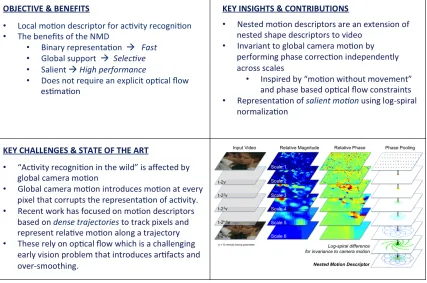
1.4 Thesis contributions for Nested Motion Descriptors . . . 10
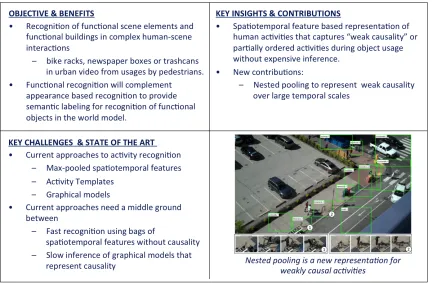
1.5 Thesis contributions for Nested Pooling . . . 11
2.1 Wittgenstein’s Joke [1]. This highlights the need for interpretation to create a useful representation of a stimulus, or on this context, why not use a 3D representation of a duck/rabbit? . . . 14
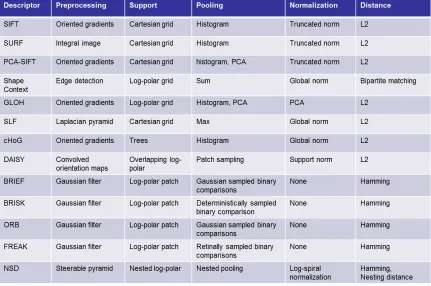
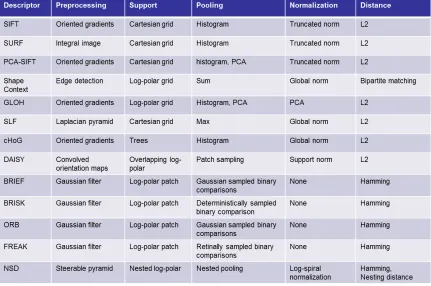
2.2 Taxonomy and comparison of local feature descriptors. . . 19
2.3 Examples of cycle and boundary groups [2] . . . 33
2.4 Persistent Homology [3]. (top) Rips complexes
R
e for increasing e. Colors cor-respond tok-simplices. (bottom) “Barcode” representation of persistent homology groups for increasinge. The vertical dotted lines correspond to the Rips complex at a specifice, and the homology groups present with this representation. . . 352.5 Optimal Homologous Cycle Matching [4]. Given a reference cycle (red) for a given homology group, optimal homologous cycle matching finds the minimum weight homologous cycle (green). . . 37
2.6 Alignment does not capture all similarities . . . 47
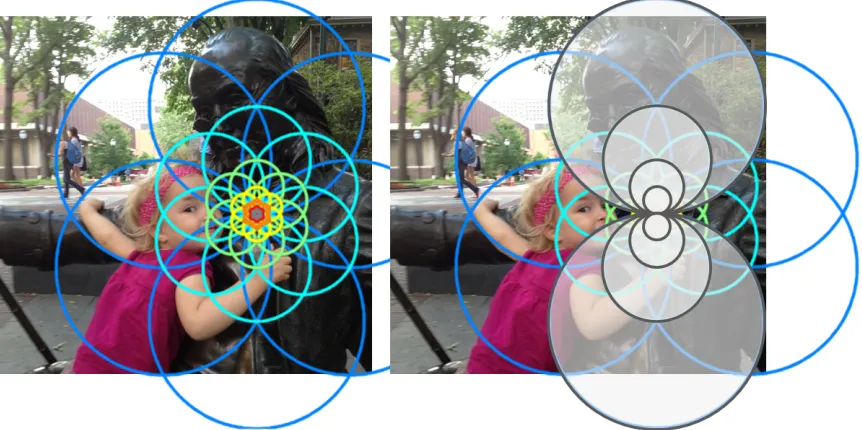
3.1 Nested shape descriptors pool scaled and oriented gradients over large geometric structures calledHawaiian earrings. (left) Hawaiian earrings withk-fold rotational symmetry define a member of the nested shape descriptor family called the seed-of-life descriptor (right) Two Hawaiian earrings substructures in the seed-of-life descriptor are highlighted in grey. . . 55
3.2 Taxonomy and comparison of local feature descriptors. . . 57
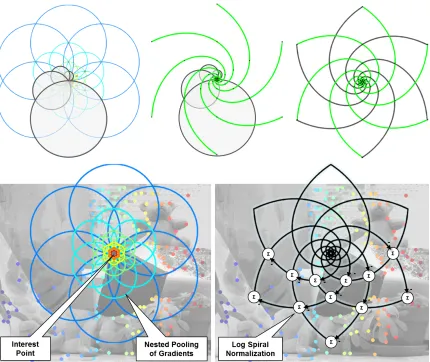
3.4 (top) Logarithmic spiral property of the nested shape descriptor provides normal-izationandbinarization. The log-spiral and it’s reflection shown in grey form an elegant flower-like structure. (bottom) An NSD is formed at each interest point by (left) nested pooling of scaled and oriented gradients and (right) log-spiral differ-ence and binarization. . . 63 3.5 Nesting property of the nested shape descriptor. (left) Seed of life, (middle)
Hawai-ian earring, (right) Cocentric nesting. . . 64 3.6 Logarithmic spiral property of the nested shape descriptor providesnormalization
andbinarization. (right) The log-spiral and it’s reflection shown in grey form an elegant flower-like structure. . . 64 3.7 Nested shape descriptors with increasing lobes. (top row)K1 K5, (bottom row)
K6 K10. . . 65
3.8 Example stereo image matching using the nesting distance and nested shape de-scriptors. Colors encode corresponding interest points between the reference image (middle) and the observed image using the nesting distance (left) and Euclidean dis-tance (right). The Euclidean disdis-tance is affected by occlusions at the image bound-ary (left ellipse) resulting in local misalignments, while the nested distance is more robust to these occlusion effects. . . 66 3.9 Construction of a nested shape descriptor. An NSD can be considered a “flattening”
of the steerable pyramid. Supports of fixed sizes at different levels of the pyramid result in exponentially increasing descriptor supports. . . 67 3.10 Rotation invariant nested shape descriptor. (left) Relative orientations between lobe
and gradient orientation are pooled over all lobes and (right) each lobe is summa-rized with a single pooled relative orientation value. . . 72 3.11 Rotation invariant nested shape descriptor. . . 73 3.12 Trade study for the seed-of-life descriptor. (left-right) parameter analysis of
orien-tations, lobes, scales and pooling. . . 74 3.13 Example matching results from the VGG-Affine dataset.(top-bottom) wall, graf,
boat, leuven, bikes, ubc . . . 76 3.14 VGG-Affine image matching results. (top) “graf”, “bikes”, “ubc”, “boat”, (bottom)
“wall”, “trees”, “leuven” and composite. Both SOL and BSOL outperform SIFT and BRISK, and Binary-SOL is the first binary descriptor to outperform SIFT on this benchmark. . . 77 3.15 Matching score for “bark” in the VGG-Affine dataset . . . 78 3.16 Evaluation of the nesting distance on VGG-Affine dataset. See text for a discussion. 79 3.17 Example ground truth correspondence for rendered imagery in the PVC dataset.
Shown are a random subset of five hundred pixels such that colors encode corre-sponding pixels between the right and left images. (top left) camera 1 with transla-tion correspondence (bottom left) camera 2 with rotatransla-tion correspondence (top right) camera 3 with translation and rotation correspondence (bottom left) camera 4 with translation and rotation correspondence. . . 80 3.18 Photorealistic Virtual City - Translation only results. (left) Aggregate (right) Time
of day . . . 81 3.19 Photorealistic Virtual City - Translation only results per location . . . 82 3.20 Photorealistic Virtual City - Rotation only results. (left) Aggregate (right) Time of
3.22 Photorealistic Virtual City - Translation and Rotation results. (left) Aggregate, (right) Time of day . . . 85 3.23 Phtorealistic Virtual City - Rotation and Translation results per location . . . 86 3.24 Photorealistic Virtual City - Storage Weighted Matching Results . . . 87 3.25 Photorealistic Virtual City - Dense Stride. (top) Stride=32, (bottom) Stride=64.
Colors encode matching densely extracted interest points for each stride. See text in section 3.4.7 for a discussion. . . 88 3.26 Dense Stride evaluation. See text in section 3.4.7 for a discussion. . . 89 3.27 Popout examples for NSD saliency map. (left to right) Convexity, orientation,
contrast, orientation. (top) input image, (bottom) saliency map where red is high saleincy and blue is low saliency, and maximum saliency shown with a black ’+’. . 90 3.28 Qualitative saleincy results from the MIT Saliency Benchmark. . . 91 3.29 Qualitative saliency results from the MSRA salient object database. . . 91
4.1 Nested motion descriptors . . . 94 4.2 From nested shape descriptors to nested motion descriptors. Nested shape
descrip-tors pool oriented and scaled gradients magnitude which captures the contrast of an edge in an image. Nested motion descriptors pool relative phase which captures translationof an edge. Projecting the structure of the nested motion descriptor onto a single image (”collapsing” the descriptor) will form the structure of the nested shape descriptor. . . 97 4.3 Nested Motion Descriptors (NMD). (left) An input video is decomposed into a set
of frames of length 2kn, wherekis the number of scales in the pyramid
decomposi-tion andnis a fixed velocity tuning parameter. (middle) The relative magnitude and phase is computed for each orientation and scale subband in a steerable pyramid decomposition from the first frame to subsequent frames on a log-scale. Frames further away in time are represented with a large scale coarse motion, and frames close in time are represented with a small scale fine motion. Shown is the 0o
orien-tation subband only. (right) For each dense interest point in the current framet, we pool the robust component velocity derived from relative phase in a set of circular pooling regions all intersecting at the center interest point. Log-spiral normaliza-tion computes the difference between phases in neighboring scales and posinormaliza-tions along a log-spiral curve. The phase pooling aggregates component velocities, so this difference computes an acceleration which is invariant to constant velocity of the camera. The result is a nested motion descriptor at this interest point that is invariant to camera motion. . . 98 4.4 Pyramid decomposition and reconstruction with the complex steerable pyramid. . . 100 4.5 An example of the magnitude and phase response of a complex filter to a translating
1D step edge signal. (left column, top to bottom) (a) step edge signal (b) impulse response of 1D quadrature filters (c) magnitude of complex filter response to step edge (d) phase and spatial phase gradient (|~f|) of complex filter response showing linearity of phase. (right column, top to bottom) (e) A step edge translating left to right. (f) the magnitude response (g) the temporal phase gradient (ft). Observe that
at the edge, the spatial phase gradient |~f|=1 and the temporal phase gradient is
4.6 Robust Phase Pooling. The temporal phase gradient is noisy due to the measurement of phase in regions where phase is unstable, such as the region on the grass and in the crowd. The phase stability measure provides an estimate of locations of stable phase. Only the stable phase is used for pooling, resulting in pooled phase that captures the motion of the background and foreground of the golfer in the scene. This pooled phase is used to construct the nested motion descriptor. . . 105 4.7 Perspective views of the spatiotemporal pooling regions of the nested motion
de-scriptor. (left) az=90o, el=90o, the temporal axis is pointed into the page. We
over-lay the nested shape descriptor onto this view, which shows that the NMD has an equivalent pooling structure to the NSD (middle) az=45o, el=25o, with the temporal
axis pointed into the page, (right) az=90o, el=0o, with the Y axis pointed out of the
page. This view shows that the temporal pooling regions increase proportionally to spatial scale. The slope of the line connecting the centers is determined by the velocity tuning of the descriptor. A video visualization of this descriptor is available athttp://youtu.be/RfJJHmXnRAw. . . 107 4.8 (top) Logarithmic spiral property of the nested motion descriptor provides
normal-izationandbinarization. The log-spiral and it’s reflection shown in grey form an elegant flower-like structure. (bottom) An NMD is formed at each interest point by (left) nested pooling of scaled and oriented gradients and (right) log-spiral differ-ence and binarization. . . 109 4.9 The nested motion descriptor is invariant to global camera motion. (top) A video
se-quence of a rock climber where the camera is following the climber up the rock face. For a given fixed interest point on the background, we compute the nested motion descriptor. Observe that the robust component velocities for this interest points are the same. (bottom) When computing the log-spiral difference, the constant velocity due to the camera motion is removed, leaving onlyacceleration. . . 111 4.10 The nested motion descriptor represents salient motion in video. We show a
semi-transparent saliency map for motion overlayed on each frame of video. This saliency map shows salient responses in red and non-salient in blue. The salient responses show the foreground motion of the basketball dribbling and suppresses the motion of the camera in the background. . . 113 4.11 Examples frames from the six activity classes in the KTH actions dataset. . . 115 4.12 Examples frames from 14/51 activity classes in the Human Motion Database (HMDB).
. . . 117 4.13 Motion saliency for basketball dribbling. (top) Salient motion using NMD with log
spiral normalization. (bottom row) NMD without log-spiral normalization. The log-spiral normalization suppresses the camera motion and highlights the salient motion of the basketball dribbling in the scene. A video visualization of this motion saliency is available athttp://youtu.be/t6D1c6M98aE. . . 118 4.14 Motion saliency for KTH jogging. (top) Salient motion using NMD with log spiral
4.15 Motion saliency for HMDB rock climbing. (top) Salient motion using NMD with log spiral normalization. (bottom row) NMD without log-spiral normalization. The log-spiral normalization suppresses the significant camera motion in the scene fo-cusing on the salient motion of the rock climbers only. A video visualization of this motion saliency is available athttp://youtu.be/MShHPal5KsU. . . 120 4.16 Motion saliency for HMDB hug. (top) Salient motion using NMD with log spiral
normalization. (bottom row) NMD without log-spiral normalization. The log-spiral normalization focuses on the subtle hand movements that form a hug and suppresses the background motion of the camera. A video visualization of this motion saliency is available athttp://youtu.be/yx1g9rvXvuQ. . . 121 4.17 Activity recognition results on UCF sports actions. (top) Classification rate,
(bot-tom) confusion matrices. The class index for each result: ’Diving-Side’, ’Golf-Swing-Back’,’Golf-Swing-Front’, ’Golf-Swing-Side’, Front’, ’Kicking-Side’ , ’Lifting’, ’Riding-Horse’, ’Run-’Kicking-Side’, ’SkateBoarding-Front’, ’Swing-Bench’, ’Swing-SideAngle’ ,’Walk-Front’. Class confusion results show that HOG-3D is in-flating the classification results for ’kicking” by leveraging the background context of the football pitch, while the NMD is penalized for suppressing this background due to camera motion. See text for a discussion. . . 122 4.18 Activity classification results on KTH actions (top) Precision-recall curves for each
of six activity classes (middle) average precision per class, mean classification rate, (bottom) confusion matrices. For all results, the class indexes are ordered: boxing, handclapping, handwaving, jogging, running, walking. NMD results are improved for boxing and handclapping, but worse for jogging. See text body for a discussion. 124
5.1 Recognition of human-scene interactions is the classification of functional scene elements such as bike racks, newspaper boxes or trashcans using only activities performed during usage. FSEs such as bike racks (1) and (2) may vary widely in appearance, but exhibit similarweakly causal usage patterns over time which can be used for classification. . . 126 5.2 Nested pooling is the encoding of an activity as a max pooled set of motion
proto-types in a nested set of support regions centered at object usage event, where each support region inceases on a log scale. Each gray region is a pooling region which is represented by a histogram of prototype responses within the pooling region. Ob-serve that the inner support regions are fully contained within the outer support regions, formingnested pooling. . . 129 5.3 Why nesting for activity representation? Nested pooling preserves partial order
for locally unordered action prototypes (helmet/lock) and unknown temporal scale variations (loiter/depart). . . 130 5.4 Penn Functional Scene Element (Penn-FSE) dataset. Shown are representative frames
from of 12 of 24 videos in the full dataset. The dataset includes annotations for 177 functional scene elements and 463 usage annotations in over 8 hours of video. . . . 131 5.5 Data collection locations for the Penn Functional Scene Element dataset. The dataset
contains 24 data collection sites in western Philadelphia. . . 132 5.6 Examples of functional scene element usages in Penn-FSE. (rows) bench, bikerack,
crosswalk, door, newsbox . . . 134 5.7 Examples of functional scene element usages in Penn-FSE. (rows) parking kiosk,
5.8 Examples of variability of functional scene element usages in Penn-FSE. (rows) trashcan, trashcan, bench, subway, bike rack, parking kiosk, sidewalk . . . 136 5.9 Summary results. (left) Confusion matrix for nested pooling with mean
classifica-tion rate 0.45, (right) Precision recall for each class. Class indexes for confusion matrix are in the order of the legend in the precision-recall curve. . . 138 5.10 Precision recall and average precision on Penn-FSE dataset for nested pooling
com-pared to baseline pyramid pooling and bagged pooling. (rowwise) Class [APexp,
APbaseline]: (1) bench [0.26,0.33], (2) bikerack [0.36,0.39], (3) crosswalk [0.61,0.28],
(4) door [0.52,0.32], (5) newsbox [0.63,0.64], (6) parkingkiosk [0.98,0.66], (7) road [0.55,0.29], (8) sidewalk [0.32,0.25], (9) subway [0.53,0.66], (10) trashcan [0.27,0.23]. Mean classification rate over all classes shows that nesting provides a 22% improvement over bagging and 61% improvement over temporal pyramid. . . 139
6.1 Application of the nested shape descriptors to visual landing zone pose estimation. Colors encode the matching of the observed landing zone with the known markings (red=right, blue=left), and the green square encodes the detected position of the landong zone. Nested shape descriptors provide broadly selective scale matching without requiring scale invariant interest points. . . 143 6.2 LAIR precision-recall performance evaluation . . . 151 6.3 LAIR precision-recall performance evaluation (continued) . . . 152 6.4 LAIR performance evaluation summary. Shown are summary statistics and
Chapter 1
Introduction
Shape is arguably the most important property in visual perception [5]. Shape is the primary prop-erty used for visual categorization, and unlike other properties such as texture, color, motion or
depth, shape alone can be used to predict other category properties. Central to the discussion of
shape in a computational vision context, is theshape representation. The issue of representation is
a fundamental problem in vision, leading many to argue that representation and generalization of
shape istheproblem in vision [6][7][1][8].
Artists have long known the power of shape for capturing visual form. Master draughtsmen
such as Matisse, Rembrandt and Degas have captured such intangible qualities as strength, solitude
or elegance in only a few well chosen strokes. Figure1.1 shows some examples of the masters at
work, where using only contours, they are capture the subtleties of the human form. Our perception of these qualities would not be any clearer by adding color to Matisse’s “Woman Covering Her Face
With Her Hand”, or adding texture to Rembrandt’s “A Woman Sleeping”, or knowing the range
to arms and legs of “Three Studies of a Dancer” by Degas. The artists knew that shape alone can
capture these qualities, and that it is a powerful cue to inform our perception of the world.
What is a shape? Shape is an intuitive concept for most people since we perceive shapes every
moment of the day. However, it is a difficult concept to define unambiguously, which has led to
different operational definitions in different fields. For example, cognitive scientists define shape
in terms ofobjective shapeandshape equivalence [9]. Objective shape refers to the concept that objects in the world have a measurable volume, they have a surface boundary with a measurable
Figure 1.1: Master draughtsmen and the use of shape in art. (left) “Woman Covering Her Face with her Hand” by Matisse, (middle) “A Woman Sleeping” by Rembrandt, (right) “Three Studies of a Dancer” by Degas.
object’s physical surface” [10] and Palmer observes “objective shape is no different in principle from
the well established belief that each object has an objectively definable size, position, orientation”
[5]. These objects have 3D extent that is the same for all observers, and therefore objectively
definable independent of perception. Intuitively, one can think of the objective shape in terms
of computer graphics, where the objective shape of an object is that which is captured by a 3D model, used to render an image independent of the camera viewing it. Shape equivalencerefers
to those shapes that are perceived to be the same object by observers. For example, viewing a
2D square that undergoes a translation is still perceived to be a square. The same holds for a
scaling or small in-plane rotation. Observers viewing such objects that undergo transformations of
translation, rotation or scaling perceive the same object following the transformation. The shape
before the transformation is equivalent to the shape after. In general, shape equivalence refers to
the variation due to the pose of the viewer relative to a fixed objective shape. A viewer can change
position (translation) move towards or away from (scale) or tilt their head (rotation), and “the shape” perceived remains equivalent, even though the retinal image may change significantly.
Statisticians define shape in terms of astatistical shape model[11]. Different views of a shape
are assumed to have common keypoints such that theselandmarkscan be put into correspondence.
Given a set of shape images, a shape model is that which remains after optimally aligning landmarks,
when the translation, rotation and scale effects are removed. Alignment proceeds usingProcrustes
analysis, which performs an optimal estimate of the aligning transform for a set of known
land-marks to a reference coordinate system. This assumes correspondence of a known set of shape
landmarks are in correspondence, deformation models can be learned from the remaining
(non-similarity) alignment errors. In computer vision, this type of analysis has led to active shape models
[12][13] for shape based models of faces.
Geometry defines shape in terms of an equivalence class under a group of transformations. A
groupis a finite or infinite set of elements along with a binary group operation that satisfies closure,
associativity, identity and inverse properties. In the context of shape, the group is the setR2 under
similarity transformations. A similarity transformation is a group operatorT :R2!R2 such that
for any set of points p⇢R2, the points T(p) are similar or related by a similarity. Formally,
||pi pj||,a||T(pi) T(pj)||for all p2R2,a2R. In other words, for a similarity transform,
angles are preserved and distances are preserved up to a scale factor.
Computer vision does not provide one definition of shape, rather the literature provides many
task specific representations. Shape representations can be broadly organized into two main
cate-gories: template based and graph based. Template basedapproaches represent shape in terms of
a fixed or deformable template, where a template is a fixed, relative spatial distribution of features
[14,15,16,17,18,19,20,21,12,22].Graph basedapproaches represent shape in terms of graphs,
where features or parts have a variable spatial distribution where conditional dependencies are or-ganized in a graphical structure [23,24,25,26,27,28,29,30,31,32,33,34]. Both template and
graph based approaches represent the geometry of an object in terms of the relative position of
fea-tures, however a template assumes a fixed relative position with small allowable deformations while
a graph assumes a variable relative position of parts encoded by the graph.
1.1 Related Work
In chapter 2, we describe the related work on shape representations and shape matching. Shape
representations can be broadly organized into two main categories: template based and graph based.
Template based approaches represent shape in terms of a fixed or deformable template, where a
template is a fixed, relative spatial distribution of features [14,15,16, 17,18,19,20,21,12,22].
Graph basedapproaches represent shape in terms of graphs, where features or parts have a variable
spatial distribution organized in a graphical structure [23, 24, 25, 26,27, 28, 29, 30, 31,32, 33,
the relative position of features, however a template assumes a fixed relative position with small
allowable deformations while a graph assumes a variable relative position of parts encoded by the
graph.
The dominant local shape representation is thelocal feature descriptor. In chapter2we survey
the state of the art in local feature descriptors [23, 24, 25, 26, 27, 28, 29, 30, 31, 32, 33, 34].
We organize this survey by introducing a taxonomy for comparing and contrasting local feature
descriptors in terms of five criteria: preprocesssing, support, pooling, normalization and descriptor
distance. Preprocessing refers to the filtering performed on the input image, support patterns are the geometric structure used for constructing the descriptor and pooling is the aggregation of filter
responses over the support structure. We compare and contrast our contribution in the context of
this related work.
The dominant global shape representation isattributed graph matching. In chapter2, we
sur-vey the state-of-the-art for graph based shape representations. We organize the sursur-vey by grouping
graph based representations into geometric methods and topological methods, where each method
is organized by representations of increasing abstraction. First, we describe methods for
construct-ing attributed graphs usconstruct-ing local feature descriptors. Next, we describe geometric methods for graph matching. We use the unifying framework of weighted graph matching posed as relaxations
of a quadratic assignment problem, and we describe invariant shape properties maintained during
various tree, bipartite and general graph matching approximations. Topological methods for shape
representation are less well established for image matching, but they provide the potential for global
constraints such as interior, surrounded and connected to augment geometric representations. We
use the unifying framework of simplicial homology, and describe the persistent homology, a
tech-nique for recovering the homology given noisy data.
1.2 Globally Local Shape Representations
The problem of shape representation can be further decomposed into sub-problems of
representa-tion, similarity and inference. Representation is the problem of abstraction of an image intofeatures
that capture the local or global properties of the image at each point in an image. Similarity is the
candi-date matching features, forming the cost functionC. Finally, inference is the problem of selecting,
searching or optimizing an optimal assignmentA.
In general, this problem can be described as the shape representation and matching problem.
Given two imagesIandI0and a set of pixel locationsPandP0, an optimal shape matchingA⇤is the
assignment functionA:P!Qthat minimizes a given cost functionC
A⇤=argmin
A C(Q,A(P)) (1.1)
Shape representation and matching is a challenging problem due to the effects of occlusions,
geometric scene variation, camera pose variation, scene illumination and articulated shape
varia-tion. Imagery collected from different viewpoints of a scene vary due to the structure of the scene. Specifically, occluded surfaces that are visible in one image and not visible in the other introduce
pixels that have no matches. Changes in distance and camera orientation introduce scale and
rota-tion variarota-tions in the imagery that must be addressed. Articulated objects introduce pose variarota-tions
that change the appearance and shape between two images. These challenges must be addressed by
a robust shape matching approach.
A shape representation can be global or local depending on theimage supportused in the
rep-resentation. The image support is defined as the set of pixels used to construct the shape
repre-sentation. A global shape representation is holistic and uses pixels sampled from the entire
im-age to construct the representation. These global shape representations are typically graph based [23,24,25,26,27,28,29,30,31,32,33,34] where shape is encoded in the adjacency structure of
the graph. In contrast, a local shape representation is a representation that is localized at a specific
position in an image, with finite small scale support. Local shape representations are universally
template based, defined using properties of a local patch centered at an interest point. A near
uni-versal local shape representation is thelocal feature descriptorwhich captures the local distribution
of oriented edges within a local patch [35,36,31,37,38,39,16,40,41,42,43,44,45,46]. Global
shape representations are typically defined in terms of local shape representations, where local shape
defines the nodes in a graph aspartsand the graph structure encodes the geometric relationships between these parts.
Figure 1.2: Summary of contributions of this thesis.
local feature descriptor constructed using local support suffers from the aperture problem, where
the small support of a local image patch does not contain enough unique identifiying properties
to provide an unambiguous match. To compensate for the aperture problem, the support of the
local feature descriptor can be increased to provide additional information for an unambiguous
representation, however this increased support introduces representational errors due to occlusions and pose variations that can corrupt the representation. An ideal local shape representation is ”just
local enough”.
In this thesis, we focus on the problem of globally local or glocalshape representations. This
shape representation is local such that it is centered at a single point in an image, however it is
defined with support covering the entire image making it global. This thesis introduces thenested
descriptorwhich is a globally local feature descriptor used to represent the globally local shape in
an image. To address the selectivity and support tradeoff, we introduce a robust distance function
which is able to reject outliers as the support size of the descriptor increases. Furthermore, when extending the nested descriptor to motion, we introduce a camera invariant representation that is
able to maintain large support but it not corrupted by the effects of the global camera motion.
1.3 Primary Contributions
The primary contributions of this thesis are shape representations using nested descriptors. This
nested pooling. Using the decomposition for shape representation into problems of representation,
similarity and inference described in section1.2, this contribution for shape representation can be
described as follows.
• Shape representation in imagery.Nested shape descriptors. We define a new globally local shape representation for images. We demonstrate that this new binary local feature descriptor
capturessalient edgesin an image. We compare this to yhe state of the art in local feature
descriptors for the task of image matching, wide baseline stereo matching, dense interest point
matching and storage weighted matching. We show state of the art results. We describe this
contribution in chapter3.
• Shape similarity in imagery. Nesting distance for nested shape descriptors. This is a robust local distance function unique to the nested descriptors that outperforms the Euclidean
distance for similarity computations. We show that this distance provides robust matching of
a nested descriptor due to occlusions. We describe this contribution in chapter3.
• Shape representation in video. Nested motion descriptors. We define a new globally local shape representation for video. This is an extension of the nested shape descriptors to video
that is invariant to global camera motion. We evaluate this new representation for the task of activity recognition against the state of the art in local motion descriptors and show strong
results. We describe this contribution in chapter4.
• Shape similarity in video. Phase correction for nested motion descriptors. We show that a straightforward correction of local phase in a video can be used to remove the effect of the
dominant camera motion from an interest point. This correction provides for a descriptor
which captures the shape of the local foreground motion, so that the hamming distance of
local motion descriptors captures the similarity of the foreground motion and not the effects of the camera motion. We describe this contribution in chapter4.
• Shape representation in video. Nested pooling. We show that a bag of features representa-tion for funcrepresenta-tional scene element recognirepresenta-tion can be improved using a nested pooling strategy
over a bagged or pyramid pooling strategy. We describe this contribution in chapter5.
Figure 1.3: Thesis contributions for Nested Shape Descriptors
result for further investigation.
The primary contributions of this thesis are summarized in figure1.2. We explore each
contri-bution in turn.
1.3.1 Nested Shape Descriptors
In this thesis, we propose a new family of binary local feature descriptors called nested shape
de-scriptors. These descriptors are constructed by pooling oriented gradients over a large geometric structure called the Hawaiian earring, which is constructed with a nested correlation structure that
enables a new robust local distance function called the nesting distance. This distance function is
unique to the nested descriptor and provides robustness to outliers from order statistics. In this
paper, we define the nested shape descriptor family and introduce a specific member called the
seed-of-life descriptor. We perform a trade study to determine optimal descriptor parameters for the
task of image matching. Finally, we evaluate performance compared to state-of-the-art local feature
Our descriptor is the first binary descriptor to outperform SIFT on this benchmark.
In chapter3, we introduce the nested shape descriptor and nesting distance using key concepts
of nested pooling and log spiral normalization. We perform a trade study to determine optimal
de-scriptor parameters for the task of image matching. Finally, we evaluate performance compared to
state-of-the-art local feature descriptors on the VGG-Affine image matching benchmark and
Photo-realistic Virtual City dataset, showing significant performance gains.
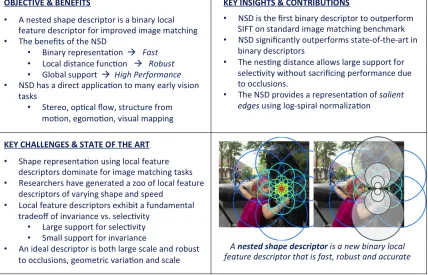
The key contributions of the nested shape descriptors are summarized in figure1.3. The NSD
is the first binary descriptor to outperform SIFT on a standard image matching benchmark. NSD significantly outperforms the state of the art in binary descriptors. The nesting distance is the first
robust local distance function. Finally, the nesting distance allows for large support without
sacri-ficing performance due to occlusions.
Finally, we motivate the structure of the nested shape descriptor in terms of bottom up saliency.
We show that the nested shape descriptor and the log spiral normalization is as representation of
salient edges in an image. We hypothesize that this salient edge representation provides a significant
performance improvement for shape representation.
1.3.2 Nested Motion Descriptors
In this thesis, we propose a new family of binary local motion descriptors called nested motion
descriptors. This descriptor provides a representation of salient motion that is invariant to global
camera motion, without requiring an explicit optical flow estimate. The key new idea underlying
this descriptor is that appropriate sampling of scaled and oriented gradients in the complex steerable
pyramid exhibitsphase offsetdue to camera motion. This phase offset can be measured in the
com-plex steerable pyramid, then removed using the log-spiral normalization. This correction provides
invariance to camera motion without an explicit estimate of optical flow. This approach is inspired by phase constancy [47], component velocity [48] and motion without movement [49,50], which
uses phase shifts as a correction for translation without an explicit motion field estimate. Finally,
the phase corrected video is used to construct a nested motion descriptor using the approach for
nested shape descriptors introduced in [51]. The nested shape descriptor is a state-of-the-art binary
local feature descriptor, which we extend to representation of motion in video. This descriptor uses
Figure 1.4: Thesis contributions for Nested Motion Descriptors
salient motion. Figure1.4summarizes the contributions of this descriptor.
In chapter4, we define the nested motion descriptor family and we evaluate performance
com-pared to state-of-the-art local motion descriptors on the the KTH actions, UCF sports actions and
HMDB activity recognition datasets.
1.3.3 Nested Pooling
In this thesis, we describe a new pooling strategy for representation of functional scene elements
callednested pooling. Bag-of-words based representations of activities rely on spatiotemporal pool-ing regions to perform max-poolpool-ing of learned prototypes to construct prototype histograms based
representation of an activity. Nested pooling represents an activity as a bag-of-words model,
how-ever instead of pooling over a uniform region as in traditional bag of words models [52], or spatial
pyramid based pooling as in spatial pyramid matching [15], the pooling regions arenested. This
representation is inspired by a general class of local feature descriptors callednested shape
Figure 1.5: Thesis contributions for Nested Pooling
commonly found with functional scene elements. This approach can be considered a middle ground
in single level representations of human activities [53] between spatiotemporal feature based
repre-sentations which ignore causality [54,55] and sequence or graphical model based activity represen-tations [56, 57] which represent causality by computationally expensive optimization of sequence
alignments or probabilistic inference of optimal activity states. Nested pooling combines the best
properties of these two approaches, which enables a representation ofweakcausality while
main-taining the fast exemplar based recognition of unordered representations. Figure1.5 summarizes
the contributions of the nested pooling.
Chapter 5 introduces the nested nested pooling. In this chapter, we describe nested pooling
structure and show results on the newly curated Penn Functional Scene Element (Penn-FSE) dataset.
We show cross validation results on Penn-FSE over ten functional scene elements, and we justify the benefit of the nesting property by showing a 22% improvement in mean classification rate relative
1.4 Summary of Results
In this section, we summarize the results of our analysis from this work. These conclusions are
derived from studies and performance evalution performed for each primary contribution on existing
benchmarks and new datasets.
• The nested shape descriptor is the first binary descriptor to outperform SIFT on the VGG-affine benchmark.
• The nested shape descriptor outperforms DAISY and other local feature descriptors on wide baseline matching benchmark. This sets a new performance standard for wide baseline
match-ing.
• The nested shape descriptor significantly outperforms all other descriptors when considering a storage weighted matching metric, comparing matching performance as a function of storage
requirements. This new metric sets a new performance standard for local feature descriptors.
• The nesting distance is the first provably robust local distance function to be proposed for local feature descriptors.
• The nesting distance outperforms the Euclidean distance for the task of image matching.
• Nested motion descriptors are the first motion descriptor that does not require an explicit optical flow solution.
• Nested motion descriptors are the first globally local motion descriptors which provide invari-ance to global camera motion.
• Nested motion descriptors outperform HOG-HOF and HOG-3D on standard activity recog-nition datasets.
Chapter 2
Related Work
In this chapter, we survey shape representations in computer vision. In the past fifteen years, there has been significant progress in shape representations in the literature, as described in surveys
[58][59][60][39,61]. In this review, we decompose shape representations into those representing
local shape vs. global shape, and describe each in detail. For local shape, we focus on local
fea-ture descriptors in imagery and video, and provide a taxonomy of these descriptors for comparing
and contrasting design choices. For global shape, we focus on graph based shape representations
which are well suited for modelling part based compositions of objects. We group graph based
rep-resentations into geometric methods and topological methods, where each method is organized by
representations of increasing abstraction. For geometric methods, we use the unifying framework of
weighted graph matching posed as relaxations of a quadratic assignment problem, and we describe invariant shape properties maintained during various tree, bipartite and general graph matching
ap-proximations. For topological methods, we use the unifying framework of simplicial homology, and
describe the persistent homology, a technique for recovering the homology given noisy data, and
op-timal homologous cycle matching for matching topologically invariant cycles. Finally, we perform
analysis of this survey by comparing and contrast these representations both in a task independent
Figure 2.1: Wittgenstein’s Joke [1]. This highlights the need for interpretation to create a useful representation of a stimulus, or on this context, why not use a 3D representation of a duck/rabbit?
2.1 Introduction
2.1.1 Scope
What is the scope of this review? Our goal is to perform a survey of local and global shape
rep-resentations, however this goal is still quite a broad. Are we interested in 2D or 3D shape? Shape
for a specific task such as object detection? Local shape representations in terms of invariant
lo-cal features? Global representations, part based or category structure? Are we interested in shape
registration, matching or shape similarity algorithms, and data structures associated with efficient
solutions? How about classification and learning of shape within a category? What about other
non-shape or non-visually grounded features such as texture, motion and color? What about the shape of a scene?
We limit the scope of the review to the following design choices:
Graph based global methods: We focus the global shape representations on graph based repre-sentations rather than template based reprerepre-sentations. The line between these two reprerepre-sentations is
often indistinct, as many graph based presentations use local templates for representation of parts,
and some deformable template representations can be modelled as a graph such as a Markov random
field. Where appropriate, we discuss the overlap between these broad categorizations.
Graph matching based global methods: We focus on graph matching, also called registration, or alignment correspondence, rather than graph similarity. Graph matching provides alignment
be-tween a reference model and an observation such that edge relations (e.g. geometry or topology)
are preserved. This matching may include matching constraints such as one-to-one, many-to-one
or many to many matching to reflect abstract representations of shape [8]. Recent work ongraph
the similarity of polynomial comparable substructures such as trees, cycles, walks or paths. These
approaches are motivated by the intractability of subgraph isomorphism for general graphs (see
sec-tion2.3.3), and the need for an efficient computation of similarity of two graphs suitable for use in a
kernel machine for discriminative classification. These approaches do not provide correspondence
and therefore do not represent global geometric shape during matching. These approaches do
con-sider local geometric shape in terms of matching substructures, but the final similarity is analogous
to a “bag of substructures” representation which is not global. Therefore, we focus on geometric
and topological matching rather than non-geometric comparisons.
Exemplar similarity:We focus on similarity computations to exemplars [6][7][1][63], rather than category models. This scope is appropriate for applications to shape matching. We will argue
in section2.4.4 that any fixed category model, even category models learned at training time, is classical categorization revisited. Therefore, since the classical theory of categorization has been
widely discredited, a category model of shape stands on a questionable foundation. As a result, we
will not consider graph based shape representations for categories such as recursive compositional
models [28,64], hierarchical generative models [65][66, 52, 67], hierarchical object parsing [21,
68], stochastic image grammars [26], composition systems [27,24]. This effectively descopes the
entire literature of generative models for visual category representation. Note that this does not
mean that categorization cannot be performed, it simply states that categorization that relies on a
fixed category model is questionable.
2D: We focus on 2D shape or view based representations rather than representation of 3D object shape. A large body of literature exists on “shape from X” recovery of 3D shape from imagery.
Edelman [1] traces the history of 3D reconstruction as a shape representation, back to the influential
work of Marr [10] and the 2.5D sketch. The motivation for 3D representations was to provideobject constancyor viewpoint invariance for specific object identification across views, by first
reconstruct-ing the 3D geometry from multiple views. However, Edelman argues that 3D shape representations
still suffer from drawbacks namely: (i) the difficulty of recovering correspondence, (ii) the need for
task specific representations and (iii) the fact that 3D representations do not aid in further higher
level processing such as categorization or detection. As observed by many researchers, a 3D
representation requires a “homonculus” or little man sitting inside our vision box looking at the
3D representation for interpretation [1]. In short, a 3D reconstruction still requiressimilarityto an
internal labeled 3D representation, on top of the challenge of 3D reconstruction itself. Therefore,
we focus on 2D representations and the challenge of similarity.
shape matching: Optimal shape representations are task dependent [8][1]. We focus on the rep-resentation for the task of shape matching. This task of matching an instance of an object in two
images, can be contrasted with related tasks. Object detection is the problem of assigning a
bound-ing box at a position and scale that surrounds all each instance of a given object category in an image. Object classification is the labelling of images that contain at least one instance of a given
object category without localization. Object recognition [69], also called object identification or
specific object recognition is object classification for a known unique object instead of an object
category. Object segmentation is the grouping and labelling of pixels corresponding to foreground
and background for each instance of a given object category in an image.
Basic level categories:We focus on shape representations of basic level categories [70,71,8]. Ba-sic level categories are the highest level category for which members have similar shape, and does
not include such categories as functional objects or scenes. There have been surveys for shape
repre-sentations of popular object categories including faces [72] and human body [73], however a general
shape representation for basic level categories should not be specialized for any one category.
2.1.2 Outline
There are many different ways of organizing and categorizing the literature on shape
representa-tions, such that each focuses on a different unifying theme. For example, we could focus on shape
matching, comparing and contrasting algorithmic complexity and data structures associated with different frameworks. We could focus shape representations only, comparing features and parts
ex-tracted from imagery used to compose shapes. We could compare and contrast graph based methods
with template based methods or texture based methods.
The structure of this review is representations of shape of increasing abstraction and invariance.
We start with local shape representations in the form of local feature descriptors which capture
patch centered at a single point in an image. We then broaden the representation to global shape
representations based on graphs, and we group the problem into two major categories of graph
based shape representations: geometric and topological graph based representations. Geometric
graph based representationsrepresent shape in terms of distances and angles between parts, such
that nodes encode parts and edges encode geometric relations. This approach can be organized in
terms of the underlying graph structure. We describe methods based on trees, bipartite graphs and
general graphs, where the underlying graphical structure allows for more expressive representations
of shape, at the cost of more expensive matching. Topological representations represent shape in terms of topological invariants such as connectivity or holes in a graph. These representations are
less well evaluated for shape representations in computer vision, so we survey the computational
topology literature and describe approaches based on persistent homology and homologous cycle
matching that have the potential to provide invariant features for shape representation.
In this review, section2.2describes the local feature descriptors used to capture the local shape
in both imagery and video. Section2.3.1describes global shape representations in terms of graphs
and describes common components to geometric and topological shape representations. Section
2.3.3describes three graphical structures: trees, bipartite graphs and general graphs and the graph constructions and graph matchings used for representation and detection. Section2.3.4describes
topology based representations which represent shape in terms of homologies. Finally, we compare
and contrast the different categories and draw conclusions for about the representations in sections
2.4-2.5.
2.2 Local Shape Representations
Alocal shape representationis a representation that is localized at a specific position in an image,
with finite small scale support. For example, a local shape representation of an eye in a face would be
constructed using the support of a small image patch surrounding the eye. Local shape
representa-tions are universally template based, defined using properties of a local patch centered at an interest
point. A common design choice is the local feature descriptorwhich captures the local
distribu-tion of oriented edges within a local patch [35,36,31,37,38,39,16, 40,41,42,43,44,45,46].
local shape defines the nodes in a graph as parts and the graph structure encodes the geometric
relationships between these parts.
In this section, we describe a taxonomy of local feature descriptors for representing the local
edge properties of a patch and the local motion properties of a video clip.
2.2.1 Local Feature Descriptors
A local feature descriptor is a representation for local 2D shape by pooling and normalizing ori-ented gradients over specific support regions. These local feature descriptors are commonly used to
provide node attributes for use in graph matching. In this section, we describe the state-of-the-art.
Local feature descriptors have emerged in the past ten years as the dominant representation for
shape matching. There exist standard benchmarks for performance evaluation [39,74, 61], and a
zoo of detectors and descriptors [38,16,37,40,42, 43,44, 45,46]. introduced with the trend of
faster and faster matching while maintaining approximately equivalent performance to SIFT [35].
Local feature descriptors have been successfully deployed for a wide range of shape matching tasks
including: stereo, optical flow, structure from motion, egomotion estimation, tracking, geolocation
and mapping.
There have been many local feature descriptors proposed in the literature in the past ten years.
From oldest to newest, the primary developments have been: SIFT [35], PCA-SIFT [36], Shape
context [31], Local Binary Patterns [37], SURF [38], GLOH [39], Sparse localized features (SLF)
[16], compressed HoG (cHoG) [40], DAISY [42], BRISK [43], BRIEF [44], ORB [45] and FREAK
[46].
The trend in local feature descriptor research has been to show comparable performance to SIFT
on the VGG-affine benchmark [39,74,61], with ever faster computation. Work has progressed from
PCA-SIFT [36] and SURF [38] which show close performance to SIFT with lower dimensionality and faster preprocessing. Recent work has focused on introducing binary features from local
com-parison tests [44, 43,45,46] which enables fast distance metric based on Hamming distance and
faster derivatives [75]. These developments have been driven by the need for faster processing to
support mobile deployment.
A taxonomy for comparing and contrasting local feature descriptors can be described in terms of
Figure 2.2: Taxonomy and comparison of local feature descriptors.
refers to the filtering performed on the input image, support patterns are the geometric structure used
for constructing the descriptor and pooling is the aggregation of filter responses over the support
structure. Figure2.2shows this taxonomy and a comparison of dominant local feature descriptors.
2.2.2 Local Motion Descriptors
Activity recognition has a long history in the computer vision literature. Recent surveys of action
recognition capturing the state of the art are are available[53,76] and a critical review of action
recognition benchmarks [77]. Classic activity recognition datasets [78] focused on tens of actions
collected with a static camera of actors performing scripted activities, however the state-of-the-art has moved to recognition of hundreds of activities captured with moving cameras and poor quality
video of ”activities in the wild” [79][80][81].
The literature on motion representation can be decomposed into approaches focused on local
motion descriptors, mid-level motion descriptors or global activity descriptors. Higher level
mid-level representations suitable for action recognition. Examples include discriminative mid level
features [82], actemes [83], motionlets [84], motion atoms and phrases[85]. In general, these higher
level representations build upon local motion representations to extract activity specific
discrimina-tive motion patterns. In this section, we will focus on local motion representations only, which are
most relevant to the nested motion descriptor.
A local motion descriptoris a representation of the local movement in a scene centered at a
single interest point in a video. Examples of local motion descriptors include HOG-HOF [86,87],
cuboid [88], extended SURF [89] and HOG-3D [90]. These descriptors construct spatiotemporal oriented gradient histograms over small spatial and temporal support, typically limited to tens of
pixels spatially, and a few frames temporally. HOG-HOF includes a histogram of optical flow
[86, 87], computed over a similar sized spatiotemporal support. Furthermore, recent evaluations
have shown that activity recognition performance is significantly improved by considering dense
regular sampling of descriptors [91][92], rather than sparse extraction at detected interest points,
such as spatio-temporal interest points (STIP) [54].
An interesting recent development has been the development of local motion descriptors that are
invariant to dominant camera motion. A translating, rotating or zooming camera introduces global pixel motion that is irrelevant to the motion of the foreground object. Research has observed that this
camera motion introduces a global translation, divergence or curl into the optical flow field [93], and
removing the effect of this global motion significantly improves the representation of foreground
motion for activity recognition. The motion boundary histogram [86,94,95] computes a global
motion field from optical flow, then computes local histograms of derivatives of the flow field. This
representation is sensitive to local changes in the flow field, and insensitive to global flow. Motion
interchange patterns [96,97,98] compute a patch based local correspondence to recover the motion
of a pixel, followed by a trinary representation of the relative motion of neighboring patches. First
order differential motion patterns [93] compute ... Finally, dense trajectories [94,95,99] concatenate HOG-HOF or co-occurrence HOG [100], and motion boundary histograms for a tracked sequence
of interest points forming a long term trajectory descriptor. The improved dense trajectories [99]
with fisher vector encoding is the current state-of-the-art on large datasets for action recognition
2.3 Global Shape Representations
2.3.1 Graphical Representations of Shape
Graphical representations of shape refer to the abstraction of an image into anattributed graph, such
that the image encodes agraph embedding. A grayscale imageI may be defined as a functionI:
Z2!R, such thatIis a mapping between integer valued pixel coordinates(i,j)and pixel intensity
I(i,j). A graph embedding in an image is a graphG= (V,E)such that each node is associated with
a pixel coordinate(i,j). An attributed graph is a graphG= (V,E,a)that has been augmented with a set of node and edge attributesaV(v) aE(u,v) for allv2V,(u,v)2E. These attributes encode
local image properties from the graph embedding. Recent work has considered attributes for higher
order simplexes in hypergraphs [102], however in this section we consider pairwise node and edge
attributes only, and postpone the discussion of higher order simplex attributes to section2.3.4.
Graph based shape representations for can be described in terms of attributes, structure,
con-struction and matching. Attributes refer to those local image properties associated with each node
and edge as determined from the graph embedding. Node attributes may be organized in order
of increasing support in an image, centered at the embedding coordinates. Pixel supportrefers to
attributes such as pixel intensity, oriented gradient filter response or corner response at only the em-bedding coordinate. Patch supportrefers to attributes derived from a fixed, local region of interest
centered at the embedding coordinate, such as a grayscale patch, intensity histogram or oriented
gradient histogram. Region or contour supportrefers to attributes derived from perceptual
organi-zation of an image, such as segmentations or boundary detections. Finally,part support refers to
attributes derived from part responses, such that a part is itself an object with shape and is used in
compositional models to compose shape in terms of simpler component shapes.
Edge attributes capture pairwise geometric or topological relationships between nodes. For
ex-ample, geometric edge attributes may include length between two nodes, the angle between a node and a reference orientation, or the scale normalized length between two nodes. As discussed in
section2.1.1:similarity, we consider only attributed graphs in this review. Other methods such as
probabilistic graphical models enable efficient inference techniques by encodingconditional
depen-dencein edge relations, however as discussed we will not consider these cases. We will revisit this
Graph construction is the process of graph embedding and attribute extraction, and graphs may
be explicitly or implicitly constructed. Explicit construction is the computation of a graph from an
image, prior to any processing or matching. Implicit construction postpones the graph constructing
to the matching phase. Implicit construction follows Marr’s principle of least commitment [10],
such that graph embedding decisions for nodes and edges are delayed until there is further
informa-tion from the matching process, rather than committing to mistaken embedding and corrupting the
match. Recent work in graph matching has transitioned from explicit to implicit graph construction,
and we will use this as a comparison criterion in section2.4.
Graph matching is the problem of finding correspondences between two graphs such that
re-lational structure is preserved. We will discuss this problem in context of the unifying framework
of thequadratic assignment problemin section2.3.2following standard definitions of graphs and
graph properties in [103].
2.3.2 Quadratic Assignment Problem
Graph matching is the problem of finding correspondences between two graphs such that relational
structure is preserved. This is a fundamental problem in computer vision, machine learning and
pattern recognition since structured data in widespread in such forms as part based object recog-nition, structured prediction, and shape representations. For recent surveys of graph matching, see
[104,105]. In general, graph matching can be posed as a weighted graph matching problem, with
special cases of subgraph isomorphism and maximum common subgraph.
Weighted graph matching can be posed as follows. Given two attributed graphsG= (V,E,a),
G0= (V0,E0,a0), letX be an|V|⇥|V0|permutation matrix, such thatX(i,i0) =1 if nodes(i,i0)are matched and zero otherwise. LetWbe an|V||V0|⇥|V||V0|weight matrix determined from attributes
(a,a0)such thatwii0,j j02Rencodes the compatibility of matching(i,i0)and(j,j0). Letxbe an an
|V||V0|⇥1 columwise vector representation ofX such thatxi j=X(i,j)andxT
i is theith row andxj
![Figure 2.4: Persistent Homology [3]. (top) Rips complexes Re for increasing e. Colors correspondto k-simplices](https://thumb-us.123doks.com/thumbv2/123dok_us/9375116.1470924/48.612.164.488.73.305/figure-persistent-homology-complexes-increasing-colors-correspondto-simplices.webp)